
Fake flowers look cheap when the vase is too wide, every bloom sits at one height, and exposed stems reveal how the arrangement was assembled.
To fill a vase with fake flowers professionally, match the vessel to the display location, secure the stems with hidden mechanics, establish height and width first, and add flowers in controlled layers. Hotels and stores typically favor repeatable formulas using limited colors, varied bloom stages, negative space, and replaceable seasonal accents.
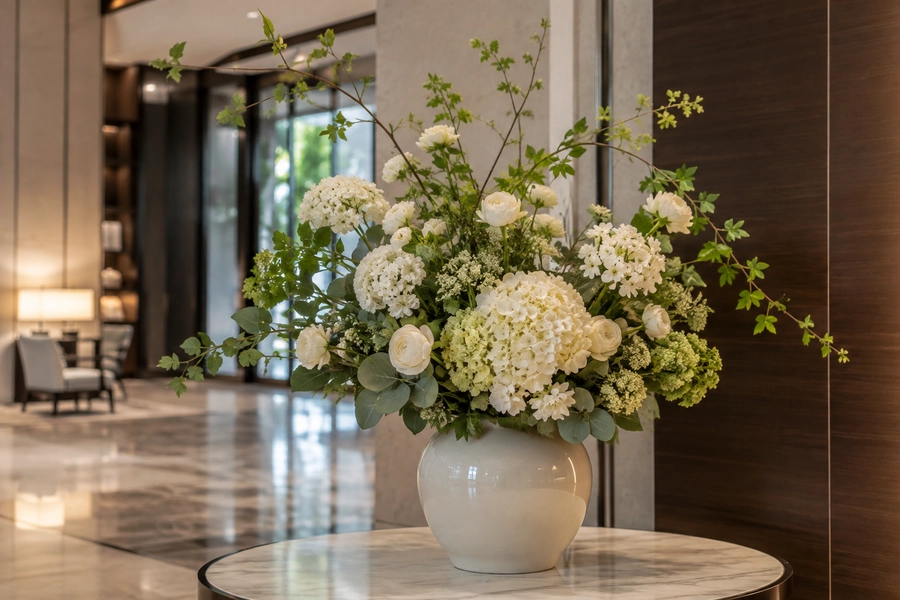
Artificial flowers allow commercial displays to remain consistent without water, refrigeration, or daily replacement. Their advantage disappears, however, when poor proportions, rigid stems, overcrowding, and visible foam make the finished arrangement look manufactured.
What Is the Best Way to Arrange Fake Flowers in a Vase?
The strongest arrangement starts with the vessel and the room—not with the flower bundle.
Choose a vase whose opening controls the stems and whose scale fits the table, counter, shelf, or lobby. Build a secure internal structure, shape every artificial stem, establish the highest and widest points, add focal flowers, and finish with smaller blooms or foliage without filling every visible gap.
A narrow vase opening is easier for beginners because it naturally keeps stems upright. Wider vessels often need a tape grid, flower frog, wire support, or another internal mechanic to hold an airy arrangement with fewer stems.
Afloral recommends choosing a vase approximately one-half to one-third the height of the stems as a practical starting point. It also notes that narrow-necked vases help hold artificial stems, while opaque vessels hide cut ends and mechanics more effectively than clear glass.
The Professional Five-Layer Method
Build most faux arrangements in this order:
- Mechanics: Add the hidden support.
- Line: Establish the highest and widest points.
- Greenery: Create structure and direction.
- Focal flowers: Place the largest or most valuable blooms.
- Supporting flowers: Add rhythm, depth, and seasonal color.
Professional flower-arranging guidance commonly recommends establishing greenery or structural material before adding focal and supporting blooms. It also emphasizes varying heights and leaving negative space rather than creating a flat, solid mass.
How Tall Should Fake Flowers Be in a Vase?
No one ratio works for every vessel, but proportion remains essential.
For many traditional arrangements, the exposed flowers and stems can begin around one-and-a-half to two times the vase height. Tall statement designs may extend further, while low bowls and dining centerpieces should remain broad and controlled so they do not block guests, staff, products, or signs.
Afloral uses a starting guideline in which stems are roughly one-and-a-half to two times the vessel height. Martha Stewart’s florist guidance describes total arrangement heights of approximately two-and-a-half times the vase for some tall designs, while low cube arrangements may be closer to one-and-a-half times the vase height and twice its width. These are design starting points rather than mandatory measurements.
Commercial Proportion Guide
| Display Type | Useful Starting Shape |
|---|---|
| Guest-room bedside table | Small and compact |
| Restaurant dining table | Low and 360-degree |
| Retail checkout counter | Front-facing and narrow |
| Hotel reception desk | Medium height with clear sightlines |
| Console against a wall | Front-facing triangular or asymmetrical |
| Store window | Dramatic, directional, and visible from a distance |
| Lobby floor urn | Tall, stable, and architecturally scaled |
| High shelf | Sparse stems with a clear silhouette |
Always test the arrangement from the guest’s actual viewing position.
A vase that looks balanced on a worktable may appear too small after being placed beneath a high lobby ceiling.
What Mechanics Hold Artificial Flowers in a Vase?
Artificial stems need support because they do not benefit from water weight.
Useful mechanics include flower frogs, reusable wire grids, tape grids, dry floral foam, stem sleeves, pebbles, sand, and fitted inner containers. Choose a method that holds the design securely, remains hidden, and allows individual stems to be removed for cleaning or seasonal replacement.
Afloral recommends floral frogs, wire, reusable foam, stones, or sand for anchoring faux stems and adding stability to containers. Martha Stewart’s florist guidance also identifies tape grids, chicken wire, and flower frogs as common mechanics for creating structure inside a vase.
Mechanics by Vase Type
| Vase | Suitable Starting Mechanic |
|---|---|
| Narrow-neck ceramic | Often no extra mechanic |
| Wide glass cylinder | Inner vase or discreet grid |
| Low compote bowl | Flower frog or fitted wire cage |
| Tall floor urn | Weighted base plus stem grid |
| Bud vase | Narrow opening |
| Rectangular retail container | Reusable foam or divided grid |
| Clear decorative vase | Hidden inner vessel or carefully arranged stems |
Avoid filling an entire wide vase with permanent glue when the display is expected to rotate seasonally.
Removable mechanics make cleaning, repairs, and inventory reuse easier.
How Should Artificial Flowers Be Prepared Before Arranging?
Flowers compressed for shipping should never move directly from the carton into the final vase.
Open every petal and leaf, remove loose threads, inspect glue joints, and bend wired stems into broad natural curves. Compare the faux flower with photographs of its living counterpart so roses, tulips, orchids, branches, and foliage receive species-appropriate movement.
Afloral recommends separating compressed petals and leaves and styling artificial stems to resemble the growth form of the real botanical variety. Its care guidance also notes that wired stems can be gently bent to fit the chosen vessel and create natural movement.
Stem-Preparation Checklist
- Open outer petals individually
- Keep flower centers appropriately tight
- Rotate repeated leaves
- Remove visible packaging ties
- Conceal exposed wire
- Correct sharp shipping bends
- Vary flower-head angles
- Reject unstable focal blooms
- Clean dust before arranging
- Test every stem under final lighting
The formula determines where the flowers go. Preparation determines whether they look convincing after they get there.
17 Stunning Formulas for Filling a Vase With Fake Flowers
The following formulas are designed for repeatability. Quantities can be increased while preserving the same visual relationships.
Formula 1: The One-Branch Luxury Vase
A single well-shaped branch can look more expensive than a crowded mixed bouquet.
Recipe: one premium flowering or foliage branch, one tall narrow-neck vase, and no filler. Bend the branch into a gradual asymmetrical line and position it so the flower or leaf clusters extend beyond one side of the vessel.
Best For
- Hotel guest-room consoles
- Luxury retail shelves
- Spa reception areas
- Minimalist offices
- Restaurant alcoves
Suitable Branches
- Magnolia
- Cherry blossom
- Dogwood
- Olive
- Eucalyptus
- Artificial quince
- Sculptural foliage
Afloral recommends using one to three elegant stems in large decorative vases when the goal is a restrained sculptural display.
Build It
- Select the strongest side of the branch.
- Bend the lower stem to follow the vase line.
- Turn several leaves sideways.
- Keep one visible open area.
- Stabilize the base with a frog or hidden weight.
- Stop before adding unnecessary filler.
This formula succeeds through silhouette, not volume.
Formula 2: The Three-Stem Sculptural Formula
Three stems create enough variation for a complete arrangement without producing clutter.
Recipe: one tall line stem, one medium focal stem, and one shorter side stem. Use related colors or one botanical family, and place each stem at a different height, depth, and direction.
Afloral’s rule-of-three guidance uses limited stem combinations to create deliberate faux floral compositions while emphasizing realistic flowers, foliage, and a complementary vessel.
Example
- One tall magnolia branch
- One medium magnolia bloom
- One shorter foliage branch
Best For
- Boutique counters
- Executive offices
- Narrow reception desks
- Guest bathrooms
- Display shelving
Use an opaque vase to hide the three separate cut ends and make the stems appear naturally gathered.
Formula 3: The Five-Stem Orchid Reception Formula
Orchids need space around their flowers to remain elegant.
Recipe: three flowering orchid stems at different heights and two substantial artificial leaves. Arrange the flowers in an upward curve, place leaves low around the base, and keep the flower centers visible without turning every bloom directly forward.
Best For
- Hotel reception desks
- Spas
- Salons
- Luxury stores
- Medical reception areas
- Restaurant host stands
Build It
- Secure the three flower stems in a low ceramic bowl.
- Set one stem tall, one medium, and one slightly outward.
- Position two broad leaves over the mechanics.
- Add artificial roots, bark, or a fitted moss layer.
- Keep the back smooth if the arrangement sits against a wall.
Orchid arrangements may benefit from flower frogs or similar support mechanics when the stems need to hold a controlled architectural line.
Formula 4: The Seven-Tulip Natural-Lean Formula
Tulips look artificial when every bloom stands rigidly upright.
Recipe: seven tulip stems in three heights—three tall, two medium, and two low. Curve several stems over the vase edge and turn the flower heads in different directions. Use one color or two closely related tones.
Best For
- Hotel breakfast areas
- Spring retail displays
- Guest-room desks
- Café counters
- Salon waiting rooms
Recommended Vase
Use:
- A narrow glass cylinder
- A ceramic pitcher
- A soft-sided oval vase
- A narrow stoneware vessel
Do not open every tulip completely. A convincing arrangement should include upright, leaning, and partially closed blooms.
Formula 5: The 3-5-8 Premium Rose Formula
This formula creates layered depth without requiring many flower varieties.
Recipe: three large focal roses, five medium supporting roses or ranunculus, and eight light elements divided among buds, leaves, and fine greenery. Keep the focal flowers close together but not at the same height.
Best For
- Hotel suites
- Wedding consultation areas
- Jewelry counters
- Premium fashion retail
- Lobby coffee tables
Build It
- Create a greenery frame using part of the eight light elements.
- Position three garden roses in a loose triangle.
- Add five smaller flowers around and behind them.
- Place buds toward the outer edges.
- Remove one filler element if the arrangement becomes dense.
The count creates a purchasing and assembly recipe. It is not a universal rule requiring every display to contain exactly 16 stems.
Formula 6: The Hydrangea-Anchor Formula
Hydrangeas create fast volume and help hold smaller artificial stems.
Recipe: three hydrangea heads, five roses or peonies, and three directional foliage stems. Place the hydrangeas low as a loose structural base, then insert focal flowers at varied heights and extend foliage beyond the flower mass.
Best For
- Hotel lobby tables
- Department-store counters
- Wedding showrooms
- Restaurant entrance consoles
- Large checkout islands
Avoid the Hard Dome
Do not place three hydrangeas side by side at exactly the same height.
Use:
- One low front cluster
- One medium side cluster
- One slightly higher rear cluster
Then allow roses and foliage to interrupt the round shape.
Formula 7: The Monochrome Tonal Formula
One color can look more sophisticated than a mixed rainbow.
Recipe: nine to thirteen flowers from one botanical family or closely related varieties, using three tones of the same color. Add minimal greenery and vary bloom size, direction, and stage instead of adding more hues.
Example Palettes
- Ivory, cream, and champagne
- Blush, dusty pink, and mauve
- Burgundy, wine, and plum
- Pale blue, slate blue, and gray-green
- Peach, coral, and faded terracotta
Current florist guidance emphasizes color harmony when selecting flowers for a cohesive arrangement.
Best For
- Luxury retail
- Branded hotel properties
- Fashion showrooms
- Beauty stores
- Formal reception areas
Monochrome does not mean every flower should have identical color. Subtle tonal variation creates depth.
Formula 8: The Greenery-First Hotel Formula
This formula creates an organic, garden-style arrangement that can be refreshed by replacing only a few flowers.
Recipe: approximately 40% structural greenery, 35% supporting flowers, and 25% focal blooms. Build the complete outline with foliage before adding flowers, then leave selected gaps between groups.
Example Medium Arrangement
- Five greenery stems
- Four supporting flowers
- Three focal blooms
Best For
- Hotel lounges
- Reception seating areas
- Restaurants
- Wellness spaces
- Corporate hospitality suites
Professional floral guidance recommends using greenery as the structural base or “nest” that supports focal and filler flowers.
Cost Advantage
The greenery base can remain while seasonal flowers change:
- Tulips in spring
- Roses in summer
- Dahlias in autumn
- Hellebores in winter
Formula 9: The Front-Facing Console Triangle
An arrangement placed against a wall does not need equal detail on every side.
Recipe: one tall central or offset line stem, two stems establishing left and right width, three focal flowers, and five supporting or foliage stems. Build a shallow triangular profile with a clean, flat rear surface.
Martha Stewart’s florist guidance notes that arrangements may be intentionally front-facing rather than designed equally from every angle.
Best For
- Hotel corridor consoles
- Retail wall cabinets
- Reception credenzas
- Restaurant sideboards
- Elevator lobbies
Build It
- Mark the viewing side of the vase.
- Establish height with one branch.
- Establish width with two side stems.
- Place the focal flowers at different depths.
- Fill selectively.
- Keep stems from pressing against the wall.
This formula saves flowers because expensive detail is concentrated where guests see it.
Formula 10: The Low 360-Degree Dining Formula
Dining arrangements should remain attractive from every direction without obstructing conversation or service.
Recipe: three low focal flowers, six smaller flowers, and six short greenery or texture pieces arranged around a low bowl. Keep every side balanced but not identical, and position the highest blooms close to the center.
Best For
- Hotel breakfast tables
- Restaurant dining tables
- Meeting-room tables
- Banquet tables
- Café communal tables
Recommended Vessel
Use:
- Low compote
- Shallow ceramic bowl
- Low glass cylinder
- Wide stoneware vessel
A flower frog, wire structure, or tape grid helps a wide vessel hold stems without requiring a tightly packed arrangement.
Sightline Test
Sit at the table before approving the display.
Guests should be able to see:
- Each other
- Menus
- Table numbers
- Serving staff
- Shared dishes
Formula 11: The Asymmetrical Retail-Counter Crescent
Retail counters need flowers that create movement without covering products or payment equipment.
Recipe: one tall stem, two outward stems, three focal flowers, and four short accents. Keep one side higher and the opposite side longer, creating a shallow crescent with open space near the transaction area.
Best For
- Fashion checkout counters
- Jewelry consultation desks
- Cosmetics stores
- Salon reception desks
- Hotel concierge counters
Orientation
Direct the tallest line away from:
- Customers’ faces
- Card terminals
- Display screens
- Product trays
- Staff working space
Use a heavy vase or hidden ballast so an asymmetrical arrangement does not tip.
Afloral recommends stones or sand to stabilize heavy faux arrangements that do not receive the additional weight of water.
Formula 12: The High-Low Window-Display Pair
Two related arrangements can create more visual movement than one oversized centerpiece.
Recipe: one tall vase containing five to nine line and focal stems, paired with one low vase containing three to five related flowers. Repeat one flower or color in both containers while changing the scale and silhouette.
Best For
- Fashion windows
- Furniture showrooms
- Bridal stores
- Hotel entrance tables
- Product-launch displays
Pairing Examples
- Tall cherry blossoms plus low peonies
- Tall olive branches plus low white roses
- Tall orchids plus low tropical foliage
- Tall magnolia plus low hellebores
Do not make the two arrangements identical.
They should feel related through:
- Color
- Vessel material
- Flower family
- Branch movement
- Brand palette
Formula 13: The Three-Bud-Vase Cluster
A group of small vases creates a light, flexible display.
Recipe: three related bud vases containing one, two, and three stems. Vary their heights and spacing, and repeat one flower or foliage element across the group. Arrange them as a loose triangle rather than a straight, evenly spaced line.
Afloral describes bud vases as narrow-opening vessels suited to simple elevated styling with a small number of stems.
Best For
- Café tables
- Hotel bathroom vanities
- Retail shelves
- Restaurant side stations
- Guest-room desks
- Product display plinths
Example
- Vase 1: one rosebud
- Vase 2: one rose plus one foliage stem
- Vase 3: two small blooms plus one branch
This system is easy to divide, relocate, clean, and rotate.
Formula 14: The Tall Lobby-Urn Formula
Large spaces require scale, but the flowers should not become a solid visual block.
Recipe: five architectural line stems, seven focal flowers, nine supporting blooms, and eleven foliage or texture stems. Build a wide stable lower structure, establish height with branches, and keep open channels through the upper arrangement.
Best For
- Hotel lobbies
- Shopping-center entrances
- Department stores
- Event venues
- Large corporate receptions
Build It in Four Zones
- Base zone: Dense enough to hide mechanics.
- Focal zone: Large flowers at varied depths.
- Movement zone: Long branches and directional foliage.
- Air zone: Intentional gaps between upper stems.
Safety Requirements
The planter should:
- Resist tipping
- Remain clear of circulation
- Avoid projecting sharp branches
- Allow safe cleaning access
- Meet applicable project requirements
Use a weighted base and a fitted internal grid rather than relying on loose stems inside a broad urn.
Formula 15: The Shelf-Cascade Formula
Shelf arrangements should create movement without dragging across products or work surfaces.
Recipe: one trailing vine, two short upright stems, one focal flower, and one compact foliage cluster. Allow the vine to fall from one side while the upright elements balance the opposite side.
Best For
- Retail shelving
- Hotel bookcases
- Café cabinets
- Spa product displays
- Reception storage walls
Build It
- Place the trailing vine first.
- Bend it into several broad curves.
- Add two short upright stems near the back.
- Position one focal flower near the vase rim.
- Add a small foliage cluster to hide mechanics.
- Keep the shelf edge and products visible.
Avoid equal vine lengths. Repeated vertical trails make the arrangement look manufactured.
Formula 16: The Seasonal 80/20 Swap Formula
Commercial displays become expensive when the complete arrangement is replaced for every campaign.
Recipe: retain approximately 80% of the vase, mechanics, greenery, and neutral support flowers. Replace approximately 20% with seasonal or promotional accents that change the color, flower type, or brand message.
Example Annual Rotation
| Season | Reusable Base | Seasonal 20% |
|---|---|---|
| Spring | Eucalyptus and ivory roses | Tulips and blossom |
| Summer | Eucalyptus and ivory roses | Blue hydrangeas |
| Autumn | Eucalyptus and ivory roses | Rust dahlias |
| Winter | Eucalyptus and ivory roses | Hellebores and berries |
The percentage is a planning tool rather than an exact stem requirement.
Best For
- Hotels
- Chain stores
- Salons
- Restaurants
- Reception programs
- Multi-site brands
This formula reduces purchasing, storage, and setup time while keeping the display visibly current.
Formula 17: The Modular Multi-Site Formula
Businesses with several locations need a formula that produces similar results without requiring one expert florist at every site.
Recipe: one standardized vase, one permanent greenery module, one focal-flower module, one seasonal accent module, and one illustrated placement map. Number each insertion point and package replacement modules separately.
Example Module System
- Module A: five-stem greenery base
- Module B: three focal flowers
- Module C: five supporting flowers
- Module D: two seasonal accents
- Module E: one optional height branch
Best For
- Hotel chains
- Retail rollouts
- Franchise locations
- Event-rental companies
- Corporate offices
- Restaurant groups
Quality-Control Advantages
The modular system makes it easier to control:
- Flower count
- Color
- Height
- Width
- Viewing direction
- Replacement stock
- Seasonal changes
- Cleaning
- Photography
- Shipping
Photograph the approved arrangement from the front, side, top, and installed viewing position.
The site team should rebuild the documented design rather than invent a new one from the supplied stems.
How Many Fake Flowers Should Go in a Vase?
The vase opening, flower-head size, and intended silhouette matter more than one universal stem count.
A narrow bud vase may need one to three stems, a medium table vase may use seven to fifteen, and a large lobby urn may require several dozen components. Begin with fewer stems, establish the outline, and add material only where the structure or visual rhythm remains incomplete.
Starting Stem Guide
| Vase Type | Starting Quantity |
|---|---|
| Bud vase | 1–3 |
| Narrow medium vase | 5–9 |
| Standard table vase | 7–15 |
| Low compote | 12–20 short components |
| Wide console vase | 10–20 |
| Tall statement vase | 8–18 long stems |
| Large lobby urn | 25+ modular components |
These are working ranges, not purchase guarantees.
Large hydrangeas occupy more visual space than small ranunculus. Long blossom branches provide more height than roses. Stem count should therefore follow botanical scale.
Should Fake Flowers Be Cut to Fit the Vase?
Permanent cutting should be the final adjustment, not the first.
Bend or raise wired stems before cutting them. Use hidden blocks, stem sleeves, frogs, or interior supports when the stems need additional height. Cut only after the arrangement, vase, and future reuse plans have been approved.
Afloral notes that faux stems have thick wire cores that can be bent gently to fit a vase and create natural arcs. It also recommends support mechanics when stems need additional stability or height.
Before Cutting, Ask:
- Will this stem be reused in a taller vase?
- Can the lower section be bent?
- Can the vase contain a raised insert?
- Does the design need another height?
- Will cutting expose sharp wire?
- Is the cutting tool suitable?
When cutting is necessary, use appropriate wire cutters rather than household scissors.
Cover or conceal the sharp cut end before returning the stem to the arrangement.
How Do You Hide Fake Flower Stems in a Clear Vase?
Clear vases reveal every mechanic and repeated cut end.
Use a smaller hidden inner vase, arrange stems deliberately, cover mechanics with coordinated foliage, or use a compatible artificial-water treatment only when the product is designed for it. Avoid filling clear glass with random loose material that makes the construction more noticeable.
Afloral notes that opaque containers provide the easiest way to hide stem ends, while clear glass is better suited to arrangements where the stems or decorative filler are intended to remain visible.
Clear-Vase Options
- Hidden inner cylinder
- Bundled natural-looking stem arrangement
- River stones around a separate support
- Decorative glass beads
- Concealed flower frog
- Artificial-water resin system
- Coordinated leaf wrap
Artificial water creates a permanent or semi-permanent arrangement and should be tested for:
- Compatibility
- Bubbles
- Yellowing
- Heat generation during curing
- Future removability
- Shipping stability
How Do Hotels and Stores Keep Arrangements Consistent?
Consistency requires documentation.
Commercial teams should approve one master arrangement, record the vessel and stem recipe, photograph all viewing angles, label the front, and create a measurement template. Replacement flowers should be compared with retained samples under the actual display lighting.
Master-Arrangement Record
Document:
- Vase code
- Stem codes
- Quantity
- Final height
- Final width
- Front orientation
- Focal-flower positions
- Seasonal module
- Mechanic
- Ballast
- Cleaning method
- Storage box
- Replacement stock
A large order should be evaluated as a group because repeated branch and leaf patterns may become more obvious when many identical arrangements are installed together.
How Often Should Faux Vase Arrangements Be Cleaned?
Cleaning frequency depends on exposure.
Inspect hotel and retail arrangements before visible dust becomes obvious. Entrances, restaurants, checkout counters, salons, and high-traffic lobbies need more frequent attention than enclosed shelves or private offices. Remove stems in modules when possible so every flower and the vase interior can be cleaned.
Afloral recommends regular dusting of both artificial botanicals and their containers. For glass vessels, it advises mild soap and water followed by complete drying before artificial stems are returned.
Practical Inspection Schedule
| Location | Starting Inspection Frequency |
|---|---|
| Restaurant table | Weekly |
| Hotel reception | Weekly |
| Retail checkout | Weekly |
| Store entrance | Weekly |
| Guest room | During regular room inspection |
| Office reception | Every one to two weeks |
| High shelf | Monthly with safe access |
| Window display | Weekly for dust and fading |
Do not use unapproved cleaners, oils, or leaf-shine products on artificial flowers. They may alter texture, color, gloss, or dust attraction.
What Are the Biggest Vase-Filling Mistakes?
| Mistake | Why It Fails | Better Correction |
|---|---|---|
| Vase opening is too wide | Stems collapse outward | Use a grid, frog, or narrower vessel |
| Every flower is the same height | Creates a flat top | Establish three or more levels |
| All blooms face forward | Reveals repeated construction | Turn flowers in several directions |
| Too many flower varieties | Creates visual noise | Limit the botanical families |
| No greenery structure | Flowers appear unsupported | Build an outline first |
| Too much filler | Eliminates depth | Leave negative space |
| Small vase under a large canopy | Looks unstable | Increase vessel scale or reduce flowers |
| Visible foam and wire | Exposes mechanics | Use opaque vessels and top dressing |
| Flowers remain shipping-flat | Makes stems look inexpensive | Shape every component |
| Equal symmetry everywhere | Looks manufactured | Introduce controlled asymmetry |
| No front orientation | Wastes flowers against a wall | Build for the actual viewing direction |
| Permanent cutting too early | Reduces future reuse | Bend and test before cutting |
| No maintenance access | Dust becomes embedded | Use removable modules |
My Insights: How to Fill a Vase With Fake Flowers—Which 17 Stunning Formulas Do Hotels & Stores Use
The most successful commercial formula is not the one containing the largest number of flowers. It is the arrangement that delivers the required visual impact with controlled materials, predictable setup, easy cleaning, and replaceable components.
The 17 formulas range from one-branch minimalism and three-stem sculpture to hydrangea anchors, tonal roses, all-round dining bowls, tall lobby urns, seasonal swaps, and modular multi-site systems. Each works by controlling proportion, direction, mechanics, viewing angle, negative space, and the relationship between reusable structure and decorative accents.
My central insight is that professional vase filling is controlled subtraction.
The 17-Formula Summary
| Formula | Strongest Use |
|---|---|
| 1. One-branch luxury vase | Minimal hotel and boutique styling |
| 2. Three-stem sculpture | Small premium surfaces |
| 3. Five-stem orchid | Reception desks and spas |
| 4. Seven-tulip lean | Spring and guest-room displays |
| 5. 3-5-8 rose formula | Premium tables and counters |
| 6. Hydrangea anchor | Fast medium-to-large volume |
| 7. Monochrome tonal | Luxury branded interiors |
| 8. Greenery-first hotel formula | Seasonal flexibility |
| 9. Front-facing console triangle | Wall-backed displays |
| 10. Low 360-degree dining formula | Tables and meeting rooms |
| 11. Retail-counter crescent | Transactions and product framing |
| 12. High-low window pair | Display windows and launches |
| 13. Three-bud-vase cluster | Small tables and shelves |
| 14. Tall lobby urn | Large architectural spaces |
| 15. Shelf cascade | Vertical retail and hospitality styling |
| 16. Seasonal 80/20 swap | Lower-waste rotation |
| 17. Modular multi-site formula | Chains and repeat installations |
The Best Formula for Beginners
Start with the three-stem sculptural formula.
It requires:
- One suitable vase
- Three coordinated stems
- Three heights
- Three directions
- No complicated filler
The limited count makes proportion and movement easier to see.
The Best Formula for Hotels
Use the greenery-first hotel formula for large recurring programs.
The same neutral base can support several seasonal flower modules while the approved height, vessel, and overall silhouette remain consistent.
The Best Formula for Retail Stores
Use the asymmetrical retail-counter crescent.
It creates movement and brand color while preserving:
- Payment space
- Product visibility
- Customer sightlines
- Staff access
The Best Formula for Dining Tables
Use the low 360-degree bowl.
Every guest sees a finished side, but the arrangement remains low enough for conversation and service.
The Best Formula for Luxury Displays
Use either:
- One premium branch
- Three sculptural stems
- A restrained monochrome palette
Luxury often comes from scale, texture, and empty space rather than maximum flower count.
The Best Formula for Seasonal Savings
Use the 80/20 seasonal swap.
Retain:
- Vessel
- Mechanics
- Greenery
- Neutral support flowers
Change:
- Focal color
- Seasonal flower
- One texture
- One small brand or event accent
The Most Important Vase Rule
Select the vase before calculating the flowers.
The vase determines:
- Stem spread
- Required mechanics
- Arrangement height
- Stability
- Viewing direction
- Flower quantity
- Maintenance access
A wide opening may force the buyer to purchase unnecessary filler simply to stop the stems from falling outward.
The Most Important Flower Rule
Use fewer flower families and more variation within them.
Variation can come from:
- Bloom stage
- Height
- Direction
- Color tone
- Depth
- Petal shape
It does not require ten unrelated botanical varieties.
The Most Important Mechanics Rule
The support should remain invisible and removable.
Reusable frogs, grids, sleeves, and inserts allow stems to be:
- Cleaned
- Replaced
- Rotated
- Stored
- Reused
- Reconfigured
Permanent construction should be reserved for displays whose full service life and design have already been approved.
The Most Important Commercial Rule
Design for the actual viewing position.
A hotel console against a wall can be front-facing. A restaurant table must work from every side. A window display may need strong height and color from several meters away. A retail counter must preserve the transaction area.
The same bouquet should not be copied into all four locations.
My Preferred Professional Workflow
I use this sequence:
- Measure the display surface.
- Identify the viewing direction.
- Select the vase.
- Choose the formula.
- Install the hidden mechanic.
- Shape every artificial stem.
- Establish height and width.
- Add greenery or structural lines.
- Position focal flowers.
- Add supporting flowers.
- Remove unnecessary filler.
- Check the arrangement from the guest position.
- Photograph the approved design.
- Label the front and component recipe.
- Establish cleaning and seasonal replacement schedules.
A repeatable formula should make the next installation faster without making every arrangement look mechanically identical.
Conclusion
Choose the vase first, secure hidden mechanics, build height and width, vary bloom direction, leave negative space, and use one of 17 repeatable formulas for commercial consistency.