
How to Make Stunning Artificial Wedding Bouquets: 9 Pro Steps
Silk wedding bouquets can look stunning, but they can also feel flat, loose, or obviously artificial. If the structure is wrong, even expensive flowers can disappoint.
To make professional artificial wedding bouquets, prepare the stems, choose a clear style, build around focal flowers, layer fillers and greenery, secure the handle, shape the bouquet, and finish with ribbon. The key is controlled spacing, natural movement, and repeatable structure.
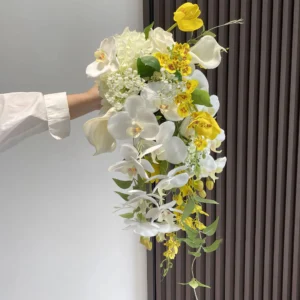
Applicable scenario: Wedding studios, bridal retailers, event planners, florists, rental companies, and wholesale wedding flower collections.
I have worked with artificial flowers for more than a decade. When I develop silk wedding bouquets, I do not simply put beautiful flowers together. I think about shape, proportion, color, hand feel, transport, photography, and production at the same time.
This matters even more when I develop artificial wedding bouquets for wedding businesses. A bouquet may look good as one sample. That is not enough. The second, twentieth, and five-hundredth bouquet should also look close to the approved sample.
Here is the nine-step method I use when developing artificial wedding bouquets for commercial projects, bridal brands, wedding studios, and rental businesses.
What Materials Are Needed for Artificial Wedding Bouquets?
Choosing beautiful silk flowers is only the beginning. Without the right tools and supporting materials, the finished bouquet can become loose, heavy, uneven, or difficult to reproduce.
I normally prepare focal silk flowers, secondary flowers, fillers, greenery, floral wire, floral tape, cable ties, scissors, wire cutters, ribbon, pins, and optional foam or stem supports before making artificial wedding bouquets.
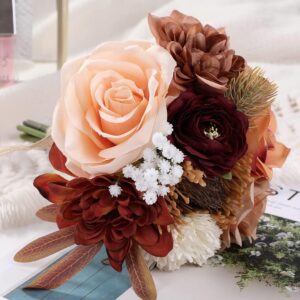
Applicable scenario: Bridal bouquet workshops, wedding flower factories, florist studios, bouquet sample development, and bulk wedding décor production.
Step 1: Prepare Materials for Artificial Wedding Bouquets
I divide the materials into four flower groups before I start.
Focal flowers create the first impression. I often use roses, peonies, hydrangeas, orchids, ranunculus, dahlias, or other large flowers.
Secondary flowers connect the focal flowers. Spray roses, smaller peonies, lisianthus-style flowers, and small garden flowers work well.
Fillers create softness and movement. Baby’s breath, berries, small wildflowers, thin branches, and tiny buds are useful here.
Greenery controls the outline. Eucalyptus, fern, olive leaves, ruscus, and soft trailing leaves can make the bouquet feel more natural.
I do not select flowers only by appearance. I also check the stems.
A beautiful flower with a very thick stem can create an uncomfortable handle. A flower with a weak stem may move after shipping. A heavy flower head may fall outward if the internal wire is too soft.
This is one reason I always inspect the complete bouquet construction, not only the flower heads.
For buyers comparing materials and suppliers, my artificial flower supplier checklist explains several quality points I normally check before approving bulk production.
Step 2: Prepare and Shape Every Stem
I rarely use an artificial stem exactly as it comes from the box.
I bend some stems slightly.
I straighten others.
I rotate leaves.
I remove unnecessary lower leaves.
I shorten stems that create too much weight.
I also open compressed petals by hand before arranging the bouquet.
This small preparation stage makes a large difference.
Artificial flowers often arrive with very straight stems because straight stems are easier to pack. Real flowers do not grow in perfect straight lines. If every artificial flower points in exactly the same direction, the bouquet can immediately feel manufactured.
I once worked on artificial wedding bouquets where the flowers themselves were good, but the first sample looked too rigid. I did not change the flower combination. I only adjusted the stem angles, opened the petals, and changed several flower heights. The bouquet suddenly looked much more natural.
That experience reminded me that realism does not always come from buying a more expensive flower.
Sometimes realism comes from how I use the flower.
If artificial flowers have been stored before bouquet production, I also inspect them before use. My guide on how to clean silk flowers explains how I deal with dust and surface care without damaging delicate petals.
For inspiration on the wide range of ways silk flowers can be used in weddings, I also review established wedding references that show how silk flowers can work in bridal bouquets and reception arrangements.[1]
How to Choose Flowers for Artificial Wedding Bouquets?
A bouquet can contain expensive flowers and still feel wrong if the flowers do not match the wedding style. I always define the design direction before selecting the final stems.
I choose artificial wedding bouquets by matching flower shape, color, texture, greenery, bouquet size, and movement to the wedding style. Romantic, garden, boho, modern, luxury, rustic, and minimalist weddings need different combinations.
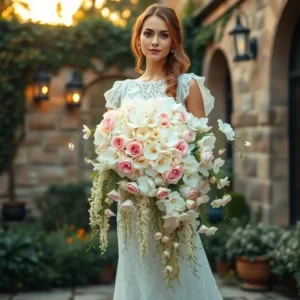
Applicable scenario: Wedding planners building themed collections, bridal wholesalers, wedding rental companies, and brands developing coordinated bouquet ranges.
Step 3: Match Artificial Wedding Bouquets to the Wedding Style
I first ask one simple question:
What should the bride feel when she sees the bouquet?
The answer helps me much more than starting with a long flower list.
For a romantic wedding, I normally use rounder flowers, soft colors, gentle transitions, and a fuller shape.
For a modern wedding, I use fewer flower types. I give each flower more visual space. Orchids, calla lily styles, anthurium-style flowers, and structured greenery can work well.
For a garden wedding, I allow more movement. I use different stem heights. I mix open flowers, buds, branches, and softer greenery.
For a boho wedding, I may use dried-look elements, grasses, muted colors, trailing pieces, and more visible texture.
For a luxury wedding, flower quality becomes especially important. I pay close attention to petal edges, color depth, flower size, and the transition between different materials.
A wedding bouquet also has many possible shapes. Round, hand-tied, cascading, oversized, posy, pageant, and other forms create very different visual effects.[2] Buyers who are still choosing a direction can use professional bouquet-style references before sample development.
Step 4: Build a Controlled Flower and Color Combination
I try not to use too many flower varieties in one bouquet.
More flowers do not always create a more premium result.
In many projects, I begin with three levels:
- 1–2 focal flower families
- 1–3 supporting flower families
- 1–2 filler or greenery families
This creates enough variety without making the bouquet visually confusing.
Color also needs control.
I normally use one main color, one supporting color, and one or two neutral tones. Greenery then connects everything.
I worked with an Australian wedding styling client who wanted a modern garden feeling mixed with a European winery style. The direction was mainly ivory white with soft green.
The first temptation was to add many flower varieties because the arrangement needed to feel full.
I chose another direction.
I focused more on flower shape, spacing, and several shades of white and green. The result felt softer and more expensive because the design had a clear identity.
This is also important for wholesale buyers.
If I develop six artificial wedding bouquets for one collection, I want customers to recognize that they belong to the same family.
The flower combinations can change, but the visual language should stay consistent.
When I need to build or confirm a color direction with a client, I can also use professional color tools to build, save, and share palettes before sampling.[3]
How to Arrange Flowers, Fillers, and Greenery in Artificial Wedding Bouquets?
Many bouquets become too round, too crowded, or too symmetrical during this stage. I avoid filling every empty space because controlled gaps help artificial flowers look more natural.
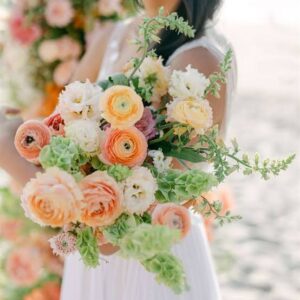
I arrange artificial wedding bouquets by placing focal flowers first, adding supporting blooms at different depths, filling controlled gaps with smaller flowers, and using greenery to shape the final outline.
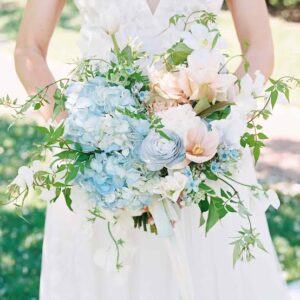
Applicable scenario: Bridal bouquet assembly, florist training, wedding sample development, wholesale wedding bouquet manufacturing, and event rental preparation.
Step 5: Build Artificial Wedding Bouquets Around Focal Flowers
I normally start with three to five focal flowers depending on bouquet size.
I do not place them in a perfect circle.
I hold one flower near the center.
I place the next flower slightly lower.
I rotate the bouquet.
Then I add another flower at a different angle.
I keep rotating while I work.
This helps me see the bouquet from every side.
Even when the bouquet has a clear front, I still check the back because the bride will move with it.
I also leave some distance between large flower heads.
If every peony, rose, or hydrangea touches another large flower, the bouquet becomes one solid block. Individual flowers lose their shape.
Step 6: Add Secondary Flowers and Fillers
Once the focal structure is stable, I add smaller flowers.
This is where I create depth.
Some flowers sit slightly behind the focal blooms.
Some sit beside them.
A few extend beyond the main outline.
I use fillers carefully.
A common mistake is using small filler flowers everywhere because there are visible gaps. The bouquet then becomes busy.
I prefer intentional gaps.
Natural flowers have shadows between petals. I want artificial bouquets to have the same visual depth.
I also keep flower sizes mixed.
When every flower head is almost the same size, the eye has nowhere to focus.
Step 7: Use Greenery to Shape the Final Bouquet
I normally add most greenery after the main flowers are already positioned.
Greenery is not only decoration.
It changes the shape.
A round eucalyptus leaf can soften a bouquet.
Long olive-style leaves can create direction.
Trailing greenery can turn a compact bouquet into a more romantic or cascading design.
Small fern leaves can fill the lower structure without making the bouquet heavy.
I often pull several leaves slightly outside the flower line.
This breaks the perfect circle.
It also gives the bouquet more movement in photographs.
I worked with an Irish wedding flower business that was developing several wedding collections. Each collection included different wedding pieces, such as bridal bouquets, bridesmaid bouquets, smaller bouquets, buttonholes, table arrangements, and aisle decorations.
Instead of treating every item as a completely different project, I looked at each collection as one design language.
The bridal bouquet became an important reference point.
Once the flower mix, colors, fullness, and shape were clear, it became easier to carry the same identity into the other wedding products.
This is how I think about artificial wedding bouquets for B2B customers.
I am not only making one beautiful product.
I am building a repeatable collection.
Businesses that want to compare more bouquet styles can also browse our current artificial flower catalogue for more flower and bouquet references.
How to Secure and Wrap Artificial Wedding Bouquets?
A bouquet may look finished before the handle is secured, but weak binding can destroy the shape during transport, handling, photography, or repeated rental use.
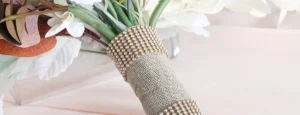
I secure artificial wedding bouquets by tightly fixing the stem bundle at several points, checking the flower positions again, trimming the handle evenly, and covering the binding with ribbon or another decorative finish.
Applicable scenario: Bridal bouquet finishing, export packaging, wedding rental bouquets, florist workshops, and private-label bouquet production.
Step 8: Secure the Stems of Artificial Wedding Bouquets
I first hold the completed bouquet firmly in one hand.
Then I check the front.
I check both sides.
I check the top.
I check the overall outline.
I make any final flower adjustments before tightening the stems.
For lightweight bouquets, floral tape and floral wire may be enough.
For larger commercial artificial wedding bouquets, I sometimes add a hidden cable tie or stronger internal binding.
The important point is that the binding should not move.
I normally secure more than one position along the handle.
One fixing point can act like a hinge. Flowers may rotate around it.
Two or more controlled fixing points can make the structure much more stable.
I keep the upper binding close enough to the flower heads to maintain the arrangement. I keep another binding lower on the handle to control the stems.
After that, I test the bouquet.
I gently move it.
I turn it upside down for a short moment.
I check whether any flower changes position.
This simple test can reveal problems before the bouquet reaches a customer.
In one sample development project, the bouquet looked excellent on the table. When I picked it up and carried it around the sample room, two heavier flower heads slowly moved outward.
That was a useful warning.
I added stronger internal fixing and changed the stem position before the final sample was approved.
A bouquet should not only survive a photograph.
It has to survive real use.
Step 9: Trim and Wrap the Handle
I trim the lower stems only after the upper bouquet shape is finished.
I do not cut too early.
If I cut every stem to the final length before arranging, I lose flexibility.
For a hand-tied look, I keep a clean section of visible stems.
For a fully wrapped bridal handle, I cover most or all of the holding area.
I normally begin the ribbon near the upper binding point.
I wrap downward with consistent overlap.
Then I finish the ribbon cleanly with pins, stitching, glue, or hidden fastening depending on the design.
I also think about hand comfort.
Very thick handles are difficult to hold.
Very thin handles can feel weak compared with a large bouquet.
The handle should visually match the bouquet size.
For wedding rental companies, I also consider cleaning and reuse.
A very delicate ribbon finish may look beautiful but become difficult after repeated events. A removable or replaceable ribbon system can sometimes be more practical.
If bouquets will be reused across weddings, my guide on how to store and reuse artificial wedding flowers covers the storage side in more detail.
This is one of the biggest advantages I see in well-made artificial wedding bouquets. A business can prepare them earlier, inspect them before the event, store them, transport them, and use them again when the business model allows it.
How Can Wedding Businesses Produce Artificial Wedding Bouquets More Efficiently?
One perfect sample is easy to admire. The real business challenge starts when a team needs 50, 500, or 1,000 bouquets that still look like that sample.
Wedding businesses can produce artificial wedding bouquets more efficiently by standardizing flower lists, dimensions, stem positions, bouquet weight, approved samples, assembly steps, packaging, and quality-control points.
Applicable scenario: Wedding wholesalers, bouquet brands, event rental chains, bridal retailers, distributors, and private-label artificial flower programs.
Standardize Artificial Wedding Bouquets Before Increasing Quantity
I never want bulk production to depend only on one worker’s memory.
For bulk artificial wedding bouquets, I create a clear production reference.
The reference should define:
- Final bouquet diameter
- Approximate bouquet height
- Handle length
- Focal flower quantity
- Secondary flower quantity
- Filler quantity
- Greenery quantity
- Color ratio
- Flower height differences
- Stem position
- Bouquet weight range
- Ribbon type
- Ribbon color
- Packing method
Photos are also important.
I normally want a front photo.
I want a side photo.
I want a top photo.
I also want close-up photos of important flower positions.
This makes the approved sample easier to repeat.
Create a Simple, Repeatable Assembly Sequence
For bulk production, I prefer an assembly method that workers can follow in the same order.
For example:
- Prepare all stems.
- Shape petals and leaves.
- Group flowers by type.
- Build the focal flower structure.
- Add secondary flowers.
- Add fillers.
- Add greenery.
- Check diameter and overall shape.
- Secure and wrap the handle.
- Complete final inspection.
The artistic result still matters.
The production process also matters.
If one bouquet takes 18 minutes and another takes 35 minutes because every worker uses a completely different method, the production cost becomes difficult to control.
Use One Approved Sample as the Standard
I keep the approved master sample separate from normal production whenever possible.
Workers should not constantly handle the master sample.
The team can use detailed images, measurements, and work instructions for daily production. Supervisors can compare finished pieces with the approved sample during inspections.
I also check flowers before assembly.
If one production batch has a slightly different rose color or hydrangea size, it is much better to find that problem before hundreds of bouquets are completed.
Our OEM and ODM artificial flower service is built around this type of sample development and production control for B2B projects.
Control Packaging During Bouquet Design
I do not treat packaging for artificial wedding bouquets as the last step.
A bouquet may be beautiful but expensive to ship.
Large flower heads take space.
Long stems increase carton dimensions.
Very open greenery can become compressed.
Ribbon can also be damaged if the bouquet moves inside the box.
I therefore test packaging while the sample is being developed.
Sometimes a small change in stem length or greenery position can reduce carton size without changing the visible design.
For B2B buyers, this can have a larger financial effect than reducing the price of one flower stem.
I have seen projects where the customer first focused heavily on the bouquet unit price. After we checked the box size, the shipping efficiency became just as important.
This is why I always think about the complete landed product.
Start With One Collection Before Building Dozens of SKUs
One of the clearest examples came from an Irish wedding business I worked with on artificial wedding bouquets and matching wedding décor collections.
The business had nine wedding collections. Each collection could include six main product types. That meant a large number of potential items.
It would have been possible to quote and sample everything immediately.
I did not think that was the best first move.
I suggested starting with one important collection.
We could develop the six main products first.
We could confirm flower combinations.
We could confirm dimensions.
We could confirm fullness.
We could confirm pricing.
We could confirm packaging.
Once that structure was accepted, the remaining collections would become much easier to develop.
This method reduces risk for both sides.
It also gives the buyer useful information before committing to a much larger program.
My Insight: Repeatability Matters More Than One Perfect Bouquet
After more than a decade working with artificial flowers and décor, I have learned to separate two ideas.
The first is sample beauty.
The second is commercial success.
A designer may spend three hours adjusting one bouquet until every petal looks perfect.
That bouquet can be beautiful.
But a wedding business may need 200 matching bouquets delivered on time.
The second challenge is very different.
I need to ask whether the materials are stable.
I need to ask whether workers can reproduce the shape.
I need to ask whether the color can remain consistent.
I need to ask whether the handle will survive transport.
I need to ask whether the bouquet fits efficiently inside the carton.
I need to ask whether replacements can be produced later.
I also need to ask whether the design can become part of a larger collection.
This is why I do not judge artificial wedding bouquets only from the front photo.
I look at the whole product.
One Australian wedding styling project taught me this clearly. The client needed wedding pieces that were beautiful but also practical for event installation. The design mattered. Speed and consistency also mattered.
That idea has stayed with me.
A professional wedding flower product should help the wedding business operate better.
For a retail customer, the question may be, “Is this bouquet beautiful?”
For a B2B buyer, I think the better question is:
“Can this bouquet stay beautiful when I order it repeatedly, transport it, photograph it, store it, and use it across my business?”
That is the standard I use when I develop artificial wedding bouquets and matching artificial wedding flowers at Botanic Blossoms.
If U are developing artificial wedding bouquets for a bridal collection, wedding rental range, private-label flower line, or matching wedding décor series, U can send the reference photos, approximate dimensions, target quantity, and preferred colors.
I can then help turn the idea into a sample that is practical for production.
U can also browse the Botanic Blossoms artificial flower catalogue before contacting us if U need more flower styles or bouquet references.
Conclusion
Professional artificial wedding bouquets need balance, secure construction, natural movement, and repeatable production so every piece can stay close to the approved design.
Footnotes
Brides — “Silk Flower Arrangements: Everything to Know.” This reference explains how silk flowers can be used for bridal bouquets and reception arrangements and notes that quality can vary between sources. View source. ↩︎
The Knot — “11 Styles, Shapes & Types of Wedding Bouquets to Know.” This guide reviews bouquet forms including cascade, hand-tied, oversized, pageant, posy, and round styles. View source. ↩︎
Pantone Connect — Color Palette Tools. Pantone provides tools for creating, saving, and sharing color palettes, which can support clearer color communication during design development. View source. ↩︎
Frequently Asked Questions About Artificial Wedding Bouquets
1. Can artificial wedding bouquets look realistic enough for professional weddings?
Yes. Well-made artificial wedding bouquets can look highly realistic. I focus on petal texture, natural color variation, different flower heights, controlled spacing, and irregular stem angles.
2. What are the best artificial flowers for bridal bouquets?
Roses, peonies, hydrangeas, ranunculus, orchids, dahlias, lisianthus-style flowers, and high-quality greenery are common choices. I select them based on the wedding style and bouquet shape.
3. How many flower types should I use in one wedding bouquet?
I usually start with one or two focal flower families, several supporting flowers, and one or two filler or greenery types. Too many varieties can make the bouquet look busy.
4. Can artificial wedding bouquets be customized for wholesale orders?
Yes. I can customize flower combinations, colors, bouquet size, fullness, ribbon, greenery, packaging, labels, and other details for B2B projects.
5. What information should a buyer provide before requesting a custom bouquet?
I prefer reference photos, approximate dimensions, target colors, expected order quantity, packaging requirements, target market, and any special quality requirements.
6. Should a wedding business order samples before bulk production?
Yes. I strongly recommend confirming a physical sample before a large order. The sample helps confirm flower quality, color, size, construction, hand feel, and packaging.
7. How can wedding rental businesses make artificial bouquets last longer?
Wedding rental businesses can extend bouquet life through secure construction, careful transport, controlled storage, regular dust removal, and replaceable ribbon when possible.
8. Can one bouquet design be developed into a complete wedding collection?
Yes. I can use the bridal bouquet as the design reference for bridesmaid bouquets, buttonholes, table flowers, aisle flowers, arches, and other matching items.
9. What is the best way to control consistency in bulk artificial wedding bouquets?
I use an approved master sample, flower quantity specifications, dimensions, production photos, assembly instructions, color references, packaging standards, and regular quality checks.
10. Can Botanic Blossoms develop private-label artificial wedding bouquets?
Yes. Botanic Blossoms supports OEM and ODM wedding flower projects, including custom designs, colors, packaging, branding, samples, and bulk production for international B2B buyers.