
From a Buyer’s Brief to a Repeatable Production Standard.
A custom artificial flower is not finished when the first sample looks good. It is finished when the material, color, structure, handwork, packaging and inspection criteria are clear enough for bulk production to reproduce the approved result.
Botanicblossoms supports product design, colors, materials, sizes, finishes, molds, private label and packaging development for wholesalers, retailers, e-commerce sellers, wedding companies, hotels, restaurants, interior designers and commercial project buyers.
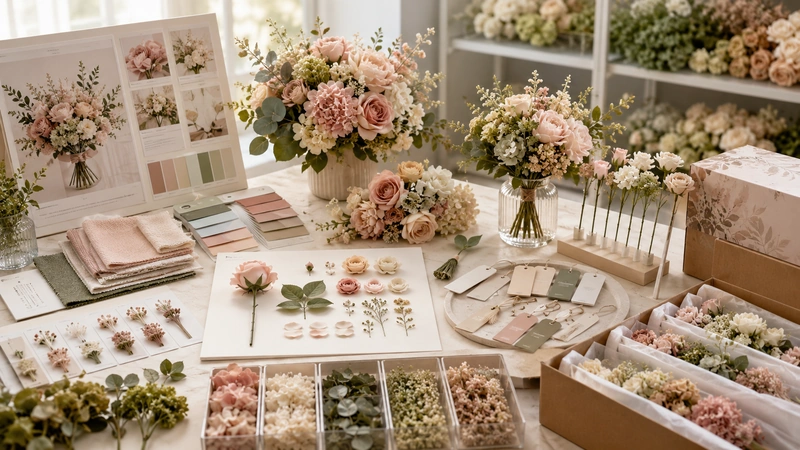
Customization Is a Stack of Decisions.
A custom product can change at one level or many levels. Defining the customization depth early helps avoid unnecessary sampling, tooling and packaging revisions.
Visual Customization
Color, flower mix, leaf tone, finish, size selection and assortment adjustment using existing structures.
Material Customization
Petal fabric, real-touch material, latex-style construction, plastic parts, coatings, adhesives and support structure.
Structural Development
New dimensions, stem structure, flower head construction, decorative components, molds or assembly method.
Brand & Packaging System
Private label, hangtags, labels, printed boxes, inserts, carton marks and market-specific packaging presentation.
Inquiry → Requirement → Material → Sample → Revision → Golden Sample → Production → Inspection → Packing → Shipment
Click any stage to see what is being decided, what can go wrong and what must be locked before the next stage begins.
We Need Enough Information to Know What Kind of Project This Is.
A product photo alone does not tell us whether you need an existing model, a color change, a material upgrade, a structural redesign, a new mold or a private-label packaging program.
Reference image, product category, target quantity, market, intended use and customization request.
Quoting too early can create the wrong cost basis and an unrealistic sample expectation.
We know whether the job is standard sourcing, light customization or new product development.
Sampling Is Where Ambiguous Requirements Become Physical Decisions.
The purpose of a sample is not simply to “show something.” It is to confirm the points that bulk production will later have to repeat: material, color, dimensions, shape, handwork, assembly, finish and packaging.
We do not define a fixed revision count because a color adjustment, a new flower head, a custom mold and a new retail package have very different development complexity. The sample loop ends when the agreed production-critical details are approved.
What information do we need before sampling? +
Ideally: reference image or physical sample, target dimensions, intended material, color reference, quantity, application, packaging concept, target price position and any must-keep details. If some items are unknown, we identify them during requirement confirmation.
How is a color sample confirmed? +
We compare the actual dyed or molded material against the buyer’s Pantone reference, physical swatch, approved product or other agreed standard. The color is judged on the real material because texture, opacity and base material can change how the shade appears.
What happens if the first sample fails? +
We do not simply remake it without diagnosis. We identify which variable failed — color, petal stiffness, structure, size, material, handwork, finish or packaging — then revise that variable so the next sample answers a specific problem.
How many revisions are normally required? +
There is no fixed number. Existing-product color changes may require fewer iterations than a new structure, mold or packaging system. We prefer to measure revision progress by unresolved production variables rather than promise a generic number.
What becomes the golden sample? +
The golden sample is the physically approved product that represents the final agreed appearance and production-critical details. It should correspond to the approved color, structure, material, dimensions, finish and any other locked specification.
Who keeps the approved sample? +
The exact retention arrangement should be confirmed by project. A practical system is to keep a controlled factory reference and, where appropriate, provide or confirm a buyer reference so both sides are judging later production against the same approved standard.
How does mass production follow the sample? +
The golden sample is translated into material references, dimensions, color standards, assembly expectations, visual checkpoints and packaging specifications. Production and inspection then compare bulk goods against those agreed controls.
Match the Shade on the Material That Will Actually Be Produced.
A Pantone reference is a target, not the finished material. Fabric texture, base color, translucency, coating and dye absorption can change the visual result. Color confirmation should therefore happen on the actual production-relevant material.
Pantone reference, buyer swatch, physical sample, existing product or approved master color.
Fabric, real-touch material, latex-style part, plastic component, stem, coating or decorative finish.
Start with One Clear Color Authority.
If the buyer sends a Pantone number, photo and physical sample that do not visually agree, we need to know which one controls the decision. Sampling becomes faster when one reference has final authority.
When Existing Products Are Not Enough.
New product development may involve a new flower head, new leaf geometry, custom size, support structure, mold, finish, assembly method or combination of existing components.
Modify an Existing Structure
Change colors, materials, size combinations, flower mix, leaves, finishes or packaging while using proven structures.
Combine Existing Components
Build a new SKU by combining established flower heads, stems, leaves, pots or decorative components into a new market-facing product.
Develop New Components / Molds
For a genuinely new form, confirm design, dimensions, material, tooling implications, sample route and production feasibility before bulk commitment.
Make the Product Belong to Your Brand System.
Private label development can involve product naming, labels, hangtags, care cards, barcode information, printed inserts, packaging graphics and carton identification.
Packaging Has to Protect the Product and Fit the Sales Channel.
E-commerce, retail shelf, wholesale master carton and commercial-project delivery may need different packaging logic. We consider presentation, protection, carton size, flower-head deformation risk and shipping efficiency together.
Confirm retail presentation and labeling needs.
Protect flower heads, petals and decorative surfaces from concentrated pressure.
Review carton volume and logistics efficiency before bulk packing.
The Golden Sample Is the Bridge Between Development and Production.
Before bulk production, the product has to stop being an idea and become an approved reference. The golden sample should represent the details that production and inspection must reproduce.
What You Can See & Touch
- • Overall silhouette
- • Color and material
- • Petal / leaf structure
- • Handwork and finish
- • Packaging appearance where applicable
What Production Needs to Repeat
- • Key dimensions
- • Material specification
- • Color reference
- • Assembly / finish checkpoints
- • Packing specification
Bulk production should begin only after the relevant production-critical details are approved and the factory reference is clear enough to control later output.
Production Is the Test of Whether Development Was Clear Enough.
The golden sample alone is not enough. Bulk production needs practical checkpoints so color, structure, assembly and packing stay aligned with the approved result.
Material Check
Confirm critical material, color and component references before assembly.
Assembly Check
Watch handwork, alignment, glue points, shape and visible finish while the lot is still being built.
Appearance & Specification
Compare bulk goods against the approved visual and written production references.
Protection & Carton Control
Confirm product protection, package presentation and master-carton execution before shipment.
MOQ and Lead Time Depend on What You Are Asking the Factory to Change.
We do not publish one universal MOQ or one universal lead time because existing-product color changes, private-label packaging, custom molds and new structures do not consume the same materials, setup time or development resources.
Existing vs. New Structure
Existing structures are generally simpler to launch than products requiring new tooling or new component development.
Material & Color Minimums
Custom-dyed fabric, molded color, specialty finish or custom packaging may have their own production minimums.
Sampling & Approval Loop
The clock is affected by how many production-critical details remain unresolved before golden-sample approval.
Production & Packaging Complexity
Handwork, custom printing, special packing, molds and large order volume can all affect confirmed production scheduling.
Send the product reference, target quantity, custom color/material requirements, packaging needs, tooling requirements and target delivery window. We can then quote against the actual production route rather than a generic number.
The Goal Is to Remove Uncertainty Before Bulk Production.
Clarify What Matters
Identify the product, market, quantity, visual target, material and packaging requirements.
Turn Feedback into Variables
Revise specific issues instead of restarting blindly.
Lock the Golden Sample
Create one agreed physical and written production reference.
Control Against the Approval
Use the approved reference during material checks, assembly, inspection and packing.
Have a Reference, Sketch, Pantone Color or Existing Product to Improve?
Send the product reference, quantity, target market, custom materials, packaging needs and any must-keep details. We can then determine the most practical sampling and production route.