
A plant labeled “UV-treated” can still fade early when the test covers the wrong material, the installation faces intense sun, or the supplier changes its formulation.
To prevent UV-treated artificial plants from fading, verify the exact weathering test, match the product to its exposure zone, approve a measurable color standard, choose stable materials, protect plants from unnecessary direct sun, control heat and moisture, clean them gently, inspect them regularly, and replace damaged modules before color differences spread across the display.
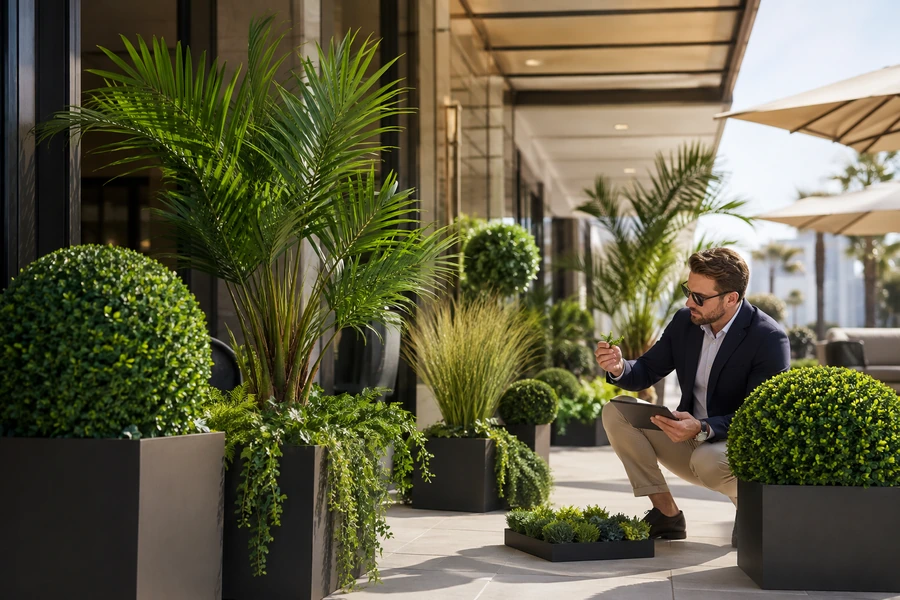
UV protection slows weathering. It does not stop it completely. The service life of an artificial plant depends on its pigments, polymer, coating, adhesive, internal wire, exposure direction, climate, cleaning method, and installation.
What Does UV-Treated Mean for Artificial Plants?
“UV-treated” is often used as a general sales phrase. It may describe an additive inside the plastic, a coating applied to the surface, a tested material, or simply a product recommended for outdoor use.
A UV-treated artificial plant contains or receives a material system intended to reduce damage from ultraviolet radiation. Protection may be incorporated into the polymer during production, applied as a surface treatment, or combined. Buyers should confirm which components are protected and which test supports the supplier’s claim.
Artificial plants often combine several materials:
- Molded polyethylene leaves
- PVC or plastic-coated stems
- Polyester flowers
- Metal wire
- Adhesive
- Paint
- Foam
- Natural wood
- Fiberglass
- Fabric wrapping
- Decorative moss
A test performed on one green plastic leaf does not automatically prove that the flower petals, trunk, glue, wire coating, or backing panel will perform in the same way.
Integral UV Protection
Integral protection is added to the resin, pigment, or material formulation before the leaf or stem is molded.
This approach can be useful because protection is distributed through the material rather than existing only on the outer surface.
However, the phrase “UV additive included” is still incomplete. The buyer should ask:
- Which material contains the additive?
- Is it present in every color?
- Is the production formula identical to the tested formula?
- Was the finished component tested?
- What color change was accepted?
- Did the test evaluate brittleness and cracking?
A supplier may change pigment, recycled content, resin source, or additive concentration between batches. The new product may look identical when delivered but respond differently outdoors.
Topical UV Treatment
A topical treatment is sprayed, brushed, dipped, or coated onto the finished foliage.
It may provide useful additional protection when the coating is compatible with the plant material. It can also create problems when it changes gloss, makes leaves sticky, attracts dust, or fails to reach hidden areas.
A surface coating should not be treated as permanent without supporting evidence.
The buyer should confirm:
- Approved substrate
- Application thickness
- Curing process
- Expected maintenance interval
- Cleaning restrictions
- Reapplication instructions
- Effect on fire performance
- Effect on color and texture
A spray added after purchase cannot automatically turn every indoor artificial plant into a long-term exterior product.
How Is UV Resistance Tested?
A statement such as “tested for 2,000 hours” sounds precise, but the number is not useful without the test method, exposure cycle, specimen, and result.
UV resistance is commonly assessed through accelerated weathering equipment that exposes specimens to controlled radiation, heat, and moisture. ISO 4892-3:2024 covers fluorescent UV exposure methods for plastics, while ASTM G154-23 addresses the operation of fluorescent UV lamp apparatus for exposing materials.
ISO 4892-3:2024 specifies methods that expose plastic specimens to fluorescent UV radiation, heat, and water to simulate parts of the weathering that occur in real end-use environments. ASTM’s current weathering standards also use controlled laboratory exposure to evaluate changes associated with UV, moisture, and heat.
Accelerated Testing Is Not a Lifetime Guarantee
Laboratory weathering helps compare materials and determine whether they meet an agreed specification. It does not automatically convert a number of chamber hours into a guaranteed number of outdoor years.
Intertek explains that accelerated weathering exposes products to controlled light, heat, and moisture. Its ASTM G155 guidance also notes that test reports are better suited to comparative ranking or specification compliance than to declaring an exact product service life.
Actual performance can differ because of:
- Geographic location
- Installation direction
- Daily exposure time
- Temperature
- Humidity
- Reflected radiation
- Salt or pollution
- Cleaning chemicals
- Product formulation
- Mounting conditions
NIST research has also shown that UV intensity, temperature, relative humidity, and wavelength influence polymer weathering. A product tested under one controlled cycle may respond differently in a hotter, wetter, or more exposed location.
What Are the 9 Proven Rules for Preventing Artificial Plants From Fading?
The strongest fading-control plan begins before the order is placed. Maintenance cannot fully correct a weak pigment, unsuitable resin, or irrelevant test report.
The nine rules are to verify test evidence, test the finished system, establish a color baseline, map the exposure zone, choose the correct protection method, reduce unnecessary radiation, control heat and water, clean gently, and monitor the installation through a planned inspection and replacement program.
Rule 1: Demand the Exact Test Method, Cycle, and Result
Do not approve a supplier based only on phrases such as:
- UV-resistant
- UV-protected
- UV-stabilized
- Outdoor safe
- Weather-proof
- Fade-proof
- Tested for 2,000 hours
Each statement needs evidence.
Ask for These Details
| Test Detail | Why It Matters |
|---|---|
| Standard and edition | Identifies the procedure |
| Lamp or light source | Defines the radiation spectrum |
| Exposure cycle | Shows UV, heat, and moisture conditions |
| Total exposure | Shows the test duration |
| Specimen | Identifies what was actually tested |
| Production color | Confirms that the ordered pigment was included |
| Evaluation method | Explains how change was measured |
| Initial result | Creates a baseline |
| Final result | Shows the change after exposure |
| Acceptance limit | Defines pass or fail |
| Laboratory | Identifies who performed the test |
| Report date | Helps detect outdated formulations |
ASTM G154 defines operating principles for fluorescent UV exposure apparatus, while ASTM D4329-26 provides procedures and conditions specifically for UV exposure of plastics. A report should identify the selected cycle rather than simply naming the standard.
Watch for Report Substitution
A supplier may provide a report for:
- A raw resin instead of the finished leaf
- One green shade instead of all ordered colors
- A previous factory
- A different product code
- A coating no longer used
- An indoor product from the same catalog
- A small flat plaque instead of a molded component
The report may be genuine but still irrelevant.
I compare the report’s company name, product description, material, color, batch, and date with the current order.
Rule 2: Test the Complete Artificial-Plant System
A plant can fade unevenly because it contains several materials and production processes.
Evaluate the visible leaves, flowers, stems, trunk, paint, adhesive, and backing—not only one raw plastic sample. The finished plant may fail visually when one component changes color faster than the others, even if the main foliage remains acceptable.
For example, a UV-stabilized palm leaf may remain green while:
- The central rib becomes pale
- The adhesive turns yellow
- The painted trunk loses color
- The potting foam breaks down
- The stem coating cracks
- The fabric flowers fade
- The wire begins to show
Adhesive joints deserve attention because UV and moisture can affect bonded components as well as foliage. ASTM D904 addresses controlled exposure of adhesive specimens to artificial light, with or without water, demonstrating that bonded joints may require their own performance evaluation.
Build a Component Matrix
| Component | Material | UV Evidence | Main Failure Risk |
|---|---|---|---|
| Main leaves | PE or PVC | Report required | Fading and brittleness |
| Colored flowers | Polyester or plastic | Separate color test | Rapid visible fading |
| Stem coating | Plastic or paint | Material confirmation | Cracking |
| Internal wire | Coated metal | Corrosion review | Rust exposure |
| Trunk | Fiberglass, plastic, or wood | Exterior suitability | Cracking or discoloration |
| Adhesive | Supplier-specific | Compatibility evidence | Yellowing or detachment |
| Green-wall backing | Plastic grid | Outdoor and fire review | Warping |
| Fasteners | Metal or polymer | Site suitability | Corrosion or failure |
For large projects, I test one complete production sample outdoors before approving the full installation.
A 60- or 90-day site trial will not prove long-term life, but it may reveal immediate problems with gloss, color consistency, heat, cleaning, and installation.
Rule 3: Approve a Measurable Color Baseline
A buyer cannot control fading when the original color is described only as “natural green.”
Approve a retained physical sample and define how color change will be evaluated. Use consistent lighting, fixed photography, or instrumental color measurements. The supplier and buyer should agree on the acceptable tolerance before production and outdoor exposure begin.
ASTM D2244 covers the calculation of color tolerances and color differences from measured color coordinates. ASTM’s current committee listing identifies D2244-25 as the active edition. The standard framework also emphasizes that buyer and seller should agree on the permissible tolerance and calculation method.
Three Practical Color-Control Levels
Level 1: Visual Comparison
Use:
- An approved retained sample
- One controlled light source
- A neutral background
- The same viewing distance
- The same evaluation team
This method is affordable but subjective.
Level 2: Standardized Photography
Use:
- Fixed camera
- Fixed distance
- Fixed exposure
- Color reference card
- Neutral background
- Repeated lighting position
Phone photographs taken at different times are not reliable enough for a formal color claim.
Level 3: Instrumental Measurement
A colorimeter or spectrophotometer can record measurable differences in lightness, chroma, and hue.
Instrumental measurement is especially useful for:
- Large hotel projects
- Retail chains
- Mall green walls
- Repeat orders
- Warranty claims
- Matching replacement panels
Texture and gloss still affect visual perception, so numerical results should be combined with a physical inspection.
Keep an Unexposed Control Sample
I retain one sample from the production batch in a dark, controlled location.
The outdoor product is compared with this reference during inspections.
Without a control, staff may fail to notice gradual fading because they see the installation every day.
Rule 4: Map the Real Exposure Zone
Two plants installed at the same property can experience very different weathering.
Classify every location as full sun, partial sun, covered outdoor, window-adjacent, reflected-light, or indoor. Record the direction, daily sunlight period, nearby glass, pale paving, water, metal surfaces, and heat sources before selecting the product or warranty.
The EPA’s UV Index predicts the expected intensity of solar UV radiation on a scale from 1 to 11+. The index is intended for human sun-safety decisions, not artificial-plant lifetime prediction, but it demonstrates that UV intensity changes by location and time.
Exposure Zones
| Zone | Typical Location | Fading Risk |
|---|---|---|
| Indoor controlled | Interior corridor | Low |
| Window-adjacent | Lobby beside glazing | Medium |
| Covered outdoor | Sheltered entrance | Medium |
| Morning sun | East-facing terrace | Medium |
| Afternoon sun | West-facing façade | High |
| Full-day exposure | Open rooftop | Very high |
| Reflected exposure | Pool, glass, or pale paving | Potentially high |
| Elevated exposure | Rooftop or upper balcony | Project-specific |
Shade reduces direct exposure, but it does not create zero UV exposure. Reflected and indirect light can still reach the foliage.
Review the Plant From Every Side
One side of a tree may face direct afternoon sun while the rear remains shaded. The result can be a visibly two-tone canopy.
I record:
- Front orientation
- Strongest sunlight direction
- Reflected-light direction
- Areas hidden from cleaning
- Areas exposed to rain
- Areas near heat-producing glass or metal
This map guides product selection, rotation, and replacement planning.
Rule 5: Match the Protection Method to the Exposure
Integral UV stabilization, topical treatment, shade, and planned replacement are different tools. They should not be treated as interchangeable.
Use a product manufactured and tested for exterior exposure in full-sun locations. Reserve ordinary indoor foliage or lightly treated products for protected areas. Treat aftermarket UV spray as secondary protection unless the spray manufacturer and plant supplier confirm compatibility and performance.
Best Strategy by Location
| Location | Preferred Protection Strategy |
|---|---|
| Indoor corridor | Standard quality foliage |
| Bright window | Light-stable product or rotation |
| Covered entrance | Exterior-rated foliage |
| Full-sun terrace | Integral UV-stabilized material with test evidence |
| Rooftop | Tested exterior system plus structural design |
| Seasonal event | Temporary-rated product with removal plan |
| Existing indoor plant moved outside | Compatibility test and short-term use only |
A UV spray may help maintain certain compatible materials, but it can also:
- Increase shine
- Change leaf color
- Leave cloudy areas
- Become sticky
- Attract dust
- Affect fire treatment
- Miss hidden surfaces
- Require reapplication
I test the spray on a spare leaf and let it cure completely before treating the full plant.
I also obtain written confirmation when fire-performance documentation matters. Applying a new surface coating may alter the tested product system or make the original report less relevant.
Rule 6: Reduce Unnecessary Direct and Reflected Exposure
Even a well-treated product can last longer when it receives less radiation.
Place valuable artificial plants beneath architectural cover, behind overhangs, or in zones with shorter direct-sun periods when the design allows it. Rotate movable plants only when all sides are designed for viewing, and use duplicate modules so heavily exposed sections can be exchanged before the contrast becomes severe.
Practical Exposure-Reduction Methods
- Move delicate flowers under cover
- Use molded greenery in full sun
- Keep pale flowers away from intense reflected light
- Place trees behind columns or overhang lines
- Rotate symmetrical planters
- Exchange exposed wall modules
- Use seasonal inserts
- Store removable décor when not needed
- Avoid unnecessary rooftop storage
Rotation does not reverse fading. It only distributes exposure more evenly.
A plant with one display-facing side should not be rotated when the rear construction is visible. Instead, use replaceable branches or modules.
Watch Reflected Heat
Large glass façades and metal surfaces can create concentrated heat around one section of an installation.
UV exposure and temperature can interact in polymer degradation. NIST research on several plastics has examined the effects of UV intensity, temperature, humidity, and wavelength on changes such as yellowing, gloss loss, and surface degradation.
I therefore inspect leaf temperature, warping, gloss, and adhesive performance—not only visible color.
Rule 7: Control Heat, Moisture, and Drainage
UV is only one part of outdoor weathering.
Keep planters draining freely, prevent standing water around foam and wire, and avoid installing artificial plants beside uncontrolled heat sources. Moisture, heat, and radiation can act together, so the entire planter and attachment system must be suitable for exterior exposure.
Accelerated-weathering systems often combine UV with heat and moisture because outdoor deterioration does not occur through light alone. ISO 4892-3 includes radiation, heat, and water, while Intertek’s QUV guidance describes cycles involving ultraviolet exposure, condensation, and controlled temperature.
Inspect the Hidden Components
The visible leaves may look acceptable while the internal system fails.
Check:
- Drainage holes
- Water trapped in sleeves
- Rust around wire
- Softened adhesive
- Cracked stem coatings
- Wet foam
- Shifted ballast
- Damaged plant liners
- Loose wall fasteners
- Warped panel grids
Avoid Heat Traps
Do not place a plant directly against:
- Hot exhaust outlets
- Dark metal walls
- Unventilated glass enclosures
- Heated lighting housings
- Equipment cabinets
- Surfaces that become extremely hot
A planter liner should have enough space for drainage and inspection. Filling the complete pot with permanent foam or concrete may hide water and make future repairs difficult.
Rule 8: Clean With Material-Compatible Methods
Dust, mineral deposits, grease, pollution, and cleaning chemicals can make foliage appear faded even when UV damage is limited.
Remove loose dust with a microfiber cloth, soft brush, or cool low-pressure air. Use moisture only when permitted by the manufacturer. Avoid bleach, solvents, abrasive brushes, and untested sprays because they can change color, gloss, coating, and adhesive performance.
Cleaning Order
- Inspect for loose leaves and cracked stems.
- Remove dry dust.
- Test an unseen area.
- Use a lightly damp cloth when approved.
- Clean from the stem toward the leaf tip.
- Avoid soaking internal joints.
- Allow the plant to dry completely.
- Record any color or texture change.
A dirty artificial plant may look gray or pale. Cleaning can restore its appearance when the problem is surface contamination rather than polymer fading.
However, cleaning cannot restore pigment that has permanently changed through weathering.
Do Not Hide Fading With Random Coatings
Paint, oil, polish, silicone spray, and leaf-shine products may create a temporary darker appearance.
They may also:
- Produce unnatural gloss
- Collect more dust
- Transfer to clothing
- Become patchy in rain
- Affect future cleaning
- Change fire performance
- Conceal cracking
For commercial projects, use only an approved repair system that matches the product specification.
Rule 9: Inspect, Grade, Rotate, and Replace
Fading becomes expensive when the buyer waits until the entire installation looks poor.
Create an inspection schedule with retained samples, fixed photographs, condition grades, and replacement triggers. Replace individual stems, fronds, panels, or seasonal inserts before a small color difference becomes a full-project mismatch.
Suggested Inspection Schedule
| Exposure | Visual Inspection | Formal Comparison |
|---|---|---|
| Indoor | Every three months | Annually |
| Window-adjacent | Monthly | Every six months |
| Covered outdoor | Monthly | Every three to six months |
| Full sun | Monthly | Every three months |
| Rooftop or poolside | After severe weather and monthly | Every three months |
| Seasonal display | Before and after each use | Every display cycle |
Condition Grades
Grade A: Color matches the control sample and the product remains suitable for close viewing.
Grade B: Minor color change is visible only during direct comparison. The plant remains suitable for normal use.
Grade C: Fading is visible from the customer’s viewing distance. Plan replacement or move the product to a lower-visibility zone.
Grade D: Strong fading, brittleness, cracking, or component failure. Remove the product.
Establish Replacement Triggers
Triggers may include:
- Agreed instrumental color difference
- Visible mismatch between panels
- Significant gloss loss
- Leaf brittleness
- Cracking
- Adhesive failure
- White stress marks
- Exposed wire
- Uneven fading across a pair
- Customer-visible deterioration
ASTM D2244 provides a framework for calculating instrumental color differences, but the acceptable tolerance must be agreed for the specific product and commercial use.
How Long Do UV-Treated Artificial Plants Last Outdoors?
Suppliers often market outdoor artificial plants with one-, three-, five-, or longer-year expectations. These statements need conditions and exclusions.
There is no universal outdoor lifespan for UV-treated artificial plants. Performance depends on formulation, test method, location, direct-sun hours, heat, moisture, color, maintenance, and installation. A laboratory exposure result should be used to compare products and support a specification—not converted automatically into guaranteed outdoor years.
Intertek states that accelerated exposure results are useful for performance comparison and compliance, but a test report does not itself declare a product’s durability or exact service life.
Factors That Shorten Service Life
- Full afternoon sun
- High temperatures
- Reflected light
- Dark saturated colors
- Thin fabric petals
- Strong cleaning chemicals
- Salt exposure
- Standing water
- Poor-quality pigments
- Changes in resin formulation
- Weak adhesives
- Infrequent inspection
Factors That Can Extend Useful Life
- Architectural shade
- Integral UV stabilization
- Tested pigments
- Replaceable components
- Gentle cleaning
- Seasonal removal
- Good drainage
- Planned rotation
- Retained control samples
- Early repairs
A product may remain structurally intact after its color becomes commercially unacceptable. Hotels, malls, retailers, and event businesses often need a stricter visual replacement threshold than private residential users.
What Should a UV-Test Report Include?
A supplier’s report should allow the buyer to connect the test specimen to the delivered artificial plant.
A useful UV report identifies the applicant, manufacturer, product, material, color, standard, test cycle, exposure duration, laboratory conditions, evaluation method, before-and-after results, photographs, and conclusion. The buyer should reject reports that cannot be linked to the ordered SKU or current production formula.
UV-Report Checklist
| Report Item | Required Question |
|---|---|
| Applicant | Is it the supplier or another company? |
| Manufacturer | Is it the factory producing the order? |
| Product code | Does it match the quotation? |
| Material | Does it match the bill of materials? |
| Color | Was the ordered shade tested? |
| Standard | Is the method appropriate? |
| Standard edition | Is it current or contractually accepted? |
| Cycle | What UV, water, heat, and timing were used? |
| Duration | How long was the exposure? |
| Evaluation | Was color, gloss, strength, or cracking measured? |
| Tolerance | What counted as acceptable? |
| Result | Did the specimen pass the agreed requirement? |
| Photographs | Do they show the tested specimen? |
| Date | Does it reflect the current formulation? |
Common UV-Test Red Flags
- Only a report cover page is provided
- Product names are hidden
- The report belongs to another factory
- The specimen is described only as “green plastic”
- No before-and-after result appears
- No color-change limit is defined
- Exposure hours are shown without the cycle
- The supplier claims exact outdoor years from chamber hours
- The report tests one leaf but the warranty covers a complete tree
- Production materials can change without buyer approval
Can UV Spray Prevent Artificial Plants From Fading?
UV spray is popular because it appears to offer a simple upgrade for existing indoor plants. Its value depends on compatibility, application, exposure, and maintenance.
A compatible UV-protective spray may provide secondary protection, but it cannot guarantee that an indoor artificial plant will become permanently outdoor-rated. The spray may not protect internal pigments, hidden surfaces, adhesives, fabric fibers, wire, trunks, or areas missed during application.
When UV Spray May Be Useful
- Short seasonal displays
- Covered porches
- Existing plants with confirmed compatibility
- Touch-up maintenance required by the supplier
- Replacement modules awaiting delivery
- Low-risk residential placements
When UV Spray Is Not Enough
- Rooftop installations
- Permanent mall façades
- Large hotel entrances
- High-wind locations
- Fire-regulated installations
- Plants with unstable fabric dyes
- Products already brittle or faded
- Projects requiring a documented warranty
Always test the coating on a spare stem. Check the dried result under daylight and project lighting.
The finish should not become:
- Sticky
- Cloudy
- Overly glossy
- Uneven
- Stiff
- Strongly scented
- Attractive to dust
For public projects, confirm whether adding the coating changes any previously supplied fire or material documentation.
My Insights: UV-Treated Artificial Plants—What 9 Proven Rules Prevent Fading
The phrase “UV-treated” is not the final answer. It is the beginning of a verification process.
The nine rules that best prevent fading are exact test verification, complete-system testing, measurable color approval, exposure mapping, correct protection selection, reduced unnecessary radiation, heat and drainage control, gentle cleaning, and scheduled replacement. Together, they turn a vague UV claim into a manageable commercial performance system.
My main insight is that artificial-plant fading should be controlled through purchasing, installation, and maintenance together.
The Nine-Rule Summary
| Rule | Main Action | Failure Prevented |
|---|---|---|
| 1 | Verify the test method and result | Unsupported UV claims |
| 2 | Test the complete product | Uneven component failure |
| 3 | Establish a color baseline | Subjective fading disputes |
| 4 | Map the exposure zone | Wrong product placement |
| 5 | Match protection to exposure | Under-specified materials |
| 6 | Reduce avoidable sunlight | Unnecessary weathering |
| 7 | Control heat and drainage | Combined environmental damage |
| 8 | Clean with compatible methods | Chemical or abrasive discoloration |
| 9 | Inspect and replace modules | Widespread visible mismatch |
Rule 1 Controls the Claim
A supplier should not be approved because its catalog uses a UV icon.
The buyer needs a report connected to the exact material, color, product, and current production batch.
Rules 2 and 3 Control the Product
Testing one leaf is not enough. The complete plant must remain visually balanced.
A retained color sample and agreed tolerance make later inspections and warranty discussions more objective.
Rules 4, 5, and 6 Control the Location
Full sun, covered outdoor, reflected light, and window exposure are not equivalent.
The product and protection strategy should change when the exposure changes.
Rules 7 and 8 Control Maintenance
Heat, moisture, blocked drainage, dirt, and strong chemicals can accelerate deterioration or make a healthy product look faded.
Cleaning and planter maintenance are part of color protection.
Rule 9 Controls Service Life
No artificial plant stays new forever.
Modular plants, green walls, palms, and flower arrangements should have planned replacement parts. Replacing one faded panel early is less expensive than allowing it to create a visible patchwork across a large wall.
My Preferred Commercial UV Specification
For hotels, malls, offices, restaurants, and outdoor retail projects, I specify:
- Exact product and component materials
- Integral or topical UV-protection method
- ISO 4892-3, ASTM G154, ASTM D4329, or another agreed test
- Defined exposure cycle and duration
- Production-color test specimens
- Before-and-after color measurement
- Agreed visual or instrumental tolerance
- Finished-product sample
- Site exposure classification
- Warranty with clear exclusions
- Replacement foliage or modules
- Inspection and cleaning schedule
The test method must suit the material and intended use. ASTM and ISO weathering standards create controlled methods, but the buyer still needs to define what performance is acceptable.
My Final UV Rule
Never purchase “UV-treated artificial plants” as one undivided category.
Purchase a specific plant for a specific exposure zone, supported by specific test evidence and a specific maintenance plan.
That approach does not eliminate all fading. It makes fading slower, more predictable, easier to inspect, and less expensive to manage.
Conclusion
Verify the test, control the color baseline, match plants to real exposure, reduce unnecessary sun, maintain drainage, clean gently, and replace fading modules before the mismatch spreads.