
Outdoor faux plants can fail quickly when bright sun fades their leaves, wind loosens stems, rain fills planters, or weak branches collapse near guests.
The best commercial artificial outdoor plants for hotels and malls include UV-rated boxwood, palms, olive trees, cedar topiaries, agave, yucca, bamboo, ornamental grasses, ferns, green-wall panels, and flowering planter inserts. Each product still requires verified weathering data, stable construction, open drainage, secure installation, and project-specific fire documentation.
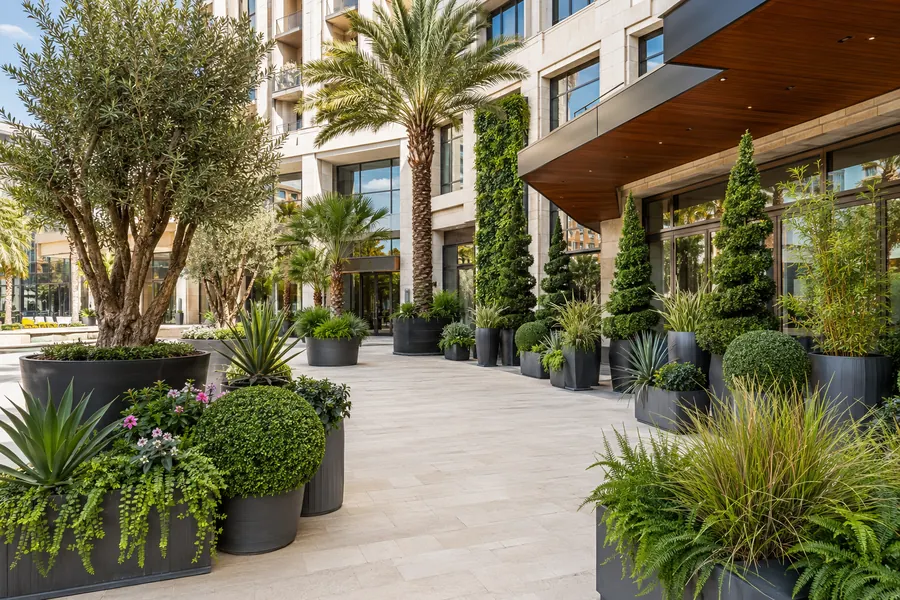
A plant species is not automatically weather-proof. An outdoor agave made from stabilized plastic may perform well, while an indoor-grade agave with painted leaves may fade within one season. Buyers must evaluate the exact material, test report, planter system, and installation location.
What Makes an Artificial Outdoor Plant Commercial-Grade?
A commercial artificial plant must survive more than sunlight. It may face wind, rain, cleaning, customer contact, trolley impacts, irrigation overspray, temperature changes, and repeated maintenance.
Commercial outdoor artificial plants should combine UV-stabilized foliage, weather-resistant stems, secure leaf connections, a stable internal frame, drainage-compatible planters, and replaceable components. Hotels and malls should also confirm flame-performance requirements, installation loads, wind exposure, warranties, and whether test reports cover the exact supplied product.
Most artificial plants are not intended for outdoor use. Consumer-horticulture guidance published in 2025 warned that indoor faux plants may fade rapidly when exposed to sun and recommended selecting products specifically sold for exterior use, commonly made from weather-resistant materials such as polyethylene, polyblend plastics, or PVC.
The Six-Part Commercial Weather Test
I assess outdoor artificial plants through six connected controls.
| Performance Area | What the Buyer Should Verify |
|---|---|
| UV resistance | Test method, specimen, exposure cycle, color result, and warranty |
| Water resistance | Foliage, trunk, adhesive, wire, planter, and drainage suitability |
| Wind resistance | Canopy size, stem retention, base weight, and structural attachment |
| Physical durability | Leaf connection, flexible stems, impact resistance, and replacement parts |
| Fire requirements | Exact product, test standard, mounting method, and authority approval |
| Serviceability | Cleaning access, modular construction, spare foliage, and reorder consistency |
A product can pass one area and fail another. UV-resistant leaves may remain green while an untreated trunk cracks. A heavy planter may stay upright while individual palm fronds detach.
What Does “UV-Tested” Actually Mean?
ISO 4892-3:2024 describes methods for exposing plastics to fluorescent UV radiation, heat, and water to simulate aspects of weathering in actual use. ASTM G154-23 provides a practice for operating fluorescent UV apparatus for material exposure. These standards describe test methods; they do not automatically guarantee that a finished tree will last a fixed number of years in every climate.
When a supplier says “2,000-hour UV-tested,” I ask:
- Which standard was used?
- Which exposure cycle was selected?
- Was the finished leaf or only the raw plastic tested?
- Were the pigment and UV additive identical to production?
- What color-change limit was accepted?
- Were cracking, chalking, and brittleness evaluated?
- Does the report cover every color in the order?
- What conditions are excluded from the warranty?
A test report without an acceptance result is incomplete. Exposure hours alone do not explain how the specimen changed.
Weather-Proof Does Not Mean Storm-Proof
A commercial plant may tolerate normal exterior exposure but remain unsafe during severe wind.
The National Weather Service advises securing outdoor objects when high winds are possible because loose items can become airborne hazards. Large artificial palms, trees, wall panels, and tall planters should therefore have engineered bases or structural attachments suitable for their location.
What Are the 17 Best Commercial Artificial Outdoor Plants?
The best categories have forms that are practical to manufacture, anchor, clean, and repair. Structured leaves and modular foliage often perform better than delicate fabric petals in exposed commercial areas.
The 17 strongest picks are boxwood hedge panels, boxwood topiaries, cedar or cypress trees, olive trees, Areca palms, date palms, bird-of-paradise plants, agave, yucca, bamboo screens, horsetail reeds, ornamental grasses, Boston ferns, Sprengeri ferns, eucalyptus shrubs, mixed green-wall panels, and flowering planter inserts.
Commercial suppliers currently offer outdoor-grade versions of boxwood, palms, ferns, grasses, bamboo, agave, hedges, topiaries, trees, and wall systems for hospitality and retail projects. Availability does not prove performance; it provides a shortlist for product-specific verification.
Quick Selection Table
| Rank | Artificial Plant | Best Hotel or Mall Location | Main Strength | Main Risk |
|---|---|---|---|---|
| 1 | Boxwood hedge panel | Terraces, queues, façades | Modular coverage | Visible panel repetition |
| 2 | Boxwood topiary | Entrances and porte-cochères | Formal, controlled shape | Unstable tall planters |
| 3 | Cedar or cypress tree | Main doors and winter displays | Narrow vertical form | Repeated branch pattern |
| 4 | Olive tree | Hotel courtyards and restaurants | Light, premium silhouette | Weak natural-wood trunks |
| 5 | Areca palm | Pool decks and resort entrances | Full tropical volume | High wind-catching area |
| 6 | Date palm | Atriums and large exterior zones | Strong destination impact | Structural complexity |
| 7 | Bird of paradise | Covered terraces and lobbies | Bold architectural leaves | Wide circulation footprint |
| 8 | Agave | Sunny entrances and rooftops | Compact molded form | Hard or projecting leaf tips |
| 9 | Yucca | Modern outdoor planters | Strong vertical shape | Weak central stem |
| 10 | Bamboo screen | Dining terraces and corridors | Visual separation | Dense leaves collect debris |
| 11 | Horsetail reed | Linear architectural planters | Narrow zoning form | Stems may loosen individually |
| 12 | Ornamental grass | Long mall and hotel planters | Fast coverage | Flattening and tangling |
| 13 | Boston fern | Covered patios and balconies | Soft natural volume | Fine fronds need cleaning |
| 14 | Sprengeri fern | Hanging and raised planters | Trailing outdoor texture | Difficult stem retention |
| 15 | Eucalyptus shrub | Wellness and neutral spaces | Muted modern color | Pale leaves show dirt |
| 16 | Mixed green-wall panel | Photo walls and façades | Large visual transformation | Fire, wind, and pattern control |
| 17 | Flowering planter insert | Entrances and seasonal displays | Color and fast changeover | Fabric blooms may fade faster |
1. Outdoor Boxwood Hedge Panels—Best Overall for Malls
Boxwood panels can cover walls, screen service areas, form queue boundaries, or create outdoor dining partitions. Their small leaves hide minor production differences better than large tropical foliage.
Choose boxwood panels with integral or documented UV protection, secure leaf attachment, several green tones, strong connection tabs, and replaceable modules. Inspect several connected panels because one sample cannot reveal repeated patterns, joining lines, or weak edge finishing.
Outdoor commercial boxwood products are currently sold as wall panels, hedges, mats, spheres, and topiaries. Some suppliers state that UV additives are incorporated into raw foliage materials rather than applied only as a surface treatment. Buyers should verify that the report and warranty cover the ordered panel, color, backing, and installation.
Boxwood works well for:
- Mall restaurant terraces
- Rooftop screening
- Parking-entry walls
- Hotel pool enclosures
- Queue dividers
- Temporary event backgrounds
- Service-area concealment
I rotate panel orientations during installation so the same leaf clusters do not create an obvious grid.
2. Boxwood Topiary—Best for Formal Hotel Entrances
Boxwood balls, cones, spirals, and rectangular topiaries create order around hotel doors and premium retail entrances.
Their compact shape offers lower wind resistance than a broad artificial tree. However, the planter still needs low ballast and a secure connection to the topiary frame.
UV-treated boxwood topiaries are sold for patios, balconies, and exterior commercial applications. Supplier claims differ significantly, so buyers should compare test documentation rather than relying on the phrase “outdoor suitable.”
I inspect:
- The central support
- Foliage density
- Color variation
- Shape symmetry
- Base connection
- Replacement sections
- Finished planter weight
Topiaries look strongest in pairs, but both pieces should not be perfectly identical. Slight shaping variation improves realism.
3. Artificial Cedar or Cypress—Best Narrow Entrance Tree
Artificial cedar and cypress forms provide height without the wide canopy of a palm or ficus. They work beside hotel doors, ticket entrances, valet areas, and covered shopping walkways.
Their naturally repetitive structure makes them easier to reproduce than broad-leaf trees, but weak products may still reveal identical branch layers.
I choose a tree with:
- Several branch lengths
- A narrow stable trunk
- Matte needles
- More than one green shade
- Outdoor-compatible internal wire
- A removable top section
- A weighted or anchored base
Cedar-style artificial trees have appeared in outdoor-rated retail ranges, but the buyer should confirm whether the specific product is designed for full exposure or only a covered porch.
4. Outdoor Artificial Olive Tree—Best Premium Neutral Pick
Olive trees suit boutique hotels, Mediterranean restaurants, luxury mall terraces, courtyards, and relaxed reception areas.
Their small gray-green leaves create a light canopy that does not hide signs or architecture. This makes them easier to place near dining tables and windows.
The main risk is the trunk. A real or natural-wood trunk may look convincing but still need treatment and protection for its actual climate. The leaves may be outdoor-rated while the trunk, branch joints, or planting foam are not.
Commercial artificial-tree specialists currently list olive trees among the common choices for large commercial projects, while outdoor suppliers also classify olive foliage among UV-resistant landscape categories.
I request separate information for:
- Foliage
- Trunk
- Branch connection
- Internal frame
- Potting material
- Base
- Warranty
5. Outdoor Areca Palm—Best for Full Tropical Volume
Areca palms suit resort hotels, pool decks, leisure malls, outdoor restaurants, and covered drop-off areas.
Their many fronds create fast volume and can hide blank walls or service equipment. That same volume increases wind pressure and cleaning time.
I use Areca palms in broad, low planters rather than narrow decorative pots. Several smaller palm modules can be safer and easier to replace than one oversized canopy.
Outdoor artificial-palm ranges are marketed for pool decks, rooftop dining, resort gardens, and other commercial exterior zones. Buyers should still verify the foliage, trunk, and structural base separately.
6. Date Palm—Best Large Hotel Landmark Tree
A large date or Phoenix palm can become a visual landmark for a resort entrance, mall atrium edge, themed restaurant, pool zone, or entertainment complex.
This category needs more engineering than an ordinary potted plant.
The buyer should request:
- Structural drawings
- Finished height
- Canopy diameter
- Section weights
- Wind assumptions
- Base design
- Assembly method
- Access route
- Lifting requirements
- Replaceable fronds
- Maintenance access
A palm may use UV-resistant foliage while still requiring a steel internal structure and engineered anchoring. Large artificial trees should be treated as constructed installations, not freestanding décor.
7. Bird of Paradise—Best for Covered Outdoor Hospitality
Bird-of-paradise plants have broad, architectural leaves that create strong visual impact in covered hotel terraces, restaurant patios, spa entrances, and protected mall courtyards.
They work best where rain and occasional sun are expected but severe wind is limited.
The wide leaves make surface quality easy to inspect. I reject products with:
- Strong plastic shine
- Identical leaf tears
- Flat printed veins
- Thin unsupported stems
- Sharp mold lines
- A narrow lightweight pot
This plant should not extend into a guest route. Its largest leaves need enough clearance from chairs, luggage, carts, and service staff.
8. Artificial Agave—Best for Hot, Exposed Architectural Areas
Agave is one of the strongest forms for sunny hotel entrances, rooftop terraces, parking approaches, and modern mall landscapes.
Its compact silhouette creates less wind load than a tall tree. Molded leaves can also be cleaned more easily than fabric foliage.
Artificial agave is included in current outdoor commercial specification ranges alongside grasses, bamboo, ferns, and hedges.
I check the leaf tips carefully. Hard pointed leaves should not project into walkways, children’s areas, seating edges, or luggage routes.
A strong commercial agave should have:
- Stable leaf attachment
- Controlled matte finish
- Several leaf angles
- A wide low base
- UV data for the actual color
- Drainage around the planter insert
9. Artificial Yucca—Best Vertical Desert-Style Plant
Yucca provides a stronger vertical line than agave while keeping a relatively compact footprint.
It suits modern hotels, desert resorts, rooftop bars, transit-connected malls, and minimalist entrances.
The central trunk and lower stem connections deserve close inspection. A thin support may bend when the upper leaves are opened or exposed to wind.
I use yucca where the architecture needs height but cannot accommodate broad palm fronds. Several plants at different heights can create a better composition than identical units in a row.
10. Artificial Bamboo Screen—Best for Terrace Privacy
Bamboo is useful for hotel restaurants, spa zones, cabana boundaries, mall dining terraces, and service-area screening.
It creates partial privacy without the visual weight of a solid wall.
Commercial artificial-landscape suppliers currently list bamboo among exterior and project plants, including divider and corridor applications.
I inspect whether the canes, leaves, and lower planting system are all outdoor-suitable. Natural bamboo canes may split or discolor outdoors even when the leaves are synthetic.
A modular bamboo screen is easier to manage than one long planter. If one section is damaged, the team can replace it without dismantling the complete boundary.
11. Artificial Horsetail or Reed Plants—Best for Linear Planters
Horsetail-style reeds create clean vertical lines in long planters. They work beside mall walkways, hotel terraces, restaurant boundaries, and covered transport areas.
Their narrow form leaves signs and storefronts visible.
The main weakness is individual stem retention. Hundreds of thin stems may pull from weak foam or shift when cleaning equipment touches the planter.
I specify:
- A rigid internal grid
- Deep stem insertion
- Replaceable reed bundles
- Heavy low ballast
- Open drainage
- A fixed decorative top layer
This category is most successful when the planter system is designed before the foliage is ordered.
12. Outdoor Ornamental Grass—Best for Fast Zoning
Artificial grasses can fill long containers quickly and create a softer barrier than boxwood.
They work along:
- Outdoor food courts
- Hotel driveways
- Pool seating
- Mall terraces
- Rooftop lounges
- Queue routes
Commercial exterior suppliers list artificial grasses as part of weather-resistant planting and planter systems.
I prefer removable grass modules. Each module can be inspected, cleaned, and replaced without removing the entire planter.
The blades should vary in height and direction. A perfectly straight row looks artificial and creates greater wind resistance than a controlled irregular form.
13. UV-Rated Boston Fern—Best for Covered Balconies
Boston ferns add soft volume to covered hotel balconies, shaded terraces, restaurant shelving, and protected mall entrances.
Current outdoor ranges include UV-treated Boston ferns in several sizes. Product descriptions commonly position them for indoor-outdoor use, but the exact exposure limits should still be confirmed.
Fine fronds collect dust and can tangle after packing. The maintenance team needs safe access around the complete plant.
I use Boston ferns where they receive protection from the strongest wind. Their visual softness is valuable, but they are less suitable for an open rooftop than molded agave or boxwood.
14. Sprengeri Fern—Best Trailing Outdoor Pick
Sprengeri-style ferns provide trailing texture for hanging baskets, raised planters, balcony boxes, and the upper edge of green-wall installations.
UV-treated hanging versions are currently sold for outdoor decorative use.
Trailing plants need multiple attachment points. One stem tied at the top may rotate or detach when wind moves the lower foliage.
For hotel and mall projects, I use:
- A secured wire grid
- Several stem ties
- A locking hanging connection
- A secondary safety cable
- Removable foliage modules
I avoid placing hanging plants above busy dining tables or primary walkways unless the complete installation has been reviewed and approved.
15. Artificial Eucalyptus Shrub—Best Muted Modern Greenery
Eucalyptus works well in wellness hotels, spas, premium restaurants, quiet retail zones, and neutral architectural schemes.
Its gray-green color creates a softer appearance than bright tropical foliage.
The main challenge is dirt visibility. Pale leaves show road dust, rain marks, and dark residue more clearly than medium-green boxwood.
I place eucalyptus where cleaning access is easy. I also compare the approved sample under daylight, warm exterior lighting, and nighttime façade lighting because muted colors can shift significantly.
Only products with exterior-specific materials and documentation should be used outdoors. The botanical name does not prove the product’s weather resistance.
16. Mixed Artificial Green-Wall Panels—Best Large-Area Transformation
A mixed green wall can transform a blank hotel façade, mall photo zone, terrace divider, parking entrance, or branded outdoor backdrop.
It offers more visual variation than one repeated boxwood panel, but it also creates more specification work.
I request:
- A large connected sample
- Panel dimensions
- Leaf recipes
- UV data for every major foliage type
- Fire documentation
- Backing material
- Fasteners
- Edge details
- Wind design
- Drainage path
- Replacement modules
Commercial suppliers offer artificial green walls, hedge screening, trellis systems, and exterior foliage for hotels and malls. Several also advertise optional UV and flame-performance systems, which must be verified against the final product and mounting method.
A test report for one green leaf does not automatically cover every fern, flower, vine, backing panel, and cable tie used in the wall.
17. Flowering Outdoor Planter Inserts—Best Seasonal Color
Hotels and malls often need color around entrances, restaurants, seasonal campaigns, and special events.
Artificial geraniums, bougainvillea, hydrangeas, lavender, and mixed flowering inserts can provide fast seasonal change without replacing the main planter.
Current commercial outdoor ranges include bougainvillea, azalea, impatiens, geranium-style flowers, and other flowering components. Retail outdoor collections also feature UV-treated hanging and potted flowers.
Flowers generally expose fading sooner than green foliage because small color changes are easier to notice in reds, purples, pinks, and whites.
I use them as replaceable modules rather than permanent structural planting.
Which Picks Work Best in Each Hotel and Mall Zone?
Exterior conditions can change significantly around one property. A covered entrance may receive little rain, while a nearby rooftop faces full sun and strong wind.
Use compact molded plants such as agave and boxwood in highly exposed areas. Use palms, olive trees, and flowering displays in protected hospitality zones. Choose modular hedges, bamboo, reeds, grasses, and wall panels where the project needs screening, zoning, or large-area coverage.
Location Selection Guide
| Commercial Location | Strongest Picks | Main Controls |
|---|---|---|
| Hotel porte-cochère | Boxwood topiary, olive, cedar | Vehicle clearance and planter stability |
| Pool deck | Palm, agave, yucca, grass | UV, water, wind, slip prevention |
| Rooftop restaurant | Boxwood hedge, agave, grass | Wind engineering and secure bases |
| Mall entrance | Topiary, cedar, flowering insert | Visibility, crowd movement, cleaning |
| Outdoor food court | Bamboo, hedge, reeds | Zoning, drainage, food-service access |
| Covered walkway | Olive, fern, eucalyptus | Light exposure and cleaning |
| Parking approach | Agave, yucca, boxwood | Impact resistance and dust |
| Mall façade | Green-wall panels | Fire, wind, mounting, replacement access |
| Hotel balcony | Fern, grass, compact topiary | Falling-object prevention |
| Seasonal activation | Flower inserts and modular walls | Fast installation and storage |
Which Materials Last Best Outdoors?
A botanical style does not determine durability. The material formulation and construction determine whether the product suits exterior use.
Outdoor artificial plants commonly use polyethylene, polyblended plastics, PVC, coated metal, fiberglass, and stabilized pigments. Buyers should prioritize documented formulations and finished-product testing rather than assuming that one polymer name guarantees superior performance.
PE, polyblend plastics, and PVC are commonly recommended for outdoor faux plants because suitable formulations can be produced with weather-resistant characteristics. Indoor fabric flowers and unprotected decorative plastics may deteriorate much faster under direct exterior exposure.
Questions to Ask About Materials
| Component | Buyer Question |
|---|---|
| Leaf | Is UV protection integral, topical, or both? |
| Pigment | Was the production color included in testing? |
| Stem | Is the coating suitable for exterior exposure? |
| Wire | How is corrosion controlled? |
| Trunk | Is it plastic, fiberglass, treated wood, or metal? |
| Adhesive | Is it used in exposed joints? |
| Backing | Is the wall-panel carrier outdoor-rated? |
| Potting insert | Can it drain and dry after rain? |
| Fastener | Is it suitable for the climate and substrate? |
A weathering report should be treated as one part of the evidence. I also use physical samples, outdoor pilot installations, inspection records, and written replacement terms.
How Do You Make Commercial Artificial Plants Wind-Safe?
A visually realistic plant can become dangerous when its canopy, planter, and site exposure are not evaluated together.
To make commercial faux plants wind-safe, reduce excessive canopy width, place ballast low in the planter, connect the plant to a rigid internal frame, secure the frame to the planter or building structure, preserve drainage, and create a severe-weather removal plan for detachable displays.
NWS guidance recommends securing loose outdoor objects when strong winds are forecast. The same principle applies to movable planters, hanging baskets, green-wall modules, and seasonal installations.
Wind Risk by Plant Form
| Plant Form | Relative Wind Exposure | Main Control |
|---|---|---|
| Low agave | Low | Heavy planter and secured central stem |
| Boxwood ball | Low to medium | Wide base |
| Ornamental grass | Medium | Deep modular grid |
| Olive tree | Medium | Trunk anchor and low ballast |
| Bamboo screen | Medium to high | Continuous frame connection |
| Large palm | High | Engineered internal structure |
| Green wall | High | Structural fasteners and edge control |
| Hanging fern | High | Locked hardware and secondary tether |
A heavier planter is not always safer. Elevated terraces, balconies, and suspended structures have load limits. A structural professional should review large or public-facing installations.
How Should Hotels and Malls Manage Rain and Drainage?
Artificial plants do not need water, but their planters still collect rain, cleaning water, irrigation overspray, and condensation.
Outdoor artificial-plant containers need open drainage or a designed overflow path. Water should not remain around wire, foam, ballast, electrical lighting, or organic decorative material. Maintenance teams should inspect drains regularly and remove standing water after storms.
The CDC recommends regularly emptying, covering, or maintaining outdoor containers such as planters and flowerpot saucers because standing water can support mosquito breeding.
I avoid sealing a decorative planter completely with concrete or expanding foam. A removable internal anchor should leave a path for water to exit.
The planter should also prevent gravel or decorative top material from entering walkways.
What Fire Documents Do Hotels and Malls Need?
Artificial greenery can add combustible decorative material to a public building. Requirements depend on jurisdiction, occupancy, location, quantity, and installation.
Hotels and malls should confirm fire and life-safety requirements with the project authority before ordering. The supplier’s report must identify the exact plant, foliage, backing, treatment, test standard, mounting condition, and result. A certificate for one material should not be applied automatically to the complete installation.
NFPA code materials address combustible artificial decorative vegetation and restrictions on open flames near artificial greenery. These requirements demonstrate why public projects need a location-specific review rather than a generic “commercial-grade” claim.
I ask:
- Which code or project specification applies?
- Which laboratory completed the test?
- Does the report name the exact SKU?
- Was the material tested before or after UV treatment?
- Does the report cover the backing and adhesive?
- Does cutting affect the result?
- Must the treatment be renewed?
- Is the installation method consistent with the test?
A supplier brochure is not an authority approval.
How Should Buyers Compare Commercial Outdoor Plant Suppliers?
Supplier comparison should begin after the plant specification is fixed. Otherwise, each company prices a different product.
Compare suppliers using one schedule covering plant dimensions, material, UV test data, fire documentation, planter construction, installation, drainage, packing, warranty, spare parts, lead time, and replacement stock. Evaluate total installed cost rather than the price of the foliage alone.
Commercial Supplier Scorecard
| Category | Suggested Weight |
|---|---|
| Weathering evidence | 20% |
| Construction and stability | 20% |
| Realism and shaping | 15% |
| Fire and project documents | 15% |
| Installation method | 10% |
| Warranty and exclusions | 10% |
| Spare parts and repeatability | 5% |
| Total installed cost | 5% |
Price remains important, but a supplier should not win after failing a mandatory safety or documentation requirement.
Hidden Costs to Include
I add:
- Samples
- Testing
- Custom color
- Structural frames
- Planters
- Ballast
- Drainage components
- Freight
- Access equipment
- Night installation
- Permits
- Replacement modules
- Cleaning equipment
- Storage
- Disposal
A low foliage price can become expensive when the project team must design every missing support after delivery.
My Insights: Best Commercial Artificial Outdoor Plants for Hotels & Malls—What Are the 17 Best Weather-Proof Picks
The strongest commercial outdoor landscape does not depend on one “indestructible” plant. It uses different plant forms for different exposure zones.
The 17 best picks are successful only when they are matched to sun, rain, wind, traffic, cleaning, and fire requirements. Boxwood and agave lead exposed areas, palms and olive trees suit hospitality statements, grasses and bamboo create zones, while green walls and flowering inserts provide modular coverage and seasonal impact.
My central insight is that hotels and malls should purchase an outdoor planting system, not a collection of individual plastic plants.
The Best Overall Pick
Outdoor boxwood hedge panels are the most flexible option.
They can form walls, dividers, planters, queue boundaries, screening, and event backgrounds. Their modules are easier to replace than one large custom tree.
However, panel repetition and edge finishing must be controlled.
The Best Hotel Pick
A UV-rated artificial olive tree is the strongest premium-neutral choice for covered hotel entrances, courtyards, restaurants, and terraces.
It creates height without the heavy visual volume of a palm. For open pool decks and resorts, palms may provide a stronger destination identity.
The Best Mall Pick
Modular boxwood, mixed green walls, ornamental grasses, and bamboo screens work best for malls because they can manage large surfaces and customer routes.
They also allow damaged sections to be replaced without removing the full installation.
The Best Full-Sun Pick
Agave and yucca provide strong shapes with relatively compact canopies.
Their molded leaves can be easier to clean and secure than delicate fabric foliage. The exact product still needs appropriate UV evidence.
The Best Covered-Outdoor Pick
Boston fern, Sprengeri fern, bird of paradise, olive, and flowering inserts work well where the building reduces the strongest sun and wind.
“Covered outdoor” is not the same as indoor. Reflected UV, heat, humidity, and wind-driven rain can still reach the plants.
The Best Zoning Pick
Use boxwood hedges for dense screening.
Use bamboo for lighter privacy.
Use reeds or grasses where signs and storefronts need to remain visible.
The planter and internal frame should be designed as part of the zoning system.
The 17-Pick Decision Matrix
| Project Need | Recommended Pick |
|---|---|
| Formal entrance | Boxwood topiary |
| Narrow doorway | Cedar or cypress |
| Premium courtyard | Olive tree |
| Resort identity | Areca or date palm |
| Covered tropical terrace | Bird of paradise |
| Full-sun planter | Agave |
| Vertical desert styling | Yucca |
| Dining privacy | Bamboo |
| Linear mall planter | Horsetail reeds |
| Soft zoning | Ornamental grass |
| Shaded balcony | Boston fern |
| Hanging greenery | Sprengeri fern |
| Neutral spa exterior | Eucalyptus |
| Large wall coverage | Mixed green-wall panels |
| Seasonal entrance color | Flowering inserts |
| Modular boundary | Boxwood hedge |
| Landmark installation | Large engineered palm |
My Final Commercial Specification Rule
I approve an outdoor artificial plant only after the supplier can show:
- The exact product dimensions
- The foliage and trunk materials
- The UV test method and result
- The expected exposure limits
- The warranty and exclusions
- The fire documents required by the project
- The wind and base design
- The drainage method
- The installation details
- The spare-part plan
The word “weather-proof” should summarize this evidence. It should not replace it.
A strong hotel or mall installation may combine boxwood at exposed boundaries, olive trees beneath cover, agave in sunny planters, palms at landmark locations, and replaceable flowers for seasonal color.
This layered approach controls risk and keeps the landscape visually varied. It also makes maintenance more predictable because each plant has a clear function, exposure level, and replacement plan.
Conclusion
Choose outdoor-rated plants by location, not appearance alone. Verify UV, fire, wind, drainage, and warranty evidence, then use modular boxwood, agave, palms, grasses, and green walls strategically.