
Dust makes silk flowers look gray and flat, but aggressive cleaning can cause a worse problem. One wrong spray may fade petals, loosen glue, or leave permanent water marks.
To clean silk flowers without color fade, start with dry dust removal, test every color in a hidden area, and use the least moisture possible. Work with cool water, white cloths, gentle pressure, and short contact times. Never soak unknown materials, and dry cleaned flowers completely in a shaded, ventilated area.
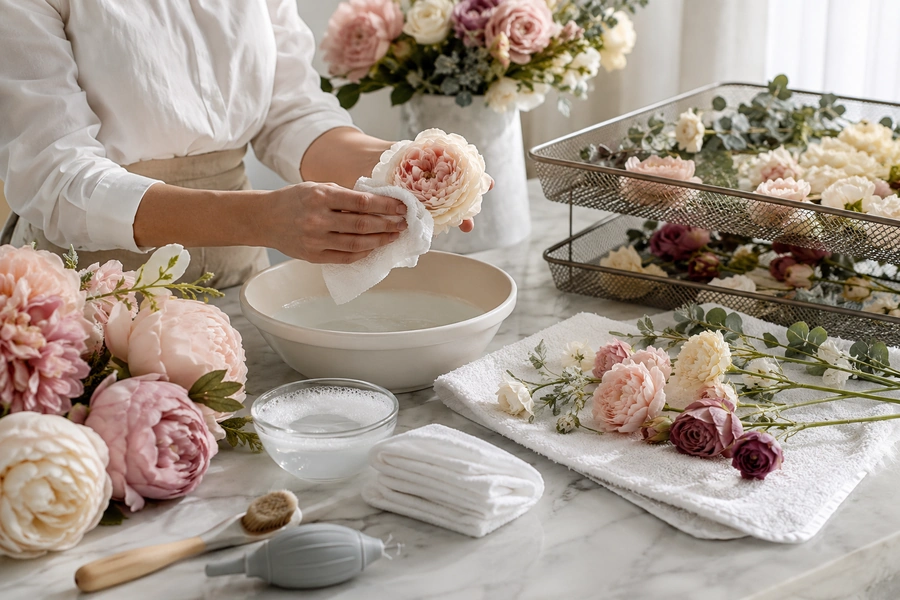
The safest cleaning method depends on the complete flower, not only the word “silk.” Many products marketed as silk flowers use polyester or other synthetic fabrics, while the leaves, stems, coatings, glue, wire, and decorative centers may use different materials. One cleaning solution may be safe for a molded leaf but harmful to the petal beside it.
Why Do Silk Flowers Fade During Cleaning?
Color loss rarely comes from one cause. Heat, moisture, cleaning chemicals, friction, and drying conditions can work together to change a flower’s appearance.
Silk flowers may fade when unstable dyes or printed pigments react with water, detergent, alcohol, vinegar, heat, or physical rubbing. Long soaking increases contact time, while direct sunlight can add UV exposure during drying. A flower can also appear faded when its surface coating becomes cloudy, glossy, stiff, or uneven.
Manufacturer care instructions vary because artificial flowers are made in different ways. Balsam Hill recommends a soft, dry cloth or fabric duster for its artificial florals and warns that chemical sprays or soapy water may damage some products or affect warranty coverage. Nearly Natural also emphasizes gentle dust removal and advises caution with immersion for synthetic silk-style flowers.
The Main Color-Fade Risks
| Cleaning Risk | Possible Result |
|---|---|
| Hot water | Distorted petals, softened glue, or color movement |
| Strong detergent | Surface-film removal or discoloration |
| Long soaking | Dye bleeding and water entering joints |
| Rubbing | Printed details and pigments wearing away |
| Bleach | Permanent lightening or yellowing |
| Alcohol or solvents | Coating damage and visible rings |
| Direct-sun drying | Uneven fading and heat-related distortion |
| Colored towels | Dye transfer to pale petals |
| Dirty wash water | Gray residue settling into fabric |
| Heavy spray coating | Gloss, stiffness, or patchy color |
Color stability can also vary within one arrangement. A dark rose may pass a damp-cloth test while a pale printed hydrangea in the same bouquet develops a water ring. Every major color and surface should therefore be tested separately.
Can You Wash Silk Flowers Without Ruining Them?
Some sturdy artificial flowers tolerate a brief cool-water rinse. Others should never be immersed, even when their petals appear to be made from washable fabric.
You can wash certain silk-style flowers when the manufacturer permits it and the complete product passes a colorfastness test. However, dry dusting or controlled spot cleaning is safer for most arrangements. Avoid washing flocked, glittered, foam, hand-painted, pre-lit, paper-wrapped, vintage, or fixed flowers unless their care instructions specifically allow water.
Nearly Natural currently gives different guidance across product and care pages: routine care focuses on brushes, cloths, and dust removal, while some product-category guidance permits a gentle cool-water rinse followed by air-drying. This variation confirms that buyers should follow the directions for the exact product rather than assume that every “silk flower” is washable.
Cleaning Method by Flower Type
| Flower Construction | Safest Starting Method | Deep-Cleaning Risk |
|---|---|---|
| Polyester fabric petals | Soft brush or cool air | Dye bleeding and creasing |
| Molded PE leaves | Microfiber cloth | Water entering wired joints |
| PU real-touch petals | Dry cleaning or approved cleaner | Stickiness and surface marks |
| Foam flowers | Gentle dry brushing | Deformation and water absorption |
| Velvet or flocked petals | Soft dry brush | Flattened texture |
| Glittered flowers | Very light air or brushing | Glitter and adhesive loss |
| Hand-painted petals | Hidden-area test and spot cleaning | Pigment transfer |
| Pre-lit arrangement | Dry cleaning only | Electrical damage |
| Fixed acrylic-water vase | Clean exposed areas only | Clouding and trapped moisture |
| Mixed dried and faux bouquet | Separate by material | Dried components breaking down |
When the material is unknown, I treat the product as moisture-sensitive. A dry brush may not remove every stain, but it is usually safer than discovering that the color is unstable after the entire arrangement has been washed.
What Are the 11 Proven Fixes for Cleaning Silk Flowers Without Color Fade?
The strongest method is a sequence of risk controls. Each fix removes one reason that silk flowers lose color, texture, or shape during cleaning.
The 11 fixes are to identify the materials, photograph the arrangement, remove dry dust first, test colorfastness, use white cleaning tools, start with plain cool water, spot-clean instead of soaking, use only approved mild products, separate colors and vulnerable components, blot and shade-dry, and clean frequently enough to avoid aggressive deep washing.
Fix 1: Identify Every Material Before Cleaning
“Silk flower” is a retail category, not a complete technical specification.
The petals may be polyester fabric. The leaves may be molded plastic. The stem may contain coated metal wire. The flower center may include foam, paper, flocking, printed details, or loose artificial pollen.
I check:
- The product label
- Original packaging
- Supplier specifications
- Online care instructions
- Material declarations
- Previous cleaning records
I then classify the flower as dry-clean only, moisture-limited, or washable.
Balsam Hill states that some of its faux florals use polyester fabric, while its care guide prioritizes dry cloths and dusters and advises against unapproved cleaning chemicals. This shows why material information and product-specific instructions should be considered together.
Stop Before Cleaning When You See:
- Exposed wire
- Loose glitter
- Cracked coating
- Peeling paint
- Weak adhesive
- Paper-wrapped stems
- Unstable flower heads
- Sticky real-touch surfaces
- Old or brittle fabric
- Unknown electrical components
A flower with existing damage may deteriorate even under a gentle cleaning process. Repair or replace the unstable component before introducing moisture.
Fix 2: Photograph and Disassemble the Arrangement
A large bouquet is easier to damage when it is cleaned as one heavy object. Flowers press against each other, stems twist, and water collects in the center.
I photograph valuable arrangements before removing any stems. I take images from the front, sides, and top so I can rebuild the original design later.
I then remove individual stems when the arrangement allows it. Each stem receives a small temporary label or is placed into a group based on:
- Flower type
- Color
- Height
- Position
- Cleaning method
Finished bouquets with wired handles or permanently wrapped stems may not be designed for disassembly. In those cases, I clean one visible section at a time and protect the handle, ribbon, foam, and base from moisture.
Afloral recommends beginning artificial-flower care by moving the arrangement to an outdoor or easy-to-clean area and gently removing surface dust. Its guidance also favors controlled tools such as a cloth, feather duster, cool hair dryer, or compressed air for detailed spaces.
Disassembly reduces contact between dark and light petals. It also allows me to keep water away from ribbons, labels, electrical parts, artificial moss, and heavy containers.
Fix 3: Remove Dry Dust Before Adding Moisture
Water and loose dust create a gray paste. That residue can settle into petal fibers, printed veins, flower centers, and glue lines.
I always dry-clean first.
Useful Dry-Cleaning Tools
- Clean makeup brush
- Soft artist’s paintbrush
- Microfiber cloth
- Fabric duster
- Cotton swab
- Cool hair dryer
- Hand-operated air blower
- Low-suction vacuum with a protected brush
Nearly Natural recommends paintbrushes and other gentle tools for removing dust from silk-style flowers and difficult spaces. Afloral also recommends a cool hair dryer or controlled compressed air for intricate areas.
My Dusting Sequence
- Hold the stem below the flower head.
- Brush the center first.
- Move outward toward the petal edges.
- Support broad leaves from behind.
- Wipe from the leaf base toward the tip.
- Clean the stem and lower branches.
- Remove debris from the planter separately.
I keep the brush moving in the natural direction of the petal. I do not scrub against fabric edges because that can create fraying.
Many flowers look significantly brighter after dry dusting alone. When the result is acceptable, I stop. Avoiding unnecessary moisture is one of the most effective ways to prevent fading.
Fix 4: Test Every Important Color for Colorfastness
A hidden-area test is more useful than a general statement that a flower is washable.
I prepare the exact cleaning method I intend to use. I then select an unseen section on the back of a lower petal or leaf.
Using a clean white cloth or cotton swab, I apply a small amount of moisture and press gently. I do not rub.
I inspect the white material for:
- Red, pink, blue, green, or yellow transfer
- Gray coating residue
- Glitter
- Printed pigment
- Sticky film
I also inspect the flower after it dries completely.
Jamali Garden recommends testing any cleaning product on an inconspicuous area before treating the complete silk flower because a solution may affect the color. This test-first approach is also consistent with manufacturer guidance that advises caution with moisture and cleaning products.
A Color Test Fails When:
- Color appears on the cloth
- The petal becomes lighter
- A dark edge spreads into a pale area
- Printed veins smear
- The surface becomes glossy
- The fabric becomes stiff
- The coating becomes sticky
- A visible ring appears after drying
- Glue turns white or cloudy
I test every strong color separately. A multicolor arrangement may contain petals made by different processes, even when all flowers came from the same supplier.
Fix 5: Use White Cloths, Towels, and Cleaning Tools
Colored cleaning materials create two problems. They may transfer dye to pale petals, and they make it harder to identify whether color is coming from the flower.
I use:
- White microfiber cloths
- White cotton swabs
- White absorbent towels
- A clean white basin where possible
- Clear or colorless soap when permitted
White artificial flowers need particular care. Ivory, cream, champagne, and blush petals can absorb color from dark towels, printed packaging, berries, ribbon, or other flowers when they are wet.
I clean pale flowers before dark ones. I also replace the water and cloth when they become dirty.
Keep These Items Separate
| Pale Flowers | Items That May Transfer Color |
|---|---|
| White roses | Red berries |
| Ivory orchids | Dark-green printed stems |
| Cream peonies | Burgundy petals |
| Blush hydrangeas | Colored tissue |
| Champagne magnolias | Glittered metallic picks |
This method does not guarantee that a pale flower will remain unchanged, but it removes an avoidable external source of discoloration.
Fix 6: Begin With Plain Cool Water
Stronger cleaning is not automatically better cleaning.
When moisture is permitted, I begin with a cloth lightly dampened with plain cool water. I wring the cloth until it is no longer dripping.
Balsam Hill’s artificial-plant care guidance recommends water on a damp cloth for certain stains and warns that harsh detergents may discolor foliage or remove adhesive. It also advises allowing damp-cleaned products to dry completely.
Why Cool Water Is Safer
Cool water reduces several risks:
- Heat-softened glue
- Distorted plastic
- Relaxed fabric shaping
- Increased dye movement
- Coating changes
- Stem warping
I avoid hot water even when the flower looks dirty. Heat can change the product before the cleaning solution has time to remove the stain.
For washable molded leaves, I wipe from the base to the tip. For fabric petals, I dab or press rather than drag the cloth across the surface.
Fix 7: Spot-Clean Instead of Soaking
A small stain does not justify immersing the whole bouquet.
Spot cleaning limits moisture to the affected area. It also keeps water away from internal wire, glue, foam, ribbon, and the flower center.
My Spot-Cleaning Method
- Place a dry white towel behind the stained petal.
- Dampen a cotton swab or white cloth with cool water.
- Press gently from the outside of the mark toward its center.
- Change to a clean section of cloth frequently.
- Blot with a dry towel immediately.
- Allow the area to dry before repeating.
I do not rub from the center outward because that can spread the stain.
Balsam Hill recommends soft dry care for artificial florals, while SilkFlorae’s current care guidance suggests using a slightly damp water-only cloth for stubborn dust. Both approaches support localized, low-moisture treatment before stronger cleaning.
Spot Cleaning Works Best For:
- Fingerprints
- Small water marks
- Light kitchen film
- One dusty petal edge
- Surface dirt on a molded leaf
- A minor mark on the stem
It works poorly when the entire flower is coated with sticky grease, smoke residue, or deeply embedded dirt. In those cases, replacement may be safer and less expensive than aggressive restoration.
Fix 8: Use Only an Approved Mild Cleaning Product
Plain water should remain the first choice. Soap or a commercial artificial-flower cleaner should be used only when the product instructions permit it and the hidden-area test succeeds.
When mild soap is allowed, I use a very small amount of colorless, fragrance-light dish soap in cool water. The solution should not create heavy foam.
I avoid:
- Bleach
- Ammonia
- Window cleaner
- Alcohol
- Acetone
- Strong degreaser
- Laundry detergent
- Fabric softener
- Baking soda paste
- Abrasive powder
- Unverified homemade spray
Manufacturer recommendations are not uniform. Balsam Hill warns against soapy water and chemical cleaning sprays for some floral products, while Jamali Garden describes damp-cloth cleaning and specialized artificial-flower cleaners after hidden-area testing. The exact product instructions should therefore override a universal recipe.
Can You Use Vinegar on Silk Flowers?
Vinegar is often suggested as a household cleaning solution, but it should not be the default choice for artificial flowers.
The petals may be synthetic, but the arrangement can still contain adhesive, paint, metal, coating, foam, and printed details. A diluted acidic solution may react differently with each component.
I use vinegar only when the flower manufacturer or supplier confirms compatibility with the exact product. Otherwise, I use dry cleaning, plain water, or an approved artificial-flower cleaner.
“Natural” does not mean universally material-safe.
Fix 9: Separate Colors and Protect Vulnerable Components
Dark flowers should not be cleaned in the same water as white, ivory, blush, or pale-blue flowers.
I also separate products by surface type. Glittered stems, flocked petals, real-touch coatings, molded leaves, and plain polyester flowers should not automatically receive the same treatment.
Protect These Components From Water
- Flower centers
- Artificial pollen
- Paper wrapping
- Ribbon handles
- Battery boxes
- Light strings
- Foam bases
- Decorative moss
- Unsealed wood
- Exposed wire
- Metal clips
- Vintage labels
For a fixed arrangement, I cover the vase opening or base with a clean waterproof barrier. I keep the flower angled so any moisture moves away from the stem opening.
I do not spray cleaning solution directly over the complete arrangement. Overspray can settle inside hidden joints and remain there after the visible petals appear dry.
Fix 10: Blot, Reshape, and Dry Completely in Shade
Drying can cause as much damage as cleaning.
Wet petals should not be stacked, squeezed, twisted, or placed back into a dense bouquet. They may dry with creases or transfer color to neighboring flowers.
I hold each flower downward briefly so excess moisture can leave. I then blot it with a clean white towel.
Reshaping Sequence
- Support the flower at its base.
- Separate petals that have stuck together.
- Open hydrangea branches individually.
- Bend wired leaves slowly.
- Turn flowers toward their original directions.
- Check buds and deep centers for trapped moisture.
- Keep neighboring blooms from touching.
I dry flowers in a ventilated, shaded area. I avoid direct sunlight, radiators, heated dryers, and hot hair dryers.
Balsam Hill recommends protecting artificial plants from heat, moisture, and direct sunlight and drying damp-cleaned foliage thoroughly before storage. Afloral recommends cool rather than hot airflow for delicate artificial and dried flowers.
Do Not Return Flowers to Storage Until They Are:
- Dry between the petals
- Dry around the stem connection
- Free from water marks
- Free from unusual odor
- Reshaped
- Stable at the glued joints
A flower that feels dry on the outer petal may still contain moisture in its center or stem opening.
Fix 11: Clean Lightly and Regularly
The best way to prevent cleaning-related color fade is to avoid letting the flowers become heavily soiled.
Routine dry dusting requires less pressure, less water, and fewer cleaning chemicals than restoring an arrangement that has collected grease and compacted dust for a year.
Balsam Hill recommends regular dusting of artificial florals with a soft cloth or duster. Its artificial-plant guidance suggests weekly or biweekly cleaning depending on the environment.
Suggested Cleaning Schedule
| Location | Dry Dusting | Deeper Inspection |
|---|---|---|
| Bedroom | Every two to four weeks | Every few months |
| Living room | Every two weeks | Seasonally |
| Office reception | Weekly | Monthly |
| Retail display | Weekly | Before major display changes |
| Kitchen | Weekly | Whenever grease appears |
| Restaurant | Weekly or more often | According to exposure |
| Covered outdoor area | Weekly inspection | After storms or dusty weather |
| Event inventory | Before and after each event | Before storage |
| Seasonal décor | Before packing and after unpacking | Once per display cycle |
A short regular routine protects the color better than repeated deep washing.
How Do You Clean Old or Heavily Dusty Silk Flowers?
Old flowers require more caution because fabric, glue, wire, coatings, and printed colors may have weakened over time.
Clean old silk flowers with dry methods first. Support every flower head, use a soft brush or cool airflow, and clean one small section at a time. Do not soak a vintage, sentimental, or brittle arrangement. When the flower has smoke residue, severe grease, mold-like marks, or unstable dye, professional conservation advice or replacement may be safer.
I inspect old flowers for:
- Brittle petals
- Cracked stems
- Rust
- Loose flower heads
- Yellowed adhesive
- Flaking paint
- Sticky coatings
- Musty odor
- Powdery residue
- Insect or storage damage
A flower may be emotionally valuable even when its retail value is low. Memorial arrangements, wedding bouquets, and family keepsakes should not be treated as ordinary washable décor.
For these products, I use a small clean makeup brush and work over a white towel. The towel catches loose components and helps me notice color or material falling from the arrangement.
How Do You Clean White Silk Flowers Without Yellowing?
White flowers reveal dust, glue, detergent film, hard-water marks, and color transfer more clearly than darker products.
Clean white silk flowers separately with white tools and plain cool water after a hidden-area test. Avoid bleach unless the manufacturer specifically approves it. Rinse or wipe away all permitted cleaning residue, and dry the flowers in shade. Existing UV yellowing or polymer aging may not be removable through cleaning.
White-Flower Protection Rules
- Clean the basin before use.
- Use a white cloth and towel.
- Wash pale flowers before dark flowers.
- Use fresh water.
- Keep colored ribbons and berries separate.
- Avoid bleach and optical brighteners.
- Check glue lines for yellowing.
- Keep drying flowers away from direct sun.
- Store only when fully dry.
A yellowed white petal may be dirty, but it may also have experienced permanent material change. Stronger chemicals can make the damage worse rather than restore the original color.
Can You Use Salt to Clean Silk Flowers?
The dry salt-bag method is often used to remove loose dust from sturdy fabric flowers. The grains move across the surface and help release particles without water.
Salt can work on sturdy, securely assembled silk-style flowers, but it is not safe for every product. Avoid it on real-touch coatings, flocking, velvet, glitter, artificial pollen, fragile petals, hand-painted surfaces, and old glue. Test one inexpensive stem before treating an important arrangement.
Several household-care guides describe placing suitable flower stems in a bag with salt and shaking gently. The method is abrasive, so it should be treated as an optional dry-cleaning technique rather than a universally safe fix.
I use a large bag, a small amount of clean dry salt, and only one or two stems at a time. I shake gently for a few seconds, remove the flowers, and use a soft brush to clear grains from the centers.
I do not use salt when the petals feel sticky or when decorative material falls during a gentle touch test.
My Insights: How to Clean Silk Flowers Without Color Fade—Which 11 Fixes Work
The safest silk-flower cleaning method does not begin with soap, vinegar, or a spray. It begins by deciding whether the flower needs moisture at all.
The 11 fixes that work best are material identification, arrangement documentation, dry dust removal, colorfastness testing, white cleaning tools, cool water, spot treatment, approved mild products, color separation, careful shade-drying, and regular maintenance. Together, these controls reduce color-fade risk without pretending that every silk flower is washable.
My main insight is that color preservation depends on cleaning in the correct order.
The 11-Fix System
| Fix | Main Action | Risk Reduced |
|---|---|---|
| 1 | Identify the materials | Using the wrong method |
| 2 | Photograph and separate stems | Shape loss and tangled handling |
| 3 | Remove dry dust first | Muddy residue |
| 4 | Test every major color | Dye bleeding |
| 5 | Use white tools | External color transfer |
| 6 | Start with cool plain water | Heat and chemical damage |
| 7 | Spot-clean instead of soaking | Excess moisture |
| 8 | Use approved mild products | Coating and adhesive damage |
| 9 | Separate colors and components | Cross-staining |
| 10 | Blot and shade-dry | Water marks and distortion |
| 11 | Maintain flowers regularly | Need for aggressive cleaning |
The Least Aggressive Method Should Win
I use a cleaning ladder:
- Soft dry brush
- Microfiber cloth
- Cool low-pressure air
- Slightly damp white cloth
- Controlled spot cleaning
- Approved mild cleaner
- Brief rinse only when permitted
I stop as soon as the flower looks clean.
This method protects artificial flowers from unnecessary contact with water and chemicals. It also reduces staff time for drying and reshaping.
Define a Successful Cleaning Result
A flower is not successfully cleaned merely because the dust is gone.
After cleaning, it should have:
- Its original color
- Its original surface texture
- No water rings
- No soap residue
- Secure petals and leaves
- A stable flower head
- No exposed wire
- No unusual odor
- A recoverable natural shape
When a stain cannot be removed without changing one of these features, replacement may be the better professional decision.
Create a Care Record for Retail and Event Inventory
Retailers, florists, hotels, and wedding planners should record which method was tested for each product family.
The record can include:
- Product code
- Petal material
- Approved cleaning method
- Prohibited cleaning products
- Test result
- Drying time
- Reshaping instructions
- Last cleaning date
- Condition grade
This prevents another staff member from repeating a method that previously caused a color change.
My Final Cleaning Rule
I never assume that a flower is safe to wash because it is artificial.
The safest order is:
Dry first. Test second. Use minimal moisture third. Dry completely before display or storage.
This approach will not restore every old or faded flower, but it gives cleanable artificial flowers the best chance of keeping their original color, texture, and form.
Conclusion
Dust first, test every color, use white tools and cool minimal water, avoid soaking and strong chemicals, then reshape and dry fully in shade to protect silk flowers from fading.