
Silk flowers can survive years of reuse, but one overcrowded box may leave premium petals creased, dusty, tangled, and unsuitable for close-up displays.
To store silk flowers without crushing them, clean and dry every stem, support flower heads with unbuffered acid-free tissue, and use rigid containers with controlled empty space. Reduce static by limiting friction, separating synthetic materials, maintaining stable moderate humidity, and avoiding unnecessary repacking. Store bouquets upright and long décor in wide, supported curves.
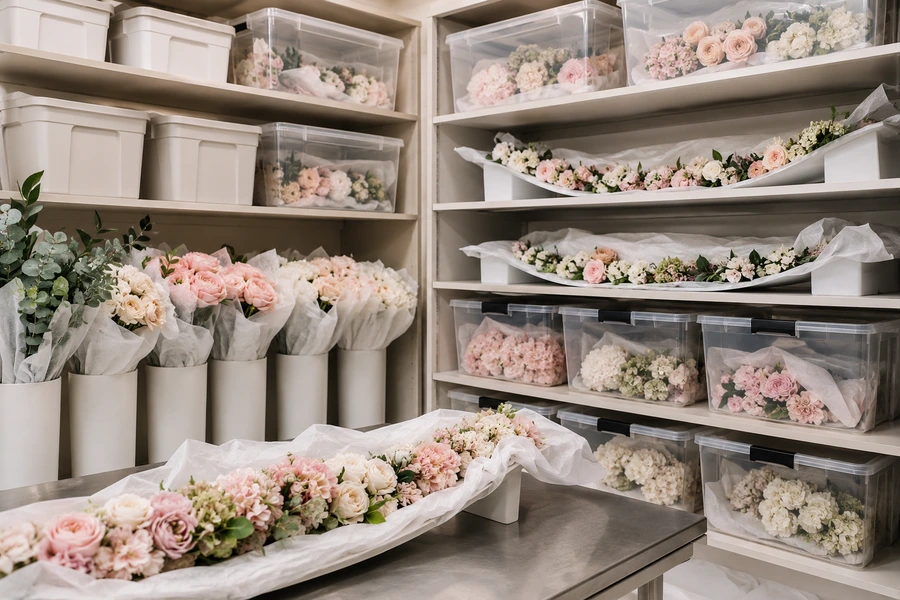
“Silk flowers” commonly include polyester fabric, plastic leaves, coated stems, wire, foam, and adhesive. Their storage system must protect every component rather than treating the arrangement as one washable, flexible textile.
Why Do Silk Flowers Get Crushed in Storage?
Most storage damage does not happen because the flowers are fragile. It happens because their petals are expected to support boxes, neighboring stems, or the weight of an entire arrangement.
Silk flowers become crushed when containers are overfilled, blooms are stacked without support, long stems are forced into short boxes, and heavy products rest on delicate petals. Static and friction can also make synthetic petals attract dust, cling together, and resist clean separation when the arrangement is unpacked.
The EOS/ESD Association explains that synthetic fabrics can generate electrostatic charge, particularly in dry environments. Applying that principle to synthetic silk-style flowers, repeated rubbing between polyester petals, plastic sleeves, and storage bins can encourage static cling. This is a practical materials inference rather than evidence that artificial flowers require electronics-grade ESD protection.
The Four Main Storage Failures
| Storage Failure | Visible Result | Better Control |
|---|---|---|
| External pressure | Flattened petals and broken centers | Rigid outer container |
| Internal movement | Scratches, tangles, and loose heads | Dividers and soft supports |
| Poor environment | Odor, fading, mould, or brittle parts | Cool, dry, stable storage |
| Excess handling | Static, dust, bent stems, and lost pieces | Clear labels and fixed locations |
A large container is not automatically safer. Too much empty space allows flowers to slide and collide. Too little space presses the lid or neighboring blooms directly against the petals.
The correct container protects the flower while preventing uncontrolled movement.
What Is the Best Environment for Storing Silk Flowers?
Attics, damp basements, exterior sheds, and delivery vehicles are convenient but unstable. Temperatures and humidity can change rapidly, while light and dust remain difficult to control.
Store silk flowers in a clean, cool, dark, and dry interior area with stable temperature and humidity. Avoid direct sunlight, heating equipment, roof leaks, exterior walls, strong fragrances, and locations where containers sit directly on the floor. Moderate stable humidity is better than extremely dry or damp storage.
Smithsonian guidance for textile storage recommends clean, cool, dry, dark conditions without major temperature or humidity changes. It identifies approximately 40% to 50% relative humidity as ideal for valuable textile storage, while also advising against airtight plastic packaging that may trap condensation.
Artificial flowers are not museum textiles, so they do not always require museum-level environmental control. However, the same general risks apply to fabric petals, painted surfaces, adhesives, wire, and decorative attachments.
The Canadian Conservation Institute notes that warm temperatures, poor air circulation, and relative humidity between 65% and 100% promote mould growth. It also warns that mould can grow on soiled synthetic fibres such as polyester.
A Practical Storage Target
For professional artificial-flower inventory, I aim for:
- Stable indoor temperature
- Moderate relative humidity, commonly around 40% to 55%
- No direct sunlight
- No visible condensation
- Clean air circulation
- Shelving above floor level
- Enough access for inspection
This is a practical operating range, not a universal material specification. The supplier’s care instructions and the building’s climate-control limits still apply.
Extremely dry conditions may increase static, while excessive moisture raises the risks of odour, mould, corrosion, and adhesive deterioration. I do not humidify a warehouse solely to solve minor static problems without monitoring the wider storage environment.
What Are the 12 Best Anti-Static Space Savers?
The best space-saving system reduces container volume without allowing flowers to touch, rub, or carry weight unnecessarily.
The 12 strongest methods are clean-storage preparation, material separation, shallow rigid boxes, tissue cradles, vertical stem cells, modular drawers, supported bouquet boxes, breathable hanging covers, wide-core garland rolls, flat wreath cases, modular installation crates, and a low-friction labelled shelving system with stable humidity.
Quick Comparison
| No. | Storage Method | Best For | Main Benefit |
|---|---|---|---|
| 1 | Clean-and-dry intake station | All inventory | Prevents trapped dirt and moisture |
| 2 | Material and colour separation | Mixed collections | Reduces rubbing and colour transfer |
| 3 | Shallow rigid boxes | Loose flower heads and short stems | Stops stacking pressure |
| 4 | Acid-free tissue cradles | Peonies, roses, hydrangeas | Supports petals without tight wrapping |
| 5 | Vertical stem cells | Long roses, orchids, branches | Uses height instead of floor area |
| 6 | Modular drawer trays | Small stems, picks, corsages | Fast access with little movement |
| 7 | Upright bouquet boxes | Finished wedding bouquets | Preserves designed shape |
| 8 | Breathable hanging covers | Light garlands and vines | Uses wall or rail space |
| 9 | Wide-core rolled storage | Long garlands and greenery | Prevents sharp folds |
| 10 | Flat wreath cases | Wreaths and circular pieces | Supports the structural frame |
| 11 | Modular installation crates | Arch and centerpiece sections | Prevents rebuilding and crushing |
| 12 | Labelled low-friction shelving | Retail and rental fleets | Reduces handling and static-generating friction |
Space Saver 1: Clean and Dry Every Flower Before Packing
Dust should not be sealed inside the storage system. Movement during handling can push loose particles deeper into flower centres and fabric texture.
Clean silk flowers with a soft brush, microfiber cloth, or cool low-pressure air before storage. Inspect them for moisture, loose petals, stains, damaged wire, and unstable glue. Do not pack flowers until every stem, petal, container, ribbon, and support is completely dry.
I establish four intake zones:
- Returned and uninspected
- Cleaning required
- Repair or reshaping required
- Clean and ready for storage
Event flowers never move directly from a vehicle into long-term storage. Outdoor arrangements may contain dust, moisture, food residue, pollen, insects, or loose decorative material.
Moisture is particularly easy to miss inside:
- Hydrangea clusters
- Orchid centres
- Layered peonies
- Ribbon-wrapped bouquet handles
- Foam inserts
- Stem sleeves
- Artificial moss
- Planter bases
Packing a slightly damp arrangement into a closed bin can create odour and condensation even when the outer petals feel dry.
I also grade the flowers during intake:
| Grade | Suitable Use |
|---|---|
| A | Bridal bouquets, counters, and close-up retail |
| B | Centerpieces and normal viewing distances |
| C | Elevated arches, walls, and background installations |
| Repair | Must be cleaned, reshaped, or reattached |
| Retire | Permanently faded, crushed, brittle, or unsafe |
This prevents damaged products from consuming premium storage space.
Space Saver 2: Separate Flowers by Material, Colour, and Shape
A rigid plastic branch should not be stored against a soft real-touch rose. Dark berries and printed leaves should not rub against ivory petals.
Separate silk flowers by material, colour family, stem length, flower-head size, and surface finish. Keep pale petals away from dark products, glitter, flocking, freshly coated items, and strongly scented materials. Bundle compatible stems loosely so they do not tangle during retrieval.
Synthetic materials may develop charge through contact and separation. Reducing unnecessary rubbing between different plastics and fabrics can therefore reduce both static cling and surface abrasion.
My minimum separation groups are:
- White and ivory
- Pale pastels
- Deep or saturated colours
- Glittered products
- Flocked and velvet products
- Real-touch or coated flowers
- Molded plastic greenery
- Fine trailing vines
- Long wired branches
- Finished arrangements
I use soft reusable stem ties around the lower stems. The ties hold each product group together without compressing the flower heads.
I avoid rubber bands. They can tighten over time, mark coatings, or break and become tangled inside the bin.
Separation also improves inventory density. Staff can retrieve one complete rose bundle without pulling it through grasses, vines, and rigid branches.
Space Saver 3: Use Shallow Rigid Stackable Boxes
Deep boxes encourage vertical piles. The lower flowers then carry the weight of every layer above them.
Use shallow, rigid, correctly sized boxes for loose blooms and short silk stems. The container—not the flowers—should carry stacking loads. Add fixed trays or dividers when more than one layer is necessary, and leave clearance between the highest petal and the lid.
Flat storage is recommended for many delicate textiles because it supports the entire object rather than asking weakened materials to carry their own weight. The Canadian Conservation Institute applies this principle to textile collections, and it is equally useful for delicate flower heads and fabric petals.
Best Box Features
- Rigid sides
- Secure lid
- Smooth interior
- No sharp staples
- Correct internal dimensions
- Flat base
- Stack limit
- External label
- Handles that do not push inward
I arrange flower heads in one direction. I offset each bloom so large heads do not sit directly above one another.
When several layers are unavoidable, I use rigid removable trays. I do not place one sheet of tissue over the first layer and then allow the next group of stems to rest on it. Tissue prevents rubbing, but it does not carry structural weight.
Shallow boxes use more shelf width but reduce repair labour and damaged stock.
Space Saver 4: Build Acid-Free Tissue Cradles
Tissue should support the flower’s natural shape. It should not wrap the petals tightly or force the bloom into a smaller volume.
Use neutral-pH, unbuffered acid-free tissue to form loose rings, nests, and separators around delicate silk flowers. Place support beneath the outer petals and beside the bloom to prevent rolling. Replace tissue that becomes wet, dirty, crushed, or chemically affected.
The Smithsonian Museum Conservation Institute recommends neutral-pH, unbuffered acid-free tissue for general textile and costume storage. The material can be shaped to support three-dimensional forms and reduce contact between delicate surfaces.
The National Archives similarly recommends using unbuffered acid-free tissue to support shapes and soften folds so permanent creases do not develop.
How I Make a Flower Cradle
- Place a loose tissue ring below the flower head.
- Add a small side support so the bloom cannot roll.
- Separate dark flowers from pale flowers.
- Keep tissue away from sticky coatings.
- Leave the upper petals free from pressure.
- Mark the box as delicate or top-load only.
I do not use ordinary printed tissue, newspaper, or coloured gift tissue around premium white flowers. Dyes, acids, inks, and surface coatings may transfer during long storage.
Bubble wrap may be useful around a rigid outer container, but I do not press plastic bubbles directly against delicate petals for long periods. The pattern can mark soft coatings and trap moisture when flowers are not fully dry.
Space Saver 5: Store Long Stems in Vertical Cells
Tall roses, delphiniums, blossom branches, and orchids waste space when each bundle lies across a full shelf.
Store strong long stems upright in tall divided bins, florist buckets, tubes, or custom rack cells. Each cell should support the lower stem while leaving the flower head free. Use horizontal storage instead when blooms are heavy, branches are broad, or the stems cannot support their own weight.
Vertical storage works well for active retail and event studios because staff can see the flower types without opening boxes.
I divide cells by:
- Product code
- Colour
- Length
- Flower type
- Event collection
- Condition grade
The container must be taller than the stem section it supports. A short bin can force the flower head against a shelf or cover.
Anti-Static Benefit
Vertical cells reduce petal-to-petal contact and repeated sliding. Flowers are lifted from the stem area instead of dragged through a crowded horizontal pile.
Space-Saving Benefit
A narrow floor area can hold many stem groups when the storage system uses the room’s vertical height.
I keep the heaviest flower heads in the most stable cells. Large branches may require wall-supported tubes or horizontal racks so they do not overturn the container.
Space Saver 6: Use Modular Drawer Trays for Small Pieces
Corsages, boutonnieres, flower heads, picks, buds, berries, and short fillers are easily lost inside large bins.
Store small floral components in shallow drawers with removable dividers. Give each section enough space for the product to lie without compression, and use smooth acid-free tissue or compatible liners where delicate fabric touches the tray.
Drawer storage saves space because several thin levels occupy one cabinet footprint.
It works well for:
- Loose rose heads
- Small orchids
- Boutonnieres
- Corsages
- Hair flowers
- Cake flowers
- Floral pins
- Repair components
- Spare leaves
- Short filler sprays
I avoid allowing small plastic components to move freely inside hard compartments. The repeated contact creates scratches, noise, and static-generating friction.
Each drawer receives an external photograph and inventory list. Staff should not open every drawer to locate one champagne ranunculus.
I also avoid overfilling. A drawer that closes only after the contents are pressed down is not a storage system; it is a compression device.
Space Saver 7: Store Finished Bouquets Upright
A finished bouquet contains an intentional shape. Laying it on its side transfers the arrangement’s weight to the outer flowers.
Store finished silk bouquets upright in rigid bouquet boxes with handle supports. The support should hold the stem bundle or handle while leaving open space around the flower heads. Cover the box against dust without allowing the lid or cover to touch the tallest bloom.
I use a rigid insert with openings sized for the bouquet handles. Each opening prevents the bouquet from falling into its neighbour.
A bouquet box should record:
- Collection or event number
- Bouquet role
- Colour palette
- Stem count
- Photograph
- Handle finish
- Condition
- Storage date
Bridal bouquets, bridesmaid bouquets, and toss bouquets may look similar while containing different flowers and ribbon treatments. Clear identification prevents unnecessary handling.
For sentimental wedding bouquets, I also place a loose tissue cradle around vulnerable outer flowers. I do not tightly wrap the complete bouquet because compressed tissue can gradually change its silhouette.
Space Saver 8: Hang Lightweight Garlands in Breathable Covers
Wall and rail space can store lightweight vines and garlands without using shelves. Hanging also prevents sharp folds.
Hang lightweight garlands from wide padded supports at several points, then cover them with a clean breathable cotton or archival-quality dust cover. Do not suspend the entire garland from one narrow hook, and do not use thin dry-cleaner bags as permanent storage.
Canadian Conservation Institute guidance warns against ordinary plastic dry-cleaner garment bags because they provide poor air circulation, do not protect from light, and may use unsuitable plastic.
A breathable cover protects the garland from dust without pressing directly against its flowers.
Suitable Hanging Products
- Lightweight ivy
- Pothos vines
- Wisteria
- Jasmine-style garlands
- Leaf garlands
- Narrow floral swags
- Fabric backdrops with attached flowers
Heavy wreaths, thick floral runners, and wired arch sections should not hang from their petals or vines. Their frames need rigid support.
I install several padded support points so the garland’s own weight does not distort one section. The label hangs outside the cover, where staff can read it without opening the package.
Space Saver 9: Coil Long Garlands Around Wide Cores
Some garlands are too heavy or long to hang efficiently. Folding them into a small box creates sharp bends that may remain visible during the next installation.
Coil long garlands in broad curves around a large acid-free or compatible inert core. Support the flowers with tissue between layers, secure the coil with soft ties, and place the complete roll in a rigid box or suspended rack. Never form tight loops simply to fit a smaller container.
The National Archives recommends wide, supported rolling for large flexible textiles because tight folds can create permanent creases.
For artificial garlands, I use the same general principle:
- Large curve
- Few layers
- No sharp bends
- No heavy product resting on flowers
- Soft ties around the structural vine
- Rigid protection outside the roll
I attach ties to the central garland structure rather than around flower heads.
This method works for:
- Table garlands
- Long greenery runners
- Floral ceiling vines
- Staircase garlands
- Mantel greenery
- Flexible wall foliage
Wide-core storage uses depth efficiently and allows several labelled rolls to sit on a suspended rack.
Space Saver 10: Store Wreaths Flat in Rigid Cases
Wreaths should be supported by their structural rings, not their front flowers.
Store silk-flower wreaths flat in rigid shallow cases or vertically on padded frame supports. Prevent the decorated surfaces from touching each other, and use internal blocks that hold the wreath frame in place without pressing the petals.
Flat storage supports the complete object and reduces the stress created by hanging heavy or fragile decorative materials. Conservation guidance generally recommends flat support for weak, decorated, or structurally vulnerable textile objects.
I do not stack several wreaths directly on one another. If a case contains multiple levels, each wreath receives a rigid tray.
Accessories such as ribbons, signs, hanging loops, and detachable ornaments go into a labelled inner pouch. They should not float across the floral surface during transport.
For vertical storage, the hook must support the wreath frame. It should never pull on an artificial vine, ribbon, or flower cluster.
Space Saver 11: Use Modular Crates for Centerpieces and Arch Sections
Large artificial-flower installations consume space because their finished shapes are irregular. Disassembling every design saves volume but increases rebuilding labour and variation.
Divide centerpieces, arches, flower walls, and aisle arrangements into planned modules. Store each module in a fitted rigid crate or rolling cart that supports its frame. Label every section by position and include a setup photograph so installers do not repeatedly bend pieces while identifying them.
I label arch modules as:
- Lower left
- Upper left
- Centre
- Upper right
- Lower right
- Ground section 1–6
Centerpieces may be separated into:
- Vessel
- Floral insert
- Candle or accessory set
- Spare flowers
The crate should support the metal, wood, grid, or rigid foam base. No crate wall should rest against the visible flower surface.
Modular storage saves labour as well as space. Several compatible arch modules can share one rolling cart when rigid dividers carry the load.
Space Saver 12: Use a Low-Friction Labelled Shelving System
The best anti-static storage container still fails when staff must drag it across shelves, unpack it repeatedly, or move six unrelated boxes to reach it.
Assign every product a permanent shelf location, place frequently used inventory between waist and shoulder height, and use smooth trays or carts for movement. Clear labels, photographs, barcodes, and location maps reduce unnecessary rubbing, opening, and repacking—the main activities that generate static and handling damage.
My shelf labels include:
- Product code
- Flower type
- Colour
- Quantity
- Condition
- Container weight
- Handling rule
- Shelf address
- Photograph
I create separate zones for:
- Clean available stock
- Reserved inventory
- Returned stock
- Repair stock
- Quarantined products
- Retired products
Static-Control Practices
I also:
- Avoid dragging synthetic bags across one another
- Lift bins instead of sliding them
- Use smooth, clean work surfaces
- Keep polyester petals away from rough plastic
- Avoid extremely dry storage
- Dust shelves regularly
- Use approved static-dissipative tools only when necessary
- Avoid untested anti-static sprays on flowers
Electronics-grade anti-static bags and liners are designed for ESD-sensitive equipment. Their use does not automatically prove chemical or archival compatibility with silk flowers. I would use a specialist liner only when its manufacturer confirms compatibility with the flower material and planned storage period.
Can You Store Silk Flowers in Plastic Bags?
A plastic bag protects against dust but cannot protect a flower against pressure. It may also trap moisture or create friction around synthetic petals.
Plastic bags are suitable only as loose dust covers around completely dry, structurally supported flowers. Do not vacuum-seal silk flowers, compress them into small bags, or depend on a thin bag for stack protection. For long storage, use a rigid outer box and a breathable or material-compatible inner cover.
Smithsonian guidance advises against sealing valuable textiles in airtight plastic because condensation may develop when conditions change.
I avoid:
- Vacuum bags
- Scented bin liners
- Thin dry-cleaner bags
- Reused food bags
- Plastic that feels sticky
- Bags pressing against flower heads
- Airtight storage of recently cleaned items
Vacuum bags are particularly damaging because their function is to remove air and compress the contents. That is useful for some bedding but directly conflicts with no-crush flower storage.
Should Silk Flowers Be Stored Airtight?
An airtight tote keeps outside dust away, but it also keeps internal moisture, residue, and odour inside.
Use a sealed tote only when the flowers, tissue, container, and supports are completely clean and dry and the storage environment is stable. Airtight storage is not a substitute for moisture control. Inspect sealed containers periodically for condensation, odour, sticky coatings, rust, and colour transfer.
For frequently accessed commercial inventory, a lidded rigid tote can work well because it protects flowers from dust and accidental contact.
I add no desiccant automatically. A desiccant packet cannot correct a damp room, wet flowers, or a leaking container. It may also make a small sealed space excessively dry when used without monitoring.
How Much Space Should You Leave Around Silk Flowers?
Leaving too much clearance allows movement. Leaving too little causes compression.
Leave enough space so the lid, divider, and neighbouring flowers do not contact the visible petals during normal handling. Use tissue supports or rigid dividers to limit movement rather than filling every empty space with loose packing material.
My no-crush rule is simple:
Support the stem, frame, handle, tray, or empty space around the bloom. Never ask the petals to carry storage weight.
A box passes the fit test when:
- The lid closes without pressure
- The flowers do not slide across the box
- Petals do not touch hard dividers
- The lower layer carries no upper weight
- Staff can remove one item without pulling others
- The container remains stable on the shelf
My Insights: How to Store Silk Flowers Without Crushing—Which 12 Anti-Static Space Savers Work Best
The strongest storage system does not force the most flowers into the smallest box. It reduces the total space, labour, dust, reshaping, and replacement required across the inventory’s complete life.
The 12 best anti-static space savers combine clean intake, material separation, rigid containers, tissue support, vertical cells, modular drawers, bouquet holders, breathable hanging covers, wide-core rolls, flat wreath cases, installation crates, and labelled low-friction shelving. Together, they prevent crushing while reducing static-producing handling and wasted warehouse space.
My central insight is that anti-static storage is mainly a friction-control system.
Static Is Usually a Handling Problem
Synthetic silk-style flowers can gain charge when surfaces contact, rub, and separate, particularly in dry conditions.
The practical controls are therefore:
- Reduce rubbing
- Reduce repeated opening
- Separate incompatible materials
- Keep shelves clean
- Use fixed product locations
- Maintain stable moderate humidity
- Avoid dragging bags and bins
- Avoid applying untested chemical sprays
The goal is not electronics-grade ESD control. It is less dust attraction, less petal cling, and easier unpacking.
The Best System for Loose Stems
For loose roses, tulips, peonies, and small fillers, I use:
- Material and colour groups
- Loose lower-stem ties
- Shallow rigid boxes
- Acid-free tissue cradles
- Removable trays
- External photographic labels
The Best System for Long Stems
For delphiniums, branches, orchids, and tall roses, I use vertical divided cells when the stems are strong.
I use horizontal supported racks when the flower heads are heavy or the branches are broad.
The Best System for Wedding Bouquets
For finished bouquets, I use a rigid upright box with a handle insert, loose outer-flower supports, a photograph, and enough overhead clearance.
The bouquet should not rest on its flowers.
The Best System for Retailers and Planners
Retail and rental fleets need:
- Permanent shelf addresses
- Digital quantities
- Return-inspection zones
- Condition grades
- Repair records
- Setup photographs
- Controlled containers
- Scheduled audits
The system should let a new staff member find and remove one flower collection without opening every bin in the warehouse.
The Final 12-Method Decision Guide
| Main Storage Problem | Best Method |
|---|---|
| Dust and moisture entering storage | Clean-and-dry intake |
| Pale petals becoming marked | Material and colour separation |
| Lower blooms becoming flattened | Shallow rigid boxes |
| Delicate petals losing shape | Acid-free tissue cradles |
| Long stems using too much shelf area | Vertical stem cells |
| Small accessories becoming lost | Modular drawer trays |
| Bouquets leaning or collapsing | Upright bouquet boxes |
| Lightweight garlands occupying shelves | Breathable hanging covers |
| Long runners developing sharp folds | Wide-core rolled storage |
| Wreath fronts being compressed | Flat rigid cases |
| Installations needing repeated rebuilding | Modular crates |
| Excess handling and static | Labelled low-friction shelving |
My Final Storage Rule
No flower head should touch a lid, shelf, divider, neighbouring container, or heavy arrangement.
Once that rule is combined with moderate stable humidity, acid-free support, reduced friction, clear labels, and correct storage orientation, silk flowers remain usable with much less reshaping.
Space saving should come from better vertical planning, modular containers, fixed locations, and separated product formats—not from compressing the petals.
Conclusion
Clean and dry every flower, support blooms with acid-free tissue, use rigid modular storage, limit friction, maintain stable humidity, and never allow petals to carry weight.