
Artificial flowers quickly reveal themselves when petals shine, colors repeat, or stiff stems force every bloom to face the same direction.
The most realistic modern artificial flowers include real-touch tulips, garden roses, peonies, ranunculus, orchids, hydrangeas, magnolias, dahlias, anemones, poppies, sweet peas, hellebores, cosmos, delphiniums, calla lilies, cherry blossoms, and wisteria. Premium materials, natural imperfections, flexible stems, and restrained styling make these flowers convincing at normal viewing distances.
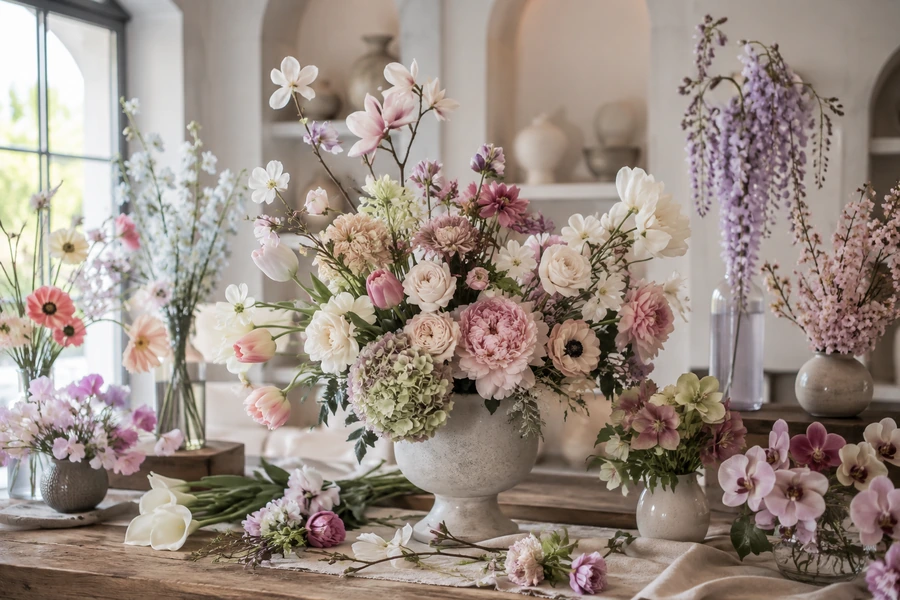
No artificial flower is guaranteed to fool every buyer during close inspection. Touch, scent, repeated molds, exposed wire, and visible glue can reveal even an expensive stem. The goal is to remove enough artificial clues that viewers notice the arrangement before questioning the material.
What Makes Modern Artificial Flowers Look Real?
Older artificial flowers often depended on bright fabric, flat printing, and rigid plastic. Modern designs create realism through layered construction, controlled texture, natural color variation, and adjustable movement.
Realistic artificial flowers have matte or softly reflective petals, detailed centers, varied bloom stages, flexible wired stems, believable leaves, and more than one shade within each flower. Slight asymmetry and minor irregularities improve authenticity because fresh flowers are never perfectly identical.
Better Homes & Gardens reported in 2025 that modern faux flowers had improved significantly in appearance and texture. Its expert guidance recommended realistic tones, dimensional petals, slight imperfections, varied greens, and stems with enough flexibility to create natural movement.
House Beautiful similarly advised buyers to look for texture, organic flow, and natural color variation while avoiding foliage that is excessively glossy or perfectly symmetrical.
The Realism Checklist
| Detail | Realistic Version | Obvious Faux Version |
|---|---|---|
| Petal color | Several related tones | One flat color |
| Surface | Matte or naturally soft | Uniform plastic shine |
| Flower center | Layered and detailed | Visible molded disk |
| Bloom stage | Buds, opening blooms, mature flowers | Every flower fully open |
| Stem | Bendable with a gradual curve | Straight and rigid |
| Leaves | Varied size and direction | Identical leaves in a row |
| Edges | Soft variation and slight irregularity | Perfect repeated outlines |
| Calyx | Correct scale and color | Thick bright-green plastic |
| Construction | Hidden attachment points | Exposed glue, seams, or wire |
Balsam Hill’s current buyer guidance also emphasizes accurate color, visible veins, realistic edges, and flower shapes that resemble their living counterparts. It recommends examining products under different lighting conditions because strong light can expose unnatural shine or color.
Modern Does Not Mean Perfect
A modern artificial flower should not look manufactured to mathematical precision.
Useful imperfections include:
- A slightly bent petal
- Two nearby shades
- An off-center flower head
- A partially open bud
- A leaf turned toward the back
- Uneven branch spacing
- A soft curve beneath a heavy bloom
Unhelpful defects include:
- Frayed fabric
- Large glue marks
- Exposed wire
- Peeling coating
- Crushed flower centers
- Identical printed stains
- Loose petals
The best products create controlled irregularity. They imitate natural growth without appearing damaged.
Which Modern Artificial Flowers Look the Most Real?
Some flowers translate into artificial materials more successfully than others. Naturally smooth, waxy, layered, or sculptural flowers are often easier to reproduce convincingly.
Tulips, orchids, calla lilies, garden roses, peonies, ranunculus, and magnolias are among the strongest close-view choices. Hydrangeas, dahlias, delphiniums, blossoms, and wisteria provide convincing volume or movement when their small branches are opened carefully and repeated mold patterns remain hidden.
The following 17 stems are my strongest shortlist for homes, weddings, hotels, retail displays, offices, events, and commercial interiors.
1. Real-Touch Tulip—Best Overall Realistic Stem
Tulips are among the most convincing modern artificial flowers because their living petals already have a smooth, softly waxed appearance.
A good real-touch tulip can imitate:
- Slightly translucent petals
- Thick green leaves
- A curved stem
- A closed or partially open flower
- The natural weight of a tulip head
The strongest products do not stand completely upright. Fresh tulips bend and change direction in a vase, so artificial tulips look more believable when their wired stems form relaxed curves.
I choose tulips in:
- Cream
- Soft white
- Blush
- Muted yellow
- Dusty pink
- Deep plum
- Controlled red
Bright artificial colors can expose the material more quickly. A slightly muted finish usually feels more botanical.
I use five, seven, or nine tulips in a simple vessel rather than mixing them with many unrelated flowers. Their recognizable silhouette benefits from restraint.
Avoid tulips with extremely thin leaves, visible seams, hard plastic petals, or identical flower-head angles. Turn some blooms outward and allow others to lean across the vase rim.
2. Garden Rose—Best Timeless Artificial Flower
Garden roses remain one of the most flexible artificial stems because layered petals hide internal construction and suit nearly every décor style.
A convincing garden rose should include:
- A dense but irregular center
- Soft outer petals
- Several bloom sizes
- Natural petal curling
- A correctly sized calyx
- Matte leaves
- A flexible wired stem
I avoid roses with a perfect spiral center. Living garden roses usually contain visual variation, shadow, and different petal directions.
Color is critical. A realistic blush rose may include ivory near the center, pale peach through the middle, and dusty pink around the outer petals.
Garden roses work well in:
- Wedding bouquets
- Dining arrangements
- Hotel rooms
- Reception displays
- Retail counters
- Memorial flowers
- Neutral interiors
The rose is also familiar enough that buyers notice mistakes quickly. Strong shine, thick fabric edges, or an unnatural blue-white color can make a premium arrangement look inexpensive.
Use buds and medium blooms around the largest roses. This creates a believable flower life cycle rather than a collection in which every rose has opened at the same moment.
3. Faux Peony—Best for Soft Luxury
Peonies create immediate volume through their large layered flower heads. Their many petals conceal stems, glue points, and molded centers more effectively than simple flowers.
Modern artificial peonies work best when they have:
- Soft fabric or real-touch petals
- Several petal sizes
- A slightly relaxed outer edge
- A partially hidden center
- Natural color shading
- A sturdy wired stem
Balsam Hill currently identifies polyester as one of the materials capable of producing realistic dahlias, tulips, and peonies. Its material guidance also notes that delicate silk-style petals are best protected from harsh conditions.
I use peonies as focal flowers rather than filling an entire vase with identical large heads.
A medium arrangement might contain:
- Three open peonies
- Two peony buds
- Several garden roses
- One loose branch
- A small amount of foliage
Artificial peonies look less realistic when their heads form one dense round surface. Leave gaps between the flowers and turn one bloom partly away from the main viewing position.
Cream, blush, coral, pale pink, and muted burgundy generally produce the strongest results.
4. Faux Ranunculus—Best Small Layered Bloom
Ranunculus has dozens of tightly layered petals, making it well suited to detailed artificial production.
Its compact head works in:
- Bridal bouquets
- Bud vases
- Spring centerpieces
- Small retail displays
- Mixed garden arrangements
- Table flowers
A realistic ranunculus should not look like a perfect flat disk. I select flowers with a slightly raised center, uneven outer petals, and more than one bloom stage.
The most convincing colors include:
- Butter yellow
- Cream
- Soft peach
- Blush
- Pale green
- Dusty rose
- Muted orange
Ranunculus stems are naturally slim, so thick artificial stalks can reveal the construction. The stem should remain flexible enough to bend without allowing the flower head to fall.
I mix ranunculus with garden roses, sweet peas, tulips, and small fillers. Its layered form connects large focal flowers with delicate movement stems.
For a modern single-flower arrangement, I group seven ranunculus stems at different heights. I keep the vase opening narrow enough to control their positions without crowding the blooms.
5. Phalaenopsis Orchid—Best Premium Modern Stem
Orchids have a smooth sculptural shape that translates well into real-touch materials. Their clean line suits contemporary, luxury, hospitality, and minimalist interiors.
A realistic orchid stem needs:
- Detailed flower centers
- Open flowers and buds
- A gradual curved line
- Thick lower leaves
- Natural-looking roots or moss
- Correctly scaled support stakes
- Different flower directions
The flower center matters more than broad petal volume. Cheap orchids often reveal themselves through a thick yellow molded center or flowers attached at identical angles.
Modern artificial-flower trends have favored single-stem arrangements and sculptural orchids placed in simple vessels. Industry trend coverage for 2025 highlighted single orchids and other statement stems as a modern alternative to crowded bouquets.
White orchids provide the broadest flexibility, while pale green, soft pink, and controlled purple create stronger statements.
For a reception counter or dining table, one high-quality orchid may look more convincing than a large mixed arrangement. Use a ceramic bowl, bark, artificial roots, and a discreet support system to complete the illusion.
6. Faux Hydrangea—Best for Fast Realistic Volume
One hydrangea stem contains many small flowers, making it useful for filling a vase or concealing arrangement mechanics.
Hydrangeas are convincing when:
- Small branches open in several directions
- The head is irregular rather than spherical
- Several nearby colors appear together
- Individual petals vary slightly
- Green leaves are matte and veined
- The stem can support the flower’s weight
A compressed hydrangea often looks flat when removed from its carton. Every branch needs to be opened separately.
I use hydrangeas around the lower or central part of an arrangement. Their broad heads create mass, while thinner branches provide height and movement.
Strong colors can look synthetic. The most convincing choices include:
- Antique green
- Dusty blue
- Ivory
- Muted lavender
- Blush
- Soft burgundy
- Faded pink
Real hydrangeas naturally show color variation within one head, so flat single-color products appear less believable.
Hydrangeas work particularly well for hotel lobbies, wedding arches, reception desks, dining centerpieces, and large retail displays. However, their size means they should not all sit at the same height.
7. Magnolia Stem—Best Large Sculptural Flower
Magnolias have thick petals and strong leaves, which makes them suitable for real-touch and molded construction.
A high-quality magnolia stem can look convincing because the natural flower already has:
- Smooth substantial petals
- A defined center
- Thick glossy leaves
- A woody branch
- A bold sculptural silhouette
The leaf surface may have some natural reflection, but it should not look like polished plastic.
I select magnolia branches with:
- Open flowers
- Tight buds
- Several branch directions
- Brown or olive-toned stems
- Green upper leaves
- Warmer leaf undersides
Magnolias work well in tall ceramic vases, large bowls, console-table displays, wedding installations, and hotel arrangements.
One or three branches may be enough. Adding too many can make the arrangement top-heavy and remove the negative space that gives the flower its modern character.
Check the flower center closely. It should have layered detail rather than one obvious molded piece.
8. Faux Dahlia—Best Detailed Statement Bloom
Dahlias contain repeated geometric petals, but living flowers still include variation in depth, angle, and color.
A convincing artificial dahlia should have:
- Several petal layers
- A recessed center
- Small directional changes
- Controlled color gradients
- A strong but flexible stem
- A bloom size suited to the real variety
The most believable products avoid arranging every petal at the same angle.
Dahlias work as focal flowers in late-summer, autumn, wedding, and editorial arrangements.
I favor:
- Cream
- Apricot
- Dusty pink
- Wine
- Rust
- Muted mauve
- Soft yellow
One large dahlia can replace several smaller flowers visually. It should therefore sit near the arrangement’s focal zone rather than at every outer edge.
Polyester construction can reproduce detailed dahlia petals effectively when the surface remains matte and the edges are clean.
Mix dahlias with branches, grasses, berries, or loose garden flowers. Avoid combining too many perfect round blooms, which can make the arrangement resemble a collection of decorative balls.
9. Faux Anemone—Best Graphic Modern Flower
Anemones have open petals surrounding a dark, highly visible center. Their contrast gives them a modern graphic appearance.
They suit:
- Black-and-white events
- Minimalist arrangements
- Modern weddings
- Editorial interiors
- Small table displays
- Contemporary retail windows
The center is the deciding quality feature. A poor molded center makes the flower instantly recognizable as artificial.
A strong artificial anemone should have:
- Fine central texture
- Slightly curved petals
- Uneven petal spacing
- A slender wired stem
- Muted green leaves
- Open blooms and buds
White anemones with dark centers are familiar and dramatic, but blush, pale lavender, burgundy, and muted blue can also work when their colors remain natural.
I use anemones in small groups rather than distributing them evenly through a large arrangement. Three flowers placed at different depths look more botanical than six placed in a perfect ring.
10. Faux Poppy—Best Delicate Artistic Stem
Poppies are difficult to reproduce because their petals appear thin, translucent, and slightly crumpled. High-quality modern versions can be exceptionally convincing because natural poppies already have irregular surfaces.
A realistic poppy needs:
- Fine lightweight petals
- Controlled translucency
- A detailed dark center
- A curved narrow stem
- Buds or seed heads
- Uneven flower directions
The petals should not be perfectly smooth. Minor ripples and folds improve realism.
Poppies work best in loose, airy arrangements with plenty of negative space.
I use them with:
- Cosmos
- Sweet peas
- Ranunculus
- Delphiniums
- Grasses
- Fine branches
Strong red poppies can expose synthetic color if the fabric is shiny. Muted coral, cream, blush, pale yellow, and controlled orange are often easier to style.
Avoid pressing poppies into dense bouquets. Their realism depends on the viewer seeing the separate outline and movement of each bloom.
11. Faux Sweet Pea—Best Romantic Movement Stem
Sweet peas have thin stems, folded petals, and small flowers arranged along a loose upper line.
Their irregular form supports garden-style, wedding, and romantic arrangements.
A convincing sweet-pea stem should have:
- Different flower sizes
- Open blooms and buds
- A soft curved stem
- Light petal folds
- Slight color transitions
- A few flowers facing away
The product should not feel stiff. A small amount of movement is important because sweet peas naturally appear delicate.
I use them as a supporting flower above or around heavier roses and peonies.
Sweet peas can provide:
- Height
- Fine texture
- Color transition
- An irregular edge
- Movement between large blooms
The best colors include ivory, blush, pale lavender, muted plum, soft peach, and dusty blue.
A stem containing too many identical flowers becomes repetitive. I trim or hide selected sections when necessary.
12. Faux Hellebore—Best Moody Garden Stem
Hellebores have nodding flower heads, visible centers, and muted petals. Their naturally understated colors suit modern, woodland, winter, and editorial arrangements.
A realistic artificial hellebore should not face every flower directly upward. Several blooms should tilt sideways or downward.
I look for:
- Green undertones
- Speckled or softly shaded petals
- Fine flower centers
- Several bloom sizes
- Dark natural stems
- Matte divided leaves
Useful colors include:
- Dusty plum
- Green
- Cream
- Muted pink
- Mauve
- Deep burgundy
Hellebores add depth without looking overly decorative. They pair well with garden roses, anemones, branches, berries, and foliage.
Their subdued appearance can help artificial flowers look more natural because they avoid the bright uniform color often associated with inexpensive faux bouquets.
13. Faux Cosmos—Best Airy Wildflower Stem
Cosmos flowers have simple open petals and fine branching stems. Their realism depends more on movement and spacing than on dense material detail.
A good artificial cosmos stem has:
- Several flower directions
- Unequal bloom heights
- Fine branch connections
- Small buds
- Lightweight petals
- Natural empty space
I use cosmos to loosen the edge of a bouquet. They should extend beyond the heavier focal flowers rather than disappear inside them.
White, pale pink, blush, and burgundy cosmos work well in meadow-style and modern garden arrangements.
The flower center should not appear as one flat plastic disk. Slight texture and depth are necessary because the open petals leave it fully visible.
Cosmos looks most convincing in small numbers. One or two stems can create several individual flowers and add movement without overcrowding the design.
14. Faux Delphinium—Best Tall Architectural Flower
Delphiniums create vertical movement. They work in floor arrangements, wedding arches, hotel lobbies, retail windows, and tall table displays.
A realistic stem should have:
- Blossoms at different stages
- Smaller flowers near the top
- A gradual taper
- Side-facing blooms
- A strong central wire
- Natural color variation
The flower spacing should become lighter toward the tip.
I use delphiniums in blue, lavender, white, pale pink, and muted purple. Electric blue can appear artificial unless the color and petal texture are exceptionally controlled.
Delphiniums should rise above the main arrangement, but they should not form a straight fence. I bend some stems slightly and vary their heights.
Their long shape makes them effective in modern arrangements that emphasize line and negative space. Minimalist floral trends in 2025 included single stems, monochromatic palettes, and intentional empty space, all of which suit tall artificial delphiniums.
15. Real-Touch Calla Lily—Best Minimalist Stem
Calla lilies have one smooth sculptural flower around a central spadix. Their clean form works particularly well in real-touch materials.
A high-quality calla lily should have:
- A soft curved flower edge
- A correctly scaled center
- Gradual color shading
- A long flexible stem
- A natural transition between flower and stalk
Because the flower is simple, every detail remains visible. A thick seam or hard plastic finish can ruin the effect.
Calla lilies work best in:
- Modern homes
- Hotel receptions
- Spa interiors
- Minimal weddings
- Corporate spaces
- Monochrome arrangements
I use three to seven stems in a narrow vase and curve each one differently.
White and cream are the most flexible choices. Deep burgundy, muted yellow, blush, and pale green can create stronger modern statements.
Do not crowd calla lilies with many round flowers. Their value comes from line, silhouette, and open space.
16. Faux Cherry Blossom Branch—Best Flowering Branch
Cherry blossoms provide height, movement, and seasonal character. Their long woody branches help conceal the artificial structure because the overall silhouette matters more than any one small flower.
A realistic branch needs:
- Flowers in different stages
- Small buds
- Irregular branch angles
- Natural brown bark tones
- Uneven blossom clusters
- Open gaps between branches
The flowers should not appear at identical distances along the stem.
Cherry blossoms work well in:
- Tall entry arrangements
- Hotel lobbies
- Dining rooms
- Wedding ceremonies
- Retail windows
- Seasonal installations
One to three branches may create enough impact. A crowded bundle can become heavy and repetitive.
I shape the main branch before opening every small blossom cluster. The branch should have a clear directional line rather than standing like a straight pole.
Modern faux-floral styling increasingly uses single statement stems and branches in sculptural vases, which allows the shape of the botanical material to remain visible.
17. Faux Wisteria—Best Trailing Flower
Wisteria provides long hanging movement for wedding arches, ceiling installations, shelves, mantels, and tall vessels.
A convincing wisteria stem should have:
- A gradual flower-size change
- Several related colors
- Flexible branching
- Mixed hanging lengths
- Open space between clusters
- Secure flower attachments
The clusters should not all end at the same level.
Wisteria is most convincing when used selectively. Covering an entire ceiling with identical purple strands can expose repetition. I mix cluster lengths, rotate the stems, and leave visible foliage or structural space.
Soft lavender, cream, pale pink, and muted mauve look more natural than highly saturated purple.
Every hanging stem needs more than one secure connection in a public or event installation. Visual realism does not replace safe installation.
Which Materials Produce the Most Realistic Artificial Flowers?
Material names can guide selection, but they do not guarantee quality. One carefully colored polyester peony may look more believable than a poorly molded product marketed as premium real-touch.
Polyester and silk-touch fabrics work well for soft layered flowers. PU or real-touch coatings suit naturally smooth petals such as tulips, orchids, and calla lilies. Molded PE and plastic are effective for waxy leaves, berries, centers, and structural details. The best stems often combine several materials.
Material Comparison
| Material | Strongest Use | Main Advantage | Main Warning |
|---|---|---|---|
| Polyester fabric | Roses, peonies, dahlias | Soft layered petals | Fraying and visible weave |
| Silk-touch fabric | Delicate indoor blooms | Fine appearance | Fragile and dust-sensitive |
| PU or real-touch coating | Tulips, orchids, calla lilies | Soft waxy feel | Stickiness or pressure marks |
| PE plastic | Leaves and structural flowers | Molded detail | Excess shine |
| PVC | Stems and supporting parts | Flexible construction | Visible seams |
| Foam | Small petals and buds | Lightweight shaping | Dents and surface damage |
| Latex-style coating | Waxy flowers and foliage | Natural surface effect | Compatibility and aging vary |
Balsam Hill’s current artificial-flower guide explains that different materials offer different textures and care needs. It notes that delicate silk-style petals may require greater protection, while realistic flowers often combine materials to imitate living forms.
“Real-Touch” Is Not a Standardized Quality Grade
The term may describe:
- A soft coating
- A rubber-like petal
- A PU film
- A latex-style surface
- A marketing category
I judge the finished flower rather than the label.
The coating should not feel:
- Sticky
- Oily
- Powdery
- Excessively thick
- Strongly scented
- Easily marked by pressure
A physical sample remains the best way to compare products.
How Can Buyers Tell Whether a Faux Stem Is High Quality?
A studio photograph can hide gloss, repeated molds, weak stems, and incorrect scale. Buyers should review samples under real lighting and from more than one direction.
Inspect artificial flowers under daylight, warm indoor light, and camera flash. Bend the stem, turn the bloom, examine the center, compare repeated leaves, and check for glue or exposed wire. A high-quality stem should recover after packing and remain convincing from the side and back—not only from the catalog angle.
The 10-Point Buyer Test
- Color test: Does the flower contain several believable tones?
- Gloss test: Does it reflect light like plastic?
- Center test: Is the most visible detail convincing?
- Edge test: Are the petals clean and softly finished?
- Stem test: Can the stem hold a natural curve?
- Back test: Does the calyx and rear construction look believable?
- Repeat test: Are identical molds immediately visible?
- Recovery test: Can compressed petals be reshaped?
- Odor test: Is there a strong chemical smell?
- Distance test: Does it work at the intended viewing range?
Balsam Hill notes that poorly constructed artificial flowers may reveal themselves through uniform texture, visible fabric or plastic, lack of scent, and unnatural touch. This is why “indistinguishable” should be treated as a viewing-distance goal rather than a literal guarantee.
How Do You Style Modern Artificial Flowers So They Look Fresh?
Even the best stem will look artificial when every flower is the same height or the arrangement remains exactly as it arrived.
Reshape every artificial flower, curve the stems, vary bloom directions, leave negative space, and use odd-numbered groups. Modern arrangements often look strongest with one flower type, a restrained palette, and a sculptural vase rather than a crowded mixture of unrelated flowers.
Afloral recommends opening and reshaping artificial flowers according to the natural form of the living plant. Its styling guidance also supports odd-numbered groupings for small and large arrangements.
Use the Single-Stem Approach
One high-quality orchid, magnolia, protea, or blossom branch can create more impact than a mixed bouquet of weaker flowers.
Single-stem and monochromatic arrangements remained visible in 2025 floral-trend coverage, together with negative space and restrained neutral palettes.
Bend Before Cutting
Many artificial stems are long because they are designed for different vessels.
I first bend the hidden lower stem inside an opaque vase. I cut only when the extra material prevents stable installation.
Bending preserves future reuse.
Turn Flowers Away
Every bloom should not face the main viewing direction.
I turn some flowers:
- Toward the side
- Slightly upward
- Partly downward
- Toward another bloom
- Toward the rear
This gives the arrangement depth and hides repeated flower centers.
Use a Suitable Vessel
Organic materials help visually ground artificial flowers. Afloral currently recommends clay, ceramic, and woven containers as natural companions for faux botanicals.
Useful vessels include:
- Handmade ceramic
- Matte stoneware
- Textured glass
- Aged metal
- Natural baskets with inner containers
- Sculptural opaque vases
Opaque vessels also hide wire, molded stems, and repeated cut ends.
Which Artificial Flowers Work Best for Each Use?
The best stem depends on viewing distance, lighting, handling, and the arrangement’s purpose.
Selection Guide
| Use | Strongest Stems |
|---|---|
| Close-view table | Tulip, ranunculus, orchid, anemone |
| Wedding bouquet | Garden rose, peony, ranunculus, sweet pea |
| Hotel reception | Orchid, magnolia, cherry blossom |
| Retail display | Dahlia, anemone, calla lily, poppy |
| Large wedding arch | Hydrangea, garden rose, delphinium, wisteria |
| Minimal interior | Calla lily, tulip, orchid |
| Romantic interior | Peony, rose, sweet pea |
| Garden-style arrangement | Hellebore, cosmos, poppy, ranunculus |
| Tall floor vase | Magnolia, cherry blossom, delphinium |
| Seasonal display | Dahlia, hellebore, blossom branch |
Best for Close Viewing
Tulips, orchids, calla lilies, ranunculus, and garden roses can work at close range when their centers, leaves, and coatings are carefully finished.
Best for Large Installations
Hydrangeas, delphiniums, magnolias, blossoms, and wisteria provide greater visual area per stem.
In large arrangements, overall form matters more than tiny petal details.
Best for Repeated Commercial Use
Garden roses, orchids, magnolias, hydrangeas, and calla lilies work across several seasons and venue styles.
Highly seasonal blossom colors or strong autumn dahlias may offer less year-round flexibility.
My Insights: Modern Artificial Flowers—17 Stems Buyers Can’t Tell Are Faux
The most convincing faux stem is not always the product with the greatest amount of detail. It is the stem whose material naturally suits the flower being imitated.
The 17 strongest modern stems succeed for different reasons. Tulips, orchids, and calla lilies suit real-touch materials. Roses, peonies, and ranunculus hide construction through layered petals. Hydrangeas and dahlias create detailed volume, while poppies, cosmos, delphiniums, blossoms, and wisteria build believable movement and irregularity.
My central insight is that realism comes from the complete visual system: product, flower type, shaping, arrangement, vase, light, and viewing distance.
The 17-Stem Realism Summary
| Stem | Why It Can Look Real |
|---|---|
| Tulip | Naturally smooth waxy petals |
| Garden rose | Dense layered construction |
| Peony | Large petals conceal mechanics |
| Ranunculus | Detailed compact layers |
| Orchid | Sculptural real-touch form |
| Hydrangea | Many small irregular flowers |
| Magnolia | Thick petals and architectural branches |
| Dahlia | Complex petal depth |
| Anemone | Strong modern contrast |
| Poppy | Natural wrinkles support imperfection |
| Sweet pea | Loose folded movement |
| Hellebore | Muted botanical color |
| Cosmos | Airy irregular branching |
| Delphinium | Tapered vertical structure |
| Calla lily | Simple smooth sculptural shape |
| Cherry blossom | Overall branch silhouette |
| Wisteria | Trailing movement and depth |
The Easiest Flowers to Reproduce
Tulips, orchids, calla lilies, magnolias, and structured roses often translate well because their natural surfaces are already smooth, waxy, substantial, or layered.
These forms work with real-touch coatings, molded components, and detailed fabrics.
The Hardest Flowers to Reproduce
Poppies, cosmos, sweet peas, and other thin-petaled flowers require better control.
Their petals should appear light without looking like flat polyester. Their stems must remain fine but strong. Their irregularity must feel natural rather than damaged.
Expensive Does Not Automatically Mean Realistic
A higher price may reflect:
- Hand finishing
- Better material
- Detailed centers
- Custom colors
- Lower production volume
- Stronger packaging
- Brand positioning
It does not guarantee realism.
I still inspect the flower under the intended lighting and at the intended viewing distance.
One Excellent Stem Can Outperform a Large Bouquet
Modern artificial-flower styling increasingly values single statements, negative space, and restrained color.
One magnolia branch in a sculptural vase may look more sophisticated and convincing than twenty unrelated flowers.
A narrow group of seven tulips may appear fresher than a mixed arrangement containing roses, lilies, sunflowers, orchids, and hydrangeas at identical heights.
My Most Reliable Modern Arrangement Formula
I use:
- One restrained color family
- One primary flower type
- One supporting flower or branch
- At least three bloom heights
- Several flower directions
- One visible area of negative space
- A matte opaque vase
- Hidden stem mechanics
- No visible dust, glue, or packaging damage
For example:
- Five blush garden roses
- Three pale ranunculus stems
- One loose magnolia branch
- A wide ceramic bowl
- A hidden reusable grid
The arrangement feels layered without becoming crowded.
The Final Buyer Rule
Do not ask only, “Does this flower look real?”
Ask:
- Does it look like the correct flower?
- Does its material suit the natural surface?
- Is the color found in living flowers?
- Does the stem move naturally?
- Does it look believable from the side?
- Can it recover after packing?
- Will it work at the intended distance?
- Can it be cleaned and reused?
When those answers are positive, modern artificial flowers do not need to deceive every person during close inspection. They need to create a convincing botanical impression before the viewer begins searching for evidence that they are faux.
Conclusion
Choose flowers whose materials match their natural texture, then reshape stems, vary bloom stages, control color, hide mechanics, and leave space. Tulips, roses, orchids, peonies, and magnolias lead realism.