
Real plants can die in the wrong location. Artificial plants can remain visually perfect yet fail to deliver the authenticity, growth, and nature connection occupants expected.
Artificial plants usually offer predictable appearance, flexible placement, and lower routine care, while real plants provide biological change, sensory authenticity, and the stronger evidence base behind workplace nature exposure. Profitable spaces rarely need one universal winner; they need the right plant type for each location, maintenance capacity, customer expectation, and risk profile.
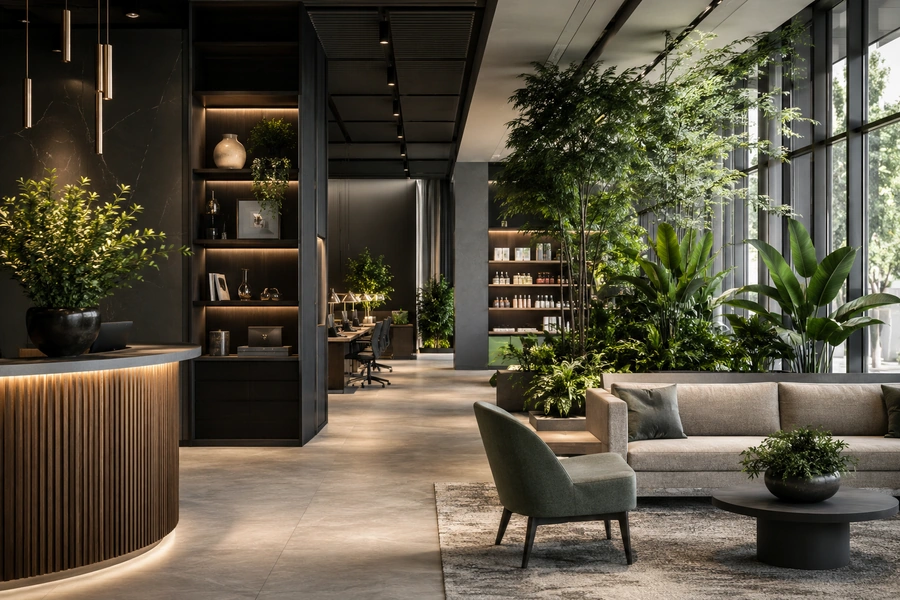
A lobby, hotel room, restaurant terrace, retail display, office workstation, and healthcare corridor should not receive the same answer. The strongest commercial strategy often uses living plants where their biological value can be supported and high-quality artificial plants where light, access, consistency, or turnover makes living greenery unreliable.
Are Artificial Plants or Real Plants Better for Commercial Spaces?
The answer depends on what the greenery is expected to accomplish. A decorative filler, employee-wellbeing feature, brand statement, space divider, and air-quality system are five different investments.
Artificial plants are often better for difficult locations, standardized multi-site programs, temporary spaces, and installations with limited maintenance access. Real plants are generally stronger where authentic nature, growth, care, and meaningful biophilic exposure are central to the user experience. Neither option guarantees higher sales, productivity, occupancy, or property value.
Research on workplace nature exposure supports a relationship with employee wellbeing, but the effects are not uniform. A 2024 longitudinal study involving open-plan office workers found that reported nature exposure correlated with wellbeing through vigor, while employees’ personal connection to nature helped explain who noticed and benefited from that exposure. The authors also acknowledged mixed findings and variability across earlier research.
That evidence should not be silently transferred to artificial plants. Faux greenery may provide color, pattern, visual softness, and nature-resembling cues, but it is not biologically equivalent to a living plant.
The 9 Trade-Offs at a Glance
| Trade-Off | Artificial Plants Win When | Real Plants Win When |
|---|---|---|
| 1. Purchase vs operating cost | Maintenance access is expensive | Care is integrated efficiently |
| 2. Consistency vs authenticity | Brand uniformity matters | Genuine nature is part of the experience |
| 3. Placement flexibility vs biological needs | Light and water are inadequate | Conditions support healthy growth |
| 4. Visual effect vs wellbeing evidence | The goal is reliable décor | Nature exposure is a design priority |
| 5. Cleaning vs horticultural care | Simple surface maintenance is preferred | Skilled care is available |
| 6. Stability vs growth and change | Fixed dimensions are essential | Seasonal development adds value |
| 7. Compliance and facility risk | Water and soil create problems | Faux-material fire concerns dominate |
| 8. Environmental narrative | Long reuse is guaranteed | Local, durable living systems are viable |
| 9. Standardization vs local character | Many sites need matching assets | Place-based design supports the brand |
Trade-Off 1: Higher Upfront Realism vs Continuing Maintenance Cost
Artificial plants often cost more than basic live plants of the same apparent size, especially when the product has a realistic trunk, premium foliage, UV treatment, or project-specific fire documentation.
Their financial argument comes later.
Artificial plants exchange recurring horticultural care for a larger decorative-asset purchase. Real plants may have a lower initial cost, but their total cost can include watering, pruning, feeding, pest management, rotation, replacement, access equipment, drainage control, and professional maintenance visits.
A professional living-plant program normally includes regular inspection, moisture management, pruning, pest monitoring, cleaning, and seasonal adjustments. Those requirements are manageable when they are planned and funded, but they remain recurring operational tasks.
Artificial plants still need:
- Dusting
- Reshaping
- Surface cleaning
- Planter inspection
- UV-damage checks
- Replacement leaves
- Secure attachments
- Periodic visual renewal
They are low-maintenance rather than maintenance-free.
Compare Total Cost of Ownership
Use this formula:
Five-year plant cost = purchase + installation + routine service + access + utilities + replacements + repairs + disposal or storage
A cheap real plant that dies every six months may cost more than one premium faux tree.
A large artificial green wall that requires specialist fire documentation, secure mounting, lift access, and panel replacement may cost more than a modest living-plant program.
Artificial Plants Usually Win When:
- Staff cannot water reliably
- Professional maintenance visits are expensive
- The location requires lift access
- Tenant turnover is frequent
- Plants must remain visually identical
- Displays move between properties
- Seasonal storage and reuse are planned
Real Plants Usually Win When:
- A horticultural contract already serves the building
- Suitable light and water are available
- The plant selection is robust
- Replacement rates are low
- Employees or operators value plant care
- Authentic nature supports the property concept
Trade-Off 2: Perfect Consistency vs Genuine Authenticity
Artificial plants remain the same size, color, and shape until they become dusty, damaged, or faded. That consistency is valuable for brands that want every customer to encounter the same visual environment.
Real plants grow, lean, shed leaves, respond to seasons, and occasionally fail.
Artificial plants provide predictable brand presentation. Real plants provide natural variation and biological credibility. The more a business promises wellness, sustainability, nature, or craftsmanship, the more closely customers may examine whether its greenery is genuine.
A realistic artificial olive tree can complete a hotel room, leasing suite, or retail display without asking guests to focus on its material.
A plastic green wall marketed as a deep connection to nature may create a credibility gap when visitors recognize that the leaves are repeated molded panels.
The distinction matters because real plants are not only visual objects. They are living systems that respond to care and environmental conditions.
Artificial Plants Suit:
- Franchise interiors
- Chain retail
- Model apartments
- Temporary offices
- Event venues
- Film and photography sets
- Short-term rental properties
- Displays requiring exact dimensions
Real Plants Suit:
- Wellness-focused hospitality
- Conservatory-style interiors
- Biophilic workplaces
- Garden restaurants
- Premium residential developments
- Properties promoting environmental stewardship
- Locations with dedicated horticultural teams
The Brutally Honest Rule
Do not describe artificial plants as living biophilic infrastructure.
They can be part of a nature-inspired visual scheme, but that wording should remain distinct from direct contact with living nature.
Trade-Off 3: Unlimited Placement vs Light, Water, and Climate Requirements
Real plants are constrained by biology. Artificial plants are constrained mainly by material performance, safety, and realism.
Artificial plants can occupy dark corridors, windowless washrooms, high shelves, enclosed retail displays, and inconsistent-temperature spaces. Real plants need species-appropriate light, water, root space, drainage, temperature, and maintenance access.
This is one of the clearest commercial advantages of faux greenery.
A living fiddle-leaf fig placed in a dark hotel corridor is not a premium design choice. It is an expensive replacement cycle.
An artificial fern under intense exterior sun is also a poor choice when the product has no suitable UV protection.
Difficult Locations That Favor Artificial Plants
- Windowless corridors
- Elevator lobbies
- High atriums
- Behind reception counters
- Above retail shelving
- Model homes
- Unoccupied rental units
- Seasonal displays
- Rooms closed for long periods
- Areas where watering is restricted
Locations That Favor Living Plants
- Daylit lobbies
- Atriums with appropriate conditions
- Workstations near natural light
- Indoor gardens
- Restaurants with horticultural servicing
- Courtyards
- Terraces
- Wellness spaces
- Community areas where plant care is visible
Artificial plants still require location analysis.
Direct sun may fade untreated leaves. High temperatures may soften adhesives. Exterior wind may pull out stems. Public buildings may require fire-performance evidence. Combustible artificial decorative vegetation can be subject to flame-propagation requirements such as NFPA 701 or heat-release criteria under applicable codes.
Trade-Off 4: Reliable Visual Greenery vs Stronger Evidence for Nature Exposure
Both plant types can add green color and organic forms. The research case is not equally strong for both.
Real plants have the more defensible evidence base when the objective is meaningful nature exposure, employee wellbeing, or an authentic biophilic environment. Artificial plants may support visual comfort and brand styling, but managers should not claim that faux greenery delivers the same psychological or physiological outcomes.
The 2024 Scientific Reports study found that exposure to nature in open-plan offices correlated with employee wellbeing and that vigor mediated the relationship. It also found that nature relatedness influenced the amount of nature employees reported noticing, reinforcing that reactions differ among individuals.
A 2025 assessment of an active living wall summarized earlier workplace research in which adding plants was associated with improved perceived attention, creativity, and productivity. The active-wall study also illustrates that some living installations are designed as functioning environmental systems, not merely visual decoration.
These findings do not prove that every office plant program will produce measurable profit.
They suggest that real nature exposure can support workplace experience when it is part of a broader environment that also addresses:
- Lighting
- Noise
- Comfort
- Layout
- Work culture
- Autonomy
- Air quality
- Social conditions
Do Not Sell Plants as a Productivity Guarantee
A plant cannot correct:
- Poor management
- Excessive noise
- Inadequate staffing
- Bad lighting
- Uncomfortable temperatures
- Unsafe workloads
- Dysfunctional layouts
The profitable decision is to treat greenery as one environmental input rather than a universal performance intervention.
Trade-Off 5: Dusting and Surface Cleaning vs Watering, Pests, and Moisture Control
Artificial plants accumulate dust. Real plants accumulate dust and require biological care.
Artificial greenery normally simplifies routine work to cleaning and inspection. Living plants require moisture control, pruning, feeding, pest management, drainage, and replacement decisions. However, poorly cleaned artificial foliage can look neglected, while poorly watered living plants can contribute to leakage, damaged finishes, odors, or damp materials.
Moisture problems deserve serious attention in commercial buildings. NIOSH states that excess moisture is generally the major cause of indoor mold growth and recommends correcting water entry and drying wetted materials quickly.
This does not mean ordinary healthy potted plants automatically create mold.
It means living-plant programs must control:
- Overwatering
- Leaking saucers
- Damaged irrigation
- Wet decorative moss
- Saturated soil
- Water near flooring or walls
- Drainage from living walls
- Unnoticed leaks behind planters
Artificial plants remove routine irrigation but introduce other cleaning needs:
- Dust on broad leaves
- Grease in restaurants
- Static attraction
- Debris in dense foliage
- Surface marks
- Fading
- Loose components
Best Choice for Healthcare and Sensitive Areas
The decision should be made with the facility’s infection-control, cleaning, and fire-safety teams.
Living plants may be restricted in selected clinical or controlled areas because of soil, water, or maintenance procedures.
Artificial plants may also be inappropriate when they are difficult to disinfect, trap dust, or lack required fire documentation.
Neither material should be placed simply because it is described as “low maintenance.”
Trade-Off 6: Fixed Dimensions vs Growth, Seasonality, and Emotional Engagement
Artificial plants remain within a controlled envelope. Real plants change.
Artificial plants are easier to specify around signs, cameras, sprinklers, doors, merchandise, and circulation paths. Real plants require pruning and adjustment, but their growth, seasonal change, and response to care can create a deeper sense of life and participation.
A faux tree beside a retail sign will not grow over the message.
A living vine may eventually cover the sign, enter equipment, or require a new support.
For facility managers, fixed dimensions simplify:
- Space planning
- Cleaning clearance
- Photography
- Store replication
- Accessibility
- Sign visibility
- Camera coverage
- Furniture changes
For occupants, biological change can be part of the value.
Living plants can develop new leaves, flowers, branches, and seasonal variations. That change can encourage observation and care in a way a static replica cannot.
Artificial Plants Win When:
- Sightlines must remain exact
- Display dimensions are contractual
- Merchandise changes often
- The plant moves between sites
- Growth would create access problems
- The space is photographed repeatedly
Real Plants Win When:
- Growth contributes to the experience
- Seasonal variation supports the brand
- Staff or guests value interaction
- Community gardening is part of the program
- Long-term development is desirable
Trade-Off 7: Less Water Risk vs More Fire and Material Scrutiny
Real and artificial plants create different facility risks.
Living plants require responsible management of water, soil, containers, pests, and plant health. Artificial plants avoid those biological requirements but can introduce combustible plastics, synthetic fabrics, coatings, exposed wire, heavy ballast, and project-specific fire documentation.
Artificial decorative vegetation may need to meet applicable flame-propagation or heat-release criteria in public buildings. NFPA materials also prohibit open flames near combustible artificial decorative vegetation in covered applications.
A supplier’s statement that a product is “commercial grade” does not prove fire compliance.
Buyers may need:
- Exact product identification
- Test method
- Laboratory
- Report number
- Tested mounting condition
- Treatment details
- Renewal requirements
- Authority approval
Living plants also require safe installation.
A large wet planter can be extremely heavy. Water can leak onto floors. Roots can damage liners. Fallen leaves may create slip or cleaning issues. Planters must not obstruct exits, accessible paths, doors, safety devices, or customer circulation.
The Profitable Risk Test
Ask which system creates the smaller controllable risk in that exact location.
Do not choose artificial because “nothing can go wrong.”
Do not choose real because “natural means safe.”
Trade-Off 8: Reusability vs Biological Renewability
Artificial plants are durable manufactured goods. Real plants are living biological products.
Their environmental comparison is complicated.
Artificial plants may reduce replacement and transport when they are reused for years across multiple installations. Their value weakens when they are poor quality, trend-specific, difficult to repair, or discarded after one short project. Real plants can be renewable and locally grown, but they still require water, growing inputs, containers, transport, maintenance, and responsible end-of-life handling.
A faux tree used in twenty events has a different use profile from one discarded after a single store campaign.
A locally maintained plant that lives for ten years has a different profile from a short-lived species repeatedly replaced in an unsuitable interior.
Evaluate Artificial Plants Through:
- Expected number of uses
- Material transparency
- Repairability
- Replaceable foliage
- Modular construction
- Storage requirements
- UV or fire treatments
- Packaging
- End-of-life options
Evaluate Real Plants Through:
- Source
- Species suitability
- Expected survival
- Water use
- Growing medium
- Container
- Transport
- Replacement rate
- Composting or reuse options
The strongest sustainability claim is not “fake is greener” or “real is greener.”
It is a documented plan that reduces unnecessary purchasing, keeps products healthy or reusable, repairs components, and prevents premature disposal.
Trade-Off 9: Multi-Site Standardization vs Local Character
Commercial profitability often depends on repeatability. A brand may need the same planter height, leaf color, and silhouette across fifty locations.
Artificial plants make standardization easier because identical product codes can be ordered, photographed, packed, and installed to one specification. Real plants vary by season, nursery, maturity, climate, and local conditions, but that variation can make a space feel more connected to its place.
Artificial plants are strong for:
- Franchise standards
- Store rollouts
- Brand manuals
- International hotel rooms
- Rental-property staging
- Temporary activations
- Repeat photography
- Replacement programs
Real plants are strong for:
- Place-based hospitality
- Regional planting stories
- Seasonal menus and displays
- Local sourcing
- Community identity
- Garden-led architecture
- Properties where uniqueness adds value
The Hidden Cost of Standardization
An artificial plant program can become visually repetitive.
Customers may notice:
- Identical leaf molds
- Matching branch angles
- Repeated panel patterns
- The same plant in every room
- A color that never changes
- Damaged replacement stock that no longer matches
Real plants vary naturally, but that variation may conflict with tightly controlled brand photography.
The profitable choice depends on whether consistency or local character creates greater commercial value.
Do Real Plants Purify Commercial Indoor Air Better?
Living plants can absorb and transform certain compounds under controlled experimental conditions, and active green-wall systems may be designed to process air more deliberately.
However, a few passive potted plants should not be presented as a replacement for ventilation, source control, filtration, or building maintenance.
Real plants have biological processes that artificial plants do not, but ordinary decorative plant displays should not be sold as a complete commercial air-cleaning solution. Active plant-wall systems are a separate category because air, roots, growing media, irrigation, and mechanical design may operate together.
The 2025 annual active-plant-wall assessment reviewed research involving carbon-dioxide removal, environmental performance, and occupant responses. Its technical setup should not be confused with placing several passive pots in an office.
Artificial plants do not photosynthesize, absorb carbon dioxide, transpire, or biologically process indoor contaminants.
Their contribution is visual and spatial.
Which Option Is More Profitable?
Profitability should be evaluated through the role the plant plays.
Artificial plants are often more profitable when they prevent repeated plant failure, simplify multi-site styling, reduce difficult maintenance visits, or allow unused spaces to remain presentation-ready. Real plants are often more profitable when authentic nature strengthens the brand, supports occupant experience, or becomes an important part of the property itself.
Artificial Plants May Create Value Through:
- Lower routine horticultural labor
- Reduced watering access
- Consistent photography
- Faster store installation
- Reuse across events
- Stable dimensions
- Fewer dead-plant replacements
- Easier seasonal storage
- Operation in low-light locations
Real Plants May Create Value Through:
- Stronger nature credibility
- More meaningful biophilic exposure
- Premium hospitality experience
- Seasonal interest
- Community engagement
- Long-term landscape development
- Emotional attachment
- Authenticity in wellness settings
Neither Plant Type Automatically Creates:
- Higher employee productivity
- Increased retail conversion
- Faster property leasing
- Higher room rates
- Lower absenteeism
- Better air quality
- Stronger brand loyalty
Those outcomes depend on many variables. Plants should support a larger operating and design strategy.
What Is the Best Hybrid Strategy?
For many profitable spaces, the most practical answer is a mixed plant program.
Use real plants where light, water, maintenance, and human interaction support healthy growth. Use artificial plants in inaccessible, dark, temporary, highly standardized, or visually demanding locations. Keep the two categories separated enough that lower-quality faux foliage is not placed directly beside premium living specimens.
Hybrid Placement Matrix
| Location | Recommended Starting Point |
|---|---|
| Daylit reception desk | Real plant or premium living arrangement |
| Dark corridor | Artificial plant |
| Employee break area | Real plants where care is available |
| High atrium ledge | Artificial plant |
| Hotel guest room | Artificial or exceptionally robust managed plant |
| Wellness lounge | Real plants |
| Retail window | Artificial, seasonal, or mixed |
| Restaurant terrace | Site-appropriate real plants or outdoor-rated faux |
| Temporary leasing suite | Artificial plants |
| Living-wall feature | Professionally designed real or active system |
| Upper shelving | Artificial trailing greenery |
| Community workspace | Real plants with an assigned care plan |
Do Not Mix Them Carelessly
A visibly plastic ficus beside a healthy living ficus makes the artificial product easier to recognize.
A stronger hybrid design may use:
- Real plants at eye level
- Artificial foliage above reach
- Real statement plants in daylit zones
- Artificial filler in dark corners
- Living exterior planting
- Faux seasonal accents indoors
The material difference should feel deliberate.
How Should Buyers Calculate the Business Case?
A plant comparison should include cost, use, risk, and expected value.
Five-Year Evaluation Table
| Category | Artificial Plant | Real Plant |
|---|---|---|
| Purchase | Record installed cost | Record plant and planter cost |
| Installation | Include shaping and fixing | Include planting and drainage |
| Routine care | Cleaning and inspection | Watering, pruning, feeding, cleaning |
| Specialist service | Fire, UV, or repair work | Horticultural visits |
| Replacement | Faded or damaged components | Dead or unsuitable plants |
| Utilities | Normally minimal | Irrigation, lighting, pumps where used |
| Storage | Seasonal inventory | Usually not applicable |
| Risk | Fire, dust, fading, stability | Water, pests, plant decline |
| Residual value | Reuse, resale, rental | Continued growth or propagation |
| Experience value | Visual consistency | Authentic nature and change |
Use a Weighted Score
A hotel might weight:
- Guest experience: 30%
- Maintenance: 20%
- Brand authenticity: 20%
- Safety: 15%
- Cost: 15%
A short-term retail activation might weight:
- Installation speed: 30%
- Visual consistency: 25%
- Reusability: 20%
- Cost: 15%
- Authenticity: 10%
The winner changes when the business objective changes.
My Insights: Artificial Plants vs Real Plants—What Are the 9 Brutally Honest Trade-Offs for Profitable Spaces
The wrong comparison asks which plant type is universally better. The useful comparison asks which option can perform a defined commercial role with the lowest credible lifetime cost and risk.
Artificial plants win on consistency, difficult placement, standardization, and reduced horticultural care. Real plants win on authenticity, biological change, meaningful nature contact, and the stronger evidence base behind biophilic exposure. Hybrid programs usually produce the best commercial balance when each material is assigned deliberately.
My central insight is that profitable greenery needs a job description.
The Nine-Trade-Off Summary
| Trade-Off | Artificial Advantage | Real Advantage |
|---|---|---|
| 1 | Predictable operating cost | Lower-cost plants may be easy to source |
| 2 | Consistent brand appearance | Genuine natural credibility |
| 3 | Low-light placement | Healthy biological performance in suitable sites |
| 4 | Reliable visual effect | Stronger nature-exposure evidence |
| 5 | No watering program | Living sensory experience |
| 6 | Fixed size | Growth and seasonal change |
| 7 | Avoids soil and irrigation | Avoids synthetic imitation concerns |
| 8 | Long reuse potential | Biological renewability |
| 9 | Multi-site standardization | Local character |
The Real-Plant Business Case Is Strongest When:
- The plant can remain healthy
- Maintenance is already funded
- Nature is part of the brand
- Occupants can see and engage with it
- Light and water are suitable
- The installation will remain for years
- Seasonal change adds value
The Artificial-Plant Business Case Is Strongest When:
- Living plants repeatedly fail
- The property is temporary
- Staff cannot provide care
- Plants sit beyond safe access
- Brand standards require identical products
- The display moves frequently
- The location has little usable light
- The asset will be reused
The Hybrid Business Case Is Strongest When:
- A building contains several exposure zones
- Real plants can be concentrated where they matter most
- Artificial plants can solve difficult background areas
- Maintenance resources are limited but not absent
- The brand wants authenticity without operational failure
My Final Profitability Rule
Do not compare the price of one faux tree with the price of one living tree.
Compare:
- Five-year installed cost
- Maintenance access
- Replacement frequency
- Customer viewing distance
- Employee experience
- Brand credibility
- Facility risk
- Reuse or growth value
- End-of-life plan
Then assign the plant type by zone.
The most profitable commercial space may use a genuine living tree in the daylit lobby, real plants around employee seating, artificial vines on inaccessible shelves, and premium faux plants in dark guest corridors.
That is not indecision. It is specification discipline.
Conclusion
Choose real plants for authentic, supportable nature and faux plants for difficult, standardized locations. The most profitable spaces use each where its strengths exceed its lifetime cost and risk.