
Glossy leaves, repetitive branches, undersized planters, and visible plastic bases can make an expensive business interior feel neglected within seconds.
The best-looking fake plants for business include olive trees, bird of paradise, monstera, fiddle-leaf figs, ficus, palms, snake plants, rubber plants, pothos, orchids, and architectural succulents. Choose natural color variation, matte or botanical leaf texture, adjustable branches, convincing trunks, stable bases, and proportions suited to the viewing distance.
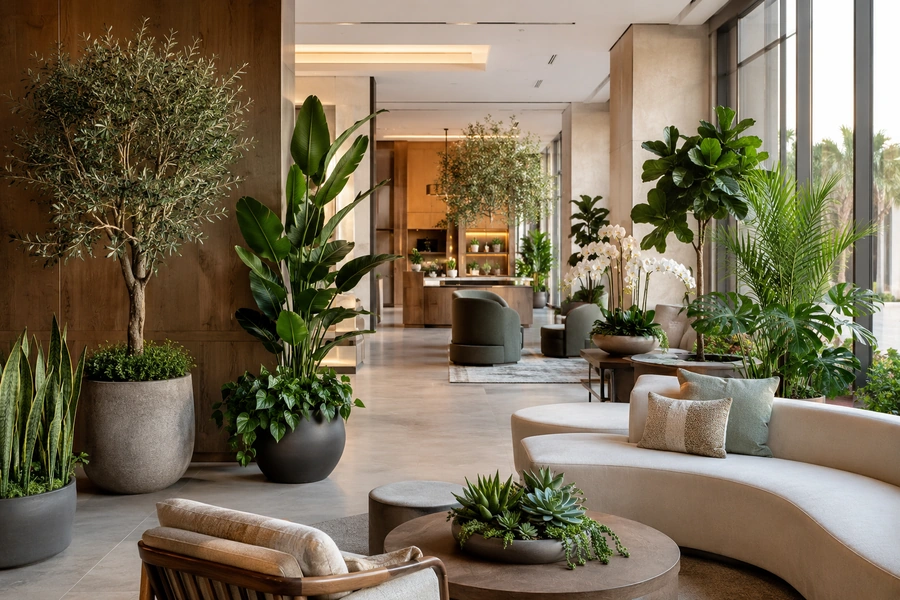
“Guests swear they are real” should be treated as a design objective, not an absolute promise. High-quality faux greenery can be convincing from normal guest distances, while touch, scent, repeated leaf molds, exposed wire, or poor styling may reveal the construction.
What Makes a Fake Plant Look Real in a Business?
A plant that looks convincing in a product photograph may fail beneath bright lobby lighting or beside genuine landscaping.
Realistic commercial faux plants use believable leaf texture, varied green tones, irregular branch spacing, detailed trunks, and several leaf sizes. They also need natural shaping, a correctly scaled planter, concealed mechanics, and enough open space around the foliage for guests to read the plant’s complete silhouette.
The Spruce tested 18 artificial plants for realism, durability, adjustability, and dust collection. Its strongest findings favored products with veined leaves, bendable stems, waxy botanical texture, varied leaf sizes, and realistic overall proportions. It also found that viewing distance matters: some products remained attractive from several feet away even when close inspection exposed their artificial construction.
Current styling guidance similarly emphasizes uneven stem lengths, subtle drooping, hidden bases, and controlled asymmetry. Perfectly straight stems and uniform branches often look manufactured because natural plants grow with variation.
The Business Realism Scorecard
| Factor | What to Inspect | Common Failure |
|---|---|---|
| Leaf color | Several related greens and natural undertones | One bright uniform green |
| Surface | Matte, softly waxy, or species-appropriate reflection | Hard plastic shine |
| Leaf pattern | Variation in size, direction, and markings | Repeated identical molds |
| Branches | Adjustable, irregular, and well spaced | Flat symmetrical canopy |
| Trunk | Textured transition into branches | Smooth molded pole |
| Base | Stable and concealed | Visible foam or small black pot |
| Scale | Appropriate for furniture and ceiling height | Small plant in a large lobby |
| Recovery | Regains shape after shipping | Permanent folds or dropped leaves |
| Cleaning | Accessible leaves and replaceable parts | Dense foliage that traps visible dust |
| Documentation | Project-specific fire or outdoor information | Generic “commercial grade” claim |
Artificial plants are widely chosen for convenience and durability. Research published by Plants & Flowers Foundation Holland in 2025 found that more than half of surveyed consumers in the Netherlands, Germany, France, and the United Kingdom had artificial flowers or plants at home, with convenience and durability as the primary motivations.
What Are the 21 Best-Looking Fake Plants for Business?
The easiest plants to reproduce convincingly often have naturally waxy, structured, small, or sculptural leaves. Highly delicate plants can also work, but they demand more detailed manufacturing and maintenance.
The 21 strongest commercial choices cover lobby trees, compact desk plants, trailing shelf greenery, formal entrance shapes, hospitality accents, and architectural foliage. Olive, monstera, bird of paradise, snake plant, rubber plant, ficus, palms, pothos, and orchids offer the broadest combination of realism and business flexibility.
Quick Ranking
| Rank | Faux Plant | Best Business Location | Why It Looks Real | Main Risk |
|---|---|---|---|---|
| 1 | Olive tree | Hotel, office, retail | Fine leaves and open canopy | Cheap trunks look artificial |
| 2 | Monstera | Creative office, retail | Graphic varied leaves | Repeated splits reveal molds |
| 3 | Bird of paradise | Lobby, restaurant | Naturally waxy broad leaves | Needs generous clearance |
| 4 | Fiddle-leaf fig | Reception, showroom | Bold recognizable foliage | Gloss exposes poor quality |
| 5 | Ficus tree | Office, clinic, bank | Dense adaptable canopy | Repetitive small leaves |
| 6 | Kentia palm | Hotel, lounge, spa | Elegant relaxed silhouette | Fine fronds collect dust |
| 7 | Areca palm | Restaurant, resort | Full tropical volume | Can become visually crowded |
| 8 | Snake plant | Corridor, elevator lobby | Narrow architectural form | Uniform leaves look molded |
| 9 | Rubber plant | Executive office, retail | Naturally substantial leaves | Excess shine |
| 10 | Dracaena | Office, healthcare | Clean vertical structure | Weak central trunks |
| 11 | ZZ plant | Waiting room, side table | Naturally smooth leaves | Oily-looking finish |
| 12 | Alocasia zebrina | Console, boutique | Distinctive stems and large leaves | Thin leaves may sag |
| 13 | Bamboo | Restaurant, spa, divider | Open vertical structure | Identical canes |
| 14 | Eucalyptus tree | Wellness, salon, hotel | Muted modern color | Pale foliage shows dirt |
| 15 | Pothos | Shelf, ceiling, reception | Patterned trailing leaves | Equal vine lengths |
| 16 | Philodendron | Lounge, creative office | Flexible heart-shaped foliage | Dense generic shape |
| 17 | Boston fern | Shelf, balcony, hospitality | Soft detailed volume | High cleaning burden |
| 18 | Ric rac cactus | Café, modern office | Sculptural unusual form | Wrong scale looks decorative |
| 19 | Agave | Entrance, rooftop, showroom | Molded architectural leaves | Hard projecting tips |
| 20 | Boxwood topiary | Formal entrance, terrace | Controlled repeatable shape | Bright green looks cheap |
| 21 | Phalaenopsis orchid | Reception, spa, luxury retail | Sculptural flowers and leaves | Weak flower centers |
1. Artificial Olive Tree—Best Overall for Business
The artificial olive tree is the most adaptable choice for modern commercial interiors.
Its fine gray-green leaves create height without forming a dense visual wall. The open canopy works beside reception desks, lounge seating, mirrors, display tables, restaurant entrances, and hotel corridors.
A convincing olive tree should have:
- Several leaf sizes
- Muted green and gray tones
- Irregular branch spacing
- A textured trunk
- Sparse but balanced foliage
- Adjustable branches
- A stable weighted base
In testing, The Spruce praised an artificial olive tree for realistic veined leaves, bendable branches, secure packaging, and its ability to fill vertical space. It noted that the canopy was somewhat sparse, but that openness can suit commercial interiors when the tree is shaped carefully.
I avoid artificial olives shaped into perfect balls. Living olive trees normally have irregular canopies and visible internal branching.
2. Artificial Monstera—Best for Modern Retail
Monstera has one of the most recognizable plant silhouettes. Its large split leaves work well in fashion stores, creative offices, cafés, showrooms, and contemporary waiting areas.
The Spruce reported that one tested artificial monstera was difficult to distinguish from a living plant when placed beside the real version. Varied stem heights, veined leaves, two leaf colors, and bendable wire contributed to its realism.
The most convincing monstera includes:
- Young leaves with few or no splits
- Mature leaves with different openings
- Several leaf sizes
- Side-facing foliage
- A few downward leaves
- Flexible stems
Do not position every split leaf directly toward the guest. Repeated hole patterns become easier to identify when all leaves face the same direction.
3. Bird of Paradise—Best Statement Plant
Bird of paradise is one of the strongest choices for tall hotel lobbies, restaurants, spas, showrooms, and modern office receptions.
Its living leaves are naturally broad, smooth, and slightly waxy. That makes high-quality replicas easier to produce convincingly than highly textured, delicate foliage.
The Spruce found that a tested bird-of-paradise plant benefited from waxy leaf texture and an upright shape that required little reshaping.
I choose a product with:
- Several stem heights
- Visible central leaf ribs
- Natural bends or small splits
- Open spacing
- A wide planter
- Enough weight to resist contact
Do not place broad leaves in narrow walkways. The plant needs empty space around its upper canopy to appear intentional.
4. Fiddle-Leaf Fig—Best Bold Reception Tree
Fiddle-leaf figs create strong visual weight with relatively few leaves. They suit reception areas, executive offices, furniture showrooms, hotel lounges, and premium retail.
The plant’s naturally broad, substantial leaves can be reproduced effectively, but they expose defects quickly.
Look for:
- Matte or softly waxy surfaces
- Deep natural veining
- Curved edges
- Different leaf sizes
- Varied green tones
- A trunk that supports the canopy without leaning
Artificial-plant buyer guidance commonly identifies fiddle-leaf figs, olive trees, and snake plants as convincing categories because their natural foliage already has a firm or slightly waxy character.
Avoid placing a glossy fiddle-leaf fig directly beneath a strong spotlight. The reflection may make every mold line visible.
5. Ficus Tree—Best All-Purpose Office Tree
Ficus trees provide a fuller appearance than olive trees and work across corporate offices, banks, clinics, educational spaces, conference centers, and hotel corridors.
Their many small leaves help conceal the internal branch structure.
A realistic ficus needs:
- More than one green tone
- Irregular leaf spacing
- A natural trunk transition
- Several branch lengths
- A canopy that is not excessively dense
The main risk is repetition. Hundreds of identical leaves attached at equal intervals create a mechanical pattern.
I use ficus where the design needs volume, but I keep enough internal space for light and cleaning access.
6. Kentia Palm—Best for Elegant Hospitality
Kentia palms create a refined, relaxed silhouette. They suit hotel lounges, premium restaurants, spas, resorts, and executive reception areas.
A convincing Kentia palm should have:
- Different frond lengths
- Soft outward curves
- Open lower spacing
- Natural-looking central stems
- A few relaxed or slightly downward fronds
The plant should look airy rather than dense.
Fine palm leaves require more cleaning than broad monstera or bird-of-paradise leaves. A commercial maintenance plan should account for the increased surface area.
7. Areca Palm—Best for Tropical Volume
Areca palms have more stems and greater visual density than Kentia palms. They work in resorts, casual restaurants, pool lounges, shopping centers, and event venues.
Use an Areca palm when the goal is to:
- Fill a wide corner
- Screen a service area
- Soften a structural column
- Create a tropical environment
- Divide hospitality seating
I avoid placing several full palms close together. Excessive fine foliage can create visual noise and increase dusting time.
A wide, low planter usually looks more stable than a narrow decorative pot beneath a large canopy.
8. Snake Plant—Best for Narrow Spaces
Snake plants are ideal beside doors, along corridors, near elevator banks, between workstations, and on reception credenzas.
Their upright leaves occupy little floor area and do not extend far into circulation routes.
The strongest products include:
- Several leaf heights
- Natural curves
- Varied green striping
- Irregular spacing
- A dense lower cluster
- Matte leaf edges
Snake plants are among the categories frequently identified as naturally suitable for artificial replication because their living leaves are already firm and structured.
Avoid products where every leaf reaches the same height or follows the same printed pattern.
9. Rubber Plant—Best for Executive Interiors
Rubber plants have broad dark leaves that work with walnut, stone, leather, black metal, and warm neutral finishes.
They suit executive offices, luxury retail, restaurants, design studios, and hotel rooms.
A strong artificial rubber plant should have:
- Rich but varied green
- Slight natural reflection
- Several leaf angles
- Visible veins
- A substantial central stem
Its broad leaves are relatively easy to clean, which is useful in customer-facing environments.
Too much shine remains the main weakness. The leaves should resemble healthy botanical foliage, not polished plastic.
10. Dracaena—Best Clean Vertical Plant
Dracaena offers height without a wide canopy. It works well in healthcare settings, offices, educational buildings, corridors, and reception areas.
The main quality test is the central trunk. A weak trunk may lean after the leaves are opened or after the planter is moved repeatedly.
Choose:
- Several leaf clusters
- Different leaf lengths
- A strong internal stem
- Natural color transitions
- Leaves that hold curved positions
Dracaena is particularly useful when an olive tree looks too decorative and a palm occupies too much space.
11. ZZ Plant—Best Compact Structured Pick
The ZZ plant is useful for waiting rooms, side tables, shelving, counters, meeting rooms, and executive credenzas.
Its living leaves are naturally smooth and orderly, so artificial versions can remain believable even with a relatively simple construction.
Look for:
- Several stem heights
- Soft, controlled reflection
- Varied leaf angles
- A correctly scaled planter
- An irregular lower cluster
Avoid leaves that appear wet or oily beneath commercial lighting.
12. Alocasia Zebrina—Best Boutique Accent
Alocasia zebrina has large leaves and distinctive striped stems. It creates a memorable accent without requiring a full floor tree.
It works on console tables, plant stands, retail display platforms, café counters, and creative-office shelves.
The Spruce found a tested faux Alocasia durable and visually distinctive, with two large leaves, patterned stems, and a cemented base. Its broad, limited foliage also reduced shedding and simplified maintenance.
Because the product has few leaves, each leaf must be strong. One crease or unnatural gloss becomes highly visible.
13. Artificial Bamboo—Best Divider Plant
Bamboo creates height while maintaining partial visibility through the canes. It suits spa corridors, restaurant booths, hotel terraces, waiting areas, and Asian-inspired interiors.
A convincing bamboo should use:
- Canes of different thicknesses
- Natural joint details
- Varied leaf clusters
- Uneven heights
- Open internal spacing
Cheap bamboo often uses identical straight canes arranged at equal intervals.
For long dividers, I use several modular planters instead of one continuous container. Modules are easier to move, inspect, and replace.
14. Eucalyptus Tree—Best Muted Greenery
Eucalyptus has a quieter gray-green palette than most tropical plants. It suits salons, wellness businesses, calm offices, boutique hotels, clinics, and neutral retail interiors.
Its muted foliage works particularly well with:
- Pale timber
- Warm plaster
- Linen textures
- Soft stone
- Cream upholstery
- Brushed metal
Pale leaves reveal dark dust and greasy residue more quickly than medium-green foliage.
I keep artificial eucalyptus away from kitchen extraction, open doors facing busy roads, and vents that move visible particles.
15. Artificial Pothos—Best Trailing Shelf Plant
Pothos works on bookcases, floating shelves, reception cabinets, ceiling frames, and wall planters.
Its natural leaf pattern helps conceal small manufacturing differences.
The Spruce found that a tested faux pothos benefited from realistic color variation, waxy leaf feel, a full silhouette, and pliable branches that were easy to position.
For stronger realism:
- Use several vine lengths
- Bend one vine across the shelf
- Allow another to hang
- Keep one close to the planter
- Turn some leaves toward the wall
Equal vertical vines look staged rather than grown.
16. Philodendron—Best Relaxed Lounge Plant
Heart-leaf and split-leaf philodendron forms work in lounges, coworking areas, cafés, hospitality seating, and creative workplaces.
The plant is more relaxed than a snake plant and less dramatic than a monstera.
Choose products with:
- Several leaf sizes
- Soft trailing or outward movement
- Natural green variation
- Flexible branches
- Open gaps inside the plant
Avoid dense domes of identical heart-shaped leaves. A few visible stems and lower leaves improve the growth pattern.
17. Boston Fern—Best for Soft Volume
Boston ferns add soft texture to shelves, balcony displays, waiting rooms, hospitality planters, and high cabinets.
Their many fine fronds help hide the internal structure from normal viewing distance.
The trade-off is cleaning. Detailed plants with numerous small leaves take more time to dust than broad-leaf products. The Spruce specifically noted that large-leaf artificial plants are generally easier to wipe than pothos, tradescantia, or other intricate foliage.
Place ferns where staff can access them safely without ladders over guests or merchandise.
18. Ric Rac Cactus—Best Sculptural Hanging Pick
Ric rac cactus has an unusual zigzag shape that works in cafés, design studios, creative offices, salons, and modern retail.
Its silhouette is more important than tiny botanical detail.
A hanging faux ric rac cactus also adds greenery without occupying floor or counter space. The Spruce included this form among its tested recommendations for areas where furniture, children, or other objects limit available surfaces.
Use a planter that looks substantial enough to balance the long trailing structure. Secure hanging installations with approved hardware.
19. Artificial Agave—Best Architectural Plant
Agave is one of the strongest choices for contemporary entrances, rooftops, showrooms, car dealerships, pool areas, and desert-inspired hospitality.
Its thick molded leaves are easy to wipe and can appear convincing when color and edge details are controlled.
Choose:
- Several leaf angles
- A muted central gradient
- A stable low planter
- Strong leaf connections
- Tips that do not create a contact hazard
Do not place projecting agave leaves in narrow guest routes or children’s areas.
For outdoor use, confirm that the exact product—not merely the plant category—is intended and documented for the expected sun, rain, and temperature exposure.
20. Boxwood Topiary—Best Formal Entrance Plant
Boxwood balls, cones, spirals, and rectangular hedges create a controlled arrival experience.
They suit:
- Hotel doors
- Office entrances
- Restaurant terraces
- Formal reception areas
- Premium retail storefronts
- Event stages
The product should combine dark, medium, and muted green leaves. One bright green creates a synthetic surface.
Topiaries are most effective in pairs, but I adjust each one slightly so the two plants do not appear computer duplicated.
Exterior products need verified outdoor suitability, secure planters, and a wind-management plan.
21. Phalaenopsis Orchid—Best Reception Counter Plant
Orchids combine green foliage with a refined floral element. They suit hotel reception desks, spas, salons, clinics, professional offices, luxury retailers, and restaurant host stands.
A convincing artificial orchid requires:
- Detailed flower centers
- Open flowers and buds
- Curved stems
- Thick lower leaves
- Visible roots or bark
- Discreet support stakes
- A correctly scaled ceramic pot
The Spruce found that a budget artificial orchid was identifiable as faux at close range but still attractive from several feet away because of its curved stem, roots, and support stake. This illustrates how complete form and viewing distance can matter as much as perfect petal detail.
For business use, white, cream, and pale green offer the greatest flexibility.
Which Fake Plant Is Best for Each Business?
The best plant depends on ceiling height, furniture scale, customer traffic, brand tone, cleaning access, and normal viewing distance.
Hotels perform well with olive trees, palms, orchids, and bird of paradise. Offices benefit from ficus, snake plants, dracaena, rubber plants, and pothos. Retailers can use monstera, Alocasia, eucalyptus, and architectural succulents. Restaurants need stable planters, cleanable leaves, and foliage that does not interfere with service routes.
Business Placement Guide
| Business Type | Best Picks | Primary Goal |
|---|---|---|
| Corporate reception | Olive, ficus, orchid | Warmth and professional polish |
| Open office | Dracaena, snake, pothos | Soft zoning without clutter |
| Executive office | Rubber plant, ZZ plant | Controlled architectural greenery |
| Hotel lobby | Olive, Kentia palm, bird of paradise | Arrival scale |
| Hotel room | Orchid, eucalyptus, small palm | Repeatable room styling |
| Restaurant entrance | Ficus, olive, boxwood | Clear and welcoming arrival |
| Restaurant seating | Palm, bamboo, pothos | Separation and atmosphere |
| Luxury retail | Orchid, rubber plant, olive | Premium product framing |
| Fashion retail | Monstera, Alocasia, eucalyptus | Graphic brand styling |
| Healthcare waiting room | Snake, dracaena, ZZ | Calm and easy-to-clean form |
| Spa or salon | Orchid, bamboo, eucalyptus | Soft wellness character |
| Café | Pothos, fern, ric rac cactus | Relaxed vertical texture |
| Showroom | Fiddle-leaf fig, agave, bird of paradise | Strong architectural scale |
How Do You Stop Business Faux Plants From Looking Cheap?
The plant is only one part of the display. Poor shaping and an undersized planter can expose even a premium product.
Reshape every branch, vary leaf directions, conceal the starter pot, and use a planter with enough visual and physical weight. Match the plant’s scale to the furniture and ceiling height, then keep enough negative space around the canopy for its silhouette to remain visible.
Current stylist guidance recommends varying stem lengths, introducing natural droop, and hiding foam or plastic bases. These actions remove the perfect symmetry that often makes artificial foliage obvious.
Re-Pot the Starter Plant
Many artificial plants arrive in small black plastic pots designed for shipping, not display.
Place the starter pot inside:
- Matte ceramic
- Textured fiberglass
- Stone-effect composite
- Brushed metal
- Wood veneer
- A woven basket with a rigid inner container
Then stabilize the inner pot and conceal the surface with river rock, bark, fixed moss, or an artificial-soil insert.
Shape From the Trunk Outward
I use this order:
- Confirm the plant’s intended front.
- Open the lowest branches.
- Separate repeated leaf clusters.
- Turn some leaves sideways.
- Bend one or two branches slightly downward.
- Keep visible gaps inside the canopy.
- Check the shape from the guest entrance.
- Photograph it under the actual lighting.
Use Imperfection Carefully
Useful variation includes:
- Different leaf heights
- Uneven branch spacing
- Side-facing foliage
- One relaxed lower branch
- Slight color differences
- Open space
Damage is not realistic imperfection.
Remove or replace:
- Crushed leaves
- White stress marks
- Visible wire
- Glue strings
- Detached foliage
- Strong creases
- Broken trunks
How Should Commercial Buyers Test Faux Plants?
A catalog sample may not represent the complete order. Business buyers need repeatability, packaging recovery, cleaning access, and replacement options.
Approve a physical sample and a written specification covering height, opened width, leaf colors, trunk construction, stem count, base weight, materials, packaging, shaping, and documentation. Test the product after realistic transport compression rather than approving only a carefully prepared showroom sample.
Sample Approval Checklist
Record:
- Total height
- Canopy width after shaping
- Starter-pot dimensions
- Product weight
- Trunk material
- Number of main branches
- Leaf colors
- Leaf finish
- Stem flexibility
- Base construction
- Odor
- Recovery time after unpacking
- Detached-leaf count
- Approved planter
- Viewing distance
The Spruce’s testing found differences in packaging recovery, adjustability, leaf retention, and maintenance effort across artificial plants. Those factors become more important when a business orders dozens of matching units.
Review Multiple Units Together
One plant may look natural. Ten identical plants placed in a row may expose repeated molds and branch patterns.
For multi-site or large-volume projects, inspect:
- At least three production samples
- Batch color consistency
- Trunk variation
- Leaf orientation
- Pot dimensions
- Packaging
- Replacement stock
A product may be realistic individually but unsuitable for heavy repetition.
Are Fake Plants the Same as Biophilic Design?
Artificial plants can support a nature-inspired visual language, but they should not be described as biologically equivalent to living nature.
Faux plants provide color, organic forms, visual softness, and consistent decorative greenery. Evidence about workplace nature exposure and wellbeing largely concerns real plants, natural views, daylight, or broader biophilic environments. Businesses should not claim that artificial foliage delivers identical health, air-quality, or productivity outcomes.
A longitudinal workplace study involving two groups of open-plan office employees found relationships among nature exposure, vigor, nature relatedness, and wellbeing. The research concerns exposure to nature and biophilic workplace design; it does not demonstrate that artificial plants produce equivalent results.
A strong business environment can use faux plants honestly as decorative assets while incorporating genuine nature through:
- Daylight
- Outdoor views
- Living plants in supportable locations
- Natural materials
- Courtyards
- Terraces
- Water
- Seasonal landscaping
What Safety and Maintenance Issues Matter?
Artificial plants avoid watering but still require cleaning, stability, placement review, and applicable fire documentation.
Keep faux plants clear of exits, doors, sprinklers, electrical equipment, heaters, and primary circulation routes. Use stable planters, secure overhead greenery, and obtain product-specific fire documentation where required. Clean leaves on a schedule and replace faded or damaged components promptly.
NFPA guidance states that combustible artificial decorative vegetation in covered applications may need to meet specified fire-test requirements. Exact obligations depend on the occupancy, jurisdiction, plant type, quantity, and installation, so the project authority should confirm the applicable rule.
Suggested Maintenance Schedule
| Location | Inspection |
|---|---|
| Reception counter | Weekly |
| Hotel lobby | Weekly |
| Restaurant | Weekly for dust and grease |
| Office floor plant | Every two to four weeks |
| High shelf | Monthly with safe access |
| Green divider | Monthly |
| Exterior planter | After storms and at least monthly |
| Hanging greenery | Attachment and dust inspection monthly |
Broad leaves such as monstera, Alocasia, rubber plant, and bird of paradise are easier to wipe than dense palms, ferns, and pothos.
My Insights: Best Looking Fake Plants for Business—Which 21 Faux Greens Do Guests Swear Are Real
The most convincing commercial faux plant is not necessarily the most detailed product in a close-up photograph. It is the plant that remains believable after delivery, reshaping, lighting, guest traffic, cleaning, and repeated use.
The 21 best-looking faux greens succeed because their natural forms suit artificial production and commercial placement. Olive, monstera, bird of paradise, fiddle-leaf fig, ficus, palms, snake plants, rubber plants, and orchids provide the strongest overall realism, while trailing and architectural plants solve shelves, counters, dividers, and narrow spaces.
My main insight is that guests judge the complete installation, not the leaf in isolation.
The 21-Pick Summary
| Plant | Strongest Business Role |
|---|---|
| Olive tree | Premium all-purpose floor tree |
| Monstera | Modern retail and creative spaces |
| Bird of paradise | Large statement greenery |
| Fiddle-leaf fig | Bold reception corner |
| Ficus | Full general-purpose office tree |
| Kentia palm | Elegant hospitality |
| Areca palm | Tropical volume |
| Snake plant | Narrow corridors |
| Rubber plant | Executive and luxury interiors |
| Dracaena | Controlled vertical structure |
| ZZ plant | Compact tables and waiting areas |
| Alocasia zebrina | Distinctive boutique accent |
| Bamboo | Soft partitions |
| Eucalyptus | Muted wellness styling |
| Pothos | Trailing shelf greenery |
| Philodendron | Relaxed lounge foliage |
| Boston fern | Soft detailed volume |
| Ric rac cactus | Sculptural hanging feature |
| Agave | Architectural planter |
| Boxwood topiary | Formal entrance |
| Phalaenopsis orchid | Premium reception counter |
Best Overall Pick
The olive tree ranks first because it provides height without excessive visual weight.
It suits offices, hotels, retailers, restaurants, showrooms, and rental properties. Its open canopy also makes signs, artwork, windows, and furniture remain visible.
Best Close-View Pick
A premium Phalaenopsis orchid works well on reception counters, spa desks, host stands, and luxury retail surfaces.
The flower centers, roots, stake, leaf thickness, and planter finish must all remain convincing.
Best Large Lobby Pick
Bird of paradise, Kentia palm, Areca palm, ficus, and oversized olive trees provide the strongest lobby scale.
Choose according to the brand:
- Olive for restrained luxury
- Kentia for elegant hospitality
- Areca for tropical fullness
- Bird of paradise for modern impact
- Ficus for adaptable volume
Best Office Pick
Snake plant, dracaena, ZZ plant, rubber plant, and pothos provide the best combination of controlled size and easy placement.
One well-sized floor plant often looks more intentional than several identical small pots scattered around workstations.
Best Retail Pick
Monstera, Alocasia, rubber plant, eucalyptus, and agave create graphic silhouettes that can frame products without resembling traditional office décor.
The merchandise should remain visually dominant.
Best Low-Maintenance Pick
Monstera, Alocasia, rubber plants, snake plants, ZZ plants, and bird of paradise have relatively large, accessible leaves.
Fine palms and ferns may look convincing but require more detailed dusting.
Best Space-Saving Pick
Use snake plants on the floor, pothos on shelves, orchids on counters, and ric rac cactus in approved hanging positions.
These plants add greenery without occupying broad circulation space.
My Final Commercial Selection Formula
I use this order:
- Define the plant’s business purpose.
- Measure the location and viewing distance.
- Select the botanical form.
- Review the leaf texture and color variation.
- Inspect the trunk and base.
- Test recovery after packing.
- Choose the final planter.
- Shape the plant under project lighting.
- Confirm safety and fire requirements.
- Establish cleaning and replacement procedures.
A plant should perform a clear role. It may soften a lobby, frame a retail display, divide seating, complete a hotel room, or add height to an empty corner.
When a faux plant has no purpose, incorrect scale, and no maintenance plan, it becomes clutter regardless of its realism or price.
Conclusion
Olive, monstera, bird of paradise, ficus, palms, snake plants, and orchids lead business realism when natural variation, correct scale, strong planters, shaping, and cleaning work together.