
Fake flowers that look flawless in a factory showroom may fade, warp, collect gray dust, or become trapped at customs after reaching Dubai.
To buy fake flowers for Dubai successfully, match each product to its real exposure, verify finished-product UV and heat evidence, choose dust-friendly materials, test packing recovery, specify fire documents, confirm the correct HS code, calculate duty and VAT, verify the importer, and select an Incoterm that preserves customs transparency.
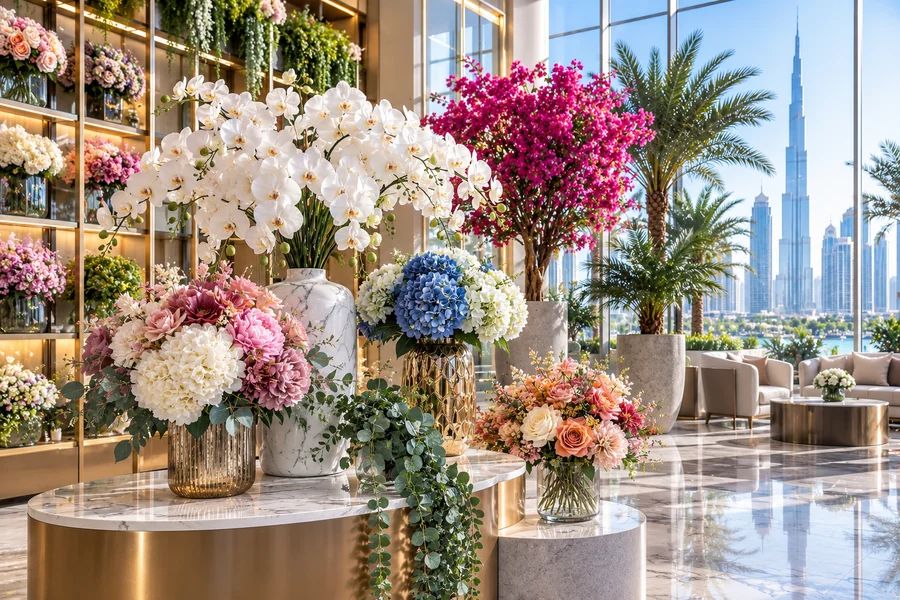
Dubai’s climate, commercial standards, and import procedures turn artificial-flower purchasing into more than a color-and-price decision. The most reliable buyer controls product performance and customs documentation before production begins.
Why Are Fake Flowers Harder to Buy for Dubai?
Dubai’s official fact sheet describes a tropical desert climate with hot, humid summers. The UAE National Center of Meteorology also monitors particulate pollution such as PM10 and operates a dust-forecast model, highlighting the need to consider both heat exposure and airborne dust when specifying decorative foliage.
Dubai fake flowers face three connected risks: environmental deterioration, visible dust accumulation, and customs errors. A product can survive indoor air-conditioning but fail beside hot glazing; another may tolerate sunlight but become difficult to clean. Incorrect importer records or tariff classification can then delay an otherwise acceptable shipment.
The Three-Risk Buying Framework
| Risk Area | What Can Go Wrong | Buyer Control |
|---|---|---|
| Heat and UV | Fading, brittleness, warping, adhesive failure | Exposure map and test evidence |
| Dust and cleaning | Gray appearance, sticky surfaces, difficult maintenance | Material and foliage selection |
| Customs | Wrong HS code, unclear value, missing documents, unexpected taxes | Broker review and landed-cost file |
The cheapest quotation is rarely the safest purchase. A stronger buying decision compares installed appearance, maintenance, replacement rates, shipping recovery, clearance documentation, and total landed cost.
What Are the 11 Buyer Rules for Fake Flowers in Dubai?
The strongest rules begin before the purchase order. Cleaning, reshaping, and customs corrections become expensive once the shipment has already arrived.
The 11 rules are to map the exposure zone, verify UV testing, test the complete product for heat, choose dust-friendly foliage, approve real production samples, control packing compression, obtain project-specific fire documents, classify the goods correctly, calculate customs duty and VAT, verify the importer, and choose transparent delivery terms.
Rule 1: Classify the Exact Exposure Zone Before Choosing Flowers
“Dubai use” is not one environmental condition.
A fake-flower arrangement inside a climate-controlled hotel room experiences different stress from one beside a sun-facing window, beneath a covered entrance, or on an exposed restaurant terrace.
Classify every location as indoor controlled, window-adjacent, covered outdoor, partial sun, or fully exposed. Specify the artificial flowers for that exact zone rather than purchasing one generic “indoor-outdoor” product for the entire project.
Exposure-Zone Guide
| Zone | Typical Placement | Main Buyer Concern |
|---|---|---|
| Indoor controlled | Hotel rooms, offices, shops | Dust, lighting, fire documents |
| Window-adjacent | Lobby glazing, retail windows | Heat buildup and filtered UV |
| Covered outdoor | Porte-cochère, shaded terrace | Heat, humidity, indirect UV, dust |
| Partial sun | Courtyard, morning-sun entrance | Uneven fading |
| Full exposure | Rooftop, open terrace, exterior planter | UV, heat, wind, rain, dust |
Do not assume that a roof automatically creates a low-exposure area. Reflected light, hot paving, surrounding glass, wind-driven rain, and dust may still reach the flowers.
I record:
- Direction of the strongest sunlight
- Approximate direct-sun period
- Distance from glazing
- Proximity to doors and roads
- Cleaning access
- Air-conditioning exhaust
- Irrigation overspray
- Expected guest viewing distance
This map becomes part of the supplier specification.
Rule 2: Demand Relevant UV Evidence—Not a “UV-Protected” Sticker
A UV label may refer to an additive, surface spray, raw plastic plaque, or marketing claim. It does not automatically prove the finished flower will remain commercially acceptable.
Request the test standard, exposure cycle, specimen description, color evaluated, total exposure, before-and-after result, and acceptance limit. Confirm that the report covers the production petals, leaves, stems, and colors—not an unrelated resin or one generic green sample.
ISO 4892-3:2024 specifies laboratory methods that expose plastic specimens to fluorescent UV radiation, heat, and water to simulate aspects of real weathering. It is a test method, not a promise that a product will last a fixed number of outdoor years in every Dubai location.
UV Evidence Checklist
| Required Detail | Why It Matters |
|---|---|
| Test standard and edition | Identifies the method |
| Exposure cycle | Shows the light, heat, and moisture conditions |
| Tested specimen | Confirms what was actually evaluated |
| Exact color | Pigments may perform differently |
| Exposure duration | Provides comparison context |
| Color-change result | Shows measurable deterioration |
| Cracking or brittleness result | Color is not the only failure |
| Laboratory identity | Supports traceability |
| Production batch link | Connects the report to the order |
| Warranty exclusions | Defines where the claim does not apply |
Avoid translating accelerated-weathering hours directly into outdoor years unless the supplier provides a defensible correlation for that exact product and use.
Integral Protection vs Surface Spray
Integral UV stabilization is incorporated into the material or pigment formulation.
A topical UV coating is applied after manufacturing.
Either system may be useful, but the buyer should know which one is supplied. A surface spray may need reapplication and may alter:
- Gloss
- Color
- Texture
- Dust attraction
- Cleaning instructions
- Fire-performance documentation
Test any aftermarket coating on a spare stem before treating the complete order.
Rule 3: Test Heat, Adhesive, and Shape—Not Only Color
A flower can retain its color and still fail.
Heat may soften a coating, distort a petal, weaken glue, expose wire, or cause the flower head to droop. These problems are especially visible in broad-petal roses, orchids, hydrangeas, and real-touch flowers.
Evaluate the complete finished stem under realistic heat and light conditions. Inspect the petals, coating, adhesive, flower center, wire, stem covering, and leaf attachments after exposure and cooling. A raw-material report cannot reveal every assembled-product failure.
Heat-Trial Procedure
For a commercial order, I request several production-representative samples and place them in conditions resembling the final installation.
I inspect them for:
- Petal warping
- Sticky real-touch coating
- Increased shine
- Color migration
- Glue whitening
- Flower-head droop
- Loose leaves
- Exposed wire
- Stem bending
- Chemical odor
A window-adjacent trial should include the actual interior lighting because strong daylight and spotlights may reveal changes that are difficult to see in a warehouse.
Separate Flower and Foliage Decisions
Plastic foliage often tolerates demanding conditions better than delicate fabric flowers.
For heavily exposed locations, consider:
- Molded bougainvillea-style clusters designed for exterior use
- Structured greenery
- Boxwood
- Agave
- Grasses
- Small-leaf shrubs
Reserve fine fabric peonies, poppies, sweet peas, and velvet flowers for protected areas unless the supplier provides relevant finished-product evidence.
Rule 4: Choose Leaves and Petals That Can Be Cleaned Quickly
Dust changes the apparent color and texture of artificial flowers. A pale or glossy surface may show residue long before the product has technically faded.
Choose broad, accessible leaves and smooth matte petals for high-dust locations. Avoid excessively dense ferns, flocked flowers, loose artificial pollen, glitter, and sticky coatings where routine cleaning will be difficult. The maintenance method should be approved before the order is placed.
The UAE’s air-quality platform monitors particulate matter, including PM10, and provides a dust-forecast model. This does not determine a universal cleaning schedule, but it supports designing exposed installations for practical dust removal.
Dust-Friendly Choices
| Better for Frequent Cleaning | Higher Cleaning Burden |
|---|---|
| Rubber leaves | Dense Boston ferns |
| Monstera | Fine palm fronds |
| Bird of paradise | Flocked foliage |
| Magnolia leaves | Glittered flowers |
| Agave | Artificial pollen |
| Snake plant | Highly layered fabric blooms |
| Structured orchids | Sticky real-touch coatings |
Approve the Cleaning Method
Ask the supplier whether the flower tolerates:
- Dry microfiber wiping
- Soft brushing
- Cool low-pressure air
- A lightly damp cloth
- A brief water rinse
- A specified commercial cleaner
Do not assume that “washable plastic” describes the entire flower. The stem may contain wire, paper wrapping, adhesive, fabric, or painted details.
Avoid Leaf-Shine Products
Oils and shine sprays may temporarily darken dusty foliage, but they can create an unnatural gloss and attract additional particles.
For commercial use, rely on approved cleaning methods and replace permanently faded components rather than concealing damage with an untested coating.
Rule 5: Approve Production Samples Under Dubai-Style Lighting
A carefully styled showroom sample may not represent the production shipment.
Approve multiple physical samples under daylight, warm interior lighting, and strong directional light. Record height, bloom size, color, gloss, stem count, wire flexibility, odor, base construction, and viewing distance. Retain one approved sample for incoming inspection and later replacement matching.
Sample-Approval Record
| Feature | Approved Requirement |
|---|---|
| Overall length | Defined tolerance |
| Flower-head diameter | Defined range |
| Petal color | Retained sample or color reference |
| Surface reflection | Matte or specified finish |
| Stem color | Approved green or brown |
| Wire strength | Holds the approved curve |
| Leaf count | Minimum quantity |
| Flower-head attachment | No loose movement |
| Odor | No unacceptable chemical odor |
| Packing recovery | Returns to approved shape |
| Materials | Written component description |
Photograph each sample from:
- Front
- Back
- Side
- Top
- Normal guest distance
- Close inspection distance
A replacement shipment should be compared with the retained sample, not only with old catalog photographs.
Rule 6: Control Packing Compression Before It Creates Waste
Artificial flowers occupy substantial volume. Factories may reduce carton size by bending stems, flattening flower heads, and compressing foliage.
Lower freight volume is useful only when the flowers recover without excessive labor or permanent damage.
Run a packing-recovery trial using the planned export carton, quantity, compression, and storage period. Record the reshaping time, permanent creases, detached components, broken wires, and final flower dimensions after unpacking.
Packing Rules for Dubai Shipments
Require:
- Rigid outer cartons
- Moisture-protected inner packaging
- Flower-head guards for premium blooms
- Separation between pale and dark colors
- No heavy accessories above petals
- Carton arrows and handling labels
- Defined maximum carton stacking
- Carton dimensions and weights
- Product codes on every inner pack
- Desiccant only when compatible and necessary
Calculate Recovery Labor
A shipment of 2,000 stems requiring three minutes of repair per stem creates 100 labor hours before merchandising begins.
The cost comparison should therefore include:
Product cost + freight + unpacking + reshaping + repairs + rejected units
A slightly larger carton may produce a lower true cost when it prevents damaged stock and opening delays.
Rule 7: Request Fire Documents for Hotels, Malls, and Public Interiors
“Commercial grade” does not prove fire performance.
For hotels, malls, restaurants, offices, event venues, and public interiors, confirm the local project requirement before ordering. Request documentation linked to the exact artificial flower, foliage, treatment, backing, adhesive, and mounting method.
NFPA guidance states that combustible artificial decorative vegetation in covered applications may need to meet specified flame-test criteria. UAE and Dubai project approval remains subject to the applicable local authority and building requirements, so foreign certificates should be treated as supporting documents rather than automatic approval.
Fire-Document Checklist
Ask for:
- Exact product or SKU
- Material covered
- Test standard
- Laboratory
- Report number
- Test date
- Result
- Specimen dimensions
- Mounting or installation condition
- Treatment method
- Retreatment requirement
- Restrictions on cutting or modification
A report for green plastic leaves may not cover fabric flowers, foam, moss, backing grids, cable ties, or adhesives used in the completed arrangement.
Applying an aftermarket UV or cleaning coating may also affect the relevance of the original fire evidence. Obtain written clarification before modifying regulated products.
Rule 8: Confirm the Correct HS Classification Before Shipping
Artificial flowers are not classified with living plants or fresh cut flowers.
WCO heading 6702 covers artificial flowers, foliage, fruit, their parts, and articles made from them. Subheading 6702.10 covers plastic products, while 6702.90 covers other materials. The final Dubai tariff code must reflect the supplied construction and current UAE classification system.
The WCO identifies heading 6702 for artificial flowers and foliage, with separate international subheadings for plastics and other materials.
Dubai Customs uses an integrated tariff based on the WCO Harmonized System and provides a GCC 12-digit classification structure and current online classification tools. Buyers should verify the applicable Dubai code rather than copy a supplier’s six-digit or foreign national code without review.
Product Details Needed for Classification
Give the broker:
- Petal material
- Leaf material
- Stem material
- Main visible material
- Assembly method
- Whether parts are plastic or textile
- Whether flowers are loose stems or finished articles
- Presence of vases, lights, frames, or accessories
- Product photographs
- Samples when necessary
Avoid Generic Invoice Descriptions
Weak description:
Decorative flowers
Stronger description:
Artificial polyester rose stems with plastic calyxes and plastic-coated iron-wire stems
Another example:
Molded plastic artificial bougainvillea foliage panels assembled on a flexible plastic backing
Detailed descriptions help the broker evaluate whether different product families need separate tariff lines.
Rule 9: Calculate Customs Duty and VAT Before Comparing Suppliers
Dubai Customs states that the normal customs-duty rate is 5% of CIF value, except where different treatment applies. CIF means the cost of the goods plus insurance and freight.
The UAE standard VAT rate is 5%. FTA guidance states that import VAT is calculated on the value of the goods inclusive of customs duty and any excise tax due; VAT-registered importers may account for import VAT through the applicable tax-return mechanism when conditions are met.
Simplified Dubai Import Example
Assume:
| Cost Item | Amount |
|---|---|
| Fake flowers | AED 25,000 |
| Freight | AED 3,000 |
| Insurance | AED 250 |
| CIF value | AED 28,250 |
Customs duty:
AED 28,250 × 5% = AED 1,412.50
Simplified VAT base:
AED 28,250 + AED 1,412.50 = AED 29,662.50
Import VAT:
AED 29,662.50 × 5% = AED 1,483.13
Total customs duty and import VAT:
Approximately AED 2,895.63
This simplified example excludes broker fees, declaration charges, port handling, inspections, storage, delivery, bank costs, free-zone treatment, preferential origin, and any classification-specific variation.
Customs Cost Sheet
| Cost | Include in Comparison? |
|---|---|
| Factory price | Yes |
| Export packing | Yes |
| Origin delivery | Yes |
| International freight | Yes |
| Insurance | Yes |
| Customs duty | Yes |
| Import VAT cash treatment | Yes |
| Port or airport handling | Yes |
| Customs broker | Yes |
| Inspection and storage risk | Yes |
| Dubai final delivery | Yes |
| Unpacking and reshaping | Yes |
| Defect replacement | Yes |
Compare suppliers at the same destination and cost boundary. Do not compare one supplier’s FOB product price with another supplier’s DDP warehouse price.
Rule 10: Verify the Importer, Customs Business Code, and VAT Records
Customs clearance needs a valid importer structure.
Identify whose name will appear as importer before choosing DDP, courier delivery, or buyer-controlled freight. Dubai license holders clearing goods for local sale should obtain a Customs Business Code, while authorized clearing and forwarding agents may submit declarations for registered consignees.
Dubai Customs states that a license holder clearing goods for local sale should obtain a Customs Business Code and use the appropriate declaration. It also states that companies with a code may submit declarations or authorize a licensed clearing and forwarding agent.
The FTA defines the importer as the person whose name is listed as importer for customs-clearance purposes. This identity matters for VAT accounting and supporting records.
VAT Registration Check
As of July 2026, UAE-resident businesses generally face mandatory VAT registration when taxable supplies and imports exceed AED 375,000 over the previous 12 months or are expected to exceed that threshold within 30 days. The voluntary threshold is AED 187,500, subject to the applicable rules.
Importer Checklist
Confirm:
- Trade-license activity
- Dubai Customs registration
- Customs Business Code
- Customs broker authorization
- VAT registration status
- TRN
- Importer name
- Warehouse delivery address
- Free-zone or mainland destination
- Required customs-declaration type
Do not wait until arrival to discover that the consignee cannot clear commercial merchandise.
Rule 11: Choose an Incoterm That Keeps the Customs Trail Visible
A delivered quotation may reduce operational work but create uncertainty about customs value, importer identity, and tax records.
Use DDP only when the seller can legally and transparently manage UAE import clearance. For buyer-controlled container shipments, consider FCA rather than automatically using FOB. FOB applies only to sea or inland-waterway transport and is often unsuitable for container cargo handed to a terminal before vessel loading.
ICC guidance confirms that FOB is a maritime rule and explains that FCA is generally more appropriate for containerized cargo because delivery can occur when the goods are handed to the buyer’s carrier at the named place.
DDP Buyer Questions
Before accepting DDP, ask:
- Who is the importer?
- Which UAE broker clears the shipment?
- Are duty and VAT included?
- Will the buyer receive the customs declaration?
- Is destination handling included?
- Who pays examination and storage charges?
- What happens if customs changes the HS code or value?
- Is unloading included?
- Which exact Dubai address is named?
- Can the buyer verify that the shipment was lawfully declared?
FCA Buyer Questions
For a containerized order, define:
- Exact named place
- Factory-loading responsibility
- Export clearance
- Origin trucking
- Terminal delivery
- Freight forwarder
- Cargo insurance
- Destination charges
- UAE customs broker
- Final delivery
Example:
FCA Supplier Warehouse, Guangzhou, China, Incoterms® 2020
or:
FCA Named Container Terminal, China, Incoterms® 2020
DDP Red Flags
Investigate when the supplier:
- Cannot identify the UAE importer
- Refuses to provide customs documents
- Uses an unrealistically low declared value
- Describes duty and VAT only as “free”
- Provides no named destination
- Cannot explain inspection or storage costs
- Promises VAT recovery without importer records
- Changes the landed price after arrival
Convenience should not require losing the audit trail.
Dubai Fake-Flower Customs Cheat Sheet
| Question | Practical Starting Answer |
|---|---|
| Are fake flowers treated as fresh flowers? | No; artificial products generally begin under HS heading 6702 |
| Plastic or other material? | International subheading differs by material |
| Which Dubai code should be used? | Confirm through the current integrated-tariff system |
| Normal customs-duty starting point | Commonly 5% of CIF, subject to exceptions |
| Standard VAT | 5% |
| Importer requirement | Customs registration and correct declaration structure |
| Core documents | Commercial invoice, packing list, origin and transport records as applicable |
| DDP safe automatically? | No; verify importer, broker, taxes, and declaration |
| FOB correct for air freight? | No |
| FOB ideal for containers? | Usually review FCA instead |
| Can UV claims replace testing? | No; request the method, specimen, and result |
What Documents Should the Supplier Prepare?
A complete customs and quality file should be assembled before the balance payment.
Commercial Documents
- Commercial invoice
- Packing list
- Certificate of origin where applicable
- Bill of lading, sea waybill, or airway bill
- Purchase order
- Incoterm and exact named place
- Product descriptions
- Carton marks
- Country of origin
- Declared values and currency
Product Documents
- Bill of materials
- UV test report
- Heat or weathering information
- Fire documentation where required
- Cleaning instructions
- Packing specification
- Approved sample photographs
- Color references
- Batch details
- Warranty and exclusions
Invoice Consistency Check
The following should agree across the invoice, packing list, transport document, and customs instructions:
- Seller
- Buyer
- Consignee
- Importer
- Product code
- Quantity
- Carton count
- Weight
- Value
- Currency
- Incoterm
- Country of origin
- Product description
Discrepancies should be corrected before shipment.
Which Fake Flowers Work Best in Dubai?
The best selection depends on exposure and cleaning access rather than popularity alone.
Better Indoor-Controlled Choices
- Real-touch orchids
- Peonies
- Garden roses
- Ranunculus
- Hydrangeas
- Magnolia stems
- Artificial tulips
- Fine wedding flowers
Better Dust-Prone Commercial Choices
- Structured orchids
- Magnolia leaves
- Rubber foliage
- Monstera
- Bird of paradise
- Snake plants
- Boxwood
- Agave
Better Starting Choices for Verified Outdoor Products
- Molded bougainvillea-style flowers
- UV-rated boxwood
- Agave
- Yucca
- Grasses
- Small-leaf shrubs
- Modular green-wall foliage
The botanical name does not prove outdoor suitability. An indoor bougainvillea and a documented exterior bougainvillea may use different pigments, plastics, wire, glue, and production methods.
What Are the Biggest Dubai Buying Mistakes?
| Buyer Mistake | Commercial Result |
|---|---|
| Buying one specification for every location | Early fading or unnecessary cost |
| Accepting “UV-proof” without evidence | Unsupported performance claim |
| Testing only one leaf | Uneven product failure |
| Ignoring dust and cleaning access | Gray, neglected displays |
| Approving catalog photos only | Production mismatch |
| Compressing cartons too aggressively | Creased flowers and labor waste |
| Treating “commercial grade” as fire proof | Missing project documentation |
| Copying the supplier’s HS code | Classification disputes |
| Comparing FOB with DDP headline prices | False cost comparison |
| Using an unknown DDP importer | Weak customs and VAT records |
| Ordering no replacement components | Visible batch mismatch later |
My Insights: Fake Flowers Dubai—Which 11 Buyer Rules Beat Heat, Dust, and Customs Headaches
The strongest Dubai buyer does not purchase flowers first and solve the climate and customs problems later. The buyer converts those risks into written specifications before production.
The 11 rules work because they connect product performance with import compliance. Exposure mapping prevents wrong placements; UV and heat evidence controls fading; dust-friendly materials reduce maintenance; sample and packing tests protect appearance; fire and customs documents control approval; and importer and Incoterm checks protect the landed-cost record.
The 11-Rule Summary
| Rule | Main Risk Controlled |
|---|---|
| 1. Map the exposure | Wrong product placement |
| 2. Verify UV evidence | Unsupported fade claims |
| 3. Test heat and construction | Warping and adhesive failure |
| 4. Choose cleanable flowers | Dust-related appearance loss |
| 5. Approve production samples | Quality inconsistency |
| 6. Test packing recovery | Crush damage and labor |
| 7. Confirm fire documents | Public-project approval problems |
| 8. Verify HS classification | Customs errors |
| 9. Calculate duty and VAT | Landed-cost surprises |
| 10. Verify the importer | Clearance and VAT-record issues |
| 11. Select the correct Incoterm | Hidden freight and customs responsibility |
Heat Problems Begin With the Wrong Specification
Dubai’s hot, humid summer conditions do not mean every artificial flower must use the most expensive exterior formulation.
They mean the buyer must distinguish:
- Air-conditioned interiors
- Hot window displays
- Covered exterior areas
- Fully exposed outdoor installations
Over-specifying indoor flowers wastes money. Under-specifying exterior products creates replacements and complaints.
Dust Is a Design Variable
Dust management begins with the product form.
A broad molded leaf can be wiped quickly. A fine flocked floral wall may require specialist access and detailed cleaning.
The purchase decision should therefore include:
- Cleaning method
- Cleaning frequency
- Staff access
- Replacement modules
- Surface finish
- Color
A beautiful sample that cannot be maintained is not a strong commercial product.
Customs Starts With the Product Description
The customs broker cannot classify “decorative flowers” accurately without knowing whether the article is plastic, polyester, mixed material, wired, mounted, illuminated, or supplied with another product.
Detailed descriptions reduce ambiguity and improve consistency between commercial and customs records.
DDP Should Be Transparent, Not Invisible
DDP can be appropriate for small or urgent orders when the supplier has a verified UAE import process.
It becomes risky when the buyer cannot identify:
- The importer
- The broker
- The declared value
- The HS code
- The duty
- The VAT treatment
- The customs declaration
A black-box delivered price may be convenient until a tax, valuation, or clearance question appears.
My Preferred Dubai Buying Sequence
I use this order:
- Confirm every installation location.
- Classify the exposure zone.
- Select the flower construction.
- Request UV, heat, and fire documents.
- Approve several physical samples.
- Run packing-recovery testing.
- Obtain a detailed bill of materials.
- Confirm the Dubai HS classification.
- Calculate full landed cost.
- Verify importer, Customs Business Code, and VAT records.
- Select FCA, DDP, DAP, or another suitable Incoterm.
- Inspect production before shipment.
- Retain replacement flowers and approved samples.
This sequence prevents a low factory price from concealing higher replacement, reshaping, cleaning, storage, or customs costs.
My Final Dubai Buyer Rule
Do not buy “Dubai-ready fake flowers” as a generic product category.
Buy a documented flower for a defined location, shipped under a clear delivery term, entered under a reviewed customs classification, and supported by a maintenance and replacement plan.
That approach does not eliminate heat, dust, or customs risk. It makes each risk visible, measurable, and manageable before the order becomes difficult to change.
Conclusion
Map exposure, verify UV and heat evidence, choose cleanable flowers, test packing, confirm HS codes and taxes, and keep the importer and customs trail transparent.