
A beautiful hotel lobby can quietly waste money through dying flowers, excessive replacement, difficult maintenance access, dusty faux arrangements, and oversized displays that obstruct daily operations.
Real flowers deliver authentic scent, natural variation, and a stronger sense of occasion, while silk flowers provide predictable color, flexible placement, and longer reuse. Budget-conscious hotels should not choose one material everywhere. They should reserve fresh flowers for high-contact focal points and use premium faux flowers in elevated, dark, remote, or standardized locations.
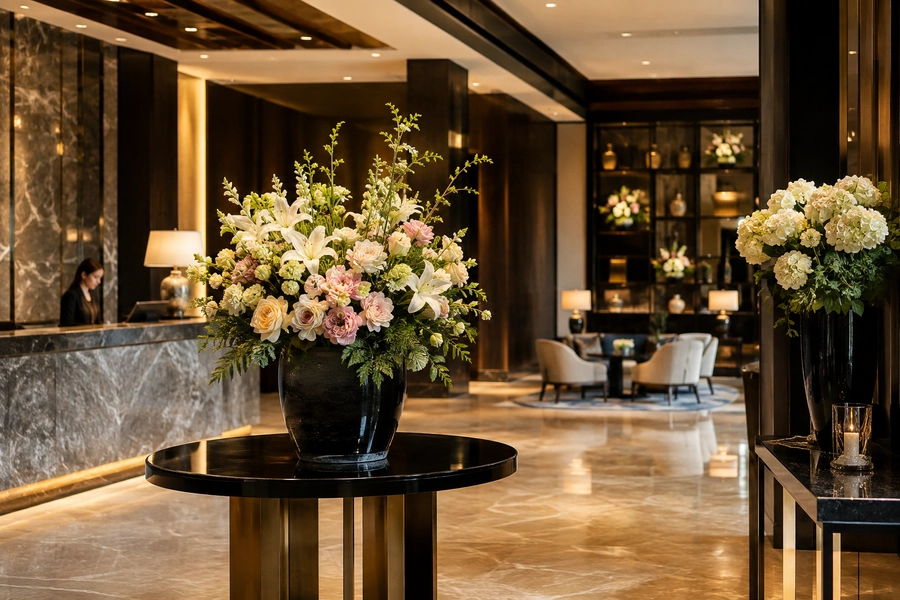
In this guide, “silk flowers” refers broadly to premium artificial flowers, many of which are now made from polyester, plastic, foam, coated fabric, wire, and other synthetic materials rather than literal silk.
Are Real or Silk Flowers Better for Hotel Lobbies?
The better material depends on the job assigned to the arrangement.
Real flowers are stronger when fragrance, seasonality, ceremony, and close-view authenticity matter. Silk flowers are stronger when the hotel needs consistent appearance, difficult placement, advance preparation, multi-property standardization, or lower recurring horticultural work. A hybrid lobby usually achieves the best balance between guest experience and operating control.
Hospitality research indicates that lobby aesthetics and biophilic design can influence guest emotions, perceived quality, satisfaction, hotel image, and behavioral intentions. However, these studies generally examine greenery or biophilic environments rather than isolating fresh cut flowers against artificial flowers. Hotels should therefore avoid claiming that a faux arrangement or one weekly bouquet will independently produce a measurable revenue increase.
Cornell hospitality guidance also emphasizes the importance of establishing a clear sense of arrival in the lobby. Flowers can support that arrival experience, but they must work with lighting, architecture, furniture, circulation, service, and brand positioning.
Real vs Silk at a Glance
| Decision Area | Real Flowers | Silk Flowers |
|---|---|---|
| Authenticity | Naturally strongest | Product- and styling-dependent |
| Scent | Natural, though not always desirable | Usually absent |
| Appearance over time | Changes and declines | Remains stable until dusty, faded, or damaged |
| Routine care | Water, recutting, cleaning, replacement | Dusting, reshaping, inspection |
| Natural-light requirement | Cut flowers do not need growing light, but heat and sun can shorten display life | No growing light required |
| Placement flexibility | Limited by water, temperature, access, and lifespan | High, subject to fire, dust, heat, and UV requirements |
| Multi-site consistency | Lower | High |
| Advance preparation | Limited by vase life | Strong |
| Seasonal authenticity | High | Requires deliberate product changes |
| Waste profile | Organic material plus packaging and transport | Mixed durable materials that should be reused |
| Close-view performance | Naturally convincing | Requires premium construction |
| High-level installation | Difficult to service frequently | Often more practical |
| Budget predictability | Recurring and variable | Higher initial cost, more predictable reuse |
What Costs Should Hotels Compare?
Comparing the purchase price of one fresh bouquet with one artificial arrangement produces an incomplete answer.
Hotels should calculate the full cost per display cycle, including sourcing, delivery, conditioning, installation, daily care, water changes, removal, cleaning, storage, repairs, replacement, disposal, and staff access. The correct comparison is the cost of maintaining an approved guest-facing standard—not the wholesale price of the flowers alone.
Fresh cut-flower care normally involves using a clean vase, recutting stems, removing submerged foliage, using clean water or preservative, and changing water regularly to limit bacterial buildup and premature decline.
Artificial flowers avoid vase-water care but still need reshaping, surface cleaning, inspection, and suitable storage. Afloral recommends routine dust removal, material-appropriate deeper cleaning, and reshaping artificial flowers to resemble their living counterparts.
Hotel Floral Cost Formula
Use:
Annual floral cost = flowers + delivery + installation + maintenance labor + replacements + cleaning + storage + damage + disposal − reusable residual value
For a fair comparison, include:
- Loading and unloading
- Florist or staff time
- Night or early-morning installation
- Water spill cleanup
- Vase cleaning
- Lift or ladder access
- Dusting
- Seasonal storage
- Damaged-stem replacement
- Event changes
- Emergency orders
- Disposal or composting
- Reusable components
Track Cost per Guest-Facing Day
A useful internal measure is:
Cost per guest-facing day = total display-cycle cost ÷ acceptable display days
This measure prevents a low-cost bouquet that declines quickly from appearing more economical than a higher-cost arrangement that maintains the required appearance for longer.
When Should Hotels Use Real Flowers?
Fresh flowers are most valuable where guests can experience their authentic qualities.
Use real flowers at high-contact, close-view locations where freshness reinforces service and occasion: the main reception desk, VIP welcome table, concierge counter, luxury lounge, restaurant host stand, wedding arrival point, and premium suite. Keep the number of fresh-flower zones limited enough to maintain them properly.
Fresh flowers make the strongest case when:
- Guests stand close to the arrangement
- Fragrance is compatible with the environment
- Seasonal change supports the brand
- A florist or trained team is available
- Water can be changed safely
- The hotel can replace declining stems promptly
- The arrangement marks a ceremony or special arrival
- Local or distinctive flowers reinforce the property story
Avoid Fresh Flowers Where:
- Water may reach electrical equipment
- Vases may be knocked into guest circulation
- Daily access requires ladders or lifts
- The display sits near intense heat
- The hotel cannot maintain water quality
- Strong fragrance may affect sensitive guests
- Fallen pollen may mark pale finishes
- The arrangement will remain unattended
- Replacement deliveries are unreliable
Real flowers should look intentionally fresh. A declining bouquet at the reception desk communicates weaker care than a well-made artificial arrangement in the same position.
When Should Hotels Use Silk Flowers?
Silk flowers perform best where operational stability matters more than natural change.
Use premium faux flowers on high shelves, elevator consoles, wall niches, dark corridors, architectural urns, guest-floor landings, meeting-room credenzas, seasonal backdrops, and repeated multi-property installations. Select products according to viewing distance, cleaning access, fire requirements, lighting, and expected reuse.
Artificial flowers are particularly useful when:
- The display must be prepared far in advance
- The hotel needs identical arrangements across sites
- The area is difficult to access
- Water creates operational risk
- Flowers must remain stable through a long event
- The location has little natural light
- The arrangement is mainly viewed from a distance
- Seasonal modules will be reused
- A property remains vacant periodically
- Replacement consistency matters
Commercial faux flowers still require periodic dusting and cleaning to remain convincing.
What Are the 13 Lobby Layouts That Protect the Budget?
The layouts below are operational formulas rather than universal interior-design rules.
The 13 layouts include a fresh arrival island, silk architectural urns, a hybrid reception desk, low lounge flowers, wall-niche faux displays, seasonal modular consoles, elevator-lobby arrangements, restaurant transition flowers, event overlays, greenery-first hybrids, rotating VIP pieces, multi-property kits, and a zone-based real-versus-silk master plan.
Layout 1: The Fresh Arrival Island
This layout uses one significant real arrangement as the lobby’s principal floral moment.
Place one premium fresh arrangement on a central arrival table where guests can see it immediately, then keep surrounding floral decoration restrained. Concentrating the fresh-flower budget in one highly visible position creates stronger impact than distributing several small, inconsistent bouquets around the lobby.
Best For
- Luxury hotels
- Boutique properties
- Resorts
- Heritage hotels
- Wedding-focused venues
- Properties with staffed floral maintenance
Recommended Structure
- One stable central table
- One correctly scaled fresh arrangement
- A wide, protected base
- Clear circulation around all sides
- Controlled flower fragrance
- No water or foliage overhanging guest paths
- One documented replacement schedule
Budget Protection
This layout reduces duplicated deliveries and allows maintenance staff to focus on one hero display.
A single focal point can support Cornell’s “sense of arrival” principle without turning the lobby into a collection of unrelated flower vases.
Main Risk
A central fresh arrangement is highly visible when it begins to decline. The hotel needs a defined refresh threshold rather than waiting until every flower has failed.
Layout 2: Two Silk Architectural Urns at the Entrance
Large matching urns create permanent arrival scale without requiring frequent fresh-flower replacement.
Place two premium silk arrangements beside the principal entrance, staircase, or architectural threshold. Use tall branches, limited focal flowers, and substantial greenery. Keep the silhouettes related rather than perfectly identical so repeated artificial components remain less obvious.
Best For
- High-ceiling lobbies
- Conference hotels
- Grand entrances
- Formal city hotels
- Properties with difficult delivery schedules
Recommended Flowers
- Magnolia branches
- Orchids
- Olive foliage
- Large roses
- Delphinium
- Hydrangea
- Seasonal removable accents
Budget Protection
The large urns, mechanics, and structural greenery can remain in service while a limited number of seasonal flower modules change.
This follows a reuse-first purchasing principle: retaining durable components and changing only what is necessary reduces purchasing and disposal at the source.
Main Risks
- Dust at upper levels
- Repeated branch patterns
- Unstable planters
- Inadequate fire documentation
- Flowers touching doors or guest circulation
Artificial decorative vegetation may be subject to fire-performance requirements depending on the jurisdiction, occupancy, quantity, material, and installation. Hotels should obtain project-specific approval rather than relying on a generic “commercial grade” label.
Layout 3: The Hybrid Reception Desk
This is one of the most practical hotel formulas.
Use a small or medium fresh arrangement where guests check in, then place permanent silk greenery or flowers behind the desk, on a high shelf, or inside an architectural niche. Guests experience authentic flowers at close range while the larger background remains operationally stable.
Suggested Mix
- Fresh orchids, roses, tulips, or seasonal local flowers on the desk
- Silk branches or greenery behind the team
- One coordinated vessel family
- Shared color palette
- Separate maintenance methods
Budget Protection
The hotel pays recurring fresh-flower costs only at the point of strongest guest contact.
The larger visual field is filled with reusable faux material, reducing the volume of fresh flowers replaced each cycle.
Main Risk
Do not place visibly weak faux flowers directly beside exceptional fresh flowers. The immediate comparison may expose artificial shine, repeated molds, and poor flower centers.
Layout 4: Low Real Flowers Around Lobby Seating
Low fresh arrangements can make a lounge feel cared for without competing with conversation or sightlines.
Place small, low real-flower arrangements on selected coffee or side tables rather than every surface. Use one flower family, one vessel style, and compact designs that staff can lift, clean, and replace quickly.
Best For
- Boutique lounges
- Afternoon-tea hotels
- Club floors
- Luxury residential-style lobbies
- Properties with seated check-in
Budget Formula
Instead of twelve different bouquets, use:
- Four approved arrangements
- Two alternating flower recipes
- One standard vase
- One replacement schedule
- One backup set of clean vessels
Budget Protection
Standardization lowers design time, simplifies ordering, and makes vase cleaning and replacement easier.
Main Risks
- Spilled water
- Guest handling
- Bags striking vases
- Fragrance near food and beverages
- Flowers blocking table use
Use low, stable containers and preserve enough surface for guests’ drinks, phones, documents, and personal items.
Layout 5: Silk Flowers in High Wall Niches
High niches create atmosphere but are expensive to service frequently.
Use premium artificial branches or sculptural faux flowers in elevated wall recesses, bookcases, ledges, and upper cabinetry. Keep the arrangement sparse enough for safe dusting and design it as removable modules rather than permanently filling the entire niche.
Best For
- Elevator waiting areas
- Lobby libraries
- Restaurant transitions
- High retail-style display walls
- Decorative reception backdrops
Budget Protection
This layout removes frequent florist access, water handling, and replacement work from elevated positions.
It can also reduce the need for repeated ladder or lift setup.
Main Risk
Low maintenance is not no maintenance. Elevated artificial flowers can collect dust unnoticed because guests view them from below.
Create:
- A safe access procedure
- A monthly inspection
- Removable trays
- Photographs of the approved arrangement
- A module replacement plan
Layout 6: The 80/20 Seasonal Console
This layout keeps most of the arrangement and changes only a limited seasonal layer.
Retain approximately 80% of the vase, mechanics, greenery, and neutral supporting flowers. Replace approximately 20% with spring blossom, summer color, autumn texture, holiday accents, or event-specific flowers. Treat the percentage as a planning tool rather than a mandatory stem count.
Example Rotation
| Reusable Base | Spring | Summer | Autumn | Winter |
|---|---|---|---|---|
| Olive and eucalyptus | Tulips | White roses | Rust dahlias | Hellebores |
| Neutral ceramic vase | Blossom | Hydrangea | Seed heads | Magnolia |
| Reusable grid | Pale yellow | Blue-green | Burgundy | Deep green |
Budget Protection
The hotel avoids buying four completely separate arrangements and reduces storage volume.
Source reduction and reuse rank above disposal in the EPA’s materials-management hierarchy, making modular seasonal replacement a more defensible purchasing strategy than replacing complete displays unnecessarily.
Main Risk
Seasonal accents must be compatible with the retained base. Adding unrelated colors or flower types each cycle can create clutter rather than freshness.
Layout 7: Silk Elevator-Lobby Consoles
Guest-floor elevator lobbies need consistency but often receive limited daily attention.
Use one narrow artificial arrangement or sculptural branch display on each elevator console. Standardize the vessel, maximum width, height, and floral recipe across floors while allowing small color differences to identify wings, room categories, or design zones.
Recommended Forms
- One magnolia branch
- Three-stem orchid
- Narrow olive arrangement
- Compact eucalyptus
- One premium seasonal module
Budget Protection
One approved design can be ordered, installed, photographed, cleaned, and repaired consistently across many floors.
Main Risks
- Arrangement extending into circulation
- Vases blocking directional signs
- Dust on rear-facing leaves
- Identical branches exposing repeated molds
- Loose top dressing entering the floor area
Use heavy vessels and mark each planter’s intended front.
Layout 8: Real Flowers at the Bar or Restaurant Threshold
The transition from lobby to food-and-beverage space is a strong location for authentic seasonal flowers.
Place a restrained real arrangement at the host stand, bar entrance, afternoon-tea display, or restaurant threshold. Keep the lobby’s larger background flowers artificial if necessary, but use fresh material where food, service, seasonality, and social activity become more immediate.
Best For
- Destination restaurants
- Afternoon tea
- Cocktail bars
- Resort dining
- Seasonal menus
- Wedding hotels
Budget Protection
The hotel concentrates fresh material where it can reinforce a revenue-generating outlet rather than distributing it indiscriminately.
This remains a strategic inference, not proof that flowers alone increase restaurant revenue.
Main Risks
- Strong fragrance near food
- Pollen
- Water spills
- Grease accumulation
- Flowers interfering with menus or payment equipment
Use cleanable, stable vessels and coordinate flower care with the food-and-beverage team.
Layout 9: Greenery-First Silk Base With Fresh Focal Flowers
This hybrid arrangement combines durable structure with authentic close-view detail.
Build the arrangement’s height, width, and volume with high-quality artificial foliage or branches. Insert a smaller number of replaceable fresh focal flowers in separate water-holding vessels or tubes, ensuring that moisture cannot reach materials not designed for wet use.
Suggested Ratio
A starting commercial mix may be:
- 50–70% reusable silk structure
- 30–50% fresh focal material
The correct percentage depends on viewing distance, flower size, maintenance access, and brand position.
Budget Protection
The hotel purchases fewer fresh stems while preserving natural flower centers, movement, scent, and seasonal variation where guests notice them most.
Important Construction Rule
Do not place fresh stems into dry floral foam or artificial-flower mechanics without an appropriate water system.
Keep real and faux components removable so the hotel can:
- Replace fresh flowers
- Clean artificial foliage
- Inspect water containers
- Repair individual modules
- Store seasonal pieces
Main Risk
Artificial foliage may become dusty while fresh focal flowers remain bright. Both materials require separate inspection schedules.
Layout 10: Low 360-Degree Hybrid Lounge Bowl
A round lobby seating area requires a finished appearance from every side.
Use a low bowl with reusable silk foliage and several fresh focal flowers positioned around the complete circumference. Keep the arrangement below primary sightlines and leave enough open table space for drinks, phones, and guest belongings.
Best For
- Circular lounge seating
- Central coffee tables
- Club lounges
- Residential-style lobbies
- VIP waiting areas
Budget Protection
The reusable structure reduces the number of fresh stems needed for full 360-degree coverage.
Design Formula
Use:
- Three low fresh focal flowers
- Six smaller fresh or premium silk flowers
- Six silk foliage or texture elements
- One reusable mechanical grid
- One stable low bowl
Main Risk
A hybrid table arrangement may be viewed from less than one meter away. The silk components therefore need stronger realism than flowers installed high above eye level.
Layout 11: Silk Window and Photography Backdrop
Many hotel lobbies now function as social, event, and photography spaces.
Use modular artificial flowers for dramatic backdrops, staircase rails, branded alcoves, and photography points. Keep the display separate from the primary circulation route and design it so seasonal flowers, signage, and event colors can be changed without replacing the complete structure.
Hospitality studies indicate that aesthetic environments and greenery can affect guest attention, emotional responses, hotel image, and booking-related perceptions, though these effects depend on the complete environment rather than floral decoration alone.
Budget Protection
A reusable structure can serve:
- Weddings
- Conferences
- Holidays
- Brand campaigns
- Afternoon tea
- Hotel photography
- Social events
Main Risks
- Fire-performance requirements
- Poorly secured overhead flowers
- Blocking exits or signs
- Visible cable ties
- Repeated wall-panel patterns
- Guest damage
- Difficult dusting
Use numbered removable panels and inspect attachments before every event.
Layout 12: Temporary Real-Flower Event Overlay
Hotels do not need to redesign the permanent lobby whenever a wedding, conference, or VIP arrival occurs.
Keep the permanent lobby arrangement neutral and largely artificial, then add temporary real flowers at the registration table, welcome sign, central arrival point, or event desk. Remove the overlay after the event while retaining the underlying hotel décor.
Best For
- Weddings
- Corporate events
- Product launches
- VIP arrivals
- Holiday meals
- Press events
Budget Protection
The hotel pays for real flowers only when an event, guest package, or client contract justifies the expense.
The permanent lobby remains operational before and after the occasion.
Contract Questions
Clarify:
- Who supplies the flowers?
- Who installs and removes them?
- Who protects hotel furniture?
- Who cleans water spills?
- Who disposes of organic material?
- Which vases belong to the hotel?
- Which fire and access rules apply?
- When must the lobby return to standard presentation?
This prevents event flowers from creating unplanned hotel labor.
Layout 13: The Zone-Based Real-vs-Silk Master Plan
The strongest budget layout treats the complete lobby as several operational zones.
Assign real flowers to close-view, high-emotion, and revenue-supporting zones. Assign silk flowers to high, dark, remote, repeated, and difficult-to-service zones. Leave some areas without flowers so the lobby retains visual hierarchy and maintenance remains concentrated.
Zone Matrix
| Lobby Zone | Recommended Starting Material | Reason |
|---|---|---|
| Main arrival table | Real or premium hybrid | Highest emotional visibility |
| Reception desk | Small real arrangement | Close guest contact |
| Reception backdrop | Silk | Consistent, low-access visual volume |
| High architectural urns | Silk | Difficult recurring maintenance |
| Lounge coffee tables | Low real or hybrid | Close-view hospitality |
| Elevator consoles | Silk | Multi-floor consistency |
| Restaurant host stand | Real | Seasonal and service connection |
| Wall niches | Silk | No water and limited access |
| Photography backdrop | Modular silk | Reuse across events |
| VIP welcome table | Real | Occasion and personalization |
| Dark corridor | Silk | No biological or water requirement |
| Temporary event desk | Real overlay | Client-funded occasion |
| Administrative or service area | Minimal or none | Budget and operational focus |
Budget Protection
This layout avoids the two most expensive extremes:
- Replacing fresh flowers throughout the complete lobby
- Filling every location with permanent artificial flowers that later become dusty and visually repetitive
A zone plan concentrates both expenditure and maintenance where they create the greatest visible value.
Which Lobby Layout Is Best for Each Hotel Type?
Different hotel categories require different floral priorities.
Luxury Hotel
Use:
- Fresh arrival island
- Fresh reception flowers
- Silk architectural background
- Real flowers in restaurant and VIP areas
- Modular event overlay
The guest encounters authentic flowers closely, while large-scale volume remains manageable.
Boutique Hotel
Use:
- One distinctive real arrangement
- Seasonal local flower story
- Minimal silk support
- Small lounge flowers
- One reusable event backdrop
The floral design should feel specific to the property rather than standardized.
Business Hotel
Use:
- Hybrid reception desk
- Silk elevator consoles
- One seasonal lobby arrangement
- Limited conference overlays
- No unnecessary flowers in service zones
Consistency and low operational interruption are priorities.
Resort
Use:
- Real flowers at arrival and food-and-beverage thresholds
- Silk flowers in high or climate-challenging interiors
- Modular tropical backdrops
- Outdoor-rated faux only where specifically documented
- Local living landscape where supportable
Extended-Stay Hotel
Use:
- Premium silk arrival arrangement
- Small real flowers only for events or VIP packages
- Silk elevator consoles
- Minimal seasonal changes
- Easy-clean broad foliage
A stable, lower-frequency program may align better with the operating model.
Economy Hotel
Use:
- One strong artificial reception arrangement
- One reusable seasonal module
- No scattered small vases
- Easy-clean flowers
- A strict dusting schedule
One well-maintained focal display will usually look more intentional than numerous low-quality arrangements.
How Can Hotels Stop Silk Flowers From Looking Cheap?
Artificial flowers look inexpensive when their construction becomes more noticeable than the overall design.
Choose realistic flower centers, botanical color variation, matte or species-appropriate surfaces, flexible stems, and convincing leaves. Reshape every product, hide foam and wire, use substantial vessels, vary bloom direction, and leave negative space. Replace faded or visibly damaged focal stems promptly.
Commercial Realism Checklist
- Several related color tones
- Different bloom stages
- Varied flower angles
- Detailed centers
- No exposed glue
- No visible wire
- Strong calyx-to-stem transition
- Correct vessel scale
- No uniform plastic shine
- No completely symmetrical canopy
- Clean rear leaves
- Hidden starter pots
- Stable mechanics
Artificial flowers should be evaluated under the lobby’s actual lighting. Strong spotlights can reveal gloss, molded seams, and repeated leaves that remain hidden in product photography.
How Can Hotels Extend Fresh-Flower Value?
Fresh flowers protect the budget only when their usable display period is managed carefully.
Begin with healthy flowers, use clean tools and vessels, recut stems, remove foliage below the water line, follow preservative instructions, replace the water regularly, and keep arrangements away from avoidable heat. Remove declining stems before they reduce the appearance of the complete arrangement.
Penn State and University of Minnesota Extension recommend clean vases, fresh stem cuts, removal of foliage below the water line, clean water, and regular water changes as core cut-flower care practices.
Use Long-Lasting Flowers Strategically
Depending on season and supplier quality, hotels may consider:
- Carnations
- Chrysanthemums
- Alstroemeria
- Orchids
- Anthuriums
- Selected roses
- Protea
- Long-lasting foliage
Actual vase life varies with cultivar, freshness, transport, conditioning, water quality, temperature, and care. Run property-specific trials rather than accepting a universal lifespan claim.
Remove Individual Failures
A fresh arrangement does not always need total replacement because one flower has declined.
Design it so staff can:
- Remove damaged stems
- Rebalance the composition
- Replace one focal group
- Refresh water
- Clean the vase
- Retain healthy foliage
How Should Hotels Measure Whether the Layout Protects the Budget?
A floral plan should be evaluated after several display cycles.
Floral Performance Scorecard
| Metric | What It Reveals |
|---|---|
| Annual fresh-flower spend | Recurring purchase burden |
| Artificial-flower investment | Long-life asset cost |
| Acceptable display days | Real service value |
| Installation hours | Operational complexity |
| Maintenance hours | Hidden labor |
| Emergency replacements | Planning or quality failures |
| Water incidents | Operational risk |
| Dust-related complaints | Faux maintenance weakness |
| Guest mentions or survey responses | Perceived floral relevance |
| Reused components | Asset utilization |
| Storage damage | Packaging weakness |
| Discarded components | Waste and specification failure |
| Cost per lobby zone | Allocation efficiency |
| Cost per guest-facing day | Cross-material comparison |
Ask the Right Questions
Do not ask only:
Which arrangement cost less?
Ask:
- Which arrangement remained acceptable longer?
- Which one required more staff attention?
- Which one supported the intended guest experience?
- Which one created cleaning or safety problems?
- Which one can be reused?
- Which components failed first?
- Which zone did guests actually notice?
- Was the design appropriate for the hotel category?
What Are the Biggest Real-vs-Silk Mistakes?
| Mistake | Result | Better Decision |
|---|---|---|
| Fresh flowers everywhere | High replacement and labor | Concentrate fresh flowers |
| Silk flowers everywhere | Repetitive or inauthentic impression | Use authentic focal points |
| Cheap faux beside premium fresh | Immediate quality contrast | Separate or upgrade faux |
| No maintenance schedule | Dust or declining flowers | Define inspection intervals |
| Giant arrangements on small desks | Operational obstruction | Scale by function |
| Water beside electronics | Spill risk | Relocate or use silk |
| High fresh flowers | Expensive access | Use premium faux |
| Permanent glued seasonal displays | Limited reuse | Use removable modules |
| No retained faux sample | Color mismatch | Store a reference stem |
| No vase standard | Higher replacement complexity | Standardize vessels |
| Ignoring fragrance | Guest discomfort | Select low-scent flowers |
| Generic “fireproof” claim | Compliance uncertainty | Verify exact documentation |
| Counting only flower cost | False savings | Calculate lifetime cost |
My Insights: Flowers for Hotels—Real vs Silk: Which 13 Lobby Layouts Protect the Budget
The strongest hotel floral program is not defined by whether the flowers are real or artificial. It is defined by how accurately each material is assigned to the guest experience and operational requirements of its location.
The 13 budget-protecting layouts use fresh flowers for high-contact arrival, reception, dining, VIP, and event moments; silk flowers provide architectural scale, high-level decoration, elevator consistency, modular backdrops, and seasonal reuse. Hybrid layouts protect the budget most effectively because they concentrate authenticity while reducing unnecessary recurring volume.
The 13-Layout Summary
| Layout | Main Budget Advantage |
|---|---|
| 1. Fresh arrival island | Concentrates fresh impact |
| 2. Silk entrance urns | Reuses large architectural volume |
| 3. Hybrid reception desk | Combines authenticity and consistency |
| 4. Low real lounge flowers | Targets close guest contact |
| 5. Silk wall niches | Reduces difficult servicing |
| 6. 80/20 seasonal console | Reuses most components |
| 7. Silk elevator consoles | Standardizes multiple floors |
| 8. Real restaurant transition | Focuses freshness near revenue activity |
| 9. Silk base with fresh focal flowers | Reduces fresh stem volume |
| 10. Low hybrid lounge bowl | Provides close-view 360-degree design |
| 11. Modular silk backdrop | Reuses event structure |
| 12. Real event overlay | Assigns temporary cost to occasions |
| 13. Zone-based master plan | Matches material to each location |
My Central Insight
A hotel should purchase authenticity by the guest-contact zone and durability by the operational zone.
This means:
- Real flowers where guests stand close
- Silk flowers where staff cannot service easily
- Fresh seasonal accents where occasion matters
- Reusable faux structure where volume matters
- No flowers where the location adds little guest value
The Best Luxury Formula
For a luxury hotel lobby:
- One large real arrival arrangement
- One small real reception arrangement
- Two silk architectural urns
- Silk elevator-lobby arrangements
- Real restaurant flowers
- Modular silk event backdrop
- Fresh VIP overlays when required
This formula preserves authentic close-view encounters without replacing every large floral component each week.
The Best Midscale Formula
For a midscale property:
- One premium hybrid reception arrangement
- Two reusable silk console displays
- One 80/20 seasonal module
- Small real flowers only for events or premium packages
- No decorative flowers in low-value service zones
This places the strongest floral spend at arrival while controlling recurring replacement.
The Best Economy Formula
For an economy property:
- One premium artificial arrangement at reception
- One stable, substantial vase
- One reusable greenery base
- Two or three seasonal accent modules
- Weekly dust inspection
- Immediate replacement of visibly damaged focal stems
One convincing, clean display is stronger than several small arrangements with inconsistent materials.
The Best Waste-Reduction Formula
Use:
- Standard vessels
- Reusable mechanics
- Neutral artificial greenery
- Removable seasonal flowers
- Repairable modules
- Fresh flowers only where justified
- Composting or suitable organic handling for real flowers where available
- Documented reuse and retirement records for faux materials
The EPA’s hierarchy prioritizes source reduction and reuse before recycling and disposal. For hotels, this supports buying fewer compatible assets and using them repeatedly rather than continually replacing complete designs.
The Most Important Fresh-Flower Rule
Do not continue paying for fresh flowers in a zone where guests cannot experience their freshness.
A fresh arrangement on a high ledge may create:
- Expensive access
- Water-handling difficulty
- Limited fragrance experience
- Low close-view authenticity
- More frequent replacement
Use fresh flowers where their natural qualities can be perceived.
The Most Important Silk-Flower Rule
Do not leave artificial flowers in place merely because they have not wilted.
They still become:
- Dusty
- Faded
- Misshapen
- Repetitive
- Damaged
- Visually outdated
Build cleaning, reshaping, seasonal rotation, and replacement into the annual operating plan.
The Most Important Hybrid Rule
Do not mix real and silk flowers randomly.
Use a clear visual hierarchy:
- Real focal flowers
- Silk structural greenery
- Separate water mechanics
- Coordinated colors
- Removable modules
- Different maintenance procedures
The guest should experience one coherent arrangement rather than a visible compromise between materials.
My Preferred Hotel Planning Sequence
Use this order:
- Map every lobby zone.
- Record normal viewing distance.
- Identify guest-contact intensity.
- Measure maintenance access.
- Review water, lighting, and fire constraints.
- Select real, silk, hybrid, or no flowers.
- Build one physical sample for each zone.
- Calculate full display-cycle cost.
- Test maintenance and replacement procedures.
- Photograph and document the approved layout.
- Standardize vessels and mechanics.
- Create seasonal modules.
- Review costs and condition after each cycle.
My Final Budget Rule
Do not ask whether real or silk flowers are cheaper in isolation.
Ask which material can deliver the required lobby experience at that exact viewing distance, with acceptable maintenance, safety, reuse, and replacement costs.
The answer may be:
- Real at reception
- Silk above eye level
- Hybrid on the arrival table
- Modular silk for events
- No flowers in low-value corners
That is not inconsistency. It is disciplined hotel floral planning.
Conclusion
Use real flowers for authentic close-view moments, silk for scale and difficult access, and hybrid layouts to concentrate guest impact while controlling maintenance, replacement, and waste.