
Cheap fake plants can make a carefully decorated room feel unfinished when glossy leaves, identical branches, and tiny plastic pots reveal the illusion immediately.
The best fake plants for home include olive trees, fiddle-leaf figs, bird of paradise, monstera, snake plants, rubber plants, ZZ plants, ficus, palms, pothos, orchids, and realistic succulents. Choose species with naturally structured foliage, varied leaf sizes, believable trunks, flexible stems, and matte or species-appropriate surfaces.
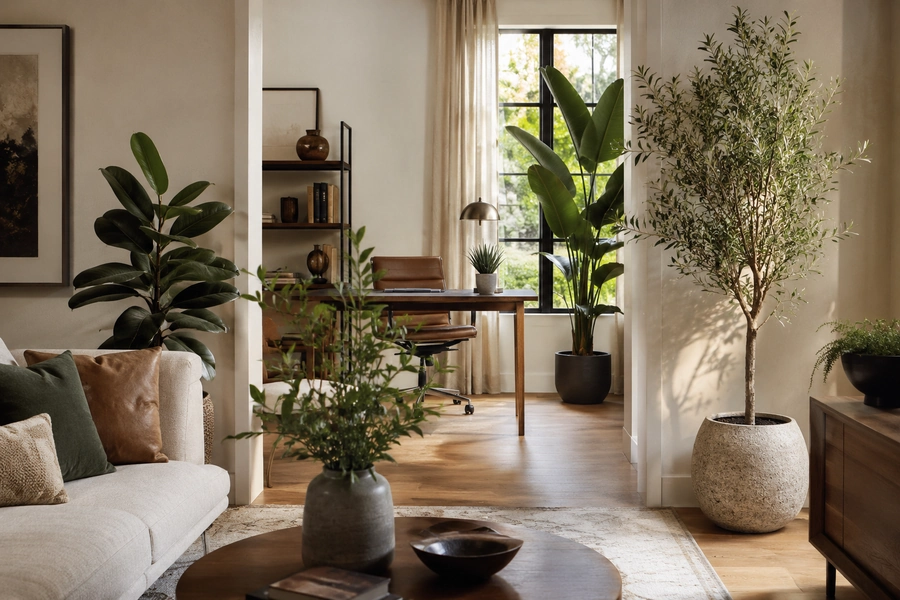
The strongest home setup does not fill every corner with artificial greenery. It uses a few correctly scaled plants where they solve a visual problem: an empty living-room corner, a dark bookshelf, a home-office background, or a desk that needs softer organic shapes.
What Makes the Best Fake Plants for Home Look Real?
Artificial plants look convincing when the entire object makes botanical sense, not merely when one leaf has realistic printing.
Look for irregular branch spacing, multiple shades of green, several leaf sizes, visible veins, believable stems, and enough flexibility to reshape the plant after shipping. Avoid perfect symmetry, one-tone foliage, hard plastic shine, exposed foam, repeated leaf molds, and undersized nursery pots.
Balsam Hill’s current guidance identifies plants with naturally waxy or structured leaves—including fiddle-leaf figs, olive trees, and snake plants—as particularly suitable for realistic artificial reproduction. It also recommends natural-looking stems and leaf-color variation.
The Spruce tested 18 artificial plants for realism, durability, ease of styling, and dust collection. Its stronger performers shared characteristics such as realistic leaf texture, flexible stems, stable bases, varied foliage, and shapes that recovered well after unpacking.
Use This 10-Point Realism Test
| Feature | Expensive-Looking | Artificial-Looking |
|---|---|---|
| Leaf color | Several related greens | One flat green |
| Texture | Matte or naturally waxy | Hard uniform shine |
| Leaf size | Mixed | Identical |
| Stem direction | Varied | Perfectly symmetrical |
| Trunk | Textured and irregular | Smooth molded pole |
| Branch spacing | Open and organic | Equal spacing |
| New growth | Smaller/lighter leaves | Every leaf identical |
| Base | Concealed | Visible black nursery pot |
| Planter scale | Matches canopy | Too small |
| Shape | Natural asymmetry | Perfect cone or ball |
Check the Viewing Distance
A plant beside a sofa may be inspected from less than a meter away. A tree behind a home-office desk may primarily appear on video calls.
That changes what matters.
For close viewing, prioritize:
- Detailed veins
- Natural edges
- Convincing stems
- Minimal visible glue
- Good leaf undersides
- Realistic trunk transitions
For background use, prioritize:
- Overall silhouette
- Scale
- Color
- Branch movement
- Planter quality
A slightly less detailed tree may still look excellent from three meters away if its proportion and shape are convincing.
Match Artificial Texture to the Real Plant
Naturally firm or waxy foliage often translates particularly well into artificial construction.
That makes the following categories easier starting points:
- Snake plants
- Rubber plants
- ZZ plants
- Monstera
- Bird of paradise
- Orchids
- Agave
- Succulents
Fine, translucent, highly delicate leaves can also look convincing, but manufacturing quality becomes more important.
Do Not Forget the Planter
A realistic tree inside a tiny black transportation pot rarely looks finished.
Move it into:
- Matte ceramic
- Stoneware
- Textured fiberglass
- Terracotta-style composite
- Woven basket
- Wood planter
- Stone-effect pot
Then conceal the original base with:
- Moss
- Bark
- River stones
- Artificial soil
- A fitted planter insert
The goal is to make the entire plant look intentional, not merely the foliage.
Which 21 Fake Plants Look Most Real in Living Rooms and Home Offices?
The best choices combine convincing artificial construction with shapes that suit normal residential layouts.
For large living rooms, olive trees, fiddle-leaf figs, ficus, palms, and bird of paradise provide scale. Home offices benefit from snake plants, ZZ plants, rubber plants, dracaena, pothos, and philodendron. Orchids, succulents, Alocasia, and maidenhair work particularly well on desks, shelves, consoles, and side tables.
Quick Ranking
| Rank | Fake Plant | Best Home Location | Realism Strength |
|---|---|---|---|
| 1 | Olive tree | Living-room corner | Open irregular canopy |
| 2 | Fiddle-leaf fig | Sofa or console area | Bold textured leaves |
| 3 | Bird of paradise | Large living room | Naturally waxy foliage |
| 4 | Monstera | Modern living room | Graphic varied leaves |
| 5 | Rubber plant | Home office | Substantial dark foliage |
| 6 | Snake plant | Desk or narrow corner | Naturally structured leaves |
| 7 | ZZ plant | Office credenza | Smooth believable foliage |
| 8 | Ficus tree | Living room | Familiar full canopy |
| 9 | Kentia palm | Relaxed living room | Airy natural silhouette |
| 10 | Areca palm | Large bright room | Soft tropical volume |
| 11 | Dracaena | Office corner | Controlled vertical shape |
| 12 | Pothos | Bookshelf | Natural trailing habit |
| 13 | Philodendron | Shelf or cabinet | Relaxed heart-shaped leaves |
| 14 | Alocasia zebrina | Side table | Sculptural large leaves |
| 15 | Eucalyptus | Neutral interiors | Muted botanical color |
| 16 | Boston fern | Shelf or plant stand | Detailed soft texture |
| 17 | Phalaenopsis orchid | Desk or console | Refined floral form |
| 18 | Bamboo | Reading corner | Light vertical screening |
| 19 | Agave | Modern office | Architectural shape |
| 20 | Succulent | Desk | Molded leaves suit replication |
| 21 | Maidenhair-style plant | Bookshelf | Fine compact softness |
1. Artificial Olive Tree—Best Overall
Olive trees are among the most versatile artificial plants for contemporary homes.
Their fine gray-green leaves and open branch structure add height without creating a dark visual wall.
The Spruce’s testing found an artificial olive tree effective for vertical spaces, highlighting realistic veined leaves, adjustable branches, and a convincing overall form.
Choose:
- Muted green leaves
- Visible internal branches
- Irregular canopy
- Several branch lengths
- A textured trunk
Best placement:
- Beside the sofa
- Behind an accent chair
- Next to a console
- Home-office background
Avoid shaping it into a perfect sphere.
2. Artificial Fiddle-Leaf Fig—Best Bold Living-Room Tree
Fiddle-leaf figs make strong visual anchors because their leaves are broad and recognizable.
Balsam Hill identifies fiddle-leaf figs among plant forms that can translate convincingly into artificial materials because the living foliage already has substantial structure.
Look for:
- Deep veining
- Different leaf sizes
- Curved edges
- Natural green variation
- Controlled sheen
Place one beside a large sofa, fireplace, media console, or reading chair.
3. Artificial Bird of Paradise—Best Statement Pick
Bird of paradise works particularly well in large rooms.
Its naturally smooth, broad leaves make convincing artificial versions possible when the veins, stems, and finish are handled carefully.
The Spruce included a faux bird of paradise among its tested top selections for home interiors.
Use it where the plant has enough empty space around its canopy.
Avoid squeezing it between furniture.
4. Artificial Monstera—Best for Modern Interiors
Monstera provides one of the strongest graphic silhouettes.
A tested faux monstera reviewed by The Spruce benefited from varied stem heights, leaf colors, realistic veining, and flexible construction.
The strongest version includes:
- Young leaves with fewer splits
- Mature leaves with larger openings
- Different leaf sizes
- Several stem heights
Turn some leaves sideways so repeated molds are harder to detect.
5. Artificial Rubber Plant—Best for Home Offices
Dark-green rubber foliage pairs especially well with desks, bookshelves, walnut furniture, leather, and black metal.
Its naturally substantial leaf surface means a small number of leaves can create significant visual impact.
Use one:
- Beside the desk
- Behind an office chair
- Beside a filing cabinet
- Near a bookcase
Avoid overly glossy versions.
6. Artificial Snake Plant—Best for Narrow Spaces
Snake plants require very little horizontal room.
They work beside:
- Desks
- Doorways
- Bookcases
- Media cabinets
- Filing units
Balsam Hill includes snake plants among artificial varieties whose naturally structured leaves can make realistic replicas particularly convincing.
Look for several leaf heights rather than a uniform row.
7. Artificial ZZ Plant—Best Compact Floor or Cabinet Plant
ZZ plants have smooth, orderly foliage that adapts well to artificial materials.
They work beautifully in home offices because they offer greenery without creating a large visual distraction behind a workstation.
Use:
- Several stem heights
- Varied leaf angles
- Dark and medium greens
- A simple ceramic planter
Avoid leaves with an oily-looking surface.
8. Artificial Ficus Tree—Best for Filling an Empty Corner
Ficus gives greater canopy volume than an olive tree.
It works when a room has one obviously empty corner that needs visual weight.
Choose:
- Irregular branch spacing
- Several foliage shades
- A convincing trunk
- Visible openings through the canopy
Avoid an excessively dense artificial dome.
9. Artificial Kentia Palm—Best Relaxed Luxury Pick
Kentia palms have a softer, more elegant profile than many dense artificial palms.
They suit:
- Calm living rooms
- Reading corners
- Bedroom sitting areas
- Larger home offices
Allow several fronds to curve downward rather than forcing everything upward.
Fine palm foliage requires more dusting than broad-leaf alternatives.
10. Artificial Areca Palm—Best for Tropical Volume
Choose Areca when a room needs more greenery than a Kentia provides.
It works well behind:
- Sectional sofas
- Lounge chairs
- Large desks
- Room dividers
The main risk is excessive density.
Remove or bend repeated fronds until internal space becomes visible.
11. Artificial Dracaena—Best Clean Vertical Office Plant
Dracaena provides height while occupying relatively little floor space.
It works beside:
- Standing desks
- Storage cabinets
- Home-office doors
- Reading chairs
Real dracaenas are among the indoor plants University of Minnesota Extension lists for lower-light conditions, so their presence also feels visually plausible in ordinary home interiors.
Artificial versions eliminate the plant-care requirement entirely.
12. Artificial Pothos—Best Bookshelf Plant
Pothos is one of the easiest ways to soften hard shelving.
Use it on:
- Bookcases
- Kitchen shelving
- Home-office cabinets
- Floating shelves
- Media units
Afloral specifically highlights hanging artificial plants for bookshelves and home-office spaces because they provide trailing greenery without sunlight or watering.
Use vines of different lengths.
Avoid four identical trails hanging straight downward.
13. Artificial Philodendron—Best Relaxed Trailing Pick
Heart-leaf philodendron provides a softer alternative to pothos.
It works in:
- Informal living rooms
- Reading corners
- Home libraries
- Office shelves
University of Minnesota Extension lists real philodendron among lower-light indoor plants, making the botanical form familiar in interior settings.
Allow part of the vine to rest on the shelf rather than hanging every branch.
14. Artificial Alocasia Zebrina—Best Sculptural Table Plant
Alocasia zebrina combines broad leaves with distinctive stems.
The Spruce included a tested artificial Alocasia among its strongest tabletop options, noting its visual character and stable construction.
Best locations:
- Console
- Side table
- Credenza
- Large desk corner
Because the design uses relatively few leaves, each one must look good.
15. Artificial Eucalyptus—Best for Neutral Homes
Eucalyptus works with Scandinavian, minimalist, coastal, farmhouse, and warm-modern interiors.
Its gray-green foliage coordinates naturally with:
- Cream
- Beige
- Oak
- Linen
- Soft gray
- Terracotta
Use it as a small tree, loose branch arrangement, or shelf plant.
Pale leaves reveal dark dust quickly, so keep them on an accessible cleaning schedule.
16. Artificial Boston Fern—Best for Soft Texture
A fern can soften the straight edges of desks, cabinets, and shelving.
Use it where a room contains a lot of:
- Wood
- Metal
- Rectangular furniture
- Screens
- Bookshelves
The trade-off is cleaning.
Its many small leaflets collect more visible dust than a snake plant, rubber plant, or Alocasia. The Spruce included dust accumulation as one of the criteria in its artificial-plant testing.
17. Artificial Phalaenopsis Orchid—Best Desk Flowering Plant
An orchid adds flowers without creating the fullness of a floral bouquet.
It suits:
- Home-office desk
- Entry console
- Sideboard
- Bathroom vanity
- Bedroom dresser
The Spruce included an artificial orchid in its tested selections, noting that the complete form can remain visually effective at ordinary viewing distances even when close inspection reveals the artificial construction.
Choose:
- Detailed flower centers
- Buds plus open flowers
- Thick lower leaves
- Artificial roots or bark
- Curved stems
18. Artificial Bamboo—Best for Vertical Screening
Bamboo provides partial screening without creating a solid wall.
It can separate:
- Desk and living area
- Reading corner and sofa
- Open-plan work area
- Entry and lounge
Choose several cane thicknesses and irregular leaf clusters.
Avoid identical canes spaced evenly like fence posts.
19. Artificial Agave—Best Architectural Pick
Agave suits contemporary, desert-modern, industrial, and minimalist interiors.
Its molded leaves make it relatively easy to clean.
Use it near:
- Low cabinets
- Concrete surfaces
- Modern desks
- Sculptural furniture
Keep rigid leaves away from narrow circulation routes.
20. Artificial Succulent—Best Desk Pick
Small succulents work particularly well on desks because naturally thick botanical leaves can be convincingly replicated with molded materials.
Use one rather than a collection of numerous tiny pots.
A substantial container makes a small faux succulent look more intentional.
Good locations include:
- Desk corner
- Bookshelf
- Side table
- Video-call background shelf
21. Artificial Maidenhair-Style Plant—Best Small Softener
Maidenhair-style foliage gives a shelf or console a fine, relaxed texture without requiring a large plant.
Use it in:
- Home libraries
- Reading rooms
- Smaller offices
- Soft traditional living rooms
Its main disadvantage is dusting complexity.
Place it where you can reach every side rather than on an inaccessible high shelf.
How Should You Style Fake Plants in a Living Room?
Living rooms benefit from scale and hierarchy more than quantity.
Use one tall artificial tree as the main anchor, one medium plant near another furniture group, and one small trailing or tabletop plant. Repeat planter materials or green tones so the room feels coordinated, then leave some corners intentionally empty instead of surrounding every chair with foliage.
Formula 1: The Large Living-Room Corner
Use:
- One 5–7 ft olive, ficus, fiddle-leaf fig, or bird of paradise
- One substantial planter
- One small side-table succulent or orchid
Best for:
- Sectional sofas
- Tall ceilings
- Large windows
- Open-plan rooms
A large tree should visually connect the furniture to the room’s vertical architecture.
Formula 2: The Sofa + Console Formula
Behind or beside the sofa:
- One olive or rubber plant
On the console:
- One eucalyptus branch arrangement
- Or one small orchid
This creates two heights without turning the room into a greenhouse.
Formula 3: The Bookshelf Formula
Use:
- One pothos or philodendron
- One compact succulent
- Books and decorative objects
Do not place a fake plant on every shelf.
One trailing plant crossing several shelf levels creates more natural movement.
Afloral specifically recommends artificial hanging greenery for shelves and other locations where year-round appearance and easy rearrangement are useful.
Formula 4: The Television Wall
Use one tall narrow plant at only one side of the media console.
Best picks:
- Snake plant
- Dracaena
- Olive tree
- Rubber plant
Avoid matching artificial trees on both sides unless the room has a deliberately formal design.
Formula 5: The Reading Corner
Combine:
- One Kentia palm or olive tree
- One chair
- One floor lamp
- One small table
The plant should help define the corner without blocking the lamp or encroaching on the chair.
Keep Negative Space
Artificial plants often look less convincing when there are too many.
Negative space allows guests to see:
- The trunk
- Individual leaves
- The planter
- Furniture
- Wall art
One correctly scaled tree can look more expensive than five small faux plants scattered throughout the room.
Use the Right Height
As a starting point:
| Furniture | Plant Scale |
|---|---|
| Large sectional | Tall tree |
| Accent chair | Medium/tall plant |
| Console | Medium branch or tabletop plant |
| Coffee table | Small compact plant |
| Bookshelf | Trailing or compact foliage |
| Fireplace mantel | Minimal stem or no plant |
| TV console | One narrow floor plant |
Scale should respond to the actual room rather than a rigid formula.
How Should You Choose Fake Plants for a Home Office?
A home-office plant should improve the background and room balance without using valuable desk space or creating a complicated cleaning problem.
Choose narrow floor plants beside workstations, trailing greenery on shelves, and one compact plant on a desk or credenza. Snake plants, ZZ plants, rubber plants, dracaena, pothos, philodendron, and orchids offer the strongest balance of realism, controlled size, and easy maintenance for most home offices.
Artificial greenery is particularly practical where a workspace does not provide the light required by a living plant. Afloral explicitly describes faux plants as useful for offices where suitable plant-growing conditions are absent, while University of Minnesota Extension notes that even genuine low-light plants still require usable light.
Formula 1: The Video-Call Background
Behind the desk, use:
- One olive tree
- Or one rubber plant
- Or one dracaena
Then add one pothos on a shelf.
Do not position foliage directly behind your head on camera. Offset the main plant so its silhouette frames the workspace.
Formula 2: The Small Office
Use:
- One snake plant on the floor
- One compact ZZ or succulent on a shelf
Skip the large tree.
The goal is to make the room feel softer without sacrificing movement.
Formula 3: The Executive Home Office
Use:
- One large olive or rubber plant
- One orchid on a credenza
- Coordinated ceramic planters
This works particularly well with:
- Walnut desks
- Leather chairs
- Built-in bookshelves
- Neutral walls
Formula 4: The Windowless Home Office
Use species people already associate with interior environments:
- Snake plant
- ZZ plant
- Pothos
- Philodendron
- Dracaena
University of Minnesota Extension includes all five among lower-light living plants.
The artificial versions do not biologically need light, but using botanically plausible species can make the room styling feel more believable.
Formula 5: The Shelf-Heavy Office
Use trailing plants rather than multiple floor pots.
Try:
- Pothos
- Philodendron
- Maidenhair
- Small fern
Vary the vine lengths and keep some shelf areas free.
Cleanability Matters
For the easiest maintenance, prioritize:
Low cleaning burden
- Snake plant
- ZZ plant
- Rubber plant
- Monstera
- Bird of paradise
- Alocasia
- Agave
- Succulents
Higher cleaning burden
- Areca palm
- Kentia palm
- Boston fern
- Maidenhair
- Dense ficus
- Fine eucalyptus
- Pothos
Afloral recommends regular dusting with a soft cloth or feather duster and a gentle damp wipe where appropriate for the product.
Balsam Hill similarly recommends regular maintenance of artificial plants, with the exact cleaning method determined by the product.
Do Not Mistake Faux Greenery for the Whole Workspace
Artificial plants can soften a home office visually, but they do not replace:
- Good lighting
- Comfortable furniture
- Ventilation
- Screen ergonomics
- Outdoor breaks
- Real nature exposure
They are décor tools first.
My Insights: Best Fake Plants for Home—Which 21 Picks Look Real in Living Rooms and Home Offices
The best fake plant is not necessarily the product with the greatest number of leaves. The strongest choice is the plant whose natural shape translates convincingly into artificial materials and whose size, viewing distance, planter, and maintenance requirements fit the room.
The 21 best fake plants fall into four practical groups: olive, ficus, palms, fiddle-leaf fig, and bird of paradise for room-scale structure; snake, ZZ, rubber, dracaena, and agave for controlled architecture; pothos, philodendron, fern, bamboo, eucalyptus, and maidenhair for softer texture; and orchids, Alocasia, monstera, and succulents for focal detail.
The 21-Pick Summary
| Pick | Strongest Home Use |
|---|---|
| 1. Olive tree | Best overall living-room tree |
| 2. Fiddle-leaf fig | Bold furniture-scale anchor |
| 3. Bird of paradise | Large statement corner |
| 4. Monstera | Modern graphic greenery |
| 5. Rubber plant | Home-office floor plant |
| 6. Snake plant | Narrow spaces |
| 7. ZZ plant | Credenzas and compact offices |
| 8. Ficus | Full living-room corner |
| 9. Kentia palm | Relaxed elegant interiors |
| 10. Areca palm | Tropical volume |
| 11. Dracaena | Vertical office greenery |
| 12. Pothos | Bookshelves |
| 13. Philodendron | Relaxed trailing foliage |
| 14. Alocasia zebrina | Sculptural tabletop accent |
| 15. Eucalyptus | Neutral interiors |
| 16. Boston fern | Soft detailed texture |
| 17. Phalaenopsis orchid | Desk and console |
| 18. Bamboo | Light screening |
| 19. Agave | Architectural modern rooms |
| 20. Succulent | Desk and small shelves |
| 21. Maidenhair-style plant | Compact visual softness |
Best Overall: Olive Tree
The olive tree earns the top position because it balances:
- Height
- Open foliage
- Muted color
- Flexible styling
- Modern and traditional compatibility
It works in both living rooms and home offices.
Its sparse natural structure also helps prevent the dense molded appearance that exposes many lower-quality artificial trees.
Best for Small Homes: Snake Plant
Snake plants offer maximum vertical effect with minimal footprint.
They work where a broad tree would obstruct:
- A doorway
- Desk chair
- Cabinet
- Small sofa
- Hallway
Because the living plant already has firm architectural leaves, artificial versions can appear convincing when the color and pattern are handled carefully.
Best for Home Offices: Rubber Plant
Rubber plants provide enough foliage to soften an office while remaining visually controlled.
Their dark green works particularly well on video because it creates a defined organic shape without the visual noise of hundreds of small leaves.
Best Shelf Plant: Pothos
Pothos creates movement where floor space is unavailable.
Its biggest styling advantage is flexibility: individual vines can be bent along a shelf, dropped vertically, or partly hidden behind books.
Best Luxury Pick: Phalaenopsis Orchid
A realistic orchid provides a polished focal detail without occupying significant floor space.
Use it on:
- Console tables
- Executive desks
- Sideboards
- Vanities
Spend more attention on the flower center than the overall number of blooms.
Best Low-Cleaning Pick: Snake Plant or Agave
Broad, accessible molded leaves are easier to maintain than highly detailed fern or palm foliage.
For households where dust is the main maintenance concern, fewer large leaves usually outperform hundreds of narrow ones.
Best Realism Principle: Copy Nature’s Imperfection
The most convincing faux plant should contain controlled irregularity:
- Several leaf sizes
- New and mature growth
- Branches at different angles
- Slightly drooping lower leaves
- Open areas
- Several green tones
Do not make every branch equally full.
Balsam Hill’s realism guidance similarly highlights natural stems and hand-painted or varied foliage as characteristics that improve artificial plant credibility.
Best Styling Principle: Improve the Pot Before Buying More Leaves
A cheap-looking planter can undermine an excellent artificial tree.
Before replacing the plant, try:
- Moving it into a larger decorative pot.
- Adding ballast for stability.
- Raising the starter pot internally if necessary.
- Concealing the surface.
- Reshaping every branch.
- Removing one or two repetitive leaves.
- Rotating the most convincing side toward the room.
The transformation can be greater than adding another expensive plant.
Best Buying Principle: Judge the Whole Plant
Before purchasing, inspect:
- Overall silhouette
- Leaf fronts
- Leaf backs
- Stem transitions
- Trunk
- Base
- Gloss
- Repeated molds
- Shipping recovery
- Adjustability
- Cleaning access
The Spruce’s testing methodology similarly considered the complete artificial plant—realism, durability, styling, and maintenance—rather than relying only on catalog appearance.
My Preferred Living-Room Formula
For a medium living room:
- One 5–7 ft olive or fiddle-leaf fig
- One medium snake or rubber plant
- One trailing pothos on shelving
- One small orchid or succulent
- One coordinated planter material
- At least one empty corner
Four well-placed plants normally create more visual coherence than ten unrelated pots.
My Preferred Home-Office Formula
For a medium home office:
- One rubber plant, olive, or dracaena behind the desk
- One snake plant near storage
- One pothos or philodendron on a shelf
- One small orchid, ZZ plant, or succulent
- Neutral coordinated planters
- Clear desk surfaces
This provides several foliage heights without turning the office into an artificial jungle.
My Final Selection Rule
Choose fake plants in this order:
- Measure the location.
- Decide whether you need height, width, trailing movement, or a tabletop accent.
- Pick a botanical form that suits the room.
- Inspect leaf texture and color variation.
- Check the trunk and stem construction.
- Test the plant under your actual lighting.
- Move it into a correctly scaled planter.
- Reshape every adjustable stem.
- Leave intentional negative space.
- Establish a simple dusting schedule.
The best fake plant for home is not the one that tries hardest to fool people at five centimeters. It is the one that looks botanically believable from the places where people actually live, work, sit, and move.