
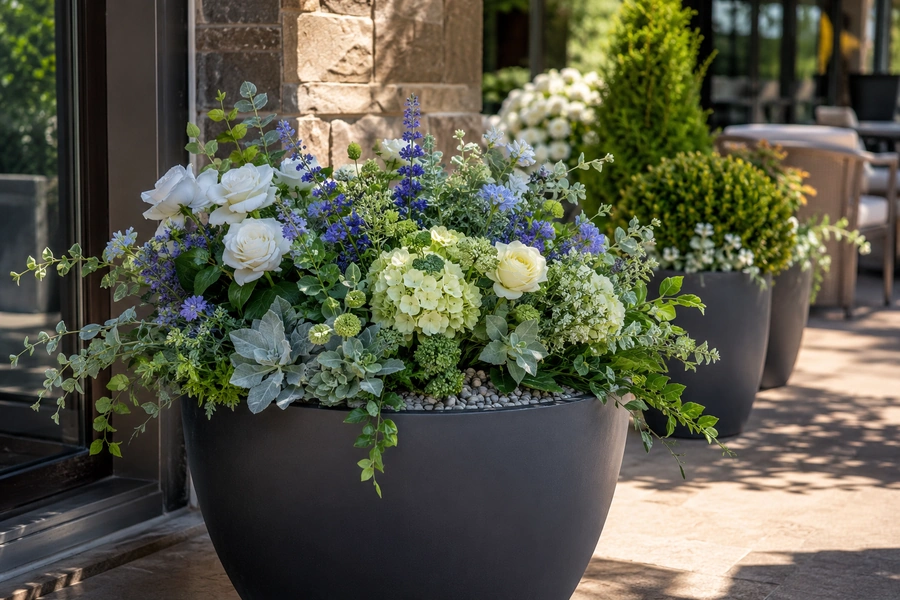
Outdoor fake flowers can look perfect at installation, then fade, lean, spin, or blow loose when the planter is built for appearance rather than exposure.
To put fake flowers in an outdoor pot, start with an outdoor-rated planter and UV-suitable flowers, add stable lower ballast, secure the stems inside a removable grid or rigid insert, and finish with weather-tolerant top dressing. Keep the silhouette low enough for wind exposure and use replaceable flower modules instead of permanently fixing every stem.
The most durable outdoor arrangement separates three jobs: the planter carries the weight, the internal mechanic controls the stems, and the flowers create the visible design. Asking petals, wire stems, loose foam, or decorative stones to perform all three jobs leads to faster failure.
How Do You Put Fake Flowers in a Pot Outdoors?
A convincing outdoor planter must look like a floral arrangement while behaving like a small exterior installation.
Build the pot from the bottom upward: stabilize the planter, preserve drainage, install a rigid stem-support system, position the strongest greenery first, add UV-suitable flowers at controlled heights, secure removable modules, and finish the surface without blocking water escape. Test the complete planter for tipping, stem movement, cleaning access, and seasonal removal.
Outdoor suitability should be checked on the exact artificial flowers rather than assumed because the product is plastic. Balsam Hill distinguishes “Outdoor Safe” artificial florals from indoor or covered-outdoor products and recommends additional shade and limited exposure for its own outdoor-safe collections.
ISO 4892-3:2024 specifies laboratory methods for exposing plastic specimens to fluorescent UV radiation, heat, and water to simulate important aspects of weathering. Such testing is useful evidence of material resistance, but it is not a universal promise that a flower will remain unchanged for a fixed number of outdoor years.
Build the Planter in Five Layers
| Layer | Job | Practical Materials |
|---|---|---|
| 1. Outer planter | Carries load and defines appearance | Fiberglass, ceramic, composite, metal, heavy plastic |
| 2. Ballast zone | Lowers center of gravity | Pavers, purpose-made weights, clean gravel, secured weighted insert |
| 3. Structural insert | Holds flower stems | Rigid grid, drilled insert, fitted nursery pot, wire framework |
| 4. Floral layer | Creates height, color, and volume | Outdoor-rated flowers and foliage |
| 5. Finish layer | Hides mechanics | Large secured stones, fitted moss mat, bark-style insert, artificial soil cover |
The visible top dressing should not be the primary anchoring system.
Loose decorative stones may hide the stems beautifully while doing little to prevent the complete internal flower bundle from rotating.
Start With the Pot, Not the Flowers
Before selecting stems, record:
- Pot opening diameter
- Internal depth
- Overall planter weight
- Drainage openings
- Exposure direction
- Daily direct-sun period
- Wind exposure
- Whether the planter can be anchored
- Required viewing direction
- Maintenance access
- Seasonal removal route
A deep, narrow planter behaves differently from a low bowl.
A narrow container may support tall vertical stems well but become top-heavy. A broad low planter offers a lower center of gravity but needs better internal stem organization.
Keep Drainage Functional
Artificial flowers do not need irrigation, but an outdoor pot may still collect rain.
Do not create a hidden basin beneath:
- Internal wire
- Paper-wrapped stems
- natural moss
- metal mechanics
- adhesives
- wooden blocks
Build a route for water to leave the planter and make that route accessible for inspection.
When a decorative outer planter has no drainage, a removable inner insert is often a more manageable solution than permanently sealing the entire floral structure inside it.
Use a Removable Inner Module
One of the strongest commercial methods is:
- Heavy outer planter
- Weighted lower chamber
- Smaller removable inner pot
- Stem grid fixed inside the inner pot
- Faux flowers secured to that grid
- Removable decorative top cover
The flowers can then be:
- Rotated
- Cleaned
- Reshaped
- Recoated
- Replaced
- Stored during severe weather
without moving the heavy decorative planter.
Establish the Lowest Stable Center of Gravity You Can
Tall artificial stems create leverage.
For exposed patios and balconies, the arrangement usually becomes more stable when:
- Heavy materials stay near the bottom
- The widest floral volume remains relatively low
- Long stems are limited
- Trailing material stays controlled
- The planter is wider relative to the canopy
- The inner insert cannot rotate
The National Weather Service advises securing outdoor items when strong winds are possible because unsecured objects may become hazards. The same principle should guide exterior artificial-flower planters.
Prepare Every Flower Before Installation
Do not install stems directly from shipping cartons.
First:
- Open compressed petals.
- Separate leaves.
- Correct sharp shipping bends.
- Inspect flower-head attachments.
- Remove loose threads.
- Confirm the outdoor rating.
- Check the intended front.
- Group stems by height.
- Mark replacement modules.
- Photograph the approved color.
Use Three Height Zones
A practical planter normally becomes more convincing when the flowers occupy at least three levels:
High zone: directional foliage or limited line flowers
Middle zone: focal blooms and primary color
Low zone: foliage, smaller flowers, and edge coverage
Avoid positioning every bloom on one horizontal plane.
How Much of the Stem Should Be Buried?
Bury enough stem to create stable mechanical engagement, not merely enough to hide the cut end.
The exact depth depends on:
- Stem length
- Internal wire strength
- Flower-head weight
- Pot depth
- Support grid
- Exposure
A tall heavy flower inserted only a few centimeters into loose filler behaves like a lever.
A shorter stem captured at two structural points behaves much more predictably.
Outdoor Planter Preflight Checklist
Before moving the pot into service, verify:
| Check | Pass Condition |
|---|---|
| Planter stability | Does not rock or tip during controlled handling |
| Insert movement | Cannot freely rotate or lift |
| Flower retention | Stems remain fixed during gentle pull test |
| Petal clearance | Flowers do not drag on walls or ground |
| Drainage | Water has a clear exit route |
| UV suitability | Exact visible stems approved for exposure |
| Wind profile | No excessively long unsupported stems |
| Maintenance | Flowers can be accessed and cleaned |
| Replacement | Individual modules can be removed |
| Severe weather | Removal or tie-down plan exists |
Which 15 Outdoor Planter Layouts Survive Sun and Wind Best?
No layout is wind-proof in every storm. These formulas are designed to reduce common outdoor failures while preserving a natural floral silhouette.
The best outdoor layouts use low centers of gravity, repeated support points, replaceable flower groups, limited sail area, and exposure-appropriate foliage. Low bowls and compact balcony boxes suit windy areas, while weighted urns and taller fan layouts work better in sheltered entrances where architectural protection reduces wind load.
15-Layout Quick Guide
| # | Layout | Best Location | Wind Profile |
|---|---|---|---|
| 1 | Low 3-5-7 Bowl | Open patio table/floor | Very low |
| 2 | Weighted Porch Urn | Covered entrance | Medium |
| 3 | Thriller-Filler-Spiller | Protected patio | Medium |
| 4 | Repeating Window Box | Storefront/window ledge | Low |
| 5 | Low Balcony Rail Box | Balcony | Very low |
| 6 | Double-Pot Removable Insert | Commercial entrance | Low-medium |
| 7 | Sun-Sheltered Half-Moon | West-facing wall | Low |
| 8 | Corner Triangle | Patio corner | Low-medium |
| 9 | Paired Entrance Pots | Hotel/store entrance | Medium |
| 10 | Grid-and-Gravel Commercial Planter | Retail/hospitality | Low |
| 11 | Green Base + Color Collar | Seasonal display | Low-medium |
| 12 | Compact Windy-Site Dome | Coastal/open site | Very low |
| 13 | Front-Facing Storefront Fan | Recessed storefront | Medium |
| 14 | Secured Hanging Basket | Covered porch | Higher |
| 15 | 80/20 Modular Seasonal Pot | Multi-season program | Adjustable |
Layout 1: The Low 3-5-7 Patio Bowl
This is one of the safest starting formulas for an exposed outdoor area.
Formula: three focal flowers, five supporting blooms, and seven foliage or texture elements inside a broad low planter. Keep nearly all flowers below roughly one planter-width above the rim and direct the outer foliage sideways rather than vertically.
Example:
- 3 outdoor-rated geranium or rose clusters
- 5 smaller supporting blooms
- 7 boxwood, eucalyptus-style, or grass elements
Build the focal flowers in a loose triangle.
Use the five smaller flowers to interrupt the spaces between them.
Place the seven foliage elements around the perimeter and through the center rather than forming a rigid green ring.
Best for:
- Open patios
- Poolside areas with adequate setback
- Café terraces
- Low hotel planters
- Restaurant entrances
Why it handles wind well: its floral mass remains low and close to the pot.
Layout 2: The Weighted Porch Urn
Tall urns look luxurious but need a disciplined internal structure.
Formula: three to five limited height stems, five to seven focal flowers, and nine or more lower foliage pieces. Keep the visual width near the lower half of the arrangement and use the tallest branches sparingly.
Build:
- Heavy lower ballast
- Removable central insert
- Two-level stem grid
- Lower foliage collar
- Focal flowers
- Limited vertical stems
Best flowers include:
- Dahlias
- Geraniums
- Outdoor-safe roses
- Bougainvillea-style branches
- Structured greenery
Best for: recessed front doors and covered hotel/store entrances.
Do not use a tall urn in an exposed position merely because the urn itself is heavy. Long branches can still create substantial leverage.
Layout 3: The Outdoor Thriller-Filler-Spiller Formula
The classic container silhouette also works with artificial flowers when wind exposure is controlled.
Formula: one restrained vertical “thriller,” five to seven mid-height filler stems, and three to five controlled trailing elements. Keep the thriller shorter than you would in a protected indoor arrangement.
Example:
- 1 vertical foliage or flower branch
- 5 hydrangea/geranium-style clusters
- 2 supporting flowers
- 3 short trailing vines
The artificial advantage is that every element can be permanently shaped into the approved direction.
Best for:
- Covered patios
- Porch corners
- Protected restaurant terraces
Avoid long lightweight trailing vines in exposed wind.
Layout 4: The Repeating Storefront Window Box
Repetition is more stable and easier to repair than one continuous tangled arrangement.
Formula: divide the rectangular planter into three or five identical modules. Each module contains one focal cluster, two secondary flowers, and two foliage elements.
For a three-module box:
- 3 focal flowers
- 6 smaller blooms
- 6 foliage pieces
Leave a small visual gap between modules instead of building one solid floral wall.
Benefits:
- Damaged sections are replaceable
- Color is easy to rotate
- The profile stays low
- Cleaning is simpler
- Inventory can be standardized
Best for: storefronts, hospitality window boxes, covered ledges.
Layout 5: The Low Balcony Rail Planter
Balcony designs should prioritize containment.
Formula: six to nine compact flower stems, four short foliage elements, and no more than two restrained trailing pieces. Keep the canopy inside the planter footprint as much as possible.
Strong starting flower forms include:
- Geranium-style clusters
- Small roses
- Compact bougainvillea
- Low hydrangea modules
- Small mixed greenery
Avoid:
- Tall blossom branches
- Large artificial palms
- Long unsecured vines
- Top-heavy flowers
- Loose decorative stones
NWS guidance to secure or bring in loose objects before strong winds is particularly relevant to balcony décor, where falling objects can affect areas below.
Layout 6: The Double-Pot Removable Insert
This is my strongest choice for commercial maintenance.
Formula: one heavy decorative outer pot, one smaller weighted insert, one rigid flower grid, and three removable floral modules—greenery, focal color, and seasonal accent.
The visible floral recipe might be:
- 8 permanent greenery stems
- 5 focal flowers
- 3 seasonal stems
The complete insert can be lifted out for:
- Severe weather
- Cleaning
- UV treatment
- Seasonal replacement
- Storage
The outer planter never needs to be moved.
Best for:
- Hotels
- Restaurants
- Stores
- Office entrances
- Multi-site commercial programs
Layout 7: The Sun-Sheltered Half-Moon
Use this when the planter has one severe sun-facing side.
Formula: place the most UV-resistant greenery toward the exposed outer face and position the more delicate flowers slightly deeper and toward the shaded half of the pot.
Viewed from above, the main flower group forms a half-moon rather than a complete ring.
Use:
- Durable foliage at the exposed edge
- Focal flowers nearer the building
- Limited high stems
- Replaceable color modules
This does not make delicate flowers UV-proof. It simply gives the more vulnerable elements a lower-exposure position.
Balsam Hill recommends shade such as a canopy, archway, or pergola to reduce fading and weather exposure for its artificial florals.
Layout 8: The Corner Triangle Planter
A pot placed against two walls does not need a 360-degree floral design.
Formula: one higher rear group, two medium side groups, and a broad low front layer. Concentrate expensive flowers toward the visible diagonal instead of filling the hidden rear equally.
Example:
- 3 tall rear foliage stems
- 5 medium focal flowers
- 7 low flowers/greenery
Advantages:
- Less exposed floral surface
- Fewer stems required
- Walls provide some wind protection
- Back mechanics can remain highly structured
Best for: patio corners, hotel corridors open to outdoors, recessed storefront entrances.
Layout 9: The Paired Entrance Pots
Two coordinated planters can frame a doorway without needing perfectly identical artificial flowers.
Formula per pot: three structural foliage stems, five focal blooms, and seven lower supporting elements. Mirror the overall direction while varying individual flower angles.
Do not build identical clones.
Instead:
- Keep height equal
- Keep color equal
- Keep planter equal
- Vary the exact leaf directions
- Turn one or two flowers differently
This avoids making the artificial construction obvious.
Keep both pots outside the door swing and primary walking line.
Layout 10: The Grid-and-Gravel Commercial Planter
This layout prioritizes maintenance and stem retention.
Formula: a rigid internal grid controls every primary stem, while heavy lower ballast stabilizes the container. Decorative gravel or a fitted cover hides the mechanic but does not carry the flowers.
A practical medium layout:
- 4 structural stems
- 6 focal flowers
- 8 supporting flowers/foliage
Use two stem-support levels for taller products:
- Lower grid
- Upper grid several inches above it
The two points reduce stem pivoting.
Best for:
- Retail entrances
- Hotel patios
- Restaurant terraces
- Office courtyards
Layout 11: The Permanent Green Base + Seasonal Color Collar
Keep the expensive structural greenery and replace only the flowers.
Formula: eight to twelve outdoor-rated greenery stems form a permanent base; five to nine removable seasonal flower stems create a color collar around the middle.
Spring:
- Tulip-style or blossom accents
Summer:
- Geranium
- Bougainvillea
- Hydrangea
Autumn:
- Rust dahlia
- Dark foliage
- Berry-style accents
Winter:
- Evergreen-style foliage
- Magnolia
- Hellebore-style flowers
The exact products still need appropriate outdoor ratings.
This formula lowers seasonal storage because the base remains consistent.
Layout 12: The Compact Windy-Site Dome
Open coastal or elevated locations benefit from a low, dense silhouette.
Formula: five focal flowers, eight supporting flowers, and eight to twelve short foliage elements contained inside a low broad planter. No branch should project dramatically above the central flower mass.
Think “low natural mound,” not formal ball.
Use varying flower heights within a relatively narrow vertical range.
Best features:
- Broad container
- Heavy lower ballast
- Multiple stem restraints
- Short foliage
- Minimal trailing material
- Removable full insert
Best for: exposed patios, breezy roof terraces where permitted, coastal entrances, open courtyards.
A severe-weather removal plan is still necessary. NWS recommends securing outdoor items when strong winds are forecast.
Layout 13: The Front-Facing Storefront Fan
A recessed shop entrance can support a taller design because the arrangement only needs to look finished from the front.
Formula: three higher rear stems, five medium flowers, seven lower blooms, and five foliage elements. Spread the top stems like a loose fan rather than a vertical bundle.
Keep the rear:
- Flat
- Structured
- Accessible
- Clearly labeled
Position the planter so flowers do not:
- Hide store signage
- Cross the door
- Touch glazing
- Obstruct merchandise
- Extend into the accessible route
Layout 14: The Secured Hanging-Basket Formula
Hanging arrangements require more caution because both the flowers and entire container are suspended.
Formula: three compact focal flower groups, five filler flowers, and six to eight short foliage/trailing pieces. Keep the floral profile controlled and use hardware appropriate for the total installed load and substrate.
Best locations:
- Covered porch
- Protected pergola
- Recessed shop canopy
Balsam Hill markets outdoor-safe hanging florals with UV protection but also recommends limited outdoor exposure for its relevant collections, illustrating why product-specific limits still matter.
The National Weather Service advises securing loose exterior objects before strong-wind events; suspended décor should therefore have a clear severe-weather removal procedure.
Layout 15: The 80/20 Modular Seasonal Planter
This is the strongest long-term formula for buyers managing multiple seasons.
Formula: roughly 80% reusable planter, ballast, mechanics, and neutral greenery; roughly 20% removable seasonal flowers. The ratio is a planning method rather than a mandatory stem percentage.
Reusable layer:
- Planter
- Weight
- Insert
- Grid
- Neutral outdoor greenery
Seasonal layer:
- 5–9 colored flower stems
- 1–3 texture accents
Advantages:
- Lower replacement volume
- Faster seasonal change
- Easier cleaning
- Smaller storage requirement
- Better replacement control
- Less need to disturb structural mechanics
Label the modules by season and planter.
How Do You Protect Outdoor Fake-Flower Planters From Sun?
A good planter layout can still deteriorate quickly when it contains indoor-only flowers in strong direct sun.
Start with flowers specifically intended for the exposure, then reduce direct and reflected sunlight through placement and shade. Use naturally varied colors, keep delicate blooms out of the harshest orientation, rotate removable inserts, clean surface residue, and apply only compatible UV protectants according to the exact product instructions.
ISO 4892-3:2024 describes laboratory exposure of plastics to fluorescent UV radiation, heat, and water. Buyers can use relevant test evidence to compare materials, but test hours should not be converted casually into guaranteed outdoor years.
Buy Outdoor-Rated Flowers First
Before asking about sprays, ask:
- Is the exact flower outdoor-safe?
- Full sun or covered outdoor?
- Was the finished flower tested?
- Which colors were tested?
- Are the petals included?
- Are the adhesives included?
- Is the stem coating included?
- Is there a seasonal exposure limit?
Balsam Hill explicitly tells buyers to distinguish outdoor-safe florals from products intended only for indoor or covered outdoor use.
Use Shade as the First Protection Layer
Good planter positions include:
- Under a porch roof
- Beneath a balcony slab
- Inside a recessed doorway
- Under a pergola
- Beneath an awning
- Against a shaded wall
Shade protects the entire flower assembly rather than only the surfaces reached by a spray.
Watch Reflected Exposure
A planter may technically sit in shade and still receive strong light from:
- Glazing
- Pale walls
- White paving
- Water
- Metal
- Light stone
Observe the planter through the day.
If one side consistently receives stronger exposure, either:
- Rotate the insert
- Move vulnerable flowers inward
- Use tougher foliage on that side
- Add a screen
- Change the planter position
Use Color Variation to Hide Minor Aging
Outdoor planters generally age more gracefully when foliage contains:
- Gray-green
- Medium green
- Dark green
- Variegation
- Matte highlights
- Mixed bloom stages
One flat neon-green hedge or identical bright-red flowers make small color changes more visible.
This is a design strategy, not a claim that muted pigments are inherently more UV-resistant.
Be Careful With White Flowers
White faux flowers reveal:
- Dust
- yellowing
- staining
- surface residue
quickly.
Reserve premium white flowers for:
- Covered porches
- Recessed entrances
- Lower-exposure seasonal installations
unless the exact product has appropriate exterior evidence.
Use UV Spray as Supplementary Protection
Afloral recommends choosing a UV protectant specifically intended for artificial flowers and plants, cleaning first, applying it evenly according to instructions, and allowing it to dry fully. Its current guidance suggests a 6–12 month reapplication interval for its recommended approach, but that interval is brand guidance—not a universal industry schedule.
Before coating your production flowers, test a spare stem for:
- Yellowing
- Gloss increase
- Stickiness
- Stiffness
- Color darkening
- Glue softening
- White residue
- Dust attraction
Do not assume generic varnish, furniture polish, or automotive clear coat is compatible.
Rotate the Insert Rather Than Every Stem
If the entire floral module is removable, mark four orientations:
- Position A
- Position B
- Position C
- Position D
Rotate the insert periodically where this does not create an unsafe new orientation.
This balances repeated one-sided exposure and is much faster than rearranging dozens of flowers.
Clean Before the Planter Looks Gray
Balsam Hill currently recommends weekly or biweekly dusting for its artificial flowers depending on location and weather conditions, using gentle dry-cleaning methods appropriate to its products.
Outdoor cleaning frequency should be based on the site.
Busy storefronts may accumulate visible residue faster than protected residential porches.
Create a Protected Reference Stem
Keep one unused flower from the original batch:
- Clean
- Dry
- Dark
- Labeled
- Away from the outdoor display
Compare the installed flowers with that reference periodically.
Without a reference, gradual fading is easy to overlook.
How Do You Anchor Fake Flowers in a Pot Against Wind and Rain?
Wind resistance comes from controlling both the pot and the flowers.
Use a heavy or anchored planter, keep ballast low, restrain the inner insert, capture tall stems at multiple points, limit long lightweight branches, and maintain drainage. High-wind forecasts should trigger a removal or additional securing procedure; no decorative planter should be treated as permanently wind-proof simply because it feels heavy by hand.
The National Weather Service specifically recommends securing loose outdoor objects when strong winds are expected and bringing or tying down vulnerable items before wind becomes dangerous.
Use a Three-Part Anchoring System
For most exposed planters:
Part 1: Planter stability
The outer container resists tipping.
Part 2: Insert stability
The flower-holding module cannot lift, slide, or rotate.
Part 3: Stem retention
Individual flowers cannot pull out of the support grid.
All three must work.
A heavy pot with loose flowers still fails.
A perfectly secured flower bundle inside a lightweight pot can still tip.
Practical Lower Ballast
Depending on the planter and installation, lower ballast may include:
- Purpose-made weights
- Heavy internal pavers
- Secured gravel chamber
- Weighted removable base
- Sand contained inside a durable closed bag or chamber
Keep weight low rather than placing heavy decorative material at the surface.
For commercial or elevated installations, the actual anchoring system should be appropriate to the building, planter, substrate, and local requirements.
Use Two Stem-Control Points for Tall Flowers
Tall stems benefit from a lower and an upper support.
For example:
- Stem enters lower fitted insert.
- Stem passes through upper grid.
- Flower emerges above the decorative cover.
This makes the stem much harder to pivot than a single-point insertion.
Do Not Depend on Loose Foam Alone
Lightweight loose material may control initial placement but should not be treated as sufficient outdoor anchoring for a tall exposed planter.
For windy layouts, pair the floral holder with:
- Rigid grid
- Mechanical stem clips
- Deep fitted holes
- Wire framework
- Removable locked insert
The goal is mechanical restraint, not simply friction.
Keep Long Stems to the Protected Side
Where wind typically arrives from one direction:
- Use lower flowers on the exposed edge.
- Place taller branches closer to the building.
- Avoid long horizontal branches facing the wind.
- Keep trailing vines short.
- Use the planter wall as partial shielding where appropriate.
This is a practical risk-reduction strategy, not an engineering wind-load calculation.
Build a Severe-Weather Removal Plan
For removable planters, the plan should state:
- Who monitors weather
- Which forecast triggers action
- Which modules come indoors
- Where they are stored
- Who secures remaining planters
- How balcony components are handled
- When reinstalling is allowed
NWS guidance is clear that loose outdoor objects should be secured before strong-wind conditions develop.
Rain Should Not Turn the Planter Into a Reservoir
After rain:
- Check drainage.
- Look beneath the top dressing.
- Inspect wire connections.
- Check stem coatings.
- Remove trapped water.
- Allow the floral module to dry.
- Check whether the ballast shifted.
- Reinspect the planter’s stability.
A removable top-dressing panel makes this inspection much easier.
Best Top Dressings for Outdoor Faux Planters
A top layer should hide the mechanics while remaining manageable.
Options include:
- Large secured decorative stones
- Fitted artificial moss panel
- Removable bark-effect layer
- Perforated artificial soil insert
- Custom rigid cover with stem openings
Avoid loose lightweight filler in high-wind locations.
What Not to Put in an Outdoor Fake-Flower Pot
Avoid depending on:
- Loose lightweight packing peanuts
- Open cardboard
- Unprotected paper filler
- Unsecured floral foam
- Loose moss on exposed balconies
- Tiny lightweight stones that can scatter
- Water-absorbing packaging left from shipping
- Sharp exposed wire
- Unknown adhesives as the only anchor
- Soil added merely because the flowers are supposed to look real
The interior does not need to imitate a living plant’s root zone. It needs to manage the artificial display safely.
Match the Layout to the Wind Exposure
| Exposure | Better Layout Choices |
|---|---|
| Deep sheltered porch | Porch urn, thriller-filler-spiller |
| Moderate patio | 3-5-7 bowl, double-pot insert |
| Open courtyard | Compact dome, grid-and-gravel |
| Balcony | Low rail box, removable insert |
| Storefront recess | Front-facing fan, paired pots |
| Very exposed seasonal site | Compact removable modules |
| Strong-wind warning | Remove or additionally secure vulnerable décor |
Outdoor Maintenance SOP
| Step | Check |
|---|---|
| 1 | Inspect planter movement |
| 2 | Check anchors and inner insert |
| 3 | Pull-test representative stems gently |
| 4 | Check drainage |
| 5 | Remove dry dust |
| 6 | Inspect fading and brittleness |
| 7 | Check flower-head connections |
| 8 | Rotate insert where appropriate |
| 9 | Replace damaged modules |
| 10 | Review weather forecast |
| 11 | Remove vulnerable modules before severe wind |
| 12 | Photograph completed inspection |
The Most Common Outdoor Potting Mistakes
| Mistake | What Happens | Better Approach |
|---|---|---|
| Indoor flowers in full sun | Fast fading or deterioration | Specify outdoor-rated stems |
| Tall stems in a light pot | High tipping leverage | Add low ballast and reduce height |
| Loose foam only | Stems rotate or pull free | Use rigid mechanical support |
| Heavy stones only on top | High center of gravity | Put ballast low |
| No drainage | Water becomes trapped | Maintain exit path |
| Long trailing vines | Wind catches material | Keep trails controlled |
| Every flower permanently glued | Difficult repair | Use modules |
| No removable insert | Difficult storm response | Build inner pot system |
| Too much height | More wind exposure | Widen and lower silhouette |
| Never rotate | One-sided sun aging | Rotate when safe |
| No reference stem | Fading goes unnoticed | Retain protected sample |
| “UV proof” assumption | Poor lifecycle planning | Verify product evidence |
| No weather procedure | Emergency handling becomes improvised | Write removal plan |
My Insights: How to Put Fake Flowers in a Pot—Which 15 Proven Outdoor Planter Layouts Survive Sun and Wind
The strongest outdoor faux-flower pot is not the one containing the most concrete, glue, or flowers. It is the one whose structure can control movement while allowing the visible components to be maintained and replaced.
The 15 strongest layouts combine low ballast, rigid stem control, outdoor-rated foliage, limited height, shade-aware placement, drainage, replaceable flower modules, and severe-weather planning. Low bowls, balcony boxes, compact domes, and grid-supported planters suit higher wind exposure; urns, fans, and hanging displays belong in more protected positions.
The 15-Layout Summary
| # | Formula | Strongest Advantage |
|---|---|---|
| 1 | Low 3-5-7 bowl | Low wind profile |
| 2 | Weighted porch urn | Large sheltered impact |
| 3 | Thriller-filler-spiller | Familiar layered silhouette |
| 4 | Repeating window box | Easy modular repair |
| 5 | Low balcony rail box | Strong containment |
| 6 | Double-pot insert | Easy maintenance and removal |
| 7 | Sun-sheltered half-moon | Protects sensitive flowers |
| 8 | Corner triangle | Uses architectural shelter |
| 9 | Paired entrance pots | Strong doorway framing |
| 10 | Grid-and-gravel planter | Reliable stem control |
| 11 | Green base + color collar | Fast seasonal replacement |
| 12 | Compact windy-site dome | Lowest exposed profile |
| 13 | Front-facing storefront fan | High visual impact with fewer flowers |
| 14 | Secured hanging basket | Uses overhead space |
| 15 | 80/20 modular planter | Best long-term rotation system |
My Best Overall Layout
For most patios, commercial entrances, and large residential porches, I prefer the double-pot removable insert.
The outer planter provides:
- Appearance
- Weight
- Architectural scale
The inner module provides:
- Stem control
- Rotation
- Cleaning access
- Seasonal removal
- Storm preparation
The two jobs remain separate.
My Best Layout for Windy Areas
Use the compact windy-site dome.
The formula is simple:
- Broad planter
- Low ballast
- Locked insert
- Short stems
- Dense internal support
- Limited trailing foliage
- No unnecessary vertical branches
It cannot eliminate storm risk, but it reduces the sail-like silhouette created by tall, loose artificial flowers.
My Best Balcony Layout
Use the low balcony rail or rectangular planter only when the complete planter and components can be secured appropriately.
Keep:
- Flowers below or close to the rail profile
- Trailing material controlled
- Stones secured
- Insert removable
- Weight low
- All components inside the balcony boundary
When high winds are forecast, follow local safety information and remove or secure vulnerable exterior objects.
My Best Storefront Layout
Use the front-facing fan inside a recessed entrance.
You can concentrate:
- Better flowers
- Strong color
- Height
- Seasonal detail
on the guest-facing side.
The protected rear can contain:
- Heavy mechanics
- Grid
- fasteners
- replacement labels
This provides strong visual impact without wasting premium flowers where nobody sees them.
My Best Seasonal Layout
Use the 80/20 modular planter.
Retain:
- Pot
- Weight
- Grid
- Neutral greenery
Change:
- Flowers
- seasonal color
- one or two accent textures
The planter does not need complete reconstruction every season.
The Most Important Sun Rule
Buy the right flower before buying UV spray.
An artificial flower specifically intended for exterior exposure gives you a stronger starting point than trying to convert an indoor product with an aftermarket coating.
Balsam Hill’s own care guidance distinguishes outdoor-safe products and still recommends shade and exposure limits for its collections.
Afloral likewise recommends dedicated UV-protected artificial products and treats UV spray as additional protection rather than a substitute for choosing suitable foliage.
The Most Important Wind Rule
Secure the planter and the flowers.
A heavy pot containing loose stems is incomplete.
A complete system requires:
- Stable outer planter
- Low ballast
- Fixed or captured inner insert
- Multiple stem-control points where necessary
- Controlled floral height
- Severe-weather removal procedure
The Most Important Fill Rule
Do not confuse filler with structure.
Decorative moss, stones, bark, and artificial soil make the surface attractive.
They should not replace:
- Ballast
- Grid
- Anchors
- Insert
- Stem restraints
Hide the engineering after it works.
The Most Important Height Rule
Every additional centimeter of dramatic height should earn its place.
A tall branch can create visual impact, but outdoors it also creates:
- More exposed surface
- Greater leverage
- Greater movement
- More clearance requirements
In sheltered entrances, use height strategically.
In open wind, move the visual interest outward rather than upward.
The Most Important UV Evidence Rule
Treat accelerated weathering data as comparative evidence, not a countdown clock.
ISO 4892-3:2024 defines methods involving UV radiation, heat, and water for plastic weathering exposure. The real outdoor result still depends on the product and environment.
Do not automatically translate:
“1,000 laboratory hours”
into:
“X guaranteed years outdoors.”
unless a defensible correlation for the exact material and use environment supports that statement.
The Most Important Maintenance Rule
Design the pot so the flowers can come out.
A removable insert turns major jobs into simple ones:
- Dusting
- Repair
- UV-treatment application
- Rotation
- Storm removal
- Seasonal storage
- Replacement
Permanently burying every flower in adhesive may create a neat first installation while increasing later maintenance and waste.
My Preferred Outdoor Planter Build
For a medium exterior planter, I use this sequence:
- Select the exposure zone.
- Confirm the exact flowers are appropriate for it.
- Choose a broad, stable planter.
- Preserve drainage.
- Put ballast at the lowest practical level.
- Install a removable inner pot.
- Fit a rigid stem grid.
- Add lower structural greenery.
- Add focal flowers in three heights.
- Keep long stems toward shelter.
- Test every visible direction.
- Lock the insert against rotation.
- Add removable top dressing.
- Photograph the approved arrangement.
- Create cleaning, rotation, and severe-weather procedures.
This gives the planter a decorative exterior and a maintainable internal system.
My Final Outdoor Planter Rule
Do not ask only:
“What can I put in the pot to hold fake flowers?”
Ask:
“How will the planter remain stable, drain after rain, resist ordinary wind movement, reduce UV exposure, allow damaged flowers to be replaced, and come apart when severe weather arrives?”
That question produces a better outdoor planter than simply filling the container with more foam, stones, or glue.
Conclusion
Use outdoor-rated flowers, low ballast, rigid removable inserts, controlled height, drainage, shade, modular stems, and a wind-removal plan to keep faux outdoor planters attractive and maintainable.