
Dubai flower projects can fail before installation when buyers underestimate heat, accumulated dust, harsh light, compressed packing, approval delays, and customs or shipping buffers.
For artificial flowers Dubai and UAE projects, define the installation zone first, verify suitable materials and UV performance, choose dust-friendly finishes, plan simple cleaning, approve production samples, protect flowers during packing, and calculate lead time backward from the installation date. Heat, dust, logistics, and maintenance must be specified before bulk production starts.
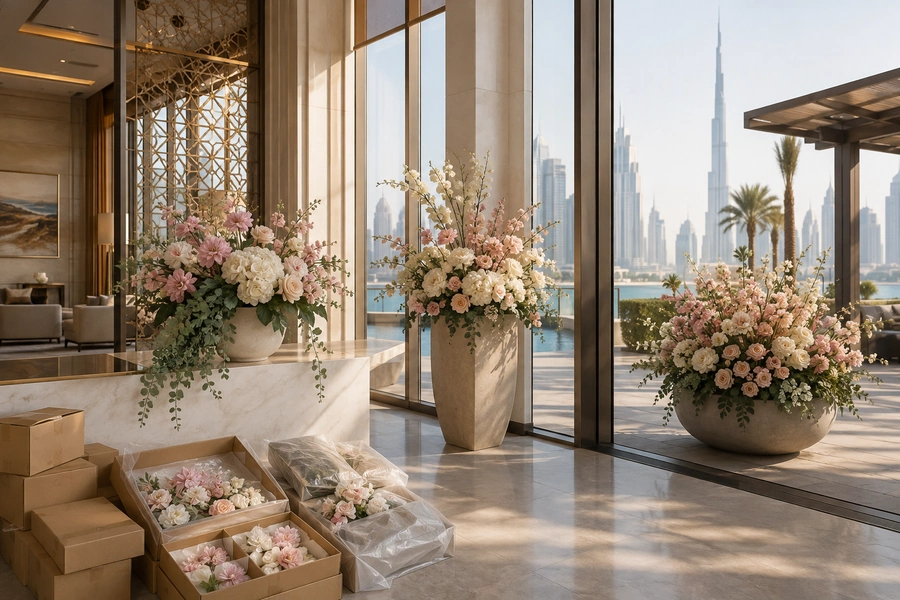
Dubai’s heat, humidity, dust, and sand create different risks for artificial flowers. Buyers should match each product to its actual location, from air-conditioned lobbies to exposed outdoor entrances.
How Long Do Artificial Flowers Last Outdoors?
There is no reliable universal lifespan for an artificial flower outdoors because the result changes with the material, color, UV exposure, heat, shade, wind, dust, cleaning, and acceptable appearance standard.
High-quality outdoor artificial flowers may remain usable for multiple seasons, but no buyer should purchase them based only on a promised number of years. For Dubai and UAE projects, approve the exact SKU for its installation zone, inspect color and construction regularly, and use replaceable modules so individual faded components can be changed.
Rule 1: Define the UAE Installation Zone Before Choosing the Flower
The first purchasing decision should not be rose versus peony.
It should be where the flower will actually be installed.
A useful UAE project brief separates at least these zones:
| Installation Zone | Main Exposure | Specification Priority |
|---|---|---|
| Air-conditioned lobby | LEDs, AC airflow, guest touch | Realism and dust control |
| Glass-façade reception | Light, glare, heat gain | Color stability and finish |
| Mall entrance | Dust, airflow, handling | Cleanability and strong mechanics |
| Covered terrace | Heat, indirect UV, dust | Outdoor suitability |
| Full-sun exterior | Direct UV, heat, wind | Tested outdoor construction |
| Restaurant area | Dust plus possible grease | Easy-clean surfaces |
| Event installation | Handling and transport | Packaging and fast assembly |
| High-level floral feature | Difficult maintenance access | Durable low-dust construction |
Dubai’s official climate information describes high heat and humidity during summer. That makes the difference between an interior and an exterior zone commercially important.
A buyer should send the supplier a one-page zone sheet containing:
- Indoor or outdoor use
- Direct sunlight duration
- Window proximity
- Artificial lighting
- AC direction
- Expected dust level
- Touch frequency
- Installation height
- Cleaning access
- Required project duration
This prevents one vague instruction such as:
Suitable for Dubai.
That phrase is not a specification.
Rule 2: Match the Complete Material System to Heat, Not Just the Petal
Heat performance is not only about whether polyester melts.
A finished artificial flower may contain:
- Polyester fabric
- Polyethylene or other plastics
- Internal metal wire
- Adhesive
- Foam
- Paint
- Printed pigment
- Real-touch coating
- Paper or tape wrapping
The complete assembly matters.
A petal may remain stable while:
- Glue softens
- Leaves rotate
- Flower heads sag
- A coating becomes sticky
- Stem covering cracks
- Dark materials distort
For every major project SKU, approve a physical sample using the same:
- Petal
- Stem
- Leaves
- Adhesive
- Color
- Coating
- Packaging
planned for mass production.
I would also classify acceptable performance by viewing distance.
A flower installed six meters above a mall floor does not need the same microscopic realism as an arrangement on a hotel reception desk.
However, it still needs:
- Stable color
- Strong connections
- Safe mechanics
- Clean surfaces
- Reliable shape
Do not pay for unnecessary close-view detail while ignoring the structural features the location actually needs.
How Do You Keep Artificial Flowers From Fading Outside?
Artificial flowers fade more slowly when the product, color, UV resistance, and placement are selected as one system rather than relying on a vague “UV proof” label.
Choose flowers specifically intended for the expected outdoor exposure, verify relevant weathering evidence, reduce direct sunlight with architectural shade where possible, and keep replaceable flowers in the highest-exposure positions. UV-resistant does not mean permanently fade-proof, especially in strong UAE sun and heat.
Rule 3: Ask for UV Evidence Before Approving Outdoor UAE Flowers
A supplier statement such as:
UV resistant for five years.
should create more questions, not end the discussion.
ISO 4892-3:2024 describes methods for exposing plastic specimens to fluorescent UV radiation, heat, and water to simulate important aspects of weathering. The method can support comparison and product evaluation, but laboratory exposure hours should not automatically be translated into a guaranteed number of years in Dubai.
Ask the supplier for:
- Test standard
- Standard edition
- Test laboratory
- Specimen description
- Material tested
- Color tested
- Exposure cycle
- Exposure duration
- Measured color change
- Cracking or brittleness observations
- Relationship between the sample and production SKU
What Exactly Was Tested?
This question is critical.
The report might cover:
Green polyethylene leaf material.
But the project might contain:
- Pink polyester petals
- Foam centers
- Painted stems
- Adhesive
- Wire
- fabric leaves
The report does not automatically cover the entire finished arrangement.
Use a Reference Sample
Keep one approved flower unexposed in protected storage.
Every few months, compare it with the installed piece under consistent lighting.
Evaluate:
- Color
- Gloss
- Texture
- Brittleness
- Petal shape
- Leaf attachment
- Flower-head stability
Gradual fading becomes difficult to notice when staff see the arrangement every day.
A retained reference makes deterioration easier to identify.
Rule 4: Reduce Exposure Before Adding More Chemicals
Physical placement is one of the strongest ways to improve exterior display life.
Use:
- Entrance recesses
- Pergolas
- Canopies
- Awnings
- Balcony overhangs
- Shaded wall positions
when they fit the design.
The principle is simple:
less accumulated exposure usually means less stress on the visible materials.
For glass-front retail projects, inspect both:
- Direct sunlight
- Reflected light
Bright façades, pale paving, glazing, and surrounding architecture can produce an exposure pattern that is not obvious during a single morning site visit.
Build an Exposure Map
For each planter or arrangement, record:
| Item | Example |
|---|---|
| Zone | West entrance |
| Direct sun | Afternoon |
| Glass nearby | Yes |
| AC | No |
| Dust | High |
| Cleaning | Weekly |
| Rotation possible | Yes |
| Flower module | Replaceable |
| Reference sample | Stored |
| Inspection | Monthly |
This helps the supplier understand why two identical arrangements may need different materials.
Choose Colors for the Actual Lighting
Dubai hotel and retail projects frequently combine natural daylight with intense indoor lighting.
Evaluate flowers:
- Under daylight
- Under warm LEDs
- Under cool LEDs
- Under spotlights
A white flower may look cream under one light and gray under another.
A bright blush may become almost white under powerful illumination.
The approved sample should be viewed under lighting that resembles the final site rather than only under warehouse fluorescent lamps.
How Do You Clean Artificial Flowers?
Artificial flowers are easiest to maintain when dust control is designed into the product before production rather than solved later with aggressive cleaning.
For Dubai and UAE projects, choose matte or dry-touch finishes that are easy to dust, then use microfiber, a soft brush, or controlled air for routine maintenance. Avoid sticky surfaces and extremely dense flowers in high-dust zones. Use moisture only when the exact materials and manufacturer instructions allow it.
Rule 5: Choose Dust-Smart Finishes and Flower Shapes
Dust is not merely a housekeeping issue.
It influences:
- Material selection
- Labor
- Display life
- realism
- replacement frequency
The UAE National Air Quality Platform includes PM10 among the pollutants used in its Air Quality Index, while UAE weather bulletins can include blowing dust and sand conditions.
For projects near entrances, roads, loading zones, or frequently opened doors, cleanability should become part of the RFQ.
Lower-Maintenance Artificial Flowers
Usually easier to clean:
- Orchids with broad petals
- Magnolia leaves
- Structured roses
- Rubber-style foliage
- Monstera
- Large eucalyptus
- Agave
- Broad tropical foliage
Higher-Maintenance Artificial Flowers
Usually slower to clean:
- Dense hydrangeas
- Fine ferns
- Artificial baby’s breath
- Fine blossom branches
- Heavy flocking
- Velvet surfaces
- Sticky real-touch coatings
- Artificial pollen
- Glitter
That does not mean delicate flowers should never be used.
Use them in protected locations where the visual benefit justifies the cleaning cost.
Add a Cleaning Test to Sample Approval
During sample approval:
- Photograph the flower.
- Apply representative dry dust where appropriate.
- Clean it using the proposed maintenance method.
- Inspect the petal finish.
- Check for scratches.
- Check for color transfer.
- Check whether the surface becomes sticky.
- Record the cleaning time.
For a 20-stem hotel arrangement, a small increase in cleaning time may be insignificant.
For a mall flower wall containing thousands of components, the same difference becomes an operating cost.
Rule 6: Create the Maintenance Plan Before Shipping
Do not wait until the flower wall looks gray.
Routine dusting is less aggressive than emergency deep cleaning.
Current artificial-flower care guidance commonly recommends gentle dry cleaning, and Balsam Hill recommends weekly or biweekly dusting depending on location and conditions.
For UAE commercial projects, use a site-specific schedule.
Example Maintenance Matrix
| Zone | Inspection | Typical Action |
|---|---|---|
| Hotel lobby desk | Weekly | Microfiber + detail brush |
| Mall entrance | Weekly | Dust and attachment check |
| High wall feature | Monthly or planned access cycle | Controlled dry cleaning |
| Restaurant | Weekly or more often | Dust + residue inspection |
| Covered exterior | Weekly/biweekly | Dust + fade inspection |
| Full exterior | Frequent condition check | Dust + UV + structural review |
Rotate High-Exposure Modules
If possible, construct:
- Flower wall panels
- Hanging sections
- planter inserts
- table arrangements
as removable modules.
Then one damaged or dusty module can be:
- Removed
- cleaned
- repaired
- replaced
- rotated
without rebuilding the whole project.
This also reduces waste.
Keep a Maintenance Kit With the Project
A useful site kit can contain:
- White microfiber cloths
- Soft brushes
- Cool-air blower
- Cotton swabs
- Spare focal flowers
- Spare leaves
- Approved fasteners
- Project care sheet
Do not distribute one generic chemical spray for every flower material.
How Long Does Shipping to UAE Take?
Search results show that UAE delivery times vary widely by origin and service, so there is no single shipping duration that a commercial artificial-flower project should rely on. International services may quote a number of working days after dispatch, but production, sample approval, customs, inspection, and site access must be added separately.
For bulk artificial flowers, calculate lead time backward from the UAE installation date rather than using freight transit time alone. Include RFQ, sample development, revisions, production, pre-shipment inspection, export handling, transport, customs, local delivery, unpacking, reshaping, and a project buffer for site or approval changes.
Rule 7: Build Lead Time Backward From the Installation Date
A supplier saying:
Production takes 25 days.
does not mean the flowers will be ready on site in 25 days.
The complete schedule may contain:
- RFQ clarification
- Sample preparation
- Sample courier
- Buyer review
- Revision
- Revised sample
- Deposit
- Material preparation
- Mass production
- Quality inspection
- Corrective action
- Packing
- Export handling
- International freight
- Customs
- UAE local transport
- Site receiving
- Unpacking
- Reshaping
- Installation
Example Backward Planner
| Project Stage | Internal Planning Allowance |
|---|---|
| Site survey/specification | Set by project |
| First sample | Supplier-confirmed |
| Revision cycle | Add explicitly |
| Golden-sample approval | Buyer-controlled |
| Mass production | Written commitment |
| Inspection | Reserve window |
| Correction | Add buffer |
| Export preparation | Logistics-confirmed |
| Freight | Carrier-specific |
| Customs | Do not assume zero delay |
| UAE delivery | Local logistics |
| Reshaping/QC | Often forgotten |
| Installation | Fixed site window |
| Contingency | Project-specific |
Do not copy generic day counts from another project.
Protect the Opening Date
Start with:
Installation access: 20 October.
Then move backward.
For example:
- Site delivery deadline
- Customs-clear date
- Required UAE arrival
- Factory shipment
- PSI
- production completion
- mass-production start
- sample approval
This makes schedule risk visible before the PO is placed.
Rule 8: Treat Packaging, Customs Documents, and QC as Lead-Time Controls
Weak packaging does more than damage flowers.
It creates:
- Rework
- replacements
- emergency air shipments
- installation delay
Long artificial stems and large flowers should not carry carton compression.
Use:
- Rigid cartons
- Correct head clearance
- Dividers
- restrained bundles
- controlled stem direction
- no-crush zones for focal flowers
Inspect Packaging Before the Cartons Close
Request photographs showing:
- Inner arrangement
- Flower-head clearance
- dividers
- stem bundles
- carton dimensions
- shipping marks
For important projects, inspect the packaged product rather than approving only loose flowers.
Confirm Dubai Import Documentation Early
Dubai Customs’ service information lists documents such as the invoice, packing list, certificate of origin, and permits where applicable for customs declarations. Exact requirements depend on the transaction and goods involved, so the importer or customs broker should confirm the final document set before shipment.
Do not wait until cargo arrives to discover:
- Invoice descriptions are unclear
- Quantity differs from the packing list
- Country-of-origin information is missing
- Buyer/importer details are incorrect
- Required documentation is unavailable
Freeze the Golden Sample Before Bulk
The final approval package should include:
- Product code
- Flower dimensions
- Color
- Material
- Stem specification
- leaf count
- Surface finish
- Packing method
- Carton quantity
- Label
- Approved sample photos
The bulk order should be inspected against this package.
Use a Pre-Shipment Release Gate
Do not ship merely because production is finished.
Release only after:
- Quantity approved
- Product quality approved
- Color approved
- Packing approved
- carton markings approved
- documents checked
- logistics booking confirmed
A three-day correction at the factory can be much cheaper than emergency replacement after installation teams are already waiting in Dubai.
My Insights: Which 8 Critical Rules Make Artificial Flowers Dubai & UAE Projects Work Despite Heat, Dust, and Lead Time
The core problem in UAE artificial-flower projects is not heat alone. It is the interaction between environment, product specification, maintenance, packaging, and schedule.
The eight critical rules are to define the installation zone, qualify materials for heat, verify outdoor UV evidence, reduce unnecessary exposure, choose dust-smart flowers, schedule maintenance, calculate lead time backward, and treat packaging, QC, and customs documentation as part of delivery. Together, these controls make Dubai and UAE floral projects far more predictable.
The 8-Rule Summary
| Rule | Main Project Risk Controlled |
|---|---|
| 1. Define the installation zone | Wrong product specification |
| 2. Match complete materials to heat | Sagging, coating, or glue failure |
| 3. Verify UV evidence | Unsupported fade claims |
| 4. Reduce exposure | Accelerated color aging |
| 5. Choose dust-smart finishes | High cleaning labor |
| 6. Plan maintenance early | Displays becoming visibly dirty |
| 7. Calculate lead time backward | Late installation |
| 8. Control packing, QC, and documents | Damage and logistics delays |
The Most Important Heat Insight
“Indoor Dubai” and “outdoor Dubai” are not specifications.
A flower in an air-conditioned hotel lobby experiences a completely different environment from one beside a west-facing glass entrance.
Write the exposure into the RFQ.
The Most Important Dust Insight
Dust cost starts during product selection.
A dry-touch broad artificial leaf may be cleaned in seconds.
A dense, sticky, fine-textured flower may require much more time.
Multiply that difference across:
- Hundreds of flowers
- Many locations
- Twelve months
and surface finish becomes a purchasing decision.
The Most Important UV Insight
Do not ask only:
Is it UV resistant?
Ask:
Which exact material and color were tested, under which method, for how long, and what changed after exposure?
ISO 4892-3 provides a recognized laboratory weathering framework for plastics, but the interpretation still depends on the product and end-use conditions.
The Most Important Lead-Time Insight
Freight transit is only one part of lead time.
For project procurement:
Total project lead time = specification + sampling + revision + production + QC + packing + freight + customs + local delivery + reshaping + installation buffer
If any term is missing, the delivery date is optimistic.
The Most Important Packaging Insight
The flower must survive the carton before it can survive Dubai.
Inspect the packaged product for:
- Crushed petals
- Sharp stem bends
- detached heads
- abrasion
- color transfer
- excessive compression
Do not accept:
It will fluff out.
as the only packaging qualification for a premium commercial project.
The Most Important Supplier Insight
A reliable supplier should be able to explain:
- What the flower is made from
- Which zone it suits
- What test evidence exists
- How it will be packed
- How long each stage takes
- What QC happens before release
Unclear answers in these areas are more important than a beautifully edited catalog photograph.
My Preferred UAE Project Workflow
Use this sequence:
- Survey the installation site.
- Divide it into exposure zones.
- Create the product specification.
- Ask for material and UV evidence where required.
- Approve physical samples under relevant lighting.
- Test cleanability.
- Approve packaging.
- Freeze the golden sample.
- Calculate the schedule backward from installation.
- Start production only after approval.
- Inspect bulk production and packaging.
- Check customs documentation.
- Ship with project buffer remaining.
- Inspect and reshape after UAE arrival.
- Install and photograph the approved display.
- Begin the maintenance and rotation record.
This workflow does not remove every project risk.
It makes the main risks visible early enough to control them.
Conclusion
For Dubai and UAE artificial-flower projects, specify the zone first, control heat and dust through product design, and protect installation dates with documented samples, QC, packing, and realistic lead-time buffers.