
Dust can make even expensive faux flowers look gray, flat, and obviously artificial. The bigger problem starts when aggressive cleaning damages the petals faster than the dust did.
The fastest safe way to clean faux flowers is to start dry: use microfiber, a soft brush, a fabric duster, or cool airflow. Move to a damp cloth or mild soap only when dry cleaning fails and the material allows moisture. Never assume every silk, polyester, plastic, foam, or real-touch flower can be washed.
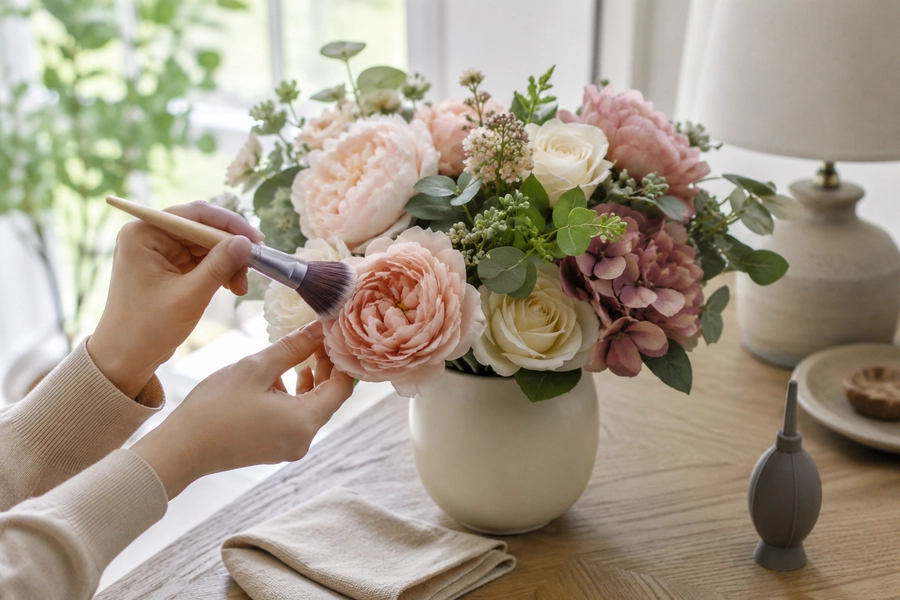
Clean faux flowers with the gentlest effective method. Start with dry dusting or cool air, then use limited moisture only when materials allow it, protecting petals, coatings, and adhesives.
What Is the Best Way to Clean Artificial Flowers?
For most faux flowers, dry cleaning should come first because ordinary surface dust does not justify introducing water, detergent, pressure, or heat.
The best cleaning sequence is to inspect the flower, remove loose dust with the gentlest tool, clean detailed areas separately, and use moisture only for remaining marks when the manufacturer allows it. Microfiber, soft brushes, fabric dusters, cool air, low-suction vacuuming, and careful spot cleaning cover most routine artificial-flower maintenance.
Quick Cleaning Decision Table
| Flower Condition | First Method | Escalate To | Main Risk |
|---|---|---|---|
| Light surface dust | Fabric duster | Microfiber | Crushing petals |
| Dust in flower centers | Soft brush | Cool air | Pulling glued details |
| Dense layered bloom | Cool hair dryer | Soft brush | Excess airflow |
| Large sturdy arrangement | Microfiber | Low-suction vacuum | Excess suction |
| Fingerprints | Slightly damp microfiber | Approved mild soap | Color transfer |
| Sticky grime | Patch test + damp wipe | Mild soap if approved | Coating damage |
| Sturdy washable plastic flower | Dry dusting | Gentle rinse if approved | Glue/wire damage |
| Real-touch or unknown material | Dry methods | Supplier-approved method only | Stickiness or surface change |
| Paper/flocked/glittered flower | Dry methods only | Manufacturer guidance | Water damage |
1. Use a Microfiber Cloth for Broad Petals and Leaves
Microfiber is one of the simplest tools for artificial flowers because it can pick up loose dust without requiring liquid cleaner.
Balsam Hill recommends gently wiping artificial florals with microfiber for routine cleaning, while Afloral also includes cloth-based dust removal among its basic care methods.
Support the petal or leaf from underneath.
Then:
- Wipe in one direction
- Use almost no downward pressure
- Turn to a clean section of cloth frequently
- Work from upper flowers downward
- Avoid rubbing fragile edges repeatedly
Microfiber works especially well on:
- Magnolia leaves
- Orchid foliage
- Roses with firm petals
- Artificial eucalyptus
- Molded greenery
- Broad artificial leaves
It becomes slower on hydrangeas, peonies, and other flowers containing many small folds.
2. Use a Soft Makeup Brush or Paintbrush for Detailed Blooms
A clean soft brush is one of the safest tools for reaching flower centers without flattening the surrounding petals.
Jamali Garden recommends soft-bristled brushes for intricate artificial flowers and small leaves, while Balsam Hill recommends soft-bristled brushing for suitable artificial greenery.
Use this method for:
- Peonies
- Ranunculus
- Hydrangeas
- Dahlias
- Artificial pollen centers
- Small blossom branches
- Textured foliage
Hold the flower by the calyx or stem rather than squeezing the bloom.
Brush outward so loosened particles leave the flower instead of being pushed deeper into the center.
3. Use a Fabric or Feather Duster for Fast Weekly Maintenance
A light duster works best when the arrangement is cleaned frequently enough that dust has not become sticky.
Balsam Hill recommends fabric dusters as an alternative to microfiber for routine care. Jamali Garden also recommends feather dusters for regular faux-flower maintenance.
The method is fast because you can clean a complete arrangement without removing every stem.
However, do not whip the duster across delicate flowers.
Use slow passes and let the fibers contact only the outer surfaces.
This method works particularly well for:
- Hotel lobby arrangements
- Retail shelving
- Office reception flowers
- Home console displays
- Seasonal arrangements that are cleaned often
4. Use a Hair Dryer on Cool for Layered Petals
Cool airflow is useful when dust sits between petals where a cloth cannot reach.
Afloral recommends a hair dryer on a cool setting for intricate spaces and advises holding it at a distance. Jamali Garden likewise recommends cool airflow for detailed artificial flowers.
Use:
- Cool setting only
- Low airflow
- Short passes
- Enough distance that petals barely move
Do not use heated air.
Heat may affect synthetic surfaces, adhesives, and flower shape, while excessive airflow may loosen lightweight flower components.
5. Use Controlled Compressed Air for Tiny Crevices
Compressed air can remove particles from flower centers and dense foliage quickly, but pressure needs to be controlled.
Afloral identifies compressed air as an option for hard-to-reach areas. Balsam Hill notes that buyers using compressed air should maintain distance rather than placing the nozzle directly against the arrangement.
Use short bursts.
Do not aim directly at:
- Loose artificial pollen
- Weak glued centers
- Glitter
- Very thin petals
- Detached leaves
For a large commercial arrangement, test one inconspicuous bloom before cleaning the entire display.
6. Use Low-Suction Vacuuming for Large, Sturdy Arrangements
Vacuuming can save time on large artificial trees, branches, and robust floral installations.
Jamali Garden recommends a vacuum with a brush attachment on its lowest setting for larger artificial arrangements.
I would keep the nozzle from making direct contact with delicate flower heads.
Use vacuuming mainly around:
- Thick foliage
- Structural branches
- Planter surfaces
- Artificial tree leaves
- Large commercial greenery
Avoid it on:
- Loose orchids
- Poppies
- Thin fabric peonies
- Artificial pollen
- Weakly glued petals
If the vacuum changes the flower’s shape, the suction is too strong.
7. Spot-Clean Marks With a Damp Microfiber Cloth
When dusting removes the gray film but leaves fingerprints or isolated marks, a damp cloth may be enough.
Afloral recommends limited wiping with diluted mild soap and water for some artificial flowers, while also warning against saturating latex- or foam-containing pieces.
First test:
- A hidden petal
- A leaf underside
- A nonvisible part of the stem
Then check for:
- Color transfer
- Added shine
- Stickiness
- Softened glue
- Distortion
If the white test cloth picks up color, stop.
8. Use Mild Soap Only on Confirmed Compatible Flowers
Soap is an escalation step, not the default weekly method.
Afloral states that selected artificial flowers made from compatible fabric and plastic combinations can be gently wiped with diluted mild soap and water, followed by complete air drying. Balsam Hill, by contrast, tells owners of its products to avoid soapy water.
That apparent disagreement is useful.
It shows why cleaning advice must be product-specific.
Do not assume mild soap is safe simply because it sounds gentle.
Use it only when:
- The manufacturer permits water
- The color is stable
- The glue is protected
- The coating is compatible
- The flower can dry completely
9. Gently Rinse Only Sturdy, Confirmed Washable Flowers
Some molded-plastic and selected polyester artificial flowers may tolerate water, but full washing is not a universal cleaning method.
Current cleaning guidance found in search results specifically warns against immersing arrangements containing glued components, wired paper wrapping, foam, glitter, flocking, ribbon, or uncertain dyes.
When rinsing is explicitly allowed:
- Dust first.
- Use cool or lukewarm water.
- Keep pressure low.
- Support the flower head.
- Avoid twisting.
- Shake off water gently.
- Reshape the petals.
- Air-dry completely in a shaded, ventilated area.
Do not move directly from “dusty” to “submerge in a sink.”
Most routine dirt can be removed much faster with dry methods.
Can You Wash Artificial Flowers With Water?
Water can be safe for some artificial flowers and damaging for others. Material labels such as “silk flower” are not enough to make the decision.
You can wash some sturdy plastic or polyester artificial flowers when the manufacturer permits it, but delicate fabric petals, real-touch coatings, paper wrapping, foam, flocking, glitter, unknown dyes, exposed wire, and heavily glued arrangements should be approached with dry cleaning first. Always patch-test before using water.
Why Water Is Not Automatically Safe
One artificial stem can contain:
- Polyester petals
- Molded plastic leaves
- Steel wire
- Hot-melt adhesive
- Foam
- Paint
- Latex-like coatings
- Paper wrapping
The plastic leaf may tolerate water while the flower center does not.
That is why “Can plastic get wet?” is the wrong question.
The better question is:
Can this complete artificial flower assembly tolerate moisture?
Flowers That Usually Need More Caution
Use dry methods first for:
- Real-touch roses
- Flocked flowers
- Velvet finishes
- Paper-wrapped stems
- Glittered flowers
- Artificial pollen
- Foam flowers
- Hand-painted petals
- Unknown vintage flowers
Jamali Garden specifically warns against soaking delicate silk flowers because water may contribute to warping or discoloration, and it warns against hot water because of possible color bleeding.
When a Damp Cloth Is Better Than Washing
A damp cloth gives you more control because moisture reaches only the dirty area.
Use it for:
- Fingerprints
- Small food marks
- Light residue
- One dirty leaf
- Vase-side flowers exposed to handling
Avoid saturating the complete bouquet just to clean one mark.
Never Skip the Patch Test
A hidden-area test should answer four questions:
| Test | Pass Condition |
|---|---|
| Color | No dye transfers |
| Texture | Surface remains unchanged |
| Adhesive | Nothing loosens |
| Shape | Petal returns to original form |
If any test fails, return to dry methods.
Dry Completely Before Display or Storage
Afloral recommends complete air drying after approved moisture cleaning. Balsam Hill also advises ensuring artificial flowers are dry before storage.
Do not seal damp flowers inside:
- Storage boxes
- Plastic sleeves
- Bouquets
- Floral-wall modules
Cleaning should remove a maintenance problem, not create a moisture problem.
How Do You Clean Silk Flowers Without Damaging Them?
Modern “silk flowers” often use synthetic fabrics rather than true silk, so the safest process starts with the exact construction rather than the category name.
Clean delicate silk-style flowers with dry, low-contact methods first: a soft brush, microfiber cloth, feather duster, or cool hair dryer. Support each bloom while cleaning, avoid scrubbing, keep heated air away, and do not soak the flower unless its manufacturer specifically confirms the complete product is washable.
Support the Petal Before Touching It
A petal is easier to crease when it is hanging unsupported.
Place a finger beneath the surface and clean above it.
This reduces:
- Pulling
- Folding
- Fraying
- Stress on the glue joint
Work From the Outside Toward the Center
For roses and peonies:
- Clean the outer petals.
- Rotate the flower.
- Work through each visible layer.
- Finish the center with a brush.
Do not push a cloth into the center.
A soft brush reaches tight spaces with less pressure.
Use Different Tools for Different Flower Parts
| Flower Part | Preferred Tool |
|---|---|
| Broad outer petal | Microfiber |
| Fine flower center | Makeup brush |
| Deep petal folds | Cool airflow |
| Large stable leaf | Microfiber |
| Dense foliage | Soft duster |
| Strong artificial branch | Low-suction vacuum |
| Small isolated mark | Damp cotton/microfiber contact if approved |
Avoid Hot Water and Heat
Jamali Garden warns that hot water can contribute to color bleeding on silk-style products and recommends cool airflow when using a hair dryer.
If you need warmth to reshape a crushed flower, treat that as a separate material-restoration process—not an ordinary cleaning method.
Avoid Hairspray as a Cleaning Shortcut
Some online cleaning hacks recommend hairspray to add shine.
That is risky.
Jamali Garden specifically advises against hairspray because residue can make faux flowers sticky, attract dirt, alter color, or stiffen the petals.
A clean flower should not need a shiny coating to appear clean.
Skip Abrasive Bag-Shaking for Delicate Premium Flowers
Salt and cornmeal bag methods appear frequently in household cleaning discussions, but they involve direct abrasive contact and uncontrolled movement.
For fragile peonies, orchids, real-touch roses, painted petals, or premium rental flowers, I would use a soft brush and cool airflow instead.
The goal is not only to remove dust quickly.
It is to keep the original:
- Petal texture
- Printed color
- Flower center
- Edge shape
- Surface finish
Reshape After Cleaning
Afloral recommends fluffing artificial flowers and gently reshaping wired stems and petals into more natural forms.
After cleaning:
- Open compressed petals
- Rotate repeated leaves
- Correct accidental bends
- Restore the intended bloom angle
Cleaning and reshaping together often improve realism more than adding any shine product.
How Often Should You Clean Artificial Flowers?
There is no useful universal cleaning interval because dust exposure changes dramatically between a bedroom shelf, kitchen counter, hotel entrance, restaurant, retail store, and event-rental warehouse.
Inspect faux flowers regularly and clean before dust becomes a visible film. Weekly or biweekly dusting is a practical starting point for exposed commercial displays, while quieter home locations may need less attention. Deep cleaning should be based on visible grime and material compatibility rather than performed automatically on a fixed schedule.
Balsam Hill currently recommends weekly or biweekly dusting for its artificial flowers depending on location and conditions. Another current industry cleaning guide similarly uses weekly quick dusting as a starting point and reserves deeper methods for less frequent maintenance.
Cleaning Frequency by Location
| Location | Starting Inspection Routine | Main Problem |
|---|---|---|
| Living-room shelf | Every 2–4 weeks | General household dust |
| Bedroom | Every 2–4 weeks | Light dust |
| Home office | Every 1–2 weeks | HVAC and paper dust |
| Reception desk | Weekly | High visibility and handling |
| Hotel lobby | Weekly | High traffic |
| Retail store | Weekly | Dust and customer contact |
| Restaurant | Weekly or more often | Dust plus possible grease |
| Kitchen-adjacent display | Inspect weekly | Sticky film |
| Event rental flowers | Every return | Makeup, dust, transport residue |
| Seasonal décor | Before storage and before reuse | Long-term dust and crushing |
These are starting points, not universal manufacturer rules.
Use the White-Cloth Test
Run a clean white microfiber cloth lightly across:
- One horizontal leaf
- One top-facing petal
- The vase rim
If the cloth shows a visible gray line, the arrangement is already overdue for cleaning.
High-Risk Locations Need Shorter Intervals
Flowers collect residue faster when positioned near:
- Air vents
- Open doors
- Roads
- Food preparation
- Fireplaces
- High foot traffic
Afloral specifically notes that high-traffic areas and rooms with fireplaces may need more frequent dusting.
Clean Before Storage
Balsam Hill recommends cleaning artificial flowers before putting them into storage and keeping them protected in suitable containers so dust does not simply rebuild.
A useful seasonal workflow is:
Display → Dust → Inspect → Repair → Store → Inspect Again → Reuse
Do not pack a dusty arrangement because it will be easier to clean “next season.”
Dust is easier to manage before months of storage.
Fast Maintenance Beats Aggressive Deep Cleaning
A two-minute weekly dusting can prevent the need for a much riskier deep clean later.
That matters commercially because repeated aggressive cleaning can create:
- More reshaping
- More detached petals
- More color risk
- More labor
- More replacement
The best cleaning program does not try to make every flower washable.
It tries to keep flowers from becoming dirty enough to require washing.
My Insights: 9 Easy Ways to Clean Faux Flowers Fast (Without Damaging Petals)
The fastest artificial-flower cleaning method is not one dramatic household hack. It is a simple escalation system that stops as soon as the flower becomes clean.
The nine safest fast methods are microfiber wiping, soft brushing, light fabric dusting, cool hair-dryer airflow, controlled compressed air, low-suction vacuuming for sturdy arrangements, damp spot cleaning, manufacturer-approved mild-soap wiping, and gentle rinsing only for confirmed washable flowers. Start dry, increase intervention slowly, and stop before cleaning changes the petal.
The 9-Way Summary
| # | Cleaning Method | Best For | Risk Level |
|---|---|---|---|
| 1 | Microfiber cloth | Broad petals and leaves | Very low |
| 2 | Soft makeup/paint brush | Centers and layered blooms | Very low |
| 3 | Fabric/feather duster | Routine whole-arrangement dusting | Very low |
| 4 | Cool hair dryer | Deep folds and fine flowers | Low |
| 5 | Controlled compressed air | Tiny crevices | Low |
| 6 | Low-suction vacuum | Large sturdy arrangements | Medium |
| 7 | Damp microfiber | Isolated marks | Medium |
| 8 | Mild-soap wipe | Compatible washable materials | Medium |
| 9 | Gentle rinse | Confirmed washable plastic/polyester flowers | Highest |
My Fastest Safe Cleaning Formula
For routine cleaning, I would use this order:
- Move the arrangement to a clean work area.
- Photograph complicated arrangements if stems may move.
- Hold the flower securely by the stem or calyx.
- Dust with microfiber or a soft brush.
- Use cool air for hidden areas.
- Reinspect under strong light.
- Spot-clean only the remaining marks.
- Allow any moisture to dry.
- Reshape the flowers before returning them to display.
Most arrangements should stop around steps four or five.
My Most Important Rule: Dry Before Wet
Dry cleaning provides information.
After dust is removed, you can see whether the flower is actually stained.
Many “dirty” flowers simply have a loose gray surface layer.
Introducing soap immediately creates unnecessary risk.
Afloral and Balsam Hill both begin their care guidance with gentle surface cleaning rather than universal immersion.
My Most Important Petal Rule: Support Before Wiping
Never scrub a loose petal as if it were a kitchen surface.
Support it from underneath.
Then let the cleaning tool move over the surface with minimal force.
This is especially important for:
- Peonies
- Poppies
- Roses
- Hydrangeas
- Orchids
My Most Important Hair-Dryer Rule: Cool Means Cool
The hair dryer is being used as an air source, not a heat source.
Afloral and Jamali Garden both recommend cool airflow for artificial-flower dust removal.
If the flower feels warm, change the distance or stop.
My Most Important Water Rule: Ask What Else Is Inside
Before washing one flower, consider everything that may be hidden inside it:
- Wire
- Glue
- Foam
- Paper
- Dye
- Coating
- Flocking
A plastic-looking petal does not prove the complete stem is safely washable.
My Most Important Commercial Rule: Build a Cleaning Kit
For hotels, retailers, wedding planners, and rental companies, one standardized cleaning kit can contain:
- White microfiber cloths
- Soft makeup brushes
- Small clean paintbrush
- Fabric duster
- Cool-air hair dryer
- Low-suction vacuum attachment
- Cotton swabs
- Approved mild cleaner for identified washable SKUs
- Product-care reference sheet
Label the tools by job.
Do not use the same greasy cloth for vases, planters, and pale flower petals.
My Most Important Supplier Rule
Save the care instructions for every major artificial-flower SKU.
Balsam Hill may prohibit a method that another manufacturer allows. Afloral may permit limited moisture on one construction while another flower contains water-sensitive coatings.
That does not make one source wrong.
It means artificial flowers are mixed-material products.
My Most Important Speed Rule
Do not clean every flower with the strongest method.
Use a triage system:
Level 1 — Dust: duster, microfiber, brush
Level 2 — Detail: cool air, vacuum
Level 3 — Marks: damp spot cleaning
Level 4 — Grime: approved soap or rinse
This keeps fast jobs fast.
My Most Important Prevention Rule
Cleaning frequency should rise before cleaning intensity does.
If an arrangement repeatedly needs strong washing, shorten the dusting interval or move it away from the contamination source.
A weekly brush may be cheaper and safer than a quarterly deep wash.
My Final Cleaning Rule
A faux flower is clean when the dust and visible marks are gone.
It does not need to become:
- Wetter
- Shinier
- Heavily scented
- Chemically coated
- Scrubbed harder
Stop when the dirt is removed.
The safest cleaning process preserves the flower’s original color, texture, shape, glue joints, and surface finish while using the least time and intervention possible.
Conclusion
Start with microfiber, soft brushes, and cool air. Add moisture only when the flower allows it, and clean often enough that delicate petals never need aggressive scrubbing.