
Artificial plants do more than fill an empty corner. Their quality, scale, condition, and placement can silently suggest care, calm, consistency, or neglect.
In offices, retail stores, and rental properties, artificial plants can signal welcome, visual calm, thoughtful maintenance, brand identity, spatial order, operational consistency, and adaptability. These meanings are design interpretations, not fixed psychological facts. The strongest message appears when realistic greenery suits the location and remains clean, balanced, and properly scaled.
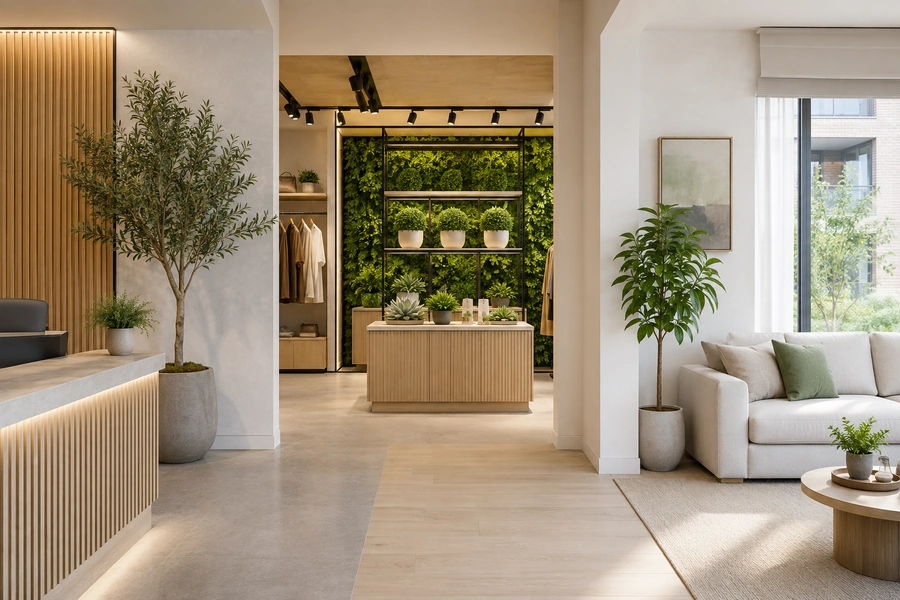
Artificial plants do not communicate through traditional flower symbolism alone. Their commercial meaning comes from what they help a space express. A well-placed olive tree may make an office reception feel warmer. A green wall may frame a retail display. A small faux plant may make a rental listing feel prepared rather than empty.
What Do Artificial Plants Symbolize?
Artificial plants are sometimes described as symbols of permanence because they remain green without natural growth or seasonal decline. In commercial spaces, their meaning is usually more practical.
Artificial plants often symbolize lasting presentation, controlled beauty, convenience, and continuity. They can suggest that a business wants greenery without depending on watering, natural light, plant replacement, or daily horticultural care. Their message becomes positive when the plants appear realistic and maintained, but negative when they are faded, dusty, or badly placed.
Consumer research published by the Plants and Flowers Foundation Holland found that convenience and durability were major reasons people selected artificial flowers and plants. More than half of surveyed consumers across the Netherlands, Germany, France, and the United Kingdom had artificial varieties at home, although many also continued to purchase living plants.
Permanence Without Growth
A live plant represents growth, change, care, and biological life. An artificial plant represents a stable visual result.
That difference may communicate:
- Continuity
- Predictability
- Long-term presentation
- Low-maintenance planning
- Freedom from seasonal changes
- Visual control
These qualities are valuable in offices, shops, showrooms, serviced apartments, event rentals, and properties that must look consistent for many visitors.
However, permanence can also become stagnation. A faded artificial tree left in the same dark corner for years does not communicate stability. It communicates that nobody has reviewed the space.
The condition of the plant changes the meaning.
| Plant Condition | Likely Visual Message |
|---|---|
| Clean and realistic | Care and thoughtful presentation |
| Correctly scaled | Confidence and design control |
| Dusty | Neglect |
| Faded | Poor maintenance or old inventory |
| Too small for the room | Cost cutting or unfinished styling |
| Too large for the area | Clutter and weak planning |
| Clearly repetitive | Mass-produced or temporary appearance |
| Carefully shaped | Attention to detail |
Artificial Does Not Mean Emotionally Empty
An artificial plant can still create warmth because viewers respond to color, shape, texture, scale, and composition. Yet it should not be treated as a complete substitute for the biological experience of nature.
Research on biophilic workplace design supports links between exposure to natural elements and employee well-being. A 2024 study of open-plan office workers found that reported nature exposure was associated with well-being through increased vigor, while also showing that individual connection with nature influenced the result. The study examined nature exposure broadly and did not establish that artificial plants produce the same effects as living plants.
This distinction matters. Faux plants can provide a visual nature cue. They do not grow, release fragrance, change with the seasons, or create the experience of caring for a living object.
What Are the 7 Signals Artificial Plants Send?
A commercial plant does not deliver one universal message. Its meaning depends on the room, plant type, planter, surrounding materials, and reason for placement.
The seven most useful artificial-plant signals are welcome, calm, care, consistency, brand identity, spatial guidance, and adaptability. Offices use these signals to soften work environments. Retailers use them to shape customer experience. Rental operators use them to create warmth, scale, and a move-in-ready impression.
Signal 1: Welcome and Approachability
A bare reception desk can feel transactional. A carefully placed plant softens hard edges and introduces a less formal shape.
Artificial greenery near an entrance may communicate:
- You are welcome here.
- This space has been prepared for visitors.
- The environment is professional but not cold.
- The business has considered the arrival experience.
In an office, I may place an artificial olive tree, ficus, or palm beside the reception seating rather than directly between the visitor and receptionist.
In a retail store, I may use greenery around the entrance or first display to make the transition from the street feel less abrupt.
In a rental property, a small tree near the entry can make an empty hallway look more intentional. It also gives listing photographs a clear foreground element.
Home-staging guidance from the National Association of Realtors describes staging as presenting a property so viewers can understand its strengths and imagine using it. Its 2025 report found that 83% of buyers’ agents believed staging helped buyers visualize a property as a future home. The guidance also recommends clean, restrained décor and small potted plants at entrances. This evidence concerns home sales rather than artificial plants or rentals specifically, so applying it to rental staging is a practical design inference rather than a proven rental-price effect.
Best Plants for a Welcoming Signal
| Setting | Plant Choice | Why It Works |
|---|---|---|
| Office reception | Olive tree or ficus | Soft canopy and professional shape |
| Retail entrance | Tall tropical plant or grouped pots | Creates a visible transition |
| Rental hallway | Narrow snake plant | Adds height without blocking movement |
| Hotel-style rental | Artificial orchid | Controlled and polished |
| Reception seating | Palm or fern | Softens furniture lines |
A welcoming display should not block sightlines, signs, doorways, accessibility routes, or staff communication.
Signal 2: Calm and Visual Relief
Offices and stores contain screens, signs, shelves, lights, cables, packaging, furniture, and hard architectural surfaces. Greenery introduces a familiar organic form.
The signal is not that the plant medically reduces stress. The signal is that the space has been designed to feel less visually severe.
Research on biophilic office environments has associated nature exposure with employee well-being, attention, creativity, and perceived productivity. However, much of this research studies living plants, natural views, or broader biophilic design rather than artificial plants alone. Faux greenery should therefore be described as a visual design tool, not as a clinically proven wellness treatment.
How Artificial Plants Create Visual Relief
They can:
- Break up long blank walls
- Soften sharp furniture corners
- Add a resting color between bright products
- Reduce the empty appearance of large rooms
- Create a natural-looking pause between work zones
- Balance screens and technical equipment
In an open office, one large tree may create more useful relief than many small desk plants. Small repeated pots can add clutter when employees already have limited workspace.
In retail, greenery can create breathing space between products. It should support the merchandise rather than compete with it.
In a rental property, one medium plant may make a neutral room feel calmer without introducing a strong personal taste that limits broad appeal.
Calm Does Not Mean Empty
A calm artificial-plant design still needs variation.
I use:
- Different leaf sizes
- Matte surfaces
- Muted greens
- Natural branch spacing
- Simple planters
- Visible negative space
I avoid placing identical plants in a perfectly even line unless the architecture specifically needs repetition.
Signal 3: Care and Readiness
A well-maintained artificial plant can suggest that the business pays attention to the small details visitors notice.
This signal depends almost entirely on condition.
A dusty plant says the opposite of care. A cracked planter, exposed foam, bent trunk, or missing leaf can weaken the perceived standard of the whole room.
In offices, clean greenery may support the impression that shared spaces are maintained.
In retail, a carefully shaped plant can make the visual-merchandising program look deliberate.
In short-term rentals, clean décor helps the property appear prepared for the next guest.
Current home-staging guidance emphasizes cleanliness, reduced clutter, appropriate scale, inviting entry areas, and restrained decorative additions. These principles apply directly to the way artificial plants should be used, even though the guidance does not specifically compare live and faux greenery.
Maintenance Signals
| Visible Detail | Message Sent |
|---|---|
| Clean leaves | The space is regularly checked |
| Stable planter | Safety and operational care |
| Hidden nursery pot | Finished presentation |
| Correctly opened branches | Staff prepared the display |
| Replaced damaged stems | Quality is monitored |
| Current seasonal styling | The space is actively managed |
| Dust and cobwebs | Neglect |
| Faded window-facing leaves | No review of exposure |
Artificial plants are low maintenance, not maintenance-free.
I schedule:
- Light dusting
- Leaf and stem inspection
- Planter cleaning
- Reshaping
- Rotation away from strong sunlight
- Replacement of faded or broken components
The more closely customers can view the plant, the higher its maintenance standard should be.
Signal 4: Consistency and Operational Control
Artificial plants stay in the same visual condition without watering schedules, replacement cycles, or changes in natural growth.
This makes them useful where the same design must be repeated across several locations.
They can signal:
- A controlled customer experience
- Repeatable brand presentation
- Reliable event styling
- Standard room preparation
- Reduced dependence on local plant conditions
A retailer may use the same artificial planter at several branches. A serviced-apartment operator may use matching plants in every unit. An office group may repeat one greenery style across reception areas.
The artificial plant becomes part of the operating standard rather than an individual decoration.
Where Consistency Matters Most
| Commercial Use | Value of Artificial Plants |
|---|---|
| Retail chains | Repeated visual identity |
| Serviced apartments | Standardized listing and room appearance |
| Property staging inventory | Reusable décor across properties |
| Trade-show rentals | Predictable setup |
| Offices with low natural light | Stable appearance |
| Seasonal pop-ups | Early preparation and fast installation |
| Model homes | Long-lasting staged presentation |
Consistency should not become obvious repetition. If every room has the same plant in the same corner, the design may feel generic.
I standardize the product family while adjusting the scale and placement.
For example, a collection may use the same olive foliage in three forms:
- Tall tree for reception
- Medium floor plant for meeting rooms
- Small branch arrangement for sideboards
This creates a related system without copying one exact display.
Signal 5: Brand Identity and Positioning
Artificial plants can communicate what kind of business the customer has entered.
A tropical palm sends a different message from a clipped boxwood. An orchid sends a different message from a wild grass arrangement.
Retail research has found that store layout and visual merchandising influence customer perceptions and shopping decisions. Research on biophilic store design has also linked natural design elements with visual quality, store preference, willingness to visit, and willingness to spend. These studies generally address greenery or biophilic environments, not necessarily artificial plants, so faux greenery should be viewed as one component of the full retail setting.
What Different Plant Styles Can Signal
| Artificial Plant Style | Possible Brand Signal |
|---|---|
| Olive tree | Calm, natural, Mediterranean, understated |
| Monstera | Modern, youthful, creative |
| Orchid | Polished, premium, controlled |
| Palm | Relaxed, tropical, hospitality-focused |
| Boxwood | Formal, ordered, traditional |
| Eucalyptus | Soft, contemporary, wellness-oriented |
| Tall grass | Minimal, architectural, flexible |
| Flowering tree | Expressive, decorative, event-led |
| Moss-style wall | Immersive, nature-inspired, high-impact |
These signals are not fixed. A black planter can make an olive tree feel modern. A terracotta planter can make the same tree feel rustic.
The plant, planter, lighting, materials, signage, and product display create the final message together.
Offices and Employer Identity
In an office, greenery may support a company’s desired identity:
- Creative
- People-focused
- Calm
- Contemporary
- Environmentally inspired
- Hospitality-led
However, artificial plants should not be used to make unsupported sustainability claims. A plastic plant does not prove that a company is environmentally responsible.
If sustainability is part of the brand message, the company should be prepared to explain material choice, durability, repairability, reuse, supplier documentation, and end-of-life planning.
Signal 6: Spatial Guidance and Zoning
Artificial plants can show people how to move through a space without adding a solid wall.
A line of planters can separate reception from work areas. A tall tree can mark a waiting zone. A low planter can guide customers toward a display while keeping sightlines open.
This signal is functional as well as visual.
Office Applications
Artificial plants can help define:
- Informal meeting zones
- Quiet areas
- Breakout spaces
- Reception boundaries
- Routes between departments
- Screened seating areas
They should not replace acoustic systems, privacy walls, safety barriers, or required signage. Their purpose is to reinforce a spatial decision.
Retail Applications
A retailer may use plants to:
- Frame a hero product
- Mark the start of a department
- Direct attention toward a promotion
- Separate checkout queues
- Reduce the empty appearance of wide aisles
- Create a visual stop at the end of a sightline
Biophilic retail studies suggest that natural elements can influence perceived visual quality and customer responses, but greenery still needs to work with circulation, merchandising, lighting, and product access.
Rental Applications
In a studio apartment, one artificial plant can help distinguish a sitting area from a sleeping area.
In a large open-plan rental, plants can suggest how the tenant might use an empty corner.
This is especially useful in photographs. A plant gives the viewer an immediate sense of scale, but its stated dimensions must be accurate. A very small plant placed close to the camera can make a room look misleadingly large.
Signal 7: Adaptability and Low-Friction Hospitality
Artificial plants can be moved, stored, reused, and installed before a space opens. This sends a final signal: the environment has been designed to remain presentable under changing operational conditions.
In offices, a plant can move when a department or furniture layout changes.
In retail, seasonal flowers or greenery can be replaced without changing the full fixture.
In rental staging, one plant can serve several properties.
In event rentals, the same artificial tree may appear in a reception area, ceremony entrance, photo background, or lounge.
Convenience and durability are among the main consumer reasons for choosing artificial flowers and plants, according to 2025 research in several European markets.
Adaptability Does Not Mean Random Placement
A movable object still needs a plan.
Before relocating a plant, I check:
- Scale
- Light logic
- Walking clearance
- Fire and safety requirements
- Planter stability
- Background color
- Viewing distance
- Cleaning access
The plant should appear to belong in its new position.
Are Artificial Plants Good for Offices?
Artificial plants can solve several office-design problems, particularly where natural light, watering access, maintenance budgets, or plant survival are limited.
Artificial plants are useful in offices when they provide realistic greenery without blocking movement, collecting visible dust, or creating unsupported health claims. They work best in reception areas, meeting rooms, low-light corners, breakout zones, and repeated multi-site designs. Living plants remain preferable when biological growth, care, and authentic nature contact are important.
Advantages for Office Operations
Artificial plants provide:
- Stable appearance
- No watering
- No dropped soil
- No growth into walkways
- No seasonal leaf loss
- Easier multi-location standardization
- Flexible placement in low-light areas
They can also remain in rooms that are closed for long periods.
What They Do Not Provide
Artificial plants do not:
- Grow
- Create the experience of plant care
- Respond biologically to the environment
- Provide the full sensory experience of living greenery
- Automatically improve air quality
- Guarantee reduced stress or higher productivity
Research supports the wider value of biophilic workplaces and natural exposure, but findings vary and may depend on employees’ connection with nature. Managers should avoid translating this research into a claim that any plastic plant will increase productivity.
Best Office Placement Guide
| Office Area | Recommended Plant |
|---|---|
| Reception | Olive tree, ficus, or orchid |
| Meeting room | One medium floor plant |
| Open-plan zone | Tall planters used as soft dividers |
| Breakout area | Palm, monstera, or mixed foliage |
| Executive office | Sculptural tree or orchid |
| Windowless corridor | Snake plant or narrow greenery |
| Video-call background | One asymmetrical medium plant |
I avoid covering every desk with small plastic plants. Employees should have enough working space and should be able to personalize their own area.
What Do Artificial Plants Mean in Retail?
Retail greenery is part of the store’s visual language. It can support product value, create atmosphere, guide movement, or make the brand feel more approachable.
In retail, artificial plants can signal freshness, lifestyle, quality, calm, and careful merchandising. They are most effective when they support the product story. Greenery should not hide merchandise, reduce usable shelf space, obstruct signs, or create a false environmental claim.
Visual-merchandising research published in 2025 examined how store layout and presentation affect customer shopping decisions. Separate biophilic-retail studies have linked greenery with visual quality, patronage intentions, and consumer responses. These findings support thoughtful use of nature-inspired design, but they do not prove that adding any artificial plant will increase sales.
Match the Plant to the Product Category
| Retail Category | Suitable Artificial Greenery |
|---|---|
| Fashion | Olive trees, palms, sculptural branches |
| Beauty | Orchids, eucalyptus, soft foliage |
| Home décor | Mixed realistic houseplants |
| Outdoor lifestyle | Grasses, ferns, broad-leaf plants |
| Luxury goods | Controlled orchid or architectural tree |
| Children’s retail | Soft, rounded, securely installed greenery |
| Wellness | Muted foliage with natural materials |
| Food display | Cleanable plants kept away from food-contact areas |
The plant should strengthen the customer’s understanding of the product.
A tropical plant beside winter outerwear may feel disconnected unless the store’s broader identity makes that contrast intentional.
Retail Red Flags
Artificial greenery weakens the store when it:
- Looks cheaper than the products
- Blocks labels or price signs
- Collects visible dust
- Creates narrow aisles
- Uses unstable planters
- Shows repeated identical leaves
- Fades under window light
- Claims sustainability without evidence
A retailer should inspect the plant from the customer’s viewing distance, not only from behind the display.
Why Use Artificial Plants in Rentals and Property Staging?
An empty property can be difficult to understand from photographs. Small decorative elements give rooms scale and suggest how they may be used.
Artificial plants are useful in rental staging because they are reusable, transportable, and consistent across viewing dates. They can add warmth to neutral rooms, provide scale in photographs, and help define functional zones. They should remain restrained so prospective tenants can imagine their own belongings in the property.
NAR’s 2025 staging guidance found that most surveyed buyers’ agents believed staging made it easier for buyers to visualize a property as a future home. The report concerns properties for sale, not rental listings, but its core staging principle—helping viewers understand space—also provides a reasonable framework for rental presentation.
Best Rental Uses
I use artificial plants to:
- Warm an empty living room
- Balance a bare corner
- Frame a balcony door
- Add scale beside a sofa
- Soften a home-office desk
- Improve a bathroom shelf
- Define zones in a studio
- Add color without strong personal décor
Avoid Overstaging
A rental should not resemble a plant showroom.
Too many plants can:
- Make the room look smaller
- Hide electrical outlets
- block walking routes
- distract from property features
- create unrealistic listing photographs
- add unnecessary moving labor
One well-scaled plant usually communicates more care than several small, unrelated products.
Do Artificial Plants Create Bad Energy?
Artificial plants are sometimes criticized as symbols of fake growth, stagnation, or poor energy. These interpretations depend on personal and cultural belief.
Artificial plants are not objectively positive or negative. Their effect comes from condition, placement, realism, and meaning. A clean plant placed intentionally may communicate care and calm. A faded, dusty, or broken plant may communicate neglect. Personal beliefs should guide private spaces, while commercial spaces should prioritize safety, maintenance, and audience expectations.
The strongest practical rule is simple: remove any plant that no longer improves the space.
A commercial object should earn its place through at least one function:
- Warmth
- Scale
- Brand expression
- Wayfinding
- Privacy
- Color
- Visual balance
When an artificial plant performs none of these functions, it becomes clutter.
How Do You Choose the Right Artificial Plant Signal?
The buyer should begin with the message, not the catalog.
Choose an artificial plant by deciding what the space needs to communicate. Select the plant form, size, color, planter, and placement that support that message. Then evaluate realism, safety, maintenance, and viewing distance before approving the final product.
Signal Selection Guide
| Desired Signal | Plant Direction | Placement |
|---|---|---|
| Welcome | Soft tree or open palm | Entrance or reception |
| Calm | Muted greenery with open space | Waiting or work area |
| Care | Clean, detailed plant in finished planter | Close-view location |
| Consistency | Repeatable product family | Multiple sites or units |
| Premium identity | Orchid or sculptural tree | Feature display |
| Spatial order | Tall narrow planters | Zone boundary |
| Adaptability | Modular and lightweight plants | Rentals and events |
Use the Three-Distance Test
I inspect every plant from:
- Close range: Are there visible glue marks, mold lines, or exposed foam?
- Normal range: Does the shape look natural from where customers sit or walk?
- Photographic range: Does the plant balance the room without dominating it?
A product that looks convincing only from one angle may be suitable for a wall display but not for a central reception area.
Match Quality to Visibility
Premium real-touch plants are most valuable where people can see and touch them.
Less detailed greenery may work:
- Above eye level
- Behind furniture
- In distant window displays
- Across large event backgrounds
- Inside layered green walls
This approach controls cost without lowering the quality of the most visible areas.
My Insights: Artificial Plant Meaning—What 7 Signals Do They Send in Offices, Retail, and Rentals
Artificial plants do not reveal one fixed truth about a business or property. They show what the designer chose to prioritize and what the operator continues to maintain.
The seven signals are welcome, visual calm, care, consistency, brand identity, spatial guidance, and adaptability. Offices use them to soften and organize work settings. Retailers use them to reinforce customer experience. Rental operators use them to add warmth and scale. The message succeeds only when the greenery looks intentional.
My main insight is that artificial-plant meaning comes less from the fact that the plant is artificial and more from the quality of the decision around it.
Signal 1: We Expected You
Entrance greenery shows that the arrival area was considered.
This signal is useful in receptions, hotel-style rentals, showrooms, clinics, and stores.
The plant should feel open and welcoming rather than acting as a barrier.
Signal 2: This Space Allows a Pause
Greenery can provide visual relief between technical, commercial, or architectural elements.
The evidence for nature-rich environments is stronger than the evidence for artificial plants alone, so the responsible claim is that faux plants offer visual softness—not guaranteed health or productivity outcomes.
Signal 3: Details Are Managed
A clean and correctly shaped artificial plant suggests routine attention.
A dusty one reveals that maintenance standards stop at the most obvious surfaces.
The plant becomes a small test of operational consistency.
Signal 4: The Experience Is Repeatable
Artificial plants support the same visual standard across offices, shops, staged homes, and rental units.
This repeatability is valuable where living-plant conditions differ between locations.
Signal 5: We Know Our Identity
A plant style can strengthen a brand position.
An orchid may feel controlled and premium. A palm may feel relaxed. An olive tree may feel quiet and natural. A boxwood may feel formal.
The plant should support the brand rather than serve as a random green accessory.
Signal 6: This Is How the Space Works
Planters can mark routes, divide areas, frame displays, and explain room functions.
Their placement should guide rather than obstruct.
Signal 7: The Space Can Change Without Looking Unfinished
Artificial plants can move with furniture, retail collections, tenants, events, and seasonal displays.
This flexibility makes them useful assets rather than disposable decoration when they are stored, repaired, and reused properly.
The Seven-Signal Summary
| Signal | Office Meaning | Retail Meaning | Rental Meaning |
|---|---|---|---|
| Welcome | Approachable workplace | Inviting entrance | Move-in-ready arrival |
| Calm | Softer work setting | Less severe merchandise environment | Comfortable neutral room |
| Care | Maintained shared space | Detailed merchandising | Prepared viewing |
| Consistency | Repeatable office standard | Multi-store visual control | Standardized property presentation |
| Brand identity | Employer character | Market positioning | Intended lifestyle |
| Spatial guidance | Defined work zones | Customer flow | Clear room function |
| Adaptability | Easy layout change | Seasonal display flexibility | Reusable staging inventory |
My Final Rule
I keep an artificial plant only when it clearly improves the space.
It should make the room more welcoming, understandable, balanced, or memorable. It should remain clean and stable. It should suit the scale of the furniture and the expectations of the audience.
An artificial plant does not automatically say that a company is caring, sustainable, modern, or premium. It communicates those qualities only when the full environment supports the same message.
Conclusion
Artificial plants can signal welcome, calm, care, consistency, identity, spatial order, and adaptability. Their meaning depends on realistic quality, thoughtful placement, and visible maintenance.