
A faux plant may look convincing online but fail in a busy lobby when its leaves shine, its base tips, or its branches collect visible dust.
The best faux plants for commercial spaces in 2025 include olive trees, ficus trees, palms, snake plants, monsteras, orchids, pothos, boxwood, agave, grasses, and mixed green-wall panels. Buyers should evaluate realism, stability, cleanability, scale, replacement options, fire documentation, UV performance, and consistency across repeat orders.
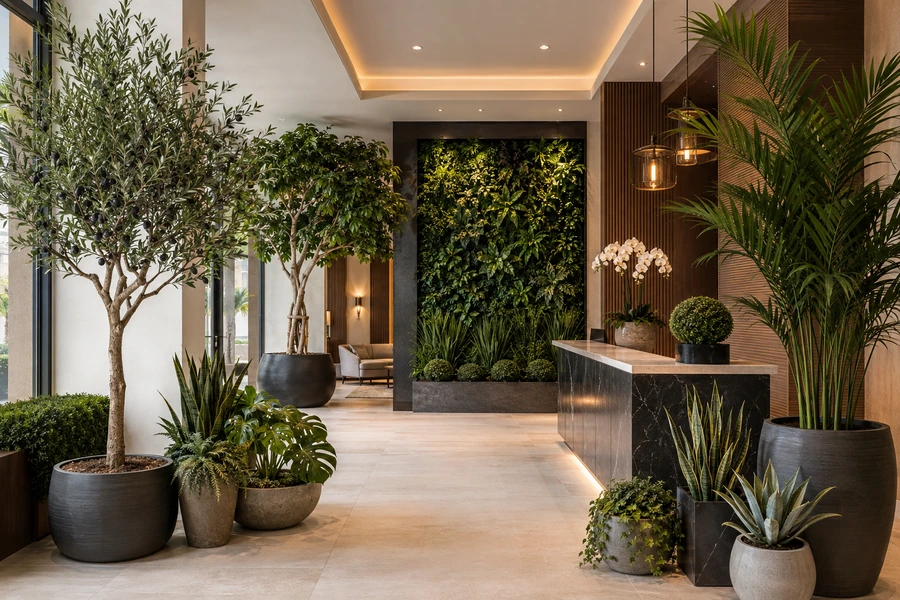
In this guide, “tested” means that each plant category has been assessed against a commercial-use scorecard. It does not mean that every branded product was physically tested in a laboratory. Independent 2025 faux-plant testing emphasized realism, durability, adjustability, and dust collection. I added the factors that matter in offices, hotels, stores, restaurants, healthcare facilities, and rental properties.
What Makes a Faux Plant Suitable for Commercial Spaces?
A realistic leaf is only one part of the decision. A commercial plant must also remain stable, clean, replaceable, and consistent through daily traffic and repeated maintenance.
A commercial-grade faux plant should have natural color variation, a matte finish, adjustable branches, secure leaf connections, a stable base, and materials suited to its intended location. Public-facing projects may also require project-specific fire-performance documents, while exterior installations need verified UV and weathering information.
Commercial spaces create more pressure than an average home. Visitors may touch the leaves. Cleaning teams may move the planter. Sunlight may strike one side of the plant every afternoon. A hotel may need the same product for several properties, while a retailer may need matching replacement stock six months later.
The Commercial-Use Scorecard
I evaluate each pick against eight factors.
| Test Factor | What I Check |
|---|---|
| Realism | Matte leaves, natural veins, varied color, believable trunk |
| Stability | Weighted base, wide planter, secure central stem |
| Adjustability | Wired or bendable branches that recover after packing |
| Cleanability | Surfaces that tolerate dusting or approved damp wiping |
| Commercial scale | Dimensions that suit lobbies, counters, walls, or work areas |
| Repeatability | Matching colors, sizes, and materials across production batches |
| Replaceability | Spare fronds, foliage, panels, stems, or planter parts |
| Documentation | Applicable fire, UV, material, or project records |
Independent consumer testing published in 2025 assessed artificial plants for realism, durability, adjustability, and dust accumulation. Those criteria are useful, but commercial buyers also need to evaluate installation safety, repeat purchasing, cleaning access, and project documentation.
Realism Should Match Viewing Distance
A reception-desk orchid may be viewed from less than one meter away. Its flower center, roots, support stake, and pot finish need close attention.
A ten-foot palm in a hotel atrium is normally seen from farther away. Its overall silhouette, height, frond direction, and planter scale matter more than tiny leaf details.
I divide commercial placements into three zones:
- Close view: reception counters, restaurant tables, retail displays, and meeting rooms
- Medium view: waiting areas, corridors, offices, hotel rooms, and lounge corners
- Long view: atriums, stages, upper shelves, green walls, and large entrances
I use the highest-detail products in close-view locations. This controls the budget without placing visibly weak products where customers can inspect them.
Commercial Does Not Automatically Mean Fire-Rated
A supplier may use the phrase “commercial-grade” to describe size or durability. That phrase does not automatically prove fire performance.
Requirements vary by building type, occupancy, location, installation method, and local authority. NFPA materials note that artificial imitations of natural vegetation used as decoration are often regulated through fire and life-safety codes. Buyers should confirm the exact project requirement before ordering.
What Are the 21 Best Faux Plants for Commercial Spaces?
Not every plant form translates equally well into artificial materials. Structured, waxy, small-leaf, or naturally sculptural plants are often the easiest to reproduce convincingly.
The 21 strongest commercial choices cover large statement trees, narrow office plants, hospitality accents, trailing greenery, outdoor structures, and wall systems. Olive, ficus, palm, snake plant, monstera, orchid, boxwood, agave, and mixed foliage remain especially flexible because their natural forms suit artificial production and repeated commercial placement.
Quick Ranking
| Rank | Faux Plant | Best Commercial Use | Main Strength | Main Caution |
|---|---|---|---|---|
| 1 | Olive tree | Offices, hotels, retail | Versatile and visually light | Sparse low-quality canopies |
| 2 | Ficus tree | Lobbies and workplaces | Dense, adaptable canopy | Repetitive small leaves |
| 3 | Bird of paradise | Large open interiors | Strong tropical scale | Wide leaves need space |
| 4 | Kentia palm | Hotels and lounges | Elegant soft silhouette | Fine fronds collect dust |
| 5 | Areca palm | Restaurants and hospitality | Full, relaxed volume | Can look crowded |
| 6 | Fiddle leaf fig | Reception and feature corners | Bold broad leaves | Gloss exposes poor quality |
| 7 | Snake plant | Corridors and compact offices | Narrow footprint | Identical leaves look artificial |
| 8 | ZZ plant | Desks and waiting areas | Structured low form | Strong shine can look plastic |
| 9 | Dracaena | Offices and healthcare | Clean vertical shape | Weak trunks may lean |
| 10 | Rubber plant | Executive areas and retail | Rich, architectural leaves | Needs controlled reflection |
| 11 | Aglaonema | Counters and compact displays | Natural color variation | Printed patterns may repeat |
| 12 | Bamboo | Spas, restaurants, partitions | Tall and visually light | Cheap canes look uniform |
| 13 | Monstera | Modern retail and offices | Graphic recognizable leaves | Repeated splits reveal molds |
| 14 | Orchid | Reception and hospitality | Premium close-view detail | Weak flowers look inexpensive |
| 15 | Boston fern | Shelves and hanging zones | Soft cascading volume | Detailed fronds trap dust |
| 16 | Pothos | Shelves and ceiling displays | Flexible trailing form | Equal vine lengths look staged |
| 17 | Eucalyptus tree | Wellness and neutral interiors | Muted modern color | Pale leaves show dirt |
| 18 | Boxwood topiary | Entrances and formal spaces | Strong repeatable structure | Bright green looks unnatural |
| 19 | Agave | Outdoor and architectural spaces | Durable sculptural form | Sharp tips need safe placement |
| 20 | Ornamental grass | Planter rows and zoning | Movement and fast coverage | Loose blades can flatten |
| 21 | Mixed green-wall panel | Retail, offices, hospitality | Large-area transformation | Repetition and fire requirements |
1. Faux Olive Tree—Best Overall
The olive tree is my strongest overall choice because it adds height without creating a dense visual barrier. Its narrow leaves work with contemporary, Mediterranean, farmhouse, hospitality, and quiet luxury interiors.
Commercial suppliers and designers widely used tall artificial olive trees to frame entrances and soften customer-facing spaces in 2025.
I use faux olive trees beside reception desks, sofas, retail mirrors, dining-room entrances, and hotel seating groups.
A good commercial olive tree should have:
- Muted gray-green leaves
- Several leaf sizes
- Irregular branch spacing
- A textured trunk
- Enough open space inside the canopy
- A weighted base
- Bendable branches
I avoid trees shaped like a perfectly round ball. I also avoid bright green leaves with identical pale undersides.
For a large lobby, a pair of matching olive trees can frame the reception area. For an office, one medium tree normally looks more natural than several small copies.
2. Faux Ficus Tree—Best All-Purpose Commercial Tree
Ficus is useful when a project needs a fuller canopy than an olive tree. Its small leaves create visual density and help hide the internal branch system.
I use ficus in:
- Corporate offices
- Clinics
- Banks
- Hotel corridors
- Restaurant waiting areas
- Conference centers
- Co-working spaces
The ficus silhouette works with many design styles, so the buyer can reuse it after furniture or branding changes.
The main risk is repetition. Low-quality trees may have hundreds of identical leaves attached at equal intervals. The result looks manufactured even from a distance.
I look for several greens, varied branch directions, a realistic trunk transition, and enough internal space for cleaning. A canopy that is too dense collects dust and becomes difficult to maintain.
3. Faux Bird of Paradise—Best Large Statement Plant
Bird of paradise is one of the strongest options for tall hotel lobbies, large restaurants, showrooms, and modern office receptions.
Its broad paddle-shaped leaves create an immediate visual statement. The plant can fill a large empty corner without requiring a dense canopy.
A strong product should have:
- Individually adjustable stems
- Several leaf heights
- Visible central ribbing
- Slight bends or natural-looking splits
- Open space between leaves
- A wide, stable planter
I do not place this plant in a narrow corridor. Its leaves project outward and can interfere with walking routes or cleaning equipment.
The plant works best in high-ceiling areas where the top leaves have enough empty space around them.
4. Faux Kentia Palm—Best for Elegant Hospitality
A Kentia palm has a softer and more refined silhouette than many dense tropical palms. It suits hotels, premium restaurants, lounges, spas, and resort-style interiors.
I place it near:
- Lounge seating
- Lobby windows
- Restaurant banquettes
- Spa waiting rooms
- Hotel room corners
- Large mirrors
The best versions have varied frond lengths and a relaxed outward curve. Every frond should not form the same flat fan.
Fine palm leaves collect dust, so the plant needs enough space for routine cleaning. It should not be pushed tightly between furniture and a wall.
A dark planter creates a formal effect. Woven or textured neutral containers create a more relaxed hospitality mood.
5. Faux Areca Palm—Best for Full Tropical Volume
Areca palms provide a fuller canopy than Kentia palms. They work in restaurants, event venues, resort interiors, shopping centers, and casual reception areas.
Hotel-market commentary in 2025 highlighted oversized statement palms and larger artificial greenery as a strong lobby direction. That reflects supplier and design activity rather than an independently measured global market share.
I use an Areca palm when the goal is to:
- Hide an empty corner
- Soften a large structural column
- Add visual separation
- Create a tropical atmosphere
- Fill a wide planter
I avoid placing several dense palms close together. Too many fine fronds create visual noise and increase cleaning time.
6. Faux Fiddle Leaf Fig—Best Bold Office Tree
The fiddle leaf fig has large, recognizable leaves that provide strong visual weight. It works beside a reception sofa, in an executive office, near a boardroom entrance, or beside a retail seating area.
The broad leaves expose quality problems quickly. A glossy surface, obvious mold seam, or repeated printed vein becomes visible under commercial lighting.
I select leaves with:
- Several sizes
- Curved edges
- Natural veining
- Controlled matte reflection
- Slight color variation
- Different facing directions
The trunk should carry the canopy without leaning. Large leaves catch more air, so outdoor or frequently moved versions need a stable base.
7. Faux Snake Plant—Best for Narrow Commercial Spaces
Snake plants are practical for corridors, washroom entrances, desk ends, elevator lobbies, compact clinics, and spaces beside doorways.
Their upright form occupies little floor area. It also reduces the risk of branches extending into walkways.
A convincing faux snake plant should include:
- Leaves of different heights
- Slight curves
- Natural striping
- Several shades of green
- A dense but irregular base
I avoid products where every leaf has the same height and angle.
Snake plants work well in repeated commercial programs because they are easy to size. A buyer can use a short version on a counter, a medium version beside seating, and a tall version in a floor planter.
8. Faux ZZ Plant—Best Compact Structured Plant
The ZZ plant has glossy, rounded leaves arranged on upright stems. It is useful for waiting rooms, counters, side tables, executive desks, and office storage cabinets.
Its natural leaf form already appears smooth and structured, so molded artificial versions can look convincing.
The challenge is reflection. Strong commercial lighting can make poor plastic leaves appear oily.
I choose a product with:
- Soft rather than mirror-like shine
- Several stem heights
- Slightly varied leaf angles
- A finished base
- A container that does not look too small
A faux ZZ plant should not be placed directly beneath a strong spotlight unless the finish has been reviewed under that lighting.
9. Faux Dracaena—Best Clean Vertical Tree
Dracaena provides a controlled vertical shape with narrow leaves. It works well in offices, healthcare settings, educational buildings, reception areas, and modern commercial interiors.
It is especially useful where a broad tree would occupy too much space.
I inspect the central trunk carefully. A thin, flexible trunk may lean after the foliage is opened. The weighted pot should also be large enough to balance the plant’s height.
For a natural result, leaf clusters should appear at several levels rather than only at the top.
10. Faux Rubber Plant—Best Architectural Foliage
Rubber plants have broad, dark leaves and a strong modern shape. They work in premium retail, executive offices, showrooms, restaurants, and contemporary hotel rooms.
The deep green surface pairs well with:
- Walnut
- Black metal
- Warm stone
- Leather
- Textured plaster
- Dark ceramic planters
A low-quality rubber plant may look more artificial than a low-quality olive tree because the broad leaf surface reveals mold lines and excessive gloss.
I use rubber plants in medium-view areas unless the product has strong close-up detail.
11. Faux Aglaonema—Best Color-Varied Compact Plant
Aglaonema adds pattern without using flowers. It works on reception credenzas, side tables, café counters, healthcare waiting-room cabinets, and retail display shelves.
Its natural leaves may include silver, pale green, cream, or muted pink markings. This color variation can make artificial versions appear less flat.
The print should not repeat too clearly from leaf to leaf. I turn the plant during sample review and check whether identical patterns are visible from several angles.
12. Faux Bamboo—Best Soft Partition Plant
Artificial bamboo provides height while allowing some visibility through the stems. It can soften dividers, restaurant seating, spa corridors, hotel entrances, and Asian-inspired interiors.
A good bamboo plant should have:
- Canes of different thicknesses
- Natural joint details
- Varied leaf clusters
- Open internal spacing
- Stable lower construction
I avoid perfectly straight canes arranged at equal distances. A controlled amount of irregularity improves realism.
For large divider programs, I use several planters rather than one extremely long container. Smaller modules are easier to move, repair, and replace.
13. Faux Monstera—Best for Modern Retail and Creative Offices
Monstera leaves have a graphic shape that works well in design studios, fashion stores, cafés, showrooms, and contemporary offices.
Artificial monstera products were included in both independent 2025 testing and major editorial selections, largely because the split-leaf shape is recognizable and works from normal viewing distance.
I check whether the leaf splits and holes vary. Several identical leaves facing forward can reveal the mold pattern quickly.
Monstera works best when its stems are opened asymmetrically. One or two leaves should turn sideways, and lower leaves can bend slightly downward.
14. Faux Orchid—Best Premium Counter Plant
Orchids work well at hotel reception desks, spa counters, salon stations, restaurant host stands, executive offices, and luxury retail displays.
They add a controlled floral element without creating the visual weight of a large bouquet.
A good artificial orchid needs:
- Detailed flower centers
- A mixture of blooms and buds
- Natural stem curves
- Thick lower leaves
- Visible roots, bark, or moss
- A well-scaled container
Independent 2025 testing found that even an orchid that was identifiable as artificial could still work effectively from several feet away when its stem curve, support stake, roots, and overall form looked convincing.
I use white or cream orchids for the broadest commercial flexibility. Bright purple and pink versions need stronger color control.
15. Faux Boston Fern—Best Soft Shelf or Hanging Plant
Boston ferns are useful for high shelves, hanging baskets, bathroom ledges, hospitality displays, and cabinet tops.
Their many small leaflets create soft volume and hide minor manufacturing differences from a distance.
The main commercial issue is dust. Dense fronds can trap particles and require more cleaning time than broad-leaf plants.
I place ferns where cleaning staff can reach them safely. I do not install them above food-preparation areas or in places where fallen decorative material could become a problem.
16. Faux Pothos—Best Trailing Plant
Pothos can soften the edge of a shelf, ceiling frame, retail fixture, cabinet, or wall-mounted planter.
Trailing pothos and similar cascading plants were prominent in 2025 office and commercial styling content because they add greenery without using floor space.
A realistic product should have:
- Several vine lengths
- Different leaf sizes
- Mixed green tones
- Irregular leaf intervals
- Flexible stems
I divide the vines rather than letting every strand fall vertically. One may cross a shelf, one may hang, and another may remain close to the planter.
For ceiling displays, every vine needs a secure attachment. Decorative foliage should never depend on one loose hook.
17. Faux Eucalyptus Tree—Best for Neutral and Wellness-Led Interiors
Eucalyptus has muted gray-green leaves that suit spas, clinics, salons, modern offices, quiet retail interiors, and neutral hotel rooms.
Its color is less intense than tropical greenery, so it can soften a space without dominating it.
Pale leaves reveal dark dust, however. I avoid installing eucalyptus directly beside busy roads, open kitchen areas, or vents that move visible particles.
A strong product should have thin irregular branches, several muted greens, and enough negative space to avoid a dense artificial canopy.
18. Faux Boxwood Topiary—Best Formal Entrance Plant
Boxwood works well in pairs. It can frame hotel doors, store entrances, office reception desks, event stages, and restaurant terraces.
The shape may be a ball, cone, spiral, hedge, or rectangular panel.
For commercial use, I check:
- Leaf density
- Grid or internal-frame strength
- Color variation
- UV suitability for outdoor placement
- Base stability
- Replacement sections
A bright single green often looks artificial. Dark, medium, and muted green leaves create a more natural surface.
Exterior boxwood should have product-specific weathering information. A generic plastic description does not prove resistance to sunlight.
19. Faux Agave—Best Sculptural Outdoor Pick
Agave is useful in modern entrances, pool areas, rooftops, restaurants, hotels, and large architectural planters.
Its thick leaves can be molded from durable materials, and its structured form works without many separate attachment points.
I inspect the leaf tips because they can bend during packing or create contact risks in narrow areas. Agave should not project into a walking route.
For exterior use, I request documentation tied to the supplied material and color. ISO 4892-3:2024 specifies methods for exposing plastic specimens to fluorescent UV radiation, heat, and water to simulate aspects of weathering. A supplier should explain the actual method, specimen, duration, and acceptance result rather than citing only “UV tested.”
20. Faux Ornamental Grass—Best for Zoning and Long Planters
Artificial grasses work in office dividers, restaurant terraces, hotel corridors, window boxes, retail boundaries, and long architectural planters.
Their many blades provide fast coverage, movement, and a soft visual barrier.
I select grasses with:
- Several blade heights
- More than one green tone
- Flexible but resilient material
- Secure lower clusters
- Replaceable sections
Long planters should be divided into removable modules. This makes cleaning, replacement, and access easier.
Exterior grasses need secure planting because wind can pull out individual clusters even when the container remains stable.
21. Mixed Green-Wall Panel—Best Large-Area Solution
A mixed green wall is not one botanical species, but it is one of the most useful faux-plant formats for commercial spaces.
It can cover:
- Reception walls
- Retail photo areas
- Restaurant dividers
- Office collaboration zones
- Hotel corridors
- Event backgrounds
- Branded feature walls
A good panel should use several leaf shapes and depths. Repeating one panel without rotation can create visible squares across the wall.
Commercial suppliers often tailor artificial green walls to project dimensions, sightlines, and brand palettes. Some also offer UV- or fire-rated foliage options, but the buyer must verify whether the documentation applies to the exact finished system.
I request a connected sample area rather than one isolated panel. Joining lines, repeating patterns, edge finishing, and logo openings become visible only across a larger section.
Which Faux Plant Is Best for Each Commercial Space?
A plant that looks right in a hotel atrium may overwhelm a medical waiting room. Selection begins with function, traffic, viewing distance, and brand position.
Offices perform well with olive, ficus, snake plant, dracaena, and pothos. Hotels can use palms, orchids, olive trees, and large green walls. Retailers benefit from monstera, rubber plants, eucalyptus, and compact display greenery. Exterior spaces need weather-suitable boxwood, agave, grasses, or other verified outdoor products.
Commercial Placement Guide
| Commercial Space | Best Picks | Main Design Goal |
|---|---|---|
| Corporate reception | Olive, ficus, orchid | Welcome and polish |
| Open office | Dracaena, snake plant, grass | Zoning without clutter |
| Meeting room | Rubber plant, ZZ plant | Controlled visual softness |
| Hotel lobby | Olive, Kentia palm, bird of paradise | Large-scale hospitality |
| Hotel room | Orchid, small palm, eucalyptus | Consistent room styling |
| Restaurant entrance | Ficus, olive, boxwood | Clear arrival experience |
| Dining room | Palm, bamboo, pothos | Warmth and separation |
| Retail display | Monstera, orchid, rubber plant | Product framing |
| Healthcare waiting room | Snake plant, dracaena, aglaonema | Calm, clean form |
| Spa or salon | Orchid, eucalyptus, bamboo | Soft premium atmosphere |
| Rental or model unit | Olive, snake plant, pothos | Scale and move-in readiness |
| Exterior entrance | Boxwood, agave, grass | Durable architectural greenery |
| Feature wall | Mixed panel | Branding and visual impact |
Offices
I prioritize narrow footprints, easy cleaning, and restrained design. One correctly sized floor tree often performs better than several small plants placed randomly around desks.
Olive, ficus, dracaena, snake plant, and ZZ plant are reliable starting categories.
Hotels
Hotels need stronger scale and a clear relationship with the interior architecture.
A tall palm may balance a double-height lobby. Orchids work at reception counters. Olive trees suit calm lifestyle properties, while green walls create high-impact arrival or social-media areas.
Retail
A retail plant should support merchandise.
I keep plants away from price labels, product access, fitting-room routes, and security equipment. Compact orchids, monsteras, eucalyptus, rubber plants, and trailing pothos work well when matched to the product category.
Restaurants
Restaurants need cleanable products and stable planters. Plants should not interfere with food service, emergency access, guest movement, or cleaning routines.
Palms and bamboo can create soft partitions. Olive trees and ficus can define entrances. Hanging pothos can add overhead greenery when the installation is secure and approved.
Are Faux Plants Safe for Commercial Buildings?
Artificial plants can add combustible material, physical weight, projecting leaves, unstable planters, and overhead attachment points. Their decorative role does not remove these risks.
Faux plants can be used safely when the buyer confirms local fire and building requirements, keeps exits and safety systems clear, uses stable planters, and secures overhead or exterior installations. Fire or UV claims must match the exact supplied product and installation—not a generic material, company brochure, or unrelated test report.
Fire Performance
Artificial decorative vegetation may be regulated by fire and life-safety codes. Requirements differ by jurisdiction, occupancy, plant location, quantity, and building system.
I request:
- The exact tested product name
- Material description
- Test standard
- Laboratory
- Report number
- Test date
- Result
- Installation or mounting conditions
- Any limitations on cutting or modification
I do not accept a certificate for one foliage type as proof that every tree, green wall, flower, pot, and adhesive in the project has the same performance.
Topical fire-retardant treatment and inherently treated material are not automatically interchangeable. The project team should determine which approach and documentation are acceptable.
Egress and Accessibility
Planters should not reduce required walkway width, block door movement, hide emergency equipment, or create projecting hazards.
Broad bird-of-paradise leaves and agave tips need more clearance than narrow snake plants.
A planter that appears stable can still move when bumped by a trolley, suitcase, wheelchair, or cleaning machine.
Overhead Installations
Hanging pothos, vines, moss effects, and ceiling greenery need a secondary support system. Every major section should remain secured if one connection fails.
The building structure—not the decorative plant—must carry the load.
Exterior Installations
Outdoor faux plants need wind stability as well as UV suitability.
The planter, ballast, stem holder, foliage, internal wire, adhesive, and connection points must work as one system. A UV-rated leaf does not prevent the complete planter from tipping or individual stems from blowing out.
How Do You Choose the Right Size and Planter?
Many commercial plants look wrong because the plant and planter were selected separately. A small shipping pot beneath a large canopy creates an unstable and unfinished result.
Choose the plant height according to ceiling height, furniture scale, and viewing distance. Then select a planter wide and heavy enough to balance the canopy. Floor plants should normally rise clearly above nearby seating, while counter plants should remain below important signs, screens, and staff sightlines.
Practical Size Guide
| Placement | Suggested Plant Scale |
|---|---|
| Reception counter | 30–70 cm |
| Desk or shelf | 20–60 cm |
| Beside lounge chair | 120–180 cm |
| Beside sofa | 150–210 cm |
| Standard lobby corner | 180–270 cm |
| Double-height atrium | Custom 300 cm and above |
| Long divider planter | 60–140 cm foliage above the planter |
| Large feature wall | Sized to architecture, not furniture alone |
These are design starting points rather than fixed rules.
Planter Proportion
The decorative planter should look capable of supporting the plant.
For a tall tree, I choose a planter with enough width and visual weight. A slim planter can work when its internal base is engineered and secured, but it should not appear ready to tip.
The original nursery pot can sit inside the decorative planter. I then stabilize it and cover the visible top with:
- Preserved moss
- Fixed artificial moss
- Bark
- Matte stones
- Artificial soil
- A fitted decorative insert
Loose lightweight material should not be used where it can blow, spill, or enter a walking route.
Match the Shape to Circulation
Use narrow plants beside doors and in corridors.
Use broad plants in corners, atriums, lounges, and spaces with enough clearance.
Use hanging or wall greenery when floor space is limited, but confirm structural and fire requirements first.
How Should Commercial Buyers Inspect Faux Plants?
A supplier’s best sample may not represent the full shipment. Commercial buyers need repeatable dimensions, colors, packing, and construction.
Inspect faux plants against an approved physical sample and written specification. Check height, canopy width, leaf color, stem count, trunk construction, base weight, odor, surface shine, attachment strength, packaging recovery, labels, and documentation. Repeat orders should be compared with retained samples from the original approved batch.
Sample Approval Checklist
I record:
- Overall height
- Maximum opened width
- Pot dimensions
- Product weight
- Trunk material
- Leaf material
- Leaf count or density
- Number of main stems
- Color range
- Surface finish
- Flexibility
- Base construction
- Approved shaping
- Packaging position
I also photograph the plant from several sides.
Packing-Recovery Test
Large artificial plants are usually folded or compressed for transportation.
I ask the supplier to pack a sample using the proposed production method. I then open it after a realistic period and record:
- Reshaping time
- Permanent creases
- Broken stems
- Detached leaves
- Trunk movement
- Final canopy dimensions
A lower freight cost is not a true saving when every tree requires extensive repair.
Repeat-Order Control
Commercial projects may need replacement stock months or years later.
I ask whether the supplier can maintain:
- Leaf mold
- Pigment formula
- Trunk finish
- Product height
- Pot size
- Fire or UV formulation
- Packaging
- Product code
A product described by a generic name such as “180 cm olive tree” may change without notice. A detailed specification gives the buyer a better reference.
How Do You Maintain Faux Plants in Busy Spaces?
Artificial plants do not need water, but they still collect dust, fingerprints, grease, debris, and surface marks. Poor maintenance can make an expensive product look cheap.
Maintain commercial faux plants through scheduled dusting, material-compatible cleaning, branch reshaping, planter inspection, and timely replacement of damaged foliage. High-touch and food-service locations need more frequent checks than distant lobby trees or elevated wall installations.
Suggested Maintenance Schedule
| Location | Routine |
|---|---|
| Reception counter | Inspect weekly |
| Restaurant or café | Check weekly for dust and grease |
| Office floor plant | Dust every two to four weeks |
| Hotel lobby tree | Inspect weekly and clean as needed |
| Green wall | Visual check monthly; planned deep cleaning |
| Exterior planter | Inspect after storms and strong sun exposure |
| Ceiling greenery | Scheduled professional access and attachment checks |
Clean by Material
Use a microfiber cloth on broad molded leaves.
Use a soft brush or cool low-pressure air on ferns, palms, and detailed greenery.
Use moisture only when the supplier’s care instructions allow it. Test an unseen area before wiping real-touch, flocked, printed, or coated foliage.
Replace Parts Before the Whole Plant Fails
Commercial buyers should keep spare:
- Fronds
- Leaf branches
- Flower stems
- Green-wall panels
- Attachment clips
- Planter toppers
- Internal stakes
A single faded branch can make a whole tree look neglected. Replacing the damaged component may be faster and less expensive than replacing the full plant.
My Insights: Best Faux Plants for Commercial Spaces—Which 21 Picks Perform Best in 2025
The best commercial faux plant is not always the product that looks most realistic in a close-up photograph. It is the product that continues to support the space after delivery, shaping, cleaning, customer contact, and repeat ordering.
The 21 strongest picks for 2025 combine believable forms with practical commercial roles. Olive and ficus trees provide broad flexibility. Palms and bird of paradise create hospitality scale. Snake plants and dracaena solve narrow-space problems. Orchids support premium counters, while boxwood, agave, grasses, and green walls serve architectural and exterior projects.
My main insight is that commercial plants should be selected as equipment for a designed environment, not as isolated decorations.
Best Overall Commercial Choice
The olive tree ranks first because it works in offices, hotels, retail, restaurants, rentals, and reception areas.
Its narrow leaves reduce visual weight. Its irregular form looks natural when shaped properly. It also pairs with many planter and interior styles.
Best Choice for Large Lobbies
Bird of paradise, Kentia palm, Areca palm, ficus, and custom olive trees provide the strongest height and canopy options.
I choose among them according to the architecture:
- Olive for restrained warmth
- Bird of paradise for modern impact
- Kentia for elegant hospitality
- Areca for tropical volume
- Ficus for flexible fullness
Best Choice for Offices
Snake plant, dracaena, ZZ plant, rubber plant, and olive tree provide the best balance of scale, controlled form, and easy placement.
I avoid filling every desk with identical mini plants. One correctly positioned floor plant can create more impact with less clutter.
Best Choice for Retail
Monstera, orchid, eucalyptus, rubber plant, and pothos can frame merchandise without making the display feel like a hotel lobby.
The plant should support the brand and leave the product visually dominant.
Best Choice for Restaurants and Hotels
Palms, olive trees, orchids, bamboo, ficus, and trailing plants provide a broad hospitality toolkit.
I prioritize cleanability, stable planters, secure overhead installation, and enough access for staff.
Best Choice for Exterior Commercial Areas
Boxwood, agave, grasses, and verified outdoor foliage are the safest starting categories.
I do not choose them only because they are plastic. I request weathering information tied to the exact material and inspect the complete planter system for wind stability.
Best Choice for Walls and Limited Floor Space
Mixed green-wall panels and trailing pothos can add large-area greenery without using valuable floor space.
The design must control:
- Visible repetition
- Edge finishing
- Fire documentation
- Attachment strength
- Cleaning access
- Replacement panels
My Final Commercial Selection Formula
I use this sequence:
- Define the space and viewing distance.
- Select the plant form before choosing a supplier.
- Confirm the required dimensions.
- Match detail level to visibility.
- Check planter stability and circulation.
- Confirm fire or UV requirements.
- Approve a physical sample.
- Test packing recovery.
- Keep replacement components.
- Create a cleaning schedule.
This process often matters more than the difference between two similar product photographs.
A well-selected olive tree can remain useful through several interior updates. A poorly selected fashionable plant may look wrong as soon as the furniture changes.
The most valuable commercial faux plants have a clear role. They welcome visitors, soften hard surfaces, support merchandise, divide zones, create scale, or complete a brand environment. When a plant performs no clear function, it becomes clutter regardless of its price.
Conclusion
Olive, ficus, palm, snake plant, monstera, orchid, boxwood, agave, grass, and green-wall formats lead commercial use when realism, safety, scale, cleaning, and replacement are planned together.