
One careless wash can leave silk flowers streaked, misshapen, rusty, sticky, or missing the petals that made the arrangement valuable.
To wash silk flowers safely, identify every material, remove loose dust first, test a hidden area for color transfer, and use water only when the product’s care instructions permit it. Work with cool water, minimal mild soap, gentle support, brief moisture contact, thorough residue removal, and slow air-drying without heat or direct sunlight.
“Silk flowers” is often a trade name rather than a literal material description. Many modern faux flowers combine polyester or silk-like fabric with plastic leaves, coated wire stems, foam, adhesives, painted centers, and other synthetic components. Each part may react differently to water.
Can You Wash Silk Flowers With Water?
Some artificial flowers tolerate careful wet cleaning. Others should never be immersed.
Wash silk flowers with water only when the manufacturer allows it and a hidden-area test shows no dye transfer, coating change, glue failure, or distortion. When the construction is unknown, begin with dry dusting and localized damp wiping rather than soaking the entire flower.
Manufacturer instructions are not universal. Afloral states that some artificial flowers made from combinations of fabric and plastic may benefit from mild soap and water. Nearly Natural recommends gentle dry cleaning first and, when deeper cleaning is needed, a slightly damp microfiber cloth with a small amount of mild soap. Balsam Hill advises owners of its artificial florals not to wash them or apply commercial cleaning sprays.
The correct answer is therefore product-specific.
Cleaning Method Decision Table
| Flower Condition | Safest Starting Method |
|---|---|
| Light surface dust | Soft brush or dry microfiber cloth |
| Dust inside flower centers | Soft artist’s brush or cotton swab |
| Moderate dirt on plastic leaves | Slightly damp microfiber cloth |
| Localized mark on a fabric petal | Hidden-area test, then careful spot cleaning |
| Washable plastic-and-fabric stem | Brief mild wet cleaning if approved |
| Unknown material or vintage arrangement | Dry cleaning only until professionally assessed |
| Flocked, velvet, paper, feathered, or glued decoration | Avoid immersion |
| Fixed arrangement in foam or a decorative base | Clean in place without saturating mechanics |
| Strong color transfer during testing | Stop wet cleaning |
A cleaner’s first task is not to choose a detergent. It is to determine whether water belongs in the process at all.
Why Does Washing Ruin Some Silk Flowers?
Water does not affect only the visible petal. It can reach dyes, adhesives, coatings, wire, paper wraps, foam, and hidden attachment points.
Wet cleaning can cause artificial flowers to bleed color, form water marks, lose stiffness, stretch, rust internally, release glued components, or dry in a distorted shape. The risk increases when several materials are permanently assembled and cannot be cleaned separately.
Conservation guidance for textiles identifies several potential forms of water damage, including dye movement, tide lines, stretching, loss of flexibility, corrosion where metal is present, and staining caused by prolonged dampness. Artificial flowers are not museum textiles, but these risks help explain why fabric petals, embedded wires, and attached decorations should not be immersed without testing.
Common Water-Related Failures
| Failure | Likely Cause |
|---|---|
| Color on the cleaning cloth | Dye is not waterfast |
| Pale ring after drying | Uneven wetting or detergent residue |
| Limp petals | Fabric finish softened or removed |
| Stiff white residue | Too much soap or poor rinsing |
| Loose flower head | Adhesive weakened |
| Brown marks near the stem | Internal metal corrosion |
| Sticky real-touch surface | Coating reacted with cleaner |
| Curled or rippled leaf | Heat, saturation, or poor drying support |
| Darkened artificial moss | Base retained moisture |
| Musty smell | Arrangement was stored before fully dry |
These failures are easier to prevent than reverse.
What Are the 9 Rules for Washing Silk Flowers Safely?
The safest process moves from the least aggressive treatment to the most aggressive one.
The nine rules are to identify the construction, dry-clean first, test colorfastness, isolate water-sensitive components, use cool water and minimal mild soap, support every bloom, limit moisture contact, air-dry without heat, and inspect the arrangement completely before reshaping or storage.
Rule 1: Identify Every Material Before Cleaning
Two flowers sold under the same “silk flower” label may require completely different care.
Inspect the petals, leaves, centers, stems, wires, adhesives, foam, vase filler, ribbon, pollen, flocking, and surface coatings. Locate the manufacturer’s care instructions whenever possible. When the materials or finish cannot be identified, treat the flower as water-sensitive.
Modern artificial flowers may contain:
- Polyester petals
- Silk-like synthetic fabric
- Nylon
- Polyurethane or real-touch coatings
- PVC or polyethylene leaves
- Foam petals
- Coated iron wire
- Paper-wrapped stems
- Hot-melt adhesive
- Painted flower centers
- Artificial pollen
- Glitter
- Flocking
- Natural bark or dried materials
Nearly Natural states that contemporary artificial products may use polyester, nylon, PVC, PE, PU, foam, and other manufactured materials rather than literal silk. Balsam Hill likewise distinguishes delicate silk-style petals from the polyester commonly used in modern artificial flowers.
High-Risk Components
Avoid immersion when the flower contains:
- Paper
- Cardboard
- Feathers
- Velvet or flocking
- Loose glitter
- Natural dried materials
- Unsealed wood
- Exposed metal
- Unidentified hand-painted details
- Fragile glued centers
- Battery-powered lights
- Electrical components
- Fabric ribbon that may bleed
A plastic leaf may tolerate water while the fabric bloom attached to the same stem does not.
Rule 2: Remove Loose Dust Before Adding Water
Water turns loose dust into dirty liquid that can migrate into petal seams and dry as gray marks.
Begin with dry surface cleaning. Hold the flower securely and remove dust with a soft brush, dry microfiber cloth, cotton swab, or gentle cool air. Work from the upper petals downward so loosened debris does not settle onto already cleaned areas.
Nearly Natural recommends gentle tools such as soft brushes, cotton swabs, and low-impact dust removal for artificial flowers, especially around detailed centers and hard-to-reach areas. Afloral also recommends routine dusting before deeper cleaning is considered.
Dry-Cleaning Sequence
- Move the arrangement to a clean work surface.
- Photograph its original shape.
- Remove detachable stems where possible.
- Support each flower head from below.
- Brush the outer petals.
- Clean the center with a smaller brush.
- Wipe broad plastic leaves individually.
- Clean stems from top to bottom.
- Vacuum or wipe the work surface before continuing.
Do not shake a delicate arrangement violently. This may remove dust, but it may also loosen flowers, berries, and glued details.
Using Compressed Air
Use only gentle, cool, controlled air.
Keep the nozzle far enough away that petals do not whip, fold, or detach. Avoid heated air, high-pressure workshop compressors, and air streams contaminated with oil or moisture.
For heavily dusty flowers, dry removal may eliminate enough soil that wet cleaning is unnecessary.
Rule 3: Test for Colorfastness and Surface Changes
A flower that looks colorfast when dry may release dye as soon as water or detergent touches it.
Test a hidden petal edge, the underside of a leaf, and any strongly colored decorative component before washing. Use a white cloth or blotting material dampened with the proposed water or cleaning solution. Stop immediately if color transfers or the surface changes.
The Canadian Conservation Institute advises testing textile colors with water before wet cleaning and then testing again with the proposed detergent solution. It cautions that washing remains risky even after a satisfactory test because dyes can sometimes behave unexpectedly during the full cleaning or drying process.
Practical Artificial-Flower Patch Test
- Choose an inconspicuous area.
- Moisten a clean white cotton swab or cloth with cool water.
- Press gently without rubbing.
- Check the white material for transferred color.
- Let the tested area dry completely.
- Inspect for rings, stiffness, shine, or texture change.
- Repeat with the proposed diluted cleaner.
- Stop if any visible change occurs.
Test every major color separately.
A white rose with dark red edges may contain different dyes. Green leaves, flower centers, berries, and ribbons may also respond differently.
Stop the Wash When You See:
- Color on the white cloth
- A darker wet ring that remains after drying
- Sticky coating
- Removed surface pigment
- Fraying
- Swelling
- Softened glue
- Distorted petals
- Strong chemical odor
Do not assume a larger rinse will correct a failed patch test.
Rule 4: Remove or Protect Water-Sensitive Attachments
The petals may be washable while the completed arrangement is not.
Detach removable ribbons, ornaments, batteries, lights, natural moss, paper tags, and decorative accessories before wet cleaning. Protect foam-filled bases, exposed wire, wooden containers, and glued mechanics from saturation. Clean fixed arrangements one accessible section at a time.
Textile-conservation guidance recommends removing attachments that cannot withstand immersion or may transfer color before washing. The same principle applies to artificial arrangements assembled from mixed components.
Components to Remove First
- Ribbon bows
- Decorative wrapping
- Paper labels
- Battery packs
- Light strings
- Removable berries
- Loose artificial moss
- Vase filler
- Detachable flower picks
- Fabric accessories
- Metal ornaments
Fixed Arrangements
For flowers permanently installed in:
- Floral foam
- Cemented pots
- Artificial-water resin
- Wreath frames
- Garlands
- Wall panels
- Bouquets
- Weighted planters
use localized cleaning rather than immersing the complete object.
Place absorbent towels beneath the working area and prevent dirty water from running into the base.
Rule 5: Use Cool Water and the Minimum Mild Soap
Hot water can soften adhesives, alter coatings, and encourage deformation. Strong cleaners may remove pigments or leave residue.
When wet cleaning is approved, use cool or slightly lukewarm clean water and the smallest effective amount of mild, dye-free soap. Avoid bleach, solvents, disinfectant concentrates, abrasive powders, furniture polish, strong fragrance, and untested silk-flower sprays.
Afloral allows mild soap and water for some mixed fabric-and-plastic artificial flowers. Nearly Natural recommends only a small quantity of mild soap on a slightly damp microfiber cloth for deeper cleaning. By contrast, Balsam Hill advises against water and commercial cleaning sprays for its artificial flowers, reinforcing the need to follow the exact product instructions.
Safer Cleaning Solution
For an approved washable flower:
- Use clean cool water.
- Add only enough mild soap to break surface dirt.
- Mix fully before introducing the flower.
- Prepare a separate container of clean rinse water.
- Replace dirty water rather than continuing with a gray solution.
Avoid pouring concentrated soap directly onto petals.
Products to Avoid Without Specific Approval
- Chlorine bleach
- Oxygen bleach
- Alcohol
- Acetone
- Dry-cleaning solvent
- Glass cleaner
- Degreaser
- Essential oil
- Fabric softener
- Furniture polish
- Hairspray
- Adhesive remover
- High-alkaline detergent
- Strong acid cleaner
Commercial cleaning teams should not apply a general-purpose surface disinfectant to artificial flowers merely because it is used on nearby furniture.
Rule 6: Support the Flower—Never Scrub or Wring It
Wet fabric carries more weight and may stretch or distort when handled roughly.
Support each flower head from beneath and clean one stem or small section at a time. Use gentle pressing, light wiping, or brief controlled agitation. Never twist petals, scrub edges, wring fabric, or pull a wet arrangement by its flower heads.
Conservation guidance notes that wet textiles may stretch or tear because fibers must support additional water weight. Artificial petals may be stronger than historic textiles, but saturated fabric and weakened adhesive still require careful support.
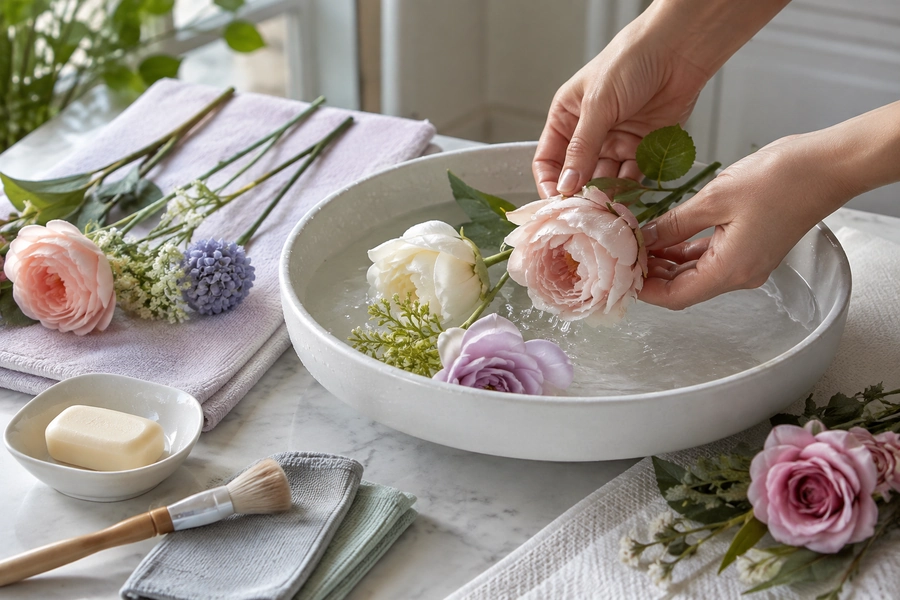
Three Safer Wet-Cleaning Methods
Method A: Damp-Cloth Cleaning
Best for:
- Plastic leaves
- Molded foliage
- Smooth real-touch surfaces that passed testing
- Light localized dirt
- Fixed arrangements
Method:
- Dampen a clean microfiber cloth.
- Wring it thoroughly.
- Support the leaf or petal with one hand.
- Wipe in the direction of the material.
- Use a fresh cloth area for each section.
- Dry the surface promptly.
Method B: Controlled Spot Cleaning
Best for:
- One stained petal
- Flower centers
- Small areas around stems
- Arrangements that cannot be dismantled
Method:
- Apply the tested solution to a cotton swab.
- Work from the stain’s outer edge inward.
- Avoid spreading moisture into clean fabric.
- Blot with a separate damp swab.
- Support the area while it dries.
Method C: Brief Stem Washing
Best only for flowers approved for wet cleaning.
Method:
- Hold the stem below the flower head.
- Lower the washable section briefly into prepared water.
- Move it gently without crushing petals.
- Avoid prolonged soaking.
- Transfer immediately to clean rinse water.
- Remove and support the flower for drying.
Do not clean several strongly colored flowers together. Dye released from one flower may transfer to a pale product.
Rule 7: Limit Soaking and Remove Soap Completely
Long immersion allows moisture to travel into stem wraps, wire cores, calyxes, adhesives, and foam.
Keep water contact as brief as practical. Rinse only as much as necessary to remove the cleaning solution, and prevent water from pooling inside flower centers or along wrapped stems. Detergent residue can stiffen fabric, attract dirt, and create pale marks after drying.
Why Long Soaking Fails
Extended immersion may:
- Release dye
- Soften glue
- Saturate paper wrapping
- Encourage internal corrosion
- Weaken molded connections
- Remove petal sizing
- Trap water inside foam
- Increase drying time
- Create odor
The Canadian Conservation Institute identifies dye transfer, tide lines, corrosion, and prolonged dampness among the risks associated with water exposure in mixed textile objects.
Rinsing Rules
- Use clean cool water.
- Keep rinse contact brief.
- Do not hold the flower beneath a forceful faucet.
- Change rinse water when it becomes soapy.
- Blot rather than squeeze.
- Check flower centers for trapped droplets.
- Keep stem cut ends out of water when possible.
- Do not leave washed flowers standing in a bucket.
A detergent smell or slippery surface indicates that more residue remains.
Rule 8: Air-Dry in the Flower’s Natural Shape
Drying is part of the cleaning process. A flower washed correctly can still be ruined by hot air, direct sun, crowding, or poor support.
Blot excess water with a clean white towel, reshape the petals while damp, and air-dry the flower in a supported natural position. Use cool circulating air, keep stems separated, and avoid hair dryers, tumble dryers, radiators, direct sunlight, and sealed containers.
Water-sensitive dyes and structural components can continue changing during drying, even when they seemed stable during the initial test. CCI advises caution throughout washing and drying because color movement may occur unexpectedly.
Drying Options
| Flower Type | Recommended Position |
|---|---|
| Strong single stem | Upright in an empty stable vase |
| Heavy peony or hydrangea | Supported horizontally or at an angle |
| Delicate poppy | Individual supported stem |
| Long branch | Horizontal rack with broad support |
| Fixed bouquet | Upright with air around every side |
| Wreath | Flat on a clean breathable support |
| Garland | Broad loose curves with several support points |
Hanging every flower upside down is not universally safe. A heavy wet bloom may pull against its calyx, adhesive, or stem connection.
Drying Checklist
- Petals do not touch dirty surfaces
- Flowers are not crowded
- Air reaches the centers
- Metal ends are not sitting in water
- Towels are replaced when damp
- No heat source is nearby
- No direct sun reaches the colors
- The arrangement remains out of storage until completely dry
Do not place damp flowers immediately into plastic bags, storage boxes, or enclosed cabinets.
Rule 9: Inspect, Reshape, and Document Before Reuse
Cleaning is complete only after every flower has dried and passed inspection.
Check for color change, stiffness, loose petals, weakened glue, corrosion, odor, residue, and shape loss. Reshape wired stems only after the components are stable, replace damaged flowers, and record the approved method so future cleaners do not repeat risky experiments.
Post-Wash Inspection
Examine:
- Front and back of every bloom
- Flower center
- Petal edges
- Calyx
- Leaf attachment
- Wire entry points
- Stem wrapping
- Glue joints
- Ribbon
- Foam or planter base
- Decorative moss
- Vase interior
Separate any flower that remains:
- Damp
- Sticky
- Discolored
- Rust-marked
- Misshapen
- Strongly scented
- Structurally loose
Cleaning Record
For commercial inventory, record:
| Field | Example |
|---|---|
| Product code | SF-RS-104 |
| Material | Polyester petals, plastic leaves, wired stem |
| Approved method | Dry brush and localized damp wipe |
| Cleaner | Mild dye-free soap |
| Test location | Underside of rear petal |
| Result | No transfer or coating change |
| Drying method | Upright, cool air |
| Rejected units | Two loose flower heads |
| Next inspection | Before next event |
A written method protects the flowers and makes cleaning outcomes more consistent across staff and locations.
Can You Wash Silk Flowers in a Sink?
A sink may be appropriate for detachable, tested, washable stems. It is not automatically safe.
Use a clean sink or basin only when the flowers are approved for wet cleaning. Clean the basin first, protect the flowers from metal edges, avoid forceful running water, and keep the drain clear of loose petals and decorative pieces. Never place a complete foam-filled arrangement into the sink.
Kitchen sinks may contain grease, food residue, bleach, or strong cleaner. Utility sinks may contain paint, chemicals, or metal debris.
A removable plastic basin provides better control over:
- Water cleanliness
- Soap concentration
- Flower support
- Rinsing
- Loose parts
Wash pale flowers before dark flowers and replace the water between color groups.
Can You Wash Silk Flowers in a Washing Machine?
No ordinary washing-machine cycle is appropriate for assembled artificial flowers.
Do not place silk flowers, wired stems, wreaths, bouquets, or floral arrangements in a washing machine. Agitation, spinning, heat, detergent concentration, and mechanical impact can bend wire, detach petals, damage the machine, and permanently distort the flowers.
The flowers are three-dimensional mixed-material objects rather than washable garments.
The same warning applies to:
- Dishwashers
- Tumble dryers
- Steam-cleaning machines
- Pressure washers
- Ultrasonic tanks
- Hot-water extraction equipment
Mechanical equipment should be used only when the exact manufacturer has approved the process for that specific product.
Can You Clean Silk Flowers With Salt or Cornmeal?
Bag-shaking methods involving salt, rice, or cornmeal are often suggested as dry-cleaning shortcuts. They can also create new problems.
Avoid shaking delicate silk flowers in granular material unless the manufacturer specifically approves it. Salt, meal, or rice can abrade pigments, enter flower centers, remain in adhesive joints, attract moisture, and become difficult to remove from dense arrangements.
A soft brush provides better control because the cleaner can see the pressure, direction, and affected area.
Granular methods are especially unsuitable for:
- Sticky real-touch petals
- Flocked foliage
- Open rose centers
- Dense hydrangeas
- Artificial pollen
- Glittered products
- Foam flowers
- Pale fabric blooms
Can You Use a Hair Dryer?
A hair dryer can soften glue, distort plastic, and force dust deeper into a flower.
Do not use heated air. Gentle cool air may help remove loose dust or support drying when the nozzle remains distant and the airflow does not bend petals. The flower should stay cool throughout the process.
Nearly Natural advises caution with heat when reshaping artificial materials because excessive temperature can melt or warp leaves.
A small fan on a cool setting is generally easier to control than a handheld dryer.
How Often Should Silk Flowers Be Cleaned?
Cleaning frequency depends on location rather than a universal calendar.
Inspect silk flowers regularly and clean them before visible dust becomes embedded. Reception desks, restaurants, kitchens, entry areas, salons, and event inventory need more frequent attention than enclosed cabinets or low-traffic bedrooms.
Practical Inspection Schedule
| Location | Suggested Inspection |
|---|---|
| Restaurant or café | Weekly |
| Reception desk | Weekly |
| Retail entrance | Weekly |
| Salon or spa | Weekly |
| Office meeting room | Every two weeks |
| Hotel guest room | During routine room inspection |
| Home living area | Every two to four weeks |
| Enclosed display cabinet | Monthly |
| Wedding and rental stock | Before and after every use |
| Stored inventory | At scheduled storage audits |
Inspection does not always require wet cleaning. Regular dry dusting reduces the need for stronger intervention.
Which Flowers Should Never Be Immersed?
Immersion is generally inappropriate for flowers with unknown materials, fragile surfaces, mixed decorative components, or fixed bases.
High-Risk Flower Types
- Genuine antique silk flowers
- Hand-painted flowers
- Velvet flowers
- Flocked flowers
- Paper flowers
- Feather flowers
- Foam flowers with fragile surfaces
- Glittered flowers
- Flowers with loose artificial pollen
- Sticky real-touch products
- Battery-lit garlands
- Flowers fixed in foam
- Resin-filled arrangements
- Wreaths with natural materials
- Bouquets with dyed ribbons
- Products whose manufacturer prohibits washing
Balsam Hill specifically advises avoiding washing and chemical sprays for its artificial flowers. That instruction should override a generic internet cleaning method for those products.
Commercial Cleaner’s Quick SOP
| Step | Action | Stop Condition |
|---|---|---|
| 1 | Identify product and materials | Unknown valuable item |
| 2 | Read care instructions | Water prohibited |
| 3 | Photograph original arrangement | — |
| 4 | Remove loose dust | Component becomes loose |
| 5 | Patch-test water | Color or finish changes |
| 6 | Patch-test diluted cleaner | Transfer or residue appears |
| 7 | Remove sensitive accessories | Cannot isolate them safely |
| 8 | Clean gently in sections | Glue, wire, or shape fails |
| 9 | Rinse minimally | Color begins moving |
| 10 | Blot and support | — |
| 11 | Air-dry completely | Odor or dampness remains |
| 12 | Inspect and document | Product fails acceptance check |
My Insights: How to Wash Silk Flowers Without Ruining Them—Which 9 Rules Must Every Cleaner Know
The safest silk-flower wash is not necessarily the process that uses the most water. It is the least aggressive method that removes the dirt without changing the product.
The nine essential rules are to identify the construction, dry-clean first, test every color and coating, isolate vulnerable components, use minimal cool water and mild soap only when permitted, support wet flowers, limit soaking, air-dry without heat, and inspect completely before reuse or storage.
My central insight is that “washable” must describe the complete assembled flower, not only its most visible material.
The Nine-Rule Summary
| Rule | Main Damage Prevented |
|---|---|
| 1. Identify every material | Wrong cleaning method |
| 2. Dry-clean first | Muddy residue and unnecessary washing |
| 3. Test colorfastness | Dye bleeding and surface loss |
| 4. Protect attachments | Glue, foam, ribbon, and electrical damage |
| 5. Use minimal mild solution | Chemical and residue damage |
| 6. Support every bloom | Stretching and distortion |
| 7. Limit water contact | Corrosion, saturation, and adhesive failure |
| 8. Air-dry without heat | Warping and color change |
| 9. Inspect and document | Repeated damage and unsafe storage |
The Most Important Rule: Follow the Product
Manufacturer advice differs.
Afloral permits mild wet cleaning for some mixed fabric-and-plastic flowers. Nearly Natural recommends dry methods first and localized damp cleaning for deeper soil. Balsam Hill tells owners of its artificial flowers to avoid washing and commercial sprays.
These instructions are not contradictory when they apply to different constructions.
The flower’s exact materials, dyes, coatings, and attachments determine the method.
Dry Cleaning Should Solve Most Routine Maintenance
Regular use of:
- A soft brush
- Dry microfiber
- Cotton swabs
- Gentle cool air
- Careful vacuuming around—not directly against—delicate petals
reduces the frequency of wet cleaning.
Once dust combines with moisture, oil, smoke, kitchen residue, or pollution, removal becomes more difficult.
Spot Cleaning Is Usually Safer Than Immersion
One dirty petal does not justify soaking:
- The stem wire
- The flower center
- The calyx
- The leaves
- The adhesive
- The foam base
- The ribbon
Localized treatment limits the number of components exposed to risk.
Water Temperature Is Not a Cleaning Shortcut
Hot water may appear to dissolve grease faster, but artificial flowers can contain heat-sensitive coatings, glue, foam, and plastic.
Cool water and patience offer more control.
Strong dirt that cannot be removed safely may justify replacement of one stem rather than escalation to a damaging cleaner.
Drying Determines the Final Shape
A saturated peony placed face-down may dry with flattened petals.
A heavy hydrangea hung by a weak connection may pull away from its stem.
A wreath stored while slightly damp may develop odor or marks.
Every washed product needs enough time, airflow, separation, and physical support to dry in its intended form.
My Final Cleaner Rule
Use this decision sequence:
- Read the care label.
- Identify all materials.
- Photograph the original form.
- Remove loose dust.
- Test cool water.
- Test the diluted cleaner.
- Select spot cleaning before immersion.
- Keep moisture contact brief.
- Support every wet component.
- Rinse away residue.
- Air-dry without heat.
- Inspect before reuse.
- Store only when completely dry.
When any test fails, stop wet cleaning and return to a dry method or replace the affected stem.
Conclusion
Dry-clean first, test every material, use cool water only when permitted, support wet blooms, avoid heat and soaking, and never store silk flowers until completely dry.