
Artificial flowers never wilt, but their meaning is not lifeless. Their permanence, color, flower type, and placement can communicate love, memory, confidence, calm, or practical care.
Artificial flowers often symbolize lasting beauty, enduring affection, remembrance, consistency, and intentional design. The specific message depends on the chosen bloom, its color, the occasion, and its cultural context. Displaying faux flowers may suggest that you value beauty, preparation, personal expression, and low-maintenance surroundings, but it does not define your personality.
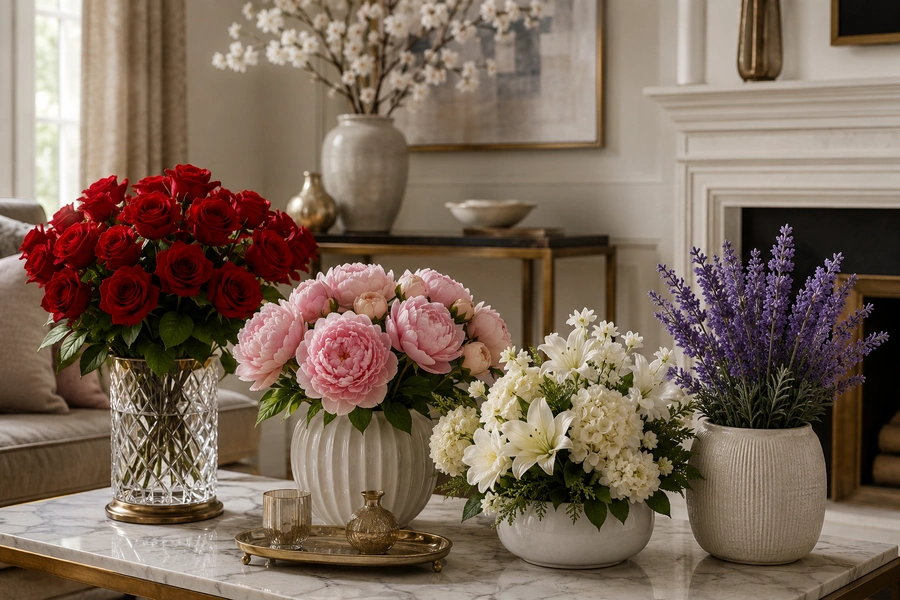
The meaning of artificial flowers comes from two layers. The flower carries traditional symbolism, while the artificial form adds ideas such as permanence and preservation. A faux red rose can still express love, but its lasting form may also suggest a wish to preserve that feeling.
What Do Artificial Flowers Symbolize?
Calling artificial flowers “fake” can make them sound emotionally empty. In practice, a carefully chosen faux arrangement may carry as much personal intention as a fresh bouquet.
Artificial flowers commonly symbolize permanence, preserved memories, dependable beauty, and feelings that are meant to last. They can also represent practicality because they need no watering, remain available in every season, and can be prepared long before a wedding, celebration, memorial, or commercial event.
These meanings are interpretations rather than a fixed universal language. Traditional floriography assigns meanings to flower species and colors, but even historical flower dictionaries did not always agree. Smithsonian Gardens notes that Victorian guides sometimes gave the same flower conflicting meanings, so symbolism should be treated as a flexible form of communication rather than a strict code.
Permanence and Enduring Affection
A fresh flower changes visibly. It opens, reaches full bloom, and fades. An artificial flower remains in its chosen form.
That difference naturally supports ideas such as:
- Lasting affection
- Stable friendship
- Preserved beauty
- Continued remembrance
- Long-term commitment
- A moment held in time
A faux wedding bouquet may represent a relationship intended to continue beyond the ceremony. An artificial memorial arrangement may suggest that remembrance continues even when the original flowers would have faded.
The material does not create these meanings automatically. The giver or owner gives the arrangement its emotional value. A mass-produced flower placed without thought may communicate very little, while an inexpensive artificial bloom kept from an important event can become deeply personal.
Consistency and Reliability
Artificial flowers can also represent steadiness. Their appearance does not depend on season, temperature, water, or daily maintenance.
A permanent arrangement in a reception area may communicate order and dependable care. Matching faux flowers used across many stores or event locations can express a consistent visual identity.
Modern faux flowers are often selected for places with little natural light, long setup times, allergy concerns, or limited maintenance. Their durability and predictable appearance are practical benefits, not evidence that the owner dislikes nature.
Control and Intentional Design
Fresh flowers have natural variation. Artificial flowers allow more control over size, color, shape, and timing.
This control may suggest that a person values:
- Careful planning
- Visual consistency
- Long-term usefulness
- Reusable décor
- Exact color coordination
- Reduced last-minute uncertainty
A person who chooses artificial flowers may simply want a specific look that remains unchanged. That preference says more about the demands of the space or occasion than about the person’s emotional depth.
| Artificial-Flower Quality | Possible Symbolic Interpretation |
|---|---|
| Does not wilt | Lasting affection or remembrance |
| Remains consistent | Reliability and stability |
| Available year-round | Freedom from seasonal limits |
| Can be reused | Resourcefulness and preparation |
| Holds an exact color | Intentional self-expression |
| Needs little care | Practical beauty |
| Preserves an event design | Memory and continuity |
Artificial flowers therefore carry both emotional and functional symbolism. They can represent something permanent while also solving a practical problem.
Do Artificial Flowers Have the Same Meaning as Real Flowers?
A red rose remains visually recognizable as a rose whether it is grown, dried, painted, carved, or made from fabric. The material changes part of the message, but it does not necessarily erase the flower’s traditional symbolism.
Artificial flowers can carry the same traditional meanings as real flowers because the symbolic message usually comes from the flower type, color, arrangement, and occasion. The artificial form adds another possible layer: permanence. However, scent, natural growth, fragility, and seasonal meaning may be reduced or absent.
Floriography became especially popular in Europe during the Victorian era. Flowers and floral arrangements were used to communicate emotions that could not always be stated directly. Roses became strongly connected with romance, while many other flowers represented friendship, innocence, faithfulness, sorrow, hope, or admiration.
What Remains the Same
An artificial version can preserve the recognizable visual language of a flower.
For example:
| Flower | Common Traditional Meaning |
|---|---|
| Red rose | Romantic love and passion |
| White rose | Purity, innocence, or reverence |
| Tulip | Love, affection, or a declaration of feeling |
| Orchid | Beauty, refinement, and admiration |
| Lily | Purity, renewal, or sympathy |
| Daisy | Innocence and simplicity |
| Sunflower | Adoration, warmth, and loyalty |
| Chrysanthemum | Friendship, joy, or remembrance |
| Peony | Romance, prosperity, and a happy marriage |
| Poppy | Remembrance |
Flower meanings vary between sources, periods, and cultures. Iowa State University Extension, for example, lists several meanings for many popular flowers and warns that a single bloom may carry more than one interpretation.
The intended message should therefore be made clear through the complete arrangement and the occasion. A white artificial lily displayed at a memorial will be read differently from the same lily used in an Easter arrangement or wedding ceremony.
What Changes With the Artificial Form
Fresh flowers carry the symbolism of living growth and natural change. Their short life can make a gift feel precious because it exists for a limited time.
Artificial flowers communicate differently. Their strength is continuity rather than change.
A faux flower may lose some associations connected with:
- Fragrance
- Seasonal arrival
- Natural growth
- Freshness
- Fragility
- The passage of time
It may gain associations connected with:
- Preservation
- Repetition
- Control
- Reuse
- Availability
- Lasting visual memory
Neither message is automatically better. Fresh and artificial flowers tell different versions of a similar story.
Meaning Comes From Context
The same artificial flower can communicate love, grief, professionalism, celebration, or decoration.
A red faux rose in a romantic gift expresses affection. A row of red roses in a theater set creates atmosphere. A red rose kept from a wedding becomes a personal memory. A red floral display in a retail window may simply support a seasonal color story.
Symbolism does not exist independently of context. The relationship between giver, receiver, flower, color, location, and event creates the final message.
What Does Your Choice of Artificial Flower Say About You?
People often ask whether a favorite flower reveals a hidden personality. Floral preferences can reflect taste and intention, but they should not be treated as a scientific personality test.
Your artificial-flower choice may suggest the mood, values, or visual qualities you want to express. Roses can communicate romance, orchids can suggest refinement, sunflowers can create warmth, and wildflower arrangements can imply informality. These are design interpretations, not reliable psychological diagnoses.
The safest question is not, “What type of person chooses this flower?” It is, “What feeling does this flower help the person create?”
Artificial Roses: Romantic and Classic
Someone who chooses faux roses may value familiar beauty and emotional clarity. Roses are immediately recognized and can communicate love without a long explanation.
A tightly arranged bouquet of identical red roses feels formal and direct. A loose arrangement of garden roses, buds, and greenery feels softer and more personal.
Possible impressions include:
- Romantic
- Traditional
- Sentimental
- Elegant
- Confident
- Emotionally expressive
The color changes the impression. Deep red feels passionate, blush feels gentle, ivory feels calm, and yellow often feels friendly or cheerful in modern use.
Historical meanings are less consistent. Some Victorian sources connected yellow roses with jealousy or declining affection, while modern audiences often associate them with friendship. This difference shows why personal and cultural context matters more than one symbolism chart.
Artificial Orchids: Refined and Selective
Orchids have a controlled, sculptural appearance. A person who displays them may prefer clean lines, restrained color, and a polished room.
Possible impressions include:
- Refined
- Independent
- Detail-oriented
- Calm
- Selective
- Design-conscious
Orchids have long been associated with beauty and refinement in flower-language references.
A single white faux orchid in a simple ceramic container communicates something different from a large purple orchid arrangement with decorative crystals. The first feels quiet and minimal. The second feels expressive and luxurious.
Artificial Peonies: Romantic and Abundant
Peonies have large, layered flower heads. They create a soft sense of abundance and are widely used in romantic weddings and feminine interiors.
Choosing faux peonies may suggest a preference for:
- Softness
- Celebration
- Full arrangements
- Romantic color
- Traditional beauty
- Visual comfort
Because peony seasons are limited in nature, artificial versions may also express a desire to enjoy a favorite flower without seasonal restrictions.
Artificial Sunflowers: Warm and Optimistic
Sunflowers create a clear visual message because of their bright color and open shape.
They may suggest:
- Warmth
- Energy
- Cheerfulness
- Informality
- Loyalty
- Confidence
A sunflower arrangement usually feels welcoming rather than formal. It works well in kitchens, casual dining spaces, rustic events, and seasonal displays.
The impression can change when the colors are muted. Dusty yellow sunflowers with brown foliage feel more autumnal and thoughtful than bright yellow blooms in a summer arrangement.
Artificial Wildflowers: Relaxed and Individual
A mixed faux wildflower arrangement often contains different heights, colors, and flower forms. It avoids the controlled symmetry of a formal bouquet.
It may suggest:
- Creativity
- Independence
- Natural styling
- Informality
- Curiosity
- Comfort with imperfection
The arrangement looks most convincing when it includes open spaces, bent stems, buds, seed heads, and uneven flower placement.
Artificial White Flowers: Calm and Ordered
White artificial flowers can communicate simplicity, purity, remembrance, peace, or restraint.
Someone who chooses an all-white arrangement may prefer:
- Visual calm
- Clean design
- Neutral interiors
- Formal elegance
- Easy color coordination
- Quiet emotional expression
White flowers also require careful maintenance. Dust, yellowing, glue marks, and color transfer are easier to see, so a clean white arrangement may signal attention to detail.
What Do Artificial Flower Colors Mean?
Flower type gives the arrangement its shape, but color often creates the first emotional response. A rose may remain a rose, yet red, white, yellow, or black versions communicate very different moods.
Artificial flower colors can suggest specific emotions: red communicates passion, pink expresses affection, white suggests peace or purity, yellow creates warmth, orange conveys energy, blue feels calm, purple suggests dignity, and green represents balance. These meanings are broad associations, not universal rules.
Color symbolism changes between cultures and occasions. A color used for celebration in one place may be associated with mourning in another. Buyers should consider the receiver’s background, the event, and the location before relying on a traditional meaning.
Red Artificial Flowers
Red is visually strong. It commonly communicates:
- Romantic love
- Passion
- Courage
- Energy
- Desire
- Celebration
Red roses are the clearest romantic example, but red tulips, peonies, and poppies create different levels of formality.
A person who chooses red flowers may want the arrangement to be noticed. That does not automatically mean the person is extroverted. The color may simply suit a holiday, brand, room, or ceremony.
Pink Artificial Flowers
Pink can communicate affection without the intensity of red.
Possible meanings include:
- Gratitude
- Gentleness
- Happiness
- Admiration
- Romance
- Care
Pale blush feels calm and romantic. Bright pink feels modern and playful. Dusty pink feels softer and more mature.
White Artificial Flowers
White often suggests:
- Purity
- Peace
- Innocence
- New beginnings
- Sympathy
- Reverence
White lilies, roses, orchids, and chrysanthemums are widely used in both joyful and solemn settings. The occasion determines how they are read.
Yellow Artificial Flowers
Yellow often creates a cheerful modern impression, but its historical symbolism is mixed.
It may communicate:
- Friendship
- Joy
- Optimism
- Success
- Warmth
- Welcome
Some older flower-language guides connected yellow roses and other yellow flowers with jealousy or reduced affection. Modern gifting practices often use yellow for friendship and positive energy.
Purple Artificial Flowers
Purple is commonly connected with:
- Dignity
- Luxury
- Creativity
- Admiration
- Spirituality
- Success
Deep purple orchids or hydrangeas feel formal, while lavender flowers feel softer and more relaxing.
Blue Artificial Flowers
True blue is uncommon among many natural flower species, so artificial blue flowers can appear artistic or deliberately imaginative.
Blue may suggest:
- Calm
- Trust
- Reflection
- Mystery
- Individuality
- Distance
Muted blue usually looks more natural than intense electric blue. Strong blue flowers make a clearer decorative statement but may carry less traditional botanical realism.
Black or Very Dark Artificial Flowers
Black roses and other dark artificial flowers are created mainly through dye, coating, or design because naturally black blooms are rare.
They may communicate:
- Mystery
- Rebellion
- Dramatic change
- Elegance
- Mourning
- Gothic style
The meaning depends heavily on presentation. A black rose in a romantic gothic bouquet can feel luxurious, while the same flower in a memorial arrangement may suggest loss.
| Flower Color | Common Emotional Message | Typical Design Effect |
|---|---|---|
| Red | Love, passion, courage | Bold and direct |
| Pink | Affection, gratitude, gentleness | Soft and romantic |
| White | Peace, purity, remembrance | Calm and formal |
| Yellow | Friendship, joy, optimism | Warm and welcoming |
| Orange | Energy, enthusiasm, confidence | Lively and modern |
| Blue | Calm, trust, mystery | Cool and reflective |
| Purple | Dignity, creativity, luxury | Rich and expressive |
| Green | Balance, renewal, harmony | Natural and restful |
| Black | Mystery, grief, rebellion | Dramatic and unconventional |
Is It Appropriate to Give Artificial Flowers as a Gift?
A gift should reflect the receiver’s needs and preferences. Artificial flowers can be thoughtful, but they are not the correct choice for every person or occasion.
Artificial flowers are appropriate gifts when the receiver values long-lasting décor, has allergies, travels frequently, cannot maintain fresh flowers, or wants to keep a symbolic arrangement. Choose a realistic design, explain its meaning, and avoid presenting it as a cheaper substitute for fresh flowers when the occasion carries strong expectations.
A well-chosen artificial arrangement can show careful attention. The giver may select the receiver’s favorite flower, match a meaningful color, or reproduce a wedding bouquet that would otherwise disappear.
When Artificial Flowers Make a Thoughtful Gift
They can work particularly well for:
- Housewarming gifts
- Long-distance relationships
- Hospital or care settings with floral restrictions
- Allergy-sensitive recipients
- Memorial keepsakes
- Wedding-bouquet replicas
- Retirement gifts
- Office décor
- People who travel frequently
- Recipients with limited mobility
The practical advantage can become part of the emotional message. Choosing something the receiver can use and enjoy may show more care than following a conventional rule.
When You Should Ask First
Some people strongly prefer fresh flowers because they value fragrance, natural change, or the tradition of receiving a living bouquet.
It is wise to ask or consider alternatives when:
- The recipient dislikes artificial décor
- Fresh flowers have an important family tradition
- Cultural customs specify living flowers
- The occasion has formal floral expectations
- The artificial product looks visibly cheap
- The recipient has limited storage space
The issue is not whether faux flowers are respectful in general. The issue is whether they feel respectful to that specific person.
Add a Message Card
A short note can prevent the arrangement from being misunderstood.
For example:
I chose these because they will keep their color, just as I hope this memory will stay with you.
The message gives the artificial form a clear purpose. It changes the gift from a convenient object into an intentional symbol.
Artificial Flowers for Memorials
Artificial flowers are often used where regular replacement is difficult. Their continued presence can represent lasting remembrance.
However, cemetery, memorial, religious, and public-site rules differ. Some locations allow artificial flowers only during certain seasons or require specific containers. The giver should confirm local rules before leaving an arrangement.
The selected bloom should also suit the person being remembered. A favorite flower may carry more emotional meaning than a traditional sympathy flower chosen only from a general symbolism list.
Are Artificial Flowers Bad Luck or Bad Energy?
Artificial flowers are sometimes described as unlucky, emotionally cold, or associated with “fake” relationships. These claims come from personal beliefs and selected cultural interpretations, not from a universal rule.
Artificial flowers are not objectively bad luck. Their emotional effect depends on their condition, placement, cultural context, and personal meaning. Clean, realistic flowers used intentionally can make a space feel cared for, while dusty, faded, or damaged arrangements may communicate neglect and stagnation.
Some feng shui discussions favor living plants because they represent active growth. Other interpretations focus on symbolism, color, cleanliness, and the intention behind the décor. These views are not standardized scientific findings.
Condition Changes the Message
A fresh-looking artificial arrangement can suggest:
- Care
- Beauty
- Welcome
- Stability
- Preparedness
A dusty or faded arrangement can suggest:
- Neglect
- Emotional distance
- Stagnation
- Lack of attention
- An outdated space
The negative impression often comes from maintenance rather than the artificial material itself.
Placement Changes the Meaning
Artificial flowers in a dark hallway can add color where living flowers would struggle. A permanent arrangement in a hotel lobby can maintain a stable visual standard. A faux bouquet in a bedroom can preserve a personal memory.
The same flowers placed in every available corner may feel excessive. The problem is visual balance, not bad luck.
Intention Matters More Than Superstition
A memorial flower chosen with love is not emotionally false because it is artificial. A wedding bouquet preserved as a keepsake does not represent an artificial marriage. A practical arrangement in an allergy-sensitive home does not communicate a lack of care.
Symbolism becomes useful when it helps people express meaning. It becomes unhelpful when it creates fear without considering context.
How Should You Choose Artificial Flowers for a Specific Message?
Choosing flowers only by appearance can create a mixed message. A symbolic arrangement should connect the bloom, color, form, and occasion.
To choose artificial flowers for a specific message, begin with the feeling you want to express. Select a flower traditionally associated with that feeling, choose a supporting color, and decide whether the artificial form adds an appropriate message of permanence. Confirm cultural expectations and include a note when the symbolism may not be obvious.
For Romantic Love
Choose:
- Red roses
- Red tulips
- Peonies
- Orchids
- Gardenias
Use deep red for passion, blush for tenderness, or ivory for commitment.
Artificial flowers are especially meaningful when the arrangement is intended to become a long-term keepsake.
For Friendship
Choose:
- Yellow roses
- Sunflowers
- Chrysanthemums
- Daisies
- Alstroemeria-style flowers
Use warm yellow, peach, or mixed cheerful colors.
Keep the arrangement open and informal rather than tightly romantic.
For Gratitude
Choose:
- Pink roses
- Hydrangeas
- Orchids
- Camellias
- Mixed garden flowers
Pink, cream, lavender, and soft peach communicate appreciation without the romantic intensity of red.
For Sympathy and Remembrance
Choose:
- Lilies
- White roses
- Chrysanthemums
- Poppies
- Forget-me-nots
White, cream, pale blue, and muted purple often create a calm tone. Cultural and religious traditions should guide the final choice.
For New Beginnings
Choose:
- Daffodils
- Tulips
- Cherry blossoms
- White flowers
- Green foliage
These work for new homes, new jobs, graduations, weddings, and personal transitions. Illinois Extension describes daffodils as symbols of renewal and hope, which makes them suitable for a positive new beginning.
Message-Building Guide
| Intended Message | Flower Choice | Color Direction | Meaning Added by Faux Form |
|---|---|---|---|
| Romantic love | Rose or tulip | Red, blush, ivory | Enduring affection |
| Friendship | Sunflower or yellow rose | Yellow, peach | Lasting support |
| Gratitude | Orchid or pink rose | Pink, lavender | Continued appreciation |
| Sympathy | Lily or chrysanthemum | White, cream | Ongoing remembrance |
| New beginning | Daffodil or blossom | Yellow, white, green | Hope that continues |
| Celebration | Peony or hydrangea | Bright or soft mixed colors | Preserved memory |
| Calm | Orchid or simple foliage | White, blue, green | Stable peacefulness |
My Insights: Artificial Flowers Meaning & Symbolism—What Do They Say About You
An artificial flower does not reveal a fixed personality. It reveals a choice: which beauty you want to preserve, which emotion you want to repeat, and which practical needs you want the arrangement to meet.
Artificial flowers may say that you value lasting beauty, emotional continuity, planning, and personal expression. Your flower type and color communicate the visible message, while the artificial form can add permanence. The most accurate meaning comes from your reason for choosing the arrangement, not from a rigid symbolism chart.
My main insight is that faux flowers create a form of modern floriography. They use traditional flower language, but they also introduce a new message: this visual moment is meant to remain.
The Flower Communicates Emotion
The species provides the emotional starting point.
A rose speaks of love. An orchid suggests refinement. A sunflower brings warmth. A lily can communicate purity, renewal, or sympathy. A poppy supports remembrance.
These meanings are culturally familiar, but they are not universal or fully standardized. Historical flower guides often disagreed, so the receiver’s personal associations should carry more weight than a single dictionary.
The Color Sets the Tone
Color tells the viewer how strongly and in what mood the message is being expressed.
Red is direct. Pink is gentle. White is quiet. Yellow is warm. Purple is rich. Blue is reflective. Green is balanced.
The same flower changes character when its color changes. A red rose declares itself, while an ivory rose creates a calmer and more formal impression.
The Artificial Form Adds Duration
The artificial material adds a message that a fresh flower cannot carry in the same way.
It can say:
- I want this to last.
- I want to keep this memory.
- I value consistency.
- I planned this carefully.
- I chose beauty that fits your life.
- I want this symbol to remain visible.
This does not make the feeling artificial. A photograph, ring, letter, or preserved object can carry a real emotion even though it is not alive. Artificial flowers can work in the same way.
Placement Reveals Purpose
Where you place artificial flowers changes what they communicate.
| Placement | Possible Message |
|---|---|
| Entryway | Welcome and attention to presentation |
| Living room | Comfort and personal style |
| Bedroom | Calm, romance, or private memory |
| Office | Order, energy, or professional polish |
| Dining table | Hospitality and readiness |
| Wedding venue | Lasting commitment and planned beauty |
| Memorial | Continued remembrance |
| Retail display | Brand mood and visual consistency |
A single orchid on a desk feels controlled and quiet. A large wildflower arrangement in a living room feels expressive and relaxed. A permanent memorial wreath feels reflective and loyal.
Quality Affects Interpretation
High-quality artificial flowers with natural color, texture, and movement can communicate care. Cheap-looking flowers may communicate convenience when they are glossy, repetitive, dusty, or badly arranged.
Quality does not always mean a high price. A simple arrangement of three realistic stems may feel more intentional than a crowded bouquet of fifty weak flowers.
I look for:
- Matte or softly reflective petals
- Several nearby shades
- Different bloom stages
- Adjustable stems
- Natural asymmetry
- Clean flower centers
- A suitable vase or planter
- Regular dusting and care
The Most Honest Interpretation
Choosing artificial flowers may mean that you are romantic, practical, nostalgic, creative, organized, or design-focused. It may also mean that you have allergies, a dark room, a busy schedule, a limited local flower supply, or a need to prepare an event early.
No one should use a décor choice to make a final judgment about personality.
The most honest reading is simple: artificial flowers show that you want floral beauty without depending on a short natural lifespan. The chosen bloom explains the emotion, and the lasting form explains how long you want that emotion to remain visible.
Conclusion
Artificial flowers combine traditional floral symbolism with permanence. Their type, color, placement, and purpose may express love, memory, calm, creativity, or practical care—never a fixed personality.