
A wedding arch should frame the ceremony, not hide the couple. The wrong shape, color, or flower density can distract from every important photograph.
The best wedding arch ideas for 2025 include asymmetrical floral arches, ground arches, broken arches, open circular frames, garden-style structures, minimalist pillars, and architectural installations. High-quality faux roses, peonies, hydrangeas, orchids, delphiniums, and greenery make these designs reusable, predictable, and easier to prepare before the ceremony.
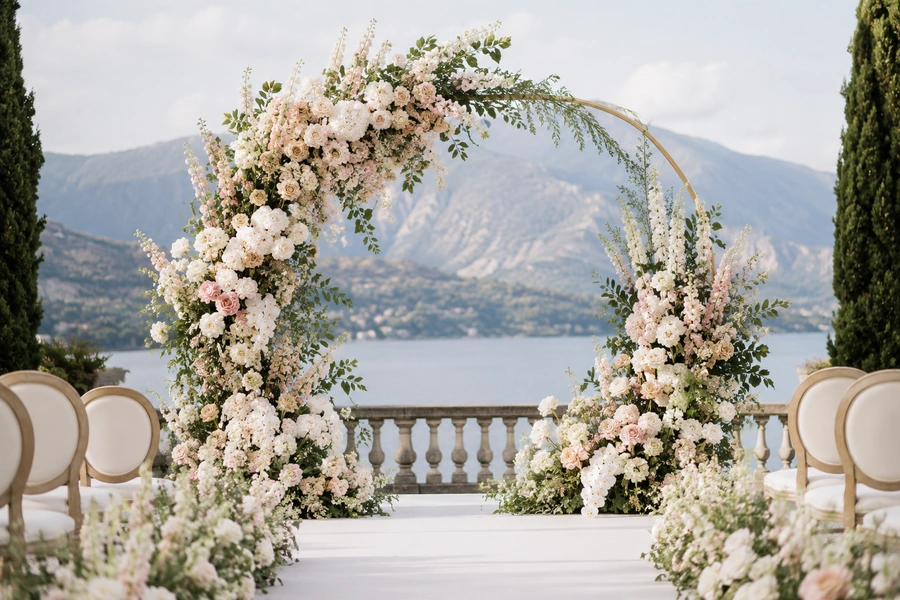
The strongest design does not simply follow a trend. It suits the venue, frames both partners clearly, remains stable throughout the event, and still looks elegant years later in wedding photographs.
What Wedding Arch Styles Were Popular in 2025?
Traditional full arches remained useful, but couples increasingly chose structures with open space, irregular movement, and a closer connection to the surrounding venue.
Popular 2025 wedding arch styles included asymmetrical arches, detached floral pillars, ground-level flower meadows, broken arches, layered frames, and natural-looking installations. These designs replaced rigid symmetry with movement, negative space, and flowers that appeared to grow from the floor, structure, or surrounding landscape.
The Knot’s 2025 arch coverage highlighted offset, non-symmetrical structures, detached arches, and flowers arranged directly on the ground. Its examples also showed arches that intentionally left open areas so the venue remained visible behind the couple.
1. The Asymmetrical Faux Flower Arch
An asymmetrical arch concentrates flowers on one side or at two uneven points. The design may begin with a large floral section near the floor, rise along one side, and finish with a smaller cluster near the top.
This style works because it creates a strong frame without surrounding the couple with a complete floral border. It also leaves open space for scenery, architecture, or a distant landscape.
I would use:
- Large faux peonies or garden roses near the base
- Hydrangeas for broad coverage
- Delphiniums or snapdragon-style stems for vertical movement
- Trailing jasmine, amaranthus, or wisteria
- Eucalyptus, olive leaves, or ruscus
- A few smaller flowers at the upper edge
The lower floral cluster should carry most of the visual weight. The upper section should feel lighter so the structure does not appear ready to fall.
| Design Element | Recommended Treatment |
|---|---|
| Main floral section | Lower left or lower right |
| Secondary cluster | Opposite upper corner |
| Open space | Keep the couple’s faces and shoulders clear |
| Best frame | Square, curved, or incomplete metal arch |
| Best setting | Garden, estate, industrial venue, or ballroom |
An asymmetrical arch works especially well when the venue already has a strong background. It adds shape without covering stone walls, windows, mountain views, or mature trees.
2. The Ground Floral Arch
A ground arch uses flowers arranged in a semicircle or open meadow around the ceremony area. It can frame the couple without placing any structure above their heads.
Ground-level floral clusters were one of the visible directions in 2025 wedding design, with florists predicting less reliance on polished overhead arches and more interest in scattered, natural-looking ceremony flowers.
I build this style from several separate modules rather than one long piece. Modular sections are easier to transport, install, adjust, and reuse.
A balanced ground arch may contain:
- Two large side clusters
- Two medium connecting sections
- Several small filler pieces
- Open areas between flowers
- A clear central standing space
The flowers should rise gradually toward the sides. They should not form a high wall directly in front of the couple.
This style is useful when:
- The venue does not allow a tall structure
- Strong scenery should remain visible
- The ceremony takes place indoors beneath chandeliers
- The ceiling is low
- The design team needs easy installation
- The flowers will be moved to the reception afterward
Ground arches can be repurposed around a sweetheart table, stage, welcome sign, bar, cake display, or photo area.
3. The Broken or Detached Arch
A broken arch consists of two separate floral pillars or partial frames. One side is usually taller, while the other is lower and wider.
The open middle keeps the design modern and prevents a heavy floral border from competing with the couple. The Knot’s 2025 wedding-arch reporting described detached structures and incomplete arches as established alternatives to the traditional symmetrical frame.
For a timeless result, I keep the difference between the two sides clear but not extreme.
For example:
| Left Side | Right Side |
|---|---|
| 7-foot floral pillar | 4-foot floral pillar |
| Narrow upper movement | Wide lower flower cluster |
| More branches and greenery | More focal flowers |
| Lighter flower density | Denser base |
The structure can use freestanding metal frames, weighted columns, plinths, or hidden bases. Every base must be stable before flowers are attached.
This design is practical for narrow ceremony spaces because the couple can stand between the two pieces without being enclosed by a full structure.
4. The Open Circular Arch
A circular wedding arch creates a soft frame and works well with romantic, modern, and garden-inspired weddings. In 2025, the strongest versions often left part of the circle uncovered rather than hiding the complete frame.
I prefer flowers around one lower side and the opposite upper section. This keeps the shape visible and makes the installation feel lighter.
Suitable faux flowers include:
- Roses
- Ranunculus
- Peonies
- Hydrangeas
- Orchids
- Sweet pea-style sprays
- Trailing greenery
A full circle covered with identical flower heads can look artificial. I mix flower sizes and leave small areas of the frame visible.
The circle must also be large enough for two people. A small hoop positioned directly behind the couple can appear like a ring around their heads in photographs.
5. The Natural Garden Arch
A garden arch should look as though flowers and branches have grown around the structure over time. It uses irregular spacing, several stem lengths, and visible movement.
Vogue’s 2025 wedding-arch feature described successful floral structures as natural-looking arrangements layered over engineered frames made from materials such as steel, wood, or acrylic. It also emphasized matching flowers and foliage to the location rather than placing an unrelated design in front of the scenery.
For a faux version, I combine:
- Long flowering branches
- Open garden roses
- Small filler flowers
- Ferns
- Olive or eucalyptus foliage
- Trailing vines
- A few buds and partially open flowers
I avoid distributing every flower evenly. Real gardens contain dense areas, open areas, tall stems, fallen branches, and irregular growth.
This design works well in:
- Private gardens
- Historic estates
- Vineyards
- Woodland venues
- Courtyards
- Greenhouses
- Conservatories
The flower colors should relate to the landscape. Soft cream, pale yellow, blush, muted blue, and natural green usually blend more easily than a single bright artificial color.
6. The Minimalist Floral Pillar Design
Some ceremonies need definition without a large arch. Two or three floral pillars can create a strong focal area while keeping the background open.
Each pillar can hold a compact arrangement at a different height. The design feels architectural and is easier to move than a full flower-covered structure.
I would use:
- One tall narrow pillar
- One medium pillar
- One low floral meadow
- Repeated focal flowers across all sections
- Limited greenery
- A restrained color palette
This design is especially useful for:
- City weddings
- Art galleries
- Restaurants
- Rooftops
- Small ceremonies
- Modern hotels
The pillars should not look like unrelated arrangements. Repeating the same flower types and color sequence across the sections connects them visually.
7. The Layered Multi-Frame Arch
A layered arch uses two or three frames at different depths. The frames may be curved, rectangular, or irregular.
This creates visual depth without requiring every surface to be covered with flowers. One frame may hold fabric, another may carry flowers, and a third may remain almost bare.
A layered structure works well for a large stage or ballroom. It can also help make a wide ceremony area feel more intimate.
I keep the floral design concentrated where the frames overlap. This prevents the installation from becoming visually confusing.
8. The Flower-Free Botanical Arch
Not every arch needs traditional flowers. Branches, textured foliage, moss, fruit-like decorative elements, grasses, and sculptural leaves can create a strong ceremony backdrop.
Some 2025 floral forecasting noted interest in flower-free designs and in unusual natural elements that looked more like art or still-life compositions than standard wedding arrangements.
A faux botanical arch may use:
- Olive branches
- Eucalyptus
- Magnolia leaves
- Ferns
- Artificial grasses
- Moss panels
- Bare branches
- Seeded sprays
- Decorative fruit
- Trailing foliage
This approach is useful for couples who want a natural design without a traditional rose-covered frame.
Which Faux Flowers Look Best on a Wedding Arch?
An attractive bouquet flower does not always work on a large structure. Wedding arches need flowers that remain visible from a distance and recover well after transportation.
The best faux flowers for wedding arches include roses, peonies, hydrangeas, orchids, delphiniums, magnolias, ranunculus, wisteria, and small filler sprays. Hydrangeas create volume, roses provide familiar romance, orchids add sculptural detail, and long flowering stems create height and movement.
Roses remain one of the most flexible wedding flowers because they can appear in bouquets, centerpieces, and large ceremony arches.
Faux Roses
Roses suit almost every wedding style. They can look traditional, garden-inspired, modern, or dramatic depending on color and arrangement.
For an arch, I mix:
- Large open roses
- Medium rose heads
- Rosebuds
- Spray roses
- Several nearby shades
Using only one rose size makes the structure look flat. Rosebuds and partially open flowers create a more believable growth pattern.
Faux Peonies
Peonies create soft volume and work well in romantic spring and summer designs. Their layered petals also hide the internal flower center and attachment point.
I use peonies as focal flowers rather than filling the entire arch with them. Too many large round heads can create a heavy, repetitive surface.
Faux Hydrangeas
Hydrangeas cover large areas quickly. They are useful around bases, frame joints, foam blocks, wire grids, and other visible mechanics.
One hydrangea head creates more visual volume than several small flowers. This can reduce installation time and the total number of attachment points.
I open each branch carefully after unpacking. Compressed hydrangeas need reshaping before they are placed on the arch.
Real-Touch Orchids
Orchids provide curved lines and an elegant shape. They work particularly well in modern, tropical, monochrome, and luxury designs.
I place them where guests can see them closely, such as the lower side of an asymmetrical arch or around eye-level clusters. Premium real-touch flowers provide more value in these visible areas than at the highest point of the frame.
Faux Delphiniums and Other Vertical Stems
Tall flowers create upward movement. Delphiniums, foxglove-style stems, snapdragons, and blossom branches prevent the arrangement from becoming a low collection of round flower heads.
They should emerge from the design at different angles rather than standing in a straight row.
Faux Wisteria and Trailing Flowers
Trailing flowers soften the edge of a metal frame and create movement. They are useful for circular arches, garden structures, and overhead installations.
I secure trailing stems at several points. One connection at the top can allow the entire piece to twist, slide, or detach.
Faux Greenery
Greenery connects the flower groups and hides mechanics. Useful options include eucalyptus, ruscus, olive leaves, fern, ivy, smilax-style vines, and magnolia foliage.
However, I do not automatically add large amounts of greenery. Some 2025 designs used concentrated flowers with less foliage, while others removed flowers entirely and focused on botanical structure.
| Faux Flower | Best Function | Strongest Style |
|---|---|---|
| Rose | Main romantic flower | Classic, garden, modern |
| Peony | Soft focal volume | Romantic and spring |
| Hydrangea | Coverage and mechanics | Luxury and full floral |
| Orchid | Sculptural detail | Modern and tropical |
| Delphinium | Height and movement | Garden and meadow |
| Magnolia | Large elegant shape | Southern and formal |
| Ranunculus | Small layered detail | Garden and European |
| Wisteria | Trailing movement | Romantic and dramatic |
| Baby’s breath | Light filler | Minimal and airy |
| Eucalyptus | Connecting foliage | Modern and natural |
Which Wedding Arch Color Palettes Feel Timeless?
A highly fashionable palette may look exciting now but appear strongly tied to one period in future photographs. Timeless does not have to mean colorless.
Timeless wedding-arch palettes include ivory and green, blush and cream, white with muted blue, champagne and warm neutrals, soft garden colors, and controlled burgundy accents. Natural color variation and a limited number of dominant tones usually age better than neon colors or too many competing shades.
Pinterest’s 2025 wedding reporting showed interest in surreal floral design and rich chocolate-inspired color. Other 2025 coverage emphasized concentrated color schemes and designs that reflected the couple’s personality.
Ivory, White, and Green
This is the safest long-term palette. It works with traditional venues, modern interiors, gardens, beaches, and destination weddings.
To prevent it from looking flat, I mix:
- Warm ivory
- Soft white
- Cream
- Pale green
- Dark foliage
- Gray-green leaves
I avoid combining bright blue-white petals with warm ivory fabric unless the contrast is intentional.
Blush, Peach, and Cream
This palette feels soft without becoming completely neutral. It works especially well with garden roses, peonies, ranunculus, and hydrangeas.
Muted colors generally look more realistic in faux materials than highly saturated pinks.
White and Muted Blue
Blue can add identity without overwhelming the ceremony. Dusty blue, gray-blue, and pale hydrangea tones work better for a timeless design than strong electric blue.
I pair blue with ivory, green, or a small amount of pale yellow.
Champagne and Warm Neutrals
Champagne, beige, cream, caramel, and mocha create a warm editorial effect. These colors suit indoor venues, autumn ceremonies, historic buildings, and candlelit settings.
The palette needs enough contrast to remain visible in photographs. Dark foliage, bronze leaves, or deeper brown branches can prevent the flowers from blending into a beige background.
Soft Garden Color
A mixed garden palette can remain timeless when the colors are muted and repeated carefully.
I might combine:
- Butter yellow
- Blush pink
- Pale peach
- Lavender
- Dusty blue
- Cream
- Natural green
The arrangement should not distribute every color equally. One or two colors should dominate, while the others act as accents.
Burgundy and Cream
Burgundy adds depth to autumn, winter, estate, and ballroom weddings. I combine it with cream, muted pink, brown foliage, or antique metallic details.
A completely dark arch may lose detail in low light. Pale flowers around the couple help preserve separation in photographs.
How Do You Match a Faux Flower Arch to the Wedding Venue?
The arch should look as though it belongs in the venue. A structure that ignores the architecture or landscape can feel like a portable display placed in the wrong location.
Match the wedding arch to the venue’s scale, background, colors, and natural lines. Use low ground flowers for scenic outdoor locations, tall frames for large ballrooms, botanical arches for gardens, simple pillars for modern interiors, and stable compact designs for beaches or rooftops.
Wedding-arbor guidance describes the ceremony structure as both a visual anchor for photographs and, in some cases, a source of shade. Arbors are often built from wood or metal and decorated with attached greenery or floral pieces.
Garden or Estate
Choose an asymmetrical garden arch, broken arch, or ground meadow.
Use flowers that appear to belong in the landscape. Repeat nearby foliage shapes or garden colors where practical.
Do not block an important tree, fountain, staircase, or building entrance.
Beach
Use a stable metal or weighted wooden structure with a lower, more compact floral design.
Large fabric panels and long trailing flowers can move heavily in wind. The frame, bases, and every decorative element must be secured.
Soft white, sandy neutrals, pale blue, and controlled tropical accents work well.
Ballroom
A ballroom can support more height, depth, and drama. Circular frames, layered arches, full floral structures, and tall pillars can balance high ceilings.
Check how stage lighting changes the flower colors. Very pale flowers may disappear against a white wall, while dark flowers may lose detail in low light.
Church or Historic Interior
The design should respect the existing architecture. A pair of floral pillars or low ground arrangements may work better than a large frame placed in front of detailed stone, wood, or stained glass.
Confirm all venue rules before attaching flowers to permanent structures.
Rooftop
Use a compact shape with low wind resistance. Weighted bases and secondary safety connections are essential.
Avoid tall unsupported branches and wide fabric panels. Every item that could detach needs an independent connection.
Forest or Woodland
Use branches, ferns, moss, muted flowers, and uneven botanical movement. A highly polished white circular frame may feel disconnected unless the contrast is intentional.
Modern Gallery or Restaurant
Use clean frames, minimal floral clusters, monochrome flowers, or sculptural leaves.
Negative space is especially important. Let the architecture remain part of the design.
How Do You Make a Faux Wedding Arch Look Real?
The main risk is repetition. When every flower head faces forward and every leaf has the same color, the entire structure reveals its artificial construction.
Make a faux wedding arch look real by mixing flower sizes, combining open blooms with buds, bending stems in different directions, using several nearby colors, and leaving visible negative space. Hide the frame carefully, concentrate premium flowers at eye level, and reshape every stem before installation.
Use a Three-Level Flower Mix
I divide the flowers into three groups:
- Focal flowers: large roses, peonies, orchids, magnolias
- Supporting flowers: ranunculus, smaller roses, hydrangeas
- Movement flowers: delphiniums, blossom branches, fillers, vines
A structure made only from focal flowers looks dense and repetitive. Movement flowers create the irregular edges found in real floral design.
Mix Materials Strategically
I use the most realistic real-touch flowers in close-view areas. Lightweight silk-touch flowers provide volume higher on the frame and in background sections.
This controls weight and cost without reducing the visual effect.
Vary the Flower Direction
Not every flower should look toward the aisle.
I turn some blooms upward, some sideways, and a few toward the back. I angle buds away from the main view and bend long stems around the frame.
This creates depth when the arch is photographed from different positions.
Use Several Nearby Shades
A blush arch may include pale pink, warm pink, dusty rose, ivory, and a small amount of peach.
A white arch may include cream, ivory, pure white, and pale green.
Natural variation prevents the flowers from appearing as one flat block of manufactured color.
Hide Mechanics Without Overfilling
Cover visible foam, ties, wire, and frame joints. Do not cover every inch of the structure simply because mechanics need hiding.
Use leaves, hydrangeas, moss, fabric, or small filler flowers around attachment points. Leave intentional sections of the frame visible elsewhere.
Reshape Before Installation
Every flower should be opened and checked before it reaches the venue.
I:
- Separate compressed petals
- Open hydrangea branches
- Bend wired leaves
- Remove loose threads
- Check glue marks
- Match color batches
- Replace damaged stems
- Prepare pre-built floral modules
The installation team should not discover major quality problems while guests are arriving.
How Many Faux Flowers Do You Need for a Wedding Arch?
There is no universal stem count because arch size, flower-head diameter, coverage, and design density vary widely.
Estimate faux flowers by building one sample section and measuring its coverage. Count focal blooms, supporting flowers, fillers, and greenery in that section, then multiply the recipe across the planned floral areas. Add spare pieces for damage, reshaping problems, design changes, and on-site repairs.
Start With Coverage, Not Total Frame Size
A 7-foot frame does not need flowers across all 7 feet. An asymmetrical design may cover only one lower section and one upper corner.
Measure the actual decorated length or area.
For example, a medium asymmetrical arch might begin with:
| Component | Planning Quantity |
|---|---|
| Large focal flowers | 30–45 |
| Medium supporting flowers | 40–60 |
| Hydrangea or coverage flowers | 15–25 |
| Vertical flowering stems | 15–25 |
| Filler sprays | 25–40 |
| Greenery stems | 40–70 |
These figures are a starting illustration, not a fixed formula. A large flower head covers more area than a small spray rose, and a loose meadow design uses space differently from a fully covered arch.
Build a Sample Module
I create a small section using the approved frame, attachment method, and flowers.
I then record:
- Module dimensions
- Flower count
- Greenery count
- Weight
- Assembly time
- Number of ties
- Visual density
- Viewing distance
This gives a more reliable estimate than ordering from a reference photograph alone.
Add Spare Stock
Spare flowers are useful when:
- A petal is stained
- A head detaches
- A color differs from the sample
- A stem breaks during bending
- Wind damages a flower
- A venue corner needs more coverage
- The photographer requests a small adjustment
The spare quantity should be higher for custom colors and products that cannot be replaced locally.
How Do You Keep a Faux Wedding Arch Stable and Safe?
Beautiful flowers cannot compensate for an unstable frame. A wedding arch stands near the couple, guests, musicians, and staff, so structural safety comes first.
Keep a faux wedding arch stable with a purpose-built frame, wide weighted bases, secure mechanical connections, balanced flower placement, and venue-approved installation. Test the completed structure before the ceremony, account for wind and uneven ground, and never depend on floral foam, tape, or decorative fabric as structural support.
Vogue’s wedding-arch reporting notes that natural-looking flowers are commonly built over steel, wood, or acrylic frames secured to manage weight and wind.
Separate Structure From Decoration
The frame carries the load. Floral foam, cable ties, wire, tape, and clips attach decoration to that frame.
Flowers should never be expected to strengthen the structure.
Use Weighted Bases
Weights should sit as low as possible. Sandbags, steel plates, concrete blocks, or engineered base systems may be used according to the frame and venue.
The weights must be hidden without creating a trip hazard.
Balance the Floral Load
A heavily decorated upper corner creates leverage. The opposite base may need additional weight even when that side has few flowers.
I assemble and test the arch in its final orientation. Rotating an asymmetrical arch can change the load balance.
Prepare for Outdoor Conditions
For an outdoor wedding, check:
- Forecast wind
- Ground slope
- Surface type
- Rain exposure
- Anchor permissions
- Emergency relocation
- Removal time
- Nearby electrical equipment
A design that is stable indoors may not be suitable for an open coastal or rooftop ceremony.
Use Modular Attachments
Pre-built floral modules reduce on-site labor. Each module should have several attachment points so one failed tie does not release the complete section.
I use mechanical attachments as the primary fixing method. Adhesive may support details, but it should not hold a large module by itself.
My Insights: Wedding Arch Ideas 2025—Which Faux Flower Designs Create Timeless Ceremonies
A timeless arch is not the design with the most flowers. It is the one that frames the couple clearly, belongs in the venue, and remains visually balanced in wide and close photographs.
The strongest wedding arch ideas of 2025 combined asymmetry, ground-level flowers, open frames, botanical movement, and venue-responsive design. Faux flowers make these concepts more predictable and reusable, but timeless results still depend on realistic materials, controlled colors, negative space, correct scale, and a secure structure.
My main insight is that trend and timelessness can work together when the underlying design is simple.
Choose a Timeless Structure and Trend-Led Details
The structure may be:
- A clean circle
- Two simple pillars
- A low ground semicircle
- A classic wooden frame
- An incomplete metal arch
Trend-led details can then appear in the flower placement, color accent, unusual stem, or sculptural branch.
This approach makes the wedding feel current without allowing one decorative feature to dominate every photograph.
Keep the Couple as the Main Focal Point
I check the arch from the aisle, guest seating, photographer’s position, and side angles.
Flowers should not:
- Cover either partner’s face
- Create a line through the head
- Make one person appear visually crowded
- Hide the landscape completely
- Block the officiant
- Narrow the standing area
- interfere with clothing or veils
The opening should still work when the couple changes position during vows, rings, and the first kiss.
Use Faux Flowers Where They Add the Most Value
Faux flowers are especially useful when:
- The flower is out of season
- Installation must happen early
- The structure will be moved
- The event is in a hot or dry location
- Several matching arches are needed
- The design will be rented again
- Exact color control matters
- Long preparation time is required
I use premium flowers at eye level and near the couple. I use lighter, less expensive pieces in high or distant areas.
Design for Repurposing
A modular wedding arch can move into the reception.
| Ceremony Piece | Reception Reuse |
|---|---|
| Ground floral modules | Sweetheart-table flowers |
| Two floral pillars | Cake or entrance display |
| Circular arch | Photo backdrop |
| Arch side clusters | Stage decoration |
| Trailing floral section | Bar or welcome sign |
| Greenery garland | Head-table runner |
Repurposing should be planned before the structure is built. Modules need accessible attachments, stable bases, and dimensions that fit the second location.
The Most Timeless Faux Arch Formula
My preferred formula is:
- A simple open or asymmetrical frame
- One strong lower floral cluster
- One lighter balancing section
- Three flower sizes
- Two or three related colors
- Real-touch focal flowers at eye level
- Lightweight volume flowers elsewhere
- Visible negative space
- A venue-related botanical detail
- A tested structural system
This formula can become romantic, modern, garden-inspired, coastal, formal, or minimalist without losing clarity.
The best wedding arch does not need to look fashionable from every angle. It needs to feel personal on the wedding day and remain visually calm when the photographs are viewed many years later.
Conclusion
Choose an open, venue-appropriate structure, realistic faux flowers, controlled colors, and secure modular mechanics. The most timeless arch frames the couple clearly without overpowering the ceremony.