
Wholesale artificial flowers can look extremely profitable on a supplier page, then become expensive after buyers discover color inconsistencies, unrealistic petals, oversized MOQs, weak packaging, missing documentation, or rejected inventory.
When buying wholesale artificial flowers, compare the complete landed specification rather than the lowest unit price. Confirm MOQ by SKU and color, approve physical samples, freeze a detailed quality standard, inspect production before shipment, and treat vague quotations, changing bank details, inconsistent factory information, copied test reports, and resistance to inspection as major supplier red flags.
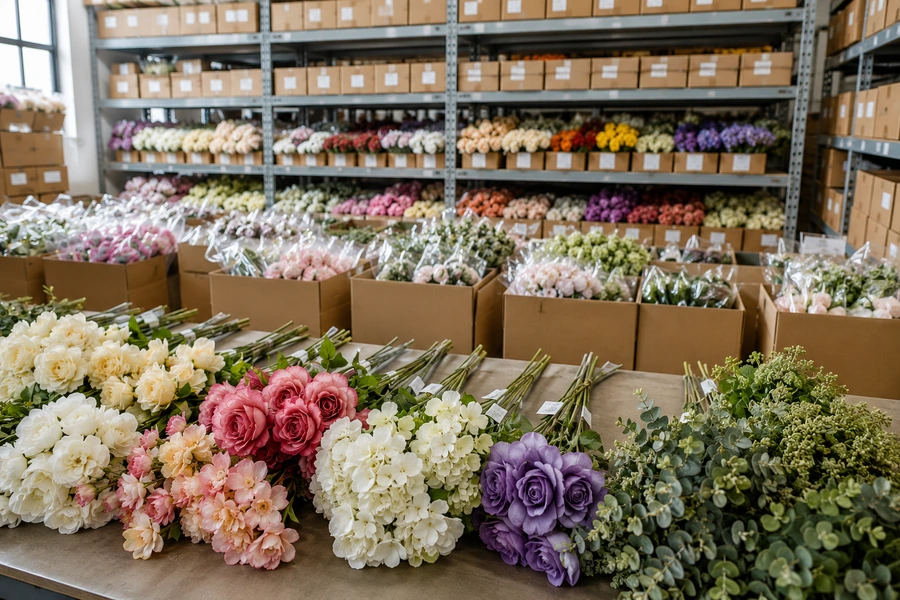
The cheapest flower is rarely the cheapest product if it arrives crushed, looks artificial under retail lighting, cannot match the approved sample, or forces the buyer to hold years of slow-moving inventory.
How Much Do Wholesale Artificial Flowers Cost, and What Should the Price Include?
There is no meaningful universal “wholesale artificial flower price” because one product description can cover a tiny flower head, a long wired stem, a real-touch tulip, a multi-head rose bush, a UV-treated outdoor product, or a complete wedding arrangement.
Wholesale pricing should be compared only after the buyer fixes the flower size, stem length, material, petal count, color, packaging, order quantity, customization, Incoterm, and quality requirements. A low online unit price is useful for initial market screening, but it is not a reliable landed-cost quotation.
Current Alibaba artificial-flower listings illustrate how wide the market can be: one assortment page recently showed products around $0.15 with a 2-piece MOQ, $0.25–$0.30 with a 100-piece MOQ, $0.52–$0.56 with a 10-piece MOQ, $1.10–$1.17 with a 500-piece MOQ, and $1.40–$1.55 with a 100-piece MOQ. Those listings represent different products and suppliers, so they should be treated as a sourcing snapshot—not a benchmark for an equivalent flower.
The Eight Variables That Change Artificial-Flower Pricing
A useful RFQ should control at least these eight variables.
| Price Variable | Lower-Cost Direction | Higher-Cost Direction |
|---|---|---|
| Flower size | Small head | Oversized focal bloom |
| Construction | Simple molded flower | Multi-layer hand-assembled flower |
| Material | Basic polyester/plastic | Real-touch coatings or detailed mixed materials |
| Stem | Short/simple | Long wired or branched stem |
| Color | Standard stock color | Custom Pantone-style development |
| Surface | Plain | Hand shading, flocking, printing, UV treatment |
| Packaging | Bulk compressed carton | Individual sleeves, trays, retail boxes |
| Quantity | Standard production run | Small custom batch |
The important lesson is not that one column is automatically “good” and the other “bad.”
A retailer selling inexpensive seasonal décor may intentionally choose a simpler construction. A wedding rental company or luxury hotel supplier may need stronger close-view realism and be willing to pay for more detailed flowers.
Ask for a Price Breakdown Instead of One Number
Request a quotation showing:
- Product unit price
- Currency
- MOQ
- Price tier by quantity
- Packaging included
- Inner-pack quantity
- Master-carton quantity
- Carton dimensions
- Gross and net weight
- Custom-label cost
- Custom-color cost
- Mold or setup charges
- Sample price
- Sample freight
- Production lead time
- Incoterm
- Quote validity
Do not compare:
Supplier A: $0.68
with:
Supplier B: $0.74
until you know whether they are quoting the same flower construction and commercial terms.
Compare Cost per Usable Stem
The most useful sourcing calculation is often:
Usable cost per stem = total landed cost ÷ saleable or usable quantity
Suppose two suppliers deliver 5,000 stems.
Supplier A:
- Lower purchase price
- 8% visually unacceptable units
- More reshaping labor
- Higher replacement claims
Supplier B:
- Slightly higher unit cost
- Consistent colors
- Strong packaging
- Lower rejection rate
Supplier B can produce the lower usable cost even though its invoice price is higher.
Build a Landed-Cost Sheet
At minimum, include:
| Cost Layer | Buyer Should Capture |
|---|---|
| Product | Unit price × quantity |
| Packaging | Retail or export packaging |
| Tooling/setup | Custom molds, labels, colors |
| Inspection | Factory audit or shipment inspection |
| Inland logistics | Factory to port/warehouse |
| International freight | Air, courier, LCL, FCL |
| Insurance | Where applicable |
| Duties/taxes | Destination-specific |
| Customs/brokerage | Clearance costs |
| Local delivery | Port to warehouse |
| Rework | Reshaping, repacking, labeling |
| Rejects | Unusable flowers |
| Storage | Inventory carrying requirement |
The supplier’s unit price is therefore only one line in the commercial decision.
Do Not Pay Extra for Unspecified “Premium Quality”
Replace adjectives with measurable specifications.
Instead of:
Premium silk rose
write:
68 cm finished stem, approximately 10 cm flower head, three green leaves, internal iron wire, approved blush color, matte polyester petals, no visible glue at 50 cm viewing distance, packaged 24 stems per inner box.
The more measurable the specification becomes, the easier it becomes to understand what the extra price actually buys.
Sample Price and Bulk Price Are Different Questions
A supplier may charge a much higher unit price for:
- One sample
- A handmade development sample
- Courier freight
- Custom color development
- Small production quantities
That alone is not a red flag.
The buyer needs separate answers for:
- Development sample cost
- Production sample cost
- Bulk unit cost
- Freight or delivery cost
Freeze the Price Against the Golden Sample
The final negotiated price should point to the approved physical sample and specification.
Otherwise, the buyer may negotiate the price down and unknowingly receive:
- Fewer petals
- Thinner fabric
- Shorter stems
- Smaller flower heads
- Different leaves
- More visible plastic
- Lighter packaging
The quote should effectively mean:
This price produces this approved flower.
That relationship is more valuable than another one-cent reduction without specification control.
What MOQ Should Buyers Accept for Wholesale Artificial Flowers?
MOQ is not simply a supplier’s arbitrary minimum. It may reflect material purchasing, dye lots, labor setup, packing quantities, customization, or the supplier’s preferred production economics.
Buyers should negotiate MOQ at four levels: total order MOQ, SKU MOQ, color MOQ, and packaging MOQ. A supplier advertising a low overall MOQ may still require much larger quantities for each custom color or design, so the commercial order matrix must be confirmed before sampling is finalized.
Current marketplace listings show just how inconsistent artificial-flower MOQs can be. The same current Alibaba assortment includes examples from 2 or 6 pieces through 10, 40, 96, 100, and 500 pieces, depending on the product. Global Sources likewise exposes MOQ information in supplier profiles as part of wholesale supplier comparison.
Understand the Four MOQs
1. Total Order MOQ
Example:
Minimum total purchase: 2,000 pieces.
This may allow several flower types.
2. SKU MOQ
Example:
500 pieces per rose model.
Now a buyer ordering four flower styles needs 2,000 pieces.
3. Color MOQ
Example:
500 pieces per color.
Four colors of one rose can again become 2,000 pieces.
4. Packaging MOQ
Custom printed sleeves or boxes may have a different minimum from the flowers themselves.
A buyer can therefore meet the flower MOQ and still fail to meet the custom-box MOQ.
Ask for an MOQ Matrix
| SKU | Color | Quantity | Custom? | Supplier MOQ | Approved? |
|---|---|---|---|---|---|
| Rose R01 | Ivory | 500 | No | 500 | Yes |
| Rose R01 | Blush | 300 | Custom | 500 | Negotiate |
| Peony P04 | White | 400 | No | 300 | Yes |
| Hydrangea H02 | Blue | 200 | Custom | 500 | No |
This makes the inventory commitment visible before the purchase order is signed.
When a Higher MOQ Is Reasonable
A higher MOQ can be commercially sensible when:
- A custom color needs a production run
- Material must be purchased specifically
- The order requires special packaging
- The flower uses unique molds or printing
- The buyer wants exclusive specifications
- Factory setup is substantial
The question should therefore be:
Why is the MOQ 1,000 pieces?
rather than:
Can you make it 100?
A supplier with a clear production reason is easier to evaluate than one whose MOQ changes unpredictably during every conversation.
When to Push for a Lower MOQ
Lower MOQs are particularly valuable for:
- First supplier trial
- New color
- New market
- Trend-sensitive products
- Wedding-season products
- Retail assortment testing
- Large high-priced stems
- Products with uncertain sell-through
The goal is to buy information before buying excessive inventory.
Five Ways to Negotiate MOQ Without Destroying Quality
Use Existing Materials
Ask the factory to use:
- Existing petal fabric
- Existing molds
- Existing stems
- Stock leaves
- Standard packaging
while changing only the color or flower combination.
Combine Colors Carefully
Ask whether several colors can share one production run.
Confirm that the supplier means a combined MOQ rather than quietly requiring the original MOQ for every color.
Remove Custom Packaging
For the pilot order, use:
- Neutral sleeve
- Master carton
- Buyer-applied label
instead of a fully printed retail pack.
Increase Unit Price for the Trial
Paying slightly more per flower for 300 units may be economically stronger than saving a few cents while purchasing 3,000 untested units.
Commit to a Scale-Up Plan
For example:
300-piece pilot after sample approval, followed by 3,000 pieces if inspection and sell-through meet target.
The supplier receives a path to volume while the buyer limits first-order exposure.
Beware the “Fake Low MOQ”
A supplier may advertise:
MOQ: 10 pieces.
But after inquiry:
- Custom color MOQ = 1,000
- Logo MOQ = 2,000
- Export-carton MOQ = 500
- Quoted price applies only at 5,000
- Ten-piece quantity comes from mixed clearance stock
That does not necessarily mean fraud, but the advertising number is commercially useless for the buyer’s actual specification.
Calculate MOQ in Money, Not Pieces
A 2,000-piece MOQ sounds large.
But the more relevant calculation is:
Inventory commitment = MOQ × landed unit cost
Then add:
- Storage
- Sell-through time
- Reorder lead time
- Obsolescence risk
A 500-piece premium flower can require more working capital than 5,000 inexpensive flower heads.
Use Trial Orders to Measure Supplier Performance
A trial order should test:
- Communication
- Specification discipline
- Color consistency
- Production timing
- Packaging
- Inspection cooperation
- Documentation
- Shipment condition
Do not treat it merely as a smaller version of the final purchase.
It is a supplier qualification exercise.
What Quality Checklist Should You Use Before Approving a Bulk Order?
Artificial flowers should not be inspected with a vague instruction such as “check quality.”
Create a product-specific checklist covering color, flower-head size, petal construction, stem length, leaf count, wire strength, glue visibility, surface finish, odor, attachments, packaging, carton compression, labeling, and any UV, fire, or market-specific documentation. Approve one golden sample and make every production inspection compare against it.
AQL sampling is commonly used to decide whether a sampled production lot falls within defined defect limits; different limits can be assigned to minor, major, and critical defects. QIMA states that its AQL sampling follows ISO 2859 methodology, while also emphasizing that buyers should calibrate the limits to their actual product risks rather than copying another company’s settings.
Part 1: Appearance Checklist
Inspect:
- Correct botanical style
- Approved flower diameter
- Correct petal count or visual fullness
- Approved color
- Color variation within tolerance
- Natural shading
- Leaf color
- Leaf printing
- Surface gloss
- Visible mold seams
- Flower-center realism
- Glue residue
- Threads
- Fraying
- Stains
- Dust
- Scratches
Part 2: Construction Checklist
Check:
- Stem length
- Stem diameter
- Internal wire
- Stem straightness
- Adjustable range
- Flower-head attachment
- Leaf attachment
- Side-branch strength
- Calyx attachment
- Exposed wire
- Sharp cut ends
- Loose plastic
- Loose petals
Part 3: Realism Checklist
At the intended viewing distance, ask:
- Are all blooms identical?
- Do all leaves face forward?
- Is every flower at the same stage?
- Does the stem look unnaturally glossy?
- Is glue visible?
- Does the flower center look molded?
- Do leaf undersides look unfinished?
- Does the product recover after packaging?
For premium flowers, photograph:
- Front
- Side
- Rear
- Flower center
- Leaf front
- Leaf back
- Stem connection
Part 4: Color-Control Checklist
Color disputes are common because:
- Screen images vary
- Lighting differs
- Dye lots vary
- Gloss changes perceived color
Approve color with:
- Physical sample
- Supplier color code
- Buyer reference
- Controlled lighting where practical
Do not accept:
same as photo
as the complete color specification.
Part 5: Dimensions and Weight
Record measurable tolerances for:
- Overall stem length
- Flower-head diameter
- Leaf length
- Branch count
- Bouquet width
- Product weight
Avoid meaningless requirements such as:
Size must be exact.
Hand-assembled artificial flowers may naturally contain limited variation, so the buyer should define what is commercially acceptable.
Part 6: Odor
Open representative samples after packaging.
Strong chemical odor can create problems for:
- Retail display
- Weddings
- Hotels
- Indoor events
- Enclosed warehouses
An odor requirement can be included as a buyer-defined inspection criterion even when the product is not subject to a specific odor regulation.
Part 7: Pull and Handling Tests
Create simple repeatable checks for:
- Flower-head retention
- Leaf retention
- Branch connection
- Stem flexibility
- Wire exposure
The test method should be agreed in advance.
Do not tell the inspector merely to:
pull hard.
Define:
- Component
- Force or handling method
- Duration
- Pass condition
Part 8: Packaging Recovery
Artificial flowers are frequently compressed for shipping.
Inspect a defined sample after unpacking and reshaping.
Record:
- Petal creasing
- Stem bends
- Detached heads
- Leaf folds
- Recovery time
- Required labor
A flower that looks good before packing but requires ten minutes of repair per stem after delivery may be unsuitable for a large retail program.
Part 9: Carton Checklist
Check:
- Carton dimensions
- Gross weight
- Stem direction
- Bundle size
- Flower-head clearance
- Inner dividers
- Moisture condition
- Shipping marks
- Quantity per carton
- Carton strength
- Seal condition
Pre-shipment inspection services can include product specification, quantity, labels, packing, and carton checks before dispatch. QIMA describes PSI as an on-site review typically conducted once at least 80% of the production order is complete.
Part 10: UV and Outdoor Products
For outdoor artificial flowers, request:
- Exact test method
- Test report
- Tested specimen
- Color tested
- Exposure cycle
- Result
- Whether the finished flower was tested
- Whether protection is integral or coated
- Cleaning instructions
- Retreatment requirements
Do not accept:
UV certified
without determining what that phrase means for the exact product.
Part 11: Fire Requirements
Where products are destined for:
- Hotels
- Malls
- Events
- Public buildings
- Commercial installations
the buyer may need project-specific fire documentation.
Request the actual report and confirm:
- Product identity
- Tested material
- Method
- Laboratory
- Result
- Treatment
- Validity for the supplied construction
Do not assume a report for plastic greenery also covers:
- Fabric flowers
- Moss
- Foam
- Adhesives
- Ribbon
- Backing mesh
Create Defect Classes
A practical inspection might classify defects as:
Critical
- Safety hazard
- Exposed sharp dangerous wire
- Prohibited or incorrect material where safety requirements apply
Major
- Wrong color
- Wrong flower
- Missing flower head
- Severe crushing
- Visible glue on focal surface
- Major stem-length error
- Loose head
- Wrong packaging
Minor
- Small hidden thread
- Slight removable dust
- Small cosmetic inconsistency outside normal viewing area
The correct classification belongs in the buyer’s specification.
Approve a Golden Sample
The golden sample should be:
- Signed or uniquely marked
- Dated
- Photographed
- Stored safely
- Linked to the PO
- Linked to the inspection checklist
Ideally:
- Buyer retains one
- Factory retains one
- Inspector receives photos/specifications
Use Independent Inspection for Meaningful Orders
A supplier badge does not replace shipment inspection.
QIMA specifically notes that independent sampling is materially different from allowing the factory’s own team to decide whether its lot passes, because the independence of the inspection affects the credibility of the result.
A pre-shipment inspection can verify:
- Quantity
- Color
- Construction
- Labeling
- Packaging
- Dimensions
- Buyer-defined tests
before the goods leave the factory.
Which Artificial-Flower Supplier Red Flags Should Make Buyers Stop or Investigate?
A weak supplier rarely announces itself with one dramatic warning. Risk usually appears as a pattern of small inconsistencies.
Major supplier red flags include constantly changing company details, inability to explain production, refusing physical samples, unusually low quotations with no specification, changing bank accounts, requesting payment outside agreed channels, copied certificates, resistance to inspections, inconsistent lead times, poor production photographs, and unwillingness to write quality requirements into the purchase order.
Alibaba’s own supplier-verification guide says basic verification confirms legal registration but is not a guarantee of quality or reliability; it distinguishes more extensive on-site assessment from basic registration checks and recommends buyers review information beyond badges.
Red Flag 1: The Supplier Cannot Explain the Flower Construction
Ask:
- What is the petal material?
- What is the stem material?
- How many leaves?
- Where is the wire?
- How is the flower head attached?
- Which process adds the color?
A manufacturer or technically competent trading supplier should be able to obtain clear answers.
Repeated vague responses such as:
very good silk
are not enough.
Red Flag 2: Every Product Is “Highest Quality”
A serious quotation should distinguish:
- Entry level
- Mid-market
- Premium
- Real-touch
- Outdoor
- Commercial project grade
If every flower is described as:
Best quality, best price, no problem
the buyer still has no measurable specification.
Red Flag 3: The Price Is Dramatically Lower but the Specification Is “Same”
When a quote drops substantially, ask what changed.
Possible differences include:
- Petal layers
- Stem thickness
- Flower diameter
- Fabric weight
- Leaf count
- Packaging
- Printing
- Coating
Do not assume identical catalog photos mean identical construction.
Red Flag 4: The Sample Is Excellent but Bulk Specification Is Vague
A perfect sample has limited value if the PO says only:
Artificial rose, pink.
The supplier should agree that production matches:
- Sample number
- Dimensions
- Materials
- Color
- Construction
- Packaging
- Inspection standard
Red Flag 5: The Company Identity Keeps Changing
Compare:
- Quotation company
- Business license
- Email domain
- Invoice
- Bank beneficiary
- Factory address
- Export company
- Platform profile
Different entities can have legitimate explanations.
The red flag is when the supplier cannot explain the relationship clearly.
Red Flag 6: Bank Details Change Immediately Before Payment
Any unexpected payment-detail change should trigger independent reconfirmation through a known communication channel.
Do not rely solely on the same email thread announcing the change.
When sourcing through Alibaba, Trade Assurance provides platform-based payment and dispute processes for qualifying orders; Alibaba states that payments made through the program can be held in escrow and that buyers can seek resolution for covered order problems.
Platform protection is not a replacement for specification control, but moving a protected transaction outside the agreed system can remove useful safeguards.
Red Flag 7: The Supplier Refuses Third-Party Inspection
A supplier may reasonably ask:
- Who is inspecting?
- When?
- What checklist?
- Who pays?
But unexplained refusal to allow independent pre-shipment inspection deserves investigation.
Independent PSI is specifically designed to check whether production matches buyer requirements before shipment.
Red Flag 8: Certificates Cannot Be Linked to the Product
Check whether the document identifies:
- Product
- Material
- Applicant
- Manufacturer
- Test method
- Date
- Result
- Laboratory
A legitimate-looking PDF for a different artificial plant is not evidence for the flower being ordered.
Red Flag 9: The Factory Cannot Produce Consistent Production Evidence
Request live or current evidence showing:
- Raw materials
- Production line
- Work-in-progress flowers
- Packing
- Cartons
- Warehouse
- Product labels
Be cautious when every “factory” photograph appears to be a polished catalog image.
Red Flag 10: MOQ Changes After the Sample Is Approved
Clarify MOQ before expensive development.
If the sequence is:
MOQ 300 → sample approved → actual MOQ 5,000
ask why.
There may be a legitimate custom-material issue, but it should have been disclosed earlier.
Red Flag 11: The Supplier Will Not Confirm the Production Lead Time in Writing
Ask for:
- Sample lead time
- Material preparation
- Production time
- Packaging time
- Inspection window
- Earliest shipment date
Avoid treating:
around 15 days, maybe
as a committed shipment plan.
Red Flag 12: The Supplier Resists Detailed Defect Criteria
The supplier does not need to agree with every requested tolerance.
But a strong supplier should discuss:
- What can be controlled
- What variation is normal
- What would increase price
- Which defects can be prevented
A supplier who simply says:
Do not worry, quality perfect
is not giving a quality plan.
Red Flag 13: The Supplier Wants Full Production Before Final Sample Approval
For a customized artificial flower, approve:
- Material
- Color
- Construction
- Packaging
before authorizing the complete production run whenever the project permits.
Changes after production has finished are much more expensive.
Red Flag 14: Packaging Is Treated as an Afterthought
A supplier who says:
We pack normally.
has not answered:
- How many per bundle?
- How many per carton?
- Are blooms compressed?
- Are long stems bent?
- Is there a divider?
- What are carton dimensions?
Artificial flowers can leave the factory perfect and reach the buyer crushed.
Packaging is part of product quality.
Red Flag 15: Verification Badges Are Used as the Entire Sales Argument
Supplier verification is useful for narrowing a long list.
It should not replace:
- Samples
- Specification
- Factory assessment
- Inspection
- Payment control
- Production monitoring
Alibaba itself states that basic supplier verification is a minimum check rather than a guarantee of quality, while its stronger on-site assessment tier examines factory capabilities and quality systems more extensively.
Supplier Risk Scorecard
| Category | Weight | Questions |
|---|---|---|
| Sample quality | 20% | Does product match target? |
| Specification discipline | 15% | Are details documented accurately? |
| Price competitiveness | 15% | Is cost reasonable for specification? |
| MOQ flexibility | 10% | Can buyer test market safely? |
| Factory capability | 10% | Can production be explained and verified? |
| Communication | 10% | Are answers clear and consistent? |
| QC cooperation | 10% | Will supplier accept inspection? |
| Packaging | 5% | Is transit risk controlled? |
| Documentation | 5% | Are required reports traceable? |
Do not automatically award the contract to the supplier with the highest score after one email.
Use the scorecard to make comparisons explicit.
My Insights: Wholesale Artificial Flowers—How Should Buyers Balance Pricing, MOQ, Quality, and Supplier Red Flags
The most expensive wholesale artificial-flower mistake is not overpaying by five cents. It is scaling an inadequately specified product from an inadequately qualified supplier.
The strongest wholesale strategy is to control four variables in sequence: define the exact flower, buy enough samples to establish a golden standard, negotiate MOQ and price against that standard, and inspect production before shipment. Supplier badges and online prices help build the shortlist, but physical quality, documented specifications, production evidence, inspection cooperation, and transaction discipline should decide the purchase.
The Pricing Insight
Do not begin with:
Who is cheapest?
Begin with:
Which suppliers are quoting the same specification?
Only then compare price.
A useful price comparison table is:
| Supplier | Product Match | MOQ | Unit Price | Packaging | Inspection | Estimated Risk |
|---|---|---|---|---|---|---|
| A | Excellent | 1,000 | Medium | Strong | Accepted | Low |
| B | Moderate | 500 | Low | Weak | Reluctant | High |
| C | Excellent | 2,000 | Low-medium | Strong | Accepted | Low-medium |
Supplier B may have the most attractive unit price and the weakest commercial offer.
The MOQ Insight
A low MOQ has value because it buys learning.
For a new supplier, a smaller first order can reveal:
- Actual production quality
- Shipment consistency
- Packaging performance
- Communication discipline
- Inspection response
- Real lead time
Once those variables are proven, larger MOQs become easier to justify.
The Quality Insight
The golden sample is more valuable than the phrase “premium quality.”
A professional buying file should contain:
- Physical approved sample
- Measurement sheet
- Color reference
- Material description
- Product photographs
- Packaging standard
- Defect classification
- Inspection checklist
- PO reference
A stranger should be able to inspect the flower using the file without asking the buyer what “good quality” means.
The Supplier Insight
Verification reduces uncertainty; it does not eliminate due diligence.
Current B2B platforms provide useful supplier-profile information. Global Sources exposes supplier characteristics and MOQ information, while Alibaba distinguishes different verification levels and explicitly warns that basic registration verification is not a quality guarantee.
Use those tools to create the shortlist.
Then independently verify what matters to your order.
The Inspection Insight
Inspect before the goods become your logistics problem.
A pre-shipment inspection performed while most production is finished but before dispatch gives the buyer an opportunity to identify specification, quantity, color, packaging, and workmanship problems before the shipment leaves the supplier. QIMA describes its PSI timing at approximately 80% completion or later.
For a high-risk custom order, consider quality control at more than one stage:
- Pre-production approval
- Early-production check
- During-production check
- Final pre-shipment inspection
Not every order justifies every stage.
The inspection effort should rise with:
- Order value
- Customization
- Supplier novelty
- Failure cost
- Delivery deadline
My Wholesale Artificial-Flower Buying Checklist
Before paying a bulk deposit, confirm:
Product
- Exact SKU
- Dimensions
- Materials
- Flower-head size
- Stem length
- Leaf count
- Color
- Surface finish
- Wire
- Glue standard
Commercial
- MOQ
- Price tier
- Currency
- Incoterm
- Lead time
- Quote validity
- Packaging
- Payment schedule
Quality
- Golden sample
- Tolerances
- Defect definitions
- Packaging test
- Color standard
- Inspection plan
- Required test documents
Supplier
- Legal company identity
- Factory/trader status understood
- Production location
- Bank beneficiary checked
- Platform profile reviewed
- Audit or factory evidence reviewed
- Third-party inspection accepted
Shipment
- Carton dimensions
- Carton quantity
- Gross weight
- Shipping marks
- Packing photographs
- PSI result
- Corrective action completed
My Preferred First-Order Sequence
I use this sequence:
- Shortlist 5–8 suppliers.
- Send the same RFQ to all of them.
- Remove suppliers giving incomplete answers.
- Order samples from 2–4 finalists.
- Compare samples blind where practical.
- Select one golden sample.
- Rewrite the specification from the physical sample.
- Negotiate MOQ and price.
- Confirm packaging.
- Create defect criteria.
- Place a controlled pilot order.
- Conduct independent inspection where risk justifies it.
- Review incoming quality.
- Score the supplier.
- Increase volume only after performance is demonstrated.
This takes more work before the first container but reduces the probability of buying a large quantity of flowers that cannot meet the intended market.
The Most Important Negotiation Rule
Never trade specification silently for price.
When a supplier says:
We can reduce another $0.08.
ask:
What changes in material, construction, quantity, packaging, or payment terms make that reduction possible?
A legitimate cost reduction should be explainable.
The Most Important MOQ Rule
Do not celebrate a low MOQ before confirming the price tier.
A supplier can technically offer:
- MOQ 100
while the attractive quotation applies only to:
- 5,000 pieces
Record both numbers.
The Most Important Quality Rule
Inspect what customers will notice first.
For artificial flowers, that usually means:
- Flower center
- Petal texture
- Color
- Visible glue
- Repeated molds
- Stem realism
- Packaging recovery
A minor hidden mark on the lower stem may matter less commercially than an unrealistic shiny flower center visible from a meter away.
Your defect definitions should reflect the intended customer and viewing distance.
The Most Important Supplier Red Flag
The biggest red flag is not one imperfect answer.
It is inconsistency without explanation.
Examples:
- Company name changes
- Factory address changes
- Price changes
- Material changes
- MOQ changes
- Bank account changes
- Lead time changes
- Test document changes
Businesses sometimes have legitimate reasons for changes.
The supplier should be able to explain them clearly and document them.
The Most Important Transaction Rule
Keep commercial expectations written.
For platform orders, Alibaba’s Trade Assurance is designed to provide payment and order protections when transactions are completed through the program, including mediation or refund-related processes for covered product and shipment issues.
Regardless of payment channel, protection becomes stronger when the order states precisely:
- What is being supplied
- When it will ship
- What quality is required
- What packaging is required
A dispute mechanism cannot substitute for a missing specification.
My Final Supplier Decision Formula
Score each finalist on:
Product + Price + MOQ + Quality Control + Communication + Documentation + Packaging + Transaction Risk
Do not optimize one variable.
The supplier offering:
- Good—not necessarily lowest—price
- Manageable MOQ
- Strong sample
- Transparent factory information
- Measurable quality standards
- Inspection cooperation
- Consistent communication
is often commercially stronger than the supplier leading with the lowest catalog price.
Conclusion
Buy wholesale artificial flowers against a frozen specification, not a photograph. Compare landed cost, negotiate MOQ strategically, inspect against a golden sample, and treat unexplained supplier inconsistencies as serious risk signals.