
Dusty artificial flowers can lose their realism, but careless washing may cause even greater damage. Water, heat, friction, and strong detergent can fade petals, loosen glue, or distort their shape.
To wash artificial flowers without unnecessary color fade, identify the material, remove loose dust, test a hidden petal, use cool water and minimal mild soap, avoid soaking, rinse quickly, blot without rubbing, reshape the blooms, and dry them completely in the shade. Do not wash flowers whose manufacturer recommends dry cleaning only.
No washing process can guarantee zero color change across every artificial flower. Products sold as silk, real-touch, foam, polyester, plastic, velvet, or latex-style flowers can react differently. The safest method always begins with the care instructions and a colorfastness test.
Can You Wash Artificial Flowers With Water?
Putting a complete artificial arrangement under a strong shower may seem efficient. It can also trap water inside flower heads, expose internal wire, and soften adhesives that were never designed for washing.
Many sturdy plastic and some polyester artificial flowers can be rinsed briefly with cool water. Delicate silk-touch, real-touch, flocked, foam, glittered, painted, pre-lit, and mixed-material flowers may require dry dusting or careful spot cleaning instead. Always follow the manufacturer’s instructions and test an unseen area before washing.
Artificial-flower care advice varies because the products themselves vary. Nearly Natural recommends soft brushing or cool air for routine cleaning and says its silk-style flowers should not be soaked. Balsam Hill recommends dry cleaning for many artificial florals and warns that soapy water or chemical sprays may damage products or affect warranty coverage.
Which Artificial Flowers Are Usually Safer to Wash?
Washability depends on the complete construction, not only the petal material.
| Artificial-Flower Type | Water-Washing Suitability | Main Risk |
|---|---|---|
| Molded PE or plastic flowers | Often suitable after testing | Water entering stems or joints |
| Sturdy polyester flowers | Sometimes suitable | Dye bleeding and petal creasing |
| PVC foliage | Often suitable for brief rinsing | Water around exposed internal wire |
| PU real-touch flowers | Use strong caution | Coating changes, stickiness, or marks |
| Foam flowers | Usually avoid soaking | Surface deformation |
| Flocked or velvet flowers | Usually use dry methods | Flattened or patchy texture |
| Glittered flowers | Usually avoid washing | Glitter and adhesive loss |
| Hand-painted petals | Spot-test carefully | Pigment transfer |
| Pre-lit arrangements | Do not immerse | Electrical damage |
| Flowers fixed in acrylic water | Do not soak | Clouding, separation, or trapped moisture |
A product described as a “silk flower” usually does not contain natural silk. Many modern silk-style flowers use synthetic fabrics. The marketing name alone does not tell me whether the dyes, coatings, glue, and internal structure tolerate water. Nearly Natural, for example, states that its silk artificial flowers use synthetic fabrics and recommends avoiding immersion.
When Should You Avoid Washing?
I avoid washing when the arrangement has:
- No clear material or care information
- Visible color transfer during a test
- Loose artificial pollen
- Glitter or flocking
- Foam petals
- Paper-wrapped stems
- Exposed metal wire
- Battery-powered lights
- Old or brittle adhesive
- Natural dried flowers mixed with artificial stems
- A heavy fixed vase or permanent base
- A manufacturer instruction that says to use dry cleaning only
When washing is unsafe, I begin with a microfiber cloth, soft paintbrush, makeup brush, cotton swab, or cool low-pressure air. These dry methods remove much of the dust without exposing the flower to water.
What Causes Artificial Flowers to Fade During Washing?
Color loss is often blamed on water alone. In practice, fading usually results from several stresses working together.
Artificial flowers may fade during washing because their dyes or printed pigments are not waterfast. Hot water, alkaline detergent, long soaking, rubbing, wringing, direct sunlight, and high-heat drying can increase color movement or surface damage. Adhesive failure and coating changes can also make a flower appear faded even when the original pigment remains.
A flower may not lose color evenly. A printed vein may disappear while the main petal remains unchanged. A dark edge may bleed into a pale center. One color in a multi-tone hydrangea may be less stable than the others.
The Main Causes of Color Change
| Cause | What It Can Do |
|---|---|
| Hot water | Softens plastic, coating, or adhesive |
| Long soaking | Gives unstable dye more time to move |
| Strong detergent | Removes finish or changes the surface |
| Bleach | Strips or lightens color |
| Heavy rubbing | Abrades printed or coated pigments |
| Wringing | Creases petals and stresses glued joints |
| Direct-sun drying | Adds UV exposure while petals are wet |
| Hot hair dryer | Distorts petals and weakens glue |
| Colored cleaning cloth | Transfers dye to pale flowers |
| Mixed-color washing | Allows dark pigments to stain light petals |
Balsam Hill advises using only a damp cloth with water for many faux plants and avoiding harsh detergents because they can discolor products or affect adhesives. It also recommends fully drying damp-cleaned foliage before storage.
Color Fade Is Not the Only Risk
A washed flower may retain its color but lose realism in other ways.
Possible damage includes:
- Hard water marks
- A glossy coating becoming cloudy
- A soft real-touch finish becoming sticky
- Petals drying in a folded position
- Artificial pollen washing away
- Rust appearing around wire openings
- Glue turning white
- Fabric edges fraying
- Moss or bark falling from the base
- Dust drying into flower centers
This is why I inspect color, texture, shape, and construction after the hidden-area test. A petal that does not bleed may still become stiff or glossy.
What Are the 9 Pro Steps for Washing Artificial Flowers Without Color Fade?
The safest process uses the lowest level of cleaning needed. I do not begin with full immersion when dusting or spot cleaning can solve the problem.
The nine professional steps are to identify the material, remove loose dust, test colorfastness, separate vulnerable parts, prepare a mild cool-water solution, wash gently in sections, rinse briefly, blot and reshape, and dry completely in shade. Stop immediately if color, texture, adhesive, or shape begins to change.
Step 1: Identify the Material and Read the Care Instructions
The first step happens before water touches the flower.
I check the product label, packaging, invoice, supplier specification, or online care page. I want to know what the petals, leaves, stem coating, flower center, and base are made from.
A single arrangement may combine:
- Polyester petals
- Molded PE leaves
- PVC stems
- PU coatings
- Foam buds
- Metal wire
- Hot-melt adhesive
- Printed fabric
- Artificial pollen
- Moss or bark
The care instruction for one component may not be safe for another.
I classify the arrangement into one of three groups:
| Cleaning Group | Recommended Direction |
|---|---|
| Washable | Brief cool-water rinse may be suitable |
| Moisture-limited | Damp cloth or controlled spot cleaning |
| Dry-clean only | Brush, microfiber cloth, or cool air |
Manufacturer instructions take priority over a general cleaning guide. Some Balsam Hill artificial floral products should be cleaned with a soft dry cloth and not with water or chemical sprays. Nearly Natural recommends avoiding soaking its silk-style artificial flowers.
I also photograph a valuable bouquet before cleaning. The picture records its original flower positions and provides a guide if stems move during handling.
Step 2: Remove All Loose Dust Before Washing
Water turns loose dust into dirty residue. That residue can settle in fabric texture, petal seams, glue lines, and flower centers.
I move the arrangement outside, over a bathtub, or onto a clean sheet. I then use a soft brush or microfiber cloth to remove surface dust.
For layered blooms, I use a hair dryer only on a cool, low setting and from a safe distance. Nearly Natural recommends a soft brush or a cool-setting hair dryer for artificial flowers, while Balsam Hill recommends soft cloths and dusters for routine floral care.
My Dust-Removal Order
- Hold the stem below the flower head.
- Brush the flower center gently.
- Move from the inner petals toward the edges.
- Wipe broad leaves from base to tip.
- Clean the stem and lower branches.
- Shake out loose debris without snapping the stem.
- Inspect again under strong light.
I do not use a high-powered vacuum directly on delicate petals. Strong suction can pull flower heads from stems or remove decorative material.
Removing dust first may show that washing is unnecessary. A lightly dusty artificial bouquet usually looks fresh again after careful dry cleaning.
Step 3: Perform a Complete Colorfastness Test
A quick test on a hidden petal is the most important protection against color fade.
I choose the back of a lower petal or a leaf that will not be visible during normal display. I test every major color and material, not only one green leaf in a bouquet containing red, pink, and white flowers.
How I Test
I prepare the same water and cleaning solution that I plan to use on the full arrangement.
I dampen a clean white cotton cloth or cotton swab. I press it gently against the test area for several seconds. I do not scrub.
I then inspect:
- The white cloth for transferred color
- The petal for a lighter patch
- Printed veins for movement
- The surface for gloss or cloudiness
- The material for softness or stickiness
- The glued joint for whitening
- The dried area for a water ring
I allow the test section to dry completely before deciding whether to continue. A flower may look unchanged while wet and reveal a mark after drying.
Stop Washing When:
- Color appears on the white cloth
- The petal becomes lighter
- A printed detail smears
- The surface becomes sticky
- The material wrinkles
- The glue changes color
- The test area dries with a ring
- The flower develops an unusual odor
When the test fails, I return to dry dusting or use a manufacturer-approved cleaning product. I do not dilute the detergent further and continue without testing again.
Step 4: Remove or Protect Vulnerable Parts
A washable plastic leaf does not make the entire arrangement washable.
Before cleaning, I remove individual stems from the vase when possible. I separate washable parts from items that must remain dry.
I protect or remove:
- Ribbons
- Paper labels
- Battery packs
- Light strings
- Wooden bases
- Foam inserts
- Artificial moss
- Fabric-wrapped handles
- Metal clips
- Decorative glitter pieces
- Natural dried components
For a wedding bouquet, I may cover the handle and ribbon with a clean waterproof bag while cleaning only the flower heads. I hold the opening tightly around the stems so water does not run into the handle.
For a potted artificial plant, I tilt the leaves away from the pot and clean them in sections. I do not allow water to collect around foam, dry soil, internal wire, or decorative moss.
I also check whether flower heads are removable. A head that slides from its stem too easily should be cleaned separately by a dry method or repaired before washing.
Step 5: Prepare Cool Water and the Mildest Possible Solution
I begin with plain cool water. Soap is added only when water alone cannot remove the dirt and the product has passed the test.
For compatible flowers, I add a very small amount of mild, colorless dish soap to a basin of cool or lukewarm water. The solution should not feel slippery or create heavy foam.
I avoid:
- Bleach
- Ammonia
- Strong degreasers
- Solvents
- Alcohol-based cleaners
- Powdered detergent
- Fabric softener
- Optical brighteners
- Colored or fragranced soap
- Abrasive cleaning paste
Some artificial-flower manufacturers advise against all soapy water, so I use detergent only when the product’s instructions or supplier permit it. Balsam Hill specifically warns that soapy water and chemical cleaning sprays can damage some artificial florals or affect their warranty.
Why Cool Water Is Safer
Cool water reduces the risk of heat-related shape changes and adhesive softening. It also gives unstable dyes less encouragement to move than hot water.
I do not add vinegar simply because it is described as natural. Acidic solutions may still react with dyes, coatings, metal components, or adhesive.
I prepare a second basin or container of clean cool water for rinsing. This prevents the flowers from remaining in dirty cleaning water while I look for another container.
Step 6: Wash Gently in Small Sections
I do not place the whole arrangement in the basin and leave it to soak.
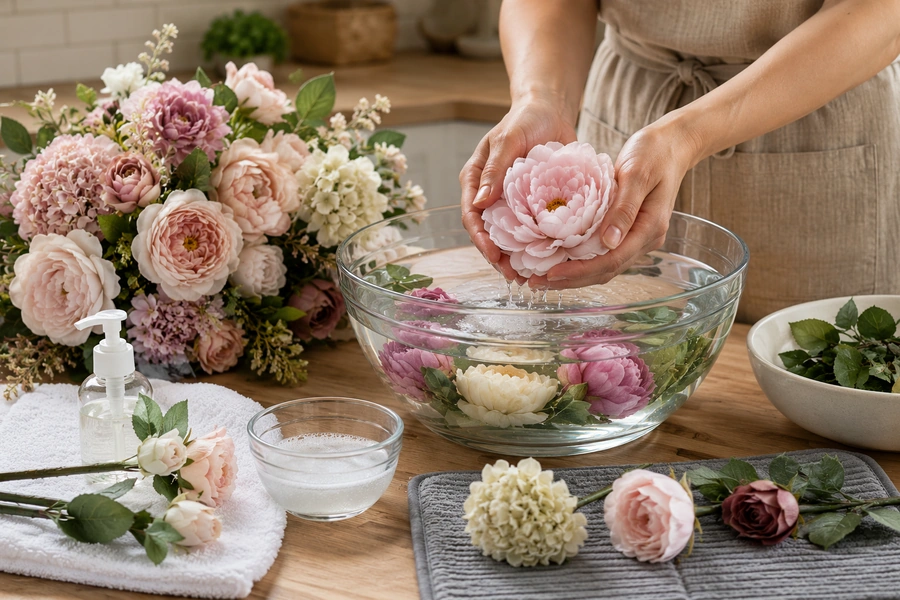
For loose washable stems, I hold the flower head securely and move it briefly through the water. I use gentle swishing rather than scrubbing.
For large artificial plants, I wipe or rinse one section at a time.
The Correct Washing Motion
- Support the flower head from below.
- Move the stem through water briefly.
- Use fingertips only on strong molded leaves.
- Dab fabric petals instead of rubbing.
- Clean from the center toward the edge.
- Keep glued joints out of the water when possible.
- Remove the flower as soon as the dirt loosens.
I wash pale flowers separately from dark flowers. Red, purple, blue, and heavily printed petals should never share dirty wash water with ivory or white flowers.
I also change the water when it becomes gray, oily, or colored. Continuing in dirty water can redeposit residue onto clean petals.
Never Do These During Washing
| Unsafe Action | Possible Result |
|---|---|
| Scrubbing petals together | Abrasion and dye movement |
| Twisting the flower head | Loose glue or broken attachment |
| Holding by one petal | Tearing |
| Soaking overnight | Color bleed and trapped moisture |
| Using a stiff brush | Surface scratches |
| Washing many colors together | Color transfer |
| Pressing blooms against the basin | Permanent creases |
Most artificial flowers do not need full immersion. A brief controlled wash is safer than treating them like washable fabric.
Step 7: Rinse Briefly With Clean, Low-Pressure Water
Soap residue can dry into a pale film and attract new dust. The rinse must remove residue without adding unnecessary water exposure.
I hold the flower under a gentle flow of cool water or move it briefly through the clean rinse basin.
I avoid strong shower pressure. A forceful stream can bend petals, detach leaves, and drive water into flower centers.
Nearly Natural states that a quick rinse works for many artificial plants but advises checking whether the product is intended for indoor or outdoor use. Its flower-care guidance remains more cautious and recommends avoiding soaking synthetic silk-style blooms.
I keep the flower angled downward so water runs away from the flower center and stem opening.
For broad leaves, I rinse from the stem toward the tip. For layered roses and peonies, I use minimal water and avoid forcing the petals open while they are wet.
If the rinse water shows visible color, I stop immediately. I blot the flower and allow it to dry before deciding whether the damage is limited or progressive.
Step 8: Blot, Drain, and Reshape Without Rubbing
Wet artificial petals are easier to crease. I do not throw washed flowers into a pile or wrap them tightly in a towel.
I place a clean white towel on a flat work surface. I hold each stem over the basin and allow excess water to drip away.
I then blot the leaves and petals gently. I use a pressing motion rather than rubbing.
How I Reshape Wet Flowers
I work from the flower center outward.
I separate petals that have stuck together. I open wired branches slowly and return bent leaves to their approved positions.
For roses and peonies, I support the base and lift the outer petals individually.
For hydrangeas, I separate the small branches without pulling the individual flower heads.
For orchids, I check the flower centers and buds because water can remain in their deeper shapes.
I do not wring, twist, squeeze, or spin the stems. These actions can damage wire and adhesive even when the petals appear undamaged.
A cool hair dryer may be used from a distance only when the care instructions allow it. Hot air should not be used. Manufacturer care guidance commonly favors cool air for dust removal and gentle drying rather than heat.
Step 9: Dry Completely in Shade and Inspect Again
Drying is part of the washing process. A flower that is returned to a dense arrangement while damp may develop water marks, odor, rust, or weakened glue.
I place the stems in a clean, well-ventilated, shaded area. I keep enough space between them for air to move around the petals.
I may place long stems upright in an empty vase, but I ensure that no wet flower heads touch.
Short stems can lie on a towel when their flower heads are supported and turned periodically.
I Avoid:
- Direct sunlight
- Radiators
- Space heaters
- Hot hair dryers
- Clothes dryers
- Closed plastic bags
- Crowded vases
- Stacking wet blooms
- Outdoor drying during dusty or windy weather
Balsam Hill recommends keeping artificial plants away from heat, moisture, and direct sunlight and fully drying damp-cleaned foliage before storage.
After drying, I inspect the flowers under daylight and indoor lighting.
I check:
- Color consistency
- Water rings
- Stiffness
- Gloss changes
- Sticky coatings
- Loose petals
- Rust
- Glue whitening
- Unusual odor
- Remaining dirt
I do not return the flowers to storage, a retail display, or an event container until every section is completely dry.
What Is the Best Soap for Artificial Flowers?
The word “mild” is not enough. A highly fragranced or colored product may still leave a film or react with a flower’s finish.
For washable artificial flowers, use plain cool water first. When soap is necessary and permitted, use only a tiny amount of mild, colorless dish soap. Avoid bleach, strong detergents, solvents, fabric softener, abrasive powders, and untested household sprays. Some manufacturers recommend no soap at all, so always follow the product instructions.
The cleaning goal is not to create foam. It is to reduce enough surface tension to release light grease or dirt.
Safe-Solution Decision Guide
| Dirt Level | Recommended Starting Point |
|---|---|
| Loose dust | Dry brush or microfiber cloth |
| Dust between petals | Cool low-pressure air |
| Small water-soluble mark | Damp white cloth |
| Light grease on washable plastic | Very dilute mild soap |
| Heavy unknown stain | Supplier-approved product or professional advice |
| Color transfer during test | Stop and use dry cleaning |
| Sticky real-touch coating | Do not experiment with detergent |
I prepare fresh solution for white and ivory artificial flowers. Even slightly dirty water may create a gray cast on pale fabric.
I also use a white cloth and white towel. A colored towel can transfer dye to wet petals and make it difficult to identify whether the flower itself is bleeding.
How Do You Wash White Artificial Flowers Without Yellowing?
White petals reveal every mistake. Dust, soap film, glue, hard-water residue, and color transfer are more visible on white than on darker flowers.
Wash white artificial flowers separately with clean cool water, a white cloth, and minimal colorless soap only when approved. Test for yellowing, keep dark stems and flowers away from the basin, rinse completely, and dry in shade. Do not use bleach unless the manufacturer specifically authorizes it for that exact product.
Bleach may make one type of white plastic look temporarily brighter while damaging fabric, adhesive, printed detail, or protective coating.
My White-Flower Rules
- Clean the basin before use.
- Wash white flowers before colored flowers.
- Use fresh rinse water.
- Keep dark ribbons and berries separate.
- Use only white towels.
- Avoid rusty drying racks.
- Check glue lines for yellowing.
- Dry away from direct sunlight.
- Store only after complete drying.
A white flower that already appears yellow from UV exposure or aging may not become white through washing. Surface dirt can be removed, but permanent pigment or polymer change cannot be safely reversed with stronger detergent.
How Often Should Artificial Flowers Be Washed?
Deep washing creates more risk than routine dusting. The best way to preserve color is to prevent dirt from becoming heavy enough to require immersion.
Dust artificial flowers every one or two weeks in busy, dusty, or customer-facing areas. Use damp spot cleaning only when needed, and reserve full washing for washable products with visible grime that dry cleaning cannot remove. Kitchens, entrances, outdoor-covered displays, and retail environments may need more frequent attention.
Balsam Hill suggests weekly or biweekly dusting for artificial plants, depending on location and weather. Regular light maintenance helps stop dirt from building up and reduces the need for stronger cleaning.
Suggested Cleaning Schedule
| Location | Light Dusting | Deeper Cleaning |
|---|---|---|
| Bedroom | Every two to four weeks | Only when visibly dirty |
| Living room | Every two weeks | As needed |
| Kitchen | Weekly | Spot-clean grease early |
| Retail display | Weekly | Based on customer contact |
| Reception area | Weekly | As needed |
| Covered outdoor area | Weekly inspection | After dirt or weather exposure |
| Seasonal storage | Before packing | Only after compatibility testing |
I record the cleaning method for rental and commercial inventory. This helps staff avoid repeating an unsuccessful treatment on the same product.
Can You Put Artificial Flowers in a Washing Machine or Dishwasher?
Mechanical washing may save time, but it removes control over water pressure, movement, heat, and detergent contact.
Do not place artificial flowers in a washing machine or dishwasher unless the manufacturer explicitly provides instructions for doing so. Agitation, spinning, hot water, heated drying, and strong detergent can bend stems, detach petals, strip color, damage coatings, and expose internal wire.
A dishwasher is especially unsuitable because the water may be hot and the spray pressure may be strong. Dishwashing detergent is also designed for hard kitchen surfaces rather than decorative fabric petals and glued assemblies.
A washing machine can tangle stems and force flowers against the drum. A protective bag does not eliminate the force created during agitation and spinning.
Hand cleaning takes longer, but it lets me stop as soon as color or texture changes.
My Insights: How Do You Wash Artificial Flowers Without Color Fade in 9 Pro Steps
The safest wash is not the deepest wash. It is the minimum controlled cleaning that removes the dirt without changing the flower.
To wash artificial flowers without unnecessary color fade, follow nine steps: identify the material, remove dry dust, test colorfastness, protect vulnerable parts, prepare cool mild water, wash briefly, rinse gently, blot and reshape, and dry fully in shade. Flowers that fail the test should not be washed.
My main insight is that preventing color fade depends more on decisions made before washing than on the washing motion itself.
The Nine-Step Protection System
| Step | Action | Risk Controlled |
|---|---|---|
| 1 | Identify the materials | Wrong method |
| 2 | Remove loose dust | Muddy residue |
| 3 | Test colorfastness | Dye bleeding |
| 4 | Protect vulnerable parts | Water damage |
| 5 | Use cool minimal solution | Chemical and heat damage |
| 6 | Wash briefly in sections | Soaking and abrasion |
| 7 | Rinse at low pressure | Soap film and broken parts |
| 8 | Blot and reshape | Creases and distortion |
| 9 | Shade-dry completely | Water spots, rust, and odor |
Dry Cleaning Should Remain the Default
Most artificial flowers do not need washing every time they look dull.
A microfiber cloth, soft brush, cotton swab, or cool air removes loose dust with less risk. Both Balsam Hill and Nearly Natural prioritize gentle dry methods for routine artificial-flower care.
I move to moisture only when dry cleaning leaves visible dirt.
A Hidden Test Is More Valuable Than a Strong Cleaner
The product’s response provides more useful information than a general label such as “silk,” “plastic,” or “real-touch.”
A hidden-area test shows whether the specific dye, coating, fabric, and adhesive tolerate the chosen process.
For a large wholesale, wedding, retail, or rental collection, I test a spare stem first. I record:
- Water temperature
- Cleaning solution
- Contact time
- Drying method
- Color result
- Texture result
- Reshaping time
This creates a repeatable care standard for staff.
Separate Color Protection From Stain Removal
A strong product may remove a stain while also removing pigment. That is not a successful cleaning result.
I define success as:
- Dirt removed
- Color unchanged
- Texture unchanged
- Shape recovered
- Glue secure
- No water marks
- No new odor
- No visible residue
When a stain cannot be removed without damaging the flower, replacing one stem may be more economical than risking an entire arrangement.
My Preferred Professional Workflow
For most washable artificial flowers, I use this order:
- Photograph the arrangement.
- Remove each stem from the vase.
- Dust the flower completely.
- Test every important color.
- Separate pale and dark products.
- Use plain cool water first.
- Add minimal soap only when approved.
- Swish briefly without soaking.
- Rinse with low pressure.
- Blot with a white towel.
- Reshape while the stems are supported.
- Dry separately in shade.
- Inspect before rebuilding the arrangement.
The nine core steps remain the same, while the additional handling details protect complex professional arrangements.
What I Would Never Do
I would not:
- Wash an unknown material without testing
- Put the whole bouquet into hot water
- Soak flowers overnight
- Use bleach on white petals without approval
- Scrub printed veins
- Mix dark and pale flowers
- Wring fabric petals
- Dry flowers in strong sunlight
- Use a hot hair dryer
- Store flowers while damp
- Assume “silk” means washable
- Treat glue and wire as waterproof
Color preservation comes from restraint. Artificial flowers stay attractive longer when they receive frequent light dusting and only occasional, carefully controlled washing.
Conclusion
Identify the material, test a hidden petal, use cool minimal water, avoid soaking and friction, rinse quickly, reshape gently, and dry fully in shade to reduce color-fade risk.