
How to Wash Artificial Flowers Without Color Fade — 9 Ultimate Pro Steps?
Operations need clean displays that still look new. Dust builds up. Colors risk bleeding. U need a safe standard that works in every store and venue.
Here is how to wash artificial flowers without fading: use 25–30°C water, a
pH-neutral detergent (0.1–0.2%), and gentle swish. Dust first. Wash only when sticky film or stains appear. Rinse cool, blot, shade-dry, reshape, and store with
anti-static care.
For related care topics, see
How to Pot Artificial Flowers
and
Artificial Flower Meaning.
Keep brand color consistent and returns low. The steps below show how to wash artificial flowers with simple tools and a repeatable flow that seasonal staff can copy in one shift.
This guide shows how to wash artificial flowers consistently across sites.
Quick Dust vs. Deep Wash: How to Wash Artificial Flowers the Right Way?
Dirty product loses detail. Over-washing opens seams and dulls gloss. A fast decision keeps color safe and labor tight.
Rule: dust when soil is dry and loose; only deep wash for sticky film or visible stains. Always test one stem first and shield hangtags and wire ends.
Learn tool basics:
microfiber and
compressed air.
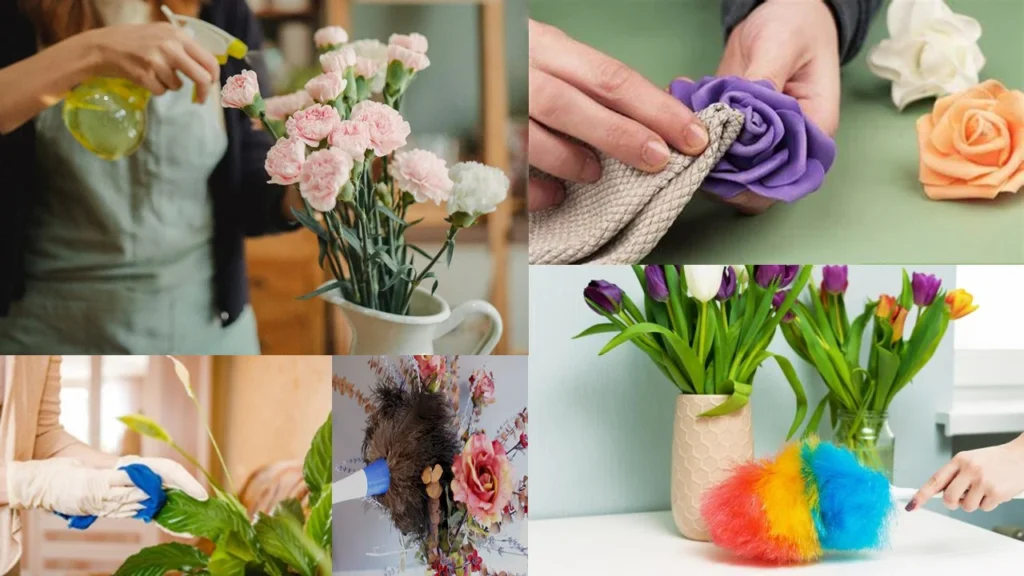
Use this decision tree when training new hires on how to wash artificial flowers.
Dive deeper
U confirm materials before U decide how to wash artificial flowers.
Most petals are polyester.
Many leaves are polyethylene (PE) or
polyurethane (PU).
Latex-touch petals have a thin coating that hates soaking.
Bouquets also hide hot-melt glue and printed veins.
Unknown material? Dust only, then ask your supplier. Keep a QR to
Botanic Blossoms Care
on racks so staff check specs fast.
Material IDs decide how to wash artificial flowers without risking prints or coatings.
- If U can blow dust off and see no film, dust only.
- If U see fingerprints, makeup, food, or tacky film, wash.
- If U see flaking print, cracked latex, or loose glue, stop and tag for repair.
Dust flow: hold stems upside down; wipe once, one direction, with clean microfiber (no scrubbing); give a short cool-air burst from 20–30 cm to clear seams.
Deep-wash flow: remove picks and tags; tape wire ends; mix 1–2 ml neutral detergent per liter of 25–30°C water; swish 30–60 s (no twisting); rinse cool; blot; shade-dry with airflow.
Service story — beach rental reset: a planner returned two arches with salt film. Crew followed my decision tree: dust first, then a 30-second front-petal swish. Ivory tone held and the set re-shipped the same day—no repaint, no rush fee.
Water Temp, Detergent, and Color-Lock Rules for How to Wash Artificial Flowers?
Heat speeds bleed. Harsh cleaners strip coating. Set limits that any warehouse can follow with a $5 thermometer.
Safe limits: use 25–30°C water and 0.1–0.2% neutral detergent. Avoid bleach, ammonia, acetone, and citrus degreasers. Rinse cool.
Never soak latex-touch petals. Do a quick white-towel test on a hidden petal.
Need a refresher on chemistry? pH basics.
For conservation-minded handling, see
AIC: Caring for Your Belongings.
Temperature and dose are the core of how to wash artificial flowers safely at scale.
Dive deeper
- Temperature: 25–30°C lifts soil and protects glue on polyester; room-temp is safer for PE/PU; above 40°C edges curl; below 15°C coatings stiffen and trap grit.
- Detergent: dose 1–2 ml per liter; U want slip, not foam; skip bleach/oxygen boosters; keep alcohol away from prints and latex.
- Color-lock myths: salt and vinegar do not “fix” disperse dyes and may corrode wire ends; time, temp, and neutral soap are the real guards.
These controls simplify how to wash artificial flowers during busy seasons.
Service story — multi-store reset: a retailer used scented cleaner in hot water; pink peonies dulled. After switching to 0.15% neutral soap at 27°C with a 45-second cap, shade stability returned and rewashes fell 22%. The fix was measurement, not exotic chemistry.
Drying Choices for How to Wash Artificial Flowers: Air, Towel, or Low-Heat?
Wet petals seem fine, then crease or yellow when drying goes hot or uneven. Move water out fast but keep it cool.
Best practice: blot with a lint-free towel; air-dry in shade with airflow; use a fan on cool only; avoid sun and heat guns; reshape while damp.
Why sun bites: ultraviolet basics.
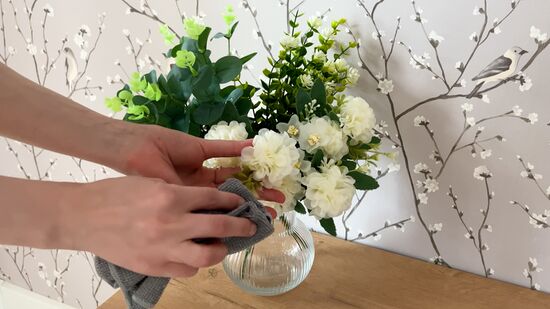
Shade and airflow define how to wash artificial flowers without dents or yellowing.
Dive deeper
Start with blotting. Press, do not rub. Support the petal from below so edges do not fray. Build a drying zone that never changes: wire racks in full shade, a small fan across (not at) the flowers, and a one-meter gap so stems do not touch. Turn stems once after 20 minutes to release water at bases and sepals—core to how to wash artificial flowers without dents.
Ban heat and sun. Hot air warps PE and softens glue. UV makes hard fade lines. Tumble motion breaks shape memory. Reshape while damp: open cups, lift edges, set the face angle, then fan on cool. Polyester holds a crease when U set it in this stage.
Mixed bouquets need order. Dry heavy leaves first so drips do not spot light petals. Point wire ends down for 10 minutes. Keep barcode labels out of airflow so they do not curl.
Service story — hotel lobby save: housekeeping used warm blowers; edges went wavy. After a switch to blot-rack-cool-fan and damp reshaping, the next rotation stayed crisp. Guest photos improved and upsells rose that week.
Stain Lifts You Need When Learning How to Wash Artificial Flowers?
Events cause real stains. Lipstick, sunscreen, coffee, and hairspray cling to synthetics. Wrong solvent removes ink faster than soil.
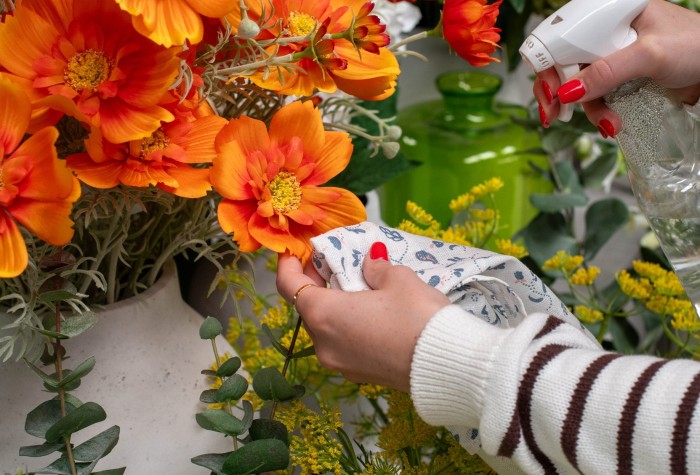
Targeted moves: for oil, use diluted dish soap; for makeup, use gentle
micellar water on polyester only; for coffee/tea/wine, use a weak color-safe booster.
Always test first and work small.
For a handy household list, see the
Good Housekeeping stain chart.
Targeted stain kits are part of how to wash artificial flowers for rentals and hotels.
Dive deeper
Oil & sunscreen: mix 2 ml neutral dish soap per liter of lukewarm water; touch the stain with a cotton swab for 30 s; blot; rinse cool; repeat once if needed—do not scrub.
Makeup & lipstick: waxes and pigments transfer fast; use micellar water on a swab for polyester petals; avoid alcohol on prints and latex coatings; if alcohol is the only option, keep it under 20%, dab once, rinse, then flag the SKU for inspection.
Coffee/tea/wine: use a color-safe booster at one-quarter strength on polyester only; dab for one minute, then rinse; do not soak printed leaves or latex-touch petals; skip vinegar tricks that dull coatings and leave odor.
Glitter/hairspray/adhesive: lift loose glitter with low-tack tape; for sticky film, try warm water with neutral soap first; if residue persists, use a tiny drop of citrus-free adhesive remover on a swab and test on a hidden back vein.
Service story — bridesmaids at a beach resort: six roses picked up pink smudges after hugs. Micellar water and a rinse recovered all six. The set stayed in rotation, the planner avoided fees, and the venue booked the same kit for the next weekend.
Anti-Static & Storage: The Final Step in How to Wash Artificial Flowers?
Clean petals attract dust if static remains. Tight packing crushes cups and kills the “new” look. Close the loop with storage.
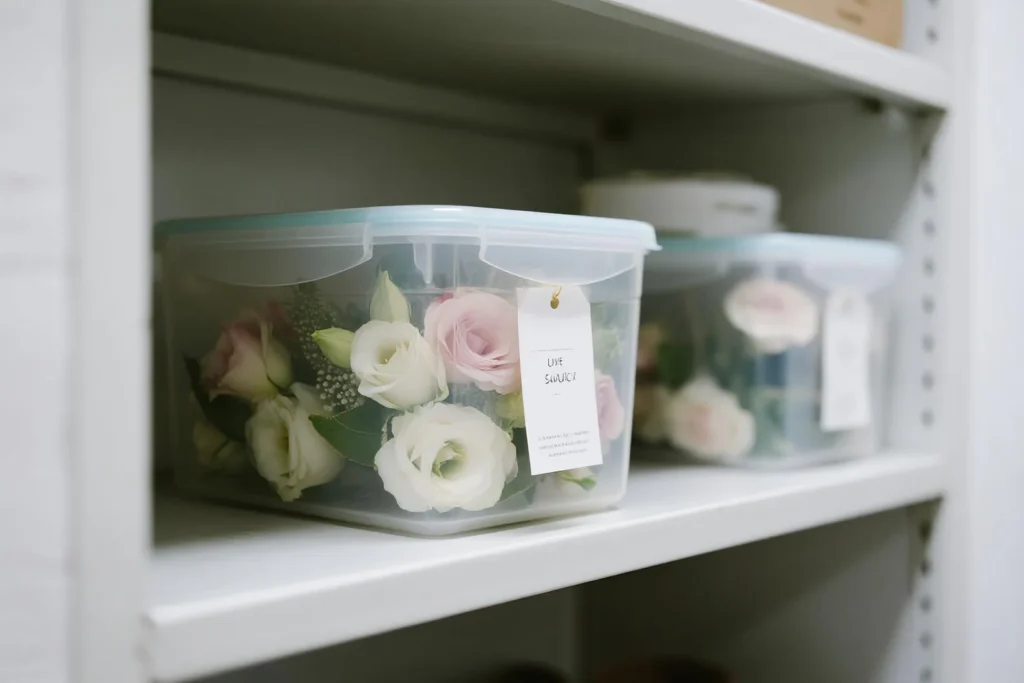
Aftercare: use a textile-safe anti-static wipe; bag sets in breathable liners with
silica gel;
store in shade at 15–25°C; add labels, photos, and a repack SOP to each box.
Basics of static elimination.
Storage discipline completes how to wash artificial flowers from sink to shelf.
Dive deeper
Beat static with one pass. Glide a wipe across each major face. Skip perfume sprays and heavy softeners; they leave residue that grabs dust.
Pack for shape, not space: boxes taller than the tallest face; tissue dividers; no compressed cups; stems straight with wire ends inward.
Control moisture and light: two silica packets per medium box, change date on flap; 40–60% RH; 15–25°C; away from windows.
Service story — event agency turnaround: peony kits looked flat after three cycles. Taller cartons, tissue dividers, and anti-static wipes on return fixed shape. Breakage dropped and refresh time fell 35% per job.
My Pro Insight for How to Wash Artificial Flowers at Scale?
Most “fade” complaints trace to hot water, strong soap, and sun during drying. U do not need new chemistry. U need boring controls and short cycles.
Program the basics: post a temperature card, mount a 15 ml pump on a 10 L bucket, and run a quick white-towel check before any wash.
Reshape while damp, then store in shade.
For cross-site rollouts and printable SOPs, see our internal guides on
Botanic Blossoms.
Simple measurement is how to wash artificial flowers across multiple stores.

Dive deeper
Measure what matters: a $5 aquarium thermometer and a fixed-dose pump remove guesswork; post the range above every sink (25–30°C; 0.1–0.2% soap; 30–60 s swish); add a QR to the SOP so staff scans, follows, and logs.
Keep a control stem per collection. Compare washed stems to it under the same light. If shade matches, the process is fine. If not, tune water, time, or dose and note the change.
Train in five-minute drills. Each new hire washes one stem, blots, racks, cool-fans, reshapes, and records time. Aim for smooth motion. Mistakes drop after two drills; speed comes later.
Maintain a simple log: date, SKU, method (dust/wash), water temp, dose, time in water, notes, initials. When a store reports “yellow whites,” the log usually shows sun drying or heavy dose. The fix is free: move the rack, reset the pump, retrain reshaping.
Service story — national chain audit: after moving racks off windows and standardizing dose and temp, white roses returned to “true white.” Returns dropped the next quarter with no product change.
Conclusion
Follow these controls and U master how to wash artificial flowers. Color holds. Shape holds. Margin holds. Simple habits beat fixes across every site.
FAQ (B2B)
- Can U wash silk-touch petals? Yes, but keep water cool and time short. Blot, not rub. Always test first. See AIC care guidance.
- What detergent is safe for bulk ops? pH-neutral dish detergent at 0.1–0.2%. Avoid bleach, ammonia, acetone, and citrus degreasers.
- How often should displays be washed? Dust weekly. Wash only when sticky film or stains appear. Over-washing shortens service life.
- Is pressure washing okay outdoors? No. Use a hose on gentle flow and shade-dry. Pressure flattens petals and opens seams.
- Do anti-static sprays change sheen? Textile-safe sprays do not when used lightly. Always test on a hidden area.
- Is alcohol safe for lipstick? Only low-strength on polyester and never on prints or latex-touch. Try micellar water first.
- How do U protect labels and barcodes? Bag tags before washing or remove and re-tag after drying. Keep labels above the water line.
- Will sun speed safe drying? No. UV causes uneven fade and brittle edges. Use shade and airflow. Read UV basics.
- How do U train seasonal staff fast? Use a one-page SOP, a control stem, and five-minute drills. Add a fixed-dose pump and a thermometer.
- What storage cuts dust the most? Breathable liners, an anti-static wipe before packing, sealed cartons, and silica gel. Store away from windows.
Notes
- Understanding pH-neutral detergents for safe cleaning without damaging materials:
Warsaw Chemical. - Conservation-minded handling and storage principles for consumer items:
AIC — Caring for Your Belongings. - Micellar water basics and use cases for gentle cleansing:
Cleveland Clinic.