
Buying imitation wedding flowers in bulk can reduce shortages, yet careless ordering often leaves unopened boxes, unusable colors, damaged blooms, and hundreds of unmatched stems.
To cut waste with bulk artificial flowers and wedding kits, finalize quantities, prototype every arrangement, standardize recipes, combine curated kits with targeted bulk stems, preserve full stem lengths, use reusable mechanics, transfer ceremony flowers to the reception, protect inventory during transport, and create a clear plan for every leftover component.
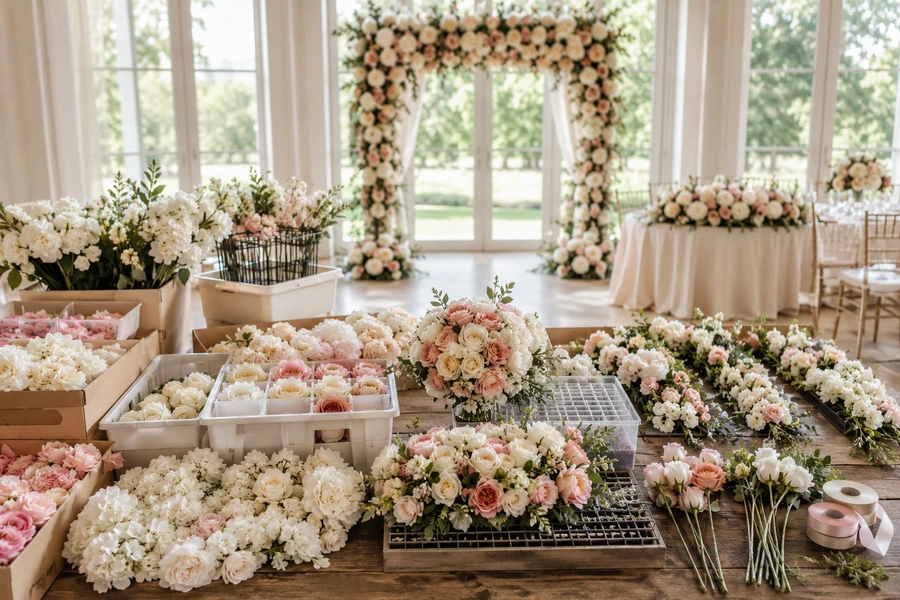
In this guide, “proven” refers to repeatable procurement and design controls supported by the waste hierarchy. It does not mean imitation flowers are automatically more sustainable than fresh flowers in every situation.
Can Imitation Wedding Flowers Actually Reduce Waste?
Artificial flowers do not wilt after one event, but reusability alone does not guarantee low waste. Overordering, excessive cutting, permanent gluing, poor storage, and mixed-material disposal can eliminate much of their reuse value.
Imitation flowers can reduce wedding waste when they replace multiple single-use purchases, remain adaptable, and have a confirmed second use. The most effective strategy follows the waste hierarchy: prevent unnecessary purchasing first, reuse complete products and components second, and consider recycling only after practical reuse options have been exhausted.
The U.S. Environmental Protection Agency places source reduction and reuse above recycling in its non-hazardous materials and waste-management hierarchy. WRAP similarly treats reuse as a method for keeping products and materials higher in the resource hierarchy and has developed life-cycle tools for evaluating reuse systems.
This principle changes the question from:
How many artificial flowers can I buy cheaply?
to:
What is the smallest adaptable flower system that can complete every required arrangement and remain useful afterward?
Faux Does Not Automatically Mean Sustainable
An artificial bouquet used once and discarded may create more avoidable material than a carefully planned alternative.
Its total impact depends on factors such as:
- Materials
- Manufacturing
- Packaging
- Shipping distance
- Damage rate
- Number of uses
- Storage
- Repairs
- End-of-life options
I therefore do not describe imitation wedding flowers as universally greener. Their strongest waste advantage is durability, but that advantage exists only when the flowers are reused, resold, rented, donated, repurposed, or stored correctly.
Should You Buy Bulk Artificial Flowers or Wedding Kits?
Bulk boxes offer flexibility and lower per-stem pricing in some orders. Kits offer coordinated colors, predefined quantities, and less design uncertainty. Neither format is always better.
Use wedding flower kits for repeated items that need consistent colors and proportions, such as bridesmaid bouquets or centerpieces. Use bulk stems for focal flowers, greenery, large installations, and components needed across several designs. A hybrid purchase usually controls waste better than buying everything through one format.
Current wedding-flower suppliers sell both curated DIY boxes and bulk artificial bundles. Some kits provide preselected flowers and greenery for sets of bridesmaid bouquets, while larger designer boxes specify the approximate wedding items that can be produced from a defined number of boxes.
Bulk Versus Kits
| Buying Format | Main Advantage | Main Waste Risk | Best Use |
|---|---|---|---|
| Complete bouquet kit | Predictable finished item | Unwanted accessories or fixed recipe | Bridesmaids and attendants |
| Coordinated flower box | Color and texture compatibility | Too many minor flower types | DIY bouquets and centerpieces |
| Bulk flower bundle | Flexible allocation | Overordering one variety | Focal flowers and fillers |
| Bulk greenery | Works across many designs | Excess volume and repetition | Arches, tables, bouquets |
| Premade arrangement | Less assembly damage | Harder to modify or reuse | Small weddings and fast setup |
| Loose individual stems | Precise purchasing | Higher counting and labor burden | Feature flowers and replacements |
The safest buying plan usually uses:
- Kits for predictable repeated products
- Bulk bundles for high-volume shared components
- Individual stems for focal details
- Premade pieces only where labor or installation risk is high
What Are the 15 Proven Rules for Cutting Waste?
The following rules address waste before purchasing, during construction, at the wedding, and after the event.
The 15 rules are to define the floral scope, prototype first, create stem recipes, standardize the palette, match kits to repeated items, reserve bulk for shared components, calculate from finished prototypes, build transferable modules, preserve stem length, use reusable mechanics, label every allocation, prevent transport damage, centralize spares, plan second uses, and complete a post-event material audit.
Rule 1: Freeze the Floral Scope Before Buying
The largest source of avoidable waste is not damaged flowers. It is purchasing for arrangements that were never clearly defined.
Before ordering, list every floral item by location and quantity.
Wedding Floral Scope Sheet
| Item | Quantity | Final Size | Viewing Distance | Second Use |
|---|---|---|---|---|
| Bridal bouquet | 1 | 11 inches | Close | Home display |
| Bridesmaid bouquet | 4 | 7 inches | Close | Guest gifts |
| Boutonniere | 6 | Small | Close | Keepsakes |
| Ceremony aisle marker | 8 | Medium | Medium | Reception chairs |
| Arch module | 3 | Large | Long | Sweetheart-table backdrop |
| Centerpiece | 12 | Low | Close | Resale or rental |
| Welcome-sign flowers | 1 module | Medium | Medium | Bar display |
| Cake flowers | 1 set | Small | Very close | Discard if food-contaminated |
Do not order from a visual inspiration board alone.
A mood board may show forty different flower types across several photographs. That does not mean the final wedding needs all forty.
Freeze:
- Number of locations
- Number of arrangements
- Approximate dimensions
- Color palette
- Installation method
- Reuse destination
When the scope changes, update the quantities before adding products to the order.
Rule 2: Build One Complete Prototype Before the Bulk Order
Catalog photographs do not reveal how many stems a real vase, bouquet, or arch section will require.
Order a small sample box and build one finished version of each repeated arrangement. Record its stem count, weight, construction time, dimensions, and leftovers. Use that physical prototype—not an online photograph—to calculate the main order.
Current suppliers offer sample-scale coordinated flower boxes and small bouquet kits intended for one test arrangement or a limited number of wedding pieces. These products allow buyers to review color, texture, scale, and compatibility before committing to larger quantities.
Prototype Test
Record:
- Finished width
- Finished height
- Number of focal flowers
- Number of supporting flowers
- Number of fillers
- Number of greenery branches
- Length removed from each stem
- Number of rejected flowers
- Assembly time
- Required tools
- Packaging dimensions
Photograph the prototype from the front, side, top, and normal viewing distance.
Then leave it assembled for several days. Check whether:
- Stems rotate
- Heavy blooms fall
- Foam loosens
- Ties become visible
- Petals recover after packing
- Colors still match under venue lighting
A prototype that uses too many stems should be simplified before multiplication.
Removing two unnecessary stems from one sample seems minor. Removing two stems from fifty centerpieces prevents one hundred stems from being purchased, unpacked, arranged, stored, and eventually managed.
Rule 3: Create a Stem Recipe for Every Arrangement
A stem recipe is a bill of materials for floral design.
Specify the exact number of focal blooms, supporting flowers, fillers, greenery pieces, ties, and mechanics for every bouquet or centerpiece. Recipes stop individual makers from adding extra stems simply because one arrangement appears slightly less full than another.
Example Bridesmaid-Bouquet Recipe
| Component | Quantity |
|---|---|
| Medium rose | 3 |
| Ranunculus | 2 |
| Small dahlia | 1 |
| Filler spray | 2 |
| Eucalyptus branch | 2 |
| Olive greenery | 1 |
| Floral wire | As required |
| Stem wrap | One measured length |
| Ribbon | One precut length |
Supplier guidance for some current DIY wedding collections suggests approximately 10–15 flower stems and 4–6 greenery branches for a bridesmaid bouquet, while centerpiece guidance may suggest 8–12 flower stems plus greenery. These are commercial starting points, not universal formulas; the physical prototype should determine the final recipe.
Add a Tolerance
A recipe can permit controlled variation.
For example:
- Three focal roses, plus or minus one
- Two greenery branches
- Maximum finished width of eight inches
- No more than one replacement stem
This preserves a natural appearance without allowing uncontrolled overfilling.
Rule 4: Standardize the Color Palette
Waste increases when the order contains several nearly identical whites, greens, blushes, and burgundies that do not work together.
Choose one approved shade for each major role: primary flower, secondary flower, light neutral, dark accent, and greenery. Order samples under the venue’s expected lighting and keep a retained reference stem for every approved color.
Artificial flower colors may appear different under:
- Daylight
- Warm indoor lamps
- Cool LED lighting
- Camera flash
- Colored event lighting
- Dark venue walls
- Outdoor shade
I normally limit a wedding system to:
- One dominant color family
- One supporting color
- One neutral
- One optional accent
- Two compatible greens
This does not make the design boring. Texture, size, shape, and height can create variation without introducing another color box.
Avoid “Emergency Matching” Orders
Last-minute matching often creates:
- Duplicate products
- Extra shipping
- Unused minimum quantities
- Colors that still do not match
- Packaging waste
- Unnecessary express freight
Approve the palette before ordering large quantities.
Rule 5: Use Kits for Repeated, Predictable Items
Kits reduce decision-making when the wedding needs several matching bouquets, corsages, or centerpieces.
Use kits when the required finished pieces closely match the kit’s intended output. Confirm the included flowers, greenery, size, and quantities before ordering. A kit saves waste only when most of its contents are used without extensive substitutions.
Current DIY bridesmaid-bouquet kits may include preselected flower combinations and greenery for sets of four coordinated bouquets. Other designer boxes list expected outputs such as one bridal bouquet, several bridesmaid bouquets, boutonnieres, or corsages.
A Kit Is a Good Choice When:
- Four bridesmaids need matching bouquets
- The palette has already been approved
- The desired bouquet size matches the kit
- The maker has limited design experience
- The included greenery will be used
- Few substitutions are required
A Kit Creates Waste When:
- Half the flower types are unwanted
- The bouquet needs a very different size
- The kit includes accessories already owned
- Several boxes are purchased only to obtain one component
- Every finished item must be heavily redesigned
Calculate the kit-utilization rate:
Useful components ÷ total supplied components × 100
A lower-priced kit is not efficient when a large portion remains unused.
Rule 6: Buy Bulk Only for Components Shared Across Designs
Bulk purchasing works best when one flower or greenery type appears throughout the wedding.
Buy focal roses, hydrangeas, eucalyptus, fern, berries, or filler flowers in bulk only when the same component serves several planned arrangements. Avoid bulk quantities of unique accent flowers used in just one small location.
Current artificial-flower sellers offer bundles that can be displayed as complete centerpieces or separated into individual wedding-bouquet stems. Bulk flower boxes are also sold for bouquets, centerpieces, event décor, and craft projects.
Strong Bulk Components
- Greenery used in bouquets, arches, and centerpieces
- Neutral focal flowers used across the complete wedding
- Fillers that work at several scales
- Hydrangea used for large-volume mechanics
- Replacement leaves or floral heads
- Structural vines used in multiple installations
Weak Bulk Components
- One unusual tropical stem
- Highly specific colored flowers
- Oversized blooms needed only for one sign
- Preassembled clusters that cannot be separated
- Fragile products with no replacement use
A bulk product should have at least two confirmed wedding uses and one post-event destination.
Rule 7: Calculate the Main Order From Prototypes, Not Estimates
Once the prototype is approved, multiply its recipe by the exact number of arrangements.
Stem-Count Formula
Required stems = prototype quantity × number of arrangements
Then add a controlled reserve for:
- Manufacturing defects
- Transport damage
- Last-minute guest-count changes
- Repairs
- Photography styling
- Installation access problems
The reserve should be one central pool. Do not add extra stems to every bouquet and centerpiece.
Example Calculation
A wedding requires:
- 1 bridal bouquet
- 4 bridesmaid bouquets
- 12 centerpieces
- 8 aisle markers
- 3 arch modules
After prototyping, the approved recipes require:
| Flower | Calculated Need | Central Reserve | Final Order |
|---|---|---|---|
| Garden roses | 92 | 8 | 100 |
| Ranunculus | 48 | 4 | 52 |
| Hydrangea heads | 30 | 3 | 33 |
| Filler sprays | 54 | 6 | 60 |
| Eucalyptus | 76 | 8 | 84 |
| Olive greenery | 32 | 4 | 36 |
This reserve is an operational choice, not a universal recommended percentage. High-damage, custom-colored, or difficult-to-replace stems may justify a larger reserve than standard greenery.
Rule 8: Design Ceremony Flowers as Transferable Modules
Ceremony décor may be visible for less than an hour. Designing a separate reception set creates avoidable duplication.
Build ceremony flowers in removable modules that can move to the sweetheart table, bar, stage, welcome area, or photo backdrop. Plan the transfer locations, dimensions, staff responsibility, transport route, and setup window before the wedding day.
EPA waste-prevention guidance prioritizes reuse and specifically encourages saving and reusing party decorations. Its 2026 special-event guide also identifies the donation and reuse of floral arrangements and decorations as event-waste practices.
Transfer Opportunities
| Ceremony Piece | Reception Reuse |
|---|---|
| Arch flower module | Sweetheart-table backdrop |
| Aisle marker | Chair-back decoration |
| Welcome-sign flowers | Bar or gift-table flowers |
| Ground meadow | Stage or dance-floor edge |
| Pedestal arrangement | Buffet or lounge feature |
| Ceremony urn | Reception entrance |
| Pew-end flowers | Window or staircase décor |
Design for Fast Transfer
Use:
- Removable clips
- Hidden hooks
- Reusable ties
- Numbered bases
- Transport trays
- Lightweight modular frames
- Clear placement photographs
Do not permanently glue a flower module to a ceremony structure if it needs to move thirty minutes later.
Rule 9: Preserve Full Stem Lengths Whenever Possible
Cutting artificial stems creates permanent specialization. A short centerpiece stem may no longer work in a tall vase, bouquet, arch, or resale bundle.
Bend long stems inside opaque containers before cutting them. Use sleeves, grids, or deeper mechanics to absorb excess length. Cut only when the full stem prevents safe assembly or creates visible distortion.
Use These Alternatives to Cutting
- Bend the lower stem into a broad curve
- Fold wire below the vase opening
- Use a deeper inner vessel
- Insert the stem through a lower grid
- Use removable stem sleeves
- Bundle stems at different levels
- Add a false bottom to a tall container
When cutting is necessary:
- Confirm the final recipe.
- Mark the required length.
- Cut with proper wire cutters.
- Retain usable offcuts.
- Label short stems separately.
- Seal exposed wire where necessary.
Preserved length improves the flowers’ resale, rental, and repurposing potential.
Rule 10: Use Reusable Mechanics Instead of Permanent Adhesive
Floral mechanics determine whether an arrangement can be dismantled without destroying its components.
Use chicken wire, floral frogs, grids, clamps, stem sleeves, reusable foam inserts, cable ties, pins, and removable tapes where appropriate. Limit hot glue and permanent adhesive to components that have no realistic second configuration.
Reusable mechanics allow flowers to become:
- Bouquets
- Centerpieces
- Arch modules
- Wreaths
- Home arrangements
- Rental inventory
Permanent adhesive can bond together:
- Fabric
- plastic
- wire
- foam
- wood
- metal
- tape
This makes separation, cleaning, repair, and local recycling more difficult.
Mechanics Comparison
| Mechanic | Reusable? | Best Use | Waste Risk |
|---|---|---|---|
| Chicken wire | Yes | Large arrangements | Sharp edges if unmanaged |
| Floral frog | Yes | Bowls and low centerpieces | Limited stem capacity |
| Perforated grid | Yes | Repeated arrangements | Requires size planning |
| Stem sleeve | Yes | Modular arches and pots | Needs secure base |
| Cable tie | Partly | Structural attachment | Cut ties become waste |
| Dry foam | Limited | Individual stems | Crumbles after repeated use |
| Hot glue | Usually no | Small permanent details | Prevents separation |
| Adhesive foam | Limited | Lightweight accessories | Mixed-material disposal |
Rule 11: Pre-Pack Every Arrangement as a Labeled Kit
Bulk boxes save money only until stems become mixed, misplaced, or allocated incorrectly.
After receiving the main order, divide the flowers into labeled arrangement kits. Each bag, tray, or box should contain the approved recipe for one bouquet, centerpiece, or installation module, plus its photograph and construction instructions.
Kit Label Example
Item: Centerpiece C07
Recipe: 3 roses, 2 ranunculus, 1 hydrangea, 2 fillers, 4 greenery branches
Vessel: Low ceramic bowl
Finished width: 16 inches
Table: 7
Reuse destination: Guest gift
Status: Ready for assembly
This system prevents the first makers from using the best or fullest stems and leaving weak leftovers for the final arrangements.
It also makes discrepancies visible early. When the team cannot complete twelve identical kits, the shortage is found before the wedding morning.
Rule 12: Prevent Crushing and Transport Damage
Waste is not limited to unused stems. Damaged flowers may become unusable before they reach the venue.
Transport bouquets upright, support large flower heads, separate rigid branches from soft petals, and place arch modules in fitted crates. The container—not the flowers—should carry stacking weight. Label every box by orientation, destination, and unpacking sequence.
Packing Rules
- Clean flowers before packing
- Dry every component completely
- Support heavy bloom heads
- Use shallow rigid boxes
- Keep pale flowers away from dark dyes
- Avoid pressing lids against petals
- Secure arrangements to trays
- Store loose repair stems separately
- Do not stack weight on bouquets
- Photograph each box before closing
Create a load order that matches the setup schedule.
The first flowers needed at the venue should not be underneath twenty centerpiece boxes.
Preventing one damaged arch module may eliminate the need for an entire duplicate arrangement.
Rule 13: Create One Central Spare-Stem Bank
Adding several backups to every arrangement creates hidden overordering.
Keep one labeled reserve box containing approved replacement focal flowers, fillers, greenery, ties, ribbon, and repair tools. Release these components only when a stem is damaged, missing, or required by an approved design change.
Spare Bank Contents
- Focal flowers
- Greenery
- Small fillers
- Leaves
- Flower heads
- Floral wire
- Outdoor or structural ties
- Ribbon
- Stem wrap
- Glue for emergency repairs
- Wire cutters
- Repair instructions
Record every item removed from the bank.
At the end of setup, the unopened reserve becomes a clean, sorted asset rather than a mixture of extra stems hidden inside oversized arrangements.
Rule 14: Assign a Second Use Before the Wedding
“Reusable” is only a possibility until someone is responsible for the next use.
Assign every bouquet, centerpiece, arch module, and leftover box to a named post-wedding route: keep, gift, rent, resell, donate, return, repurpose, or store. Confirm recipient requirements and transportation before the event.
EPA guidance places reuse above recycling and has advised borrowing, renting, or sharing infrequently used products such as party decorations. EPA event guidance also suggests donating floral arrangements and decorations to suitable community organizations.
Post-Wedding Routes
| Item | Possible Second Use |
|---|---|
| Bridal bouquet | Home keepsake |
| Bridesmaid bouquets | Attendant gifts |
| Centerpieces | Guest gifts or resale |
| Arch modules | Rental inventory |
| Loose bulk stems | Home arrangements or resale |
| Greenery | Holiday or event décor |
| Vases | Rental, donation, or home use |
| Unopened kits | Return where permitted |
| Damaged stems | Repair parts or craft use |
Contact donation recipients before the wedding. A hospital, shelter, school, or care facility may have material, hygiene, delivery, or storage restrictions.
Do not arrive with dozens of arrangements and assume they will be accepted.
Rule 15: Complete a Post-Event Material Audit
The final rule turns one wedding’s leftovers into better purchasing data for the next event.
Count unused, damaged, reusable, donated, sold, and discarded components. Record why each item remained. Update future recipes, reserve quantities, supplier ratings, packaging standards, and storage procedures from the results.
Waste-Audit Categories
| Category | Examples |
|---|---|
| Unopened stock | Sealed flower boxes and unused kits |
| Clean reusable stock | Undamaged stems and greenery |
| Finished reusable items | Bouquets and centerpiece modules |
| Repairable stock | Loose petals, bent stems, damaged ties |
| Packaging | Cardboard, films, paper, foam |
| Non-reusable mixed material | Glued or contaminated pieces |
| Donated or gifted | Complete arrangements |
| Sold or rented | Recoverable inventory |
| Discarded | Material with no safe second use |
EPA advises checking local recycling requirements before placing materials into collection bins because non-accepted items can contaminate recyclable loads. Artificial flowers frequently combine fabric, plastic, wire, foam, and adhesive, so complete stems should not be assumed to belong in curbside recycling.
Separate clean cardboard, eligible film, metal frames, and other materials only where the local program accepts them.
Recycling is not a justification for overbuying. Prevention and reuse remain higher priorities in the waste hierarchy.
How Many Imitation Flowers Do You Need for a Wedding?
No universal stem count works for every wedding. Flower size, arrangement style, viewing distance, venue scale, and desired density can change the requirement significantly.
Calculate quantities from one approved prototype of each item. Multiply the tested recipe by the number required, then add one controlled reserve. Do not estimate quantities from inspirational photographs because photographs rarely show the rear construction, stem depth, or complete arrangement dimensions.
Planning Benchmarks
Some current DIY suppliers use ranges such as:
- 10–15 flower stems for a bridesmaid bouquet
- 4–6 greenery branches for a bridesmaid bouquet
- 8–12 flower stems for a centerpiece
- Several additional greenery pieces per centerpiece
These figures illustrate how kit sellers estimate outputs, but they should be treated as planning references rather than fixed floral rules.
Factors That Reduce Stem Counts
- Large hydrangea heads
- Open garden roses
- Wide peonies
- Greenery with several branches
- Low compact arrangements
- Visible negative space
- Small wedding tables
- Long viewing distance
Factors That Increase Stem Counts
- Small flower heads
- Dense round bouquets
- Large vessels
- Fully covered arches
- Double-sided displays
- Close viewing
- Weak or narrow greenery
- Large reception tables
Ask whether each arrangement needs to be attractive from one side or all sides. A welcome-sign module against a wall does not require the same rear coverage as a centerpiece in the middle of a round table.
What Is the Best Bulk-and-Kit Buying Strategy?
The strongest plan uses each buying format where it produces the least unused material.
Use complete kits for standardized attendant flowers, curated boxes for DIY centerpiece recipes, bulk bundles for shared focal flowers and greenery, and individual stems for rare accents. Prototype first, then compare the exact useful-stem cost rather than the advertised price per box.
Useful-Stem Cost
A bulk box costs $120 and contains 100 components.
If only 70 components fit the wedding design:
Useful-stem cost = $120 ÷ 70 = $1.71
The advertised cost per component is $1.20, but the practical cost of each usable component is higher.
Include:
- Unwanted colors
- Unusable flower sizes
- Damaged stems
- Duplicate accessories
- Excess greenery
- Minimum-order quantities
- Shipping
- Replacement orders
Bulk pricing creates savings only when the components are actually used or retained for a confirmed second purpose.
My Insights: Imitation Wedding Flowers—Which 15 Proven Rules Cut Waste with Bulk & Kits
The greatest waste reduction happens before the flowers arrive. Once unwanted materials have been manufactured, packed, shipped, and unpacked, even responsible disposal cannot reverse the unnecessary purchase.
The 15 strongest rules combine precise scope, physical prototyping, recipe control, coordinated palettes, selective kits, targeted bulk purchasing, modular design, preserved stem lengths, reusable mechanics, protected transport, centralized spares, confirmed second uses, and post-event measurement. Together, they turn imitation flowers into reusable inventory rather than one-day décor.
My central insight is that the best bulk order is usually smaller and more standardized than the first estimate.
The 15-Rule Summary
| Rule | Waste-Control Result |
|---|---|
| 1. Freeze the scope | Stops purchasing for undefined décor |
| 2. Build prototypes | Replaces guesses with tested quantities |
| 3. Create recipes | Prevents overfilling |
| 4. Standardize colors | Reduces mismatched leftovers |
| 5. Use kits selectively | Controls repeated items |
| 6. Reserve bulk for shared stems | Improves component utilization |
| 7. Calculate from prototypes | Creates accurate order quantities |
| 8. Transfer ceremony modules | Eliminates duplicate décor |
| 9. Preserve stem length | Protects future reuse |
| 10. Use reusable mechanics | Enables disassembly |
| 11. Label arrangement kits | Prevents allocation errors |
| 12. Protect during transport | Reduces damage waste |
| 13. Centralize spares | Limits hidden overordering |
| 14. Assign second uses | Turns reuse into an actual plan |
| 15. Audit after the event | Improves the next purchase |
Kits Control Variation
Kits are strongest for repeated close-view products such as bridesmaid bouquets.
The colors and flower proportions are already coordinated, and the maker does not need to buy full bulk packs of every small filler.
However, kits should not be purchased blindly. Review the component list and calculate how much will actually be used.
Bulk Controls Shared Volume
Bulk purchasing is strongest when one flower appears in many locations.
For example, a neutral rose can support:
- Bridal bouquets
- Bridesmaid bouquets
- Centerpieces
- Arch modules
- Welcome-sign flowers
- Spare inventory
One unusual blue anemone needed only for the cake table does not deserve the same bulk quantity.
Modules Create the Largest Event-Day Reuse
Ceremony-to-reception transfer can replace an entire second set of decorations.
A flower module built for the ceremony arch can move behind the sweetheart table. Aisle markers can become chair flowers. Pedestal arrangements can frame the reception entrance.
The transfer must be designed, staffed, timed, and photographed. Otherwise, the flowers may remain at the ceremony site because no one knows where they belong.
Reusable Mechanics Protect Material Value
A stem that can be removed from a grid remains a usable product.
A stem permanently glued into a mixed foam, plastic, wood, and wire structure becomes much harder to clean, redesign, sell, or separate.
Design the connection before designing the flower placement.
A Smaller Reserve Is Better Than Larger Arrangements
A reserve exists to solve real defects or shortages.
It should not be distributed across every arrangement merely because the flowers are available. Overfilling increases visual density, labor, storage volume, and later disassembly.
Keep the spares clean, labeled, and unused until needed.
The Best Final Buying Sequence
I use this order:
- Confirm the venue and floral locations.
- Define the finished arrangements.
- Select one controlled palette.
- Order samples.
- Build and photograph prototypes.
- Write stem recipes.
- Identify repeated items suitable for kits.
- Identify shared components suitable for bulk purchasing.
- Calculate quantities.
- Add one controlled reserve.
- Allocate stems into labeled arrangement kits.
- Design transfer and second-use plans.
- Audit everything after the event.
This sequence follows the central logic of the waste hierarchy: prevent excess first, maximize reuse second, and sort remaining materials responsibly at the end.
Conclusion
Prototype first, standardize every recipe, combine kits with targeted bulk stems, reuse ceremony modules, preserve stem lengths, centralize spares, and assign every leftover flower a second purpose.