
Wedding flowers used to feel like a choice between beauty and stress. Couples wanted lush designs, but they also feared wilting blooms, high costs, and last-minute floral problems.
The 2025 faux wedding flower trend is about realism, flexibility, and smarter event design. High-quality artificial wedding flowers now support bold colors, sculptural arches, reusable centerpieces, destination weddings, allergy-friendly décor, and early setup without losing the soft, romantic feeling couples expect from wedding flowers.
This report is not about replacing every fresh flower. It is about knowing where faux wedding flowers work best. In 2025, artificial flowers are becoming part of modern wedding planning because they help couples and planners control color, timing, cost, scale, and reuse. The strongest designs still need care, texture, proportion, and a clear floral story.
Why Are Faux Wedding Flowers Trending in 2025?
Faux wedding flowers are trending because couples want more control. They want floral designs that look beautiful all day and do not depend on weather, season, shipping, or a tight setup window.
Faux wedding flowers are trending in 2025 because they offer year-round availability, stable colors, early preparation, lower maintenance, and strong reuse potential. They also support bold wedding flower trends like large arches, monochromatic displays, floral clouds, and statement photo backdrops without the same risk of wilting.
This trend is also connected to wedding budget pressure. Fresh flowers can be beautiful, but large floral designs require labor, transport, timing, refrigeration, and careful installation. Faux flowers do not remove every cost, but they make the planning process easier to control. A couple can order samples, build a mockup, test the palette, and adjust the design before the wedding week.
Planning Control Matters More Now
Couples are more visual than ever. They save wedding inspiration from Pinterest, Instagram, TikTok, and real wedding galleries. They often want very specific colors, shapes, and flower types. Fresh flowers can shift in shade or availability. Faux flowers make it easier to repeat a design across bouquets, ceremony décor, and reception flowers.
Faux Flowers Fit Modern Wedding Timelines
Many weddings now include destination venues, outdoor ceremonies, multi-day celebrations, and fast room flips. Faux flowers help because they can be prepared early and moved more easily between spaces. A floral arch can become a sweetheart table backdrop. Aisle flowers can move to guest tables. Welcome sign flowers can move to the bar or cake table.
| Planning Problem | Faux Flower Solution |
|---|---|
| Hot outdoor ceremony | Flowers keep their shape longer |
| Tight setup time | Arrangements can be built early |
| Specific flower color | Artificial stems offer more consistency |
| Destination wedding | Designs can be shipped or packed ahead |
| Allergy concerns | No pollen or natural fragrance issues |
| Large installations | Volume is easier to plan and reuse |
The trend is not only about saving money. It is also about reducing risk. Wedding flowers are emotional because they appear in the most photographed moments. Couples want to know the bouquet, arch, aisle, and centerpieces will look the way they imagined. Faux wedding flowers give them more certainty.
What Faux Wedding Flower Styles Are Most Popular in 2025?
The most popular faux wedding flower styles in 2025 are bold, layered, and less traditional. Couples are moving away from flat, perfect arrangements and choosing flowers that feel more personal.
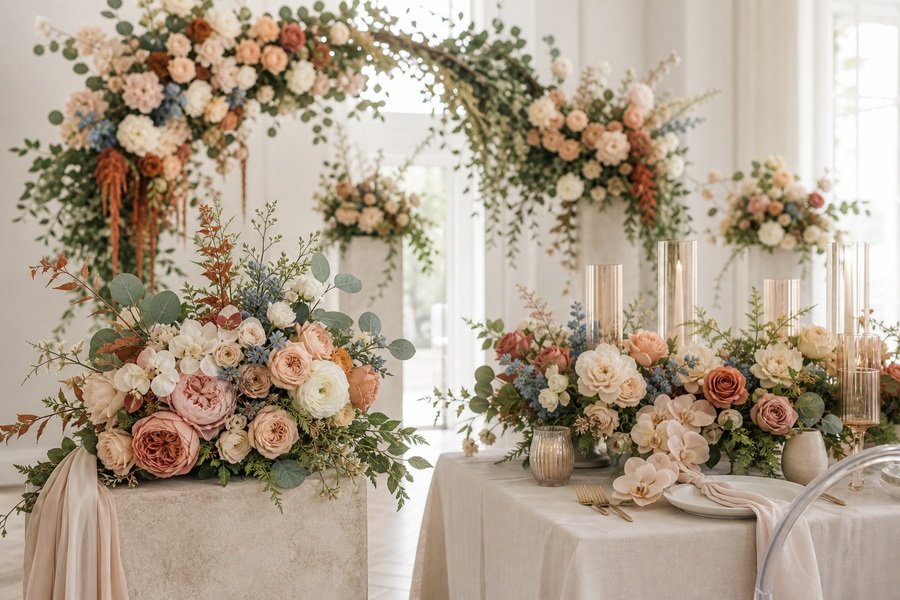
Popular faux wedding flower styles in 2025 include asymmetrical arches, monochromatic flower clouds, bold color palettes, garden-style bouquets, potted aisle flowers, floral walls, bouquet bags, and residential-style centerpieces. The trend is less about perfect symmetry and more about movement, depth, and personality.
A strong 2025 floral design should not feel stiff. It should feel like it has grown into the space. Faux flowers can support this look because wired stems can be bent, layered, and shaped. Designers can create movement in advance and keep the final design stable through the full event.
Style 1: Sculptural Ceremony Arches
Ceremony arches are becoming more artistic. Couples like asymmetrical shapes, broken arches, crescent designs, and floral frames that feel less formal. Faux flowers work well here because the structure can be built early. Large blooms can be placed for balance, and trailing greenery can soften the edges.
Style 2: Bold and Unexpected Color
Soft blush and white flowers are still common, but 2025 weddings are also using butter yellow, cherry red, coral, terracotta, cobalt blue, lavender, and electric green. Faux wedding flowers make these palettes easier because couples are not limited by seasonal supply.
Style 3: Residential-Style Centerpieces
Many reception tables now look less like formal banquet tables and more like styled dinner parties. Low floral bowls, taper candles, small lamps, fruit, fabric, and collected vessels create a warmer feeling. Faux flowers can work well in this setting when the stems look soft and the arrangement stays low enough for conversation.
| 2025 Faux Floral Style | Best Flowers to Use | Design Tip |
|---|---|---|
| Garden-style bouquet | Peonies, roses, ranunculus, sweet pea-style stems | Keep the shape loose |
| Sculptural arch | Hydrangeas, orchids, roses, greenery | Build depth in layers |
| Monochromatic display | One flower family in many tones | Mix sizes and textures |
| Potted aisle look | Faux flowering plants and greenery | Use varied pot heights |
| Floral wall | Roses, hydrangeas, orchids, filler blooms | Avoid flat panel styling |
| Bouquet bag | Calla lilies, orchids, compact roses | Keep structure clean |
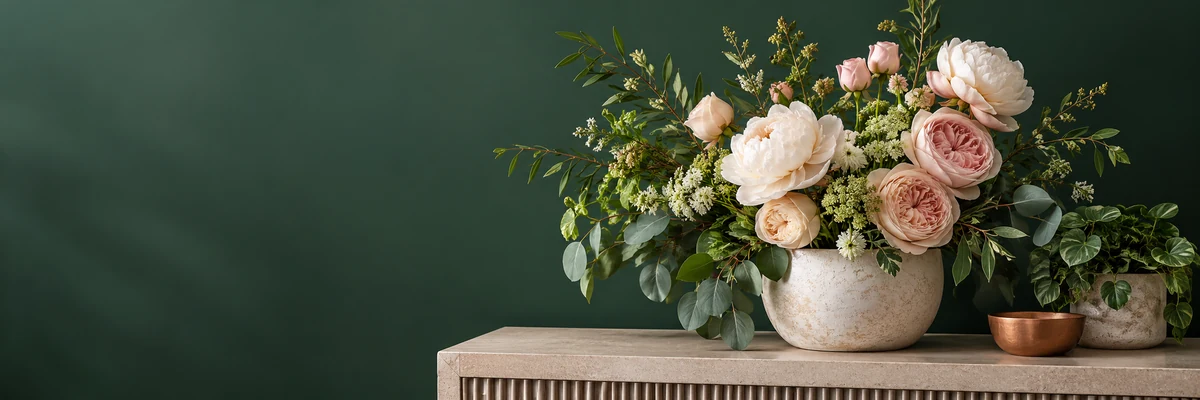
The most expensive-looking faux wedding flowers usually have restraint. A design does not need every flower type. It needs a clear palette, a good mix of bloom sizes, and enough negative space. When every inch is packed, the arrangement can look heavy. When flowers have room to breathe, the design looks more natural.
How Can Faux Wedding Flowers Look Real and Luxury?
Faux flowers look real when they copy nature. Real flowers are uneven, soft, layered, and slightly imperfect. Luxury faux design begins with those details.
To make faux wedding flowers look real and luxury, choose matte petals, real-touch texture, bendable stems, varied flower sizes, natural color shifts, and realistic greenery. Shape every stem by hand, avoid perfect symmetry, hide plastic mechanics, and photograph the flowers in soft natural light.
The first rule is quality. Cheap artificial flowers can look shiny, flat, and plastic. They may work in distant areas, but they are risky in bouquets and guest table centerpieces. Close-up areas need better stems. This includes the bridal bouquet, boutonnières, sweetheart table flowers, cake table flowers, and any arrangement guests will touch.
Use the Focal, Filler, Greenery Method
A good faux arrangement needs structure. Focal flowers create the main shape. Filler flowers soften gaps. Greenery adds movement. Detail stems make the design feel less perfect.
| Design Role | Examples | Purpose |
|---|---|---|
| Focal flowers | Roses, peonies, hydrangeas, orchids | Create visual impact |
| Filler flowers | Ranunculus, baby’s breath-style stems, small roses | Add softness |
| Greenery | Eucalyptus, ruscus, olive leaves, fern | Add movement |
| Trailing stems | Ivy, hanging amaranthus-style greenery | Add flow |
| Texture accents | Buds, berries, seed pods | Add realism |
Shape the Flowers Before Styling
Faux flowers often arrive compressed. They should be opened, fluffed, and shaped before use. I would bend stems slightly, turn some blooms outward, open petals gently, and separate leaves. A bouquet should not look like a perfect ball. A centerpiece should not look like a hard dome. An arch should not look like a flat flower board.
Hide the Mechanics
The parts that make faux flowers look fake are usually the stems, bases, repeated leaves, and plastic joints. These can be hidden with ribbon, floral tape, moss, opaque vases, deeper layering, or real greenery. For bouquets, soft silk ribbon helps cover the handle. For centerpieces, ceramic bowls and compotes hide stems better than clear glass. For arches, greenery should cover zip ties, wire, and frame edges.
Lighting also changes the final result. Harsh flash can reveal shine. Soft daylight helps petals look more natural. This is why sample testing matters. I would check faux flowers beside dresses, table linens, candles, and venue walls before ordering in bulk.
Are Faux Wedding Flowers Better Than Fresh Flowers for Weddings?
Faux flowers are better for some wedding uses, but fresh flowers are better for others. The smartest 2025 floral plans often use both.
Faux wedding flowers are better for early setup, large installations, outdoor heat, allergy-sensitive guests, destination weddings, and reusable décor. Fresh flowers are better when natural scent, delicate texture, and personal tradition matter most. A hybrid fresh-and-faux floral plan often gives the best balance.
This choice should not be emotional only. It should be practical. A summer outdoor ceremony may need flowers that can survive heat. A destination wedding may need décor that can travel. A large hanging floral installation may need lightweight, stable materials. Faux flowers are strong in these areas.
Fresh flowers still have a special feeling. A fresh garden rose, lily of the valley, or sweet pea has scent, softness, and movement that artificial flowers cannot fully copy. Some couples want that feeling in the bridal bouquet. That is a good reason to use fresh flowers where they matter most.
Where Faux Flowers Work Best
Faux flowers are excellent for ceremony arches, aisle markers, floral walls, hanging installations, welcome signs, seating charts, bar décor, and cake table accents. These areas need visual impact and structure. Guests usually see them as part of the whole scene, not as single stems.
Where Fresh Flowers May Still Be Best
Fresh flowers may be better for bridal bouquets, family corsages, small bud vases, and intimate dinner tables where guests sit very close. These areas involve touch, scent, and detail. If the budget allows, fresh flowers can add emotion to the personal parts of the day.
| Wedding Area | Best Choice | Why |
|---|---|---|
| Bridal bouquet | Fresh or premium faux | It is photographed closely |
| Bridesmaid bouquets | Faux or hybrid | Repetition is easier |
| Ceremony arch | Faux or hybrid | Needs structure and volume |
| Aisle markers | Faux | Easy to move after ceremony |
| Guest tables | Hybrid | Close-up realism matters |
| Hanging flowers | Faux | Lower maintenance and lighter setup |
| Cake table | Faux or fresh | Must be clean and food-safe |
| Photo backdrop | Faux | Needs long-lasting impact |
The best choice depends on priorities. If scent and tradition matter most, fresh flowers deserve space in the plan. If cost control, timing, durability, and reuse matter most, faux flowers can carry much of the design. A thoughtful mix often looks more natural than an all-or-nothing approach.
How Should Couples Budget for Faux Wedding Flowers in 2025?
Faux wedding flowers can save money in some cases, but premium artificial flowers are not always cheap. The real value comes from control, reuse, and fewer last-minute risks.
Couples should budget for faux wedding flowers by separating close-up pieces from large-impact pieces. Spend more on bridal bouquets, sweetheart table flowers, and guest-facing centerpieces. Use mid-range faux flowers for arches, aisle décor, signage, backdrops, and reception accents that need volume more than close inspection.
A faux flower budget should include more than stems. Couples also need vases, stands, wire, floral tape, zip ties, ribbon, storage boxes, shipping, and setup labor. These items are easy to forget. They can make the difference between a polished design and a stressful one.
Budget by Visibility
The closer the flowers are to people, the better they need to be. A bridal bouquet needs premium real-touch stems. A high ceiling installation can use more affordable filler because guests see it from a distance. This is one of the best ways to control cost without making the design look cheap.
| Budget Priority | Spend More | Spend Less |
|---|---|---|
| Close-up photos | Bridal bouquet, boutonnières, sweetheart table | Distant background filler |
| Guest touchpoints | Centerpieces, welcome sign, cake table | High hanging pieces |
| Main ceremony view | Arch focal flowers | Hidden greenery filler |
| Reception reuse | Aisle flowers, sign flowers | One-time small accents |
Buy, Rent, or DIY?
Buying works well when the couple wants to keep the flowers, resell them, or reuse them for home décor. Renting works well for couples who want a complete look without storing everything after the wedding. DIY works best for simple designs, but it can become stressful for large installations.
I would only DIY pieces that can be finished early. Bouquets, boutonnières, aisle markers, and small centerpieces are manageable. Large arches, hanging flowers, and ceiling installations need structure and safety. Those pieces may need a professional installer.
Plan for Reuse
A smart faux floral budget uses the same flowers twice. Ceremony aisle flowers can become reception centerpieces. Arch flowers can move behind the sweetheart table. Welcome sign flowers can move to the bar. Bridesmaid bouquets can decorate the cake table after portraits.
This is where faux wedding flowers become very practical. They are not only wedding-day décor. They are design assets that can move, store, and appear again.
What Is the Best 2025 Faux Wedding Flower Strategy?
The best strategy is to build a floral plan around impact, realism, and reuse. Couples should not choose faux flowers only because they are artificial. They should choose them because they solve a design problem.
The best 2025 faux wedding flower strategy is a hybrid, layered plan: use premium faux flowers in high-impact installations, fresh or real-touch stems for personal flowers, reusable arrangements for ceremony-to-reception transitions, and a limited color palette that feels intentional across the whole wedding.
A good plan starts with the venue. A ballroom may need height and drama. A garden venue may need soft flowers that blend with the natural setting. A beach wedding may need weather-resistant décor. A modern gallery may need sculptural flowers with clean lines. The faux floral plan should match the space, not fight it.
Build the Floral Story First
Before buying flowers, I would choose three things: the mood, the color palette, and the main flower shape. The mood might be romantic, modern, garden-style, coastal, vintage, or minimalist. The palette might be ivory and green, blush and peach, bold red and pink, or butter yellow with blue. The flower shape might be round and soft, long and sculptural, or loose and wild.
Use a Simple Planning Framework
| Step | Question to Ask | Why It Matters |
|---|---|---|
| 1 | What will guests photograph most? | Spend quality there |
| 2 | What needs to last all day? | Use faux or hybrid |
| 3 | What can be moved after ceremony? | Plan reuse early |
| 4 | What will guests see up close? | Choose premium stems |
| 5 | What colors must stay exact? | Test samples first |
| 6 | What can be simplified? | Avoid visual clutter |
The strongest faux wedding flower designs in 2025 look intentional. They do not look like a random collection of pretty stems. They repeat colors, textures, and shapes through the whole event. The bouquet connects to the arch. The arch connects to the tables. The tables connect to the cake area. This creates a complete wedding look.
My insights: What Should Couples and Planners Know About the 2025 Faux Wedding Flower Trend
Faux flowers are no longer a backup plan. They are now a serious design choice for couples who want beauty, control, and less waste.
Couples and planners should know that the 2025 faux wedding flower trend is moving toward premium realism, bold color, sculptural floral design, hybrid fresh-and-faux styling, and reusable décor. The best results come from high-quality stems, natural movement, layered textures, and strategic placement in high-impact wedding areas.
The biggest change is confidence. A few years ago, many couples worried that artificial wedding flowers would look cheap. In 2025, the conversation is different. Couples now ask how to use faux flowers well. They want to know which stems look realistic, which areas need premium materials, and how to make the full wedding design feel natural in photos.
The Main Shift in 2025
The strongest faux wedding flower trend is not “fake flowers everywhere.” It is selective use. Faux flowers are popular for ceremony arches, floral walls, aisle markers, hanging installations, welcome signs, cake table décor, and reception accents. These areas need volume and long-lasting structure. Fresh flowers may still be used for personal pieces like the bridal bouquet, boutonnières, or family corsages when scent and touch matter most.
| 2025 Trend Direction | What It Means for Faux Flowers | Best Wedding Use |
|---|---|---|
| More realism | Softer petals, real-touch texture, matte leaves | Bouquets and close-up décor |
| Bold color | Stronger palettes without seasonal limits | Arches, backdrops, centerpieces |
| Sculptural design | Flowers used like art pieces | Ceremony and photo areas |
| Reusable décor | Flowers move from ceremony to reception | Aisle flowers and sign décor |
| Hybrid styling | Fresh and faux flowers mixed together | Bouquets, garlands, tables |
| Early setup | Designs can be prepared before the event | Destination and outdoor weddings |
I see the best faux floral designs as practical and emotional at the same time. They help solve real planning problems, but they still need to feel romantic. A wedding is not a showroom. The flowers should support the couple’s story, the venue, the dress, the lighting, and the guest experience.
Conclusion
Faux wedding flowers in 2025 are realistic, flexible, and design-forward. The best results come from quality stems, smart placement, and a clear floral plan.