
Real succulents look simple, but they can still fail. Too much water, too little light, or the wrong pot can turn a beautiful plant into a problem.
An artificial succulent is a man-made plant designed to copy the look of a real succulent without needing water, sunlight, soil, pruning, or plant care. It is usually made from plastic, PE, PU, silk, foam, or mixed synthetic materials and is used for home décor, office styling, events, retail displays, and low-maintenance greenery.
The best artificial succulents are not just green plastic objects. They copy the shape, color, thickness, and calm sculptural look of real succulent plants. A good faux succulent can bring the feeling of greenery into a dark room, a busy office, a bathroom shelf, a wedding table, or a retail display without daily care.
How Are Artificial Succulents Made?
Artificial succulents are made by shaping synthetic materials into leaves, stems, rosettes, and plant clusters. Better designs copy the small details that make real succulents believable.
Artificial succulents are usually made from plastic, PE, PU, PVC, foam, silk-like fabric, or mixed materials. Manufacturers mold, color, paint, assemble, and sometimes hand-finish the leaves to copy the thick, matte, layered, and water-storing appearance of real succulent plants.
The material matters because succulents have a special look. Their leaves are often thick, smooth, firm, and slightly powdery. A shiny plastic surface can make them look cheap. A soft matte finish can make them look more natural. This is why realistic faux succulents often use muted colors, flexible leaves, and surface texture.
Common Materials
Artificial succulents can be made in different ways depending on price and purpose. Budget pieces often use simple molded plastic. Better pieces may use PE or PU materials that feel softer and look less glossy. Some decorative pieces use foam because it creates a thicker leaf shape. Some craft succulents use felt, paper, clay, or fabric, but those are usually more artistic than realistic.
| Material | Look and Feel | Best Use |
|---|---|---|
| Plastic | Firm and affordable | Distant décor, bulk displays |
| PE | Flexible and more natural | Indoor potted succulents |
| PU | Soft real-touch feel | Close-up arrangements |
| Foam | Thick and lightweight | DIY projects and centerpieces |
| Silk-like fabric | Softer but less succulent-like | Mixed floral arrangements |
| Paper or felt | Handmade and decorative | Craft projects, gifts, wall art |
What Makes the Plant Look Real?
The best artificial succulent does not look perfect. Real succulents have slight color shifts, curved leaves, small marks, and uneven spacing. The center of a rosette may be tighter. The outer leaves may be wider. Some leaves may lean to the side. These small details help the plant feel more natural.
A good artificial succulent often has dusty green, blue-green, gray-green, muted purple, soft pink, or warm olive tones. Bright neon green usually looks less realistic. The surface should be matte or softly satin, not shiny. The leaf edges should not look too sharp. The base should also be hidden with stones, moss, soil-like filler, or a deep pot.
Are Artificial Succulents Better Than Real Succulents?
Artificial succulents are better for some spaces, but real succulents are better for people who enjoy living plants. The right choice depends on light, care habits, design goals, and budget.
Artificial succulents are better when you need no-maintenance greenery for dark rooms, busy offices, rentals, events, shelves, bathrooms, or commercial displays. Real succulents are better when you want a living plant that grows, changes, improves air connection with nature, and gives the satisfaction of plant care.
A real succulent still needs the right conditions. It needs enough light, well-draining soil, a pot with drainage, and careful watering. Many people think succulents are impossible to kill, but they are not. Overwatering is common. Low light can stretch the plant. Poor drainage can damage the roots. A beautiful succulent can fail if the space is wrong.
When Artificial Succulents Make More Sense
Artificial succulents are helpful when the plant is mainly for decoration. They work well in places where real plants would struggle. A windowless office, a dim hallway, a guest bathroom, a retail shelf, or a wedding table may not be ideal for a living succulent. A faux succulent can still give the look of greenery.
They are also useful when consistency matters. A hotel lobby, showroom, restaurant table, or event display needs décor that looks the same every day. Real plants grow and change. They can drop leaves, lean toward light, or suffer from neglect. Artificial plants stay fixed.
| Situation | Better Choice | Reason |
|---|---|---|
| Dark bathroom | Artificial succulent | No sunlight needed |
| Sunny windowsill | Real succulent | Good growing condition |
| Wedding centerpiece | Artificial succulent | Can be prepared early |
| Plant hobby collection | Real succulent | Growth is part of the joy |
| Office desk with no care time | Artificial succulent | No watering schedule |
| Retail display | Artificial succulent | Stable look for long periods |
| Outdoor patio | UV-resistant artificial or real | Depends on weather and care |
When Real Succulents Make More Sense
Real succulents are better for people who enjoy caring for plants. They bring the pleasure of growth. They can produce offsets, change color with light, and become part of a living home. They also feel more authentic because they are alive.
A good way to choose is to be honest about the space. If the area has strong light and you like plant care, choose real succulents. If the area is dark, busy, dry, temporary, or purely decorative, choose artificial succulents.
Where Can You Use Artificial Succulents?
Artificial succulents are small, flexible, and easy to style. They work in homes, offices, weddings, restaurants, hotels, stores, and event spaces.
You can use artificial succulents on desks, bookshelves, coffee tables, bathroom counters, kitchen islands, wedding tables, wall planters, terrariums, retail shelves, reception desks, and outdoor covered patios if the material is UV-resistant and weather-suitable.
The best placement depends on the style of the room. Succulents have a clean shape, so they work well with modern, boho, rustic, coastal, farmhouse, minimalist, and desert-inspired décor. A single potted faux succulent can soften a small shelf. A group of mixed succulents can create a stronger centerpiece. A vertical succulent wall can add texture to a commercial space.
Home Décor Uses
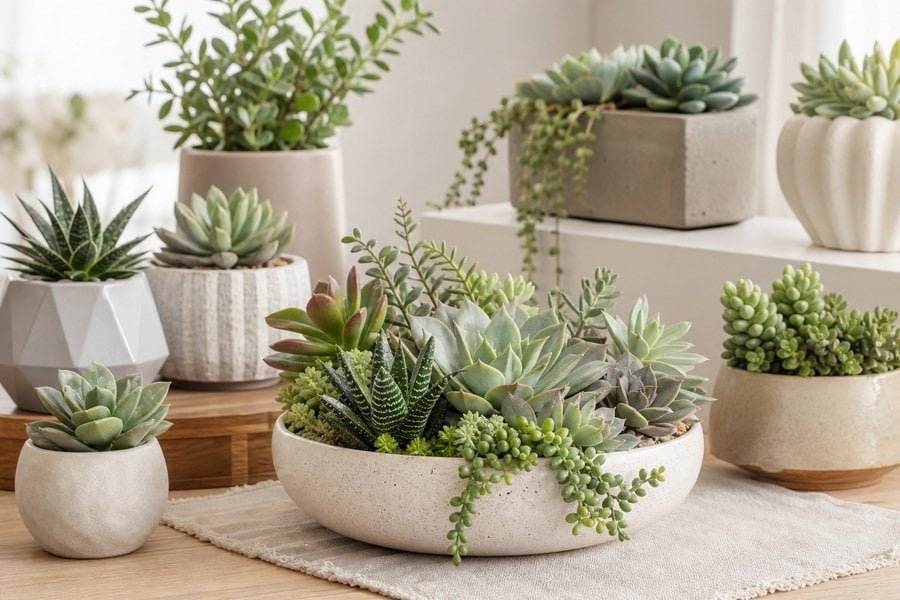
Artificial succulents are especially useful in small areas. They do not need a large floor space. A mini potted succulent can sit on a nightstand, bathroom tray, entry table, or windowsill. A shallow bowl of faux succulents can work as a coffee table centerpiece. A hanging planter can add greenery without taking up surface space.
| Home Area | Artificial Succulent Idea | Styling Tip |
|---|---|---|
| Bathroom | Small potted succulent on counter | Use ceramic or stone pots |
| Kitchen | Low bowl arrangement | Keep it away from grease |
| Living room | Coffee table centerpiece | Mix heights and leaf shapes |
| Bedroom | Nightstand accent | Choose soft muted colors |
| Entryway | Console table display | Pair with candles or books |
| Bookshelf | Mini succulent cluster | Use odd-number groupings |
Event and Commercial Uses
Artificial succulents are also useful for events. They can be used as wedding favors, table numbers, centerpieces, arch accents, bar décor, or welcome sign details. They fit desert weddings, modern weddings, rustic events, and eco-inspired themes.
In commercial spaces, they work because they stay clean-looking with little care. Restaurants can use them on tables. Offices can use them in meeting rooms. Retail stores can use them in product displays. Hotels can use them in bathrooms, lobbies, and guest rooms.
For outdoor use, the material must be checked carefully. Not every artificial succulent can handle direct sun, heat, rain, or wind. UV-resistant artificial succulents are better for patios, balconies, and covered outdoor displays. Non-UV pieces may fade or crack faster outside.
How Do You Choose a Realistic Artificial Succulent?
A realistic artificial succulent should look believable in normal light and at close range. The best choice has natural color, soft texture, solid shape, and a good container.
To choose a realistic artificial succulent, look for matte leaves, muted color variation, flexible material, natural rosette shape, hidden plastic bases, and a pot that suits the décor. Avoid overly shiny surfaces, flat green color, visible glue, repeated leaf patterns, and cheap containers.
The easiest test is simple. Place the artificial succulent where you plan to use it and look at it from normal distance. Then look closer. If the color is too bright, the leaves are too shiny, or the base looks plastic, it will not feel natural. If the plant has soft variation and a stable shape, it will be easier to style.
Quality Checklist
A good faux succulent should have a believable plant form. Succulents often have clear geometry. Echeveria forms a rosette. Aloe and agave have pointed leaves. Jade has rounded leaves. String of pearls has trailing beads. The artificial version should match that growth pattern.
| Quality Detail | Good Sign | Red Flag |
|---|---|---|
| Leaf surface | Matte or soft satin | High shine |
| Color | Green with subtle variation | One flat bright color |
| Shape | Natural rosette or plant form | Random leaf placement |
| Base | Hidden with stones or moss | Exposed plastic stem |
| Pot | Ceramic, cement, clay, wood, or metal | Thin cheap plastic |
| Weight | Stable and balanced | Falls over easily |
| Scale | Matches the room and shelf | Too tiny or oversized |
Choose by Purpose
For close-up areas, choose premium real-touch artificial succulents. This includes desks, dining tables, wedding centerpieces, bathroom counters, and gift arrangements. Guests may see these pieces closely, so quality matters.
For distant areas, mid-range pieces can work. This includes high shelves, large wall displays, background décor, and retail staging. The viewer sees the whole design, not each leaf. In these areas, shape and color matter more than touch.
The planter also changes the result. A simple faux succulent can look more expensive in a ceramic bowl, cement pot, stone tray, wood box, or glass terrarium. Add pebbles, preserved moss, sand, or soil-like filler to hide the base. This one step can make a cheap arrangement look more finished.
How Do You Care for an Artificial Succulent?
Artificial succulents do not need plant care, but they still need cleaning. Dust is the main thing that makes faux plants look fake over time.
To care for an artificial succulent, dust it regularly with a soft cloth, makeup brush, microfiber duster, or compressed air. Wipe the leaves with a slightly damp cloth when needed, keep non-UV pieces away from strong sun, and store unused arrangements in a dry place.
Artificial succulents are low maintenance, not zero maintenance. A dusty plant looks old and fake. A clean faux succulent looks fresher and more realistic. The care routine is simple, but it should be regular.
Easy Cleaning Method
Start with dry dusting. Use a soft brush to clean between the leaves. This is useful for rosette succulents because dust can sit in the center. For larger leaves, use a microfiber cloth. For tight areas, compressed air can help, but use it gently so the plant does not loosen from the pot.
If the plant has sticky dust, wipe it with a slightly damp cloth. Do not soak the plant. Too much water may loosen glue, damage foam, or leave marks on the pot filler. After wiping, let it air dry before placing it back.
| Cleaning Need | Best Tool | Note |
|---|---|---|
| Light dust | Microfiber cloth | Good for larger leaves |
| Dust in rosette center | Soft brush | Works well for echeveria shapes |
| Tight gaps | Compressed air | Use gentle pressure |
| Sticky residue | Damp cloth | Do not soak |
| Outdoor dust | Damp wipe and shade dry | Check UV rating first |
Keep It Looking Real
Placement affects care. Do not place a non-UV artificial succulent in strong direct sun for long periods. The color may fade. Avoid placing it near heat sources like radiators, ovens, or strong lamps. Heat can affect some synthetic materials.
If the succulent is in an arrangement, check the filler once in a while. Pebbles, moss, or sand may shift. Push the stems back into place if they move. If a leaf bends during storage, reshape it gently. Some materials can be warmed slightly by hand and adjusted.
The care goal is simple. Keep the plant clean, matte, and naturally shaped. A small amount of maintenance will keep an artificial succulent looking useful for years.
My insights: What is an Artificial Succulent
Artificial succulents are simple décor pieces, but the good ones are designed with real plant behavior in mind. They work because succulents already have firm leaves, strong shapes, and a slightly sculptural look.
An artificial succulent is a realistic fake version of a living succulent, made to provide long-lasting greenery without watering, sunlight, soil, or plant maintenance. It is most useful when someone wants the visual style of succulents in spaces where real plants may not grow well or may be hard to maintain.
A real succulent stores water in thick leaves, stems, or roots. That is why many succulents have plump leaves, tight rosettes, waxy surfaces, and compact forms. Artificial succulents copy these features. Some look like echeveria. Some look like aloe, agave, jade, sedum, cactus, haworthia, or string of pearls. They may come as single stems, small potted plants, wall panels, terrarium pieces, wedding favors, table centerpieces, or large commercial arrangements.
Why the Definition Matters
Many people call them fake plants, faux succulents, artificial succulent plants, or realistic succulents. These names usually mean the same thing. The difference is quality. A low-cost artificial succulent may only copy the general shape. A realistic artificial succulent copies the surface, color blend, leaf thickness, and natural spacing.
| Term | Meaning | Common Use |
|---|---|---|
| Artificial succulent | General man-made succulent plant | Home, office, events |
| Faux succulent | Softer décor term for fake succulent | Interior design and retail |
| Fake succulent | Casual term | DIY and everyday shopping |
| Real-touch succulent | Higher realism material | Close-up décor and premium displays |
| Potted artificial succulent | Faux succulent already placed in a container | Shelves, desks, bathrooms |
| Artificial succulent arrangement | Multiple faux succulents styled together | Centerpieces, walls, displays |
An artificial succulent is not alive. It will not grow, bloom, root, or change with the season. That can be a weakness for plant lovers, but it can be a benefit for decorators. The piece stays the same size, shape, and color for a long time. This makes it useful for repeated event setups, rental décor, model homes, offices, hotel styling, and low-light corners.
Conclusion
An artificial succulent gives the look of a real succulent without plant care. It is best when the material, color, shape, and placement feel natural.