
Dust can quickly make realistic artificial flowers look dull and lifeless. The wrong cleaning method can also damage petals, loosen glue, and remove color.
To clean artificial flowers, start with the gentlest method: dust them with a microfiber cloth or soft brush. You can also use cool air, dry salt, a damp cloth, or mild soapy water. Always check the flower material first and test moisture or cleaning products on a hidden area.
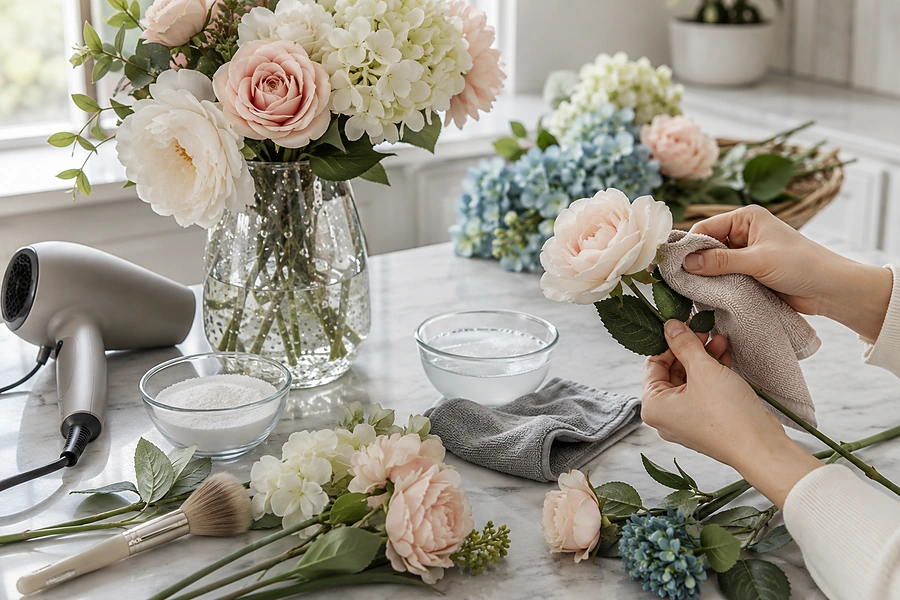
Artificial flowers can be made from polyester fabric, polyethylene, polyurethane, PVC, foam, latex-like coatings, or mixed materials. A cleaning method that works well on molded plastic leaves may damage silk-touch petals. I therefore inspect the material, color, attachments, and care label before I begin.
Method 1: How Do You Dust Artificial Flowers Safely?
Heavy dust does more than change the color of an artificial arrangement. It settles between petals, around flower centers, and along textured leaves, where it becomes harder to remove over time.
The safest way to clean lightly dusty artificial flowers is to use a dry microfiber cloth, soft paintbrush, makeup brush, feather duster, or cotton swab. Support each flower head with one hand and move from the center toward the petal edges without pulling, crushing, or scrubbing the material.
Dry dusting should usually be the first method because it adds no moisture and creates little risk of color bleeding. Artificial-flower care guides commonly recommend a soft cloth or duster for routine maintenance. Soft brushes and cotton swabs can reach detailed centers and narrow spaces without applying much pressure.
What You Need
- A clean microfiber cloth
- A soft makeup or paintbrush
- Cotton swabs
- A clean towel
- A small container for loose leaves or petals
Step-by-Step Instructions
First, move the arrangement to a well-lit work area. If possible, clean it outdoors or over a towel so the removed dust does not settle on nearby furniture.
Hold the stem below the flower head. Use a soft brush to loosen dust from the center, then move outward across each petal. Brush in the direction of the petal instead of moving against the fabric.
Use a microfiber cloth on broad leaves. Support the back of each leaf with one hand while wiping the front with the other. This reduces pressure on the joint connecting the leaf to the stem.
Use a dry cotton swab around stamens, small buds, artificial pollen, and molded details. Do not force the swab into glued areas.
| Flower Part | Best Tool | Recommended Movement |
|---|---|---|
| Wide leaves | Microfiber cloth | Wipe from stem to tip |
| Flower centers | Soft brush | Use short outward strokes |
| Small buds | Makeup brush | Turn the stem while brushing |
| Narrow spaces | Cotton swab | Dab or roll gently |
| Textured stems | Soft paintbrush | Brush downward |
Dry dusting works well for weekly or routine cleaning. Some manufacturers recommend dusting artificial flowers weekly or every two weeks to prevent buildup, although the right schedule depends on the room and display location.
Method 2: Can You Clean Artificial Flowers With Air?
Artificial roses, hydrangeas, peonies, and similar blooms often contain many overlapping petals. A cloth cannot easily reach every space without crushing the arrangement.
You can clean artificial flowers with cool, low-pressure air. Use a hair dryer on its cool setting, a hand-operated air blower, or short bursts of compressed air from a safe distance. Hold the flower securely and direct the airflow across the petals rather than straight into weak glued connections.
Air cleaning is useful for delicate arrangements, wreaths, flower walls, hanging installations, and small floral details. Care guidance for faux and preserved florals recommends canned air or a cool or low-heat hair dryer used from a distance.
How to Use a Hair Dryer
Move the artificial flowers outside, into a bathtub, or over a large sheet. Dust will leave the arrangement and spread into the surrounding area.
Set the hair dryer to cool air and the lowest speed. Do not use hot air. Heat may soften adhesives, distort thin plastic parts, or affect coatings.
Hold the dryer about 12 inches, or 30 centimeters, from the flower. Begin farther away if the petals are very thin. Point the air across the surface and use short passes.
Turn the arrangement as you work. This helps remove dust from both sides of the leaves and from the spaces between blooms.
How to Use Compressed Air
Keep the can upright and follow its safety instructions. Use short, controlled bursts instead of a continuous stream. Start at a generous distance and move closer only when necessary.
Avoid directing strong air at:
- Loose artificial pollen
- Glittered petals
- Faux snow
- Dried floral additions
- Feathers
- Unstable flower heads
- Cracked or aging adhesive
Artificial frost, decorative snow, and similar surfaces should be dusted very gently because moisture or force can loosen the finish.
| Air-Cleaning Problem | Simple Adjustment |
|---|---|
| Petals move too strongly | Increase the distance |
| Dust remains in the center | Use a soft brush afterward |
| Leaves twist around the stem | Support them with one hand |
| Arrangement is very large | Clean it in sections |
| Decorative particles fall off | Stop and switch to gentle brushing |
Air cleaning is fast, but it usually moves dust instead of collecting it. I often follow it with a microfiber cloth on large leaves and a quick cleaning of the surface below the arrangement.
Method 3: How Do You Clean Artificial Flowers With Salt?
Some fabric flowers cannot be wiped easily because they have many narrow petals. They may also be too delicate for washing.
To clean suitable artificial flowers with salt, place a small amount of dry salt in a strong paper or plastic bag. Add one or two flower stems, close the bag around them, and shake gently. The salt moves between the petals and helps lift loose dust without adding water.
The dry salt method is commonly suggested for dusty faux flowers. Cleaning guidance recommends placing the flowers in a sturdy bag with several tablespoons of salt and shaking the bag so the grains reach different surfaces.
When the Salt Method Works Best
This method is useful for sturdy polyester flowers that have flexible petals and secure parts. It can work on simple roses, carnations, daisies, and similar stems when the dust cannot be removed with a brush alone.
I do not use this method automatically. Salt is abrasive, and shaking creates physical stress. It may damage delicate coatings, scratch shiny leaves, remove glitter, loosen artificial pollen, or break old adhesive.
Avoid the salt method on:
- Real-touch PU petals
- Foam flowers
- Latex-coated flowers
- Velvet or flocked flowers
- Glittered designs
- Hand-painted petals
- Very old arrangements
- Flowers with loose centers
- Stems attached to a heavy vase
Step-by-Step Instructions
Place two or three tablespoons of clean, dry salt in a large bag. Use a bag that gives the flower enough space to move without being crushed.
Insert one or two stems. Do not pack the bag with a complete bouquet.
Close the opening around the stems. Shake gently for 20 to 30 seconds. Rotate the flowers and repeat only when necessary.
Remove each stem carefully. Hold it over the bag and tap the stem lightly so remaining salt falls away.
Use a soft brush or cool air to remove grains trapped inside the flower center.
| Check Before Cleaning | Continue or Stop? |
|---|---|
| Petals are firmly attached | Continue carefully |
| Color rubs off on a white cloth | Stop |
| Surface is sticky | Stop |
| Decorative powder is loose | Stop |
| Flower has a simple fabric construction | Continue after a small test |
| Petals crack when bent | Stop |
Salt should remain completely dry. Do not mix it with water, vinegar, or detergent. Moist salt can stick to fabric, leave marks, and become difficult to remove.
Method 4: Can You Wipe Artificial Flowers With a Damp Cloth?
Dry methods cannot remove fingerprints, light grease, kitchen residue, or small marks. In these cases, controlled moisture can be more effective.
You can wipe many plastic and synthetic artificial flowers with a slightly damp microfiber cloth. Add a very small amount of mild dish soap only when water alone does not remove the dirt. Test a hidden area first, avoid soaking the petals, and dry every cleaned part immediately.
Current care guidance from artificial-flower retailers recommends a slightly damp microfiber cloth and, where needed, a small amount of mild soap. It also warns against harsh cleaning products, rough scrubbing, and unnecessary soaking.
Make a Mild Cleaning Solution
Add one or two drops of mild, colorless dish soap to a bowl of lukewarm water. Stronger does not mean safer. Too much soap can leave a film that attracts new dust.
Dip a microfiber cloth into the solution. Wring it thoroughly. The cloth should feel damp, not wet.
Before cleaning a visible petal, wipe a small hidden area. Wait until it dries. Check for color transfer, water rings, surface changes, or loss of texture.
Clean From the Strongest Parts to the Most Delicate
Begin with molded plastic leaves and stems. These parts are usually more tolerant of moisture than fabric petals.
Support each leaf from below and wipe from the base toward the tip. Turn the cloth often so removed dirt is not spread to another area.
Use a cotton swab for tight spaces. Do not press moisture into glued joints or artificial flower centers.
For fabric petals, dab instead of rubbing. Clean only the marked area when possible. Blot it with a dry white cloth immediately.
Material Guide
| Material | Damp Cloth? | Important Precaution |
|---|---|---|
| Molded PE leaves | Usually suitable | Avoid bending thin tips |
| PVC stems | Usually suitable | Dry around wire openings |
| Polyester petals | Sometimes suitable | Test for color bleeding |
| PU real-touch petals | Use cautiously | Avoid friction and strong soap |
| Foam flowers | Usually avoid | Moisture may change the surface |
| Velvet or flocked petals | Avoid when possible | Water may flatten the finish |
| Hand-painted flowers | Use cautiously | Test for pigment transfer |
A diluted vinegar solution is sometimes recommended for sticky residue, but it should be used sparingly and tested in a hidden location first. I prefer plain water and mild soap for general cleaning because vinegar may affect some dyes, coatings, adhesives, or metal components.
After wiping, leave the flowers in a ventilated area. Keep them out of direct sunlight while they dry because wet fabric may develop uneven marks.
Method 5: Can You Wash Artificial Flowers With Water?
Washing seems like the quickest method for a dirty arrangement. It also creates the highest risk when the flower contains fabric, glue, foam, wire, painted details, or a fixed vase.
You can wash sturdy, washable plastic artificial flowers with cool or lukewarm water and a small amount of mild soap. Do not wash flowers unless the manufacturer allows it. Avoid soaking silk-touch petals, foam, flocking, paper, glitter, fixed arrangements, and products with exposed wire or delicate adhesive.
Care advice differs because artificial flowers differ. Some guides allow gentle washing for durable plastic products, while other manufacturers tell buyers not to wash their flowers or use commercial cleaning sprays. This difference is why the product label and material test must come before the cleaning method.
How to Wash Durable Plastic Flowers
Remove the individual stems from the arrangement when possible. Photograph the arrangement first so you can rebuild it correctly.
Fill a basin with cool or lukewarm water. Add a few drops of mild dish soap.
Place one test stem in the water. Gently move it through the solution instead of scrubbing it. Do not leave it soaking.
Rinse the stem with clean, low-pressure water. Shake it gently to remove excess moisture.
Pat the leaves and petals with a clean towel. Hang the stem upside down or place it on an absorbent towel in a ventilated room.
Allow it to dry completely before returning it to the vase. Water trapped inside a stem, flower head, or planter may affect wire, adhesive, or internal materials.
When Not to Wash Artificial Flowers
Do not wash an arrangement when it has:
- A “dry clean only” care instruction
- Fabric with unstable dye
- Paper-wrapped stems
- Foam petals
- Flocked or velvety surfaces
- Artificial pollen
- Glitter
- Battery-powered lights
- Exposed metal wire
- A fixed acrylic-water vase
- Natural dried flowers mixed with artificial stems
- Unknown materials or adhesives
Washing Risk Checklist
| Question | Safe Response |
|---|---|
| Does the care label allow water? | Continue only when permitted |
| Is the flower completely plastic? | Test one hidden section |
| Does color transfer when damp? | Stop immediately |
| Is metal wire exposed? | Avoid washing |
| Are stems removable? | Clean them separately |
| Is the arrangement fixed in a vase? | Use dry or spot cleaning |
| Can every part dry fully? | Continue with caution |
I never put artificial flowers in a washing machine or dishwasher. Mechanical movement, heat, and detergent can bend stems, loosen petals, damage finishes, and spread color.
How Often Should You Clean Artificial Flowers?
Cleaning too rarely allows sticky dust to build up. Cleaning too aggressively can shorten the life of the arrangement.
Dust artificial flowers lightly every one or two weeks in busy or dusty rooms. Clean them monthly in quieter areas, and perform deeper cleaning only when visible dirt remains after dusting. Flowers near kitchens, fireplaces, open windows, air vents, and entrances usually need more frequent attention.
A fixed schedule is less useful than a quick visual inspection. I look at the upper leaves, horizontal petals, and flower centers because these areas collect dust first.
| Display Location | Suggested Routine |
|---|---|
| Living room shelf | Dust every two to four weeks |
| Kitchen | Inspect weekly and remove grease early |
| Reception area | Dust weekly |
| Bedroom | Dust every two to four weeks |
| Covered outdoor display | Check weekly for dirt and debris |
| Seasonal storage | Clean before packing and after unpacking |
Regular light cleaning is safer than repeated deep cleaning. Removing loose dust early reduces the need for water, soap, salt, or stronger physical handling.
What Should You Avoid When Cleaning Fake Flowers?
A quick internet cleaning hack can create permanent damage. Material compatibility matters more than cleaning speed.
Avoid hot water, bleach, strong solvents, abrasive brushes, heavy scrubbing, high heat, long soaking, and untested cleaning sprays. Do not assume every flower sold as silk, real-touch, plastic, or washable has the same construction. Always follow the product instructions and test an unseen area.
I also avoid spraying cleaner directly onto an assembled arrangement. Liquid can collect inside flower centers, around glue, or inside stems. Applying a small amount to a cloth gives me more control.
Do not clean delicate flowers while holding them only by the bloom. Support the stem and flower head together. This protects the connection point.
Do not return damp flowers to a crowded vase. Restricted airflow slows drying and can trap water between stems.
Do not store an arrangement while it is dusty or damp. Gently clean it first, allow it to dry, and place it in a container that protects the petals from pressure. Artificial greenery care guidance also recommends cleaning items before storage.
My Insights: How to Clean Artificial Flowers With 5 Easy Methods
The best cleaning method is not the strongest one. It is the least aggressive method that removes the visible dirt without changing the flower.
Artificial flowers should be cleaned in five stages of increasing intensity: dry dusting, cool air, dry salt cleaning, damp wiping, and washing. Most arrangements need only the first one or two methods. Moisture and soap should be reserved for compatible materials after a hidden-area test.
My main insight is that artificial-flower cleaning should follow a material-based decision, not one universal recipe.
Choose the Method by Dirt and Material
| Condition | Best Starting Method |
|---|---|
| Light surface dust | Microfiber cloth or soft brush |
| Dust between many petals | Cool, low-pressure air |
| Dust in sturdy fabric flowers | Dry salt method |
| Fingerprints or small marks | Slightly damp cloth |
| Heavy dirt on washable plastic | Mild soapy-water wash |
| Unknown material | Dry brush only |
| Painted or flocked finish | Manufacturer-approved dry care |
| Mixed artificial and dried bouquet | Clean each material separately |
I begin with Method 1. I move to Method 2 only when dust remains in difficult spaces. I use Method 3 only for sturdy fabric flowers that can tolerate gentle shaking. I use Method 4 for visible marks. I use Method 5 only when I know the plant is washable.
This order reduces unnecessary risk. It also saves time because many artificial flowers do not need a deep clean.
A Simple Five-Minute Routine
For regular care, I remove the arrangement from its display area and inspect it under natural light. I brush the flower centers, wipe the broad leaves, and use cool air between dense petals. I then check for loose leaves, bent stems, exposed wire, and weakened glue.
I clean the vase separately. Dust or cloudy residue around the container can make clean flowers still look neglected.
After cleaning, I reshape the petals and rotate the arrangement. This creates a more natural view and helps prevent dust from remaining on one side.
Artificial flowers last longer visually when cleaning is gentle, regular, and matched to the material. The goal is not to make every arrangement washable. The goal is to remove dust before a risky deep-cleaning method becomes necessary.
Conclusion
Dust first, use air for tight spaces, reserve salt for sturdy fabric, spot-clean carefully, and wash only durable flowers that are clearly safe for water.