Silk flowers can lose their color surprisingly fast outdoors. A careless spray choice may also leave soft petals stiff, glossy, spotted, or permanently discolored.
UV spray can slow fading on compatible silk and artificial flowers, but it cannot make indoor flowers permanently sunproof. The best results come from a floral-specific UV protectant, light and even application, regular inspection, partial shade, and flowers made with stable dyes, durable fabric, and secure construction.
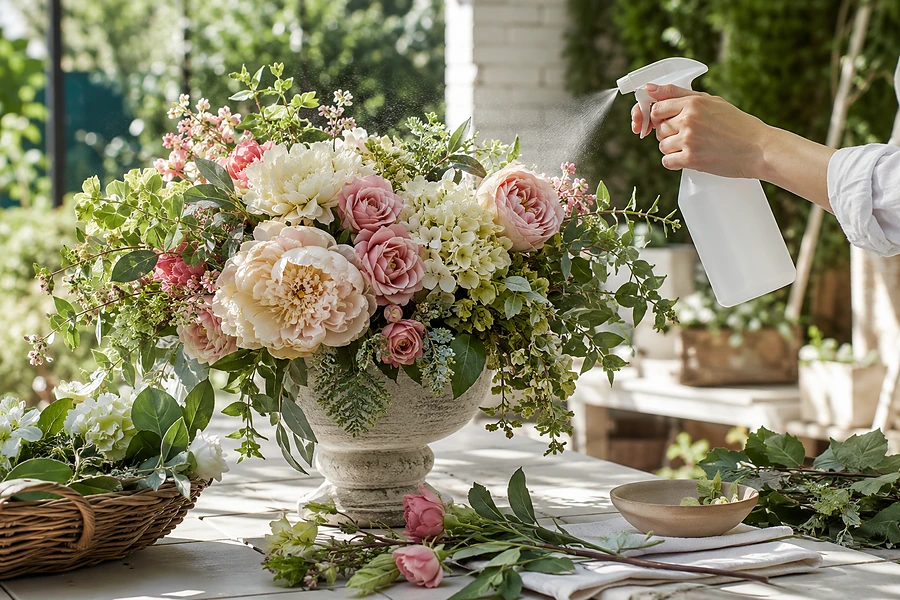
The term “silk flower” usually covers many synthetic products, including polyester fabric, coated textiles, molded plastic, and mixed-material arrangements. I therefore treat UV spray as one part of an outdoor-care system, not as a universal cure.
Does UV Spray Really Work on Silk Flowers?
A clear spray can sound like an easy solution: coat the flowers once, place them in full sun, and expect permanent color. Real outdoor exposure is more complicated.
UV spray can reduce the rate at which sunlight changes the color and surface of silk flowers. It works by adding a protective layer that absorbs or limits some damaging ultraviolet exposure. However, its performance depends on the formula, coating coverage, flower material, pigment stability, climate, and length of exposure.
Some floral protectants are specifically marketed for silk and dried flowers. For example, Krylon describes its Ultra UV Floral Protectant as a clear, non-yellowing indoor and outdoor finish intended to protect silk and dried flowers from fading, moisture, dirt, and discoloration. This type of product is more relevant than a general clear coat because its labeled use includes floral materials.
What UV Spray Actually Does
A UV-protective coating creates an added barrier between the flower surface and the outdoor environment. Depending on the product, that coating may help reduce:
- Color fading
- Surface discoloration
- Moisture contact
- Dirt penetration
- Minor surface wear
UV exposure can affect pigments and polymers over time. Heat, moisture, oxygen, and weather changes can add further stress. UV absorbers and light stabilizers are used in polymer systems to slow light-related degradation, but their effectiveness depends on the chemistry, concentration, substrate, and exposure conditions.
A spray can therefore provide useful extra protection. It does not rebuild weak fabric, improve unstable dye, strengthen poor adhesive, or replace UV stabilizers that should have been included during manufacturing.
Surface Protection Versus Built-In UV Stability
There is an important difference between a flower made from UV-stabilized material and an indoor flower treated later with a surface spray.
| Protection Type | Where Protection Exists | Main Strength | Main Limitation |
|---|---|---|---|
| Built-in UV stabilization | Inside the polymer or pigment system | Protection remains throughout the material | Quality depends on the original formula |
| Factory-applied coating | Across the finished flower surface | Controlled application during production | Coverage and durability can vary |
| Consumer-applied UV spray | Added after purchase | Convenient and replaceable | Easy to miss hidden or folded areas |
| No UV treatment | No verified protection | Lowest initial cost | Highest fading risk outdoors |
A surface spray can extend the useful appearance of a compatible flower, but it cannot fully turn an indoor-grade product into a commercial outdoor product. Current artificial-flower guidance makes the same distinction: added spray may help, but it does not provide the same performance as a product designed and stabilized for exterior exposure.
Why Results Differ Between Arrangements
Two people can apply the same spray and get very different results. One arrangement may sit under a covered porch with two hours of morning light. Another may receive eight hours of direct afternoon sun, reflected heat from concrete, wind, and rain.
Results also change with:
- Fabric thickness
- Dye quality
- Petal color
- Existing factory coating
- Number of applied coats
- Spray distance
- Drying conditions
- Temperature and humidity
- Cleaning frequency
- Direction of sunlight
Dark, muted, or mixed colors may hide slight fading longer than bright single colors. Thin petals and strongly colored flowers can show uneven change more clearly.
UV spray works best when expectations are realistic. It is a fading-control tool, not a lifetime guarantee.
Which UV Spray Is Best for Silk Flowers?
A product may contain the words “clear,” “outdoor,” or “protective” without being suitable for delicate fabric petals. The label matters more than the marketing image.
The best UV spray for silk flowers is a clear, non-yellowing product that specifically lists silk flowers, dried flowers, artificial foliage, or compatible fabric among its approved uses. It should provide application instructions, surface guidance, safety information, drying requirements, and a recommendation to test colorfastness before full treatment.
I start with floral-specific products. I only consider broader fabric or craft protectants when the manufacturer confirms compatibility with the flower’s material.
1. Floral-Specific UV Protectant
This is usually the most practical starting category. It is designed around delicate decorative surfaces and irregular floral shapes.
A strong floral-protectant label should state:
- Approved flower or fabric types
- Indoor or outdoor use
- Clear or non-yellowing finish
- Recommended spray distance
- Number of coats
- Drying or curing time
- Ventilation requirements
- Coverage per container
- Reapplication guidance
Krylon’s floral-specific product is labeled for silk and dried flowers and states that it provides a clear, non-yellowing finish for indoor and outdoor use.
2. UV-Resistant Clear Craft Coating
A general UV-resistant clear coating may work when its label includes dried silk flowers or the flower’s actual material.
Krylon’s UV-Resistant Clear Coating lists dried silk flowers among its compatible surfaces. However, a broader clear coating may create a different finish from a floral-specific spray. The buyer should still test softness, shine, color, and flexibility before treating an arrangement.
A clear coat may be more suitable for:
- Firm molded leaves
- Sturdy fabric petals
- Dried floral crafts
- Wreath frames
- Decorative branches
- Artificial planters
It may be less suitable for very soft real-touch petals, flocked flowers, velvet surfaces, foam, or flowers with loose artificial pollen.
3. Outdoor Fabric Sun and Water Shield
Some outdoor fabric protectants offer sun and moisture protection, but that does not automatically make them suitable for every artificial flower.
3M instructs users of Scotchgard Water & Sun Shield to apply it only to clean, dry items and test an inconspicuous area for colorfastness. The company also warns that the product may give some fabrics a slightly darker or richer tone.
That warning matters for white, ivory, champagne, blush, and pastel wedding flowers. A small color shift can affect the whole arrangement.
I only use a fabric protector when:
- The flower is made from a compatible fabric.
- The product label permits the intended material and location.
- A hidden test dries without color or texture change.
- The coating remains flexible.
- The finish does not look wet or glossy.
4. Artificial-Foliage Sealer
Foliage sealers are often intended for artificial leaves, trees, hedges, and outdoor greenery. They may create a heavier surface film than a delicate floral spray.
These products can be useful for:
- Artificial boxwood
- PE or PVC greenery
- Broad molded leaves
- Topiary
- Dense exterior foliage
- Commercial artificial plants
They are not always the best choice for soft polyester roses or fine hydrangea petals.
UV Spray Selection Table
| Spray Type | Best Starting Use | Main Advantage | Main Risk |
|---|---|---|---|
| Floral-specific UV spray | Silk and dried flowers | Designed for floral surfaces | May still change delicate finishes |
| UV-resistant craft clear coat | Firm fabric and craft flowers | Broad surface compatibility | Can add shine or stiffness |
| Outdoor fabric protector | Compatible polyester flowers | Sun and moisture protection | May darken fabric |
| Foliage sealer | Plastic leaves and greenery | Stronger exterior coating | May feel heavy on petals |
| General waterproofing spray | Only when clearly compatible | Moisture resistance | May offer limited UV protection |
| Unlabeled household spray | Not recommended | Easy to find | No verified floral compatibility |
The product with the strongest advertising claim is not automatically the best choice. The best choice is the one whose label matches the exact flower material.
How Do You Apply UV Spray to Silk Flowers?
Poor application can make a suitable product look bad. Heavy spraying may create droplets, glossy areas, stiff edges, or uneven protection.
To apply UV spray, clean and dry the silk flowers, test a hidden petal, work outdoors or in a well-ventilated area, and apply several light passes from the label’s recommended distance. Rotate the arrangement for even coverage and allow every coat to dry or cure fully before handling or displaying it.
The manufacturer’s directions should always take priority over a general tutorial. Different aerosol and pump formulas use different distances, coat times, and curing periods.
Step 1: Identify the Flower Material
Check the product label, packaging, supplier specification, or material declaration.
A single arrangement may contain:
- Polyester petals
- PE leaves
- PVC stems
- PU real-touch coatings
- Foam buds
- Metal wire
- Adhesive
- Flocking
- Glitter
- Printed details
One spray may not be compatible with every component. When the material is unknown, I treat the arrangement as delicate and test more carefully.
Step 2: Clean the Flowers
Spray should not trap dust, pollen, grease, or loose fibers under the coating.
Use a soft brush, microfiber cloth, or cool low-pressure air. Remove cobwebs and surface dirt. Spot-clean only when the material permits moisture.
Allow the arrangement to dry completely. Official fabric-protectant instructions also emphasize applying products only to clean, dry articles.
Step 3: Test an Inconspicuous Area
Choose the back of a lower leaf or a petal hidden inside the arrangement.
Apply the spray in the same way you plan to treat the full flower. Let it dry completely. Do not judge the result while it is still wet.
Check for:
- Color bleeding
- Darkening
- Yellowing
- White residue
- Gloss
- Stiffness
- Sticky texture
- Wrinkling
- Damage to printed veins
- Softening of glue
3M’s instructions require a colorfastness test before full treatment and note that fabric appearance can change after application.
Step 4: Prepare a Safe Work Area
Use the spray outside or in a well-ventilated area, as directed on the label. Protect floors, walls, furniture, vehicles, and nearby plants from overspray.
Wear any protective equipment required by the product instructions. Keep the spray away from flames, heat sources, children, and pets. Do not work near food, dishes, or event linens.
Place the flowers on a clean drop cloth. Separate loose stems when possible because individual stems are easier to coat evenly.
Step 5: Apply Light, Even Passes
Shake the container as directed.
Hold it at the recommended distance. Begin spraying slightly before the nozzle reaches the flower and continue past the other side. This reduces heavy spots at the beginning and end of each pass.
Do not hold the nozzle in one place. Move continuously.
Spray:
- The front of the petals
- The backs of the petals
- Flower centers
- Leaves and leaf undersides
- Stems and exposed branches
- Areas near attachment points
Rotate the flower instead of forcing petals into unnatural positions.
Step 6: Build Coverage Gradually
One heavy coat does not necessarily provide better protection. It can create runs, visible film, and stiff petal edges.
Several light coats usually give more controlled coverage when the label allows them. Let each coat dry for the required period.
| Application Problem | Likely Cause | Better Approach |
|---|---|---|
| Visible droplets | Spray held too close | Increase distance and use lighter passes |
| Glossy patches | Uneven or heavy coating | Use thinner coats |
| Stiff petals | Too much product | Reduce total application |
| Missed areas | Flower not rotated | Coat from several angles |
| Dust sealed into finish | Flowers not cleaned first | Clean and dry before spraying |
| Color change | Dye or finish incompatibility | Stop after the test area |
| Sticky surface | Heavy coat or incomplete curing | Allow full cure and review compatibility |
Step 7: Dry and Cure Completely
Drying means the surface no longer feels wet. Curing may take longer and allows the coating to reach its intended performance.
Do not immediately return treated flowers to a vase, package, doorway, wedding arch, or outdoor planter. Petals touching during curing may stick together or develop pressure marks.
Keep the flowers protected from rain, dew, dust, and direct sun during the required drying period.
What UV Spray Claims Are Hype?
The biggest problem is not that every UV spray fails. The problem is that buyers often expect a surface coating to solve problems it was never designed to solve.
Claims that UV spray makes silk flowers permanently fade-proof, completely waterproof, maintenance-free, or suitable for every climate are hype unless supported by clear product testing and warranty terms. A coating may extend useful life, but no responsible claim should promise unchanged color under unlimited sunlight and weather exposure.
The actual result depends on both the spray and the flower beneath it.
Hype 1: “One Coat Prevents Fading Forever”
No exterior coating should be treated as permanent without evidence. Sunlight, abrasion, cleaning, rain, wind, and temperature changes affect exposed finishes over time.
UV-protective products are described as reducing or slowing fading, not stopping all material change forever. Even sellers promoting added UV protection generally advise continued care and reapplication.
Hype 2: “Any Clear Spray Works”
A clear appearance does not prove UV performance or material compatibility.
A basic clear spray may provide moisture or surface protection without offering meaningful UV resistance. Another product may contain UV protection but be too rigid for fabric petals.
The label should clearly state:
- UV-resistant or fade-protective function
- Approved surfaces
- Indoor or outdoor use
- Finish type
- Application requirements
I do not use an ordinary clear coat solely because it is transparent.
Hype 3: “UV Spray Makes Indoor Flowers Outdoor-Grade”
An indoor flower may still have weak dye, thin fabric, unprotected adhesive, exposed wire, poor water drainage, or parts that soften in heat.
A spray treats the accessible surface. It cannot correct every hidden weakness. Artificial-flower guidance warns that a surface treatment cannot fully transform an indoor product into one built for outdoor exposure.
Hype 4: “More Spray Means More Protection”
Excess product can make flowers look less realistic. Thick coatings may increase shine, reduce softness, collect at petal edges, or interfere with flexible parts.
A complete but controlled film is more useful than visible buildup. Application should follow the manufacturer’s instructions rather than an improvised “more is better” rule.
Hype 5: “Water Resistance Means Waterproof”
A product that helps resist moisture is not automatically a waterproof sealer.
Krylon’s floral protectant lists moisture protection among its benefits, while 3M describes its outdoor fabric product as helping items resist rain, fading, and moisture. These statements do not mean that every treated artificial flower can remain submerged or tolerate unlimited rain without damage.
Hype 6: “You Can Use Sunscreen or Hairspray Instead”
Body sunscreen is formulated for human skin. Hairspray is formulated for hair styling. Neither product should be treated as a tested artificial-flower UV system unless its manufacturer explicitly approves that use.
A household substitute may leave fragrance, oil, stickiness, residue, or an uneven appearance. More importantly, the user has no clear performance or compatibility instructions for the flower material.
| Common Claim | Practical Reality |
|---|---|
| Stops all fading | Usually slows fading |
| Permanent after one coat | Exposure and cleaning reduce protection |
| Makes any flower outdoor-safe | Base construction still matters |
| Waterproofs the arrangement | May only add moisture resistance |
| Works on every material | Fabric, PU, foam, and plastic react differently |
| More product works better | Heavy coats can damage appearance |
| No maintenance is needed | Inspection and reapplication remain necessary |
A useful product claim should describe a specific benefit under defined conditions. Broad promises without a test method, care schedule, or warranty deserve caution.
How Often Should You Reapply UV Spray?
A fixed schedule such as “every six months” sounds simple, but it may be too frequent for a shaded porch and too slow for intense desert sun.
Reapply UV spray according to the product label and the flower’s actual exposure. Inspect outdoor flowers monthly for dullness, uneven color, powdery surfaces, cracking, or reduced water repellency. Full-sun, rainy, coastal, and frequently cleaned displays usually need attention sooner than protected seasonal arrangements.
Some artificial-plant suppliers recommend regular reapplication, but published schedules vary widely. One 2026 outdoor artificial-plant brochure recommends monthly application, while consumer and retailer guidance may suggest seasonal or exposure-based care. This variation shows why the product label and local conditions should control the schedule.
Use Exposure Zones Instead of One Universal Schedule
| Exposure Zone | Example | Suggested Inspection Approach |
|---|---|---|
| Indoor, away from windows | Interior centerpiece | Inspect during routine cleaning |
| Indoor, near bright windows | Lobby or windowsill | Check color and dryness monthly |
| Covered outdoor shade | Porch or sheltered balcony | Inspect monthly and after storms |
| Partial sun | Patio with morning light | Check every few weeks |
| Full sun | Open garden or west-facing wall | Inspect frequently |
| Severe exposure | Desert, rooftop, poolside, coast | Use outdoor-grade flowers and close monitoring |
These are inspection intervals, not automatic spraying instructions. Recoat only when permitted by the label and after checking that the existing surface is clean and stable.
Signs That Protection May Be Declining
Look for:
- One side becoming lighter
- Red or purple flowers losing intensity
- Fabric feeling dry
- Clear coating becoming patchy
- Water no longer beading where it did before
- Fine surface cracking
- Petal edges becoming brittle
- Increased chalky appearance
- Leaves fading faster than shaded parts
- Dirt becoming harder to remove
Fading is not always proof that the coating failed. The underlying pigment may have limited stability, or exposure may exceed the product’s intended conditions.
Keep a Simple Care Record
For commercial displays, wedding rental inventory, memorial arrangements, and seasonal décor, I record:
- Installation date
- Flower material
- Spray product
- Application date
- Number of coats
- Display location
- Hours of direct sun
- Cleaning dates
- Visible color changes
- Replacement date
Photographs taken under similar lighting are more reliable than memory. A monthly image can show gradual fading before it becomes obvious during an event.
Reduce Exposure Before Adding More Spray
The most effective care step may be moving the arrangement.
Use partial shade, a roof overhang, a covered porch, or a less exposed wall. Rotate the arrangement when only one side receives strong sunlight. Bring seasonal displays inside during severe storms, extreme heat, freezing weather, or long periods of non-use.
A spray works better when it is not expected to carry the entire outdoor-performance burden.
Can UV Spray Make Silk Flowers Waterproof?
Waterproof and fade-resistant are different product claims. Combining them without checking the label creates false confidence.
UV spray does not automatically make silk flowers waterproof. Some formulas also provide moisture resistance, but petals, seams, glue, stems, internal wire, foam, and flower centers may still allow water inside. Treated flowers should only remain outdoors in rain when the complete arrangement is designed for that exposure.
A silk-touch petal may repel a few droplets after treatment while water still enters through the flower center. Moisture can then reach adhesive, paper wrapping, foam, or metal wire.
Water Can Damage More Than the Petal Surface
Potential problems include:
- Dye bleeding
- Water spots
- Softened adhesive
- Rust around exposed wire
- Mold on trapped organic debris
- Foam deformation
- Staining from dark stems
- Slow drying inside dense flowers
- Dust sticking to damp coatings
A moisture-resistant spray may reduce surface wetting. It does not guarantee that the complete flower head is sealed.
Use the Right Product for the Main Problem
| Main Need | Better Product Category |
|---|---|
| Reduce fading | UV floral protectant |
| Resist light moisture | Compatible sun-and-water shield |
| Protect plastic foliage | Artificial-foliage sealer |
| Maintain soft fabric texture | Light floral-specific coating |
| Handle year-round rain | Outdoor-grade artificial flower system |
| Survive full commercial exposure | Tested product plus controlled installation |
I avoid combining several unrelated sprays without testing. Layers may react with each other, change the finish, or prevent full curing.
Plan for Drainage
Outdoor planters should not hold standing water. Drainage holes need to remain open, and the base should allow trapped moisture to escape.
After rain, inspect dense blooms and shake off excess water gently. Separate petals slightly to improve airflow. Do not store wet flowers in a closed box.
A UV spray can support weather care, but product design, placement, and drainage remain essential.
My Insights: UV Spray for Silk Flowers—What Works, What’s Hype, and How Do You Care for Them
A buyer should not ask only, “Which spray is strongest?” The better question is, “Which complete protection plan fits this flower and its exposure?”
What works is a compatible floral-specific UV spray applied in light, even coats to clean and tested flowers. What is hype is the promise of permanent fade prevention or complete waterproofing. Proper care combines outdoor-grade materials, controlled sun exposure, routine cleaning, inspection, drainage, and label-based reapplication.
My main insight is that the value of UV spray depends on the quality of the artificial flower beneath it.
Start With the Right Flower
For open outdoor exposure, I would first choose artificial flowers that are already designed for exterior use. Built-in UV stabilization, secure petal attachments, protected wire, stable pigments, and weather-resistant stems provide a stronger foundation than an indoor silk flower with a last-minute spray coating.
For a covered porch or temporary event, a well-made silk-touch flower with added UV protection may be a practical choice. It offers visual softness while the roof reduces direct environmental stress.
For full sun, I would favor molded PE or other outdoor-grade artificial foliage over very thin fabric petals. I would use silk flowers as protected accents rather than the whole installation.
Match the Product to the Material
| Flower Material | UV-Spray Approach |
|---|---|
| Polyester silk-touch petals | Floral-specific spray after color test |
| PE molded leaves | Compatible plastic or foliage protectant |
| PVC stems | Check coating compatibility |
| PU real-touch petals | Use only when expressly approved |
| Foam flowers | Avoid unless the label lists foam |
| Flocked or velvet petals | Test carefully; coating may change texture |
| Glittered flowers | Spray may loosen or cover decoration |
| Mixed-material arrangement | Test every visible material |
The term “silk flower” is not a complete material specification. I want to know what the petals, leaves, stem coating, center, and adhesive are made from.
Use a Controlled Application Standard
For a repeatable result, I use the same process each time:
- Confirm product and flower compatibility.
- Clean every surface.
- Allow the flower to dry.
- Test a hidden area.
- Record the starting color.
- Apply thin passes from several angles.
- Avoid visible buildup.
- Allow complete drying and curing.
- Inspect under natural and indoor light.
- Record the application date.
For wholesale or commercial projects, I test more than one flower from the production batch. A single sample may not represent every dye lot or surface finish.
Define Success Before Testing
“Works” needs a measurable meaning.
A homeowner may consider the spray successful when a porch arrangement stays attractive through one summer. A wedding rental company may need flowers to survive several events and repeated handling. A hotel may require consistent color across multiple planters for several seasons.
I define acceptable performance through:
- Color change
- Surface gloss
- Petal softness
- Cracking
- Leaf loss
- Cleaning resistance
- Odor
- Water spotting
- Replacement frequency
- Total maintenance cost
For larger purchases, side-by-side exposure testing is more useful than marketing language. Treat one sample, leave one untreated, place both in the intended environment, and photograph them at regular intervals. This simple comparison does not replace laboratory weather testing, but it can reveal whether the chosen spray changes the appearance or provides practical value under the buyer’s real conditions.
Use Shade as Part of the Product System
A covered location can provide more protection than another heavy spray coat. I combine UV coating with smart placement whenever possible.
The strongest care system is:
Good base material + compatible UV spray + light application + partial shade + drainage + routine inspection.
The weakest system is:
Indoor flower + unknown spray + heavy coating + full afternoon sun + no maintenance.
UV spray is useful when it is selected and applied carefully. It is hype when it is sold as a magic shield that makes every silk flower permanent.
Conclusion
Use a floral-specific UV spray, test it first, apply light coats, limit direct sun, and inspect regularly. The spray can slow fading, but it cannot eliminate outdoor aging.