
Christmas florals can sell quickly, but an unfocused range creates slow stock, color conflicts, and urgent reorders that arrive after the season has peaked.
A strong artificial Christmas floral wholesale program combines dependable red-and-green products with one or two trend-led palettes, coordinated product packs, and a planned replenishment system. Retailers should build depth in reusable greenery, poinsettias, berries, magnolias, picks, wreaths, and garlands while limiting risky colors to smaller test quantities.
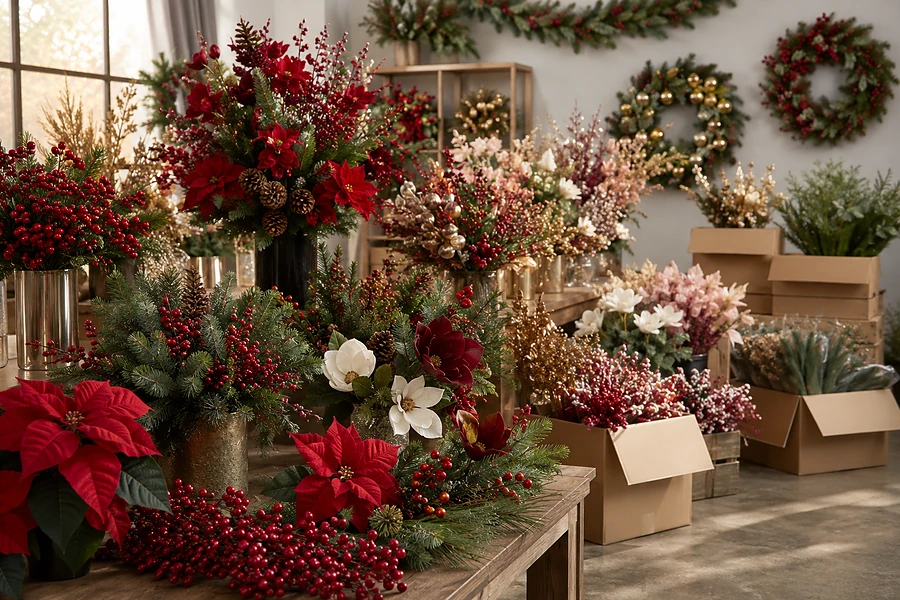
The best collection is not the one with the most styles. It is the one that lets buyers create complete displays, restock proven products quickly, and carry selected pieces into the next selling period.
Which Christmas Floral Palettes Work Best for Wholesale Collections?
A beautiful individual stem can still fail when it does not coordinate with the rest of the range. Wholesale buyers need palettes that work across wreaths, trees, tables, shelves, windows, and commercial installations.
The most dependable artificial Christmas floral palettes are classic red and green, champagne and gold, winter white, natural woodland, and deep jewel tones. Each palette should include focal flowers, supporting stems, greenery, berries, ribbon-compatible accents, and one neutral element that connects the complete collection.
Recent Christmas décor reporting has shown renewed demand for traditional red and green, full wreaths, poinsettias, berries, layered greenery, nostalgic details, burgundy, warm neutrals, and mixed metallic finishes. These directions give wholesale buyers both dependable core colors and controlled trend opportunities.
1. Classic Red, Green, and Gold
Classic red and green remains the safest base for a broad retail market. Customers recognize it immediately, and the products can be mixed with decorations they already own.
I would build this palette with:
- Red poinsettias
- Red velvet magnolias
- Holly and berry sprays
- Dark pine greenery
- Cedar and fir branches
- Gold leaves
- Gold berry picks
- Red-and-gold mixed garlands
- Traditional wreaths
- Small red floral bundles
The key is to control the red. A collection can look inconsistent when one poinsettia is orange-red, another is blue-red, and the berries are burgundy. I define one main red, one deeper accent red, and one metallic finish before approving samples.
Classic does not have to look basic. Matte berries, velvet petals, aged gold, natural pinecones, and several foliage textures can make a familiar palette look more premium.
2. Burgundy, Plum, and Antique Metallics
Burgundy has become a strong alternative to bright Christmas red. Recent holiday trend coverage paired burgundy and other moody colors with pink, raisin, amber, espresso, aged brass, antique silver, pewter, bronze, and gold.
This palette works well for:
- Hotels
- Restaurants
- Luxury gift shops
- Wedding venues
- Formal dining collections
- Premium home décor stores
- Dark or traditional interiors
Useful artificial floral products include burgundy roses, velvet poinsettias, plum hydrangeas, deep red magnolias, dark berries, brown eucalyptus, metallic leaves, and black-green pine.
I avoid making every item dark. Champagne flowers, warm ivory foliage, or muted pink accents prevent the collection from becoming visually heavy.
3. Champagne, Gold, and Warm White
Champagne and warm white create an elegant palette that can remain relevant after Christmas. This gives retailers more flexibility when seasonal sell-through is slower than expected.
A complete champagne collection may include:
- Warm-white poinsettias
- Champagne magnolias
- Cream hydrangeas
- Frosted eucalyptus
- Gold fern sprays
- Pearl berry picks
- Pale pine branches
- Soft metallic garlands
- Ivory floral bundles
Warm-white palettes have appeared in recent Christmas color reporting as a softer alternative to cold, bright white. They pair well with greenery, natural textures, and warm lighting.
I specify whether “gold” means bright yellow gold, soft champagne, antique gold, or bronze. Mixing several metallic finishes can look intentional, but only when the collection uses a controlled range rather than random shades.
4. Winter White, Silver, and Icy Blue
Winter white works for contemporary homes, winter weddings, event rental businesses, hotels, and visual merchandising.
I would combine:
- White poinsettias
- White roses
- Icy hydrangeas
- Silver leaves
- Frosted pine
- Snow-covered berry stems
- Pale blue florals
- Crystal-style picks
- White garlands
- Glittered branches
This palette depends heavily on quality control. White petals reveal carton dust, glue marks, color transfer, yellowing, and uneven glitter more clearly than dark products.
Every pale flower should be packed away from dark stems, printed cardboard, colored ribbon, and metallic products that may rub against it.
5. Natural Woodland
Natural woodland collections use layered green, brown, cream, muted red, and realistic botanical textures. Recent holiday reporting has highlighted mixed cedar, pine, eucalyptus, dried-orange effects, berries, woodsy accents, and simpler natural outdoor displays.
Useful products include:
- Cedar garlands
- Pine sprays
- Fir branches
- Eucalyptus
- Olive foliage
- Pinecone picks
- Brown berry clusters
- Cream flowers
- Dried-orange-style decorations
- Moss-effect branches
- Natural twigs
This palette is valuable because the greenery can often continue selling after Christmas. Plain pine, cedar, eucalyptus, and neutral branches can move into winter décor, weddings, commercial installations, and general home styling.
6. Jewel-Box Brights
Pink, blue, red, purple, teal, and bright metallics can support playful or maximalist Christmas stories. Recent trend coverage described jewel-box brights as a bold, expressive direction rather than a universal replacement for traditional colors.
I would treat this as a controlled fashion capsule. It can include oversized roses, bright poinsettias, colored hydrangeas, glitter sprays, candy-inspired picks, and color-shifting floral accents.
A small test order is safer than deep stock. These products can perform strongly in social media displays and themed commercial spaces, but demand may be narrower than demand for classic greenery.
Wholesale Palette Planning Table
| Palette | Core Flowers | Supporting Greenery | Best Customer Group | Stock Risk |
|---|---|---|---|---|
| Red, green, and gold | Poinsettia, magnolia, rose | Pine, cedar, holly | Broad retail market | Low |
| Burgundy and antique metallics | Rose, hydrangea, velvet poinsettia | Dark pine, eucalyptus | Premium and hospitality | Medium |
| Champagne and warm white | Magnolia, poinsettia, hydrangea | Frosted pine, gold fern | Elegant home décor | Low to medium |
| Winter white and silver | Rose, hydrangea, poinsettia | Snowy pine, silver foliage | Events and modern interiors | Medium |
| Natural woodland | Cream florals, muted berries | Cedar, fir, eucalyptus | Rustic and natural décor | Low |
| Jewel-box brights | Oversized roses, colored poinsettias | Dyed or glitter foliage | Fashion-led retail | High |
I would not divide the initial order equally across every palette. The core palette should receive the deepest inventory, while trend palettes should be measured through smaller launches and early sales data.
Which Artificial Christmas Floral Products Should Buyers Pack Together?
Single-stem purchasing offers flexibility, but it can make collection planning slow. Packs improve coordination when they are designed around a clear use rather than random product combinations.
The most useful wholesale Christmas floral packs are single-style stem packs, coordinated mixed bundles, tree-decorating kits, wreath-and-garland collections, centerpiece recipes, and retail-ready assortments. Each pack should have a defined color story, piece count, finished use, barcode plan, and replacement route for its fastest-selling components.
The purpose of a pack is to make buying or decorating easier. A pack that contains unrelated leftovers may lower its apparent price but create poor sell-through.
Single-Style Stem Packs
Single-style cartons are practical for professional florists, event businesses, and large retailers. They allow the buyer to create custom combinations and replace one item without repurchasing a complete set.
Common single-style packs include:
- Poinsettia stems
- Magnolia stems
- Berry sprays
- Pine picks
- Eucalyptus branches
- Glitter fern sprays
- Hydrangea heads
- Cedar garlands
These packs need consistent dimensions and color. Buyers should confirm whether the quantity refers to individual stems, flower heads, bundles, inner packs, or complete cartons.
Coordinated Mixed Stem Bundles
A mixed bundle combines focal flowers, berries, foliage, and decorative accents on one stem or in one retail pack.
Mixed bundles work well for:
- Smaller retailers
- Craft stores
- Gift shops
- DIY customers
- Table arrangements
- Vase displays
- Quick visual merchandising
A strong bundle should have a clear dominant flower and enough greenery to support it. I avoid bundles with too many small components because they can look busy and increase assembly failure points.
Tree-Decorating Floral Packs
Artificial flowers are increasingly used as tree decorations, including poinsettias, magnolias, hydrangeas, roses, and unconventional colors such as dusty pink, icy blue, and deep burgundy.
A tree pack can contain:
| Product | Example Function |
|---|---|
| Large focal flowers | Create the main visual rhythm |
| Medium flower picks | Fill gaps between large blooms |
| Berry sprays | Add color and movement |
| Metallic foliage | Reflect tree lighting |
| Plain greenery | Blend flowers into the tree |
| Wired ribbon-compatible picks | Connect floral and ribbon sections |
The pack should state the recommended tree size. A set described only as “one tree pack” can disappoint buyers because a 1.5-meter residential tree and a 4-meter commercial tree need very different quantities.
Wreath, Garland, and Swag Collections
Wreaths, garlands, and swags should be planned as one coordinated family. The same foliage, berry color, metallic finish, and flower material should appear across each format.
This allows a retailer to present:
- A front-door wreath
- A matching mantel garland
- A staircase swag
- A table centerpiece
- Coordinated picks for a tree
Wholesale sourcing resources commonly treat Christmas wreaths, garlands, picks, and centerpieces as coordinated seasonal programs, with product form, realism, quality, minimum quantities, lead time, and export packing all affecting the final buy.
The buyer should confirm finished dimensions after the product has been fully opened, not only compressed carton dimensions.
Centerpiece Recipe Packs
A centerpiece recipe pack contains the pieces needed to reproduce one approved design.
For example:
| Component | Quantity per Centerpiece |
|---|---|
| Velvet poinsettia | 3 |
| Magnolia | 2 |
| Berry sprays | 3 |
| Pine branches | 4 |
| Metallic foliage | 2 |
| Total main stems | 14 |
A retailer can sell the pack as a DIY set. An event company can use it internally to standardize repeated table designs.
Recipe packs reduce guesswork, but the supplier must maintain the same component sizes across reorders. A smaller replacement flower can change the balance of the finished arrangement.
Retail-Ready Packs
Retail-ready artificial Christmas florals may need:
- Printed hangtags
- Barcode labels
- Inner boxes
- Display trays
- Color names
- Material information
- Country-of-origin marks
- Care instructions
- Carton marks
- Private-label packaging
The packaging should protect the product without hiding it completely. Customers need to see flower texture, color, and scale.
Private-label and original-equipment-manufacturing programs may involve custom design, barcodes, hangtags, carton marks, sampling, minimum order quantities, and exclusivity terms.
A custom package should be approved with the product inside it. A visually attractive box can still crush a poinsettia or bend a berry spray when the internal space is too small.
How Should Wholesale Buyers Plan MOQ and Christmas Lead Times?
Christmas products have a narrow sales window. A late order may still arrive, but it can miss the period when stores build displays and customers start shopping.
Wholesale buyers should begin Christmas planning months before the sales season. Confirm palettes and samples first, approve packaging and quantities next, and reserve production capacity before the factory’s seasonal schedule becomes full. Minimum order quantity and lead time depend on product structure, materials, customization, packing, order mix, and sample approval.
Current supplier guidance emphasizes that minimum quantities and lead times vary with product complexity, material, packing, sample confirmation, and seasonal production windows. One artificial-flower guide reports real-touch programs with samples around 15 days and bulk production around 60–90 days after approval, while another Christmas-specific supplier lists standard production around 20–35 days for some orders. These are examples rather than universal timelines.
What Changes the MOQ?
MOQ can change according to:
- Flower-head mold
- Fabric color
- Printed petal design
- Glitter or flocking
- Hand assembly
- Stem length
- Pack quantity
- Private-label packaging
- Carton dimensions
- Number of colors
- Number of product styles
- Seasonal factory capacity
A supplier may accept a lower quantity for an existing red poinsettia but require a higher quantity for a custom burgundy petal, exclusive print, or branded retail box.
I ask for MOQ at four levels:
- MOQ per style
- MOQ per color
- MOQ per retail pack
- MOQ for the complete shipment
This prevents confusion when a supplier quotes one total quantity but later requires a high minimum for every color.
A Practical Christmas Buying Calendar
| Planning Stage | Main Action |
|---|---|
| Product review | Study previous sales and define the coming palette |
| Initial development | Request samples and color references |
| Range building | Select core, supporting, and test products |
| Packaging approval | Confirm labels, barcodes, and carton structure |
| Bulk production | Approve final sample and reserve capacity |
| Quality control | Inspect color, size, construction, and packing |
| Main delivery | Receive stock before displays and promotions begin |
| Replenishment window | Reorder only products that can arrive in time |
| Post-season review | Record sell-through and carryover inventory |
Seasonal inventory guidance recommends preparing several months before peak demand and considering both ordering lead times and the risk of unsold seasonal stock.
Separate Core Orders From Fashion Orders
I divide the buy into three inventory groups.
Core Products
Core products include red poinsettias, green pine, cedar, red berries, gold foliage, classic wreaths, and basic garlands.
These items deserve deeper stock because they serve the widest customer group and can often be used across several collection stories.
Seasonal Fashion Products
Fashion products include burgundy velvet flowers, unusual metallic finishes, jewel colors, oversized floral forms, and themed patterns.
These should receive controlled quantities until sales prove demand.
Reusable Winter Products
Reusable winter products include white flowers, plain greenery, frosted branches, neutral garlands, eucalyptus, and selected metallic foliage.
These can remain useful after Christmas, so they reduce end-of-season inventory risk.
Calculate Landed Cost, Not Only Unit Price
A low factory price may create a high final cost when the product uses excessive carton space.
Artificial Christmas flowers can be light but bulky. Large poinsettias, wreaths, garlands, and branches may generate high volumetric freight costs.
I compare:
- Unit price
- Inner-pack quantity
- Carton quantity
- Carton measurements
- Gross weight
- Volumetric weight
- Freight
- Duty and taxes
- Inspection
- Warehousing
- Relabeling
- Damage allowance
- Preparation labor
A compressed flower may lower freight cost but require more labor to reshape. Severe compression may also make it unsuitable for premium retail.
How Can Buyers Create a Fast Replenishment System?
Fast replenishment does not begin after an item sells out. It begins when the initial range is designed.
A fast artificial Christmas floral replenishment system uses a small group of repeatable core SKUs, shared materials, reserved components, clear sales triggers, weekly inventory reviews, approved packaging, and more than one transport option. Buyers should set the last practical reorder date before the season begins.
Long lead times make replenishment more difficult because demand information arrives after production and freight decisions have already been made. Recent inventory research also highlights the operating limits created when uncertain demand is combined with positive replenishment lead time.
Build Replenishment Around Core SKUs
A collection with 100 unique products is difficult to replenish quickly. A collection with 20 core components used across 50 finished designs is easier.
For example, the same red poinsettia can appear in:
- A single retail stem
- A mixed bundle
- A wreath
- A garland
- A tree pack
- A centerpiece
- A window-display kit
When the component sells well, the supplier can use the same material and color across several formats.
I avoid making every product dependent on a unique flower head, unique pigment, unique ribbon, and unique package. Too many exclusive components slow production and increase obsolete stock.
Use an ABC Replenishment Plan
| Inventory Group | Product Type | Review Frequency | Replenishment Approach |
|---|---|---|---|
| A | Best-selling core stems and greenery | Several times each week | Maintain safety stock and reorder early |
| B | Supporting products and secondary colors | Weekly | Reorder when sales prove stable |
| C | Trend-led or highly specific designs | Weekly or biweekly | Limit reorders and protect margin |
The exact reorder level should be based on sales rate, remaining lead time, available stock, open purchase orders, and the date when seasonal demand will decline.
Inventory guidance recommends setting reorders around supplier lead times, sales rates, and seasonal demand while monitoring inventory levels to reduce stockouts and excess stock.
Define a Reorder Trigger
A simple reorder calculation is:
Expected sales during replenishment lead time + safety stock − available and incoming inventory
For example, suppose a retailer sells 150 poinsettia stems each week. The replenishment lead time is four weeks, and the retailer wants two weeks of safety stock.
- Lead-time demand: 150 × 4 = 600
- Safety stock: 150 × 2 = 300
- Target requirement: 900 stems
When available and confirmed incoming inventory falls below the required level, the buyer reviews the reorder.
This example is only a planning model. Actual demand may rise sharply around promotions, store openings, Black Friday activity, and local events.
Reserve Raw Materials or Semi-Finished Components
Fast replenishment becomes more realistic when a supplier has approved petals, leaves, stems, berries, glitter, and packaging available.
The buyer can ask whether the supplier can:
- Reserve fabric in approved colors
- Hold molded components
- Pre-produce flower heads
- Keep standard stems available
- Stock plain packaging
- Maintain approved barcode files
- Assemble products after a reorder
- Ship partial quantities
Material reservations usually require a forecast, deposit, or purchase commitment. The terms should state who owns unused components at the end of the season.
Use Two Replenishment Speeds
A practical system may combine:
- Standard replenishment: lower-cost production and sea or regular freight
- Emergency replenishment: smaller quantities using faster transport
The emergency option should be used only for high-margin or strategically important products. Air freight can make a low-value bulky floral item unprofitable.
The buyer should calculate the maximum freight cost that each SKU can support before choosing an emergency shipment.
Share Forecasts With the Supplier
Collaborative planning and regular communication can help suppliers align production capacity with expected demand and high-volume periods.
I share:
- Initial forecast
- Promotion dates
- Store count
- Launch date
- Weekly sales
- Current inventory
- Reorder probability
- Final reorder date
- Expected markdown date
A supplier cannot prepare for fast replenishment when the buyer provides no forecast and requests an urgent order only after stock reaches zero.
Set a Final Reorder Date
Not every stockout should be replenished.
A late shipment may arrive when retailers have already started markdowns. Before the season, I calculate the final date when a new order can:
- Finish production
- Pass inspection
- Leave the factory
- Clear transport and customs
- Reach the warehouse
- Be received and labeled
- Move to stores
- Sell before markdown activity
After that date, I may substitute an available product instead of placing a new production order.
How Do You Keep Christmas Florals Consistent Across Reorders?
A repeat order can carry the same product code and still arrive with a different red, shorter stem, thinner glitter, or smaller flower head.
To keep replenished Christmas florals consistent, buyers need an approved physical sample, measurable specifications, controlled color references, repeatable bills of materials, retained production samples, and quality checks before every shipment. Reorder goods should be compared with the approved standard, not only with supplier photographs.
Consistency is especially important when first and second deliveries appear together in the same store or installation.
Create a Complete Product Specification
A useful specification includes:
- Product code
- Flower type
- Material
- Overall length
- Flower-head diameter
- Petal count
- Leaf count
- Stem diameter
- Wire strength
- Main color
- Accent color
- Glitter color
- Surface finish
- Pack quantity
- Carton quantity
- Carton size
- Label placement
- Acceptable tolerances
Color names alone are not enough. “Christmas red” can mean orange-red, blue-red, deep red, or burgundy.
I use a physical swatch or approved reference sample and inspect it under neutral light.
Check the First Production Run
Before shipment, I inspect:
| Quality Point | Common Failure |
|---|---|
| Petal color | Different shade from sample |
| Flower fullness | Missing or compressed petals |
| Glitter | Uneven application or heavy shedding |
| Berry finish | Cracks, dents, or color transfer |
| Stem strength | Wire too weak for display |
| Leaf position | Repeated or unnatural alignment |
| Glue | Visible marks or loose attachments |
| Pack count | Incorrect quantity |
| Barcode | Wrong or unreadable label |
| Carton pressure | Permanent crushing |
Wholesale artificial-flower sourcing resources recommend checking realism, fullness, color, construction, packing, and product specifications during quality control.
Keep a Retained Sample
The buyer and supplier should each keep an approved sample from the confirmed production standard.
When a reorder is produced, the new batch can be compared with this retained sample. Digital photographs are useful, but camera settings and lighting can change color.
Protect Products During Replenishment Freight
Urgent shipments often receive less packaging attention because everyone focuses on speed. This can create high damage rates.
Poinsettias, magnolias, hydrangeas, and velvet flowers need enough carton depth. Glittered and flocked products should be separated so surfaces do not rub together. Pale flowers need protection from dark foliage and printed cardboard.
The fastest shipment has little value when the products reach the warehouse crushed, stained, or incomplete.
My Insights: Artificial Christmas Floral Wholesale—Which Palettes, Packs, and Replenishment Systems Work
A successful Christmas floral program is not built from trend products alone. It needs a stable commercial structure beneath the seasonal story.
The strongest artificial Christmas floral wholesale strategy combines a deep classic core, limited trend capsules, coordinated packs, reusable winter greenery, and an early replenishment plan. Fast reorders depend on shared components, approved specifications, reserved capacity, accurate sales data, and a clear cutoff date—not last-minute pressure alone.
My main insight is that palette planning, pack design, and replenishment should be treated as one decision.
Build a Core-and-Capsule Collection
I would divide a wholesale Christmas collection into:
| Collection Layer | Approximate Role |
|---|---|
| Core classics | Main revenue and dependable replenishment |
| Premium neutrals | Elegant cross-channel range |
| Trend capsule | Visual freshness and promotional content |
| Reusable winter products | Lower end-of-season risk |
| Commercial statement pieces | High-impact installations and displays |
The exact percentage depends on the retailer. A traditional garden center may need more red-and-green stock. A design-led online shop may place more inventory in burgundy, warm white, and jewel tones.
Use One Component Across Several Packs
The best replenishment product is often a component used in several designs.
A gold fern spray can support champagne, traditional, woodland, and jewel collections. A dark pine pick can appear in wreaths, garlands, centerpieces, and tree packs. A warm-white magnolia can work for Christmas, winter weddings, and general seasonal displays.
Shared components provide several benefits:
- Higher total order volume per component
- Easier color control
- Faster production
- Lower packaging complexity
- More substitution options
- Better use of remaining stock
Protect the Best Sellers
When early sales show that a core product is outperforming, I protect its availability before adding more niche styles.
I review:
- Sales by SKU
- Sales by palette
- Attach rate between coordinated products
- Stock by warehouse and store
- Open purchase orders
- Supplier production status
- Remaining weeks of full-price selling
- Alternative products already available
Fast replenishment is useful, but substitution can be faster. A red berry pick may replace another berry style without changing the collection. A completely different burgundy flower may not.
Keep Trend Risk Small but Visible
Trend products are important because they make the collection look current. Recent seasonal reporting supports burgundy, moody colors, warm whites, natural greenery, mixed metallics, nostalgic classics, and selected bright palettes.
I would present trend products strongly in photography and displays while keeping the initial stock controlled. Strong sell-through can then trigger a reorder only when the lead time still supports full-price sales.
Make Replenishment Decisions Earlier
The correct time to reorder is before a visible stockout. The buyer needs enough remaining inventory to cover demand until the new shipment arrives.
I would set three alerts:
- Review alert: sales are above forecast
- Reorder alert: inventory has reached the calculated trigger
- Stop alert: the final profitable reorder date has passed
This system prevents two common mistakes: waiting until the product is unavailable and reordering so late that the replacement stock arrives during markdowns.
Judge the Program by Sellable Units
A wholesale order is successful only when products arrive in a condition that can be displayed or shipped to customers.
I track:
- Sellable quantity received
- Damage rate
- Reshaping time
- Label accuracy
- Color consistency
- Reorder speed
- Full-price sell-through
- Remaining reusable inventory
- Markdown rate
- Customer returns
A cheap floral program with heavy damage and slow replenishment may cost more than a slightly higher-priced program with stable construction, efficient packs, and consistent stock availability.
The best artificial Christmas floral wholesale strategy gives customers a complete visual story while giving the buyer control. Classic products create depth, trend palettes create attention, coordinated packs simplify buying, and a planned replenishment system protects the selling season.
Conclusion
Build depth in classic greenery and florals, test trend palettes carefully, coordinate useful packs, and plan replenishment before launch so best sellers return while full-price demand remains strong.