
Artificial flowers often arrive crushed because their petals—not the carton, inserts, or stem supports—are forced to carry the shipment’s weight.
To pack artificial flowers safely, clean and photograph them, lock stems into bundles, support every large bloom, separate flowers by material and color, and place them inside a rigid correctly sized box. Prevent internal movement, keep pressure away from petals, control moisture, seal every carton securely, and test the finished package for drops, vibration, and compression.
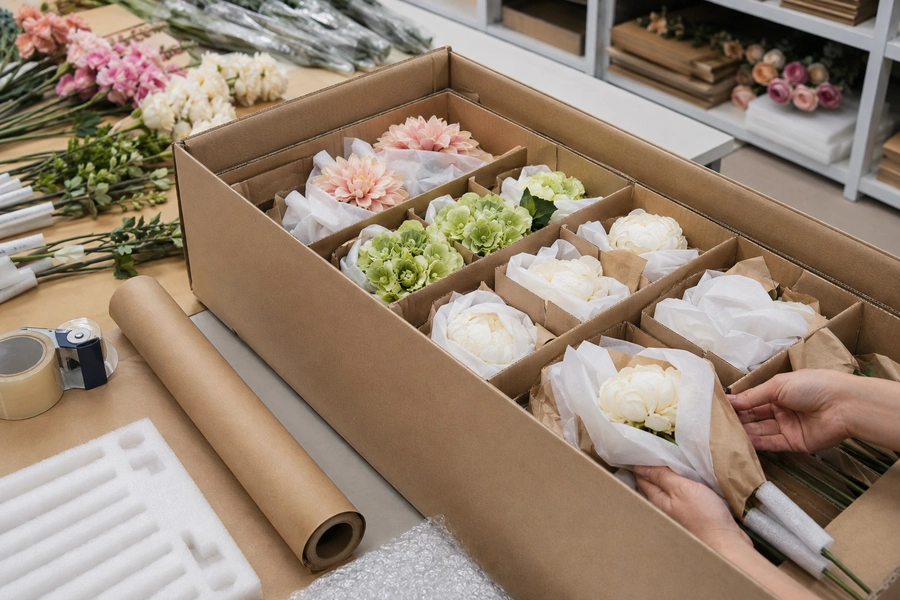
“Damage-proof” should be treated as a packaging target rather than an absolute guarantee. The strongest package transfers shipping forces into the carton, dividers, trays, stem anchors, and cushioning—not into delicate petals, flower centers, wires, or glued joints.
Why Do Artificial Flowers Get Damaged During Shipping?
Artificial flowers are lightweight but structurally irregular. Their long stems act as levers, while broad blooms and detailed flower centers are vulnerable to pressure from several directions.
Shipping damage occurs when flowers move inside the carton, heavy stems strike petals, blooms carry stacking pressure, or the box lacks enough strength. Compression, vibration, drops, temperature changes, moisture, and careless unpacking can turn small packaging weaknesses into crushed petals, detached heads, bent wire, and visible surface marks.
ISTA identifies shock, vibration, compression, temperature, and humidity among the distribution hazards that packaged products may need to withstand. Its guidance recommends designing and testing packaging around the actual hazards expected during transport.
The Main Flower-Shipping Failures
| Damage | Common Cause | Better Packaging Control |
|---|---|---|
| Flattened flower heads | Lid or neighboring products press on petals | Rigid head clearance and support collars |
| Permanent petal creases | Tight wrapping or overfilled cartons | Loose tissue cradles and correct carton depth |
| Detached blooms | Stem movement repeatedly stresses the joint | Stem anchors and individual head protection |
| Bent stems | Long stems are unsupported | Full-length backing board or stem channel |
| Scratched real-touch coating | Petals rub against plastic or each other | Soft interleaving and material separation |
| Dark marks on pale flowers | Color transfer or dirty packaging | Separate colors and use clean neutral materials |
| Crushed lower layer | Flowers are stacked without rigid trays | Load-bearing dividers |
| Damp or musty product | Moisture is sealed inside | Dry packing and controlled inner protection |
| Spilled accessories | Moss, stones, leaves, or flower heads are loose | Sealed component bags |
| Carton collapse | Weak board or excessive stacking | Correct carton grade and compression testing |
A carton that looks full may still allow damaging movement. A carton that looks spacious may still crush blooms if the product is unsupported and falls against the walls.
What Is the Best Way to Package Artificial Flowers?
The best method separates three jobs: holding the stems, protecting the flower heads, and carrying the external shipping load.
Anchor stems to a rigid base or tray, create pressure-free space around every bloom, and use a strong outer carton that carries stacking forces. Add dividers or fitted void fill so the flower unit cannot slide, rotate, or strike the carton during normal handling.
FedEx advises choosing a box that is strong enough for the product and large enough for cushioning. Its fragile-item guidance also emphasizes restricting movement and, for high-risk products, using an inner box surrounded by cushioning inside a second carton.
UPS similarly recommends wrapping items separately and using cushioning to protect them during shipment.
The Four-Layer Flower Package
| Layer | Function |
|---|---|
| Product contact layer | Prevents abrasion, color transfer, and snagging |
| Flower support layer | Holds blooms and stems in their intended shape |
| Internal restraint layer | Stops movement within the carton |
| Shipping carton | Carries impact, compression, labels, and sealing |
Bubble wrap, paper, tissue, corrugated board, and foam are not interchangeable. Each material should perform a defined job.
What Are the 13 Damage-Proof Packing Hacks?
The strongest process begins before any flower enters the box.
The 13 hacks are to inspect and document the flowers, sort compatible products, bundle stems correctly, reinforce long stems, cradle large blooms, protect flower centers, use rigid trays, select the correct carton, fill voids without compression, double-box fragile orders, control moisture, seal and label accurately, and validate the package through realistic shipping tests.
Hack 1: Inspect, Clean, and Photograph Every Order
Dust, loose petals, damaged wire, and weak glue joints should be found before the carton is sealed.
Inspect every artificial flower under bright light, remove loose dust, reshape shipping-ready stems, and photograph the approved condition. Separate defective or unstable products instead of relying on packaging to conceal existing damage.
Record:
- SKU
- Color
- Stem length
- Flower-head diameter
- Quantity
- Material
- Batch
- Visible defects
- Approved shape
- Carton assignment
Photograph pale flowers against a neutral background so marks and edge damage remain visible.
For high-value orders, include:
- One full-order image
- One image of each bundle
- One open-carton image
- One sealed-carton image
- Carton label and weight
Afloral advises customers to retain clear photographs of damaged products and the shipping carton when reporting delivery issues. Building the same evidence before dispatch creates a useful comparison if a claim arises.
Do Not Ship Flowers That Are Already Unstable
Remove or repair products with:
- Loose flower heads
- Cracked calyxes
- Exposed wire
- Detached leaves
- Sticky coatings
- Severe folds
- Visible glue strings
- Split stems
- Wet surfaces
- Strong unexplained odor
Transit vibration will usually worsen an existing weak connection.
Hack 2: Separate Flowers by Material, Color, and Shape
Soft peonies, rigid branches, flocked leaves, glittered sprays, and real-touch roses should not share one unrestricted cavity.
Pack compatible flower types together. Separate pale colors from dark pigments, soft fabric petals from hard molded foliage, and sticky or textured coatings from smooth flowers. Use clean neutral interleaving so products cannot rub, stain, or snag one another.
Recommended groups include:
- White and ivory flowers
- Pale pastels
- Deep saturated colors
- Real-touch flowers
- Glittered products
- Flocked or velvet products
- Rigid plastic foliage
- Long wired branches
- Heavy flower heads
- Loose accessories
The Canadian Conservation Institute recommends unbuffered acid-free tissue, clean cotton, polyester fill, and compatible foam as support materials for delicate three-dimensional objects and textile accessories. Applying that principle to artificial flowers, clean neutral tissue can reduce abrasion and support delicate petal forms without tight compression.
Avoid Direct Contact Between:
- Black leaves and ivory petals
- Glitter stems and soft fabric
- Sharp plastic branches and real-touch coatings
- Painted berries and white flowers
- Exposed wire and any visible petal
- Adhesive surfaces and tissue
Material separation prevents minor motion from becoming visible shipping damage.
Hack 3: Bundle Stems Without Compressing the Blooms
Loose stems slide, cross, and strike one another. Over-tight bundles create a different problem: flower heads are pulled into one dense compressed mass.
Group stems at the lower third with soft reusable ties, paper bands, or protected fasteners. Keep flower heads staggered and open rather than forcing them into one level. The bundle should move as one controlled unit without squeezing petals or marking stem coatings.
Better Stem-Bundle Method
- Align the lower cut ends.
- Turn flower heads in alternating directions.
- Stagger bloom heights.
- Place a soft tie around the lower stems.
- Add a second loose tie at mid-stem where needed.
- Check that no fastener touches visible petals.
- Attach the bundle to a rigid backing board or tray.
Avoid rubber bands because they may tighten, break, or mark coatings.
Avoid adhesive tape directly on stems unless the supplier has confirmed that the surface can tolerate it.
Bundle Size
Smaller bundles are safer than one oversized bunch.
For example, twenty roses may be better divided into:
- Four bundles of five
- Two protected tray levels
- Alternating flower directions
This reduces the weight carried by any one flower head and makes counting easier.
Hack 4: Reinforce and Immobilize Long Stems
Long wired stems can bend sharply when the carton is dropped or stood on end.
Secure long stems to a full-length corrugated board, rigid channel, or fitted tray. Restrain the lower and middle stem sections so the flowers cannot slide lengthwise. Leave enough soft clearance around the flower heads for natural recovery.
Suitable reinforcement includes:
- Double-wall corrugated pads
- Honeycomb board
- Molded pulp channels
- Reusable plastic trays
- Foam stem blocks
- Paperboard sleeves
- Corrugated corner rails
The support should be slightly longer than the exposed stem structure.
Two-Point Stem Control
Use:
- A lower anchor near the stem ends
- A middle restraint below the flower heads
One restraint point may allow the bundle to pivot like a lever.
For blossom branches and delphiniums, add several soft intermediate loops so side branches cannot whip across neighboring products.
Do not bend long stems into sharp angles merely to fit a shorter carton. A broader carton may cost more, but permanent wire kinks create labor, rejects, and customer complaints.
Hack 5: Cradle Large Flower Heads With Loose Tissue Supports
Peonies, hydrangeas, dahlias, magnolias, orchids, and garden roses need shape support without surface pressure.
Form loose rings, nests, or side supports from unbuffered acid-free tissue. Support the bloom beneath the outer petals and beside the flower head so it cannot roll. Do not wrap the flower tightly or push tissue deeply into delicate centers.
CCI guidance recommends lightly stuffing three-dimensional textile objects with acid-free tissue to retain their shape. It also recommends interleaving and padding raised areas rather than allowing pressure to flatten them. This is a useful conservation principle for soft artificial petals.
Tissue-Cradle Method
- Place a loose tissue collar below the flower head.
- Add a second support beside the bloom.
- Leave the upper petals free.
- Keep tissue away from sticky surfaces.
- Check that the flower cannot rotate.
- Confirm that the carton lid remains above the tallest petal.
The tissue should fill space around the bloom—not force the bloom into a smaller shape.
Do Not Substitute:
- Newspaper
- Printed tissue
- Colored gift tissue
- Shredded paper touching petals
- Rough recycled paper
- Adhesive-backed paper
Ink, dye, dust, and rough fibers may mark pale flowers.
Hack 6: Shield Delicate Flower Centers
Open flowers such as anemones, poppies, orchids, daisies, and lilies expose their most fragile construction at the center.
Use a light protective collar, raised divider, or custom cutout around the flower center. Keep all packaging above or beside the center rather than pressing directly against stamens, artificial pollen, resin details, or glued parts.
A flower-center protector may be made from:
- Die-cut corrugated board
- Folded paperboard ring
- Molded pulp
- Soft foam collar
- Tissue-supported paper cup
- Reusable plastic cavity tray
The protector should rest on a strong structural area such as the stem, calyx, tray, or surrounding divider.
It should not rest on:
- Petal edges
- Artificial stamens
- Loose pollen
- Thin fabric
- Glued decoration
Use Individual Cavities for Premium Blooms
One flower per cavity is appropriate for:
- Premium orchids
- Bridal bouquet focal flowers
- Large magnolias
- Real-touch calla lilies
- Delicate poppies
- Hand-finished display flowers
Individual protection costs more but may reduce claims and reshaping time for high-margin products.
Hack 7: Use Rigid Trays and Load-Bearing Dividers
Soft paper between layers reduces rubbing but cannot carry the weight of the flowers above it.
When a carton contains more than one flower layer, place each level on a rigid tray or divider that transfers load to the carton walls. The lower flowers should not support the tray, stems, or blooms above them.
The Canadian Conservation Institute advises placing heavier items below lighter ones and using interleaving when layering cannot be avoided. For shipping artificial flowers, the critical addition is a rigid structural divider that carries the load to the carton perimeter.
Effective Tray Features
- Rigid flat surface
- Side tabs or rails
- Stem channels
- Head cavities
- Finger openings
- Product labels
- Correct orientation
- No sharp cut edges
The tray should not bow when the expected upper load is applied.
Separate Heavy and Light Products
Place:
- Heavy planters and accessories in separate cartons
- Rigid branches below or beside delicate flowers
- Small flower heads in compartment trays
- Long stems against structural sides
- Loose components in sealed boxes or bags
Never place ceramic vases, stones, tools, or metal frames above exposed petals.
Hack 8: Choose a Strong Box With Correct Clearance
A box that is too small crushes flowers. A box that is too large allows the contents to accelerate before hitting the wall.
Choose a rigid carton that fits the supported flower unit and leaves controlled space for cushioning. The box should resist the expected stacking load, keep every petal clear of the walls and lid, and remain practical for the carrier’s handling system.
FedEx advises selecting a sturdy box that supports the item’s weight and provides room for cushioning. UPS also emphasizes appropriate boxes, separate wrapping, cushioning, sealing, and labeling.
Box-Fit Test
A properly fitted carton passes when:
- The flowers do not touch the lid
- Bloom edges do not touch sidewalls
- The stem unit cannot slide
- Internal trays do not bow
- Empty space is controlled
- The carton closes without pressure
- The box remains square after sealing
Use New or Verified Cartons
Previously used boxes may have:
- Crushed corners
- Moisture damage
- Weak seams
- Removed surface fibers
- Old labels
- Contamination
- Unknown stacking history
Reuse can be practical, but the box must still meet the package’s protection requirements.
For large wholesale orders, specify:
- Board grade
- Flute type
- Internal dimensions
- Maximum gross weight
- Stacking orientation
- Carton compression requirement
- Pallet pattern
Hack 9: Fill Empty Space Without Pressing the Petals
Void fill should stop motion. It should not become a hidden compression layer.
Place cushioning around the rigid flower unit, stem board, trays, and empty carton zones. Never stuff loose paper, air pillows, foam, or packing peanuts directly onto unsupported flower heads. Apply the shake test only after ensuring the blooms remain pressure-free.
FedEx’s packaging guidance stresses restricting product movement and using adequate cushioning. UPS recommends at least two inches of loose filler around suitable lightweight items but notes that loose filler is less effective for narrow items that can migrate through it.
Better Void-Fill Locations
Place cushioning:
- Beneath the rigid tray
- Beside the stem board
- Between the inner and outer carton
- Around non-visible structural sections
- At carton corners
- Above rigid head-protection rails
Do not place loose cushioning:
- Inside open roses
- Against artificial pollen
- Between sticky petals
- Directly over soft flower heads
- Around exposed glue
- Where it can migrate into the product
The Gentle Shake Test
After sealing the inner package:
- Lift it safely.
- Move it gently in each direction.
- Listen for sliding or loose accessories.
- Reopen if significant movement is detected.
- Add structural restraint rather than compressing more paper against petals.
No movement is desirable, but zero movement should come from fitted restraint—not excessive force.
Hack 10: Double-Box Fragile or High-Value Arrangements
A finished bridal bouquet, artificial-water arrangement, premium orchid, or delicate mixed-material design may need an inner presentation box and a separate shipping carton.
Place the fully restrained flower package inside a second strong carton with cushioning on every side. Center the inner box so it cannot contact the outer walls during impact. The outer carton absorbs transport abuse while the inner box maintains the flower’s shape.
FedEx recommends double-boxing fragile items and surrounding the inner package with approximately three inches of cushioning. UPS likewise describes an outer carton with space around an internal container for effective double-boxing.
Double-Boxing Is Strongest For:
- Finished wedding bouquets
- Floral cake toppers
- Premium orchids
- Resin or artificial-water arrangements
- Large delicate magnolias
- Customer-ready gift boxes
- International parcel shipping
- Replacements that cannot be delayed
- Products with fragile vases
Keep the Inner Box Rigid
The inner package still needs:
- Stem restraint
- Flower-head protection
- Internal dividers
- A moisture barrier where appropriate
- Opening instructions
Double-boxing does not correct poor inner packaging.
Hack 11: Control Moisture Without Trapping It
Artificial flowers do not require refrigeration, but moisture can still affect fabric, dyes, wire, adhesives, paper wrapping, foam, and packaging strength.
Pack only completely dry products. Use clean inner protection appropriate to the material and shipping route, but do not seal damp flowers inside airtight plastic. Keep cartons away from wet floors, rain, condensation, leaking freight, and high-humidity storage before dispatch.
CCI notes that packaging materials can be layered to cushion objects and that tissue or kraft paper may help buffer short-term humidity changes inside protective wrapping. Its shipment guidance also emphasizes matching packaging to the object and transport environment.
Moisture-Control Checklist
- Flowers are dry
- Cartons are dry
- Tissue is clean and dry
- No wet glue is present
- No recently washed stones or moss are included
- Inner bags have no condensation
- Desiccant is used only when justified and compatible
- Cartons are stored above the floor
- Export pallets are protected from rain
- Container loading occurs under controlled conditions
Plastic Bags
A loose clean bag may protect against dust or incidental moisture, but it cannot protect petals against compression.
Avoid:
- Vacuum bags
- Tight heat-shrink around flower heads
- Damp products in sealed liners
- Strongly scented plastic
- Sticky recycled bags
- Direct plastic pressure against real-touch coatings
For long international routes, test the complete inner packaging after realistic temperature and humidity conditioning.
Hack 12: Seal, Label, and Document the Carton Correctly
Weak sealing can undo careful internal packing.
Seal every major carton seam with suitable shipping tape and apply labels to a clean flat surface. Mark orientation, product code, quantity, carton number, and any required handling information. Place duplicate delivery and identification information inside the package.
UPS advises using appropriate packaging materials and securely sealing and labeling packages. USPS has also historically advised clear addressing and prominent fragile identification for breakable materials, although a “Fragile” label should never replace adequate protective packaging.
Useful Carton Markings
- Consignee
- Delivery address
- Purchase-order number
- Product code
- Carton 1 of 10
- Gross weight
- Dimensions
- Country of origin where required
- This Side Up
- Do Not Crush
- Keep Dry
- Do Not Clamp where appropriate
- Opening instructions
- Batch number
Add Unpacking Instructions
Place a card immediately beneath the lid:
- Open only from the marked side.
- Do not use a deep knife.
- Remove upper supports first.
- Lift flowers by the stems or tray.
- Do not pull the flower heads.
- Allow petals to recover.
- Reshape wired stems according to the guide.
- Photograph damage before discarding packaging.
Afloral notes that faux flowers packed for shipping can often be reshaped by opening petals, leaves, and wired stems after unpacking. Clear instructions distinguish normal recovery from actual transit damage.
Hack 13: Test the Complete Package Before Scaling Production
A packaging design is not validated because one sample survives a careful hand delivery.
Pack a production-representative order and evaluate it under expected compression, vibration, drop, impact, orientation, temperature, and humidity conditions. Inspect both the flowers and packaging afterward, then revise the weak point before using the design for bulk or e-commerce shipments.
ISTA package-testing programs are designed to evaluate packaged products against hazards such as shock, vibration, compression, handling, and atmospheric conditions. ISTA also offers testing frameworks for parcel and e-commerce distribution systems.
Minimum Internal Trial
Before laboratory testing, a business can conduct a controlled internal review:
- Hold the packed box in all approved orientations
- Apply the expected stacked weight
- Perform a controlled handling trial
- Move the carton through a representative warehouse route
- Simulate repeated parcel movement
- Leave the box packed for the expected storage period
- Inspect flower recovery after unpacking
Internal trials do not replace standardized laboratory testing where claims, risk, customer requirements, or shipment scale justify professional evaluation.
Post-Test Inspection
Check:
- Flower-head shape
- Petal creases
- Surface abrasion
- Color transfer
- Detached components
- Stem straightness
- Glue joints
- Tray movement
- Tissue displacement
- Carton deformation
- Seal condition
- Moisture
- Unpacking time
- Reshaping labor
A package passes only when both the product and the customer’s unpacking experience remain acceptable.
How Should You Pack Different Artificial Flower Types?
Different botanical forms create different packaging risks.
Flower-Type Packing Guide
| Flower Type | Main Risk | Recommended Protection |
|---|---|---|
| Garden rose | Outer-petal compression | Loose tissue collar |
| Peony | Large bloom flattening | Individual head cradle |
| Hydrangea | Cluster crushing | Rigid cavity or wide head clearance |
| Orchid | Center and branch damage | Custom channel and center shield |
| Poppy | Thin petal creasing | Individual cavity, minimal contact |
| Tulip | Surface marks and curved-stem distortion | Soft sleeve and curved stem support |
| Magnolia | Heavy head and broad-petal pressure | Rigid tray and side support |
| Delphinium | Long stem bending | Full-length board and several restraints |
| Cherry blossom | Side-branch breakage | Wide carton with branch channels |
| Wisteria | Tangling | Loose broad coils with tissue interleaving |
| Garland | Sharp folds | Wide-core rolling or large loose curves |
| Bridal bouquet | Shape collapse | Upright inner box with handle holder |
| Wreath | Decorated face compression | Flat rigid case with frame support |
How Do You Pack a Finished Artificial Bouquet?
Finished bouquets should normally travel upright because their designed shape concentrates around a handle.
Secure the bouquet handle inside a rigid holder so the flower heads remain suspended without touching the box. Add loose tissue supports around vulnerable outer blooms, protect the ribbon, and use a rigid inner box with sufficient overhead and side clearance.
Upright Bouquet Method
- Photograph the finished bouquet.
- Wrap or protect the handle.
- Insert it into a fitted handle opening.
- Lock the holder to the box base.
- Add soft side cradles around outer flowers.
- Keep the top completely pressure-free.
- Protect ribbons from tape and dirty board.
- Place the bouquet box inside a shipping carton where necessary.
Do not lay a heavy bridal bouquet on its side unless the package includes a full-form cavity supporting the bouquet without loading the petals.
How Do You Pack Long Artificial Stems?
Long stems should remain supported over most of their length.
Place long flowers in alternating directions on a rigid board or inside divided channels. Restrain the lower and middle stems, protect both ends, and ensure that large flower heads cannot strike neighboring stems or the carton wall.
For efficient use of space:
- Alternate head direction
- Stagger bloom positions
- Use shallow layers
- Add rigid dividers
- Keep heavy blooms away from delicate flowers
- Avoid sharp stem folds
Do not cut reusable stems solely to reduce freight unless the customer has approved the shorter specification.
How Do You Pack Artificial Flower Garlands and Vines?
Garlands should be packed in broad curves, not sharp folds.
Coil flexible garlands loosely around a wide core or arrange them in large supported loops. Interleave delicate flowers, secure the central vine with soft ties, and place the complete coil inside a rigid box that prevents flattening.
CCI recommends wide rolling and interleaving for flexible textiles because tight folds and unsupported raised areas can create damaging creases and pressure. This principle translates well to flower garlands containing flexible vines and fabric petals.
Attach ties to the structural vine—not around the flower heads.
Should You Use Bubble Wrap on Artificial Flowers?
Bubble wrap is useful around structural components and inner boxes, but direct petal contact can be problematic.
Use bubble cushioning around rigid trays, planters, vases, and inner cartons. Avoid wrapping delicate petals tightly because bubble patterns may mark soft coatings, compress layered flowers, or trap moisture. Place a clean compatible barrier between the flower and plastic when necessary.
FedEx recommends air-cellular cushioning for fragile products, particularly as part of individual protection or double-boxing. For artificial flowers, the practical interpretation is to apply it around the structure carrying the product rather than forcing it directly against unsupported petals.
Should You Use Packing Peanuts?
Loose fill can cushion empty spaces but may migrate between flowers.
Use loose fill only outside a closed inner tray, flower box, or protective sleeve. Do not pour packing peanuts directly over open blooms, adhesive flower centers, real-touch petals, or tangled branches.
UPS notes that loose filler is less effective for flat or narrow items that may move through it. Artificial stems present the same migration risk, so a contained flower unit should be established before loose fill is added.
Loose fill may also complicate unpacking and increase static cling around synthetic flowers.
What Should You Never Put Directly Against Artificial Petals?
Avoid materials that are rough, colored, adhesive, oily, dirty, or tightly compressed.
Direct-Contact Materials to Avoid
- Printed newspaper
- Colored tissue
- Pressure-sensitive tape
- Sticky labels
- Rubber bands
- Rough recycled paper
- Loose packing peanuts
- Unclean bubble wrap
- Strongly scented plastic
- Oily foam
- Glittered accessories
- Bare metal staples
- Sharp corrugated edges
- Desiccant packets resting on petals
The first contact layer should be clean, smooth, neutral, and compatible with the flower surface.
Shipping Quality-Control Checklist
| Inspection Point | Pass Requirement |
|---|---|
| Product condition | Clean, dry, complete, stable |
| Stem bundles | Controlled without compression |
| Flower heads | Supported with clear space |
| Materials | Compatible products separated |
| Trays | Rigid and load-bearing |
| Internal movement | No damaging sliding or rotation |
| Carton | Strong, square, correctly sized |
| Moisture control | No damp materials or condensation |
| Sealing | All major seams secured |
| Labels | Complete and readable |
| Documents | Packing list and instructions included |
| Test result | Product remains within acceptance limits |
My Insights: How to Pack Artificial Flowers for Shipping—Which 13 Damage-Proof Hacks Work Best
The best artificial-flower packaging does not try to make petals stronger. It builds a temporary transport structure that prevents the petals from carrying forces they were never designed to carry.
The 13 strongest hacks combine product inspection, material separation, controlled stem bundles, full-length reinforcement, bloom cradles, center shields, rigid trays, correctly sized cartons, restrained void space, double-boxing, moisture control, accurate labeling, and realistic package testing. Together, they reduce crushing, abrasion, detachment, and unpacking labor.
The 13-Hack Summary
| Hack | Main Damage Prevented |
|---|---|
| 1. Inspect and photograph | Disputes and pre-existing defects |
| 2. Separate materials and colors | Abrasion and color transfer |
| 3. Bundle stems correctly | Tangling and uncontrolled movement |
| 4. Reinforce long stems | Bends and leverage damage |
| 5. Cradle large blooms | Petal crushing |
| 6. Shield flower centers | Broken decorative details |
| 7. Use rigid trays | Layer-to-layer compression |
| 8. Select the correct box | Wall contact and carton collapse |
| 9. Fill voids structurally | Sliding and impact |
| 10. Double-box fragile orders | External shock and puncture |
| 11. Control moisture | Odor, staining, and weakened packaging |
| 12. Seal and label properly | Opening and handling errors |
| 13. Test the package | Repeated production failures |
My Best Overall Packing System
For most wholesale artificial stems, I use:
- Approved clean flowers
- Small staggered stem bundles
- Soft lower-stem ties
- A full-length corrugated backing board
- Loose tissue supports around major blooms
- A rigid head-clearance rail
- A fitted inner carton
- Structural void fill around—not on—the flowers
- A strong sealed outer carton where risk justifies it
- Clear unpacking instructions
This system controls both movement and compression.
The Most Important Space-Saving Rule
Save space by alternating stems, using shallow trays, and designing fitted channels.
Do not save space by pressing large blooms together.
A carton with ten percent more volume may be cheaper than a smaller carton that creates:
- Permanent creases
- Customer returns
- Replacement freight
- Reshaping labor
- Lost event deadlines
- Negative reviews
The Most Important Support Rule
Support the strongest component available.
That is usually:
- The lower stem
- A rigid backing board
- The calyx area
- A bouquet handle
- A wreath frame
- A garland’s central vine
- A tray
- The carton wall
It is rarely the visible petal.
The Most Important Testing Rule
Test the packaged product, not only the carton.
A strong box can survive while its unsupported flowers crush internally. A package test should therefore evaluate:
- Product condition
- Carton condition
- Internal movement
- Unpacking process
- Reshaping time
- Customer acceptance
ISTA’s testing approach reflects this packaged-product concept: the item and its packaging are evaluated together against expected distribution hazards.
The Best System for E-Commerce
For direct-to-consumer flowers, prioritize:
- Simple opening
- Individually controlled stems
- Clear reshaping guidance
- Limited loose fill
- Strong outer protection
- Photographic evidence
- Test results reflecting parcel distribution
E-commerce packages may experience repeated handling without pallet protection, making internal restraint particularly important.
The Best System for Wholesale Cartons
For bulk B2B shipping, prioritize:
- Standard bundle counts
- Product-level labels
- Layered rigid trays
- Alternating stem directions
- Carton compression strength
- Pallet stability
- Container utilization
- Batch traceability
- Incoming inspection instructions
Do not maximize carton quantity without measuring damage and recovery labor.
My Final Damage-Proof Rule
Use this sequence:
- Inspect the flowers.
- Separate incompatible materials.
- Control the stems.
- Support the bloom shapes.
- Protect delicate centers.
- Transfer layer weight into rigid trays.
- Prevent internal movement.
- Keep petals away from carton walls.
- Control moisture.
- Seal and label every package.
- Provide safe unpacking instructions.
- Test the complete package.
- Improve the weakest failure point before scaling.
When the packaging structure—not the flowers—absorbs compression, vibration, and impact, artificial stems arrive with fewer crushed petals and less reshaping.
Conclusion
Anchor stems, cradle blooms, use rigid trays, eliminate internal movement, protect against moisture, and test the complete package before shipping artificial flowers at scale.