
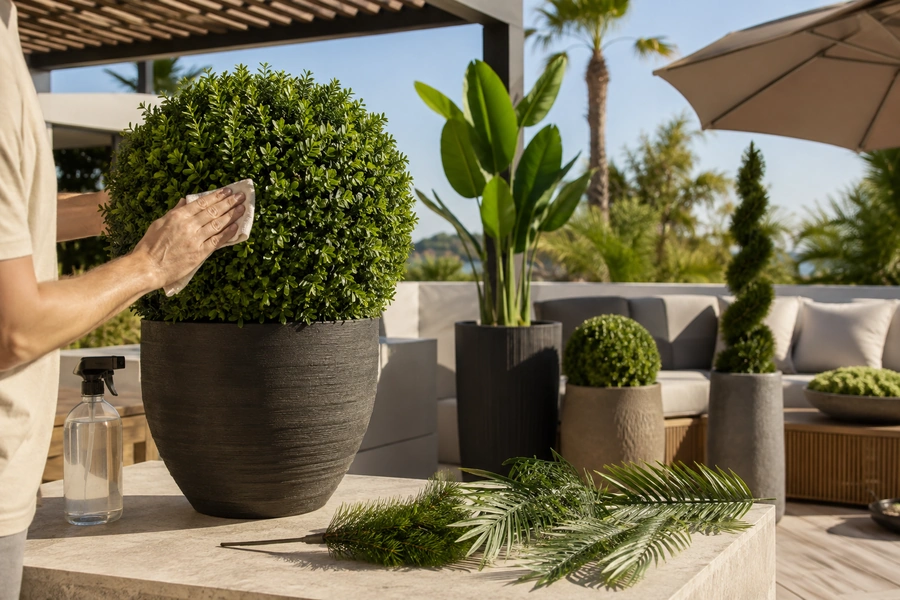
Outdoor fake plants may stay green for months, then suddenly reveal pale leaves, brittle stems, chalky surfaces, and mismatched replacement branches.
To protect fake plants outside from fading, begin with verified outdoor-safe foliage, reduce direct and reflected sunlight, add shade, rotate exposed surfaces, clean away abrasive residue, and apply only compatible UV protectants. Seasonal removal, heat control, modular replacements, and documented inspections extend usable appearance further.
No artificial plant is permanently sun-proof. UV stabilizers, pigments, coatings, shade, and maintenance can slow deterioration, but exposure continues to accumulate whenever the product remains outdoors.
Why Do Fake Plants Fade Outside?
Artificial plants do not wilt from lack of water, but their polymers, pigments, coatings, adhesives, and textile components still respond to sunlight and heat.
Fake plants fade when ultraviolet radiation changes pigments and materials faster than their protection system can resist. Heat, moisture, dust, salt, cleaning chemicals, reflected sunlight, and repeated weather cycles may accelerate visible deterioration or expose weaknesses in adhesives, wires, coatings, and leaf attachments.
ISO 4892-3:2024 describes laboratory exposure of plastic specimens to fluorescent UV radiation, heat, and water to simulate important aspects of outdoor or window-filtered weathering. ASTM G154-23 similarly establishes procedures for exposing materials in fluorescent UV apparatus under controlled conditions. These standards provide comparative testing methods; they do not convert automatically into a guaranteed number of outdoor years.
Common Outdoor Failures
| Visible Failure | Likely Contributing Factors |
|---|---|
| Pale upper leaves | Uneven direct-sun exposure |
| Blue-green leaves turning yellow | Pigment or stabilizer deterioration |
| Chalky surface | Polymer or coating weathering |
| Brittle foliage | UV exposure, heat, or aging |
| Sticky leaves | Coating response to heat or cleaner |
| Cracked stems | Material aging and movement |
| Loose leaves | Adhesive or mechanical-connection failure |
| One-sided fading | Fixed orientation toward the sun |
| Dark dust layer | Pollution, soil, smoke, or traffic residue |
| Different replacement color | Batch variation or aged surrounding foliage |
Fading is only one form of failure. A plant may retain acceptable color while becoming brittle, glossy, sticky, warped, or structurally weak.
Can You Completely Stop Artificial Plants from Fading?
No outdoor protection method eliminates every effect of sunlight.
You can slow fading substantially by specifying UV-resistant products, controlling exposure, and maintaining them correctly. However, “UV-resistant,” “UV-treated,” and “outdoor-safe” describe improved resistance—not permanent immunity. Product lifespan varies with location, orientation, climate, color, material, maintenance, and exposure intensity.
Nearly Natural currently explains that UV-resistant products use treated materials intended to reduce fading, brittleness, and cracking. Its own care guidance also states that UV resistance does not mean permanent fade prevention.
Balsam Hill likewise distinguishes outdoor-safe, UV-protected products from ordinary indoor artificial plants and recommends limiting the outdoor display period for some of its protected collections. Those instructions are product-specific rather than universal guarantees.
What “Sun-Proof” Should Mean
For a responsible buyer, sun-proof means:
- The product was selected for outdoor exposure
- Relevant test evidence was reviewed
- Direct exposure was reduced where practical
- Maintenance instructions were followed
- Color and condition were inspected
- Replacement components were planned
- Severe seasonal exposure was limited
It should never mean “will never fade.”
What Are the 11 Best Tricks for Protecting Fake Plants Outside?
The strongest strategy combines product specification with exposure management. A spray alone cannot rescue an indoor plant permanently placed in extreme sun.
The 11 best tricks are to buy outdoor-safe plants, verify UV evidence, choose durable colors and materials, map the sun path, create shade, reduce reflected exposure, rotate the display, use approved UV spray, clean gently, control heat and weather duration, and monitor fading with reference samples and modular replacements.
Quick Comparison
| No. | Sun-Proof Trick | Primary Benefit |
|---|---|---|
| 1 | Buy genuine outdoor-safe plants | Starts with suitable materials |
| 2 | Verify finished-product UV evidence | Filters weak marketing claims |
| 3 | Choose durable colors and constructions | Makes aging less obvious |
| 4 | Map direct-sun exposure | Identifies the highest-risk position |
| 5 | Add physical shade | Reduces accumulated radiation |
| 6 | Control reflected sunlight | Prevents hidden secondary exposure |
| 7 | Rotate plants and modules | Balances one-sided fading |
| 8 | Apply compatible UV protectant | Renews some surface protection |
| 9 | Remove dust and residue safely | Preserves appearance and coating |
| 10 | Reduce heat and seasonal exposure | Protects adhesives and polymers |
| 11 | Inspect against a retained reference | Finds deterioration before total failure |
Trick 1: Buy Plants Specifically Labeled for Outdoor Use
An indoor fake plant does not become an outdoor plant merely because it is made from plastic.
Select products explicitly identified as outdoor-safe, outdoor-rated, or UV-resistant by the manufacturer. Confirm whether the description permits full sun, partial sun, covered outdoor use, or only temporary seasonal display. Follow the limits for the exact SKU rather than applying one brand-level statement to every plant.
Balsam Hill advises buyers to look for an outdoor-safe label and UV protection when placing artificial plants outside. It separately warns that products not made for exterior conditions should not be left in direct sunlight and rain.
Nearly Natural likewise distinguishes UV-resistant outdoor foliage from standard indoor products and recommends checking the product title or specifications for the applicable outdoor designation.
Ask the Supplier These Questions
- Is this exact product suitable for full sun?
- Is protection integral or surface-applied?
- Were the finished leaves or only raw materials tested?
- Does the rating include fabric flowers?
- Are the stems and adhesives also outdoor compatible?
- Is the product intended for year-round exposure?
- What maintenance is required?
- What exposure invalidates the warranty?
- Are replacement branches available?
- Does cutting or reshaping affect the protection?
Watch for Vague Labels
Treat these descriptions cautiously:
- Weather-inspired
- Garden style
- Patio look
- Suitable for bright spaces
- Fade-conscious
- Commercial quality
- Durable greenery
- All-season appearance
None of these phrases necessarily confirms outdoor suitability.
Trick 2: Verify UV Testing Instead of Trusting the Label
A UV-protected claim is more useful when the buyer can see what was tested and how performance was assessed.
Request the test method, edition, exposure cycle, duration, specimen description, exact colors, evaluation criteria, laboratory, and test result. Confirm that the report represents the production leaves, flowers, stems, coatings, and pigments supplied—not an unrelated plastic plaque or generic material.
ISO 4892-3:2024 covers methods for exposing plastic specimens to fluorescent UV radiation, heat, and water. ASTM G154-23 covers the operation of fluorescent UV lamp apparatus for material exposure. Neither standard independently selects the correct exposure cycle or declares a universal acceptable amount of fading for an artificial plant.
UV Report Checklist
| Report Detail | Buyer Question |
|---|---|
| Standard | Which method and edition were used? |
| Specimen | Was the finished leaf or raw resin tested? |
| Color | Were every ordered color and pigment tested? |
| Cycle | What UV, temperature, moisture, and condensation cycle applied? |
| Duration | How long was the specimen exposed? |
| Measurement | Was color change measured objectively? |
| Other damage | Were cracking, chalking, gloss, and brittleness assessed? |
| Laboratory | Who completed the test? |
| Production link | Does the report cover the purchased batch? |
| Acceptance limit | What result counts as commercially acceptable? |
Do Not Convert Test Hours into Years Carelessly
A statement such as “2,000 test hours equals five outdoor years” requires a defensible correlation between:
- Laboratory spectrum
- Test cycle
- Material
- Color
- Moisture
- Temperature
- Actual climate
- Installation orientation
- Acceptance criteria
Without that correlation, accelerated-weathering hours are best used to compare samples tested under the same conditions.
Trick 3: Choose Colors and Materials That Age Gracefully
All artificial colors do not show weathering in the same way.
Choose layered botanical greens, matte finishes, mixed leaf tones, and plant forms that naturally include variation. Avoid one flat, highly saturated color across a large repeated surface. A design containing several related greens can remain visually acceptable longer than a perfectly uniform hedge or floral wall.
More Forgiving Visual Choices
- Olive trees with gray-green leaves
- Eucalyptus with mixed muted tones
- Boxwood containing several greens
- Grasses with green and brown variation
- Bougainvillea with layered color
- Variegated foliage
- Small-leaf shrubs
- Agave with natural gradients
More Visually Sensitive Choices
- Bright lime-green hedges
- Pure blue-green foliage
- Dark green panels installed in identical rows
- White flowers
- Red and purple flowers
- One-color floral walls
- Products with strong artificial gloss
This does not prove that muted colors are chemically more UV-stable. It means moderate color variation can make small changes less obvious to the viewer.
Match Material to Exposure
Structured molded foliage generally provides a more practical starting point for severe exterior exposure than highly delicate silk-style petals.
Use additional caution with:
- Fine polyester petals
- Velvet finishes
- Flocking
- Foam flowers
- Glitter
- Artificial pollen
- Sticky real-touch coatings
- Paper-wrapped stems
A product must be judged as a complete assembly. A UV-stabilized leaf does not protect an untested adhesive or fabric flower attached beside it.
Trick 4: Map the Sun Before Installing the Plant
A location that appears shaded in the morning may receive several hours of intense afternoon exposure.
Observe the installation area at several times of day before fixing the planter. Record direct sunlight, window reflection, wall reflection, surface heat, seasonal sun angles, and the side of the plant receiving the greatest exposure. Place the most sensitive foliage in the least exposed zone.
The EPA notes that UV reaches outdoor surfaces even on cloudy days and that a significant portion of daytime UVB occurs during the middle of the day. Although its guidance concerns human exposure, the same exposure mapping helps identify where decorative materials receive the strongest solar load.
Create an Exposure Map
Record observations at:
- Early morning
- Midday
- Mid-afternoon
- Late afternoon
- Different seasons where possible
Classify each location as:
| Zone | Exposure |
|---|---|
| A | Covered, indirect light |
| B | Short morning or evening sun |
| C | Several hours of partial sun |
| D | Long direct exposure |
| E | Direct exposure plus reflected light and heat |
Do not automatically place the highest-quality plant in Zone E. A more durable botanical type may outperform a delicate premium flower there.
Window-Adjacent Plants Still Need Protection
Sun through glazing may differ from open outdoor exposure, but heat buildup and window-filtered radiation can still affect plastics and coatings. ISO 4892-3 explicitly includes methods intended to simulate global solar radiation or radiation filtered through window glass.
Trick 5: Add Physical Shade Before Adding More Chemicals
A roof, canopy, pergola, awning, balcony, or deep doorway can reduce the plant’s direct exposure without changing its surface.
Move fake plants beneath architectural shade whenever possible. Position them behind columns, beneath covered porches, inside recessed entrances, or under UV-managing shade structures. Confirm that the canopy actually blocks the strongest sun rather than providing shade only at one time of day.
Shade is usually a more dependable first control than repeatedly applying an unknown spray.
Useful Shade Options
- Covered porch
- Deep entrance recess
- Pergola with suitable overhead coverage
- Retractable awning
- Balcony overhang
- Exterior umbrella
- Covered restaurant terrace
- Shaded wall niche
- Freestanding canopy
- Partial screening panel
Preserve Ventilation
Do not create an enclosure that traps excessive heat around:
- Adhesives
- Dark planters
- Foam
- Coated stems
- Black artificial soil
- Electrical lighting
The objective is less radiation without creating a hotter sealed space.
Check Moving Shadows
A narrow roof edge may protect a plant in spring but leave it exposed during another season.
Take reference photographs showing the shadow position and review them when the sun angle changes.
Trick 6: Control Reflected Sunlight and Hot Surrounding Surfaces
A plant may fade while technically standing in shade because light reaches it from water, glass, pale paving, polished metal, or bright walls.
Inspect the complete exposure environment, not only the sky above the plant. Move sensitive foliage away from strongly reflective glazing, water, pale pavement, light stone, metal cladding, and mirrored surfaces. Reorient the plant or add a screen where secondary exposure is concentrated.
EPA materials explain that surfaces such as water, sand, pavement, and other bright areas can reflect UV. Applying that physical principle to outdoor décor, a shaded artificial plant beside a reflective façade or pool may receive more radiation than its position initially suggests.
High-Risk Locations
- Pool edges
- Waterfront terraces
- White stone courtyards
- Pale concrete balconies
- Reflective glass façades
- Metal-clad entrances
- Rooftops
- Mirrored walls
- Bright artificial turf surrounds
Reduce Reflection by:
- Increasing distance
- Changing plant orientation
- Adding a non-reflective screen
- Using a deeper canopy
- Selecting a more resistant product
- Removing the plant during peak seasonal exposure
Do not assume the shaded side of a glass building is a low-UV location without observation.
Trick 7: Rotate Plants to Prevent One-Sided Fading
A fixed plant often receives repeated exposure on the same leaves every day.
Rotate freestanding plants periodically so one side does not carry the complete solar load. For fixed hedges and floral walls, rotate removable panels, stems, or modules where the design permits. Record the original orientation so the approved appearance can be restored.
Nearly Natural’s current care guidance recommends occasional rotation in sunny locations to encourage more even color retention.
Practical Rotation Schedule
| Exposure | Starting Rotation Interval |
|---|---|
| Covered indirect light | Every two to three months |
| Short partial sun | Monthly |
| Daily direct sun | Every two weeks |
| Reflected high-exposure zone | Weekly inspection and rotation where practical |
| Seasonal commercial display | At each maintenance visit |
These are operational starting points, not manufacturer guarantees. Adjust the schedule after comparing the exposed and sheltered sides.
Rotate Carefully
Before moving the plant:
- Photograph its approved front.
- Check the planter weight.
- Inspect anchors and cables.
- Remove loose top dressing.
- Rotate the inner insert where possible.
- Recheck clearance and stability.
- Restore the intended branch shape.
Do not rotate a permanently anchored planter without confirming its attachment system.
Trick 8: Apply UV Protectant Only When Both Products Are Compatible
A UV-protection spray may help some artificial plants, but it can also change surface appearance and maintenance requirements.
Use only a protectant specifically approved for artificial plants and compatible with the exact plastic, fabric, coating, pigment, adhesive, and project requirements. Test a spare leaf first, apply thin even coats according to the instructions, and document the product, batch, date, and reapplication schedule.
Nearly Natural recommends a UV-resistance spray for some outdoor artificial greenery and gives six months as a product-care interval in its guidance. That schedule belongs to its products and recommended treatment; it should not be copied automatically to every artificial plant.
Before Applying a Spray, Confirm:
- Suitable materials
- Indoor or outdoor curing requirements
- Surface-cleaning instructions
- Minimum temperature
- Drying time
- Number of coats
- Recoat interval
- Gloss level
- Color effect
- Flammability information
- Fire-test implications
- Environmental and handling precautions
Complete a Patch Test
Apply the protectant to a hidden or spare component and check after full curing for:
- Darkening
- Yellowing
- Added gloss
- Stickiness
- Stiff fabric
- White residue
- Cracking
- Odor
- Glue softening
- Dust attraction
Do not spray a public installation in place without protecting people, furniture, paving, glazing, merchandise, ventilation openings, and nearby living plants.
Do Not Use Random Clear Coatings
Automotive clear coat, hairspray, furniture polish, varnish, silicone spray, and general-purpose sealers are not interchangeable with a tested artificial-plant protectant.
They may alter flexibility, color, texture, fire behavior, or cleanability.
Trick 9: Keep Dust, Salt, Grease, and Residue Off the Leaves
A dusty plant can appear faded even when its pigments remain intact.
Clean outdoor fake plants before residue becomes embedded. Use a soft brush, dry microfiber cloth, gentle cool air, or the manufacturer’s approved rinse method. Remove abrasive particles before wiping, and never apply UV protectant over dirty, damp, salty, or greasy foliage.
Balsam Hill recommends dusting or rinsing suitable outdoor-safe foliage and allowing it to air-dry, with mild soap and a soft cloth for appropriate stubborn spots. The method should still be checked against the exact product’s care instructions.
Nearly Natural recommends taking portable plants outside and using a soft paintbrush to remove accumulated dirt.
Cleaning Sequence
- Photograph the plant.
- Inspect for loose or brittle leaves.
- Brush away dry particles.
- Clean from the top downward.
- Support each leaf while wiping.
- Use water only when permitted.
- Remove all cleaner residue.
- Air-dry completely in shade.
- Inspect the coating.
- Apply protectant only after full drying.
Avoid Aggressive Cleaning
Do not use:
- Pressure washers
- Hot water
- Stiff brushes
- Abrasive pads
- Solvents
- Strong degreasers
- Bleach
- Furniture polish
- Leaf shine
- Unapproved disinfectants
Repeated harsh cleaning may damage a protective surface faster than sunlight alone.
Trick 10: Reduce Heat and Limit the Harshest Seasonal Exposure
UV resistance does not automatically equal heat resistance.
Keep artificial plants away from hot glazing, black metal, barbecue equipment, heaters, exhausts, and enclosed areas that accumulate heat. Use removable inserts so vulnerable flowers can be stored during the most severe season, storms, or long vacancy periods.
Artificial plants may contain heat-sensitive:
- Glue
- Foam
- Wire coating
- Real-touch film
- Textile sizing
- Stem wrapping
- Plastic connectors
- Paint
A leaf may retain its color while its attachment weakens.
Use Seasonal Removal
Balsam Hill recommends displaying some outdoor-safe artificial floral products outside for a limited period each year to maintain their appearance. This illustrates the value of following product-specific seasonal limits rather than assuming continuous exposure is harmless.
Removable seasonal systems work particularly well for:
- Hanging baskets
- Window-box inserts
- Door wreaths
- Floral wall panels
- Restaurant centerpieces
- Balcony planters
- Wedding installations
- Hotel entrance flowers
Store Correctly
Before seasonal storage:
- Remove dust
- Confirm the plant is dry
- Repair loose leaves
- Support the canopy
- Use a rigid container
- Store away from direct sunlight
- Avoid crushing
- Label the previous exposure side
Balsam Hill recommends cool, dry, dark storage for artificial flowers to reduce fading and moisture-related damage.
Trick 11: Inspect Against a Reference and Replace Modular Parts Early
People adapt gradually to fading and may not notice deterioration until a new replacement stem is placed beside the old one.
Retain one protected leaf, stem, panel, or approved sample as a color reference. Photograph the installed plant under consistent lighting, inspect it on a schedule, and replace small modular sections before uneven deterioration forces replacement of the entire display.
Create a Fade-Control Record
Record:
| Field | Example |
|---|---|
| Product code | UV-OLV-180 |
| Installation date | 15 March |
| Exposure zone | Partial afternoon sun |
| Approved orientation | Label facing wall |
| Protectant | Product and batch |
| Application date | 10 March |
| Cleaning interval | Every two weeks |
| Rotation interval | Monthly |
| Reference sample | Stored in maintenance room |
| First visible change | Upper west leaves |
| Replacement action | Two branch modules changed |
Inspect for More Than Color
Check:
- Fading
- Yellowing
- Chalkiness
- Gloss change
- Stickiness
- Brittleness
- Cracks
- Leaf detachment
- Exposed wire
- Adhesive failure
- Warping
- Odor
- Planter movement
A plant that has become brittle may require replacement even when the color still looks acceptable.
Use Modular Construction
For large installations, specify:
- Replaceable branches
- Removable flower stems
- Independent wall panels
- Spare matching leaves
- Detachable planter inserts
- Batch-marked replacement stock
Modularity converts one damaged zone into a repair rather than a complete disposal.
Which Fake Plants Resist Outdoor Fading Best?
No botanical type is automatically fade-proof. Construction and evidence matter more than the plant name.
The strongest starting choices are usually documented outdoor versions of structured greenery such as boxwood, agave, grasses, yucca, snake plants, small-leaf shrubs, and selected molded foliage. Delicate fabric blooms require stronger evidence and more protection, particularly in full sun.
Practical Selection Guide
| Plant Type | Outdoor Starting Potential | Main Buyer Check |
|---|---|---|
| Boxwood | High when outdoor-rated | Repeated-panel color consistency |
| Agave | High | Leaf-tip safety and brittleness |
| Yucca | High | Stem and leaf connection |
| Grass | Moderate to high | Strand fading and shedding |
| Snake plant | Moderate to high | Printed pattern and warping |
| Small-leaf shrub | Moderate to high | Adhesive and branch stability |
| Olive tree | Moderate | Fine leaves and trunk materials |
| Palm | Moderate | Frond brittleness and dust |
| Bougainvillea | Product-specific | Flower pigment and attachment |
| Hydrangea | Product-specific | Fabric fading and water retention |
| Peony | Lower for severe exposure | Delicate layered petals |
| Poppy | Lower | Thin fabric and color loss |
Balsam Hill and Afloral both distinguish outdoor-safe or UV-treated collections from their broader indoor floral ranges, reinforcing that product construction matters more than botanical appearance alone.
Does Shade Prevent All Fading?
Shade reduces direct exposure but does not create complete darkness.
Shade can slow fading, yet reflected and scattered radiation may still reach the plant. Open-sided structures, bright paving, water, glass, and changing sun angles can produce meaningful secondary exposure. Combine shade with outdoor-rated materials, rotation, cleaning, and inspection.
EPA guidance notes that UV can remain present on cloudy days and that bright surfaces can reflect radiation. Its human-exposure recommendations should not be treated as artificial-plant test data, but the underlying exposure principles help identify hidden sources of outdoor light.
A covered plant still needs review when it stands beside:
- A pool
- A glass façade
- White paving
- Metal cladding
- A bright wall
- An open western exposure
Can You Make Indoor Fake Plants Safe for Outdoor Sun?
A surface treatment may improve resistance, but it cannot guarantee that every hidden component becomes suitable for outdoor conditions.
Do not assume a UV spray converts an indoor plant into a fully outdoor-rated product. The leaves may receive additional surface protection while the glue, stem wrap, fabric, foam, wire, base, and pigments remain untested for sunlight, moisture, wind, and heat.
Use converted indoor plants only in lower-risk situations when:
- The manufacturer permits the treatment
- A spare sample has been tested
- The display is covered
- The product is easily replaceable
- Failure will not create a safety hazard
- Appearance is inspected frequently
For permanent public or commercial installations, begin with documented outdoor-safe materials instead.
How Often Should You Reapply UV Spray?
There is no universal schedule for every product.
Follow the protectant manufacturer’s instructions and the artificial-plant supplier’s care requirements. Reapplication may depend on exposure, cleaning, rainfall, abrasion, material, and coating thickness. Never assume a six-month schedule applies unless it belongs to the exact approved product system.
Nearly Natural recommends six-month application for selected products and its recommended artificial-plant UV spray. That is useful manufacturer guidance, but it is not an industry-wide rule.
Reapply only after:
- Cleaning
- Complete drying
- Inspection
- Patch testing where necessary
- Confirming the coating has not failed
- Reviewing any project fire requirements
What Should You Never Do?
Several shortcuts can accelerate damage or conceal it temporarily.
Do not place indoor plants in full sun, trust undocumented “UV-proof” claims, coat dirty leaves, use random varnish, leave plants against hot glazing, or wait for complete discoloration before inspection. Avoid harsh cleaners, pressure washing, and replacement stems from visibly different production batches.
Common Mistakes
| Mistake | Likely Result |
|---|---|
| Buying indoor foliage for full sun | Rapid fading or brittleness |
| Accepting “UV proof” without a report | Unsupported performance expectations |
| Applying thick clear coat | Gloss, stiffness, cracking, or compatibility problems |
| Spraying over dust | Permanently trapped residue |
| Never rotating | Severe one-sided fading |
| Ignoring reflected light | Unexpected exposed areas |
| Placing against hot glass | Warping or adhesive failure |
| Using strong degreaser | Damaged coating or pigment |
| Leaving out all year | Unnecessary exposure accumulation |
| Keeping no spare modules | Obvious replacement mismatch |
| Judging only by color | Missed brittleness and structural decline |
Commercial Outdoor Fade-Control SOP
| Step | Action | Evidence |
|---|---|---|
| 1 | Classify the exposure zone | Site map and photographs |
| 2 | Select outdoor-safe products | SKU specification |
| 3 | Review UV evidence | Test report |
| 4 | Approve physical samples | Signed retained sample |
| 5 | Conduct site exposure trial | Before-and-after record |
| 6 | Install shade where practical | Placement drawing |
| 7 | Record plant orientation | Planter label |
| 8 | Apply approved protectant | Product and batch log |
| 9 | Establish cleaning frequency | Maintenance schedule |
| 10 | Rotate where practical | Service record |
| 11 | Compare with reference sample | Inspection photograph |
| 12 | Replace damaged modules | Asset record |
My Insights: How to Protect Fake Plants Outside from Fading—Which 11 Proven Sun-Proof Tricks Work Best
The strongest fade protection does not come from one spray. It comes from reducing exposure before asking additives and coatings to manage what remains.
The 11 best tricks combine verified outdoor materials, relevant UV evidence, durable visual specifications, sun mapping, shade, reflected-light control, rotation, compatible surface protection, gentle cleaning, seasonal removal, and reference-based inspections. Together, they slow deterioration and make replacement more predictable without promising permanent fade immunity.
The 11-Trick Summary
| Trick | Main Result |
|---|---|
| 1. Buy outdoor-safe plants | Prevents basic specification failure |
| 2. Verify UV testing | Replaces marketing with evidence |
| 3. Choose forgiving colors and materials | Reduces visible aging |
| 4. Map direct exposure | Identifies the highest-risk locations |
| 5. Add shade | Reduces accumulated sunlight |
| 6. Control reflected light | Limits hidden exposure |
| 7. Rotate plants | Balances one-sided deterioration |
| 8. Use compatible protectant | Supports surface resistance |
| 9. Clean correctly | Removes residue without damaging protection |
| 10. Limit heat and seasonal exposure | Protects complete construction |
| 11. Compare with references | Detects change early |
The Best Overall Protection System
For most outdoor artificial plants, I use:
- A genuinely outdoor-safe product
- A physical sample and written specification
- A covered or partially shaded location
- A planter orientation label
- Regular rotation where practical
- Gentle dry cleaning
- A compatible UV protectant when approved
- A stored color-reference stem
- Replacement modules from the original batch
- Seasonal removal during the harshest exposure
This system does not depend on one unverified claim.
The Most Important Buying Rule
Do not buy only by botanical name.
A UV-treated outdoor boxwood and an indoor decorative boxwood may look nearly identical in a catalog while using different pigments, plastics, adhesives, stems, and protective systems.
Approve the exact SKU.
The Most Important Placement Rule
Shade the plant before coating it repeatedly.
Reducing direct exposure protects every component, including parts the spray may not reach:
- Leaf joints
- Adhesive
- Internal wire
- Stem wrapping
- Lower foliage
- Foam
- Trunk coating
The Most Important Maintenance Rule
Compare the plant with something that has not been exposed.
Without a protected reference, slow color change becomes difficult to see. Staff may become accustomed to a faded display until a new plant is installed beside it.
The Most Important Commercial Rule
Plan the replacement at the time of purchase.
Specify:
- Spare branches
- Spare panels
- Matching flowers
- Batch information
- Installation instructions
- Maintenance frequency
- Expected review date
An outdoor display becomes more economical when one damaged section can be replaced without discarding the entire installation.
My Final Sun-Proof Rule
Use this sequence:
- Define the real exposure.
- Buy the correct outdoor-safe product.
- Verify the available test evidence.
- Install the plant in the least exposed suitable position.
- Add physical shade.
- Manage reflected sunlight.
- Rotate removable plants.
- Clean before residue bonds to the surface.
- Apply only compatible protectant.
- Remove vulnerable pieces during severe seasonal exposure.
- Inspect against a protected reference.
Every hour of avoided exposure contributes more than a marketing label alone.
Conclusion
Use verified outdoor foliage, physical shade, controlled orientation, gentle cleaning, compatible UV protection, seasonal removal, and reference-based inspections to slow fading without promising permanent sun resistance.