
A windowless office can feel flat and enclosed, yet living plants placed there without suitable grow lights may stretch, decline, or require constant rotation.
The best artificial plants for offices with no windows include snake plants, ZZ plants, olive trees, monstera, rubber plants, bird of paradise, dracaena, ficus, palms, pothos, philodendron, orchids, and architectural succulents. Choose realistic texture, adjustable stems, controlled scale, easy-clean leaves, stable planters, and species that look believable in low-light interiors.
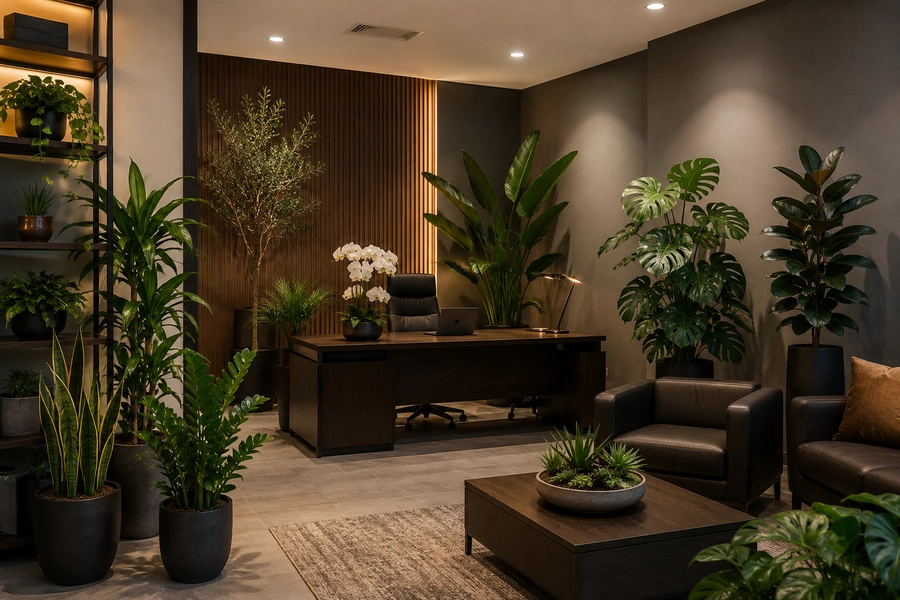
Artificial greenery solves the horticultural problem created by zero natural light. It does not replace appropriate workplace illumination, outdoor views, ventilation, or meaningful exposure to living nature.
Can Real Plants Survive in an Office With No Windows?
“Low light” and “no usable plant light” are not the same condition.
Living plants in a genuinely windowless office generally need suitable artificial grow lighting, correct positioning, and a timed light-dark cycle. Ordinary ceiling lights may illuminate desks without delivering the intensity or spectrum required for dependable plant growth. Artificial plants need no grow lights, watering, drainage, or plant rotation.
University of Minnesota Extension explains that low-light houseplants still need light and that plants grow more slowly as available light decreases. Penn State Extension similarly recommends full-spectrum artificial lighting when natural window light is insufficient for plants such as jade.
A real plant can still be a valid choice when the business is prepared to install and manage:
- Suitable grow lights
- Timers
- Correct plant-to-light distance
- Watering
- Drainage
- Pest inspections
- Fertilization
- Pruning
- Replacement plans
Artificial plants become the lower-complexity option when the office wants permanent visual greenery without running a horticultural system.
Do Not Ignore Human Lighting
A fake plant can survive in darkness. Employees should not be expected to work in poorly illuminated conditions simply because the décor remains unaffected.
OSHA notes that workplace lighting, glare, ventilation, and humidity affect comfort and the ability to work at computer stations. Artificial greenery should therefore complement an appropriate lighting plan—not become an excuse for a dim office.
Do Artificial Plants Reduce Office Stress?
Artificial plants can provide green color, organic shapes, visual softness, and nature-resembling cues. Evidence about workplace nature exposure, however, should not be transferred automatically to faux products.
Artificial plants may make a windowless office feel less visually sterile, but they should not be marketed as producing the same wellbeing effects as living plants, daylight, outdoor views, or direct contact with nature. Their strongest benefits are decorative consistency, placement freedom, and lower horticultural maintenance.
A 2024 longitudinal study of open-plan office workers found relationships among reported nature exposure, vigor, nature relatedness, and employee wellbeing. The study addressed broader biophilic workplace exposure and did not establish that artificial plants deliver equivalent effects.
A separate virtual-reality experiment found improved self-reported wellbeing and selected cognitive outcomes in an office simulation containing virtual plants. Its small experimental setting offers limited evidence that plant-like visual cues may influence experience, but it does not prove that physical faux plants produce the same workplace results.
The honest business case for artificial plants is therefore:
- Better visual warmth
- More organic form
- Stable color and scale
- No plant-growth lighting
- No irrigation
- Easier multi-site standardization
- Lower risk of plant decline
It is not a guaranteed reduction in employee stress, absenteeism, or turnover.
What Makes an Artificial Office Plant Look Real?
A realistic product should still look plausible in the room where it is installed.
Choose matte or naturally waxy leaves, several related green tones, varied leaf sizes, irregular branch spacing, convincing trunks, and stems that can hold broad curves. Avoid perfect symmetry, identical leaf angles, bright plastic shine, exposed foam, and undersized nursery pots.
The Spruce tested 18 artificial plants for realism, durability, styling, and dust collection. Strong performers used features such as veined foliage, varied leaf sizes, bendable stems, realistic waxy texture, and stable cemented bases.
Windowless-Office Realism Checklist
| Feature | Better Choice | Weak Choice |
|---|---|---|
| Leaf finish | Matte or species-appropriate sheen | Uniform hard gloss |
| Color | Several botanical greens | One bright synthetic green |
| Stem line | Adjustable and gently curved | Rigid vertical pole |
| Leaf direction | Varied | Every leaf facing forward |
| Trunk | Textured and irregular | Smooth molded cylinder |
| Base | Stable and concealed | Visible small plastic pot |
| Scale | Suits ceiling and furniture | Tiny plant in a large empty corner |
| Dust access | Leaves can be reached | Extremely dense inaccessible foliage |
| Shape | Open asymmetry | Perfect ball or triangle |
| Placement | Supports a clear design role | Randomly fills leftover floor space |
Which 19 Artificial Plants Work Best Without Windows?
The following ranking prioritizes realism under office lighting, flexible placement, low cleaning complexity, and visual compatibility with windowless rooms.
Snake plants and ZZ plants lead compact spaces. Olive trees, ficus, dracaena, rubber plants, and bird of paradise provide floor-level structure. Pothos and philodendron solve shelves, while orchids, succulents, and small foliage plants work on desks, counters, and meeting tables.
1. Artificial Snake Plant—Best Overall No-Window Pick
Snake plants are the easiest artificial plants to position in narrow offices.
Their upright leaves occupy little floor space and rarely interfere with chairs, doors, cabinets, or circulation routes.
A convincing faux snake plant should have:
- Several leaf heights
- Irregular green striping
- Slight outward curves
- A dense but uneven base
- Matte edges
- No repeated leaf pattern in the front row
Artificial snake plants work beside:
- Reception desks
- Elevator doors
- Filing cabinets
- Meeting-room credenzas
- Printer stations
- Corridor corners
- Workstation dividers
A current Afloral artificial snake plant is specifically styled for office desks and console areas, illustrating the category’s suitability for compact professional spaces.
Why It Is Stress-Free
The narrow leaves are easy to dust, the plant requires little reshaping, and its compact footprint reduces accidental contact.
Main Buying Risk
Cheap versions arrange every leaf at the same height and use one identical printed pattern.
2. Artificial ZZ Plant—Best for Reception and Waiting Rooms
The ZZ plant has orderly stems and naturally smooth leaves. Those features translate well into artificial construction.
It suits:
- Waiting-room side tables
- Reception credenzas
- Low cabinets
- Meeting rooms
- Private offices
- Shared lounge areas
Choose a product with:
- Several stem heights
- Softly reflective leaves
- Varied leaf angles
- Darker mature foliage
- Smaller inner shoots
- A substantial planter
Why It Works Without Windows
The real botanical species is widely associated with low-light interiors, so guests do not find its presence in a dim office visually implausible.
The artificial version adds that familiar low-light aesthetic without requiring plant lighting or watering.
Main Buying Risk
An overly oily finish can make the leaves look wet or plastic beneath LED ceiling lights.
3. Artificial Olive Tree—Best Premium Floor Tree
Olive trees provide height without creating a dense visual barrier.
Their fine gray-green leaves work particularly well with:
- Warm timber
- Beige walls
- Soft gray offices
- Stone reception desks
- Black metal furniture
- Neutral acoustic panels
The Spruce’s artificial-plant testing praised an olive tree for veined leaves, adjustable branches, realistic vertical scale, and secure packaging.
Choose:
- Muted gray-green leaves
- Visible internal branches
- A sparse irregular canopy
- Textured trunk construction
- Bendable branch tips
- A heavy decorative planter
Best Placement
- Executive-office corner
- Reception seating
- Boardroom entrance
- Leasing office
- Consultation room
- Brand showroom
Main Buying Risk
A perfect spherical canopy makes the tree look like commercial topiary rather than an olive.
4. Artificial Dracaena—Best for Clean Corporate Interiors
Dracaena creates vertical structure while occupying less space than a broad tree.
It works in:
- Banks
- Clinics
- Corporate offices
- Education facilities
- Administrative buildings
- Legal and accounting firms
Choose a dracaena with:
- Several foliage clusters
- Different leaf lengths
- A strong central trunk
- Controlled arching leaves
- More than one green tone
Why It Is Stress-Free
Its leaves are accessible for cleaning, and the plant can fit between furniture without needing frequent branch adjustment.
Main Buying Risk
A weak trunk may lean after the leaves are opened. Review the product’s base weight and internal support.
5. Artificial Rubber Plant—Best for Executive Offices
Rubber plants provide broad, dark foliage that works with polished professional materials.
They suit:
- Executive offices
- Law firms
- Luxury retail offices
- Financial-services reception areas
- Design studios
- Private meeting rooms
Select:
- Rich but varied green
- Visible central veins
- Several leaf sizes
- Slightly curved edges
- A substantial central stem
- Moderate natural reflection
Why It Looks Believable
Living rubber plants naturally have thick, somewhat reflective leaves. A carefully made artificial product can use molded material without looking out of place.
Main Buying Risk
Uniform high gloss becomes obvious under overhead office lights.
6. Artificial Monstera—Best for Creative Offices
Monstera gives a windowless office a bold graphic silhouette.
It works in:
- Marketing agencies
- Fashion offices
- Media companies
- Coworking spaces
- Design studios
- Casual client lounges
The Spruce reported that one tested faux monstera was difficult to distinguish visually from its living comparison because it used varied stem heights, veined foliage, two leaf colors, and adjustable wire.
Look For:
- Young unsplit leaves
- Mature split leaves
- Different hole patterns
- Several leaf sizes
- Side-facing foliage
- Visible internal spacing
Main Buying Risk
When all split leaves face forward, repeated molds become immediately visible.
7. Artificial Bird of Paradise—Best Large Statement Plant
Bird of paradise works when a windowless office has enough floor and ceiling space for one dramatic focal plant.
Strong locations include:
- Main reception
- Large boardroom
- Client lounge
- Showroom
- Staff café
- Executive suite entrance
The Spruce found that a tested faux bird of paradise benefited from waxy botanical texture and an upright form that required relatively little adjustment.
Choose:
- Several leaf heights
- Strong central ribs
- Slight natural splits
- Broad but uneven spacing
- A stable wide planter
- Leaves that can be repositioned
Main Buying Risk
Its large leaves may project into walkways or block sightlines.
8. Artificial Ficus Tree—Best Full Office Corner Plant
Ficus trees produce greater visual volume than olive trees.
They work well where the office needs to soften:
- An empty corner
- A column
- A printer area
- A waiting-room boundary
- An unused wall junction
- A wide corridor end
Choose:
- Several related leaf colors
- Irregular branch lengths
- A naturally tapered canopy
- A convincing trunk transition
- Internal gaps for depth
Why It Is Stress-Free
The plant delivers substantial greenery from one floor-level asset instead of requiring several small pots.
Main Buying Risk
Hundreds of identical leaves positioned at equal intervals can produce an obvious repeated pattern.
9. Artificial Kentia Palm—Best for Calm Professional Lounges
Kentia palms create an elegant, relaxed silhouette.
They suit:
- Wellness offices
- Hotel administration areas
- Premium waiting rooms
- Financial lounges
- Spa offices
- Staff relaxation zones
Choose a palm with:
- Several frond lengths
- Broad gradual curves
- Open spacing
- Natural downward movement
- A stable lower cluster
Why It Works
The open canopy softens a room without forming a heavy visual wall.
Main Buying Risk
Fine leaflets create more cleaning labor than broad-leaf plants.
10. Artificial Areca Palm—Best for Wide Empty Spaces
Areca palms provide denser tropical volume than Kentia palms.
Use them in:
- Large break rooms
- Collaborative lounges
- Informal meeting zones
- Call-center relaxation areas
- Internal cafés
- Broad reception spaces
Choose:
- Several cane heights
- Uneven frond directions
- A wide low planter
- Moderate rather than extreme density
- Fronds that remain separated after shipping
Main Buying Risk
Overly dense palms trap dust and can make a windowless office feel crowded rather than refreshed.
11. Artificial Pothos—Best for High Shelves
Pothos adds trailing greenery without using floor space.
It works on:
- Bookcases
- Storage cabinets
- Reception shelves
- Wall-mounted planters
- Acoustic ledges
- Secure overhead frames
The Spruce’s testing highlighted a faux pothos with realistic color variation, waxy leaf texture, a full silhouette, and pliable branches.
Current artificial pothos products are also marketed specifically for offices and areas where no plant light or watering is available.
Style It Correctly
Use several vine lengths:
- One short vine near the planter
- One medium side trail
- One longer downward line
- Several leaves turned toward the wall
Main Buying Risk
Equal straight vines look more like decoration than plant growth.
12. Artificial Heartleaf Philodendron—Best for Soft Shelf Greenery
Philodendron offers a calmer silhouette than monstera and a broader leaf than many ferns.
It suits:
- Shared offices
- Break rooms
- Libraries
- Informal meeting rooms
- Consultation spaces
- Staff lounges
Choose:
- Several leaf sizes
- Flexible trailing stems
- Open gaps
- Soft heart-shaped foliage
- Natural green variation
Why It Is Stress-Free
It fills shelf edges and cabinet tops while leaving desks and walkways clear.
Main Buying Risk
Dense domes of identical leaves look generic. Allow some stems and empty space to remain visible.
13. Artificial Phalaenopsis Orchid—Best Reception-Desk Accent
Orchids add a refined floral note without requiring a large floor planter.
They work on:
- Reception counters
- Executive desks
- Conference tables
- Salon desks
- Medical-office check-in counters
- Client hospitality stations
The Spruce found that a budget artificial orchid remained visually effective from several feet away because of its curved stem, roots, leaves, and support stake, even though close inspection revealed that it was faux.
Choose:
- Detailed flower centers
- Open flowers and buds
- Thick lower leaves
- Curved stems
- Artificial roots or bark
- A ceramic bowl
- Discreet support stakes
Main Buying Risk
The flower center is highly visible. A thick molded center can expose a poor-quality orchid instantly.
14. Artificial Alocasia Zebrina—Best Boutique Desk Plant
Alocasia zebrina provides a distinctive shape through large leaves and patterned stems.
It works in:
- Creative agencies
- Boutique offices
- Interior-design studios
- Fashion showrooms
- Contemporary consulting firms
The Spruce’s tested Alocasia was praised for durability, strong visual character, broad leaves, striped stems, and a stable cemented base.
Why It Is Stress-Free
It creates a memorable focal point with relatively few leaves, making routine dusting faster than cleaning a fern or palm.
Main Buying Risk
Because the plant has few leaves, one crease or poorly printed surface becomes highly visible.
15. Artificial Eucalyptus—Best for Neutral Offices
Eucalyptus provides muted gray-green foliage that works with contemporary office palettes.
Use it in:
- Wellness companies
- Architecture studios
- Salons
- Therapy offices
- Boutique consultancies
- Calm reception spaces
Choose:
- More than one leaf size
- Muted blue-gray and green tones
- Fine irregular branching
- A non-glossy finish
- A natural open silhouette
Why It Works Without Windows
Its subdued color can soften artificial office lighting without competing with screens, signs, or artwork.
Main Buying Risk
Pale leaves show dark dust quickly and need regular inspection.
16. Artificial Boston Fern—Best for Soft Texture
Boston ferns add detailed texture to areas that otherwise contain hard office furniture and straight architectural lines.
They work on:
- Filing cabinets
- High credenzas
- Reception shelves
- Secure plant stands
- Lounge dividers
Choose:
- Several frond lengths
- Fine but secure leaflets
- A loose outer edge
- A planter large enough to support the spread
- Fronds that separate after packaging
Main Buying Risk
The fine foliage creates a high cleaning burden. The Spruce’s testing notes that broad-leaf artificial plants are generally easier to wipe than intricate trailing or fine-leaf products.
17. Artificial Agave—Best Architectural Floor Plant
Agave works in modern, industrial, automotive, technology, and design-led offices.
Its structured leaves suit:
- Showrooms
- Reception corners
- Meeting-room entrances
- Brand-display areas
- Wide corridors
- Contemporary executive suites
Choose:
- Several leaf angles
- A controlled central gradient
- Matte molded surfaces
- A wide stable base
- Softened or safely positioned tips
Why It Is Stress-Free
Large molded leaves are fast to wipe, and the plant holds a fixed shape with little ongoing adjustment.
Main Buying Risk
Hard projecting leaf tips can create a contact hazard in narrow circulation areas.
18. Artificial Sedum or Aeonium—Best Small Desk Succulent
A compact artificial succulent works where a full plant would obstruct work.
Suitable locations include:
- Individual desks
- Meeting tables
- Phone booths
- Focus rooms
- Reception counters
- Small shelves
Current artificial sedum and aeonium products are sold as compact planter-ready desk or side-table accents.
Choose:
- Several related greens
- Matte molded leaves
- An irregular rosette
- A heavy low container
- No painted white “dust” unless botanically convincing
Main Buying Risk
Extremely bright green, perfectly repeated leaves make small succulents look like toys.
19. Artificial Maidenhair or Creeping Wire Vine—Best Compact Softener
A small maidenhair-style plant brings softness to shelves and desks without the height of a tree.
It suits:
- Libraries
- Therapy offices
- Private consultation rooms
- Administrative desks
- Small reception counters
- Bookshelves
Afloral currently positions artificial maidenhair and creeping wire vine products as care-free office desk and console accents.
Choose:
- Fine but irregular foliage
- Several branch directions
- An open lower structure
- A natural dark-green palette
- A planter that does not overwhelm the plant
Main Buying Risk
Fine leaves require careful brushing and may collect dust faster than a snake plant or succulent.
Which Artificial Plant Is Best for Each Windowless Office Zone?
The right plant should solve a spatial problem instead of being placed randomly.
Office Placement Guide
| Office Zone | Best Picks | Main Objective |
|---|---|---|
| Reception corner | Olive, ficus, bird of paradise | Create arrival scale |
| Reception counter | Orchid, ZZ plant, succulent | Add a polished focal detail |
| Narrow corridor | Snake plant, dracaena | Add height without obstruction |
| Executive office | Rubber plant, olive tree | Provide controlled visual weight |
| Meeting room | ZZ, orchid, eucalyptus | Add greenery without blocking views |
| Break room | Palm, monstera, philodendron | Soften a social area |
| High shelf | Pothos, philodendron | Use vertical space |
| Printer or storage zone | Ficus, dracaena | Screen functional equipment |
| Waiting room | ZZ, snake plant, olive tree | Create calm visual structure |
| Creative studio | Monstera, Alocasia, agave | Add graphic silhouettes |
| Desk cluster | Succulent, maidenhair, small snake plant | Provide compact greenery |
| Internal lounge | Kentia palm, Areca palm, bird of paradise | Create a softer atmosphere |
Which Artificial Plants Are Easiest to Clean?
The easiest plants have broad accessible leaves and limited surface complexity.
Snake plants, ZZ plants, rubber plants, monstera, bird of paradise, Alocasia, agave, and orchids are the lowest-burden cleaning choices. Palms, Boston ferns, maidenhair, pothos, and dense ficus trees require more detailed brushing because they contain many small leaves or narrow gaps.
Balsam Hill’s current care guidance recommends routine dusting with soft cloths or brushes and adjusting the plant’s placement for practical maintenance.
Cleaning-Burden Comparison
| Cleaning Level | Plant Types |
|---|---|
| Low | Snake plant, ZZ, rubber, agave, Alocasia |
| Low to medium | Monstera, bird of paradise, orchid, dracaena |
| Medium | Olive, eucalyptus, philodendron |
| Medium to high | Ficus, pothos |
| High | Palms, Boston fern, maidenhair |
Windowless Offices Still Produce Dust
No windows does not mean no particles.
Office greenery may collect residue from:
- HVAC systems
- Carpet fibers
- Paper
- Clothing
- Skin flakes
- Printer areas
- Construction
- Open internal doors
- Cleaning products
- Food preparation
Place the most intricate plants where maintenance staff can reach them safely.
How Do You Make Faux Plants Look Real Without Natural Light?
Artificial office lighting can expose shine and repeated details.
Test every plant beneath the actual ceiling and task lighting before approving the order. Reshape branches, turn repeated leaves away from the main view, conceal the starter pot, and use a planter that appears substantial enough for the canopy. Add a restrained top dressing and leave open space around the plant.
Re-Pot the Plant
Most starter pots are made for transport.
Place them inside:
- Matte ceramic
- Textured fiberglass
- Stone-effect composite
- Powder-coated metal
- Wood veneer
- A woven basket with a stable inner liner
Then secure the starter pot so it cannot lean or rotate.
Hide the Base
Use:
- Medium river stones
- Artificial soil
- Fixed moss
- Large bark pieces
- A fitted surface insert
Do not allow loose top dressing to interfere with cleaning or spill into circulation routes.
Shape Under the Final Lighting
- Identify the intended front.
- Open lower branches.
- Turn some leaves sideways.
- Bend one or two branches downward.
- Leave visible gaps.
- Check reflections from seated and standing positions.
- Photograph the approved shape.
- Label the planter orientation.
A glossy leaf may look acceptable in daylight photography and unrealistic under bright office LEDs.
How Many Artificial Plants Does a Windowless Office Need?
The correct quantity depends on the room’s size and the plants’ visual mass.
Use fewer, correctly scaled plants rather than filling every desk and corner. Begin with one floor plant for a small enclosed office, two or three coordinated plants for a meeting room, or one larger tree plus several compact accents for a reception area. Preserve circulation, sightlines, and usable work surfaces.
Practical Starting Points
| Space | Starting Arrangement |
|---|---|
| Small private office | One medium floor plant or one desk plant |
| Internal meeting room | Two low plants plus one corner plant |
| Reception | One large tree and one counter accent |
| Windowless corridor | Repeated narrow plants at controlled intervals |
| Staff lounge | Two large plants or one modular divider |
| Coworking zone | Several coordinated plant groups |
| Phone booth | One very small compact plant |
| Boardroom | Low orchids or structured foliage below sightlines |
These are design starting points, not fixed formulas.
Remove a plant when it:
- Blocks a door
- Narrows an accessible route
- Competes with signage
- Obstructs cameras
- Crowds the table
- Interferes with cleaning
- Makes the room visually dense
- Repeats an obvious artificial pattern
Should Every Plant Copy a Low-Light Species?
A fake plant does not biologically need light, but visual plausibility still matters.
Snake plants, ZZ plants, pothos, philodendron, and dracaena feel natural in darker interiors because people commonly associate them with indoor environments. Olive trees, palms, and bird of paradise can also work, but they need stronger styling so they appear intentionally decorative rather than accidentally placed in an impossible growing condition.
A realistic office does not require botanical literalism. It requires a convincing relationship among:
- Plant species
- Room scale
- Lighting
- Planter
- Furniture
- Brand style
- Viewing distance
One large olive tree in a premium reception area can read as designed décor.
Ten identical palms beneath low fluorescent lighting may feel artificial regardless of product quality.
What Safety Issues Matter in Commercial Offices?
Artificial plants avoid watering and soil but still need safe specification and installation.
Keep faux greenery clear of exits, door swings, fire equipment, heaters, electrical panels, sprinklers, task areas, and primary circulation paths. Secure tall planters and overhead vines, and obtain product-specific fire documentation when the applicable authority or project specification requires it.
NFPA guidance states that combustible artificial decorative vegetation in covered occupancies may need to meet specified fire-test criteria. Exact requirements depend on the code, jurisdiction, occupancy, quantity, and installation.
Office Safety Checklist
- Stable planter
- No sharp exposed wire
- No projecting leaves in narrow routes
- No blocked exit signs
- No plant against heaters
- No interference with sprinklers
- Secure hanging hardware
- Approved working-height access for cleaning
- Product-specific fire evidence where required
- No loose stones in walking areas
- No placement directly on electrical equipment
A supplier’s “commercial-grade” label is not a substitute for project review.
What Should Buyers Check Before Ordering?
Commercial orders need greater consistency than one home purchase.
Approve multiple physical samples and record their opened dimensions, leaf color, gloss, stem flexibility, trunk construction, base weight, materials, packaging recovery, cleaning access, and required documentation. Inspect several units together because repeated molds may become more obvious across a large office rollout.
Sample-Approval Checklist
| Buyer Check | Reason |
|---|---|
| Opened height and width | Confirms spatial fit |
| Starter-pot dimensions | Determines decorative planter size |
| Product weight | Affects stability and handling |
| Leaf colors | Controls batch consistency |
| Surface gloss | Predicts appearance under office lights |
| Adjustable branches | Supports natural shaping |
| Trunk construction | Controls realism |
| Packaging recovery | Predicts installation labor |
| Detached-leaf rate | Indicates transit durability |
| Cleaning access | Determines maintenance cost |
| Fire documentation | Supports compliance review |
| Spare components | Allows modular repairs |
The Spruce’s product testing found meaningful differences in adjustability, leaf retention, packaging recovery, dust collection, and overall realism. These factors become more important when a company orders dozens of units.
My Insights: Best Artificial Plants for Offices With No Windows—Which 19 Stress-Free Picks Work Best
The best plant for a windowless office is not simply the species that looks most dramatic. It is the product that improves the room without creating new problems involving clutter, dust, glare, instability, or repetitive styling.
The 19 best picks divide into four useful groups: snake plants, ZZ plants, dracaena, and agave for narrow architecture; olive, ficus, rubber, palms, and bird of paradise for floor-level scale; pothos, philodendron, fern, and maidenhair for shelves; and orchids, Alocasia, eucalyptus, and succulents for desks and counters.
My central insight is that artificial plants should be selected by office function, not only botanical preference.
The 19-Pick Summary
| Pick | Strongest Office Role |
|---|---|
| 1. Snake plant | Narrow spaces and corridors |
| 2. ZZ plant | Reception and waiting rooms |
| 3. Olive tree | Premium office corners |
| 4. Dracaena | Clean corporate interiors |
| 5. Rubber plant | Executive offices |
| 6. Monstera | Creative workplaces |
| 7. Bird of paradise | Large statement zones |
| 8. Ficus | Full empty corners |
| 9. Kentia palm | Calm professional lounges |
| 10. Areca palm | Wide social spaces |
| 11. Pothos | High shelves |
| 12. Philodendron | Soft trailing greenery |
| 13. Orchid | Reception counters |
| 14. Alocasia | Boutique desk accents |
| 15. Eucalyptus | Neutral offices |
| 16. Boston fern | Soft detailed texture |
| 17. Agave | Architectural styling |
| 18. Sedum or aeonium | Small desks |
| 19. Maidenhair vine | Compact shelf softening |
Best Overall Pick
The artificial snake plant is the strongest all-purpose choice.
It fits small rooms, requires little reshaping, cleans quickly, and creates height without consuming much floor area.
Best Premium Pick
The olive tree is the strongest choice for reception rooms, executive offices, and client lounges.
Its open canopy adds scale without making an already enclosed room feel heavier.
Best Desk Pick
A compact ZZ plant, orchid, or molded succulent provides visual greenery without reducing usable work area excessively.
The planter should be heavy enough to remain stable when papers, cables, or cleaning cloths move around it.
Best Shelf Pick
Pothos provides the strongest trailing effect.
Use varied vine lengths and keep enough space around the shelf for safe dusting.
Best Low-Cleaning Pick
Snake plants, ZZ plants, agave, rubber plants, and Alocasia have the most accessible surfaces.
Fine palms and ferns should be reserved for offices with a reliable cleaning schedule.
Best Large Windowless-Room Pick
Use one bird of paradise, ficus, Areca palm, or large olive tree.
One correctly scaled plant creates a clearer focal point than many small unrelated pots.
The Most Important Honesty Rule
Artificial plants solve the plant-survival problem.
They do not solve:
- Inadequate workplace lighting
- Poor ventilation
- Excessive noise
- Lack of breaks
- Uncomfortable furniture
- Weak management
- Complete absence of outdoor access
OSHA identifies lighting, ventilation, humidity, noise, workstation design, and other environmental factors as potential contributors to office discomfort. Faux greenery should support a broader workplace plan rather than conceal these problems.
My Best Windowless-Office Formula
For a medium internal office, I use:
- One four- to six-foot olive, ficus, or dracaena
- One narrow snake plant near storage or a doorway
- One trailing pothos on a high cabinet
- One compact orchid or ZZ plant on a shared surface
- Coordinated planters in one material family
- At least one clear area without greenery
- Warm, glare-controlled workplace lighting
- A documented dusting schedule
This creates several heights and textures without turning the room into an artificial jungle.
My Final Selection Rule
Use this sequence:
- Measure the floor, desk, and shelf space.
- Identify circulation and cleaning access.
- Define each plant’s visual job.
- Choose a believable botanical form.
- Inspect texture, color, and repeated molds.
- Test the product under office lighting.
- Select a correctly scaled stable planter.
- Reshape and photograph the approved form.
- Confirm fire and installation requirements.
- Establish dusting and replacement intervals.
A stress-free artificial plant is not merely one that survives without light. It is one that continues looking intentional without creating maintenance, safety, or space-planning problems.
Conclusion
Choose snake plants, ZZ plants, olive trees, dracaena, pothos, and orchids by office zone. Prioritize realistic texture, correct scale, easy cleaning, stable planters, and honest wellbeing claims.