
Some artificial plants look convincing online but turn glossy, stiff, and repetitive in person. Choosing the wrong shape can make an entire room feel less natural.
The most realistic faux house plants in 2025 include olive trees, fiddle leaf figs, monsteras, snake plants, bird of paradise plants, pothos, orchids, palms, ferns, and succulents. The best options use matte leaves, natural color variation, adjustable stems, realistic trunks, and proportions that suit their intended placement.
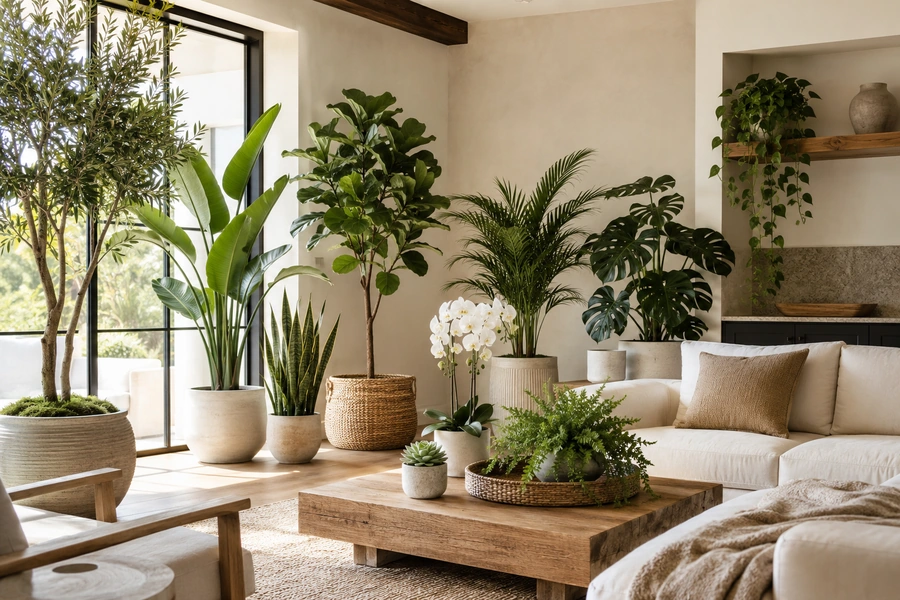
A convincing plant also needs the right styling. Its height should match the room, its branches should be reshaped after unpacking, and its basic nursery pot should usually be hidden inside a heavier decorative planter.
What Makes a Faux House Plant Look Real?
Price alone does not determine realism. An expensive faux tree can still look artificial when every leaf has the same color, angle, size, and surface shine.
A realistic faux house plant has varied leaf shapes, several natural green tones, visible veins, matte surfaces, irregular branch spacing, and adjustable stems. It should copy the growth pattern of the real species instead of creating a perfectly round or symmetrical shape. Its pot, trunk, and artificial soil should also look believable.
Home-design specialists recommend looking for texture, color variation, and organic movement. They also warn that glossy finishes and perfect symmetry are common signs of an artificial plant. Product testing by The Spruce similarly focused on appearance, durability, adjustability, dust collection, and how well each plant worked at normal viewing distance.
The Realism Checklist
I evaluate six areas before choosing a faux plant.
| Feature | What Looks Real | What Often Looks Fake |
|---|---|---|
| Leaf surface | Matte or softly textured | Strong plastic shine |
| Color | Several greens with subtle variation | One flat green across every leaf |
| Shape | Uneven, relaxed, and slightly asymmetrical | Perfectly balanced branches |
| Stem | Adjustable wire or realistic bark texture | Smooth green plastic tube |
| Base | Soil, moss, bark, or stones | Exposed foam or tiny black pot |
| Scale | Matches the plant species and room | Oversized leaves on a short stem |
A plant does not need to pass a close botanical inspection. Most people see household greenery from several feet away, so overall shape and proportion often matter more than tiny details. The Spruce’s 2025 testing noted that plants only need to look convincing at the distance from which guests normally view them.
Materials Matter, but Construction Matters More
Polyethylene and other molded plastics work well for structured leaves such as snake plants, succulents, and monsteras. Polyester fabric can create lighter leaves on palms, ferns, and large trees. Some premium products combine fabric leaves, molded details, natural wood trunks, internal wire, and hand-applied color.
No material guarantees realism. Thin plastic can look better than badly cut fabric when its mold, color, and finish are carefully controlled.
Before buying, I check whether the branches are adjustable. Bendable stems allow the plant to be opened into a natural form after shipping. Tested and designer-recommended guides repeatedly identify adjustability, irregular shaping, texture, and tonal variation as important signs of quality.
What Are the 10 Best Faux House Plants That Look Real?
The strongest choices are usually plants whose natural leaves already have a firm, smooth, waxy, or graphic appearance. These traits are easier to reproduce than extremely delicate growth.
The ten best faux house plants are the olive tree, fiddle leaf fig, monstera, snake plant, bird of paradise, pothos, orchid, palm, Boston fern, and succulent. They cover floor trees, vertical plants, trailing greenery, flowering accents, and compact tabletop displays for nearly every room.
The ranking below focuses on plant types rather than one fixed product listing. Retail availability changes, but the visual qualities that make these species convincing remain consistent. Olive trees, fiddle leaf figs, pothos, orchids, snake plants, monsteras, bird of paradise plants, palms, and succulents all appeared in prominent 2025 tested or editorial selections.
1. Faux Olive Tree—Best Overall
A faux olive tree is one of the safest choices for modern, farmhouse, Mediterranean, and neutral interiors. Its narrow leaves create a light canopy, so the plant adds height without forming a heavy wall of green.
The small leaves also hide minor material flaws better than broad, flat leaves. Natural olive trees are irregular, so slightly uneven branches make an artificial version look more convincing.
Best placement: Put a 5- to 7-foot olive tree beside a sofa, near an entry console, between two windows, or in an empty dining-room corner. Its narrow profile works well where a large fiddle leaf fig would feel too wide.
What to check: Look for a textured brown trunk, muted gray-green leaves, uneven branch lengths, and enough visible space between stems. Avoid bright green leaves arranged in a perfect ball.
Styling tip: Place the small nursery base inside a large stone, clay, or woven planter. Add bark, preserved moss, or matte pebbles to hide the top.
2. Faux Fiddle Leaf Fig—Best Statement Tree
The fiddle leaf fig remains popular because its broad leaves create an immediate visual statement. A realistic faux version can fill an empty corner without the light, humidity, and care challenges associated with maintaining a live specimen.
Architectural Digest’s 2025 selection included faux fiddle leaf fig trees, while other tested guides recommend them for living areas and large decorative corners.
Best placement: Use it in a living room, home office, dining space, or large bedroom. It works particularly well beside a low sofa, media unit, reading chair, or wide window.
What to check: The leaves should have visible veins, curved edges, varied sizes, and more than one shade of green. The top should not form a perfect dome. A real-wood or bark-textured trunk improves the result.
Styling tip: Open the upper branches more widely and keep some lower leaves close to the trunk. This creates a mature, naturally grown shape.
A fiddle leaf fig is less suitable for a narrow hallway because its large leaves need visual and physical space. Choose a height of at least 4 feet for a floor display, or the plant may look like a tabletop item placed in the wrong location.
3. Faux Monstera—Best for Modern Interiors
Monstera leaves have strong shapes, visible splits, and a naturally glossy surface. These features make them easier to reproduce convincingly than many soft or finely textured leaves.
A 2025 product test described a large faux monstera as one of the most realistic plants evaluated. Monstera also appears frequently in current editorial recommendations because its graphic foliage works well in contemporary rooms.
Best placement: Place a medium monstera beside a television console, low cabinet, office desk, or reading chair. A smaller version can sit on a plant stand or wide side table.
What to check: Leaves should have several sizes and different numbers of splits. Every leaf should not face forward. The stems should be adjustable and should emerge at varied angles.
Styling tip: Bend one or two leaves downward and turn several leaves away from the main viewing direction. This removes the showroom-perfect shape that often exposes a fake plant.
Monstera works best in rooms with clean lines, natural wood, light walls, and simple planters. Its large leaves create enough visual interest without needing several additional accessories.
4. Faux Snake Plant—Best for Narrow Spaces
The upright shape of a snake plant makes it one of the most useful faux options for small homes. It occupies little floor area and can add height beside furniture without blocking a walkway.
Its thick, structured leaves already look slightly sculptural in nature. This allows well-molded artificial leaves to appear convincing, especially when viewed from normal standing distance.
Best placement: Use it beside a bathroom vanity, in an office corner, near a nightstand, beside a hallway console, or between two pieces of furniture. It also works in compact reception areas.
What to check: Select leaves with different heights, natural striping, matte surfaces, and slightly curved tips. Avoid designs where every leaf is identical or perfectly vertical.
Styling tip: Choose a tall, narrow planter rather than a wide bowl. Add dark artificial soil or small stones around the base.
Snake plants are also practical in areas where hanging leaves would interfere with doors or movement. A 2- to 3-foot model can fill a tight gap without making the room feel crowded. Current faux-plant selections regularly include snake plants because their form works well in compact and pet-conscious interiors.
5. Faux Bird of Paradise—Best for Large Corners
Bird of paradise plants create a tropical effect with tall stems and wide paddle-shaped leaves. They provide more movement than a fiddle leaf fig and more height than a typical monstera.
The Spruce’s tested selection included a faux bird of paradise for living rooms, and current editorial guides use palms and tropical plants to complete large corners.
Best placement: Put it in a spacious living room, dining room, office reception area, or beside a wide window. It works well in rooms with high ceilings and open floor plans.
What to check: Look for long, individually adjustable stems and leaves with realistic ribbing. A good plant should have open space between the stems. Avoid products with every leaf gathered into one dense central cluster.
Styling tip: Spread the tallest stems outward and allow several leaves to face sideways. Real bird of paradise plants rarely hold every leaf in the same direction.
This plant needs enough surrounding space. A large version placed behind a small chair can appear oversized, while the same plant beside a wide sofa can balance the room.
6. Faux Pothos—Best Hanging Plant
A faux pothos is one of the easiest ways to soften shelves, cabinets, and high surfaces. Its trailing stems create movement and help connect furniture to the rest of the room.
Architectural Digest included faux pothos in its 2025 recommendations, and tested guides have also highlighted hanging pothos and related trailing plants.
Best placement: Use it on a bookcase, kitchen cabinet, bathroom shelf, wall-mounted planter, hanging basket, or tall wardrobe. It is especially useful where watering a live hanging plant would be inconvenient.
What to check: Select a design with several vine lengths, different leaf sizes, and mixed green tones. Avoid vines that repeat the same leaf at equal intervals.
Styling tip: Divide the stems into small groups instead of allowing every vine to fall straight down. Trail one stem across a shelf, let another hang freely, and place a shorter one near the pot.
Pothos looks more natural when it appears to be growing toward open space. Do not force all vines into a perfectly balanced curtain.
7. Faux Orchid—Best Flowering Plant
Artificial flowering plants are often less convincing than green foliage, but orchids are an exception when the flower shape, stem, and root details are well executed.
Orchids have a clean structure and limited number of blooms, so a manufacturer can reproduce each component with more control. They appear in both 2025 editorial recommendations and tested faux-plant lists.
Best placement: Display a white orchid on an entry console, bathroom vanity, dining buffet, coffee table, bedside cabinet, or office reception desk.
What to check: Look for adjustable flower stems, detailed centers, unopened buds, thick green leaves, and visible artificial roots or moss. Avoid arrangements where every flower faces the camera.
Styling tip: Bend the stems into gentle arcs and turn several blooms to the side. A clear or ceramic container with moss, bark, and root detail improves realism.
White orchids are the most flexible because they work with neutral, traditional, hotel-style, and minimalist interiors. Pink or purple orchids can work as stronger decorative accents, but bright colors expose uneven petal printing more easily.
8. Faux Palm—Best for Relaxed Rooms
A faux palm adds height, fine texture, and a softer silhouette than a broad-leaf tree. It suits coastal, tropical, bohemian, hotel, and relaxed contemporary interiors.
Palms appear in 2025 artificial-plant recommendations as practical choices for porches and bare living-room corners.
Best placement: Use a palm in a sunroom, bedroom corner, covered interior balcony, living room, studio, or casual office. Place it near rattan, linen, pale wood, or textured fabrics.
What to check: Look for several frond lengths, thin leaflets, adjustable branches, and a natural central stem. Avoid fronds that form identical flat fans.
Styling tip: Separate the fronds and curve some outward. A palm should look light and moving, not stiff and compact.
Fine palm leaves can collect dust more visibly than broad leaves. Choose one that can be cleaned with a soft duster or cool airflow. Very dense fronds may look attractive in a product image but require more maintenance in a real room.
9. Faux Boston Fern—Best for Bathrooms and High Shelves
A Boston fern creates soft volume and works well in rooms that benefit from a fresh, layered look. Its many small leaflets also make it difficult to inspect each detail from a distance.
Best placement: Use it on a bathroom shelf, covered kitchen ledge, laundry cabinet, plant stand, hanging basket, or high bookcase. It can also fill the top of a tall cabinet where a live plant would be difficult to water.
What to check: Choose fronds with several lengths, soft curves, and more than one green tone. Avoid a perfectly round shape or thick plastic stems.
Styling tip: Pull the fronds apart in sections. Let some fall below the pot while others extend outward. Trim or hide any identical-looking stems that repeat too clearly.
Ferns can look artificial when placed too close to eye level because viewers can see every small leaflet. A high shelf or hanging position creates a more convincing viewing distance.
10. Faux Succulent—Best for Desks and Small Shelves
Succulents are among the most believable small faux plants because real succulent leaves already appear thick, smooth, and highly structured. Molded materials can copy these forms with relatively little fabric or complex assembly.
Succulents appear across current artificial-plant buying guides as dependable tabletop options.
Best placement: Use small succulents on desks, bedside tables, kitchen shelves, bathroom ledges, open bookcases, and small office cabinets. Groups of three can fill a longer shelf.
What to check: Look for matte surfaces, dusty blue-green or muted green colors, thick leaves, and slight variation around the edges. Avoid neon colors and visible mold lines.
Styling tip: Place several different succulent shapes in mismatched ceramic or terracotta pots. Variation makes the group feel collected rather than mass-produced.
Small faux plants should not be used to fill a large empty floor corner. They work best as details within a wider arrangement of books, lamps, frames, or decorative objects.
Where Should You Place Faux Plants in Your Home?
A realistic artificial plant can still look wrong when it is placed somewhere no living plant could logically grow. A large tropical tree hidden beneath a staircase may attract attention for the wrong reason.
Place faux plants where real greenery would normally receive some natural light, even though artificial plants do not need it. Use tall trees in empty corners, vertical plants in narrow gaps, trailing greenery on high shelves, and compact plants on desks or tables. Match the plant’s scale to nearby furniture.
Placement guides recommend using the logic of live plants when styling artificial greenery. Designers also suggest considering ceiling height, room proportions, viewing distance, and the intended role of the plant before selecting its size.
Room-by-Room Placement Guide
| Room or Area | Best Faux Plants | Recommended Position |
|---|---|---|
| Living room | Olive tree, fiddle leaf fig, bird of paradise | Beside sofa, media unit, or empty corner |
| Bedroom | Palm, olive tree, snake plant | Near dresser, reading chair, or window |
| Bathroom | Snake plant, orchid, fern | Vanity, shelf, or narrow floor space |
| Kitchen | Pothos, succulent, small fern | Open shelf or upper cabinet |
| Home office | Monstera, snake plant, succulent | Cabinet, desk, or unused corner |
| Entryway | Olive tree, orchid, snake plant | Console table or door-side corner |
| Dining room | Bird of paradise, fiddle leaf fig, orchid | Buffet, window corner, or sideboard |
| Bookcase | Pothos, fern, succulent | Upper shelf or mixed decorative level |
| Hallway | Snake plant, narrow olive tree | Beside console without blocking movement |
| Low-light corner | Any appropriate faux plant | Position near visual light, mirror, or lamp |
Place Trees Near Visual Light
A faux tree does not require sunlight, but viewers expect a plant to have a reason for growing in its location. Placing it near a window, glazed door, mirror, or bright wall makes the arrangement feel logical.
I avoid positioning a large tropical plant in a dark central corridor unless the space includes a strong decorative light source. The plant may survive there, but the scene does not look botanically believable.
Match Plant Height to Furniture
A floor plant should usually rise above nearby chairs, sofas, or consoles. A 2-foot plant placed directly on the floor can look unfinished. It may work better on a stand.
A large tree should not touch the ceiling. Leave visible space above the highest leaves so the plant looks intentionally placed rather than squeezed into the room.
For a small room, choose a narrow or medium-height plant. For a larger room, a 4- to 6-foot floor plant generally creates better scale than a small tabletop piece. Current size guidance similarly recommends adjusting faux-plant height to the size and proportions of the room.
Use Viewing Distance Strategically
Place the most realistic plants in close-view areas such as entry consoles, desks, and coffee tables. Slightly less detailed plants can sit in corners, on high shelves, or behind furniture.
This does not mean hiding every affordable plant. It means matching detail level to the distance from which the item will usually be seen.
How Do You Make Fake House Plants Look More Realistic?
A convincing product can lose its effect when it remains compressed in its shipping shape. Branches packed tightly against the stem create an unnatural cone.
Make a fake plant look more realistic by reshaping every branch, varying leaf directions, hiding the nursery pot, adding moss or stones, and placing it where a living plant could logically grow. Dust the leaves regularly and avoid arranging several artificial plants in perfectly even rows.
Design and styling guides repeatedly recommend trimming or varying stems, creating slight droops and bends, hiding the base, and adding moss or another natural-looking top layer.
Reshape It After Unpacking
Start at the bottom and work upward. Hold the main stem with one hand and bend each branch gently with the other.
Turn leaves in different directions. Move some forward, some sideways, and some toward the wall. Natural plants grow toward light and available space, not toward one camera angle.
Do not create equal gaps between every branch.
Upgrade the Planter
Many faux plants arrive in a small weighted black pot. That pot is designed for shipping and basic stability, not finished interior styling.
Place it inside a larger decorative container. Fill the empty space around the nursery pot with cardboard, foam blocks, or another stable filler. Cover the visible top with:
- Preserved moss
- Artificial soil
- Bark chips
- Matte stones
- Coconut fiber
- Decorative gravel
Covering the base is one of the most effective ways to stop a faux plant from looking unfinished.
Add Controlled Imperfection
Real plants have bent stems, small gaps, uneven leaves, and growth that changes from one side to another. A faux plant should not look damaged, but it should not look mathematically perfect.
For a tree, keep one side slightly fuller. For pothos, use several vine lengths. For an orchid, turn flowers away from the main viewing direction. For a monstera, bend one or two older leaves downward.
Keep Leaves Clean
Dust creates a flat gray surface and gathers in leaf veins, immediately revealing that the plant has not changed or grown. Wipe broad leaves with a dry or slightly damp microfiber cloth when compatible with the material. Use a soft brush or cool airflow on detailed ferns and palms.
Cleaning also gives you an opportunity to reshape loose branches and check for exposed wire or detached leaves. Recent decorating guidance identifies dust and neglected shaping as common reasons faux plants begin to look unconvincing.
Mix Plant Sizes, Not Identical Copies
A room usually looks more natural with one floor tree, one trailing plant, and one small tabletop plant than with three identical trees.
Vary the forms:
- Tall and open
- Upright and narrow
- Trailing
- Broad-leaf
- Compact and sculptural
Mixing a small number of live plants with larger faux plants can also make the complete collection feel more organic, especially when all pots and materials coordinate. This is a styling inference supported by designers and buyers who recommend blending real and artificial greenery strategically.
Which Faux Plant Is Best for Each Decorating Need?
The word “best” changes with the room. An olive tree may be the strongest overall choice, but it will not solve every decorative problem.
Choose an olive tree for light vertical height, a fiddle leaf fig for a bold corner, a monstera for modern rooms, a snake plant for narrow spaces, a bird of paradise for large rooms, pothos for shelves, an orchid for tables, a palm for soft texture, a fern for hanging volume, and succulents for small surfaces.
| Decorating Need | Best Choice | Why It Works |
|---|---|---|
| Best overall | Olive tree | Light canopy and wide style compatibility |
| Bold focal point | Fiddle leaf fig | Large leaves and strong visual weight |
| Contemporary room | Monstera | Graphic split-leaf form |
| Tight floor space | Snake plant | Narrow vertical growth |
| Large open corner | Bird of paradise | Tall, wide tropical shape |
| High shelf | Pothos | Flexible trailing vines |
| Elegant tabletop | Orchid | Controlled flowers and clean structure |
| Relaxed bedroom | Palm | Soft, fine-textured silhouette |
| Bathroom shelf | Boston fern | Dense cascading greenery |
| Small desk | Succulent | Compact and easy to style |
This selection also creates a practical assortment for retailers and interior projects. It covers different price points, room sizes, plant heights, and display formats without relying on many near-identical products.
My Insights: Top 10 Best Faux House Plants That Look Real in 2025
The most realistic artificial plant is not always the one with the greatest number of leaves. Extra density can hide a weak trunk, but it can also create an unnatural, mass-produced shape.
The top faux house plants of 2025 succeed because their natural forms translate well into artificial materials. Olive trees, fiddle leaf figs, monsteras, snake plants, bird of paradise plants, pothos, orchids, palms, ferns, and succulents combine recognizable shapes with practical placement options and realistic styling potential.
My central insight is that realism comes from the relationship between the product, the planter, the room, and the viewing distance.
Plant Form Matters More Than Trend Status
The most convincing artificial species often have at least one of these characteristics:
- Naturally waxy leaves
- Strong leaf shapes
- Simple branch structures
- Small leaves that hide minor flaws
- Thick molded foliage
- A naturally sculptural appearance
- Growth that looks believable with visible irregularity
This explains why snake plants, succulents, monsteras, olive trees, and orchids repeatedly appear in tested and editorial selections. Their natural forms are easier to reproduce than very delicate, thin, or highly seasonal plants.
The Best Purchase Depends on Viewing Distance
For close placement, I would prioritize detailed leaves, realistic stems, hand-applied color, and a finished base.
For a distant corner, overall height, silhouette, and planter scale matter more.
For a high shelf, trailing shape matters more than trunk detail.
For a photograph or showroom, the plant must also look good under bright side light, which can expose glossy surfaces and repeated leaf patterns.
The Planter Is Part of the Plant
A premium faux plant in a small plastic nursery pot still looks incomplete. A moderately priced plant can look far more realistic when placed in a properly scaled container with a finished surface.
The decorative pot should be wide enough to balance the canopy. It should also have enough visual weight to make a tall tree look stable.
Natural textures such as clay, stone, fiber, wood, and matte ceramic usually support faux greenery better than glossy plastic containers.
Placement Should Follow Botanical Logic
Even though the plant needs no light, it should appear to receive light. This simple rule improves believability.
A bird of paradise near a wide window looks logical. A pothos trailing from a kitchen shelf looks natural. A snake plant in a narrow bathroom corner feels believable. A six-foot fiddle leaf fig hidden inside a dark closet-like hallway does not.
The plant should fit the story of the room.
My Final Ranking
| Rank | Faux House Plant | Strongest Quality |
|---|---|---|
| 1 | Olive tree | Most versatile |
| 2 | Fiddle leaf fig | Best statement tree |
| 3 | Monstera | Best modern foliage |
| 4 | Snake plant | Best for small spaces |
| 5 | Bird of paradise | Best for large rooms |
| 6 | Pothos | Best trailing option |
| 7 | Orchid | Best flowering option |
| 8 | Palm | Best soft texture |
| 9 | Boston fern | Best hanging volume |
| 10 | Succulent | Best compact display |
The best overall combination for an average home is one olive or fiddle leaf tree, one trailing pothos, and one small orchid or succulent. This creates height, movement, and detail without turning the room into an artificial greenhouse.
Conclusion
Choose matte leaves, natural color variation, adjustable stems, realistic scale, and the correct placement. Olive trees lead overall, while the other nine options solve specific room and styling needs.