
A summer boutonniere seems small until it starts to droop. Heat, sweat, sun, and long photos can turn a perfect lapel flower into a tired detail.
A silk boutonniere usually holds up best in summer heat because it does not need water, does not wilt, and can stay neat through outdoor photos, ceremonies, and receptions. A real boutonniere can still work well, but it needs hardy flowers, careful storage, shade, and late placement on the jacket.
The best choice depends on what matters most. Silk gives stability. Real flowers give scent, texture, and natural emotion. In summer, the smartest boutonniere is not always the prettiest one in the morning. It is the one that still looks clean after heat, hugs, photos, dancing, and hours away from water.
Why Do Real Boutonnieres Wilt Faster in Summer?
Real boutonnieres wilt faster in summer because they are small fresh arrangements with limited hydration. They are often worn in heat, sun, and movement for several hours.
Real boutonnieres wilt in summer because cut flowers lose moisture after they are removed from water. Heat, direct sunlight, body warmth, wind, and repeated handling can speed up that moisture loss. Fragile flowers like hydrangea, peony, lily of the valley, and delicate garden roses are more likely to struggle.
Fresh flowers are living materials. After cutting, they still need water and cool conditions. A centerpiece can sit in a vase. A bouquet can sometimes be placed back in water. A boutonniere has a harder job because it is usually taped, wired, wrapped, and worn without a direct water source.
Body Heat Matters
A boutonniere is not only exposed to outdoor weather. It also sits against a jacket near the chest. That means body heat can affect it. During a summer ceremony, the wearer may stand in direct sun. During photos, he may walk, hug, and move. During the reception, the flower may brush against people, table edges, and seat backs.
Flower Type Matters More Than Size
Some people assume a small flower is safer. That is not always true. A small delicate bloom can wilt faster than a larger waxy bloom. The best fresh boutonniere flowers for heat usually have firm petals, waxy surfaces, strong stems, or natural drought tolerance.
| Fresh Flower Type | Summer Performance | Notes |
|---|---|---|
| Orchid | Strong | Waxy petals hold shape well |
| Mini succulent | Very strong | Stores moisture naturally |
| Spray rose | Medium to strong | Better if hardy and conditioned |
| Ranunculus | Medium | Pretty but can soften |
| Carnation | Strong | Durable but style may feel traditional |
| Anthurium | Strong | Good for modern tropical weddings |
| Hydrangea | Weak | Often struggles without water |
| Peony | Weak to medium | Can open and soften quickly |
| Lily of the valley | Weak | Very delicate and expensive |
Timing Is the Secret
A real boutonniere should not be pinned too early on a hot day. It should stay cool as long as possible. It should be added after the wearer is dressed and close to the photo or ceremony time. This small timing change can help the flower look better for the most important moments.
If a couple wants fresh flowers in summer, the boutonniere plan needs discipline. Choose hardy blooms. Store them cool. Keep them out of direct sun. Pin them late. Have backups if the wedding is long, humid, or fully outdoors.
Why Does a Silk Boutonniere Hold Up Better in Heat?
A silk boutonniere holds up better in heat because it is decorative, not living. It does not need water, refrigeration, or perfect timing.
A silk boutonniere holds up better in summer heat because it does not wilt, bruise, dehydrate, or lose petals from lack of water. It can be made early, transported safely, worn for hours, reused, and kept after the wedding as a small keepsake.
This does not mean every silk boutonniere looks good. Low-quality silk flowers can look shiny, stiff, or too perfect. A good silk boutonniere needs realistic petals, natural color variation, soft greenery, clean wrapping, and the right scale for the lapel.
What Makes Silk Strong in Summer?
Silk flowers do not react to heat like fresh flowers. They may be affected by crushing, dust, or poor storage, but they do not collapse because they are thirsty. This makes them helpful for weddings with long timelines.
A wedding day often starts early. The groom and wedding party may take photos before the ceremony. Then they stand outside. Then they take family portraits. Then they move to cocktail hour and reception. A fresh boutonniere may look different by each stage. A silk boutonniere usually looks the same.
| Summer Wedding Challenge | Silk Boutonniere Advantage |
|---|---|
| Outdoor ceremony | No wilting during heat |
| Long photo session | Keeps shape longer |
| Destination travel | Can be packed before the event |
| Early setup | Can be prepared weeks ahead |
| Humid weather | Does not need hydration |
| Allergy concerns | No pollen |
| Keepsake request | Can be saved after the wedding |
| Matching wedding party | Easier to repeat color and shape |
Silk Also Reduces Last-Minute Stress
A real boutonniere is often made near the wedding day. That can be fine with a florist. But it creates pressure for DIY couples. Silk boutonnieres can be finished weeks before the event. They can be tested on the jacket. They can be matched with ties, pocket squares, and bridesmaid dresses. They can also be packed in labeled boxes for each person.
Quality Still Matters
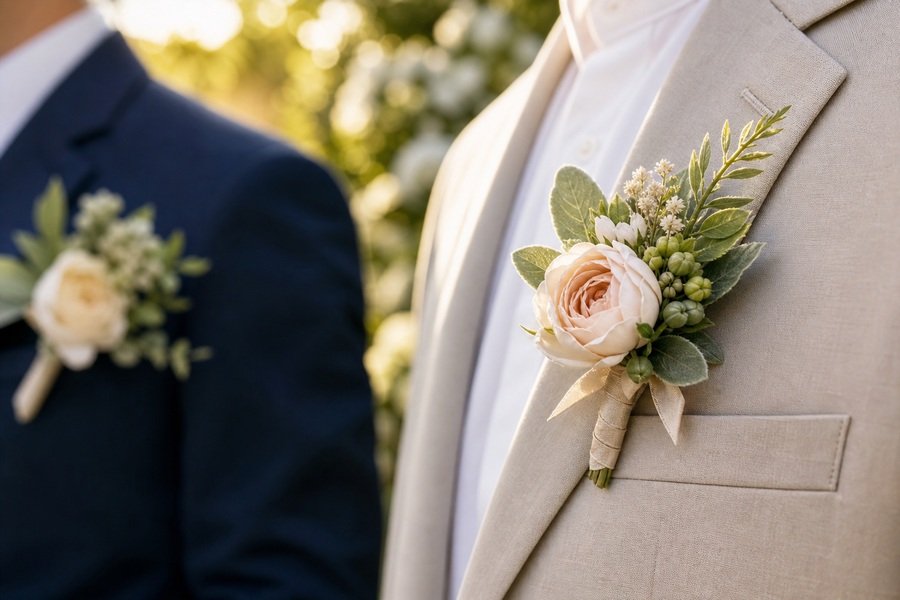
The biggest risk with silk is appearance. A boutonniere is worn close to the face and appears in portraits. Cheap artificial flowers can be easy to spot. The best silk boutonniere should be small, balanced, and not too bulky. It should use matte petals, realistic leaves, and a clean ribbon wrap. A single high-quality faux orchid or rose often looks better than a large cluster of low-quality flowers.
Which Real Flowers Work Best for Summer Boutonnieres?
Fresh boutonnieres can survive summer better when they use hardy flowers. The best choices have waxy petals, firm structure, or natural moisture storage.
The best real flowers for summer boutonnieres include orchids, mini succulents, anthurium, spray roses, carnations, mums, thistle, berries, and some sturdy foliage. These options usually handle heat better than delicate flowers because they have firmer texture or stronger moisture retention.
A summer boutonniere should be chosen differently from a spring boutonniere. In spring, soft blooms may last well because the weather is cooler. In summer, the flower must handle heat, sweat, sun, and several hours out of water. That changes the floral priority.
Best Fresh Options
Orchids are one of the strongest fresh choices. They have waxy petals and a clean shape. They also work with tropical, modern, beach, and formal weddings. A single small orchid can look polished without needing many extra flowers.
Succulents are also strong. They hold moisture naturally, so they are useful for hot weather. They work especially well for desert, rustic, boho, and outdoor weddings. The only issue is weight. A succulent boutonniere should be small so it does not pull on the lapel.
Spray roses can work if they are hardy and well-conditioned. They are classic and easy to match with bridal flowers. Carnations are very durable, but some couples avoid them because they feel too traditional. Still, a well-styled carnation boutonniere can look modern when paired with clean greenery and a simple ribbon.
| Best Fresh Choice | Style Fit | Summer Note |
|---|---|---|
| Orchid | Modern, tropical, formal | Strong waxy petals |
| Mini succulent | Desert, rustic, boho | Great heat tolerance |
| Anthurium | Modern, tropical | Bold and structured |
| Spray rose | Classic, romantic | Use hardy varieties |
| Carnation | Classic or modern | Very durable |
| Mum | Simple, colorful | Stronger than many soft blooms |
| Thistle | Rustic, blue-toned, textural | Holds shape well |
| Berries | Seasonal, rustic, garden | Adds texture without soft petals |
Flowers to Avoid in High Heat
Some flowers look beautiful but struggle in a boutonniere. Hydrangea needs a lot of water. Peony can open and soften quickly. Lily of the valley is delicate. Fragile garden roses can bruise. Sweet peas can wilt fast. These flowers may still work in cool indoor weddings, but they are risky for a hot outdoor event.
Keep the Design Small
A fresh summer boutonniere should be compact. Large designs trap heat, bend more easily, and get bumped often. A simple single bloom with sturdy greenery usually lasts better than a heavy mini bouquet pinned to the lapel.
How Should You Choose Between Silk and Real for a Summer Wedding?
The right choice depends on weather, timeline, budget, style, and the role of the boutonniere in the wedding design.
Choose silk boutonnieres for outdoor heat, long wear time, destination weddings, early preparation, allergy concerns, or keepsake value. Choose real boutonnieres when natural scent, fresh texture, tradition, and close-up authenticity matter more than heat resistance. For many summer weddings, a hybrid plan works best.
A hybrid plan means using silk for the wedding party boutonnieres and fresh flowers for a few special pieces. For example, the groom may wear a fresh orchid boutonniere, while groomsmen wear matching silk versions. Or everyone may wear silk boutonnieres, while the bridal bouquet uses fresh flowers.
Decision Framework
Couples should not ask only, “Which one is prettier?” Both can be beautiful. The better question is, “Which one will still look right when we need it most?”
| Wedding Situation | Better Choice | Reason |
|---|---|---|
| Outdoor July ceremony | Silk | Best heat stability |
| Indoor air-conditioned venue | Real or silk | Both can work |
| Beach wedding | Silk | Wind, heat, and salt air are hard on fresh blooms |
| Black-tie evening wedding | Real or premium silk | Depends on style and florist skill |
| Destination wedding | Silk | Easier to pack and prepare |
| Allergy-sensitive family | Silk | No pollen issue |
| Couple wants fragrance | Real | Natural scent matters |
| Couple wants keepsakes | Silk | Can be saved after the event |
| DIY wedding | Silk | Can be made early |
| Luxury floral design | Real or premium silk | Quality is the deciding factor |
Budget Is Not Always Simple
Many people think silk is always cheaper. It can be cheaper, but not always. Premium silk or real-touch flowers can cost more upfront than simple fresh flowers. The value comes from lower risk, early preparation, reuse, and fewer replacement concerns.
Fresh boutonnieres can be affordable because they are small. But if the flowers wilt before portraits, the low cost does not feel useful. For summer weddings, performance matters as much as price.
Match the Boutonniere to the Full Floral Plan
The boutonniere should not feel separate from the rest of the wedding flowers. If the bouquet uses orchids, the boutonniere can use a small orchid. If the ceremony arch uses roses and eucalyptus, the boutonniere can echo that look. If the wedding uses mostly silk flowers, the boutonniere should match the same quality level.
A small lapel flower can carry a surprising amount of design weight. It appears in close photos, first-look images, family portraits, and ceremony shots. So it should look intentional, not like a last-minute accessory.
How Do You Make a Summer Boutonniere Last Longer?
A boutonniere lasts longer when the design, storage, and wearing time are planned from the start. Heat resistance begins before the wedding day.
To make a summer boutonniere last longer, choose heat-tolerant flowers, keep fresh pieces cool, avoid direct sunlight, pin them as late as possible, handle them gently, and prepare backups. For silk boutonnieres, store them flat, protect them from crushing, and remove lint before photos.
Fresh and silk boutonnieres need different care. Fresh flowers need hydration and cool handling. Silk flowers need shape protection and clean presentation. Both need secure pinning or a pocket square design so they do not tilt during the event.
Fresh Boutonniere Care
Fresh boutonnieres should be stored in a cool place before use. They should not sit in a hot car, near a window, or in direct sun. If a florist provides care instructions, follow them closely. Some flowers can handle refrigeration, but not every flower likes the same conditions. The safest general rule is to keep them cool, shaded, and protected.
Pinning should happen close to photo or ceremony time. If photos start at noon and the ceremony is at four, fresh boutonnieres may need extra care between those moments. A backup boutonniere for the groom can be a smart choice.
Silk Boutonniere Care
Silk boutonnieres are easier, but they still need care. Store each one in a small box or tray. Do not crush them under shoes, suits, or travel bags. Before wearing, check the ribbon, pin, magnet, or pocket insert. Remove dust or lint with a soft brush. Gently reshape petals and leaves if needed.
| Care Step | Fresh Boutonniere | Silk Boutonniere |
|---|---|---|
| Before wedding | Keep cool and hydrated | Store in a protective box |
| During travel | Avoid heat and sun | Avoid crushing |
| Before photos | Pin late | Check shape and lint |
| During event | Handle gently | Handle gently |
| Backup plan | Strongly recommended in heat | Usually not needed |
| After wedding | May dry or be preserved | Can be kept as-is |
Consider a Pocket Boutonniere
A pocket boutonniere or pocket square boutonniere can help with stability. Instead of pinning a small stem to the lapel, flowers are attached to a flat insert that slides into the jacket pocket. This style can hold the floral piece more upright and reduce pinning damage. It works well with both silk and real flowers, but it is especially useful for heavier designs.
My insights: Which Boutonniere Holds Up Best in Summer Heat
Summer heat does not treat all boutonnieres equally. A silk boutonniere stays consistent, while a real boutonniere depends on flower type, moisture, timing, and weather.
A silk boutonniere holds up best in summer heat for most weddings because it is not affected by moisture loss, direct sun, or long wear time in the same way fresh flowers are. A real boutonniere works best when it uses heat-tolerant blooms and is pinned shortly before photos or the ceremony.
A boutonniere sits in one of the hardest floral positions at a wedding. It is pinned to a warm body. It has no vase. It is exposed to jacket fabric, body heat, direct sun, wind, and movement. It also gets touched during hugs and portraits. For that reason, a fresh boutonniere has less protection than a centerpiece or bouquet.
The Main Summer Difference
Silk and real boutonnieres age differently during the event. Silk flowers may wrinkle, bend, or collect lint, but they do not lose water. Fresh flowers can soften, bruise, droop, or brown when they sit too long in heat.
| Factor | Silk Boutonniere | Real Boutonniere |
|---|---|---|
| Heat resistance | Very strong | Depends on flower type |
| Water needs | None | Needs hydration before wearing |
| Best prep time | Days or weeks before | Morning of or close to event |
| Scent | None | Natural fragrance |
| Touch | Fabric or real-touch feel | Natural petal feel |
| Photo stability | Very consistent | Can change through the day |
| Sentimental value | Can be kept long-term | Usually short-lived |
| Summer risk | Low quality may look fake | Wilting, browning, bruising |
I usually see silk boutonnieres perform better for outdoor summer weddings, destination weddings, beach weddings, garden ceremonies, and events with long photo timelines. Real boutonnieres still make sense when the couple loves fresh flowers and can manage timing well. The key is to choose the boutonniere based on the full wedding day, not only the first photo.
Conclusion
Silk boutonnieres usually hold up best in summer heat. Real boutonnieres can still work when flowers are hardy, well-cooled, and worn at the right time.