
Long artificial stems are easy to damage when they lean unsupported, carry stacked weight, or spend months inside oversized boxes where flower heads rub together.
To store long stem artificial flowers safely, clean and inspect them first, support the full stem length, separate delicate blooms, and use rigid containers with enough head clearance. Store stems flat, angled, or upright according to their construction, prevent movement with soft dividers, avoid tight compression, label every box, and keep the storage area clean, dry, dark, and stable.
The core principle is simple: the container and internal supports should carry storage pressure—not the petals, leaves, glued flower heads, or internal stem wire.
Why Do Long Stem Artificial Flowers Bend, Crush, and Collect Dust in Storage?
Long stems create a different storage problem from compact bouquets because even a small unsupported bend can become visually obvious across 60, 90, or 120 centimeters of stem.
Long faux flowers are most often damaged by unsupported stem spans, sharp folding, heavy stacking, undersized cartons, uncontrolled movement, and pressure on flower heads. Open shelves and poorly closed boxes also allow dust to settle deeply into layered petals, flower centers, flocking, real-touch coatings, and fine foliage.
Artificial flowers frequently contain several materials in one stem: fabric or molded petals, plastic leaves, internal metal wire, adhesives, coatings, foam, and wrapped stems. That mixed construction is why one storage method should not automatically be applied to every product.
Balsam Hill describes silk-style petals as relatively delicate and recommends proper cleaning and protected storage for artificial florals. Its care guidance also warns against treating every artificial flower as washable or chemically cleanable.
The Five Main Storage Failures
| Storage Failure | What Usually Happens |
|---|---|
| Long unsupported span | Stem develops a bow or kink |
| Heavy objects above flowers | Petals and flower heads flatten |
| Stems bundled too tightly | Leaves crease and blooms interlock |
| Oversized box with no restraints | Flowers slide and strike each other |
| Open or poorly protected storage | Dust settles into difficult-to-clean surfaces |
Bent Is Not the Same as Broken
A wired artificial stem can often be reshaped after mild storage compression.
A stem becomes a more serious problem when:
- The internal wire snaps
- The outer coating splits
- A sharp crease repeatedly reforms
- The flower head becomes loose
- Leaves detach at the bend
- A paper-wrapped stem tears
- The stem no longer supports the flower head
Afloral notes that many faux botanicals contain adjustable wired stems that can be reshaped after unpacking. That flexibility is useful, but it should not be used as an excuse to store stems sharply folded for months.
Why Flower Heads Need Their Own Clearance
The long stem is often stronger than the bloom.
A peony, hydrangea, magnolia, orchid, poppy, or garden rose may contain:
- Thin layered petals
- Delicate flower centers
- Artificial pollen
- Foam
- Adhesive
- Painted details
- Soft coatings
If the box lid presses downward, the flower head—not the stem—absorbs the load.
That is the wrong load path.
Why Dust Matters During Storage
Dust is easier to remove when it remains loose on an accessible surface.
Once it settles for long periods into:
- Petal seams
- Flower centers
- Flocking
- Real-touch surfaces
- Artificial moss
- Fine fern foliage
cleaning becomes slower and may require more contact with delicate materials.
Balsam Hill recommends routine dust removal from artificial flowers rather than allowing buildup to remain indefinitely. For artificial plants, it currently recommends weekly or biweekly dusting depending on environment and exposure.
The Smithsonian Museum Conservation Institute likewise uses gentle soft-brush dust removal as a low-force conservation approach for stable delicate surfaces.
Storage Should Prevent New Damage
A good artificial-flower storage system should control:
- Bending
- Compression
- Abrasion
- Dust
- Light
- Moisture
- Heat
- Color transfer
- Handling damage
- Inventory loss
If a system solves only dust while crushing the flowers, it has failed.
What 11 Rules Prevent Long Stem Artificial Flowers From Bending, Crushing, and Gathering Dust?
The safest methods move from product preparation to structural support, then environmental and inventory control.
The 11 rules are to clean before storage, sort by construction, support the full stem length, avoid sharp folds, protect flower heads individually, use rigid containers, divide stems into shallow layers, immobilize each bundle, control the storage environment, label every container, and inspect inventory before the next display season.
Rule 1: Clean Every Stem Before It Goes Into Storage
Do not turn the storage box into a dust archive.
Remove loose dust before packing, working from the flower head downward with a soft brush, microfiber cloth, or another method approved for the exact product. Store only completely dry flowers and never seal stems carrying dampness, grease, sticky residue, or loose debris.
Balsam Hill advises using soft dry cleaning methods for its artificial flowers and cautions against water or commercial cleaning chemicals where those methods are not approved.
Afloral likewise recommends gentle dust removal and product-appropriate cleaning rather than aggressive handling.
Pre-Storage Cleaning Sequence
- Lay the stem on a clean padded surface.
- Inspect the flower head.
- Support the bloom with one hand.
- Brush the outer petals gently.
- Clean the flower center.
- Dust leaves from top to bottom.
- Wipe broad stable leaves where permitted.
- Clean the lower stem.
- Check the cut end for exposed wire.
- Let any approved damp-cleaned component dry fully.
Do Not Store:
- Wet flowers
- Sticky flowers
- Flowers smelling strongly of moisture
- Stems carrying outdoor dirt
- Greasy restaurant displays
- Products with visible mould-like growth
- Flowers with unknown contamination
Isolate questionable products before returning them to clean inventory.
Canadian Conservation Institute storage guidance recommends examining collection materials for mould or infestation before storage rather than introducing compromised items into the main collection. The same preventive principle is useful for reusable artificial-flower inventory.
Rule 2: Sort Long Stems by Construction Before Packing
A 100-centimeter artificial rose and a 100-centimeter blossom branch should not automatically share the same box.
Separate flowers by stem rigidity, flower-head size, surface material, color, and vulnerability. Pack heavy wired branches apart from delicate fabric blooms, and separate pale petals from strongly colored, glittered, flocked, or sticky products that could mark them during prolonged contact.
Create groups such as:
- Long roses
- Delphiniums
- Orchids
- Hydrangeas
- Peonies
- Blossom branches
- Magnolia branches
- Artificial grasses
- Eucalyptus
- Real-touch flowers
- Pale white flowers
- Dark saturated flowers
Separate High-Risk Contact Surfaces
Do not store these in unrestricted direct contact:
- Black foliage against white petals
- Glitter against velvet or fabric
- Rough molded branches against real-touch roses
- Exposed wire against any visible leaf
- Sticky coatings against tissue
- Artificial berries against pale flowers
A layer of clean compatible interleaving material is inexpensive compared with replacing stained or abraded flowers.
The Smithsonian Museum Conservation Institute recommends neutral-pH, unbuffered acid-free tissue for general textile storage and notes that soft interleaving or stuffing can help maintain three-dimensional shapes and reduce abrasion.
Rule 3: Support the Full Length of the Stem
This is the most important anti-bend rule.
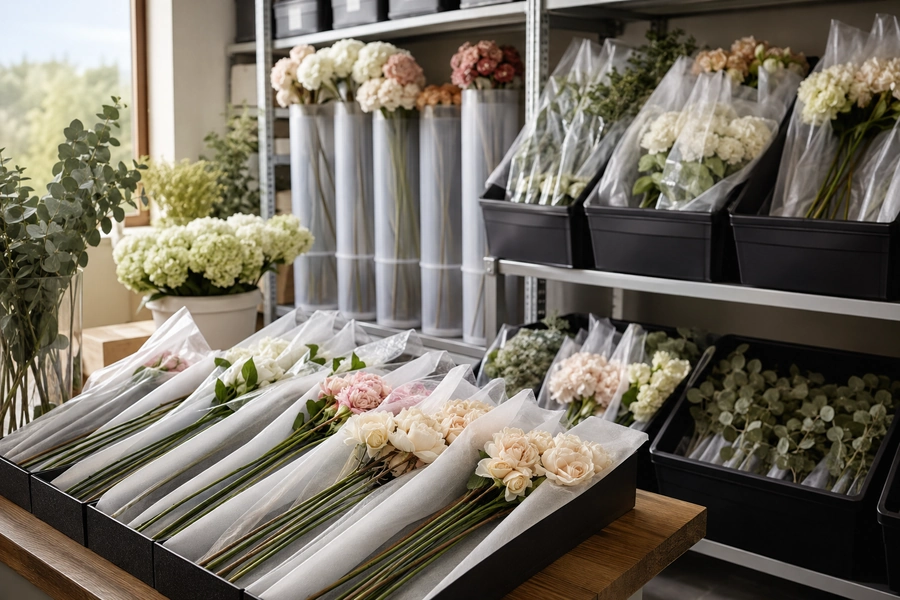
Long stems should rest on a rigid surface for most of their length instead of bridging unsupported gaps. Use long shallow boxes, corrugated trays, rigid boards, dividers, or custom stem channels so gravity does not gradually pull the middle of the stem into a bow.
Good Long-Stem Supports
- Full-length corrugated board
- Long archival-style storage tray
- Polypropylene storage box
- Rigid reusable flower tray
- Corrugated stem channels
- Foam-lined support rails
- Custom shelf trays
- Long divided cartons
A 90-centimeter flower should not lie across a 50-centimeter shelf with 40 centimeters hanging into open space.
Three Support Points
For unusually long or heavy flowers, support at:
- Lower stem
- Middle stem
- Area just below the flower head
This reduces both bending and leverage at the head-to-stem connection.
Avoid Hanging by the Flower Head
Never suspend long artificial flowers from:
- Petals
- Flower centers
- Leaves
- Weak glued branches
If hanging storage is used, the load must be carried by a strong structural stem area and the product must be suited to that orientation.
For most delicate long florals, horizontal full-length support is easier to control.
Rule 4: Never Create a Sharp Storage Fold
Folding a long wired stem in half saves space by transferring the storage problem into the product.
Use broad curves only when a flexible product absolutely must be shortened for storage. Pad the curve generously and reposition it periodically. Straight storage remains preferable for premium long stems that will later be displayed vertically.
Canadian Conservation Institute guidance on flat textile storage recommends minimizing folds and padding unavoidable curves or folds with unbuffered tissue, polyethylene foam, or other soft supports to prevent damaging creases. Although faux flower stems are different objects, the same preventive principle applies: spread a bend over a broad radius instead of concentrating it at one sharp point.
If a Stem Must Curve
Use:
- A broad storage radius
- A padded tube
- A large curved divider
- Soft tissue support
Do not:
- Fold at 90 degrees
- Tie a sharp loop
- Crush several stems into a small circular bin
- Bend the same point repeatedly
- Force heavy branches into a short carton
Better Alternative: Separate Storage Sizes
Instead of one universal box, create:
- 60 cm stem storage
- 90 cm stem storage
- 120 cm branch storage
- Oversized branch rack
The storage footprint may increase slightly, but reshaping labor and replacement damage decrease.
Rule 5: Protect Large Flower Heads With Pressure-Free Cradles
Large blooms should have space around them.
Create loose tissue collars, shallow cavities, or side supports that prevent large flowers from rolling without pressing directly on their petals. The lid, upper tray, or next flower layer should never rest on unsupported bloom surfaces.
The Smithsonian notes that light unbuffered acid-free tissue can be used for stuffing or interleaving when a three-dimensional textile form needs support.
Flower-Head Support by Type
| Flower | Storage Method |
|---|---|
| Peony | Loose tissue collar beneath outer petals |
| Hydrangea | Broad head cavity with side clearance |
| Garden rose | Shallow cradle, tight center left untouched |
| Magnolia | Individual wide slot |
| Orchid | Flower-center shield and side clearance |
| Poppy | Individual shallow cavity |
| Dahlia | Circular support below bloom |
| Delphinium | Long stem tray with side flower clearance |
| Blossom branch | Wide branch channel |
Tissue Should Support—Not Stuff
Do not force tissue deep into:
- Glued flower centers
- Artificial pollen
- Thin orchid throats
- Fragile stamens
- Sticky petals
The tissue occupies empty space around the bloom.
It should not force the flower to become larger than its natural design.
Rule 6: Use a Rigid, Correctly Sized Storage Container
Soft bags prevent dust but provide little crush protection.
Use rigid containers long enough for the stems and deep enough for the flower heads. The box should stay square when stacked, keep external weight away from the flowers, and close without forcing the blooms downward.
A good long-stem box passes five tests:
- Stem fits without a sharp bend
- Flower head clears the lid
- No bloom touches another under load
- Internal tray remains flat
- Box can be handled without product shifting
Rigid Storage Options
Best for loose long stems
- Long under-bed boxes
- Commercial flower cartons
- Custom corrugated trays
- Polypropylene bins
Best for premium stems
- Individual divided trays
- Drawer cabinets
- Flat archival-style boxes
- Modular reusable cases
Best for branches
- Long rigid cartons
- Horizontal rack trays
- Large drawer-style shelves
Avoid Oversized Boxes Without Internal Support
A large empty box seems gentle because nothing is tightly packed.
During handling, however, long stems may:
- Slide
- Rotate
- Strike a wall
- Cross over each other
- Crush flowers at one end
Large boxes still need dividers or restraints.
Rule 7: Store in Shallow Layers With Rigid Dividers
Deep piles create hidden compression.
Use one shallow layer whenever practical. If multiple layers are necessary, place each layer on a rigid load-bearing tray or divider whose weight transfers to the container walls rather than to the flowers below. Keep the heaviest and most structured stems at the bottom.
Canadian Conservation Institute guidance recommends limiting stacking for sensitive materials and using cushioning and interleaving where layering cannot be avoided.
For artificial flowers, add one further requirement:
The divider must carry the upper load.
Tissue alone does not create a load-bearing shelf.
Three-Layer Example
Layer 1: Long rigid branches
Rigid divider
Layer 2: Roses and ranunculus
Rigid divider
Layer 3: Lightweight delicate flowers
Never place:
- Heavy magnolia branches
- Metal floral structures
- Vases
- Ceramic planters
- Boxes of stones
directly above delicate loose blooms.
Maximum Layer Count
There is no universal number.
Stop adding layers when:
- Dividers begin to bow
- Flower-head clearance decreases
- Staff cannot remove a layer safely
- Lower stems carry pressure
- The box becomes too heavy for safe handling
Rule 8: Immobilize the Stems Without Tight Bundling
Movement causes abrasion; excessive restraint causes compression.
Group long stems loosely at their lower sections with soft ties or paper bands, then secure the bundle to the tray or storage box so it cannot slide lengthwise. Keep flower heads staggered rather than pulling them into one dense bouquet.
Two-Point Restraint
For long stems, use:
- One lower tie
- One loose mid-stem restraint
Do not place the second tie directly beneath delicate leaves where it may leave a permanent pressure mark.
Stagger Flower Heads
Instead of storing 12 roses with every bloom at the same level:
- 4 high
- 4 medium
- 4 lower
The stems may occupy slightly more length, but the flower heads no longer press directly into one another.
Avoid Tight Plastic Wrap
Shrink film and tightly wrapped bags can:
- Flatten petals
- Bend leaves
- Press real-touch surfaces together
- Trap moisture
- Transfer color
Use dust barriers loosely around a structurally supported flower unit rather than compressing the product itself.
Rule 9: Store in a Clean, Dry, Dark, Stable Environment
The storage room matters as much as the box.
Keep artificial flowers away from direct sunlight, damp floors, large temperature swings, leaking pipes, heaters, strong odors, and excessive dust. A clean interior closet, conditioned storeroom, or organized warehouse shelving system is generally preferable to an attic, exposed garage, or damp basement.
Canadian Conservation Institute guidance notes that vulnerable textile materials may be damaged by light, heat, incorrect humidity, pollutants, and poor storage or handling.
Balsam Hill similarly recommends protected storage for artificial florals rather than leaving them exposed to environmental conditions when not in use.
Avoid Direct Light
Long-term light exposure can alter pigments and some synthetic materials.
Storage should ideally remain:
- Dark when unattended
- Away from windows
- Away from strong UV sources
Keep Boxes Off the Floor
Use shelves, pallets, or racks.
This reduces exposure to:
- Cleaning water
- Plumbing leaks
- Floor dust
- Accidental kicking
- Pest access
Avoid Extreme Heat
Do not place flower storage:
- Beside boilers
- Under hot roofs
- Against radiators
- Beside warehouse heaters
- Inside hot vehicles for long periods
Mixed-material artificial flowers may contain adhesives and coatings that respond poorly to excessive heat.
Do Not Seal Damp Flowers
A dust-proof container should contain clean dry inventory—not hidden moisture.
If flowers have been wet-cleaned according to their manufacturer’s care instructions, allow them to dry fully before packing.
Rule 10: Label Every Box and Photograph the Contents
Opening six boxes to find one 110-centimeter white delphinium creates unnecessary handling.
Label each container with flower type, color, stem length, quantity, season, condition, and storage orientation. Photograph the open box before closing it and attach or digitally link the image to the container code.
Useful Box Label
LF-WHT-120-03
Meaning:
LF: Long flowersWHT: White120: 120 cm03: Storage box 03
Then record:
- Product SKU
- Flower family
- Quantity
- Color
- Batch
- Condition
- Storage date
- Box location
- Intended event/season
Use Orientation Labels
Examples:
- THIS SIDE UP
- FLOWER HEADS THIS END
- DO NOT STACK
- TOP LOAD ONLY
- OPEN FROM THIS SIDE
Even when a label does not control every handler, it reduces accidental misuse inside an organized storage system.
Photograph the Correct Packing Pattern
An image helps staff reproduce:
- Stem direction
- Layer order
- Tissue position
- Divider location
- Quantity per tray
This is especially useful for rental companies, wedding planners, hotels, retailers, and wholesalers with seasonal staff.
Rule 11: Inspect and Reshape Before the Next Display
Storage ends with an inspection—not with opening the box on event morning.
Retrieve flowers early enough to inspect them, remove loose dust, open compressed petals, reshape adjustable stems, and separate questionable products. Compare high-value stems against retained reference samples and repair or replace components before they reach the venue or sales floor.
Afloral recommends reshaping faux botanicals after storage or shipping by opening leaves, petals, and wired stems to restore a more natural form.
Pre-Display Inspection
Check:
- Stem straightness
- Flower-head security
- Petal shape
- Leaf attachment
- Color change
- Dust
- Abrasion
- Sticky surfaces
- Exposed wire
- Odor
- Glue failure
Use Three Outcomes
A — Display ready
Clean and stable.
B — Repair or reshape
Minor bends, dust, or compression.
C — Remove from premium use
Permanent visible damage, broken wire, strong color change, or unstable construction.
Do not return a damaged focal flower to inventory simply because it can still stand inside a vase.
Which Storage System Works Best for Different Long Stem Artificial Flowers?
The best container depends on whether the product is rigid, delicate, branched, trailing, or heavy-headed.
Straight roses and delphiniums perform well in long shallow trays; large peonies and hydrangeas need bloom cavities; orchids benefit from individual channels; blossom branches need wide rigid boxes; and large rental collections benefit from standardized drawers, racks, and numbered removable trays.
Long Roses and Ranunculus: Parallel Tray Storage
Place stems parallel with:
- Lower stems aligned
- Flower heads staggered
- One loose lower bundle tie
- Side tissue supports
Best system:
Long shallow rigid box
Avoid placing every flower head at one end in one compressed mass.
Delphiniums and Snapdragons: Full-Length Channels
These stems carry small flowers over much of their length.
Use:
- Full-length rigid board
- Several soft restraint points
- Wide head clearance
- No heavy layer above
One support only at the cut end allows the flower-heavy upper stem to flex.
Peonies and Large Garden Roses: Individual Head Cradles
Large layered blooms need:
- Generous depth
- Tissue collars
- No lid contact
- No heavy flowers above them
Store fewer stems per box.
The larger container volume is part of the protection requirement.
Hydrangeas: Broad Cavities
Hydrangea heads are large but contain many smaller branching structures.
Store them:
- In wide slots
- With side clearance
- Without tight flower-to-flower compression
Avoid using them as cushions for other flowers.
Orchids: Individual Stem Channels
Orchids have delicate flower centers and often several blooms arranged along one stem.
Use:
- One channel per stem
- Side supports
- Protective space around flower centers
- Minimal stacking
Magnolia and Blossom Branches: Rigid Long Boxes
Long branches should be stored:
- Horizontally
- Fully supported
- In alternating directions where helpful
- With secondary branches controlled loosely
Do not compact them into a narrow tube.
Grasses: Broad Loose Bundles
Artificial grasses can tolerate grouped storage better than large flowers, but sharp folds create obvious kinks.
Use:
- Long sleeves
- Tall upright containers where stable
- Long horizontal boxes
Keep heavy objects away from the tips.
Real-Touch Long Stems: Low-Contact Storage
Real-touch coatings may be more sensitive to:
- Pressure
- Abrasion
- Dust
- Plastic-to-plastic contact
Store in smaller groups and test any paper, plastic, or foam that will remain in prolonged direct contact.
Pale and White Long Flowers: Dedicated Clean Boxes
White and ivory petals quickly reveal:
- Dust
- Dark rub marks
- Color transfer
- Yellowing
- Dirty tissue
Use dedicated clean storage where practical.
Do not mix them casually with deep red, black, purple, glittered, or dusty stems.
Seasonal Branches: Numbered Horizontal Racks
Commercial collections can use:
- Spring blossom shelf
- Summer foliage shelf
- Autumn branch shelf
- Winter evergreen shelf
Each branch tray receives:
- Product code
- Length
- Quantity
- Seasonal assignment
This prevents repeated compressing and unpacking of unrelated inventory.
How Should Retailers, Wedding Planners, and Hotels Organize Long-Stem Flower Storage?
Commercial storage should reduce handling as well as physical damage.
Standardize containers by stem length, assign each flower family a fixed storage position, separate display-ready stock from repair stock, and use a check-in/check-out record. Store complete arrangements as removable modules where possible rather than dismantling and compressing every stem after each event.
Divide the Storeroom by Length
A practical structure is:
| Zone | Product Length |
|---|---|
| S | Under 45 cm |
| M | 45–70 cm |
| L | 70–100 cm |
| XL | 100–130 cm |
| Branch | Oversized or branched |
The longest inventory stops being forced into medium boxes simply because those boxes are already available.
Create Dedicated Flower-Head Zones
Inside the long-stem storage area, separate:
- Small heads
- Large soft blooms
- Rigid branches
- Orchids
- Pale colors
- Specialty finishes
Use Drawer Storage for Premium Inventory
Long horizontal drawers can be highly efficient because staff can:
- See the complete stem
- Remove one layer
- Avoid lifting heavy boxes
- Maintain flat support
- Keep dust controlled
Each drawer should still contain dividers or trays so flowers do not slide when opened.
Use Vertical Storage Only for Suitable Stems
Tall buckets or tubes can save floor area, but they create several risks:
- Flowers lean
- Lower stems carry the full load
- Flower heads overlap
- Containers tip
- Dust enters from above
Vertical storage works better for:
- Robust grasses
- Simple greenery
- Strong straight branches
than for large delicate peonies or orchids.
If using vertical storage:
- Secure the container
- Limit bundle size
- Keep stems upright
- Do not compress flower heads
- Add a loose dust cover without bending the blooms
Do Not Store Premium Flowers in Display Vases
Leaving long stems inside a vase may seem convenient.
Over months, stems can:
- Lean permanently
- Remain under uneven pressure
- Collect dust
- Be knocked over
- Receive light exposure
Use the vase for display and the support tray for storage.
Check-In Procedure
When inventory returns from an event:
- Count it.
- Photograph damage.
- Clean it.
- Separate wet or contaminated items.
- Repair suitable components.
- Restore broad stem curves.
- Grade condition.
- Return stems to the correct tray.
- Update quantity.
- Close the container.
Do not allow used flowers to be pushed directly into storage after an event.
Check-Out Procedure
Before the next installation:
- Review inventory record.
- Pull the correct box.
- Open on a clean table.
- Inspect each focal flower.
- Reshape stems.
- Remove dust.
- Confirm quantity.
- Repack for transport—not long-term storage.
- Record destination.
Storage Quality-Control Table
| Check | Pass Requirement |
|---|---|
| Stem support | Full length adequately supported |
| Bend | No sharp storage fold |
| Bloom clearance | No lid or divider pressure |
| Layering | Rigid divider carries upper load |
| Movement | Stems cannot slide freely |
| Dust barrier | Container closes properly |
| Moisture | Flowers fully dry |
| Light | Protected during storage |
| Label | Product and quantity visible |
| Box weight | Safe to handle |
| Damage record | Updated |
| Reference photo | Available |
Track Storage Damage
Record why flowers are removed from service.
Categories may include:
- Sharp stem bend
- Broken wire
- Crushed bloom
- Color transfer
- Dust embedded
- Sticky coating
- Water damage
- Poor packaging
- Misplaced inventory
- Excessive stacking
Then calculate:
Storage damage rate = stems damaged during storage ÷ total stems stored × 100
If hydrangeas show far more storage damage than roses, the system—not necessarily the hydrangea product—may need redesign.
Use Storage Data to Change Purchasing
If a company repeatedly buys 120-centimeter stems but owns only 90-centimeter boxes, either:
- Buy longer storage systems
- Change the product length
- Store the stems in modular rack trays
Repeatedly bending them is not a sustainable operating process.
Keep Repair Stock Separate
Create clearly marked areas for:
- Display-ready
- Cleaning required
- Repair required
- Replacement parts
- Retired stock
Do not let staff discover a damaged stem only after it arrives at a wedding or hotel installation.
Preserve Valuable Reference Samples
For major wholesale or multi-site collections, keep one unused reference stem from important batches.
Use it to compare:
- Original color
- Original petal shape
- Surface finish
- Stem construction
This helps distinguish normal design variation from storage damage or aging.
My Insights: How to Store Long Stem Artificial Flowers—Which 11 Rules Prevent Bends, Crush, and Dust
The biggest mistake in long-stem storage is treating flowers as lightweight objects that need only a large plastic bag. Their low weight hides the fact that their shape is mechanically vulnerable.
The 11 strongest rules prevent damage by cleaning flowers before packing, separating incompatible materials, supporting stems along their full length, eliminating sharp folds, cradling large blooms, using rigid containers, limiting layer depth, stopping internal movement, controlling the storage environment, labeling every box, and inspecting flowers before reuse.
The 11-Rule Summary
| Rule | Main Problem Prevented |
|---|---|
| 1. Clean before storage | Embedded dust |
| 2. Sort by construction | Abrasion and color transfer |
| 3. Support full stem length | Bowing and bending |
| 4. Avoid sharp folds | Permanent kinks |
| 5. Cradle large blooms | Crushed petals |
| 6. Use rigid containers | External compression |
| 7. Create shallow layers | Hidden stacking damage |
| 8. Immobilize stems | Sliding and abrasion |
| 9. Control environment | Light, moisture, heat, and dust exposure |
| 10. Label and photograph | Unnecessary handling |
| 11. Inspect before reuse | Damaged inventory reaching displays |
My Most Important Anti-Bend Rule
Support the full stem.
Do not rely on the internal wire to resist months of gravity.
The ideal storage line is:
stem supported → flower head supported → no sharp fold → no external pressure
rather than:
cut end supported → middle hanging → flower head carrying its own weight.
My Most Important Anti-Crush Rule
Create structural clearance around the flower head.
Tissue is useful for:
- Shape support
- Interleaving
- Abrasion control
It should not become the structural roof of the box.
The rigid tray and container walls should carry stacking pressure.
My Most Important Anti-Dust Rule
Clean first and close the container.
A dirty artificial flower sealed inside an expensive box is still a dirty flower.
A clean flower stored inside an open rack will become dirty again.
The two controls work together:
- Clean before storage
- Prevent new contamination
Balsam Hill and Afloral both emphasize routine gentle cleaning as part of keeping artificial botanicals looking presentable.
My Best Storage System for Home Collections
For a small collection, I prefer:
- One long rigid under-bed-style box
- One corrugated inner tray
- Two stem lengths per box at most
- Loose lower-stem ties
- Tissue cradles around large blooms
- One rigid divider when a second layer is unavoidable
- A clear label outside
This is usually more protective than stuffing the flowers upright inside a large storage tote.
My Best Storage System for Wedding Planners
For event inventory:
- Long commercial trays
- Standard stem-length categories
- Numbered removable layers
- Dedicated white-flower boxes
- Separate real-touch inventory
- Repair area
- Check-in/check-out records
Wedding flowers are handled repeatedly, so reducing handling can be as important as reducing compression.
My Best Storage System for Hotels and Retailers
Store displays as modules.
For example:
- Base greenery module
- Focal flower module
- Tall branch module
- Seasonal accent module
Instead of dismantling forty stems after every seasonal rotation, remove three or four protected modules and store each in its assigned tray.
That reduces:
- Handling
- Reshaping
- Lost stems
- Dust
- Reinstallation time
My Best Rule for Large Peonies and Hydrangeas
Buy more storage volume.
Trying to save 20% of box space by compressing large blooms can create:
- Petal creases
- Flattened flower profiles
- Loose heads
- Longer reshaping time
- Premature replacement
Storage density should reflect product vulnerability.
My Best Rule for Extra-Long Branches
Use dedicated horizontal racks.
A 120-centimeter magnolia branch should not spend ten months bent inside a 70-centimeter tote.
Either:
- Store it straight
- Store it in a broad supported curve
- Choose a shorter product specification
Do not create a sharp permanent fold merely to fit existing storage equipment.
My Best Rule for Delicate White Flowers
Give them their own clean box.
White flowers reveal contamination faster than most dark foliage.
Separate them from:
- Colored tissue
- Dark flowers
- Glitter
- rough branches
- outdoor inventory
- repair stock
and handle them with clean hands and tools.
My Best Inventory Rule
Never make staff search through flowers.
Make the inventory tell staff where the flowers are.
A proper label should answer:
- What?
- Which color?
- What length?
- How many?
- Which season?
- Which box?
- Which condition?
Opening fewer boxes means fewer opportunities for dust, crushing, and accidental handling damage.
My Best Storage Principle
Use conservation-style preventive thinking without pretending decorative flowers are museum artifacts.
Conservation organizations repeatedly emphasize several broadly useful principles:
- Support vulnerable shapes
- Minimize folds
- Use soft interleaving where contact is unavoidable
- Limit stacking
- protect from environmental deterioration
- Inspect before storage
The Canadian Conservation Institute specifically recommends padded folds, interleaving, limited stacking, and support for sensitive three-dimensional or textile-based materials.
Those principles translate particularly well to artificial flowers containing fabric petals, delicate surfaces, and long wired structures.
My Preferred Long-Stem Storage Workflow
Use this sequence:
- Remove the flowers from display.
- Photograph unusual damage.
- Dust every stem.
- Confirm flowers are completely dry.
- Separate by material and color.
- Straighten accidental sharp bends gently.
- Group by length.
- Lay stems on full-length rigid supports.
- Stagger the flower heads.
- Add loose bloom cradles where needed.
- Secure the lower and middle stems.
- Add rigid dividers before additional layers.
- Close the dust barrier.
- Label and photograph the box.
- Store it off the floor in a protected location.
- Inspect the inventory before the next use.
The process takes longer than throwing flowers into a tote, but it shifts labor from future reshaping and replacement into controlled preventive storage.
My Final Rule
The best long-stem storage system should allow you to remove a flower months later and find it straight, clean, separated, identifiable, and close to its approved shape.
If every retrieval begins with untangling, washing, reheating, rebending, or replacing stems, the storage system is saving space at the expense of the flowers.
Conclusion
Support long stems end to end, keep blooms pressure-free, use rigid dust-resistant containers, avoid sharp folds, and inspect every flower before storing and reusing it.