


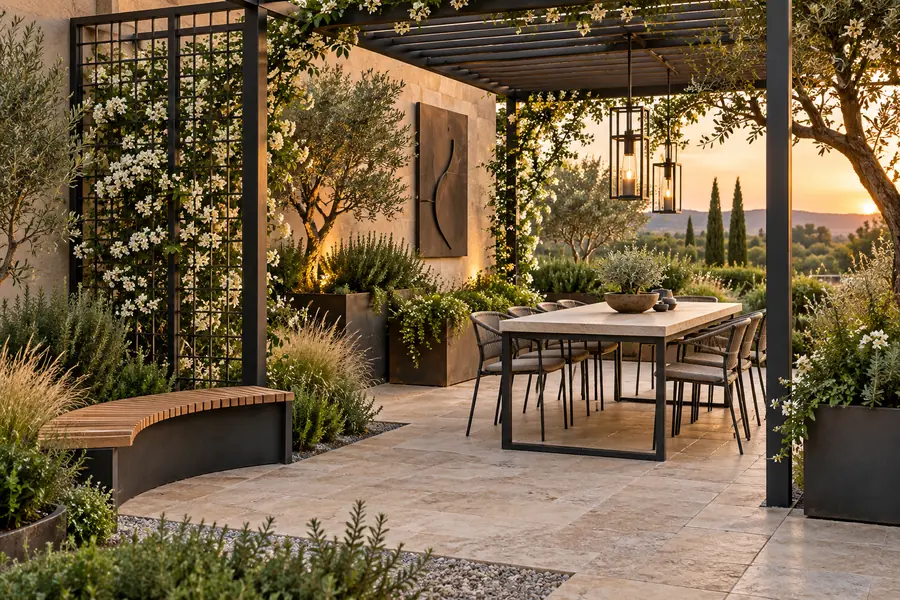
Wrought iron has spent decades associated with black scrollwork, matching patio sets, and traditional gates. That narrow image no longer reflects everything decorative metal can contribute outdoors.
The most interesting way to use wrought iron in a modern garden or patio is as architecture rather than decoration alone. Think slim screens, climbing frames, sculptural seating, pergolas, planters, lighting structures, edging, art panels, and mixed-material furniture. Clean lines and selective detailing usually feel more current than filling the entire space with matching ornate iron.
Modern garden design favors lighter, personalized metalwork over heavy matching sets. Today’s “wrought iron” is often mild steel, used for structure, privacy, contrast, and planting.n do for space, plants, shade, privacy, movement, and contrast**.
1. Use Wrought Iron as a Garden Screen, Not Just a Fence
The first shift is from enclosure to composition.
Instead of surrounding the whole garden with heavy ornamental fencing, use a freestanding or partially open wrought-iron-style screen to define one specific zone. A slim metal divider can create privacy around a dining table, hide utilities, frame a planting bed, or establish a quiet seating area without making the garden feel closed in.
Homes & Gardens’ 2026 coverage describes garden dividers as useful tools for creating privacy and defining outdoor rooms without enclosing the entire property. A well-positioned screen can make planting feel layered while separating areas for reading, dining, or relaxing.
Think in Panels Rather Than Continuous Barriers
I would use two or three metal panels rather than automatically constructing a full fence.
For example, a patio may need privacy only where it faces:
- A neighbor’s seating area
- A street
- An outdoor air-conditioning unit
- A service path
- A parking area
A patterned iron or steel screen can solve that visual problem while leaving the rest of the garden open.
Keep the Pattern Simple
Traditional scrollwork can still work beautifully, but I would use it selectively.
More contemporary patterns might use:
vertical bars,
large arcs,
simple botanical outlines,
or geometric cutouts.
The metal then reads as part of the landscape architecture rather than as decorative clutter.
Let Plants Soften the Metal
Place the screen behind:
ornamental grasses,
roses,
lavender,
hydrangeas,
or loose perennial planting.
The contrast is strong:
rigid metal + soft planting.
That is one of wrought iron’s greatest strengths outdoors.
2. Turn a Wrought Iron Trellis Into Living Architecture
A trellis does not have to disappear behind plants.
Use a decorative metal trellis, obelisk, arch, or grid as visible architecture that still looks intentional before the climber fully covers it. This makes the structure useful in winter as well as summer and is especially valuable in small gardens where vertical space matters.
The Royal Horticultural Society notes that climbing plants make efficient use of vertical space and that most need supports such as trellis, wires, archways, or pergolas. Climbers are particularly useful in smaller gardens because they create height while occupying relatively little ground area.
Design the Trellis for the Plant
Do not choose a support only because the pattern is attractive.
Think about what will grow on it.
A light clematis has different structural needs from:
wisteria,
heavy climbing roses,
or grapevines.
The RHS recommends having support systems in place before planting and notes that larger structures may require proper anchoring.
Use Several Narrow Frames
One large trellis can dominate a small wall.
Instead, I like the idea of three narrow metal frames with planting between them.
The repeated vertical lines make the garden feel taller.
Let the Structure Show
Do not feel pressure to cover every inch in foliage.
A modern metal trellis can remain partially visible.
That gives the garden structure during:
winter,
early spring,
and periods between flowering seasons.
3. Replace the Matching Patio Set With One Sculptural Iron Piece
This may be the most important design update.
Instead of buying a complete matching wrought-iron table-and-chair set, use one distinctive iron piece—such as a bench, bistro table, lounge chair, or pair of sculptural chairs—and combine it with wood, stone, woven fiber, or upholstered outdoor furniture.
This responds directly to current outdoor-design trends. Homes & Gardens reports that generic matching sets are losing favor, while mixed textures and more personal furniture combinations are gaining attention. The same publication also identifies wrought-iron details and European-style forms as part of 2026’s more expressive patio direction.
One Iron Bench Can Be Enough
Place a dark iron bench against:
a clipped hedge,
a pale stucco wall,
or loose planting.
It becomes a focal point without turning the entire garden into a wrought-iron theme.
Mix Materials Deliberately
Iron looks particularly strong beside:
oak,
teak,
limestone,
terracotta,
brick,
canvas,
and woven outdoor fabric.
The metal provides line and contrast.
The softer materials stop it from feeling severe.
Bistro Furniture Still Works
Small wrought-iron-style bistro tables are particularly effective on compact patios and balconies.
Homes & Gardens identified bistro furniture as a notable 2026 garden trend, while House Beautiful highlighted Provençal-inspired outdoor design featuring curved iron seating, clay pots, weathered wood, and relaxed European references.
The key is not to reproduce a themed French café.
Use the bistro element as one layer of the garden.
4. Use Iron Frames to Create an Outdoor Room
Wrought iron can define space without building walls.
A slim metal pergola, canopy, or four-post frame can make a patio feel like an outdoor room. The structure can support climbers, lights, curtains, shade cloth, or simply remain open as an architectural outline around dining or lounge furniture.
The RHS notes that pergolas can be made from metal or wood and that steel structures create a strong architectural feature while supporting climbing plants and shade. Its 2026 heat-focused garden guidance also points to pergolas as useful structures for creating cooler areas outdoors.
Think of the Frame as a Ceiling
People often define outdoor rooms only at ground level using:
rugs,
furniture,
and paving.
A metal frame adds the missing overhead boundary.
Even without a solid roof, it tells the eye:
this is a room.
Add Climbing Plants Strategically
You do not need to cover the entire pergola.
Train plants up one or two posts.
The RHS recommends guiding climbers onto supports and continuing to train new growth along crossbeams as plants develop.
A partly planted structure can feel more contemporary than a completely buried one.
Use Shade Without Visual Heaviness
A slender black frame paired with light fabric or climbing foliage can create shade while feeling much lighter than a solid roof.
That is particularly useful over:
small patios,
courtyard dining areas,
and narrow side gardens.
5. Treat Wrought Iron Planters as Architecture
Iron planters do not need to be small decorative baskets.
Use metal planters or planter frames at architectural scale: tall rectangular containers beside an entrance, raised iron troughs along a patio edge, or slim frames holding removable planting containers. Repeating the same metal finish across several planters can visually organize a garden without relying on matching furniture.
I particularly like iron around planting because it creates a clear boundary between soft foliage and hardscape.
Raise Plants to Eye Level
A metal stand can elevate plants without adding a massive container.
This is useful for:
ferns,
trailing plants,
herbs,
or seasonal flowers.
The stand becomes part of the composition.
Separate Structure From Plant Container
For better practicality, the visible iron frame does not necessarily need to hold soil directly.
A removable inner pot can sit inside it.
That can simplify:
drainage,
seasonal planting,
and replacement.
Repeat the Frame, Change the Planting
For a coordinated patio, I would rather repeat:
the same iron planter structure
than repeat:
the same plant.
One may contain grasses.
Another could hold rosemary.
Another could hold flowers.
The metal creates consistency while the planting remains varied.
6. Use Iron as a Framework for Outdoor Lighting
Outdoor lighting does not need to be attached only to buildings.
A slim iron arch, post, frame, or trellis can provide a permanent structure for lanterns and low-voltage lighting. This lets light become part of the garden composition rather than an afterthought attached to fences or trees.
This approach works particularly well around:
dining areas,
garden paths,
seating niches,
and entrances.
Separate Decorative Metal From Electrical Work
The ironwork can provide the form, but electrical components should be suitable for outdoor use and installed according to applicable requirements.
The design idea is simple:
metal creates the line,
light creates atmosphere.
Use Fewer, Better Fixtures
I would avoid hanging lights from every scroll or opening.
Instead, use the metal to position a few controlled light sources.
For example:
one pendant over a dining table,
two lanterns on a screen,
or a subtle linear light beneath a pergola.
Consider Daytime Appearance
Lighting structures are visible during the day.
A slim black metal frame can still look intentional when the lights are off.
That makes it more successful than temporary supports that exist only to hold string lights.
7. Reimagine Wrought Iron as Garden Art
Not every metal element needs a practical job.
Use wrought-iron-style metalwork as outdoor sculpture: oversized botanical outlines, abstract screens, forged branches, circular forms, wall-mounted panels, or freestanding pieces positioned among planting. Iron is particularly effective because its dark line remains visible against green foliage while still allowing the garden to show through.
This is one place where traditional blacksmithing language can feel very modern.
Instead of:
small decorative butterflies,
roosters,
or ornamental signs,
I would think bigger.
Use Scale
A four-foot circular iron sculpture among tall grasses can feel more intentional than ten small decorative objects.
Large scale simplifies the composition.
Frame a View
A circular or rectangular metal sculpture can be placed where it visually frames:
a tree,
a sculpture,
a bench,
or distant planting.
The garden itself becomes the artwork inside the frame.
Let Weather Influence the Look
Some owners want a perfectly uniform powder-coated finish.
Others may prefer controlled weathering on appropriate materials.
The important point is to decide whether the visual goal is:
clean and protected
or
deliberately aged.
Accidental corrosion is not the same thing as intentional patina.
8. Use Wrought Iron for Edging and Low-Level Structure
Wrought iron does not have to be tall or dominant.
Low metal edging, short decorative barriers, and narrow border frames can define planting beds without creating the visual weight of masonry. Repeated metal lines are especially useful around formal herb gardens, rose beds, gravel gardens, and paths.
This is a subtle use of iron.
From standing height, the metal does not dominate the view.
It simply organizes the ground plane.
Use It Where Materials Meet
Iron edging works particularly well between:
gravel and planting,
lawn and flowers,
or paving and a narrow border.
It creates a crisp line while taking up very little physical space.
Keep Low Barriers Low
A decorative edge should not accidentally become a miniature fence.
I prefer a restrained height that gives structure without visually chopping the garden into too many small compartments.
Repeat a Shape
If a larger gate or screen contains:
an arch,
circle,
or simple vertical rhythm,
repeat that idea in the low edging.
The garden then feels coordinated without becoming overly matched.
9. Combine Iron With Stone, Wood, or Glass Instead of Using It Alone
Modern iron works particularly well as a supporting material.
Pair wrought-iron-style frames with stone tabletops, timber benches, glass panels, ceramic planters, or woven seats. Mixed materials soften the historic associations of iron and make it easier to use in contemporary, Mediterranean, rustic, or minimalist gardens.
This reflects the broader 2026 move toward personalized material combinations rather than one-material matching sets. Homes & Gardens specifically reports increased interest in mixing textures and forms across outdoor spaces.
Iron + Stone
A black metal base under:
travertine,
limestone,
or concrete
creates strong contrast.
The stone feels substantial.
The metal keeps the structure visually light.
Iron + Wood
Iron legs with a timber bench seat create warmth without sacrificing a slim profile.
This works well in gardens where surrounding architecture already contains wood.
Iron + Upholstery
Current outdoor spaces increasingly borrow the comfort of interiors. Homes & Gardens’ 2026 reporting describes “upholstered garden” design as part of a broader shift toward outdoor spaces that feel as comfortable and considered as indoor rooms.
A sculptural iron chair with a generous outdoor cushion can participate in that trend without looking like a traditional matching patio set.
10. Use Iron as Infrastructure for a Changing Garden
The most forward-looking use of wrought iron may be the least decorative.
Design iron or steel elements as permanent frameworks that can change with plants and seasons. A metal arch can support roses one year, lights in winter, shade fabric in summer, and bare sculptural lines after leaves fall. A strong outdoor structure becomes more valuable when it can serve several roles rather than one fixed function.
This idea fits current outdoor design especially well because gardens are increasingly expected to support multiple activities throughout the day. Architectural Digest’s 2026 outdoor forecast describes homeowners wanting outdoor areas that can accommodate everything from quiet morning use to work and evening entertaining.
Design for Change
A strong metal frame might support:
spring clematis,
summer shade fabric,
autumn lights,
and winter greenery.
The structure stays.
The garden changes.
Use Vertical Space
This strategy is particularly valuable where the garden footprint is small.
The RHS emphasizes the usefulness of vertical supports for climbers in compact gardens, while its Chelsea Flower Show 2026 coverage highlighted vertical balcony gardening and metal trellises as ways to add height and screening.
Build for the Mature Plant
Do not size the structure only for the plant you bring home from the nursery.
Think about:
mature weight,
wind movement,
future pruning access,
and anchoring.
The RHS notes that heavier climbers require sturdy support and that large freestanding structures may require concrete anchorage.
Is Wrought Iron Still in Style for Gardens and Patios?
Yes, but the way it is being used is changing.
Wrought iron is not disappearing from outdoor design; heavy matching scrollwork sets are simply becoming less dominant. Current 2026 trends favor selective iron details, European-inspired bistro furniture, cleaner silhouettes, mixed materials, and more personalized outdoor spaces.
This apparent contradiction is important.
Homes & Gardens identifies heavy ornate matching furniture as an outdated direction, yet the same publication also reports a resurgence of wrought-iron details and vintage European silhouettes with a modern twist. House Beautiful similarly highlights Provençal outdoor design featuring curved iron furniture.
So the material is not the problem.
The issue is how much, how ornate, and how coordinated it becomes.
A whole patio filled with identical black scrollwork can feel dated.
One elegant iron bench beside stone paving and loose planting can feel timeless.
How Do You Keep Outdoor Wrought Iron From Rusting?
Outdoor metal needs a finish strategy.
Modern wrought-iron-style garden products—often fabricated from mild steel—need protection from prolonged moisture and corrosion. Exterior-grade paint or powder coating can provide a barrier, while hot-dip galvanizing underneath paint or powder can provide a more robust corrosion-protection system for demanding environments.
PPG currently markets exterior powder coatings for applications including garden furniture, fencing, lighting equipment, and structural steel, with formulations designed for exterior durability and resistance to corrosion and UV exposure.
Powder Coating
Powder coating can provide:
color,
consistent finish,
and a protective barrier.
However, once bare steel becomes exposed through chips or damage, corrosion can begin at the exposed area.
Regular inspection still matters.
Galvanizing
Hot-dip galvanizing adds a zinc coating that provides both barrier and cathodic corrosion protection.
For more demanding projects, particularly coastal or high-exposure locations, galvanizing may be worth discussing with the fabricator.
Galvanizing Plus Powder Coating
The American Galvanizers Association describes paint or powder coating over hot-dip galvanized steel as a duplex system. The galvanized layer protects the steel while the outer coating provides another barrier plus the desired color or aesthetic. The association says the combined system can outperform either method used alone when properly specified and prepared.
For a custom pergola, large screen, or permanent garden structure, that can be a more useful question than simply asking:
“Is it powder coated?”
I would ask:
What is beneath the powder coat?
What Should You Ask Before Buying Wrought Iron Garden Decor?
The word “wrought iron” alone is not enough information.
| Question | Why it matters |
|---|---|
| Is this genuine wrought iron, mild steel, cast iron, or aluminum? | These are different materials |
| Is it solid bar, tube, sheet, or cast construction? | Affects weight and fabrication |
| What exterior finish is applied? | Determines corrosion protection |
| Is the steel galvanized before coating? | Important for demanding exposures |
| Can damaged coatings be repaired? | Affects long-term maintenance |
| How is the item anchored? | Important for screens, arches, and pergolas |
| Can it support mature climbing plants? | Plant weight increases over time |
| Are drainage holes provided where needed? | Trapped water can increase corrosion risk |
| Is it intended for permanent outdoor use? | Decorative indoor metalwork may use different finishes |
| What maintenance does the manufacturer require? | Helps preserve the finish |
For custom architectural work, I would discuss these questions before finalizing the decorative pattern.
A beautiful structure that rusts prematurely is still a poor design.
My insights: 10 New Ways to Think About Wrought Iron for the Garden or Patio
After comparing 2026 outdoor-design trends with horticultural guidance and current corrosion-protection practices, I think the most useful way to rethink wrought iron is to stop treating it as a decorating “style.”
10 New Ways to Think About Wrought Iron for the Garden or Patio means using metal as structure, contrast, and flexibility rather than covering a space in traditional scrollwork. Modern iron can define outdoor rooms, support plants, create privacy, hold lighting, frame views, elevate planters, organize borders, and combine with stone, wood, textiles, and greenery.
My First Insight: Wrought Iron Works Best as a Line
Stone creates mass.
Plants create volume.
Fabric creates softness.
Iron creates line.
That is what makes it so useful outdoors.
A narrow dark bar can define:
an edge,
an arch,
a screen,
or a frame
without blocking the garden behind it.
This is why I think modern iron should often be slimmer and simpler rather than more ornamental.
My Second Insight: The Garden Should Remain the Main Subject
Metalwork is most successful when it makes plants look better.
A dark trellis behind pale roses gives the flowers contrast.
A slim pergola makes vines more visible.
An iron bench creates a place to stop and look at the garden.
The metal should support the experience rather than overwhelm it.
My Third Insight: “Old-Fashioned” and “Timeless” Can Be the Same Object
A wrought-iron bistro chair can look dated in one setting and elegant in another.
Context changes everything.
A complete matching scrollwork set on decorative concrete may feel overly traditional.
The same two chairs beside:
aged terracotta,
loose herbs,
linen cushions,
and simple stone paving
can feel relaxed and contemporary.
That is why current design coverage can simultaneously describe heavy wrought-iron sets as dated and European iron details as newly desirable.
My Fourth Insight: Permanent Iron Should Have Multiple Jobs
If I am paying for a custom metal structure, I want it to do more than one thing.
A screen might provide:
privacy,
plant support,
and a backdrop for lighting.
A pergola might provide:
shade,
structure,
vertical planting,
and a dining-room boundary.
A planter frame might also act as:
a railing,
room divider,
or edge.
Multi-function design makes metalwork feel architectural rather than decorative.
My Fifth Insight: Plant Growth Should Be Part of the Metal Design
A climbing rose is not decoration placed on a trellis.
Over time, the rose and trellis become one system.
The RHS emphasizes choosing suitable supports before planting and matching support strength to the climber.
Therefore, I would design the iron around:
mature plant size,
stem thickness,
pruning access,
tie locations,
and wind.
That creates a better garden ten years later, not just on installation day.
My Sixth Insight: Finish Quality Matters More Than Ornamental Complexity
A simple black steel rectangle with an excellent finish can look better for longer than elaborate scrollwork with poor corrosion protection.
For outdoor work, I care about:
surface preparation,
coating system,
drainage,
weld finishing,
and repairability.
PPG’s current exterior powder-coating products and the American Galvanizers Association’s duplex-system guidance both reinforce the importance of treating the finish as a performance system rather than only a color choice.
My Seventh Insight: Coastal Gardens Need a Different Specification
A protected inland patio and an exposed coastal terrace are not the same environment.
Salt, moisture, wind, and frequent wetting can increase corrosion demands.
For a permanent custom installation in aggressive exposure, I would discuss options such as galvanized steel plus a compatible exterior coating rather than assuming standard painted mild steel will perform equally everywhere.
The American Galvanizers Association specifically identifies aggressive industrial, coastal, and deicing-salt environments as situations where duplex protection can be particularly useful.
My Eighth Insight: Small Gardens May Benefit Most From Iron
Iron is strong without needing visually thick members.
That makes it valuable where space is limited.
A narrow trellis can add six feet of planting height while occupying almost no additional floor space.
A thin screen can divide zones without building a solid wall.
RHS guidance similarly emphasizes climbers and vertical structures as particularly useful in small gardens.
My Ninth Insight: You Do Not Need Black Iron
Black is classic, but it is not mandatory.
Exterior metalwork can also work in:
deep bronze,
dark green,
charcoal,
brown,
warm gray,
or even deliberate color.
Modern powder coatings are available in a wide range of colors and gloss levels, including exterior-durability systems intended for garden furniture and fencing.
A dark green trellis can nearly disappear into foliage.
A warm bronze frame can connect with stone.
Color can change how architectural the metal feels.
My Tenth Insight: The Best Wrought Iron Is Often Only Partly Visible
This is my favorite idea.
An iron arch covered halfway in roses.
A screen disappearing behind grasses.
A pergola softened by jasmine.
A bench surrounded by planting.
The structure remains strong and intentional, but nature gradually edits it.
That balance between:
permanent metal
and
changing plant growth
is what makes wrought iron especially suited to gardens.
Conclusion
Modern wrought iron belongs in the garden as structure, not just ornament. Use it selectively for screens, plants, shade, furniture, lighting, art, and architectural definition.

