
A Good Sample Is Only the Start. The Real Test Is Repeating It in Bulk.
Artificial flowers and decorative products combine color, handwork, material, shape, assembly and packing. Quality therefore depends on controlling the production reference from incoming material through final shipment.
Botanicblossoms operates an approximately 3,500 m² production facility with 51–100 employees, including 5–10 R&D personnel, and monthly production capacity of around 500,000 units. Our quality control is integrated through material selection, manufacturing, inspection, packaging and shipment.
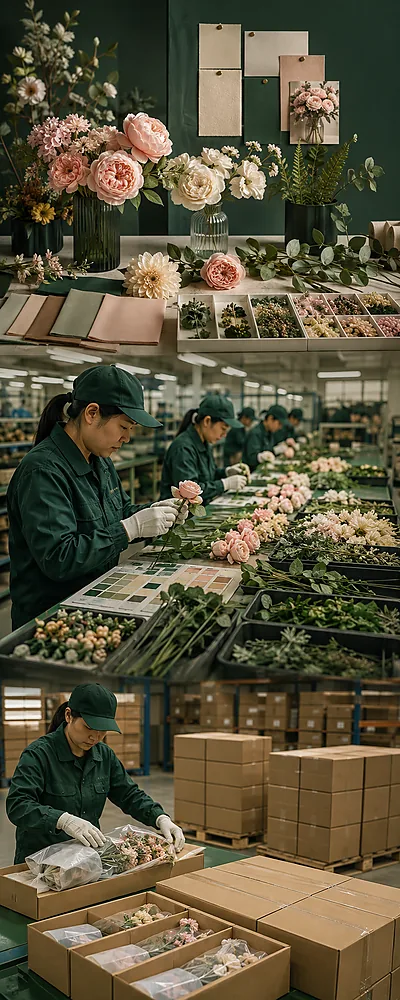

Material · Color · Shape · Handwork · Packing
The Problems Buyers Notice Are Usually Small Variations Repeated Hundreds of Times.
A single artificial flower can look acceptable while a full carton reveals shade differences, uneven stem length, inconsistent bloom opening, loose assembly or packing deformation. Quality control has to look at repeatability, not just one attractive sample.
The Approved Pink Changes from One Material to Another.
Petals, plastic leaves, stems, coatings and decorative finishes can show the same target color differently. Color needs an agreed reference and material-specific review.
The Sample Has a Full Bloom, but Bulk Flowers Open Unevenly.
Petal shaping, branch angle, foliage density and hand assembly can affect the final silhouette. Visual standards should be connected to measurable dimensions where practical.
The Product Looks Fine Until a Stem, Leaf or Component Comes Loose.
Assembly points, inserts and attached decorative parts should be reviewed according to the product construction and the buyer’s intended use.
A Passed Product Can Still Arrive as a Failed Delivery.
Artificial botanicals can be damaged by crushing, friction, uncontrolled movement or inadequate protection. Packing is part of quality because buyers receive the packed product, not the factory-floor product.
Capacity Matters When the Approved Standard Has to Be Repeated at Scale.
Our production base in Jinhua, Zhejiang supports artificial flowers, plants, trees, cactus and succulents, wedding and Christmas products, real-touch flowers, planters, resin, concrete and iron decorative products.
Multiple Product Families Under One Sourcing Program.
Buyers can combine flowers, plants, trees, succulents, seasonal items, planters and decorative products across wholesale, private-label and commercial projects.
Custom Development Before Bulk Production.
Product design, colors, materials, sizes, finishes, molds, packaging and private-label requirements can be developed around the buyer’s market and project brief.
Quality Control Is Not Left to Final Inspection Alone.
Quality control is integrated from material selection and production through inspection, packing and shipment.
Support Custom Projects and Larger-Volume Orders.
Production capacity is designed to support customized programs while maintaining stable production and delivery planning for larger quantities.
Quality Is Built Step by Step — Not Added at the End.
Select a stage to see what should be controlled, what can go wrong and what the production team needs before moving forward.
Check the Material Before It Becomes a Finished Product.
Material selection is part of the quality process. The team needs to confirm that the intended flower fabric, plastic components, stems, coatings, planters or decorative materials correspond with the approved product specification.
Material identity, visible color, finish and suitability for the approved construction.
A substitute material can change color, texture, assembly behavior or final appearance.
The material route is aligned with the approved product specification.
The Golden Sample Turns “Looks Right” into a Production Reference.
Once the buyer approves the final sample, the production reference should connect the physical appearance with written details such as material, color, dimensions, flower or foliage mix, visible handwork, finish and packaging requirements.
Bulk QC cannot compare production against an idea. It needs an approved physical and written standard.
The Approved Product Appearance.
Overall silhouette, visible color, flower opening, leaf density, surface finish and other critical visual details.
The Details the Eye Cannot Control Alone.
Dimensions, materials, color references, packaging, labels and other project-specific production requirements.
A Shared Standard for the Production Team.
The factory team can compare production against the approved direction rather than interpreting buyer comments differently.
The Same Standard Used During Inspection.
Appearance, dimensions and project-specific checkpoints can be reviewed against the approved production reference.
Different Products Need Different Inspection Priorities.
A real-touch flower, a 2-meter artificial tree and a decorative planter do not fail in the same way. Select a quality dimension to see what buyers should define.
Compare the Bulk Product to the Approved Visual Standard.
Review visible shade, bloom shape, leaf position, density, surface finish and the overall look that the buyer actually sees.
Shade consistency
Bloom / foliage shape
Visible finish
Color reference and acceptable visual range
“Same Color” Is Not Enough When the Materials Are Different.
A buyer may provide Pantone, a fabric swatch, a physical product or a reference photo. The important step is deciding which reference has authority and how that color translates across the actual materials used in the product.
Decide Which Reference Controls Approval.
Pantone, physical swatch, approved sample or another agreed reference should be clearly identified before production.
Review Color on the Actual Product Material.
Fabric, real-touch surfaces, plastic, resin, concrete-style and coated metal can display color differently.
Approve the Product, Not Only the Color Chip.
Final approval should consider how color interacts with texture, shape, lighting and surrounding components.
Keep the Approved Color Connected to the Golden Sample.
The bulk team needs one consistent color direction instead of multiple conflicting images, emails or screens.
Do Not Say “The Sample Is Wrong.” Identify Which Variable Is Wrong.
Useful QC feedback should isolate the problem. Color, size, density, material, assembly, finish and packing need different corrective actions.
Identify
Which specific detail does not match the approved reference?
Compare
Compare the affected product against the golden sample and written specification.
Correct
Adjust the relevant material, process, assembly or packing point.
Recheck
Verify that the correction resolves the defined mismatch.
Release
Continue only after the relevant checkpoint is back within the approved project standard.
The Product Has to Survive the Journey After It Passes Inspection.
Artificial flowers, leaves, branches and decorative surfaces can be sensitive to compression, abrasion and uncontrolled movement. Protective packaging should balance transport efficiency with product recovery and presentation.
Protect Flower Heads, Leaves and Canopies.
Packing should avoid permanent deformation while still controlling unnecessary transport volume.
Separate Decorative Finishes from Abrasion.
Planters, resin products, concrete-style finishes and metal decorative surfaces may need additional protection from rubbing and impact.
Make the Correct Product Easy to Identify.
Private-label, wholesale and project orders can use agreed item, carton or zone information to reduce receiving and allocation mistakes.
The Customer Opens the Carton Before They Judge the Product.
Packaging affects first impression, recovery time, installation efficiency and the rate of transport-related complaints.
We Separate Product Quality from Unverified Certification Claims.
Different customers may have different requirements for material declarations, restricted substances, fire performance, UV performance, packaging, labeling or other tests. The exact requirement should be confirmed for the actual product before any compliance claim is made.
Send the Exact Restricted-Material Requirement.
The relevant product can then be evaluated against the buyer’s actual specification.
Define Method, Specimen and Acceptance Criteria.
“Fire-retardant” or “UV-resistant” should not be treated as universal claims across every product construction.
Agree the Buyer’s Quality Criteria Before Shipment.
Product-specific dimensions, visual checkpoints, packing rules and any customer inspection requirement should be clarified before final inspection.
Use the Actual Report for the Actual Product.
Do not assume one certificate, test report or material result automatically applies to unrelated products.
Requirement → Sample → Revision → Golden Sample → Production → In-Process QC → Final Inspection → Packing
The goal is to remove ambiguity before it becomes a bulk-production problem.
Product, market, quantity, color, material, size, finish and packing.
Create the first physical version for buyer review.
Correct the specific mismatched variables.
Freeze the approved physical and written standard.
Build the required quantity to the approved construction.
Catch variation before the whole order is completed.
Review finished goods against the agreed quality criteria.
Protect shape, finish, SKU identity and delivery condition.
Questions Buyers Should Ask Before Bulk Production.
These questions help buyers turn subjective quality expectations into a clearer production and inspection standard.
The final approved physical sample should be connected with the written product specification, including the relevant material, color, dimensions, product mix, visible handwork, finish and packaging details.
First define the controlling color reference. Then review that target on the actual materials used in the product, because fabric, real-touch surfaces, plastic, resin and coatings can show the same target color differently.
Identify the exact mismatch — for example color, size, density, material, flower mix, assembly, finish or packing — revise that point and review the updated sample before bulk production.
No. A flower arrangement, artificial tree, planter, resin decoration or iron decorative product can have different critical dimensions, finishes, assembly points and packing risks.
Yes. Send the actual inspection criteria, material restrictions, labeling rules, test methods, documentation requirements or packaging specifications early so they can be reviewed against the relevant product.
Because the buyer receives the packed product. Compression, abrasion, loose movement and poor protection can damage an otherwise acceptable product during transport.
Send the product, quantity, target market, key dimensions, color reference, material requirement, packaging specification, private-label requirements and any customer inspection, testing or documentation criteria.
Send the Product Requirement Before You Define the Inspection Standard.
Share the product, quantity, color reference, materials, target dimensions, finish, private-label requirement, packaging, buyer inspection criteria and any required test or documentation. We can then build a more practical production and quality-control reference.