
A Sample Should Reduce Bulk-Production Ambiguity.
Botanicblossoms uses samples to help B2B buyers evaluate product appearance, dimensions, materials, colors, finishes, packaging and custom requirements before bulk production.
The exact sample route depends on the product and customization level. Existing product samples, customized samples, packaging samples, new mold development and golden-sample approval can require different cost, preparation and approval steps.
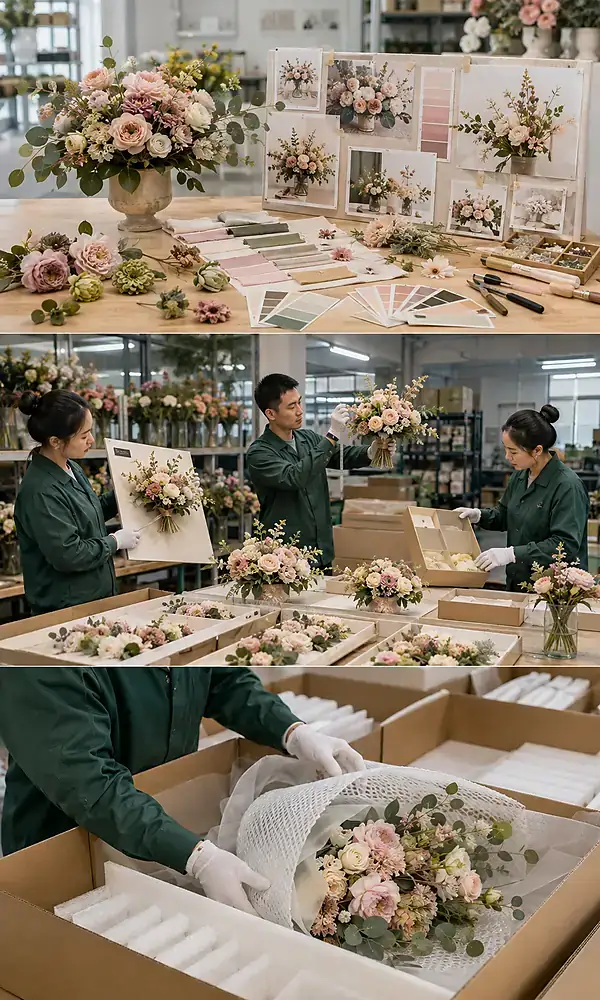

Color · Size · Material · Finish · Pack
“Approved” Is Not Enough If Nobody Can Identify What Was Approved.
Sample problems usually happen when the buyer, factory and production team are not using the same version, or when a critical product variable remains open after approval.
The Buyer Approves a Phone Photo Instead of a Controlled Color Reference.
Screen color, lighting and camera settings can change perceived shade. Critical color should be tied to an agreed physical or documented reference.
Revision B Is Approved, but Production Still Holds Revision A.
The final approved version should be identified clearly enough that old samples and old specifications cannot be confused with the current one.
The Product Sample Is Approved but Retail Packaging Is Still Open.
Private-label packaging, barcode, case pack and carton marks can affect the final order even when the product itself is approved.
A Handmade Sample Is Expected to Represent Every Bulk Unit Exactly.
The approval standard should distinguish controlled features from acceptable production variation, especially for hand-shaped botanical products.
Different Sample Objectives Need Different Development Paths.
Select the sample type closest to your buying situation. Cost, preparation time and courier arrangements are confirmed for the actual request.
Evaluate an Existing SKU Before a Wholesale Order.
Useful when the buyer wants to inspect the actual appearance, scale, material, finish and overall quality of a current product before committing to bulk quantity.
SKU / product link, color or size selection, sample quantity and delivery address.
Existing product appearance, material, construction and scale.
Existing sample availability should be confirmed before dispatch.
Approve the Customized Variables Before Bulk Production.
Use a customized sample when color, material, dimensions, shape, foliage density, finish or another product variable differs from an existing SKU.
Base product, exact requested changes, references, target quantity and approval criteria.
Customized color, dimensions, material, finish or product configuration.
Customization can affect sample cost, MOQ and timing.
Approve the Buyer-Facing Package Together with the Product.
Useful for retail and e-commerce programs where printed packaging, barcode, private label, unit pack, case pack or carton presentation is part of the final product.
Artwork, barcode data, label requirement, pack structure, case pack and market information.
Packaging artwork, label / barcode placement and presentation route.
Printed packaging can have separate material or supplier minimums.
Validate a New Product Structure Before Bulk Economics Are Locked.
New molds, components or original ODM structures need a development sample path before the product can become production-ready.
Design brief, drawings or references, target dimensions, material, function, market and projected quantity.
Product concept, construction, mold output and design direction.
Tooling, development and revision requirements can change the project scope.
Freeze the Final Approved Version for Bulk Production.
The golden sample is the final approved product reference used together with the written specification to guide bulk production and, where relevant, inspection.
Final approved sample version, specification, packaging and order reference.
Final appearance and approved product version.
It should not conflict with the current PO, specification or packaging standard.
Approve the Variables That Matter for Bulk Production.
Not every product needs every checkpoint. The checklist should follow the actual SKU and buyer use.
Color, Shape, Density and Visual Balance.
Especially important for flowers, foliage, trees and close-view decorative products.
Height, Width, Pot, Stem or Critical Fit.
Define tolerances where dimensions are critical to retail fixtures, planters or commercial installations.
Material Route and Surface Feel.
Confirm material direction when the buyer specifies real-touch feel, fabric, molded components, resin, concrete or metal décor.
Assembly, Branch Layout and Components.
Useful for trees, large greenery, planters and decorative products with multiple parts.
Texture, Coating, Paint and Decorative Detail.
Finish approval is important where visible surface character is part of the product design.
Unit Pack, Label, Barcode and Carton Method.
Private-label and retail programs should approve buyer-facing packaging where it affects the final product experience.
Brief → Feasibility → Sample Quote → Development → Review → Revision → Approval → Golden Sample
Select a stage to see what should be completed before the next step. The number of revisions is not fixed universally; it depends on the development requirement and buyer feedback.
Define What the Sample Needs to Prove.
The buyer should identify whether the sample is for general evaluation, custom color, private packaging, structural development, commercial-project approval or final golden-sample control.
Product reference, dimensions, color, material, finish, packaging and approval purpose.
A sample is requested without identifying which variables the buyer will use to approve it.
Sample objective and evaluation criteria are clear enough to begin feasibility review.
Check Whether the Requested Sample Route Is Practical.
We review the base product, materials, mold or tooling need, packaging route, development complexity and the buyer’s target bulk quantity.
Complete sample brief plus any technical or market constraints.
Sample development starts before an important material, mold or commercial limitation is identified.
The proposed development route is clear enough to quote.
Confirm the Sample Scope, Cost and Delivery Arrangement.
The quotation should state the sample basis, customization scope, applicable development or tooling cost, courier arrangement and expected preparation path.
Final feasibility result and buyer delivery information.
The buyer assumes sample fees, freight or later credit rules that were never agreed.
The buyer understands and accepts the applicable sample terms.
Build the Sample Against the Confirmed Brief.
Development may involve color matching, material selection, assembly, packaging, finish work, mold output or another project-specific process.
Approved sample brief and confirmed commercial arrangement.
The sample is developed from an outdated reference or incomplete change list.
A reviewable sample represents the current project version.
Review the Sample Against Agreed Approval Points.
The buyer should evaluate the sample using the same criteria that will matter for bulk production and inspection.
Sample plus approval checklist, measurements and reference documents where relevant.
Feedback is subjective or contradictory because the buyer has no defined approval criteria.
Buyer either approves or issues a clear revision request.
Translate Feedback into Controlled Changes.
Revision requests should identify the exact change, current sample version and whether the requested change affects material, tooling, packaging, cost or schedule.
Specific buyer feedback linked to the current sample version.
Multiple comment rounds are mixed together without version control.
The next sample version incorporates the agreed changes and is ready for review.
Approve the Final Version in a Traceable Way.
Approval should state which sample version is accepted and which written specification, color, dimensions, finish and packaging requirements remain in force.
Final review result and identification of the approved sample version.
Approval is given while open issues remain or the approved version is not identified.
The final approved version is ready to become the bulk-production reference.
Use the Approved Reference to Control Bulk Production.
The golden sample and written specification should together represent the product version that production and quality control are expected to follow.
Approved final sample, current specification, packaging standard and order reference.
Bulk production starts from a different version than the one the buyer approved.
Sample development is closed and transferred into bulk-production control.
Sample Terms Should Be Confirmed for the Actual Product — Not Assumed from a Generic Policy.
Sample price, customization cost, tooling or mold charges, courier cost, preparation time and any later credit or refund arrangement depend on the project and should be confirmed in the sample quotation.
Product- and Development-Specific.
Existing samples and custom-development samples may use different cost structures.
Confirm the Delivery Route.
Buyer courier account or another agreed shipping arrangement can be confirmed before dispatch.
Depends on Complexity and Material Readiness.
Existing products, custom color, new packaging and new molds can require different preparation paths.
Only If Specifically Agreed.
Any later credit, refund or offset arrangement should be written into the quotation or commercial agreement.
Revision Quality Matters More Than a Fixed Revision Count.
Botanicblossoms does not need to promise one universal number of free sample revisions. The useful rule is to document the requested change, identify the new version and confirm whether the change affects cost, tooling, materials or timeline.
Review one controlled version at a time. Avoid mixing comments from different sample generations without identifying which version each comment refers to.
Name the Current Sample Version.
Make it clear whether feedback applies to the first sample, a revision or the final approval sample.
Use Specific Change Instructions.
“More premium” is subjective; color reference, dimension, material or finish direction is more actionable.
Review Cost and Timing Impact.
Material, mold, packaging or structural changes may require a new feasibility or quotation review.
Replace the Old Reference with the New Approved One.
The final approved version should be the version used for bulk production and inspection.
The Golden Sample Is the Bridge Between Development and Repeatable Production.
A golden sample should represent the final approved product version together with the written specification. It is especially useful when appearance, color, density, finish or assembly cannot be fully described by measurements alone.
What Should the Product Look Like?
Useful for flowers, foliage, color, density, finish and decorative appearance.
Which Written Requirements Still Apply?
Critical dimensions, materials, packaging and tolerances should remain documented.
What Does Bulk Production Follow?
The approved sample and specification should point to the same current version.
What Does QC Compare Against?
Buyer QC or third-party inspection can use the agreed reference where relevant.
The Sample Must Arrive in a Condition That Can Actually Be Evaluated.
Delicate blooms, foliage, large trees and decorative surfaces can require different sample packing. Packing should protect the features the buyer needs to inspect.
Avoid Sample Deformation That Distorts Evaluation.
Bloom and foliage compression should be controlled where appearance is the main approval point.
Protect Decorative Finishes from Rub Marks.
Planters, resin, concrete-style and iron décor may need separation or local surface protection.
Label the Version Clearly.
Multi-SKU or revision programs benefit from clear sample identification.
Confirm the Actual Shipment Arrangement.
Courier account, destination and shipping method should be agreed before dispatch.
Sample Approval Should Trigger a Controlled Transfer — Not an Informal Handoff.
Before bulk production, make sure the approved sample and the final commercial order describe the same product.
Final Approved Sample Identified.
Old versions should not remain active production references.
Written Requirements Updated.
Dimensions, materials, color, finish and construction should align with the approved version.
Buyer-Facing Pack Locked.
Artwork, barcode, case pack and carton marks should be confirmed where relevant.
Quotation / PO / PI Match the Approved Product.
Commercial documents and technical approval should not point to different product versions.
Sampling Is Connected to the Same Team That Supports Bulk Production.
Botanicblossoms operates an approximately 3,500 m² production facility in Jinhua, Zhejiang, with 51–100 employees, including 5–10 R&D personnel, and monthly production capacity of around 500,000 units.
Our OEM/ODM services cover product design, colors, materials, sizes, packaging, finishes, molds and private-label requirements across artificial flowers, plants, trees, wedding and Christmas products, real-touch flowers, planters, vases and resin, concrete and iron decorative products.
Request a Sample →Questions Buyers Should Resolve Before Sample Development Starts.
The sample quotation and approved project documents should always control the actual commercial and technical sample arrangement.
Are samples free?
Sample cost depends on the product, availability and customization level. Existing-product samples, customized samples and new-development samples may use different cost structures. The applicable cost should be confirmed before sample preparation or dispatch.
Who pays the courier cost?
The courier arrangement should be confirmed for the request. A buyer courier account or another quoted shipping route can be used depending on the agreed arrangement.
How long does sample development take?
Sample preparation time depends on existing availability, customization complexity, material readiness, packaging, mold development and revision requirements. The expected timing should be confirmed for the actual sample request.
How many sample revisions are included?
We do not publish one universal revision count for every project. Revision requirements depend on the product and requested changes. Any cost or timing impact should be confirmed before additional development proceeds.
Can I request a custom color sample?
Yes. Provide the best available color reference and explain whether the color applies to petals, foliage, stems, planters, packaging or another component. The applicable color-matching route can then be reviewed.
Can you make a sample from my design or reference image?
Botanicblossoms supports OEM and ODM development. Feasibility depends on the design, materials, dimensions, construction, mold requirement, target quantity and commercial objective.
What is a golden sample?
A golden sample is the final approved product reference used together with the written specification to guide bulk production and, where relevant, quality inspection.
Is the sample exactly the same as every bulk-production unit?
The approved sample defines the agreed product standard, but acceptable production variation should also be considered for the specific product. Hand-shaped botanical products may require visual reference plus written tolerances or acceptance criteria for critical features.
Can sample fees be credited back after a bulk order?
Only if that arrangement has been specifically agreed for the project. Any credit, refund or offset should be stated in the sample quotation or commercial agreement rather than assumed from a general website policy.
How Sample Development and Approval Are Structured.
It explains the sample types, development logic, approval checkpoints, revision control, golden-sample role and sample-to-bulk transfer.
One Fixed Sample Fee, Lead Time, Revision Count or Refund Rule.
The final sample quotation and approved project documents should control the actual sample cost, courier arrangement, development scope, timing and any later credit or refund.
Tell Us What the Sample Needs to Prove.
Share the product or reference, quantity, dimensions, color, material, finish, packaging, target market, required date and the approval points that matter to your buying decision.