
Capacity Is Not Just How Many Units a Factory Can Make.
Real production capacity means matching order volume, product complexity, customization, quality control, packaging and delivery planning without losing consistency.
Botanicblossoms operates an approximately 3,500 m² production facility in Jinhua, Zhejiang, with 51–100 employees, including 5–10 R&D personnel, and an overall monthly production capacity of around 500,000 units.
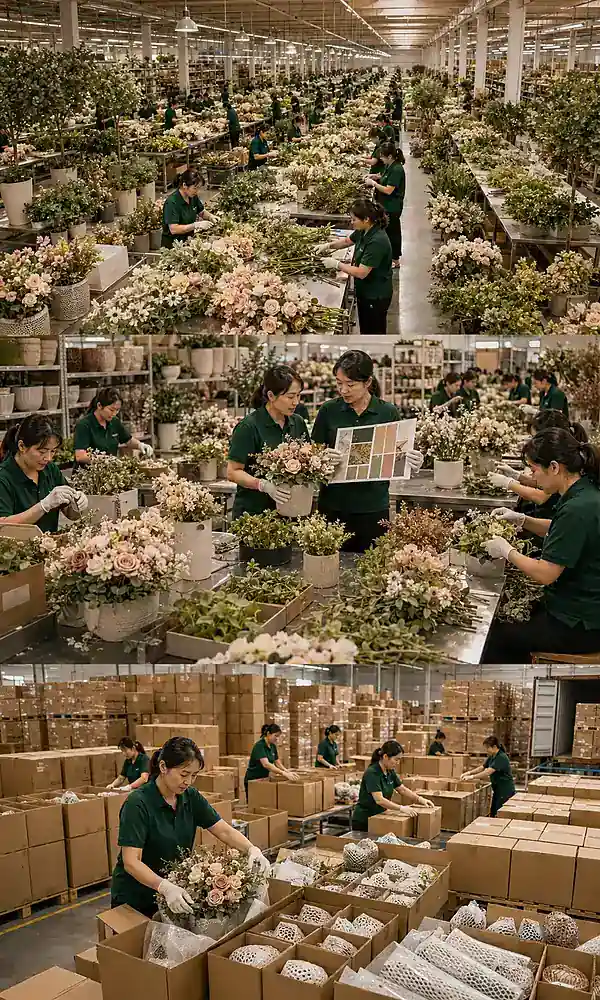

Volume · Complexity · QC · Packing · Schedule
500,000 Simple Units and 500,000 Highly Customized Units Are Not the Same Workload.
Capacity changes with product size, number of components, handwork, color variations, custom molds, private-label packaging, inspection requirements and the number of SKUs sharing the same production window.
One Large SKU Is Easier to Schedule Than Dozens of Small Custom SKUs.
More SKUs create more material preparation, color changes, packing formats and production switches. Order structure matters as much as total unit count.
More Manual Shaping and Assembly Reduces Effective Throughput.
Artificial flowers, trees and decorated products can require different levels of manual opening, assembly, shaping and finishing.
Retail-Ready Packaging Uses More Capacity Than Simple Bulk Cartons.
Private-label boxes, barcode placement, multi-SKU assortments, carton marks and protective inserts can become a meaningful part of the production schedule.
A Peak-Season Order Competes with Other Confirmed Production Windows.
Production timing should be confirmed against the actual factory schedule, especially for seasonal, promotional or event-driven deliveries.
We Look at Workload, Not Only Unit Count.
Select an order profile to understand which variables have the greatest effect on planning. This is a sourcing guide, not an automatic production quotation.
The Most Predictable Capacity Profile.
When the product structure, materials, color, assembly and packing are already established, planning can focus mainly on order quantity, material availability, current production schedule and shipment timing.
Quantity, current schedule and material availability.
Assuming an old lead time still applies during a different production window.
SKU, quantity, required ship date and destination.
Six Variables Can Change the Same “100,000-Unit” Order.
Total units are only one part of planning. The work content behind each unit determines the real production load.
More Components Mean More Production Touchpoints.
A simple stem and a multi-branch tree with many foliage modules use different amounts of preparation, assembly and inspection time.
Custom Color and Material Add Preparation Work.
Color matching, material confirmation, custom sizing and new finishes can add sampling and preparation before bulk production.
More SKUs Increase Switching and Coordination.
Separate colors, sizes, products and packaging formats create more material batches, labels, carton marks and control points.
More Checkpoints Use More Inspection Time.
Buyer-specific dimensions, visual limits, labels, tests or documentation should be considered when production timing is confirmed.
Retail Packaging Can Become a Production Stage.
Branded boxes, inserts, barcodes, assortments and project-specific carton marks add handling and verification work.
A Fixed Launch Date Changes Scheduling Priority.
Seasonal programs, events and promotional launches should be planned backward from the required shipment or installation date.
Scaling Should Increase Quantity — Not Reopen the Product Standard.
A stable volume program works best when the product, color, construction, quality checkpoints and packaging are already controlled. The next production cycle can then focus on quantity, timing and supply planning instead of redesign.
If the product changes substantially between orders, treat the change as a new production variable instead of assuming previous capacity still applies.
Confirm Product and Packing Before Scale.
Validate color, construction, visible quality, packaging and buyer feedback before using the product as a recurring volume program.
Reuse the Approved Production Reference.
Repeat programs become more predictable when the golden sample, materials, color and packing remain controlled.
Reserve the Production Window Against the Actual Quantity.
Larger orders require earlier material and schedule coordination, especially when multiple SKUs share the order.
Plan Recurring Demand Instead of Rebooking from Zero.
Forecast visibility helps production and materials planning for buyers running repeat wholesale, retail or project programs.
Product Type Changes the Workload Behind Each Unit.
Select a product family to see the capacity factors that typically matter most. No fixed unit/hour figure is published because actual output depends on the exact construction.
Volume Depends on Bloom Complexity, Color Count and Hand Finishing.
Simple stems and complex multi-head flowers do not carry the same workload. Petal shaping, flower opening, stem assembly, custom colors and retail packaging can change effective capacity.
Confirm the exact SKU mix and packaging before using monthly factory capacity to estimate a shipment window.
A Seasonal Deadline Should Be Planned Backward from Shipment.
Christmas programs, weddings, retail launches and commercial installations have deadlines that cannot be solved by factory capacity alone. Sampling, approval, material preparation, bulk production, inspection and packing all need time before dispatch.
The correct question is not “How fast can you make it?” It is “When must each approval be complete so the required shipment date remains realistic?”
Start with the Date the Product Must Be Ready.
Retail opening, hotel installation, wedding season or Christmas display timing defines the final project deadline.
Separate Factory Completion from Final Delivery.
Production completion is not the same as arrival at the buyer’s warehouse or installation site.
Reserve Time Based on Actual Order Complexity.
Volume, SKU count, handwork, QC and packing determine how much factory time the order consumes.
Lock the Golden Sample Before the Production Window Begins.
Late approval consumes the time originally reserved for material preparation and bulk production.
Output That Needs Rework Is Not Useful Capacity.
Production capacity only creates buyer value when the goods remain consistent enough to pass inspection, pack correctly and ship without avoidable rework.
We treat material control, in-process QC, final inspection and protective packing as part of capacity planning rather than separate activities.
Wrong Materials Create Rework Before Assembly Starts.
Approved material and color routes should be clear before bulk preparation.
Catch Variation While It Can Still Be Corrected.
Early checks reduce the risk that an entire production batch needs late-stage correction.
Finished Goods Still Need Time for Release.
Inspection should be included in the schedule instead of being squeezed between production and shipment.
Packing Capacity Protects Finished Production.
Artificial botanicals can require careful shape protection, surface protection and SKU identification before shipment.
Order Scope → Complexity → SKU Mix → Quality → Packing → Schedule → Capacity Confirmation → Production Window
Capacity becomes meaningful only after the order structure is clear enough to reserve a realistic production window.
Product, quantity, market and delivery objective.
Components, handwork, custom color, size and finish.
Number of products, colors, sizes and assortments.
Inspection, testing and buyer checkpoints.
Bulk, retail, private label or project-specific packing.
Current factory load and required ship date.
Confirm whether the order fits the requested window.
Reserve the realistic manufacturing and packing window.
Capacity Is Supported by Factory Space, People and Development Capability.
Botanicblossoms combines an approximately 3,500 m² production facility, 51–100 employees and 5–10 R&D personnel with a broad artificial botanical and decorative product portfolio. This supports wholesale, private-label and commercial decoration programs at different scales.
Around 500,000 Units per Month Is an Aggregate Manufacturing Capability — Not a Fixed Promise for Every Order.
Actual order output and lead time depend on product type, quantity, customization, material readiness, SKU count, quality requirements, packaging and the confirmed production schedule.
Approx. 500,000 Units / Month Overall Capacity.
This describes our overall production capability across the product mix.
Every Product Runs at the Same Throughput.
Trees, complex flowers, customized planters and simple stems use different amounts of factory work.
Capacity Against the Real Order Scope.
Product, quantity, SKU mix, customization, QC, packing and schedule are reviewed together.
Reserve Critical Seasonal Orders Earlier.
The earlier the specification and approval are locked, the easier it is to plan materials and a realistic production window.
Questions Buyers Ask Before Placing a Volume Order.
These answers explain how we turn a headline capacity number into a realistic order plan.
It describes our approximate overall monthly production capability across our product mix. It does not mean every product or every custom order can be produced at exactly that rate.
Product type, SKU list, quantities, customization, color and material requirements, packaging, quality or testing requirements, target ship date and destination are the most useful starting points.
It can. Custom colors, materials, sizes, molds, private-label packaging and complex assembly can add development, preparation, switching, inspection or packing work. The effect depends on the exact project.
Yes. Our production capability supports customized projects and larger-volume B2B orders. MOQ, schedule and production plan should still be confirmed for the actual product and customization scope.
Start from the required launch or arrival date, then work backward through shipping, final inspection, packing, bulk production, material preparation, sample approval and any revisions. The earlier the final specification is locked, the easier it is to reserve a realistic production window.
Usually yes, when the product, materials, color, construction and packing remain stable. Repeat programs can focus more on quantity, material readiness and schedule instead of reopening product development.
No. Lead time should be confirmed after product complexity, quantity, customization, SKU count, material readiness, quality requirements, packaging and the current factory schedule are reviewed.
Send the SKU Mix Before You Ask for the Lead Time.
Share the product types, SKU quantities, customization, color and material requirements, packaging, quality criteria, target ship date and destination. We can then review the real workload and discuss a more realistic production window.