
From Buyer Brief to Repeatable Bulk Production.
Artificial flowers, plants and decorative products are not manufactured by one single operation. Color, materials, forming, handwork, assembly, shaping, finishing and protective packing all affect the final result.
Botanicblossoms combines OEM/ODM development, production planning, integrated quality control and protective logistics to move a buyer’s requirement from concept and sample approval into stable bulk manufacturing.
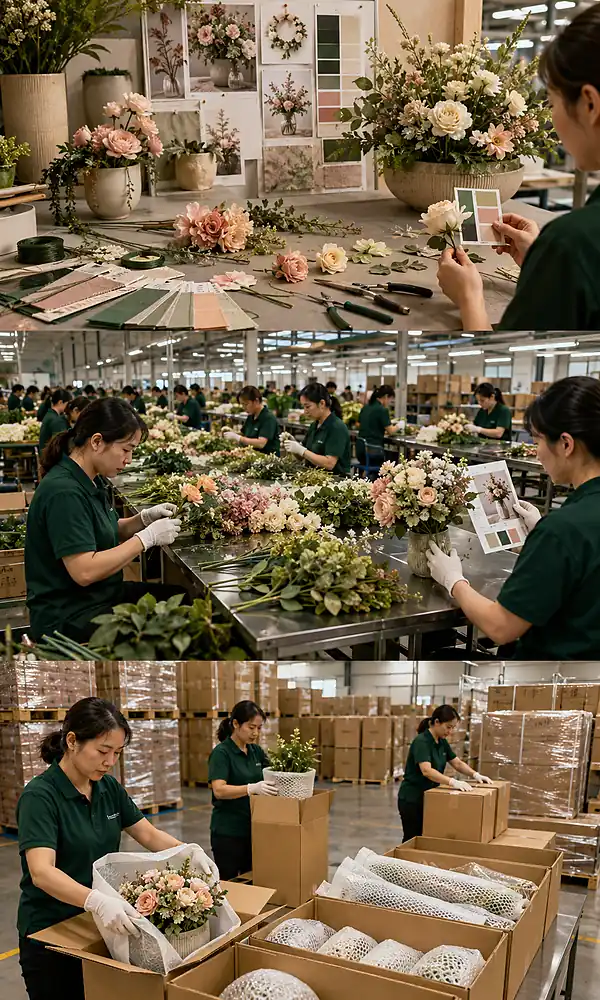

Brief · Sample · Golden Sample · Bulk · QC · Packing
Most Production Problems Start Before Mass Production Starts.
If color authority, material, dimensions, flower recipe, assembly, finish or packing remains unclear at sample approval, the production team has to interpret the requirement later. That creates inconsistency, revision and rework risk.
A Reference Photo Is Treated as a Complete Specification.
A photo does not define actual dimensions, back construction, material, density, packaging or acceptable production variation. These need to be converted into production information.
Color Is Approved on Screen but Produced on Fabric and Plastic.
Screen color, printed color, fabric, real-touch coating and molded plastic can display the same target differently. The final material needs a controlled reference.
One Sample Looks Good, but the Handwork Is Not Defined.
Flower opening, branch angle, foliage density and decorative placement may rely partly on hand assembly. The approved sample needs enough visual and dimensional definition for repetition.
Manufacturing Ends Well, but the Carton Destroys the Shape.
Artificial flowers and greenery can be compressed, rubbed or deformed in transit. Packing design must be treated as the final manufacturing stage, not a separate afterthought.
12 Stages from Requirement to Shipment.
Every stage closes a different production uncertainty. Select a step to see what information is needed, what can go wrong and what should be confirmed before moving forward.
Convert the Buyer’s Idea into Manufacturing Inputs.
The project starts with product type, reference images, target market, quantity, dimensions, color direction, material preference, application, private-label needs, packaging and any delivery or project requirement.
A complete brief reduces sampling rounds caused by missing information.
Product, reference, quantity, size, color, material, target market and packing needs.
A vague brief forces the sample team to make assumptions the buyer may not share.
The product objective and key manufacturing variables are clear enough to proceed.
Not Every Product Uses the Same Production Route.
Artificial flowers, large trees and decorative planters have different production risks. Select a product family to see which manufacturing controls become more important.
Control Color, Bloom Shape, Petal Structure and Stem Assembly.
Artificial flowers are highly visual and often viewed at close range. Material appearance, petal shaping, flower opening, stem proportion and visible assembly need consistent references.
The Golden Sample Is the Bridge Between Development and Manufacturing.
Once the final sample is approved, production-critical details should be frozen. This gives the workshop, production planning and inspection teams a shared reference before the order is scaled.
Do not release bulk production while critical color, material, structure or packing decisions remain open.
Approved Appearance and Construction.
Overall silhouette, flower or foliage mix, visible color, handwork, assembly and finish.
Dimensions, Materials and Packing Details.
Production details that are difficult to control by visual comparison alone.
The Team Builds Toward One Approved Target.
This reduces subjective interpretation during bulk forming, assembly and finishing.
Inspection Compares Bulk Back to the Same Standard.
The approved reference supports in-process and final quality checks.
Four Things the Workshop Must Keep Consistent.
Product type changes the details, but most artificial botanical production depends on controlling material, geometry, assembly and finish.
Use the Approved Material Route.
Substituting fabric, coating, plastic, stem, planter or decorative material can change appearance and production behavior.
Control Size, Proportion and Density.
Stem length, bloom size, branch spread, canopy width, planter dimensions and product density influence the final visual scale.
Repeat the Approved Component Logic.
Flower count, leaf positions, branch layout, inserts, attachments and decorative components need repeatable assembly.
Control the Visible Final Presentation.
Petal shaping, foliage opening, visible glue, paint, coating, surface texture and cleaning all affect buyer perception.
Correct the Process Before the Entire Order Is Finished.
In-process checks help detect variation while production is still active. This is especially important when appearance depends on hand assembly, shaping or multiple components.
Final inspection is too late to become the first time a production problem is discovered.
Watch for Visible Shade Drift.
Compare active production to the approved color and product reference where color is a critical buyer requirement.
Control the Dimensions That Affect Final Use.
Overall height, component length, planter size or other product-specific dimensions can be checked according to the order.
Catch Missing, Loose or Misplaced Components.
Assembly quality should reflect the product construction and intended use.
Compare Bulk Appearance to the Golden Sample.
Shape, density, flower opening, leaf layout and visible finish can be checked before full completion.
Finished Goods Must Match the Standard and Survive Delivery.
Final inspection reviews the completed order against the agreed product and buyer requirements. Packing then protects the approved product from compression, abrasion, uncontrolled movement and identification errors.
Review the Product the Buyer Will Actually See.
Overall look, visible shade, shape, density, finish and product-specific appearance checkpoints.
Confirm Relevant Dimensions and Order Details.
Product, size, SKU, quantity, labels, private-label details and order-specific requirements.
Protect Shape and Decorative Surfaces.
Flower heads, leaves, branches, planter surfaces and decorative finishes may require different protection.
Make the Correct Product Easy to Receive.
Agreed carton marks, SKU identity, store or project references can reduce receiving and allocation mistakes.
A Process Is Valuable Only When the Factory Can Scale It.
Botanicblossoms operates an approximately 3,500 m² production facility in Jinhua, Zhejiang, with 51–100 employees and 5–10 R&D personnel. Monthly capacity is around 500,000 units, supporting both customized projects and larger-volume orders.
Manufacturing Claims Should Follow the Actual Product and Requirement.
Buyers may have requirements for materials, restricted substances, fire performance, UV performance, labeling, private-label packaging, inspection or documentation. These should be provided before final product approval so they can be reviewed against the relevant construction.
Send the Actual Material Restriction.
The relevant material route can then be evaluated for the product.
Define the Required Test or Acceptance Criteria.
Do not assume one “UV” or “fire-retardant” label automatically applies to every product construction.
Agree Critical Checkpoints Before Production.
Buyer-specific dimensions, visual limits, labels and packaging rules should be incorporated before final inspection.
Use Evidence for the Actual Product.
Do not assume an unrelated report or certificate automatically supports another product, material or construction.
Questions Buyers Ask Before Moving from Sample to Bulk.
These questions help turn a design or sourcing request into a clearer manufacturing plan.
Product type, reference images or drawings, target dimensions, color reference, material preference, quantity, market, application, packaging, private-label needs and any special buyer requirement.
The mismatch should be separated into specific variables such as color, material, size, flower mix, density, structure, handwork, finish or packaging. Those variables are then revised and reviewed again.
There is no fixed number. A simple color or packaging change may need little development, while new structures, molds or material combinations can require more iteration. The important point is to close the production variables before bulk release.
The final approved sample together with the agreed written production details becomes the manufacturing reference for bulk production and quality control.
No. Artificial flowers, plants, trees, planters and decorative products have different forming, assembly, finish and packing priorities. The overall control logic is similar, but the detailed process changes by product construction.
Production follows the golden sample and agreed specification covering relevant material, color, dimensions, construction, handwork, finish and packaging. In-process checks compare active production back to that standard.
Yes. Send the actual inspection criteria, material restrictions, testing requirements, labeling rules, documentation or packaging specifications early so they can be reviewed against the relevant product.
Send the Requirement Before We Build the Sample.
Share the product type, reference images, dimensions, target color, material preference, quantity, market, customization, packaging and quality requirements. We can then build a clearer development and manufacturing path.