


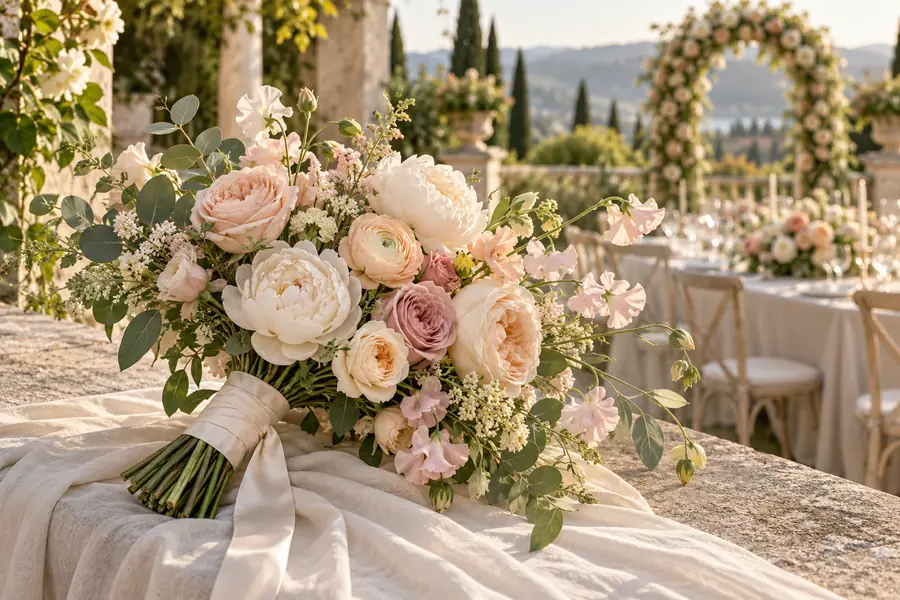
Artificial wedding flowers still carry an old reputation for looking shiny, stiff, and obviously fake. Modern faux florals, however, can look very different from those inexpensive plastic arrangements.
Fake flowers are not inherently tacky. High-quality artificial wedding flowers can look sophisticated, photograph beautifully, survive heat, stay consistent all day, and reduce seasonal limitations. They tend to look cheap when the materials are glossy, colors are flat, stems are exposed, arrangements are too symmetrical, or inexpensive blooms are used prominently in close-up areas.
Artificial wedding flowers are accepted, while fresh blooms remain valued for fragrance and character. Quality, styling, placement, and aesthetics determine whether artificial flowers look tacky.
Why Do Some Fake Wedding Flowers Look Tacky?
The problem is usually quality and styling rather than the category itself.
Artificial flowers tend to look tacky when they have excessive plastic shine, unrealistic colors, identical petals, visible glue, stiff stems, perfect symmetry, or cheap greenery. They are also more likely to look artificial when used very close to guests, photographed in detail, or arranged without enough variation in height, direction, and texture.
Excessive Shine Is One of the Biggest Giveaways
Real petals reflect light differently depending on the species.
A rose does not reflect light in the same way as:
- An orchid
- A peony
- A hydrangea
- A tulip
- A eucalyptus leaf
Cheap artificial flowers often use one similar shiny finish across everything.
That immediately creates a synthetic appearance.
For wedding arrangements, I usually prefer artificial flowers with:
- Matte or softly reflective petals
- Subtle veining
- Gradual color transitions
- Natural-looking edges
- Species-appropriate leaf texture
A premium Real Touch flower may also use coatings or molded materials to imitate the soft, slightly cool feel of fresh petals.
Flat Color Can Look Artificial
Living flowers are rarely one perfectly uniform color.
A blush rose may contain:
cream,
pink,
peach,
and slightly green tones
within the same bloom.
The best artificial flowers imitate those variations.
A low-cost faux bouquet made entirely from one bright flat color can appear more artificial, especially in daylight photography.
Perfect Symmetry Looks Manufactured
Wedding bouquets are often carefully composed, but they should not look mathematically identical on every side.
Real flowers naturally vary in:
stem length,
petal direction,
opening stage,
and shape.
If every artificial rose sits at exactly the same height and faces directly outward, the arrangement can look assembled rather than grown.
I would introduce:
- Slightly different stem heights
- A few partially open blooms
- Different flower directions
- Air between some stems
- Asymmetrical greenery
Natural irregularity usually improves artificial arrangements more than simply adding more flowers.
Cheap Greenery Can Ruin Good Flowers
Sometimes the flower heads are convincing, but the leaves reveal everything.
Bright green plastic foliage with obvious molded veins can make an otherwise attractive bouquet look inexpensive.
For close-up wedding arrangements, I pay as much attention to:
leaves,
calyxes,
stems,
and flower centers
as I do to the petals.
Can Artificial Wedding Flowers Actually Look Real?
Yes—especially from normal viewing distances and in photographs.
High-quality artificial flowers can be remarkably convincing when the materials, colors, shapes, and arrangement are realistic. They are particularly effective in larger installations, ceremony arches, aisle decorations, elevated centerpieces, and areas viewed from several feet away. Close-up bouquets require the highest material quality because guests and cameras see individual petals and stems.
Current wedding reviews provide useful real-world evidence. The Knot’s 2026 reviews for Ling’s Moment repeatedly describe guests being surprised that the flowers were artificial and note that the arrangements photographed well. Reviews of specialist faux-floral designers report similar reactions.
This does not mean every artificial flower is indistinguishable from a fresh one.
Viewing distance matters.
Close-Up Areas Need the Best Quality
I would spend the most on artificial flowers used for:
- Bridal bouquets
- Boutonnieres
- Corsages
- Cake flowers
- Sweetheart tables
- Small table arrangements
- Detail photography
These areas are inspected from inches away.
Texture matters enormously.
Large Installations Are More Forgiving
Artificial flowers can work especially well for:
- Ceremony arches
- Grounded floral meadows
- Staircase installations
- Hanging flowers
- Large entrance arrangements
- Backdrops
Guests usually experience these as complete compositions rather than inspecting every petal.
That makes silhouette, color, and scale more important than microscopic realism.
The Knot’s 2026 floral-trend report shows continued interest in large architectural and sculptural flower treatments, including grounded arches, suspended garlands and floral installations.
Artificial flowers can reproduce those forms without the same concerns about wilting or seasonal availability.
Photography Can Favor Good Faux Flowers
Cameras primarily capture:
color,
shape,
light,
and composition.
They do not capture:
fragrance,
petal temperature,
or natural moisture.
That means a carefully designed artificial arrangement may photograph better than people expect.
Current reviews of faux wedding vendors on The Knot specifically mention artificial flowers looking highly convincing in wedding photographs.
Are Fake Wedding Flowers Cheaper Than Fresh Flowers?
They can be, but artificial does not automatically mean inexpensive.
Artificial wedding flowers can reduce costs when couples rent arrangements, reuse pieces between the ceremony and reception, buy flowers well in advance, or avoid expensive seasonal blooms. However, premium Real Touch flowers, custom faux installations, professional design, shipping, setup, and high-quality rental collections can still represent a substantial investment.
According to The Knot’s 2026 Real Weddings Study, couples spent an average of $2,800 on wedding flowers, with a median of $1,900. Couples in the lower-cost quartile spent about $900, while those in the upper quartile spent about $4,800.
Guest count also affects fresh-flower spending. The same data reports averages of approximately $1,600 for weddings with 1–50 guests, $2,400 for 51–100 guests, and $3,300 for weddings with more than 100 guests.
Rentals Can Change the Economics
Rental artificial flowers are particularly interesting.
The Knot’s rental guide reports that typical full rental orders from some major providers have historically averaged around $450–$500, with bridal bouquets often around $55–$80 and many centerpieces falling below $140 each. Exact prices naturally vary by vendor and collection.
Current 2026 marketplace information for Something Borrowed Blooms shows a Knot estimate around $800, while recent reviews describe larger sets of bouquets, centerpieces, boutonnieres, and floral clusters costing considerably less than comparable fresh-flower quotes.
That makes rental particularly attractive when couples want:
large visual impact
without
large permanent inventory.
Buying Artificial Flowers Is Different
If you purchase faux flowers instead of renting them, you may also need to budget for:
- Storage boxes
- Floral foam
- Wire
- Tape
- Vases
- Arch structures
- Transportation
- Setup
- Post-wedding storage
DIY artificial flowers can save money, but they can also create work.
The cheapest stem is not necessarily the cheapest wedding solution.
What Are the Advantages and Disadvantages of Artificial Wedding Flowers?
Artificial flowers solve several genuine wedding problems, but they also create tradeoffs.
Their biggest advantages are consistency, advance preparation, seasonal flexibility, resistance to wilting, reuse, and rental options. Their disadvantages include lack of natural fragrance, variable realism, possible plastic appearance, storage requirements, and the fact that premium artificial flowers may cost much more than shoppers expect.
Artificial Wedding Flowers: Pros and Cons
| Factor | Artificial flowers |
|---|---|
| Wilting | Do not biologically wilt |
| Advance preparation | Excellent |
| Seasonal availability | Very flexible |
| Color consistency | High |
| Fragrance | No natural scent |
| Close-up realism | Depends heavily on quality |
| Heat tolerance | Generally more predictable than fresh blooms |
| Reuse | Possible |
| Rental | Widely available |
| Keepsake value | High if purchased |
| Storage | Required if kept |
| Sustainability | Depends strongly on reuse and disposal |
| Cost | Can be low, moderate, or premium |
You Can Prepare Earlier
One of the strongest advantages is timing.
Fresh flowers often require:
delivery,
conditioning,
refrigeration,
assembly,
and installation
close to the wedding day.
Artificial flowers can be assembled weeks or months earlier.
That can be extremely useful for DIY couples.
You Can Use Out-of-Season Flowers
Want peonies in winter?
A particular shade of hydrangea?
A very specific orchid?
Artificial flowers remove many seasonal limitations.
The Knot’s artificial-flower guide specifically identifies year-round availability as one reason couples choose faux blooms.
They Do Not Wilt During the Ceremony
Heat can be difficult for fresh flowers.
So can long photography sessions.
Artificial bouquets remain visually consistent from:
first look
to
last dance.
This can be useful for:
summer weddings,
destination weddings,
outdoor ceremonies,
and events with long setup windows.
They Do Not Smell Like Fresh Flowers
This is a disadvantage for some couples.
Flowers contribute more than color.
Fresh roses, sweet peas, lilies, herbs, and greenery can create a sensory memory of the wedding.
Artificial flowers cannot fully recreate that.
For someone who values fragrance strongly, fresh flowers—or a hybrid approach—may be more satisfying.
Where Should You Use Fake Flowers at a Wedding?
The best results usually come from placing artificial flowers strategically rather than treating every floral area identically.
Artificial flowers are especially effective for arches, aisle installations, backdrops, hanging arrangements, large centerpieces, signs, photo areas, and other high-volume décor. Premium Real Touch flowers are better for bouquets and close-up pieces. Couples can also combine fresh focal flowers with artificial supporting arrangements.
Ceremony Arches
Large arches can consume a significant floral budget.
The Knot notes that statement ceremony pieces can range from hundreds to several thousand dollars depending on scale and flower density.
Artificial rentals can make a lush arch more achievable.
And because guests typically view the structure from several feet away, overall composition matters more than petal-level detail.
Aisle Flowers
Artificial aisle flowers have another advantage:
they can often be moved.
A ceremony arrangement can become:
reception décor,
a sweetheart-table installation,
or entrance flowers.
That reuse improves value.
Reception Centerpieces
Faux flowers work particularly well for larger arrangements.
I would simply consider the guest’s viewing distance.
A centerpiece positioned at eye level across a dinner table receives much closer scrutiny than flowers placed high above the table.
Bridal Bouquets
This is where I would be most selective.
The bridal bouquet appears in:
portraits,
detail photographs,
ceremony images,
and reception photographs.
It is also held throughout the day.
If I use faux flowers here, I want:
excellent petals,
convincing centers,
natural greenery,
flexible stems,
and clean construction.
Boutonnieres
Boutonnieres are small, so every detail matters.
A simple artificial flower with a realistic center usually works better than an overly complicated cluster of obviously synthetic miniature greenery.
Can You Mix Real and Fake Wedding Flowers?
Yes, and for many weddings this may be the strongest strategy.
A hybrid wedding-flower plan combines fresh flowers where fragrance, touch, and close-up realism matter most with artificial flowers where volume, durability, or cost control matter more. This can preserve the sensory appeal of fresh flowers while using faux arrangements for large installations and secondary décor.
A practical hybrid plan might look like this:
| Wedding area | Flower type |
|---|---|
| Bridal bouquet | Fresh or premium Real Touch |
| Boutonnieres | Fresh |
| Bridesmaid bouquets | Fresh, faux, or mixed |
| Ceremony arch | Faux or mixed |
| Aisle flowers | Faux |
| Reception centerpieces | Mixed |
| Hanging installations | Faux |
| Cake flowers | Fresh or premium faux |
| Bar/sign décor | Faux |
| Large distant displays | Faux |
Fresh Where People Touch
I prioritize fresh flowers for anything guests will:
hold,
smell,
or inspect closely.
Faux Where Scale Matters
I prioritize artificial flowers where the design requires:
height,
volume,
coverage,
or long installation times.
This creates a more efficient budget without forcing the wedding into an all-real or all-fake decision.
Mix Materials Within One Arrangement Carefully
Fresh and faux blooms can also appear within the same arrangement.
But I would match:
color temperature,
petal scale,
finish,
and botanical style
very carefully.
A hyper-realistic faux rose beside a fresh rose may work.
A glossy inexpensive plastic rose beside a fresh garden rose will make the difference more obvious.
Are Fake Wedding Flowers Sustainable?
Not automatically.
Artificial flowers can reduce single-event floral waste when they are rented or reused many times, but most modern faux flowers contain synthetic fabrics, plastics, wire, adhesives, or mixed materials that may be difficult to recycle. Fresh flowers have their own environmental impacts through cultivation, energy, water, packaging, refrigeration, and transportation. Sustainability depends on the full lifecycle rather than simply whether the flower is fresh or artificial.
The strongest environmental argument for faux wedding flowers is reuse.
A rental flower may appear at many weddings.
A purchased bouquet may become:
home décor,
an anniversary arrangement,
or a keepsake.
The Knot describes wedding-flower rentals as a potentially more sustainable alternative precisely because artificial pieces circulate between events rather than being purchased for a single use.
However, artificial flowers purchased cheaply and discarded immediately after one event create a very different environmental story.
My rule would be:
If choosing faux flowers partly for sustainability, plan their second use before buying them.
How Can You Make Fake Wedding Flowers Look Expensive?
The biggest improvements are usually styling decisions rather than adding more flowers.
To make artificial wedding flowers look expensive, choose realistic materials, reduce plastic shine, vary bloom sizes, create asymmetrical arrangements, use believable greenery, conceal stems and mechanics, avoid excessive density, coordinate colors carefully, and spend more on pieces that will be photographed close-up.
Use Several Stages of Bloom
Real floral arrangements may contain:
buds,
half-open flowers,
and fully open blooms.
A bouquet in which every flower is fully open and identical can look artificial.
Avoid Perfect Spacing
Flowers should overlap naturally.
Some should sit deeper in the bouquet.
Others can extend outward.
Include Movement
Use:
trailing greenery,
small stems,
loose branches,
or delicate filler flowers
to break up the static look.
Hide the Mechanics
Visible:
plastic joints,
foam,
wire,
and glue
are instant giveaways.
Use ribbon, foliage, moss, floral tape, or containers strategically.
Test the Flowers in Daylight
Indoor retail lighting can hide problems.
Before committing to a large artificial order, I would photograph samples:
near a window,
outside in indirect daylight,
and with a phone flash.
If the petals suddenly look extremely shiny, reconsider the material.
Order a Sample First
This is one of the safest decisions available.
Current 2026 reviews of floral rental services specifically mention preview or sample packages helping couples evaluate realism before committing to the full order.
Online product photography can be heavily styled or color-adjusted.
A physical sample gives you much better information.
My insights: Are Fake Flowers Tacky? The Truth About Artificial Wedding Flowers
After comparing current 2026 wedding-flower trends, flower-cost data, rental pricing, artificial-floral vendors, and recent couple reviews, I think the question itself needs reframing.
Are Fake Flowers Tacky? The Truth About Artificial Wedding Flowers is that artificial flowers are no more automatically tacky than fresh flowers are automatically elegant. The final impression depends on quality, color, scale, arrangement, placement, and context. Premium faux flowers can look sophisticated; poorly designed fresh flowers can still look disappointing.
My First Insight: “Fake” Is Not a Design Style
This is the most important distinction.
Artificial describes how the flower was made.
It does not describe whether the wedding is:
luxury,
minimalist,
romantic,
modern,
rustic,
or editorial.
You can have:
a beautiful artificial arrangement
or
an unattractive artificial arrangement.
The same is true of fresh flowers.
My Second Insight: Viewing Distance Should Determine Your Budget
I would spend money according to how closely each arrangement will be seen.
High scrutiny:
- Bridal bouquet
- Boutonniere
- Cake flowers
- Sweetheart table
Medium scrutiny:
- Table centerpieces
- Bar arrangements
- Sign flowers
Lower scrutiny:
- Ceremony arches
- Large aisle installations
- Hanging displays
- Stage backdrops
This approach is more efficient than insisting every stem be the most expensive Real Touch product available.
My Third Insight: Rental Is Changing the Reputation of Fake Flowers
Older artificial wedding flowers were often DIY craft-store products.
The current market is different.
Professional rental companies now build coordinated collections specifically for wedding photography and event design. The Knot’s marketplace shows active 2026 demand for premium faux florals, and current couple reviews repeatedly describe guests not realizing arrangements were artificial.
That changes the category.
Artificial wedding flowers are increasingly a service model, not simply a craft-store substitute.
My Fourth Insight: Faux Flowers Are Most Valuable When They Solve a Problem
I think artificial flowers make the most sense when they address a specific constraint.
For example:
Budget problem: rent large installations.
Seasonality problem: use faux versions of unavailable blooms.
Heat problem: use faux flowers in exposed ceremony décor.
Setup problem: build arrangements in advance.
Allergy problem: reduce fresh floral exposure.
Destination problem: ship predictable arrangements ahead.
When artificial flowers solve a real planning problem, they feel intentional rather than like a compromise.
My Fifth Insight: Fresh Flowers Still Win the Sensory Test
Artificial flowers can imitate appearance extremely well.
They cannot fully reproduce:
fragrance,
cool petal texture,
natural movement,
aging,
and botanical irregularity.
For intimate weddings where flowers are a major emotional component, fresh blooms still have a strong advantage.
This is why I often prefer the hybrid strategy.
My Sixth Insight: Current Trends Actually Favor Strategic Faux Use
The Knot’s 2026 floral forecast emphasizes architectural installations, sculptural flowers, suspended garlands, grounded arches, and other large-scale floral moments.
Those trends require significant volume.
Artificial flowers can make that volume more practical.
Instead of asking:
“Should I use fake flowers?”
I would ask:
“Which parts of this floral design need to be fresh?”
That produces a much more flexible plan.
My Seventh Insight: Cost Comparisons Need to Include Labor
Fresh flower pricing includes much more than the stems.
Professional florists are also charging for:
design,
conditioning,
storage,
transport,
setup,
breakdown,
and expertise.
The Knot’s 2026 flower-cost guidance emphasizes that preparation, logistics, scale, seasonality and flower quantity all affect total pricing.
Artificial DIY flowers may appear much cheaper because the couple is taking over some of that labor.
If you hire a professional faux florist to design, deliver, install, and remove everything, the price difference may become smaller.
That is not a flaw.
It is an apples-to-apples comparison.
My Eighth Insight: Cheap Fake Flowers Are Riskier Than Minimal Flowers
If the budget is extremely tight, I would not automatically fill a venue with inexpensive artificial flowers.
Sometimes a stronger design is:
fewer flowers,
more candles,
greenery,
fabric,
branches,
or architectural décor.
Ten excellent faux stems can look better than 100 obviously plastic flowers.
My Ninth Insight: A Sample Is Worth More Than a Thousand Online Reviews
Color and texture are difficult to judge on a screen.
Before ordering artificial wedding flowers in bulk, I would want to:
hold them,
photograph them,
see them in daylight,
and compare them against the wedding fabrics.
This is especially important for:
white,
ivory,
blush,
and champagne flowers.
Small undertone differences can become very obvious beside a wedding dress or table linen.
My Final View
So, are fake flowers tacky for a wedding?
No.
But some fake flowers certainly can be.
The same distinction applies to almost every wedding material.
Artificial flowers look strongest when they are chosen because they support the overall design—not merely because they are artificial or inexpensive.
If I wanted the most convincing result, I would follow five principles:
Choose better materials rather than more stems.
Use premium flowers where guests see them closely.
Introduce natural asymmetry and color variation.
Use rental or faux arrangements strategically for large-scale décor.
Consider mixing fresh and artificial flowers instead of treating the decision as all-or-nothing.
The Knot’s current data shows that fresh florals remain a significant wedding expense, averaging $2,800 nationally, while rental artificial-flower services offer another established route for couples who want floral impact with different cost and logistics.
That is the real truth about artificial wedding flowers:
they do not become elegant because they are fake, and they do not become tacky because they are fake.
Design determines the result.
Conclusion
Fake wedding flowers are not inherently tacky. Quality materials, realistic colors, thoughtful placement and natural styling determine whether artificial florals look elegant—or obviously artificial.

