


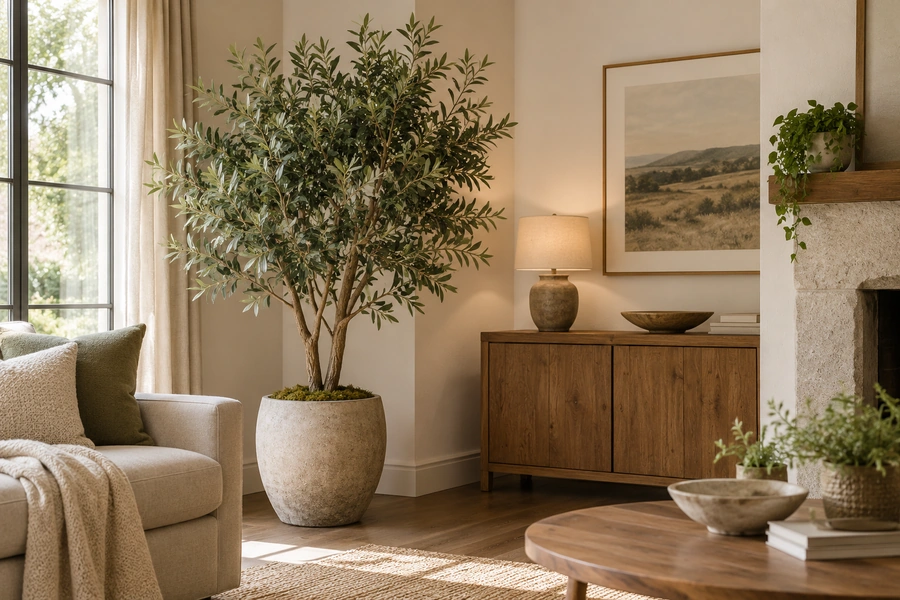
Fake plants can add greenery without watering, soil, insects, or difficult growing conditions. Still, concerns about dust, indoor air quality, materials, pets, and appearance make some homeowners question whether they belong indoors.
Fake plants are generally not bad for your house. They do not create the moisture problems associated with overwatered soil and can be practical in dark or low-maintenance spaces. However, they can collect dust, they do not meaningfully clean indoor air, and poorly made or damaged products may create material, pet, or styling concerns. Regular cleaning and careful product selection solve most problems.
I think the important distinction is between a fake plant simply existing in a home and one being poorly chosen or neglected. A realistic, clean artificial tree in a difficult corner can be useful décor. A dusty, strongly scented, glossy plastic plant beside a heater is a different situation.
Are Artificial Plants Unhealthy to Have in Your Home?
There is no good basis for treating artificial plants as inherently unhealthy household objects. Like other furnishings and decorative products, however, their quality, materials, condition, and maintenance matter.
Artificial plants are not inherently unhealthy, but I treat them like any other synthetic home furnishing. I keep them clean, avoid products with persistent strong chemical odors, and inspect them for loose pieces or exposed wire. I do not expect faux plants to improve air quality, but neither do they introduce wet potting soil, pollen, or living-plant pests.
Dust Is the Most Practical Indoor Concern
The issue I pay the most attention to is not plastic itself.
It is dust.
Artificial foliage can provide many horizontal and textured surfaces where household dust settles.
A six-foot faux ficus may contain hundreds of leaves.
A dense artificial fern has even more surface area.
If I never clean those surfaces, dust becomes visible and can be disturbed when the plant is moved.
The American Lung Association notes that household dust can include pollen, animal dander, dust-mite material, and other particles that can worsen asthma, allergies, COPD, and other respiratory sensitivities. It recommends regular dusting with tools that trap dust rather than simply pushing it back into the air.
This does not make faux plants uniquely dangerous.
Shelves, blinds, picture frames, books, lamps, and baseboards collect dust too.
I simply include artificial plants in the same cleaning routine.
For broad artificial leaves, I may use a slightly damp microfiber cloth if the manufacturer permits it.
For intricate greenery, I may use a soft duster or another material-appropriate method.
Artificial Plants Avoid Wet-Soil Problems
This is one area where faux greenery can actually simplify the indoor environment.
Living plants require soil or another growing medium and regular watering.
If that soil remains overly wet, microorganisms can grow.
The EPA specifically warns that overwatered houseplants and excessively damp planter soil can promote microorganisms that may affect people with allergies.
Artificial plants do not need wet soil.
That means I eliminate:
- Overwatering
- Damp potting mix
- Soil spills
- Fungus associated with wet soil
- Drainage problems
- Standing water in saucers
I still keep decorative moss and planter filler dry.
If I place a faux plant outdoors temporarily, wash it, or use water while cleaning, I let everything dry properly before returning it to an enclosed decorative container.
Faux Plants Do Not Produce Pollen
Artificial flowers and plants also do not release biological pollen.
That can be useful in homes where someone is sensitive to particular flowering plants.
The EPA lists pollen among biological contaminants that can affect indoor air quality.
However, an artificial plant can still collect pollen already present in the home, which brings me back to regular cleaning.
The plant is not producing the allergen.
Its leaves are simply another surface on which particles can settle.
Do Fake Plants Affect Indoor Air Quality?
One of the most common misunderstandings is that choosing artificial plants means giving up a major air-purification benefit provided by real plants.
The evidence is more complicated.
Fake plants do not photosynthesize or remove indoor pollutants biologically. However, ordinary houseplants should not be treated as practical air purifiers either. The EPA says there is currently no evidence that a reasonable number of houseplants removes significant quantities of indoor pollutants under normal home or office conditions. Ventilation, source control, and filtration matter much more.
Real Plants Are Not Substitutes for Ventilation
The popular idea that a few houseplants can dramatically clean household air is often linked to laboratory experiments conducted in sealed environments.
Those experiments are not the same as an occupied house with doors, windows, HVAC systems, furniture, cooking, cleaning products, and continuous air exchange.
The EPA explains that plant pollutant-removal mechanisms appear insignificant compared with normal ventilation and air-exchange rates in real buildings.
The American Lung Association reached a similarly practical conclusion in 2024, stating that houseplants do not improve indoor air quality to a meaningful degree in real homes.
So when I choose between real and faux greenery, I do not make the decision based on air purification.
For indoor air, I focus instead on the EPA’s three major strategies:
- Reducing pollution sources
- Providing adequate ventilation
- Using appropriate filtration or air cleaning when needed
These are the strategies the EPA recommends for improving indoor air quality.
What About Off-Gassing From Artificial Plants?
This question deserves a careful answer.
Artificial plants may contain materials such as:
- Polyethylene
- PVC
- Polyester
- Polyurethane
- Adhesives
- Paints
- Dyes
- Metal wire
But I would not automatically claim that an artificial plant is releasing dangerous amounts of chemicals simply because it contains plastic.
Product formulations vary substantially.
The EPA says VOCs can be emitted by many household products, building materials, and furnishings, but the chemicals involved and their concentrations vary widely. It also warns that broad labels such as “low VOC” do not necessarily tell consumers everything about the toxicity of individual compounds.
There is much less authoritative evidence specifically showing that ordinary artificial plants are a major source of indoor VOC exposure.
So I avoid exaggerated claims in either direction.
My practical approach is simple.
If a new faux plant has a strong chemical odor, I ventilate the room and follow the manufacturer’s instructions.
If the smell remains unusually strong or irritating, I would consider returning the product rather than assuming it will eventually become acceptable.
For large residential or commercial projects, I prefer suppliers that provide clear information about materials and applicable product testing.
Do Fake Plants Collect a Lot of Dust?
Yes, they can. This is probably the most legitimate everyday drawback.
Fake plants collect dust because their leaves and branches provide many surfaces where airborne particles can settle. The solution is straightforward: I clean them regularly rather than treating “maintenance-free” as meaning “never needs cleaning.” For allergy-sensitive households, preventing heavy dust accumulation is more important than whether the greenery itself is real or artificial.
Large Leaves Are Easy to Clean
Some faux plants are easier to maintain than others.
A fiddle leaf fig has large leaves.
So does a monstera.
I can usually wipe those leaves individually.
Dense foliage such as:
- Ferns
- Boxwood
- Small-leaf ficus
- Eucalyptus garlands
requires more effort because there are so many surfaces.
If dust sensitivity is a concern, I may deliberately choose a simpler artificial tree with larger leaves and fewer branches.
Dust Also Makes Fake Plants Look Less Real
There is an aesthetic reason to clean them too.
A layer of gray dust immediately reveals that a plant is artificial.
House Beautiful’s 2026 styling advice emphasizes that convincing faux greenery needs active styling and maintenance rather than simply being taken from the box and forgotten.
I think this is important because people often describe artificial plants as maintenance-free.
I prefer low-maintenance.
They do not need watering, fertilizing, pruning, repotting, or light management.
But they still need cleaning.
My Basic Cleaning Routine
| Faux plant type | How I usually maintain it |
|---|---|
| Large-leaf tree | Wipe leaves individually |
| Small foliage tree | Gentle dusting |
| Succulent | Soft brush or careful wiping |
| Artificial flowers | Light dusting according to material |
| Hanging plant | Remove and clean periodically |
| Large commercial tree | Scheduled routine cleaning |
I always follow the manufacturer’s care instructions because real-touch coatings, fabrics, molded plastics, and painted surfaces do not necessarily tolerate the same cleaning method.
Are Fake Plants Better for People With Allergies?
They can be useful, but I would not call them completely allergy-proof.
Artificial plants do not produce pollen and do not need damp potting soil, so they can remove two potential biological sources found with some living plants. However, faux foliage can accumulate ordinary household dust and pollen from other sources. For allergy-sensitive homes, I would choose easy-to-clean artificial plants and dust them consistently.
I Avoid Treating Faux Greenery as a Medical Solution
If someone has serious asthma or allergies, the main approach should be appropriate medical guidance and established indoor-air controls.
I would not buy fake plants expecting them to fix an air-quality problem.
But I may prefer them over a living flowering plant if pollen is a known issue.
I may also prefer them when maintaining damp soil would create another unwanted indoor condition.
The choice is practical rather than therapeutic.
Are Fake Plants Safer for Pets?
Artificial plants can solve one pet problem while introducing another.
Fake plants can be useful in pet households because they do not contain the natural toxins found in some real houseplants. However, they are decorative objects rather than chew toys. Pets can bite off plastic leaves, swallow small pieces, pull out decorative stones, expose internal wire, or knock over lightweight planters, so I still keep faux greenery away from persistent chewers.
Some Real Houseplants Are Dangerous to Pets
This is an important reason some households choose artificial greenery.
The ASPCA warns that popular houseplants including philodendrons, monsteras, peace lilies, and others can cause problems when pets chew them. Lilies from certain species can be particularly dangerous to cats.
A faux monstera does not contain the same plant toxins as a living monstera.
But that does not mean I want my dog eating artificial monstera leaves.
Plastic and other non-food materials can cause choking or intestinal obstruction when swallowed.
The AKC notes that dogs with pica may ingest plastics and other household objects, which can result in choking, blockages, gastrointestinal perforation, or other serious complications.
I Look for Pet-Friendly Construction
In a home with curious pets, I avoid:
- Loose decorative berries
- Easily detached leaves
- Exposed wire
- Small artificial stones
- Loose moss
- Lightweight planters that tip easily
I prefer a stable, weighted planter.
I also watch how the pet reacts when the plant first enters the house.
If a cat or dog repeatedly chews it, the simplest solution is to move it out of reach.
Can Fake Plants Make a House Look Cheap?
This is not a health problem, but it is one reason people sometimes say fake plants are “bad” for a home.
Fake plants can make a room look cheap when they are glossy, perfectly symmetrical, undersized, dusty, or obviously mass-produced. High-quality artificial trees and greenery can still work in sophisticated interiors, particularly in locations where living plants are impractical. The current design preference is increasingly toward fewer, more convincing pieces rather than artificial greenery everywhere.
Designers Are Divided
Current design opinion is not unanimous.
House Beautiful continues to show high-quality faux greenery as a legitimate decorating choice and notes that larger artificial trees can look particularly convincing when properly scaled and styled.
Architectural Digest also continues to recommend lifelike faux plants for people who want greenery without the maintenance requirements of living plants.
At the same time, some designers are pushing back against glossy artificial plants and generic faux greenery. Homes & Gardens reported in 2026 that several designers prefer living plants, natural branches, wood, stone, or ceramics over artificial greenery that feels static or collects visible dust.
I think both positions make sense.
The problem is rarely the simple fact that the plant is fake.
It is usually:
quality + quantity + styling.
I Use Faux Plants Selectively
My preferred approach is one realistic statement plant instead of many small generic ones.
For example:
a six-foot faux ficus in a large ceramic planter can soften a living-room corner.
I do not necessarily add another fake succulent to every shelf, a fake vine to every cabinet, and plastic flowers to every tabletop.
Restraint makes artificial greenery feel more intentional.
Are Fake Plants Better Than Real Plants?
I do not think one category wins in every home.
Real plants are better when I want living growth, natural variation, gardening enjoyment, and changing botanical character. Faux plants are better when I need greenery in poor light, travel frequently, want predictable size, or prefer to avoid watering and soil. In many homes, using both is more practical than insisting that everything be real or everything be artificial.
Real Plants Give Me a Living Element
A genuine plant grows.
Leaves emerge.
Branches change direction.
Its shape evolves.
There is satisfaction in caring for it.
Artificial plants cannot reproduce that living experience.
Artificial Plants Give Me Control
A faux tree stays the same height.
I can place it in a dark hallway.
I can leave for several weeks.
I do not need to think about watering schedules.
I do not need to protect flooring from drainage.
I do not have to move it toward better light.
That makes artificial greenery useful in:
- Windowless bathrooms
- Dark hallways
- Guest rooms
- Vacation homes
- High shelves
- Commercial interiors
- Difficult corners
House Beautiful’s designer interviews similarly identify low-light and hard-to-maintain locations as appropriate applications for artificial plants.
A Mix Often Looks Most Natural
I like combining both.
I may keep a real pothos near a bright window.
I can grow herbs in the kitchen.
Then I may place a high-quality faux tree in a corner where no living tree would thrive.
This prevents the house from feeling like an artificial showroom while still solving difficult decorating problems.
My insights: Are Fake Plants Bad for Your House
After comparing indoor-air guidance, allergy information, pet concerns, and current design advice, I do not see a strong reason to describe fake plants themselves as harmful household décor.
Fake plants are generally not bad for a house. Their main disadvantages are dust accumulation, lack of living growth, possible material or odor concerns with some products, pet chewing hazards, and the risk of looking cheap when quality is poor. Their advantages include no watering, no wet soil, no plant-generated pollen, predictable size, and usefulness in spaces where real plants struggle.
My First Insight: Dust Is a Maintenance Issue, Not a Reason to Ban Faux Plants
This is the concern I consider most realistic.
Artificial leaves collect dust.
So do bookshelves.
So do blinds.
So do picture frames.
I do not remove all of those objects from my house.
I clean them.
The American Lung Association recommends regular dusting because household dust can carry allergens and other pollutants.
So my rule is straightforward:
If I own a faux plant, it belongs on my cleaning list.
My Second Insight: Real Plants Are Not Powerful Household Air Purifiers
I would not choose a real plant over a fake one because I expect the real plant to clean a meaningful amount of indoor pollution.
EPA guidance says normal quantities of houseplants have not been shown to remove significant amounts of pollutants from ordinary homes and offices.
I improve indoor air through ventilation, moisture control, source reduction, and appropriate filtration.
Then I choose greenery based on design and lifestyle.
My Third Insight: Faux Plants Remove Some Biological Problems but Add Ordinary Object Risks
An artificial plant does not need damp soil.
It does not generate pollen.
It cannot develop the same growing-medium problems as an overwatered living houseplant.
It also does not contain the natural botanical toxins of the real plant it imitates.
But it is still an object made from materials.
It can collect dust.
A pet can chew it.
A loose piece can break off.
A poor-quality product may have an unpleasant odor.
So I do not describe fake plants as either completely risk-free or inherently dangerous.
They belong in roughly the same risk-management category as many decorative household objects: buy reasonably, place appropriately, and maintain them.
My Fourth Insight: Material Claims Should Be Evidence-Based
I am cautious when I see claims online that every PVC artificial plant is poisoning indoor air or that every premium faux plant is completely chemical-free.
Neither statement tells me enough.
EPA guidance shows that indoor VOC exposure is a real issue and that building materials, furnishings, coatings, adhesives, and many other products can contribute. But the effects depend on the specific chemicals, emission levels, and duration of exposure.
For faux plants, I prefer practical signals:
- Reputable manufacturer
- Clear material information
- No persistent strong odor
- Clean workmanship
- Appropriate product testing when relevant
If a product causes irritation or has a strong odor that does not dissipate, I do not keep it merely because the seller describes it as safe.
My Fifth Insight: The Best Faux Plant Is Easy to Maintain
A highly intricate artificial fern may look wonderful on day one.
If I know I will never clean its hundreds of tiny leaves, it may not be the best product for my home.
For low-maintenance decorating, I prefer:
| Need | Faux plant choice I might make |
|---|---|
| Easy dusting | Fiddle leaf fig |
| Large statement | Ficus tree |
| Light visual effect | Olive tree |
| Small tabletop plant | Succulent |
| Narrow corner | Dracaena |
| Dark room | Any suitable high-quality faux tree |
| Allergy-conscious cleaning | Large, accessible leaves |
| Pet household | Stable plant without loose small components |
The goal is not simply finding the most realistic plant.
It is finding one I can keep realistic.
My Sixth Insight: Styling Problems Are Different From Health Problems
A plant can be completely harmless and still look terrible.
I separate these questions.
Is it safe and practical in my home?
And:
Does it improve the room?
Current design coverage still shows that good faux greenery can work, while current criticism is aimed mainly at glossy, dusty, overused, or low-quality artificial plants.
That means I do not need to eliminate artificial plants.
I need to select them more deliberately.
My Final View
When someone asks me “Are fake plants bad for your house?”, my answer is generally no.
I would not consider a clean, well-made artificial plant a major household health problem merely because it is artificial.
I would, however, maintain it like any other furnishing.
I dust it.
I keep it away from pets that chew non-food objects.
I inspect loose pieces and wires.
I avoid products with persistent strong chemical odors.
I keep synthetic foliage away from inappropriate heat or flame sources.
And I use faux greenery selectively enough that it contributes to the room instead of turning the house into a collection of artificial plants.
I also would not choose between real and fake greenery based on exaggerated indoor-air claims.
The EPA’s current advice is much more practical: indoor air quality depends primarily on controlling pollutant sources, providing ventilation, controlling moisture, and using filtration where appropriate.
Plants—real or artificial—are primarily a design and lifestyle decision.
A living plant gives me growth and natural variation.
A faux plant gives me consistency and placement freedom.
Both can belong in a healthy, well-designed home when I understand what each one can and cannot do.
Conclusion
Fake plants are generally not bad for your house. Keep them clean, choose well-made products, manage pet access, and use them as décor—not as air purifiers.

