


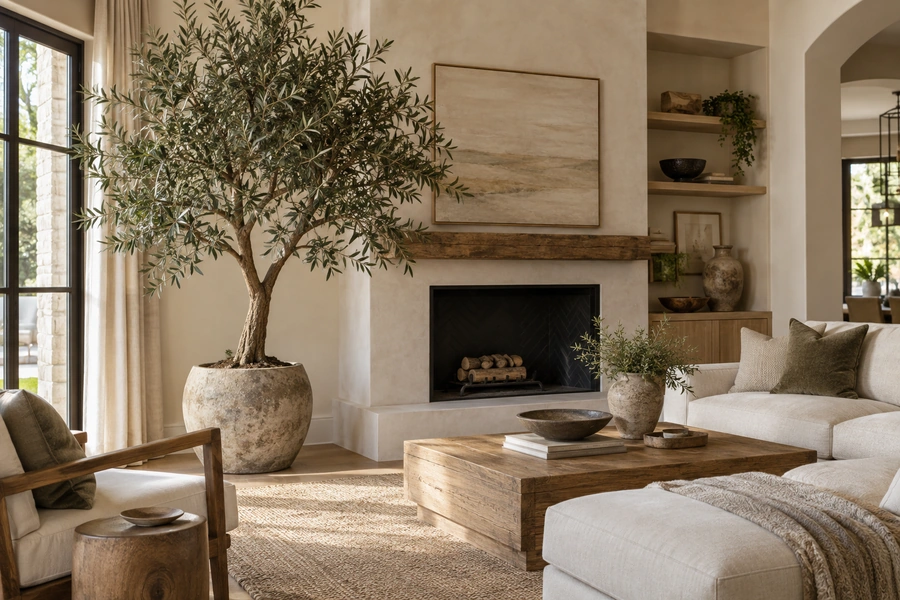
Fake trees have moved far beyond shiny plastic ficus plants. Better trunks, softer foliage, natural silhouettes, and larger statement sizes have made artificial trees much easier to use in stylish homes.
Yes, fake trees are still in style in 2026, but expectations are much higher. Realistic faux olive, ficus, fiddle leaf fig, palm, and branching trees continue to appear in current interiors. What is beginning to feel dated is the obvious mass-produced version: glossy leaves, plastic trunks, undersized pots, perfect symmetry, and the same faux olive tree copied into every room.
The distinction matters. Designers have not necessarily abandoned artificial trees. Instead, current interiors are moving toward more individuality, craftsmanship, believable materials, and intentional styling. A convincing faux tree can support that direction; an obviously artificial one can work against it.
Are Fake Trees Out of Style in 2026?
The current design conversation is more complicated than a simple yes or no. Artificial trees remain widely used, but designers are becoming more selective about quality and originality.
Fake trees are not broadly out of style in 2026. Current design publications still feature and recommend high-quality faux trees, especially when living trees would be difficult to maintain. However, there is growing resistance to generic artificial greenery—particularly inexpensive faux olive trees that became extremely common during the last several years.
Current Designers Still Use Faux Trees
House Beautiful’s March 2026 coverage describes faux olive trees as a designer favorite and specifically tests models that avoid the tacky appearance associated with older artificial plants. The publication’s point is useful: modern fake plants are not automatically the glossy plastic objects people may remember from years ago.
Martha Stewart’s July 2026 coverage also treats faux indoor trees as a legitimate alternative to living trees, particularly because not every indoor environment provides the light, humidity, or maintenance conditions a large tree requires.
Artificial trees have even appeared in high-end residential interiors. Architectural Digest documented designer Jake Arnold using a large faux tree made with preserved wood and silk foliage in Chrissy Teigen and John Legend’s home, describing live and faux full-size trees as statement features in luxury interiors.
So I would not describe the category itself as obsolete.
What Is Changing Is the Quality Standard
The criticism becomes stronger when artificial trees look generic.
Current designer commentary looking toward 2027 specifically identifies ubiquitous faux interior trees—especially the mass-market olive tree—as décor that can feel overused. The concern is less about having greenery indoors and more about repetition and lack of individuality.
That is an important distinction.
A fake olive tree with:
- A thin molded trunk
- Flat identical leaves
- Strong plastic shine
- A tiny black nursery pot
- No branch shaping
can look dated.
A larger olive tree with:
- Natural-looking trunk variation
- Gray-green matte foliage
- Irregular branching
- An appropriately scaled ceramic planter
- Moss or natural-looking top dressing
can produce a very different impression.
I therefore think the question has shifted from “Are fake trees fashionable?” to “Does this particular fake tree look convincing and intentional?”
What Types of Fake Trees Look Most Current?
Current interiors are becoming more varied. The artificial olive tree still works, but I would no longer treat it as the only stylish choice.
The fake trees that look most current include realistic olive, ficus, fiddle leaf fig, Japanese-style branching trees, palms, bird of paradise, citrus, and other sculptural forms. I prefer trees with recognizable botanical character rather than generic green foliage because specific shapes make a room feel more considered and less like a staged furniture showroom.
Faux Olive Trees
Olive trees remain useful because their foliage is airy.
They add height without forming a dense green wall.
Their muted gray-green coloring also works easily with:
- Warm white
- Cream
- Natural oak
- Walnut
- Stone
- Linen
- Terracotta
House Beautiful still described faux olive trees as a designer favorite in 2026, so I would not suddenly remove a good one simply because the category became popular.
I would, however, choose one more carefully today.
A sparse, organic silhouette often looks better than an extremely full tree.
Faux Ficus Trees
Ficus is a strong alternative if I want more volume.
A ficus can have smaller leaves and a fuller canopy than an olive tree, which makes it useful for larger living rooms and empty corners.
I also have more visual choices within the category:
- Weeping ficus
- Ficus Alii
- Fiddle leaf fig
- Shady-lady-style trees
That diversity makes ficus useful when I want greenery without repeating the same Mediterranean look throughout the house.
Fiddle Leaf Fig Trees
The fiddle leaf fig is more sculptural.
Its large leaves create stronger visual impact.
I use it when I want a tree to behave almost like furniture or sculpture rather than quiet background greenery.
Because the leaves are large, realism becomes especially important.
I inspect:
- Veining
- Leaf thickness
- Surface shine
- Color variation
- Stem connections
A glossy artificial fiddle leaf fig can look obvious very quickly.
Japanese-Inspired Branching Trees
Loose branching trees can feel especially current because they are less familiar than the standard faux olive.
Shea McGee’s artificial-tree recommendations have included Japanese quince and other more sculptural forms alongside olive trees and topiaries.
I like this category because visible branches create negative space.
The tree feels lighter and more architectural.
It can work particularly well with:
- Japandi
- Organic modern
- Warm minimalism
- Contemporary interiors
- Collected traditional rooms
Palms and Bird-of-Paradise Forms
A palm or bird-of-paradise-style tree creates wider, more dramatic foliage.
I use these in rooms with enough space for the leaves to spread naturally.
They work particularly well with:
- Wood
- Travertine
- Rattan
- Linen
- Plaster
- Large windows
They also offer an alternative when the olive-tree look feels too familiar.
My Quick Style Guide
| Interior mood | Faux tree I would consider |
|---|---|
| Warm minimalism | Olive or sparse ficus |
| Organic modern | Ficus or branching tree |
| Mediterranean | Olive or citrus |
| Contemporary | Ficus Alii or bird of paradise |
| Tropical | Palm |
| Japandi | Sparse branching tree |
| Traditional | Ficus or topiary |
| Small apartment | Slim olive or dracaena |
| Large open living room | Full ficus or large palm |
I treat this as a starting point, not a strict rule.
The tree needs to make sense with the architecture.
How Do You Make a Fake Tree Look Stylish Instead of Cheap?
A realistic product can still look wrong if it is poorly styled. I often think presentation matters almost as much as the artificial foliage itself.
I make a fake tree look stylish by reshaping the branches, creating asymmetry, upgrading the planter, concealing the artificial base, choosing the correct scale, and placing it where a living tree would visually make sense. I also avoid using too many identical faux trees throughout one home because repetition can make the greenery feel staged.
I Reshape Every Branch
Artificial trees are compressed during shipping.
I never judge one directly after removing it from the box.
I spread the branches.
I rotate leaves.
I pull some branches forward.
I bend others slightly downward.
I make one side a little fuller than the other.
The goal is not perfect symmetry.
Nature rarely produces it.
Current faux-tree styling advice similarly emphasizes asymmetrical shaping as one of the major ways to make an artificial olive tree read as more realistic.
I Replace the Shipping Pot
The small black pot included with many fake trees is functional packaging, not finished interior décor.
I usually place it inside something larger.
Good options include:
| Planter | Effect |
|---|---|
| Aged terracotta | Mediterranean and warm |
| Matte ceramic | Refined and contemporary |
| Textured stone-look pot | Architectural |
| Woven basket | Relaxed and casual |
| Plaster-look vessel | Minimal |
| Vintage planter | Collected and individual |
Scale matters.
A seven-foot tree in a nine-inch pot can look top-heavy and artificial.
A larger container visually anchors the tree.
I Hide the Base
I do not leave floral foam, artificial soil, or the original nursery pot visible.
I may use:
- Preserved moss
- Bark
- Decorative stone
- Coconut fiber
- Gravel
This is a small adjustment, but it changes the finished appearance considerably.
I Put the Tree Somewhere Plausible
A fake tree can survive in a completely dark hallway.
That does not necessarily mean it will look believable there.
I prefer locations where a real tree could visually make sense:
- Near a window
- Beside glass doors
- In a bright-looking corner
- Near an indoor-outdoor transition
- In a sunroom
The tree does not actually need the light.
The placement simply creates visual logic.
I Choose the Correct Height
One of the easiest mistakes is buying a tree that is too small.
Large furniture requires enough plant height to balance it.
A three-foot fake tree beside a large sectional often looks like an accessory.
A six- or seven-foot tree can behave more like an architectural element.
Architectural Digest’s coverage of the growing interest in full-size indoor trees reinforces how strongly large-scale greenery can function as a spatial statement rather than minor decoration.
Are Faux Olive Trees Becoming Outdated?
The olive tree deserves special attention because it became so common that it now attracts both praise and backlash.
Faux olive trees are not universally out of style, but the generic faux-olive look is becoming easier to date. A realistic tree with an organic canopy and substantial planter can still feel current, while a small, perfectly symmetrical mass-market version can look like a leftover decorating formula. The difference is increasingly about originality and execution rather than the species itself.
Popularity Creates Backlash
Every successful decorating trend eventually reaches saturation.
The fiddle leaf fig had that moment.
The all-white kitchen had it.
The faux olive tree is experiencing something similar.
Once the same product appears in:
Airbnbs, model homes, social media posts, waiting rooms, furniture showrooms, and countless living rooms,
designers naturally begin looking for alternatives.
That does not mean every olive tree suddenly looks unattractive.
It means novelty is disappearing.
I Would Keep a Good Olive Tree
If I already owned a high-quality faux olive tree, I would ask:
Does it still suit the room?
Does it look realistic?
Is the scale right?
Is the planter attractive?
If the answers are yes, I would not replace it only because trend commentary has shifted.
A well-chosen tree can outlast a trend cycle.
I Would Avoid Copying the Standard Formula
What I would avoid is the familiar formula of:
beige sofa + cream rug + boucle chair + generic faux olive tree + chain-link coffee-table object.
Current interiors increasingly favor objects with individuality rather than repeating one recognizable social-media template. Recent designer criticism of faux interior trees is part of that broader reaction against mass-produced sameness.
If I want the same soft vertical greenery today, I might choose:
- Ficus
- Japanese quince
- Citrus
- Palm
- Fiddle leaf fig
- Loose artificial branches
That creates a less predictable result.
Are Real Trees Better Than Fake Trees for Interior Design?
Real trees have qualities artificial trees cannot fully reproduce, but that does not mean they are practical in every room.
Real trees are preferable when I have suitable light, enough space, and the ability to provide ongoing care. Faux trees are useful when the room lacks appropriate growing conditions or when I need a completely predictable shape. I see them as different design tools rather than direct competitors.
Real Trees Offer Natural Change
A living tree grows.
New leaves appear.
Branches move toward light.
Its silhouette changes.
Those natural changes create authenticity that artificial greenery cannot completely imitate.
If the environment supports a living tree and I enjoy caring for plants, I often prefer the real version.
Faux Trees Give Me Predictability
Artificial trees give me control over:
- Height
- Width
- Color
- Shape
- Placement
They do not outgrow the room.
They do not drop leaves.
They do not need to be moved toward stronger light.
That can make them practical in:
- Guest rooms
- Vacation homes
- Dark corners
- Offices
- High-maintenance commercial spaces
- Difficult architectural locations
Martha Stewart’s current comparison of real and faux indoor trees makes essentially the same distinction: not every tree can thrive in every indoor environment, so artificial versions can offer a practical alternative.
I Often Prefer a Mix
I do not think every plant in a home needs to be real or every plant needs to be artificial.
I might use living herbs in the kitchen.
I might keep a real pothos near a sunny window.
Then I might use a large faux tree in a difficult living-room corner.
Mixing the two can make the artificial greenery less conspicuous and prevent the home from feeling overly staged.
My insights: Are Fake Trees Still in Style
Looking across current 2026 design coverage, I see two seemingly contradictory messages: high-quality faux trees are still being recommended and used, while designers are beginning to reject generic mass-produced artificial trees.
Yes, fake trees are still in style in 2026, but the fashionable part is no longer simply owning one. The current standard is realism, scale, individuality, and intentional styling. Faux olive, ficus, palm, fiddle leaf fig, and branching trees can all work beautifully; what feels dated is obvious plastic foliage, copied social-media styling, and trees used as generic filler rather than part of the room’s design.
My First Insight: The Category Is Still Current, but the Trend Cycle Has Matured
I think artificial trees have moved into a more mature phase.
A few years ago, simply adding a large faux olive tree could make a room look current.
That is no longer enough.
Now I look for quality and context.
The tree should contribute something specific:
- Height
- Softness
- Color
- Movement
- Architectural balance
If it does not improve the composition, I do not add it simply because the corner is empty.
My Second Insight: Realism Matters More Than Species
I would rather have a convincing ficus than a poor olive tree.
I would rather have a beautifully constructed palm than the most fashionable species made with shiny leaves and an obvious plastic trunk.
My realism checklist is simple:
| Feature | What I want |
|---|---|
| Trunk | Irregular and believable |
| Leaves | Matte or naturally reflective |
| Color | Several botanical tones |
| Branching | Asymmetrical |
| Canopy | Species-appropriate |
| Planter | Properly scaled |
| Base | Hidden |
| Height | Appropriate to furniture and ceiling |
| Placement | Visually plausible |
| Condition | Clean and dust-free |
If those details work, I care much less whether the tree is currently the most fashionable species.
My Third Insight: The Faux Olive Tree Is Becoming a Classic and a Cliché at the Same Time
This sounds contradictory, but I think it accurately describes 2026.
House Beautiful still calls convincing faux olive trees a designer favorite. Meanwhile, current designer commentary looking ahead to 2027 specifically warns that generic faux olive trees have become overused.
Both can be true.
A material or object can become common enough to lose novelty while remaining aesthetically useful.
The solution is not necessarily removing every olive tree.
It is avoiding the most predictable execution.
My Fourth Insight: Bigger Often Looks Better
I usually prefer one substantial fake tree to several small artificial plants.
A large tree can function as part of the architecture.
It can visually connect the floor and ceiling.
It can balance a tall window.
It can soften the edge of a sectional sofa.
Architectural Digest’s broader coverage of full-size indoor trees shows how strongly large greenery—real or faux—can operate as a major spatial element.
This is much more effective than placing tiny fake plants on every shelf.
My Fifth Insight: Individuality Is Becoming More Important Than Trend Compliance
This may be the biggest change.
Current design criticism is increasingly directed at rooms that look copied rather than lived in.
If every room uses the exact same olive tree, boucle chair, sculptural vase, and neutral palette, individual pieces start to feel less special.
That is why I now think about the tree as part of the home’s personality.
A citrus tree might make more sense in a Mediterranean kitchen.
A full ficus might suit a traditional living room.
A Japanese-inspired branching tree may work beautifully in a restrained contemporary space.
A palm might be perfect in a relaxed sunroom.
Choosing according to the room naturally produces a more individual result.
My Final View
When someone asks me “Are fake trees still in style?”, my answer is yes—but realistic and thoughtfully styled fake trees are in style, not artificial trees simply because they are artificial.
I would keep or buy a faux tree when it:
fits the room, provides useful scale, has convincing foliage, has a realistic trunk, and solves a location where living greenery would be difficult.
I would reconsider one when it:
looks shiny, feels undersized, has a visibly plastic trunk, sits in an unfinished nursery pot, repeats the exact same styling seen everywhere, or exists only because I thought every empty corner required a tree.
That distinction explains the current tension in design coverage.
Artificial trees remain a legitimate part of contemporary interiors in 2026. House Beautiful continues to test and recommend them, Martha Stewart treats faux trees as a practical design option, and Architectural Digest has documented faux full-size trees in sophisticated residential interiors.
At the same time, designers are clearly becoming less tolerant of generic artificial greenery.
For me, that is not evidence that fake trees are finished.
It is evidence that quality, originality, scale, and styling now matter more than the trend itself.
Conclusion
Fake trees are still in style in 2026 when they look realistic, suit the room, and are styled intentionally. Generic plastic-looking trees and repetitive faux-olive styling are what increasingly feel dated.

