
Faux plants can still make a room look current in 2026, but glossy leaves, tiny plastic pots, and obviously repeated branches can make it feel dated instead.
Yes, faux plants are still in style in 2026, but the trend has become more selective. Realistic artificial trees, sculptural greenery, natural-looking planters, irregular silhouettes, and carefully placed statement plants fit current nature-inspired interiors. Cheap shiny foliage, excessive fake greenery, and mass-produced-looking arrangements are increasingly being rejected by designers.
In 2026, interiors favor natural, personal, imperfect design. Realistic faux greenery supports this look, while glossy plants in cheap pots feel noticeably outdated indoors today.
Is It Better to Use Fake or Real Plants?
The answer depends on the location, maintenance capacity, light, desired authenticity, and purpose of the greenery rather than one material being universally better.
Real plants are stronger when natural growth, changing form, and direct contact with living nature matter. Faux plants are useful when light, watering, maintenance access, travel, consistency, or difficult placement make living plants impractical. In 2026, the strongest interiors often make this decision by location instead of applying one rule to the entire home.
Why Real Plants Still Have a Design Advantage
Living plants naturally provide qualities that artificial manufacturers try to imitate:
- Irregular growth
- Different leaf ages
- Slight imperfections
- Changing orientation
- New shoots
- Natural color variation
- Real texture
This fits 2026’s move toward authenticity.
Vogue’s 2026 trend coverage emphasizes spaces that feel organic, personal, imperfect, and genuinely lived in instead of overly coordinated.
That is one reason some designers remain strongly opposed to faux greenery.
Better Homes & Gardens included inexpensive-looking faux plants among décor choices designers want to move away from in 2026. The Spruce similarly reported designers criticizing artificial plants that feel lifeless compared with living greenery.
The important word is not simply faux.
It is inexpensive-looking.
Why Faux Plants Still Have a Place
At the same time, contemporary design coverage continues to use realistic artificial greenery.
A September 2026 Real Simple article featuring an interior designer specifically recommends realistic faux dracaenas as an affordable way to add life and warmth, suggesting larger decorative planters and dried Spanish moss to improve realism.
That tells us something important about the current trend.
The fashionable question is becoming less:
Are fake plants allowed?
and more:
Does this particular fake plant look intentional in this particular room?
Use Real Plants Where They Can Thrive
Real plants make sense when you have:
- Appropriate light
- Reliable watering
- Maintenance time
- Suitable temperature
- Accessible placement
- A genuine interest in living greenery
They are especially effective:
- Near windows
- In conservatories
- In bright kitchens
- Beside patio doors
- In dedicated plant corners
Use Faux Plants Where Real Plants Create Friction
Artificial plants become practical in:
- Dark hallways
- Windowless home offices
- High shelves
- Guest rooms
- Vacation homes
- Hard-to-access corners
- Rooms occupied only occasionally
- Video-call backgrounds
A plant placed four meters above a staircase should not require frequent watering simply because living greenery is theoretically more authentic.
Real vs Faux in 2026
| Situation | Better Starting Choice |
|---|---|
| Bright window with easy access | Real |
| Windowless office corner | Faux |
| High shelf | Faux |
| Indoor garden | Real |
| Vacation property | Faux |
| Statement living-room tree | Either |
| Kitchen herb area | Real |
| Dark bathroom shelf | Faux |
| Difficult commercial installation | Faux |
| Close-view biophilic focal point | Real where practical |
Do Not Claim Faux Plants Replace Living Nature
Biophilic design remains important in 2026. Architectural Digest continues to identify nature-related design as a meaningful interiors direction, and commercial interiorscape organizations are describing greenery as increasingly integrated into architecture rather than added as decoration afterward.
However, visual artificial greenery should not automatically be credited with every physiological or environmental benefit associated with living plants or real nature exposure.
Faux greenery primarily provides:
- Visual color
- Botanical shape
- Texture
- Scale
- Decorative consistency
That is already a useful design function.
It does not need exaggerated wellness claims to justify its place.
How Can I Make Fake Plants Look More Expensive?
The fastest way to improve a faux plant is usually not to add more foliage. Improve the silhouette, planter, branch position, and surrounding materials first.
Make faux plants look more expensive by choosing realistic species, reshaping every adjustable stem, varying leaf directions, hiding the starter pot, using a larger natural-looking planter, adding restrained top dressing, and leaving negative space around the plant. One convincing statement tree usually looks more current than several small artificial plants scattered across every shelf.
1. Choose Plants Whose Natural Texture Translates Well
Some botanical forms are easier to reproduce convincingly.
Good 2026 options include:
- Olive trees
- Rubber plants
- Snake plants
- ZZ plants
- Bird of paradise
- Monstera
- Fiddle-leaf figs
- Dracaena
- Orchids
- Agave
- Succulents
These species naturally have:
- Firm leaves
- Waxy surfaces
- Defined shapes
- Strong silhouettes
A good artificial version therefore does not have to imitate extremely delicate plant tissue.
2. Follow the Statement-Plant Trend
One noticeable change in faux styling is scale.
The 2026 artificial-plant trend analysis from TidyPlant describes artificial greenery shifting from small accent décor toward broader room-level design support, with larger statement forms, realistic materials, and considered planter choices becoming more important.
Instead of placing:
- One tiny succulent on the desk
- Another on the shelf
- Another beside the television
- Another on the windowsill
try one:
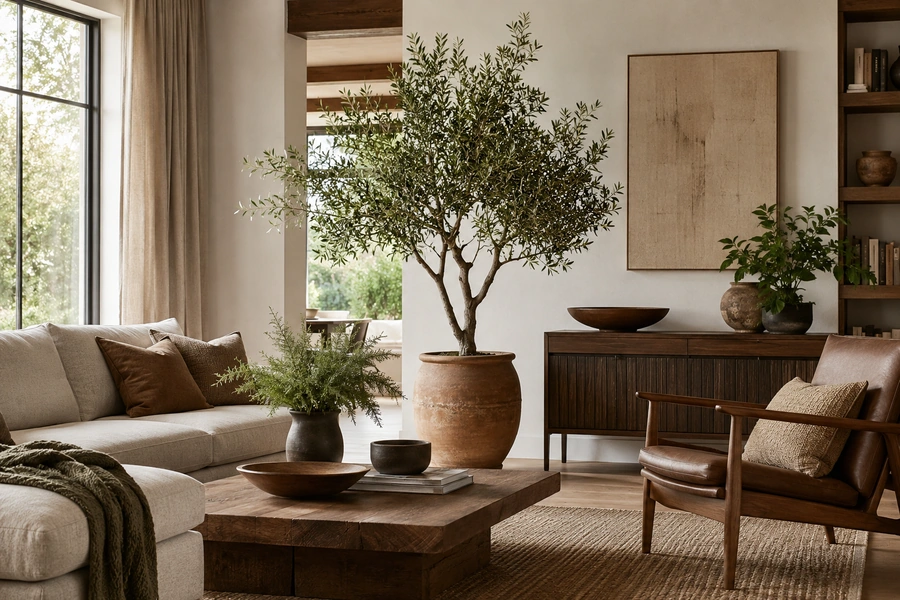
- 6-foot olive tree
- Large rubber plant
- Bird of paradise
- Sculptural ficus
A larger plant can anchor the room.
3. Replace the Black Starter Pot
This may be the highest-impact styling change.
Do not leave a premium artificial tree in a visibly undersized molded nursery pot.
Place it inside:
- Terracotta
- Stoneware
- Matte ceramic
- Aged metal
- Woven basket
- Textured fiberglass
- Stone-effect composite
2026 interiors are strongly favoring organic materials, warm woods, aged textures, and natural variation.
The planter should support that direction.
4. Cover the Base
Real Simple’s current designer advice recommends using natural-looking finishing material such as dried Spanish moss around faux plants to improve the illusion.
Other suitable finishes include:
- Bark
- Preserved moss where appropriate
- Large stones
- Coco fiber
- Artificial soil
- A fitted textured insert
Avoid neon-green artificial moss.
The finishing layer should almost disappear visually.
5. Reshape the Plant
Shipping makes many artificial plants look cheaper than they are.
Branches arrive:
- Vertical
- Compressed
- Parallel
- Repetitive
Open them.
A natural tree contains:
- High branches
- Low branches
- Empty spaces
- Forward growth
- Side growth
- Slight drooping
- Asymmetry
Do not form a perfect sphere unless the plant species genuinely grows that way.
6. Create Imperfection
Vogue’s current interiors coverage repeatedly emphasizes authenticity, irregularity, texture, and the “human touch.”
That applies particularly well to artificial greenery.
Turn some leaves sideways.
Let one branch extend farther than the others.
Keep an open area through the canopy.
Bend one stem outward.
Nature repeats patterns, but it rarely looks copy-and-pasted.
7. Remove Obviously Repetitive Leaves
Low- and mid-priced faux plants often reuse the same mold.
If several identical leaves appear together:
- Rotate one
- Bend one backward
- Hide one
- Remove one if construction permits
The goal is not maximum foliage count.
It is believable variation.
8. Match the Plant to the 2026 Color Palette
Earth tones are especially visible in 2026 interiors.
Vogue notes strong use of olive, brown, moss-like greens, wood tones, and other grounded colors.
That makes faux greenery easy to combine with:
- Walnut
- Dark oak
- Terracotta
- Burgundy
- Cream
- Taupe
- Olive
- Warm beige
- Aged brass
Bright synthetic green can feel particularly disconnected from these palettes.
What Looks Current vs Dated?
| More Current in 2026 | More Likely to Look Dated |
|---|---|
| One large olive tree | Ten tiny plastic plants |
| Irregular canopy | Perfect symmetry |
| Large terracotta pot | Tiny black starter pot |
| Matte foliage | Uniform plastic shine |
| Natural moss/bark finish | Visible foam |
| Mixed leaf sizes | Identical repeated leaves |
| Intentional placement | Greenery on every surface |
| Warm natural materials | Cheap shiny containers |
| Botanical realism | Novelty artificial greenery |
Use Better Lighting
Lighting can expose artificial materials.
Very harsh light may reveal:
- Mold lines
- Glue
- Leaf seams
- Plastic gloss
Soft side lighting usually produces a more convincing result than one intense spotlight aimed directly at a fake plant.
Test the plant in the room before removing tags or committing to a large order.
Should I Mix Fake Plants With Real Plants?
Mixing living and artificial plants can make practical sense because each material can be assigned to locations where it performs best.
Yes, real and faux plants can be mixed successfully. Use living plants in visible, accessible areas with suitable growing conditions, and place premium artificial greenery in dark, elevated, or difficult-to-maintain spaces. Keep the containers, plant scale, and color palette consistent so the room reads as one botanical scheme instead of two separate categories.
Mixing Can Make Faux Plants Less Obvious
A room containing only artificial greenery can encourage closer scrutiny.
A mixed scheme creates more natural visual variety.
For example:
Living
- Pothos near the window
- Herb planter in the kitchen
- Large monstera in bright indirect light
Faux
- Olive tree in the dark corner
- Trailing plant on the highest shelf
- Small orchid in the windowless bathroom
The room reads as green rather than as an “artificial plant collection.”
Match the Planters
Use one family of materials:
- Terracotta
- Warm ceramic
- Woven basket
- Matte stone
for both real and faux.
That creates continuity.
Avoid placing:
beautiful living fiddle-leaf fig in handmade ceramic
directly beside:
cheap artificial ficus in black plastic
The contrast will expose the artificial plant immediately.
Match Botanical Plausibility
The faux species should make sense indoors.
Useful choices include:
- Snake plant
- ZZ
- Pothos
- Philodendron
- Dracaena
- Rubber plant
- Monstera
- Olive tree
Highly improbable botanical combinations can make the artificial nature more obvious.
Do Not Try to Make Everything Perfect
Living plants often have:
- One damaged leaf
- Uneven growth
- Different shades
- New shoots
If the artificial tree beside them is perfectly symmetrical and flawless, it may appear less believable.
Style faux plants with the same visual irregularity.
A Practical Hybrid Home Formula
For a medium living room and office combination:
Living
- One window plant
- One easy-care tabletop plant
Faux
- One tall statement tree
- One high-shelf trailing plant
This creates four greenery moments without requiring four living plants to have equally suitable growing conditions.
Faux Flowers Are Also Gaining Acceptance
The wider cultural perception of permanent botanicals is changing.
Vogue reported in June 2026 that high-end faux florals are losing some of their historical stigma, with designers and makers focusing on realistic imperfections and treating artificial flowers as intentional decorative objects rather than cheap substitutes.
That same principle applies to faux plants.
The product succeeds when it is treated as a deliberate design material.
It fails when it looks like a compromise.
Are Fake Plants Good for Offices and Hotels?
Commercial interiors remain one of the clearest practical applications for artificial greenery because many spaces need consistency and architectural scale without adding plant-care requirements to every location.
Faux plants can work particularly well in offices, hotels, restaurants, retail stores, model homes, and other commercial interiors when maintenance access, lighting, consistency, or scale makes living plants difficult. Use high-quality artificial greenery selectively and keep close-view focal areas realistic, clean, correctly scaled, and professionally planted.
Why Commercial Interiors Use Faux Greenery
Commercial spaces may contain areas such as:
- Windowless corridors
- Elevator lobbies
- Reception backdrops
- High shelving
- Meeting rooms
- Retail displays
- Model apartments
- Guest rooms
These locations may not provide suitable conditions for living plants.
Artificial greenery provides predictable:
- Height
- Width
- Color
- Shape
- Placement
without changing through growth.
Consistency Matters Across Multiple Locations
A hotel may need the same look across:
- 20 elevator floors
- 50 guest rooms
- Several reception points
A retailer may need consistent greenery across:
- 10 stores
- 30 windows
- Seasonal campaigns
Faux greenery can make these specifications easier to repeat.
But Commercial Faux Plants Must Be Maintained
Artificial does not mean maintenance-free.
The commercial schedule still needs:
- Dusting
- Reshaping
- Attachment checks
- Planter cleaning
- Replacement
- Seasonal rotation
A dusty artificial plant may look worse than no plant at all.
2026 Commercial Design Is Becoming More Intentional About Greenery
Green Plants for Green Buildings describes a 2026 move toward integrating greenery into commercial design earlier, treating interiorscapes as part of the spatial plan rather than a decorative finishing layer. Planterra similarly describes 2026 biophilic workplace design as becoming more deliberate and architecture-led.
That trend favors fewer, better-planned greenery installations.
Best Faux Plants for Commercial Spaces
| Faux Plant | Strongest Application |
|---|---|
| Olive tree | Hotel lobby |
| Ficus | Reception corner |
| Bird of paradise | Lounge |
| Snake plant | Office |
| ZZ plant | Meeting room |
| Rubber plant | Executive office |
| Dracaena | Reception |
| Monstera | Creative workspace |
| Kentia palm | Hospitality lounge |
| Pothos | High shelving |
Where I Would Prioritize Real Plants Instead
Use living greenery where the project can support it and where contact with real nature is an important part of the design concept.
Examples:
- Wellness areas
- Conservatories
- Premium lounges with plant maintenance
- Indoor gardens
- Living walls designed as functioning plant systems
Then use faux strategically in the difficult zones.
Commercial Faux Plants Need Better Quality Than Home Shelf Décor
A hotel lobby tree may be seen by thousands of people.
Evaluate:
- Leaf fronts
- Leaf backs
- Trunks
- Branch repetition
- Gloss
- Planter
- Top dressing
- Stability
- Dust accumulation
For high-level or public installations, also check applicable fire, fixing, circulation, and facility requirements.
My Insights: Are Faux Plants in Style in 2026
Yes—but 2026 has changed the conditions under which faux plants look stylish.
Faux plants remain in style in 2026 when they are realistic, intentionally placed, botanically plausible, correctly scaled, and combined with natural materials. What is falling out of favor is cheap-looking artificial greenery: glossy leaves, identical branches, tiny starter pots, excessive shelf plants, and products that prioritize perfect symmetry over the irregular character current interiors favor.
My First Insight: Faux Plants Are Not the Trend—Nature Is
This distinction matters most.
The larger 2026 trend is toward:
- Organic shapes
- Natural materials
- Earthy colors
- Biophilic influence
- Warm wood
- Texture
- Imperfection
- Personal interiors
Vogue describes these qualities as central to the interiors defining 2026.
Faux plants succeed when they help deliver that atmosphere.
They are not fashionable simply because they are artificial.
My Second Insight: “Cheap Faux” Is Out Faster Than Faux Itself
This explains the apparently contradictory designer opinions.
One 2026 article says faux plants feel outdated.
Another interior designer recommends a realistic faux dracaena.
Both can be true.
The dividing line is quality and styling.
Out:
- Glossy leaves
- Tiny fake succulents
- Repetitive branches
- Visible plastic pots
- Artificial greenery everywhere
In:
- Realistic statement trees
- Matte botanical texture
- Irregular growth
- Natural containers
- Intentional placement
My Third Insight: One Large Plant Beats Five Small Ones
2026 interiors are becoming more personal and less cluttered with generic decorative accessories.
That favors a statement tree.
A 6-foot olive tree creates:
- Height
- Architecture
- Organic movement
- One clear focal point
Five small plastic plants often create visual noise.
My Fourth Insight: The Planter Is Half the Look
Current interiors favor terracotta, dark wood, aged surfaces, stone, ceramics, natural fibers, and objects with visible character.
So pair artificial greenery with:
- Aged terracotta
- Stoneware
- Woven baskets
- Plaster-like pots
- Handmade ceramics
The plant immediately feels less mass-produced.
My Fifth Insight: Imperfection Is a Feature
Artificial-plant factories naturally optimize repetition.
Interior design in 2026 is moving the opposite way.
Vogue describes a stronger appetite for irregularity, texture, handmade qualities, and objects that show human character.
Reshape the product accordingly.
A believable artificial tree should not look mathematically perfect.
My Sixth Insight: Olive Is Still One of the Safest Looks
The olive tree suits the current palette particularly well.
Its:
- Muted green
- Sparse canopy
- Fine leaves
- Irregular branch structure
works naturally with:
- Dark wood
- Brown
- terracotta
- Cream
- Aged brass
- Stone
Those colors and materials fit the earthy direction visible throughout 2026 interiors coverage.
My Seventh Insight: Mixing Real and Faux Is More Modern Than Defending One Side
Vogue’s June 2026 report on faux florals highlights designers who see permanent and fresh botanicals as capable of coexisting rather than needing to compete.
The same logic works for greenery.
Use:
- Real where conditions are good
- Faux where conditions are poor
The room benefits from both.
My Eighth Insight: Faux Plants Are Strongest Where Their Practical Advantage Is Real
A faux plant needs less justification in:
- Dark office
- Vacation home
- Hotel corridor
- High shelf
- Retail window
- Model apartment
than beside a sunny window where a living plant could thrive easily.
The more obvious the practical reason, the more intentional the design choice feels.
My Ninth Insight: Dust Can Make a 2026 Faux Plant Look Like a 2006 Faux Plant
Realism depends on maintenance.
Dust increases:
- Grayness
- Artificial shine
- Edge definition
- Visible mold lines
Choose easy-clean foliage for difficult locations.
Broad leaves such as:
- Rubber plant
- Snake plant
- Monstera
- Bird of paradise
are usually easier to maintain than hundreds of fine fern or palm leaves.
My Tenth Insight: Style for the Room, Not the Product Photo
A faux tree can look excellent online and wrong at home because:
- It is too short
- The canopy is too narrow
- The planter is undersized
- The green conflicts with the room
- Lighting exposes the material
Measure:
- Ceiling height
- Furniture height
- Available width
- Viewing distance
before ordering.
What Is Actually In Style in 2026?
| Faux Plant Direction | 2026 Verdict |
|---|---|
| Large realistic olive tree | Strong |
| Sculptural rubber plant | Strong |
| Bird of paradise | Strong |
| Natural-looking ficus | Strong |
| Snake plant in stoneware | Strong |
| Trailing pothos on one shelf | Strong |
| Premium orchid | Strong |
| Numerous tiny succulents | Weaker |
| Glossy plastic palm | Dated |
| Perfect matching topiary indoors | Situational |
| Artificial vines covering every wall | Usually excessive |
| Visible nursery pot | Dated-looking |
| Faux + natural materials | Strong |
| Real + faux mix | Strong |
My Preferred 2026 Living-Room Formula
For a medium living room:
- One realistic 5–7 ft olive, ficus, or rubber tree
- One substantial terracotta or textured planter
- Natural top dressing
- One smaller living or faux plant elsewhere
- No artificial greenery on every shelf
This gives the room greenery without making greenery the theme.
My Preferred Home-Office Formula
Use:
- One rubber plant, dracaena, or olive tree behind the desk
- One pothos or philodendron on shelving
- One ceramic or stone planter family
- Plenty of empty shelf space
The plants should soften the technology rather than surround it.
My Preferred Commercial Formula
Use:
- Real greenery at accessible high-value focal areas when conditions support it
- Faux greenery at dark, elevated, or difficult-maintenance locations
- Consistent planters
- Documented cleaning
- Replaceable modules
This gives the project a botanical identity without forcing one plant-care solution into every zone.
My Final 2026 Rule
Do not ask:
Are fake plants fashionable?
Ask:
Does this plant support the natural, warm, personal, imperfect character that defines good interiors in 2026?
If the answer is yes, a premium faux plant can look completely current.
If it is glossy, undersized, perfectly symmetrical, visibly plastic, and placed only to fill empty space, calling it a 2026 trend will not rescue it.
Conclusion
Faux plants are still in style in 2026—but realism, scale, natural planters, restraint, and intentional placement matter more than ever. Cheap-looking artificial greenery is what feels outdated.