


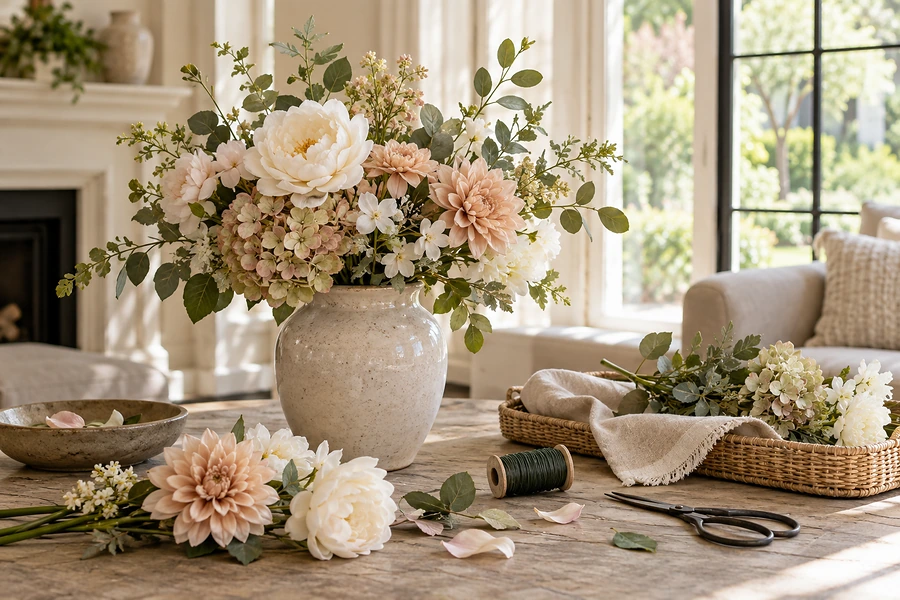
Silk flowers avoid wilting, refrigeration, and repeated replacement, but they are often made from synthetic materials. That makes their environmental impact more complicated than it first appears.
Silk flowers are not automatically bad for the environment, but most modern faux flowers contain polyester, plastics, wire, coatings, or adhesives derived partly from fossil resources. Their environmental case becomes much stronger when they are durable and reused for years or across many events. Fresh flowers also have environmental impacts, so the fairest comparison requires a full lifecycle view.
Neither fresh nor artificial flowers are always eco-friendly. Environmental impact depends on materials, cultivation, transport, energy, water, chemicals, lifespan, reuse, and disposal choices over time.
Are Silk Flowers Actually Made From Silk?
In most modern retail contexts, “silk flower” is a category name rather than a literal description of the material.
Many modern silk-style artificial flowers use polyester fabric rather than natural silk, often combined with plastic stems, metal wire, molded foliage, adhesives, foam, or polymer coatings. Real Touch flowers may use additional polyurethane or similar soft-touch materials. The exact construction varies significantly between manufacturers and products.
Mississippi State University Extension describes commercial silk florals as artificial products commonly made from materials including polyester fabrics, paper, plastic, and wire. Current 2026 artificial-flower industry guides likewise use “silk” to describe polyester-based fabric flowers rather than literal natural-silk petals.
Why Polyester Matters
Polyester is a synthetic polymer.
Its durability is useful for artificial flowers because petals can retain:
- Shape
- Color
- Structure
- Texture
- Reusability
for much longer than cut fresh flowers.
But that durability has an environmental cost during production.
Textile Exchange published an updated polyester lifecycle assessment in June 2026 examining environmental impacts from resource extraction through fiber production across virgin and recycled polyester systems. The organization emphasizes that polyester impacts vary according to feedstock, geography, manufacturing technology, and recycling pathway rather than belonging to one universal footprint.
That distinction matters.
I would not say:
“Polyester is always environmentally worse.”
I would say:
“Polyester carries manufacturing impacts, so the value of its durability depends partly on how long the finished product remains useful.”
Fake Flowers Are Usually Mixed-Material Products
A typical artificial flower may contain several materials:
| Component | Possible material |
|---|---|
| Petals | Polyester or coated synthetic fabric |
| Leaves | Polyester, PE, PVC, or other polymers |
| Stem exterior | Molded plastic |
| Stem core | Steel wire |
| Real Touch surface | Polymer coating |
| Flower center | Molded plastic or foam |
| Assembly | Adhesives |
This creates another environmental challenge.
EPA explains that plastic products may be mono-material or multi-material, and recycling depends partly on what materials and polymer types the local system accepts. Multi-material objects can therefore be more difficult to recover than a simple product made from one recyclable material.
An artificial rose containing fabric, plastic, adhesive, and wire may technically contain individually recoverable materials, but separating them economically at the end of its life can be difficult.
That is why disposal is one of faux flowers’ weakest environmental points.
Why Can Fake Flowers Be Bad for the Environment?
The main concern is not that artificial flowers exist. It is what happens when fossil-based, mixed-material flowers are manufactured for short-term decoration and then quickly discarded.
Fake flowers can create environmental problems through fossil-based plastic and polyester production, mixed-material waste, limited recycling options, transportation, and eventual fragmentation or disposal. Their impact is hardest to justify when they are treated like single-use decorations rather than durable products intended for repeated use.
1. Many Faux Flowers Depend on Fossil-Based Materials
EPA notes that plastic products are primarily produced from virgin fossil-fuel feedstocks, although recycled and alternative feedstocks also exist.
That means the environmental footprint begins before a fake flower reaches a store.
Raw materials have to be:
extracted,
processed,
converted into polymers,
manufactured into fabric or molded components,
assembled,
packaged,
and transported.
A flower that lasts ten years distributes those production impacts across a long service life.
A flower used at one party and discarded the next morning does not.
2. Plastic Waste Is a Long-Term Issue
Plastic’s durability is both its advantage and its environmental problem.
UNEP recommends evaluating plastics through their entire lifecycle—from raw-material extraction and production through use, reuse, recycling, and disposal. It emphasizes prolonging useful life and expanding reuse rather than treating recycling as the only solution.
That principle fits artificial flowers particularly well.
If I already own a high-quality artificial arrangement, repeatedly using it is generally more consistent with circular-resource principles than throwing it away because a different color is fashionable this year.
3. Recycling Can Be Difficult
Artificial flowers are not usually designed like beverage bottles.
A single stem can combine:
plastic,
textile,
metal,
foam,
paint,
and glue.
EPA explains that recycling systems vary in the resin types and product forms they accept.
That means placing an artificial bouquet into a recycling bin does not automatically make it recyclable.
Local recycling rules need to be checked.
In many cases, reuse is therefore more realistic than recycling.
4. Synthetic Textiles Have a Microfiber Issue
Polyester is also relevant to the broader problem of synthetic microfibers.
UNEP and NOAA identify synthetic textiles as a source of microfiber pollution during their lifecycle, particularly through abrasion and washing.
I would be careful not to overstate this point for artificial flowers specifically.
A faux flower sitting in a vase is not repeatedly machine-washed like a polyester shirt, so clothing microfiber estimates cannot simply be transferred to artificial flowers.
However, the broader evidence reminds us that synthetic textile materials are not environmentally inert forever.
Weathering, abrasion, cutting, deterioration, and disposal can gradually break synthetic materials down.
This matters especially for artificial flowers permanently exposed outdoors.
5. Short-Term Event Use Can Defeat the Durability Advantage
This is where I think faux flowers deserve the most criticism.
Imagine two artificial floral installations.
Installation A
Used at one wedding.
Discarded after eight hours.
Installation B
Rented for dozens of weddings over several years.
Same basic material category.
Very different resource efficiency.
UNEP’s lifecycle work repeatedly emphasizes that the distinction between single-use and reusable systems can matter more than simply labeling a product “plastic.”
For faux flowers, longevity only becomes an environmental advantage when someone actually uses that longevity.
Are Fresh Flowers Always Better for the Environment?
No. Fresh flowers are biodegradable botanical products, but growing and delivering them can still require substantial resources.
Fresh flowers are not automatically the greener choice. Their environmental footprint can involve greenhouse heating and lighting, irrigation, fertilizer, pesticides, refrigeration, packaging, and transportation. Research shows that production method can matter so much that locally grown or geographically closer flowers are not always lower-carbon than flowers grown efficiently in a more suitable climate.
Fresh Flowers Have Agricultural Impacts
Flower production is agriculture.
That can involve:
- Land
- Water
- Fertilizer
- Energy
- Pest control
- Packaging
A 2022 Journal of Cleaner Production review found significant variation among cut-flower lifecycle studies and identified energy, greenhouse-gas emissions, water, chemicals, land use, and waste as relevant impact categories.
This makes simple comparisons difficult.
A locally grown flower from a heavily heated greenhouse can have a very different footprint from a locally grown seasonal field flower.
Pesticides Can Be an Important Concern
A peer-reviewed review in Environmental Pollution examined pesticide use in flower production and identified potential environmental concerns involving water contamination, soil effects, air transport, and impacts on non-target organisms.
That does not mean every fresh flower is grown using problematic pesticide practices.
Production standards differ dramatically.
It does mean that “natural” does not automatically mean environmentally harmless.
Greenhouse Energy Can Matter More Than Distance
This is one of the most interesting findings in flower sustainability.
It is tempting to assume:
closer = greener.
But flower production can be energy-intensive in cold climates.
A critical review of sustainable ornamental-plant production found that heated greenhouse energy can dominate the environmental footprint for some flower crops. It documented major differences between roses grown in different climates and production systems.
A more recent lifecycle assessment commissioned by Fairtrade compared Kenyan and Dutch roses delivered to Switzerland.
It found that the Kenyan systems in that particular study had lower impacts across the indicators examined, even when some roses traveled by air, largely because heating and artificial lighting strongly affected the Dutch greenhouse results. Sea-freighted Kenyan roses performed best in the comparison.
This does not prove that imported flowers are always greener.
It proves something more useful:
distance alone is not enough to determine environmental impact.
Fresh Flowers Also Have a Short Useful Life
Cut flowers may last days or perhaps weeks with careful treatment.
Then they become organic waste.
Their biodegradability is an advantage over persistent synthetic materials, but repeated replacement also means repeated production and distribution.
So the relevant comparison may be:
one artificial arrangement used for five years
versus
many successive fresh arrangements over five years.
Without a lifecycle analysis covering those actual scenarios, I would not claim one always wins.
Can Artificial Flowers Be a More Sustainable Choice?
Yes, particularly when durability is intentionally used.
Artificial flowers become more environmentally defensible when buyers choose durable designs, keep them for years, reuse them across seasons, rent them across many events, repair arrangements, avoid unnecessary packaging, and resist replacing perfectly usable flowers simply because styles change. Reuse is the central environmental advantage of faux flowers.
Reuse Them for Years
This is the easiest improvement.
If I purchase artificial flowers for my home, I would choose:
- Neutral botanical colors
- Realistic species
- Durable stems
- Replaceable arrangements
- Styles unlikely to become quickly dated
Then I would continue using them.
UNEP’s lifecycle approach specifically supports extending product use and reuse as part of reducing plastic pollution.
Rent Faux Flowers for Events
Weddings are an excellent example.
The Knot reports that artificial-flower rental companies repeatedly reuse their blooms and often their packaging as well, reducing the quantity of décor discarded after individual weddings.
I think rental is one of the most logical applications for artificial flowers.
Instead of:
manufacture → one wedding → disposal,
the model becomes:
manufacture → wedding → return → wedding → return → wedding.
That is a much better use of a durable material.
Buy Fewer, Better Flowers
Cheap artificial flowers encourage replacement.
A petal frays.
A stem breaks.
The color looks poor.
The arrangement gets discarded.
I would rather buy fewer high-quality stems that remain visually convincing for years.
Durability matters because the environmental logic of faux flowers depends heavily on extended use.
Avoid Trend-Driven Disposal
Artificial flowers do not expire because Instagram changes color palettes.
A white orchid arrangement can move from:
living room,
to bedroom,
to office,
to event décor.
A faux olive branch can be restyled in another vase.
I think artificial florals should be treated more like durable interior accessories than disposable seasonal decorations.
Reuse Individual Components
Even when an arrangement no longer works as a whole, individual components may still be useful.
A bouquet can be separated.
Stems can become:
- Smaller arrangements
- Wreath materials
- Event decorations
- Photography props
- Craft projects
This delays disposal.
Choose Recycled Content Carefully
Recycled polyester and recycled plastics can reduce demand for virgin feedstocks in some applications, but recycled does not automatically mean impact-free.
Textile Exchange’s new 2026 polyester LCA specifically compares different virgin and recycled polyester production systems and shows why environmental performance needs to be assessed by actual processing pathway rather than marketing terminology alone.
I would therefore look for credible material information rather than simply assuming a “recycled” label solves every environmental concern.
My insights: Are Silk Flowers Bad for the Environment-The Truth About Fake Flowers
After comparing current polyester lifecycle research, EPA plastic guidance, UNEP lifecycle principles, cut-flower environmental studies, pesticide research, and reusable wedding-flower models, I do not think the answer can honestly be reduced to fake bad, fresh good.
Are Silk Flowers Bad for the Environment? The Truth About Fake Flowers is that modern faux flowers often contain fossil-based synthetic materials that can be difficult to recycle, but their durability creates a genuine opportunity for repeated use. Fresh flowers avoid persistent plastic waste but still carry agricultural, energy, chemical, refrigeration, and transportation impacts. The better option depends on the complete lifecycle.
My First Insight: “Silk” Can Hide the Real Material Question
The word silk sounds natural.
That can create an environmentally friendly impression.
But many products sold today as silk flowers use polyester and other synthetic materials rather than natural silk. Mississippi State University Extension describes artificial silk florals as commonly using polyester, plastic, paper, and wire.
Therefore, my first sustainability question is:
What is this flower actually made from?
Not:
What does the marketing name say?
My Second Insight: The Worst Faux Flower Is a Disposable Faux Flower
Synthetic materials are valuable partly because they are durable.
Using them once wastes that advantage.
If someone buys several hundred artificial stems for one event and sends them directly to landfill afterward, I find the environmental argument weak.
If a rental company uses those same flowers repeatedly for years, the story becomes very different.
This is why I think reuse frequency should be one of the first environmental metrics for artificial flowers.
My Third Insight: Fresh Does Not Automatically Mean Low Carbon
The fresh-flower supply chain can be surprisingly complex.
A flower may involve:
greenhouse heating,
artificial lighting,
fertilizer,
irrigation,
refrigeration,
air transport,
and refrigerated road transport.
The environmental impact varies so dramatically that a major cut-flower lifecycle review concluded that differences in cultivation and assessment methods make simple generalizations difficult.
I therefore would not automatically choose fresh because it is biodegradable.
I would ask how it was grown.
My Fourth Insight: Local and Seasonal Fresh Flowers Can Be a Strong Option
Although local does not guarantee the lowest carbon footprint in every case, seasonal production can avoid some energy-intensive greenhouse practices.
If fresh flowers are:
grown in a suitable climate,
seasonal,
responsibly managed,
and transported relatively efficiently,
they may offer a compelling environmental profile while still being biodegradable.
That is why The Knot’s discussion of sustainable wedding flowers also points to locally and seasonally sourced fresh flowers as an alternative to rented artificial arrangements.
The key is not choosing a category.
It is choosing a supply chain.
My Fifth Insight: Artificial Flowers Need Better End-of-Life Design
This is where I see the largest opportunity for improvement.
An artificial flower designed with permanently bonded:
fabric,
plastic,
wire,
foam,
and glue
is difficult to separate.
Future faux products could become more circular through:
- Replaceable flower heads
- Removable stems
- Fewer material types
- Identified polymers
- Recycled-content components
- Modular arrangements
- Take-back programs
EPA emphasizes that different polymer types and mixed-material products create different recycling challenges.
Designing for disassembly would make long-term recovery much more realistic.
My Sixth Insight: Sustainability Claims Need a Time Horizon
Whenever someone tells me:
“Artificial flowers are more sustainable because you can reuse them,”
I ask:
How many times will you actually reuse them?
Whenever someone tells me:
“Fresh flowers are greener because they biodegrade,”
I ask:
How were they grown and transported?
Both statements can be true.
Both can also be misleading without context.
A meaningful comparison needs:
production + transport + use duration + reuse + disposal.
That is exactly the lifecycle framework UNEP recommends for evaluating plastic products more broadly.
My Seventh Insight: Different Uses Need Different Answers
I would evaluate several situations differently.
| Situation | Environmental approach I would consider |
|---|---|
| Weekly home flowers | Seasonal/local fresh or one long-lived faux arrangement |
| One wedding | Local seasonal fresh or rented artificial |
| Wedding rental business | Durable reusable faux |
| Hotel permanent décor | Long-lived, repairable faux or professionally managed living plants |
| Memorial arrangement | Durable reusable artificial may be practical |
| One-night disposable event | Avoid buying new faux décor that will immediately be discarded |
| Seasonal home decorating | Reuse the same artificial flowers for many years |
There is no single flower category that wins every row.
My Eighth Insight: Keeping What You Already Own Is Often the Most Practical Choice
If someone already owns artificial flowers, replacing them with new fresh flowers solely to become “more sustainable” may create additional consumption.
The existing faux flowers have already been manufactured.
If they are still attractive and functional, I would:
clean them,
reshape them,
change the vase,
combine them differently,
and continue using them.
This follows the broader resource principle emphasized by UNEP: keeping products in useful circulation for longer can reduce the pressure created by short-lived consumption.
My Environmental Checklist for Faux Flowers
Before buying artificial flowers, I would ask:
| Question | Why it matters |
|---|---|
| What are the petals made from? | “Silk” may actually mean polyester |
| What are the leaves and stems made from? | Reveals total material mix |
| Is recycled content documented? | Can reduce reliance on virgin feedstock |
| Is the flower durable? | Longer life improves reuse potential |
| Can individual stems be replaced? | Avoids discarding entire arrangements |
| Will I use it repeatedly? | Reuse is the main environmental advantage |
| Can I rent instead? | Shared inventory increases utilization |
| Is packaging excessive? | Adds unnecessary waste |
| Can components be separated? | Improves end-of-life possibilities |
| What happens when I no longer want it? | Plan reuse before disposal |
My Final View
So, are silk flowers bad for the environment?
They can be.
Artificial flowers become difficult to defend environmentally when they are made from virgin synthetic materials, shipped long distances, used briefly, and immediately discarded.
But that is not the only possible lifecycle.
A high-quality artificial arrangement might remain in a home for ten years.
A rental bouquet might serve dozens of weddings.
A hotel could reuse seasonal faux florals repeatedly rather than purchasing short-lived replacements.
In those situations, durability is doing useful work.
Fresh flowers also deserve a more nuanced evaluation.
They are renewable biological products and eventually decompose, but their production can involve significant energy, water, pesticides, greenhouse infrastructure, refrigeration, and transportation. Research comparing flower supply chains shows that growing conditions can matter more than simplistic assumptions based solely on transport distance.
That brings me to the most useful rule:
Do not ask whether fake or fresh flowers are environmentally perfect. Ask how many resources are required to deliver the floral experience you want—and how long those resources will remain useful.
For fresh flowers, I would favor:
seasonal sourcing,
responsible growers,
efficient supply chains,
and composting where practical.
For artificial flowers, I would favor:
durability,
reuse,
rental,
repair,
timeless design,
and minimal disposal.
The environmental difference is often not simply real versus fake.
It is single-use versus long-term use.
Conclusion
Silk flowers have real material and waste impacts, but repeated reuse can change the equation. Compare materials, production, transport, lifespan, and disposal—not just “fresh” versus “fake.”

