


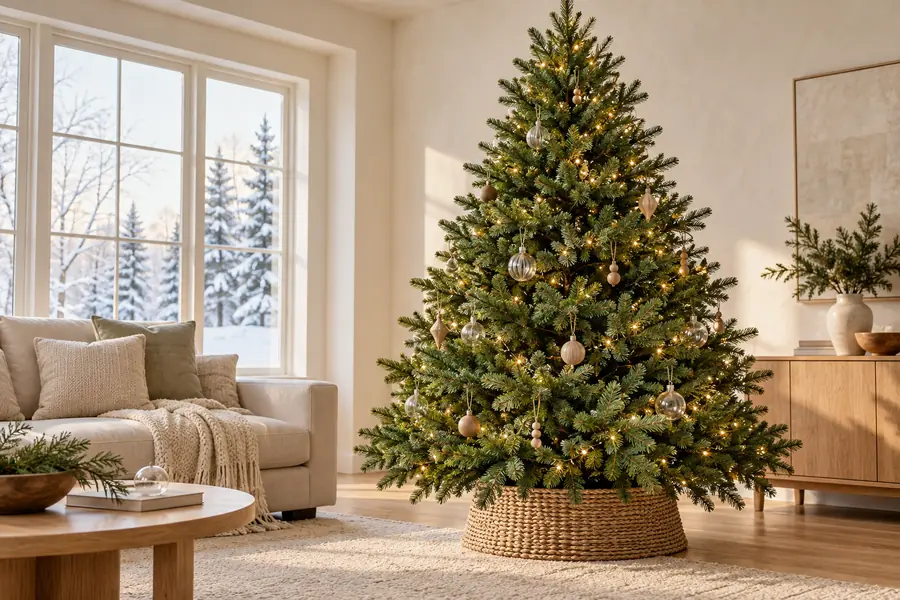
Artificial Christmas trees are convenient and reusable, but labels such as PVC, PE, flame-retardant, lead-free, and “non-toxic” can make safety comparisons surprisingly confusing.
Yes, lower-concern artificial Christmas trees are available, but “non-toxic” should not be treated as an absolute guarantee. The most transparent options use 100% PE or explicitly PVC-free foliage, disclose stabilizers and flame-retardant treatments, provide relevant test information, and use certified electrical components. A material claim alone does not prove the entire finished tree is free of every potentially concerning chemical.
Artificial Christmas trees use multiple materials, and some PVC products may contain phthalates or lead. Choose trees with material disclosure, safety testing, and fewer concerns.
What Does “Non-Toxic Artificial Christmas Tree” Actually Mean?
The phrase sounds precise, but it usually is not.
There is no single universal U.S. certification that establishes an artificial Christmas tree as completely non-toxic. Manufacturers may use terms such as lead-free, phthalate-free, PVC-free, 100% PE, low-VOC, or non-toxic, but each claim addresses only part of the product unless detailed testing specifies otherwise.
CPSC guidance in another regulated consumer-product context illustrates the general problem with the word “non-toxic”: the agency notes that the term itself is not a universal regulatory definition of a non-hazard.
For Christmas trees, I therefore want narrower claims that can actually be checked.
For example:
- 100% PE foliage
- PVC-free foliage
- Lead-free stabilizers
- Phthalate-free materials
- No intentionally added flame retardants
- Specific flocking composition
- UL-certified lighting
- Third-party chemical test report
These statements are much more useful than a large green badge saying:
“Safe”
or
“Eco-friendly.”
“100% PE” Usually Refers to the Foliage
This is an important detail.
A 100% PE artificial tree can still contain:
metal,
paint,
electrical wire,
light housings,
adhesives,
and other materials.
For example, Treetime currently sells its Prestige Pine with 100% PE foliage and explicitly states that it contains no traditional PVC filler foliage.
Royal Christmas also sells current 2026 models marketed as 100% polyethylene foliage, including the Royal Everlands and Rockefeller Premium lines.
Those are useful material disclosures.
They are not the same as saying:
“Every component of this finished tree has been proven non-toxic under every exposure scenario.”
“Lead-Free” Is Also a Specific Claim
Some manufacturers continue to use PVC but specify a different stabilizer system.
Oncor, for example, states that its recycled PVC trees use tin-based stabilizers instead of lead-based stabilizers and says the products are regularly tested against applicable requirements.
That is a different strategy from avoiding PVC.
It demonstrates why consumers should not assume all PVC trees are chemically identical.
Is PE Safer Than PVC for Artificial Christmas Trees?
For shoppers specifically trying to reduce PVC-related concerns, PE is usually the simpler material choice.
A 100% PE foliage tree avoids PVC in the needles and therefore avoids the PVC-specific questions surrounding plasticizers and historical lead stabilizers. However, PE is still a synthetic polymer, may contain pigments or performance additives, and does not automatically make the complete tree “non-toxic.”
EPA explains that phthalates are used primarily as plasticizers in PVC and can migrate from materials in which they are used.
That gives shoppers a reasonable basis for preferring a tree without PVC if phthalate exposure is a primary concern.
How PE Needles Are Made
PE tree branches are typically created by injection molding.
The process allows manufacturers to copy the three-dimensional shape of a natural evergreen branch.
Consumer Reports explains that polyethylene produces molded 3D needles, while conventional PVC foliage is generally made from flat strips wrapped around wire.
That means PE often has a second advantage:
it tends to look more realistic.
Why Many Trees Use PE and PVC Together
PE molding costs more.
For this reason, many premium artificial trees use:
PE outside + PVC inside.
The molded PE creates realistic visible tips.
The cheaper PVC fills the inner canopy.
This can be excellent aesthetically, but it is not PVC-free.
Anyone specifically trying to avoid PVC should look for words such as:
100% PE
or
PVC-free
rather than:
Realistic PE tips.
PVC-Free Materials Are Evolving
Balsam Hill’s current NextGen materials roadmap says that in 2026 it began transitioning its traditional Classic Needle material to proprietary PET that is PVC-free. The company also cautions that inventory manufactured before 2026 may not contain the updated material.
I find that caveat particularly useful.
It means buyers should check the specific SKU and manufacturing generation, not assume a brand-wide materials statement applies to every tree in inventory.
Should You Be Concerned About Lead in Artificial Christmas Trees?
The concern has historical evidence behind it, but it needs modern context.
Older PVC artificial trees have been associated with lead exposure concerns because lead compounds were historically used as PVC stabilizers. Modern manufacturing can use alternative stabilizers, and the best available older study found that most tested artificial trees did not create a significant lead risk, although certain worst-case trees did. Buyers concerned about lead should prioritize explicit lead-free documentation rather than assuming either all PVC is dangerous or all current trees are lead-free.
The 2004 Journal of Environmental Health study tested PVC artificial Christmas trees for:
lead content,
hand-transferable lead,
and lead-containing dust.
Its conclusion was nuanced: the average artificial tree did not present a significant lead exposure risk, but worst-case scenarios could create substantial risk for young children.
That study is old.
It should not be used to claim that every artificial tree sold in 2026 contains lead.
But it does explain why material transparency matters.
Why Lead Matters Particularly Around Children
CDC states that no safe blood lead level in children has been identified and that young children are particularly susceptible because of developing nervous systems and hand-to-mouth behavior.
Therefore, if a household has toddlers who crawl near the tree and frequently put their hands in their mouths, I would be more demanding about:
- Lead-free documentation
- Tree age
- Material degradation
- Dust accumulation
- Cleaning beneath the tree
Older Trees Deserve More Scrutiny
A very old artificial tree may deserve more attention than a recent product with transparent material specifications.
The broader lead literature notes that PVC materials can degrade over time, and older artificial Christmas trees were identified as one potential source in historical research.
I would not panic and discard an old tree solely because it contains PVC.
But if it is:
powdery,
cracking,
sticky,
shedding,
or leaving residue,
I would be much less comfortable continuing to use it around small children.
What About Phthalates in PVC Christmas Trees?
This is another area where precise language matters.
Phthalates are a class of chemicals widely used to make PVC flexible, but the exact phthalates and amounts depend on the formulation. A Christmas tree made with PVC should not automatically be described as hazardous; however, a shopper who wants to minimize phthalate-related uncertainty can look for explicit phthalate-free documentation or select PVC-free foliage.
EPA states that phthalates are used primarily as plasticizers in PVC consumer products and that they are not strongly bound to those materials.
EPA is also continuing modern risk evaluations of multiple phthalates under TSCA, which demonstrates why treating the entire chemical family as a trivial issue would be inappropriate.
At the same time, exposure depends on:
the specific chemical,
its concentration,
how the material is used,
contact,
dust,
and duration.
A Christmas tree displayed for several weeks is not the same exposure scenario as a flexible PVC product used continuously.
What Should Buyers Ask?
Rather than asking:
“Does this contain PVC?”
and stopping there, I would ask:
“Can you provide documentation showing whether the foliage contains regulated phthalates?”
That is more useful.
A supplier who knows its materials should be able to answer clearly.
Are Flame-Retardant Artificial Christmas Trees More Toxic?
Not necessarily.
This is one of the most complicated tradeoffs.
Fire performance is important because artificial trees can contribute significant fuel when ignited, particularly pre-lit trees. But the phrase “flame retardant” does not identify which chemistry is used. Some materials are inherently less flammable, while others use additives or treatments. Buyers who want both fire safety and chemical transparency should ask how fire performance is achieved rather than rejecting flame resistance itself.
UL warns that pre-lit artificial Christmas trees can contribute significantly to fire growth if ignited. Its certification approach uses UL 2358 and UL 588 requirements to address relevant fire and electrical safety issues.
That means I would not advise consumers to seek a tree with no fire-safety consideration simply because they want fewer chemicals.
Fire is a real hazard too.
Ask How Flame Resistance Is Achieved
Useful questions include:
- Is flame resistance inherent to the material?
- Is a flame-retardant chemical added?
- Is it surface treated?
- What chemical or formulation is used?
- Has the finished tree been tested?
- Which standard applies?
Oncor, for example, says its PVC foliage does not require added flame-retardant treatment because it relies on PVC’s inherent flame behavior.
Royal Christmas, by contrast, states that its 100% PE products are flame-retardant treated and lists European fire-performance requirements on the product pages.
These are different strategies.
Neither should be reduced to:
treated = toxic
or
untreated = safe.
Are Flocked Christmas Trees More Concerning?
They contain another layer of material, so they deserve more questions.
Flocked trees add artificial snow plus a binder or adhesive to the underlying tree. That does not automatically make them unsafe, but shoppers seeking the simplest material profile may prefer an unflocked tree because there are fewer components to evaluate.
A current manufacturer answer for one Lowe’s flocked tree states that its artificial snow uses chopped rayon cellulose fiber with a polyvinyl acetate adhesive and is lead-free.
That is exactly the sort of disclosure I want to see.
But it applies to that particular product.
It should not be generalized to all flocked trees.
Different manufacturers may use different:
fibers,
binders,
coatings,
and additives.
My Preference for Low-Uncertainty Shopping
If reducing unknown materials is my priority, I would generally choose:
unflocked
over
flocked.
Not because all flocking is dangerous.
Simply because fewer materials mean fewer unanswered questions.
Are Pre-Lit Artificial Trees Safe?
Pre-lit trees add electrical components, so material safety is only half of the equation.
For pre-lit artificial Christmas trees, electrical and fire safety should be evaluated alongside chemical composition. Look for lighting and tree systems evaluated to applicable safety standards rather than buying solely on claims such as PE, PVC-free, or lead-free.
UL says certification to UL 2358 and UL 588 can help address fire and electrical hazards associated with pre-lit artificial Christmas trees.
UL’s 2025 market-surveillance work also found that seasonal lighting certified to UL 588 had a higher compliance rate in its sampling than lighting carrying certifications from other laboratories in that survey.
Unlit Trees Simplify the Material Question
If someone is particularly sensitive to product complexity, an unlit tree offers one advantage:
the tree and lighting can be selected separately.
That gives the buyer control over:
- Tree material
- Light manufacturer
- Light certification
- Replacement
- Electrical lifespan
Integrated lighting is convenient, but it adds wiring and electronics that eventually age.
Does “Low VOC” Mean an Artificial Tree Is Non-Toxic?
No.
Low-VOC or no-VOC language should not be interpreted as a universal safety certification. VOC measurements address certain volatile chemicals, while other potential concerns may not be volatile at all.
EPA explicitly warns that “low VOC” and “no VOC” labels do not necessarily mean a product is safer from an indoor-health perspective because different volatile chemicals vary considerably in toxicity, and some hazardous compounds are not captured meaningfully by simple total-VOC claims.
That is why I would not rank an artificial tree highly just because the seller says:
low odor
or
low VOC.
I want to know what was actually tested.
What Are the Best Lower-Concern Artificial Christmas Tree Materials?
I would think in tiers rather than declaring one material perfectly safe.
| Material approach | What it reduces | What still needs checking |
|---|---|---|
| 100% PE foliage | Avoids PVC foliage | Additives, pigments, fire treatment, lights |
| PVC-free PE/PET foliage | Avoids PVC foliage | Exact formulation, coatings, electrical components |
| Lead-free PVC | Addresses lead stabilizer concern | Phthalates/plasticizers and other additives |
| Phthalate-free PVC | Addresses specified plasticizers | Stabilizers, other additives |
| Unflocked tree | Removes flocking materials | Base foliage chemistry |
| Unlit tree | Removes integrated lighting | Separate lights still need certification |
Current Examples of These Approaches
Treetime Prestige Pine: currently marketed with 100% PE foliage and no traditional PVC filler.
Royal Christmas 100% PE lines: current 2026 models include Royal Everlands and Rockefeller trees marketed as 100% PE.
Balsam Hill NextGen: Balsam Hill says its 2026 transition introduces proprietary PVC-free PET Classic Needles, although older inventory may use previous materials.
Oncor: uses a different approach, retaining recycled PVC while claiming tin-based stabilizers instead of lead-based stabilizers.
I would describe these as material strategies worth investigating, not certify any of them as medically “non-toxic.”
The manufacturer should provide the evidence for the specific model being purchased.
How Can You Choose a Lower-Toxicity Artificial Christmas Tree?
I would use a specification-first approach.
Choose a tree only after identifying the foliage polymer, PVC content, lead and phthalate claims, flame-resistance method, flocking composition, lighting certification, and any third-party chemical test reports. Prefer specific documented claims over vague terms such as safe, green, premium, or non-toxic.
Here is the checklist I would use:
| Question | Stronger answer |
|---|---|
| What are the needles made from? | “100% PE” or exact PE/PET/PVC percentage |
| Is it PVC-free? | Explicit written confirmation |
| Is it lead-free? | Current test or supplier declaration |
| Are regulated phthalates present? | Specific testing or phthalate-free declaration |
| How is flame resistance achieved? | Chemical/process disclosed |
| Is the tree flocked? | Flocking materials disclosed |
| Are lights safety certified? | Relevant NRTL/UL certification |
| Is there a Prop 65 warning? | Useful data point, not sole proof |
| Can the supplier provide test reports? | Reports tied to the exact SKU |
| When was the product manufactured? | Recent batch/material generation identified |
Do Not Rely on a Prop 65 Label Alone
A product carrying no California Proposition 65 warning is not automatically certified free from all substances of concern.
Similarly, a product that does carry a warning is not automatically unsafe for ordinary use.
Prop 65 addresses listed chemical exposures under California’s warning framework.
It is not a universal toxicology certification for Christmas trees.
Ask for the Report, Not Just the Badge
A useful test document should identify:
- Product or SKU
- Tested material
- Laboratory
- Date
- Test method
- Substances tested
- Detection limits
- Results
A generic certificate for “holiday products” is much less informative.
What If You Already Own a PVC Artificial Christmas Tree?
You do not necessarily need to throw it away.
Owning a PVC tree does not mean your household is experiencing a harmful exposure. If the tree is in good condition, the most practical precautions are to minimize dust, wash hands after extensive setup, keep small children from chewing or handling branches, and replace trees that become brittle, powdery, sticky, cracked, or unusually deteriorated.
The historical PVC-tree research did not conclude that the average artificial tree created a major lead hazard.
That matters.
I would avoid unnecessary fear.
Simple Precautions
For an older tree, I would:
- Assemble it in a ventilated area if it has a strong stored-plastic odor.
- Wash hands after prolonged handling.
- Wipe or vacuum accumulated storage dust.
- Clean the floor around the tree regularly.
- Keep detached needles and small parts away from young children.
- Inspect brittle or degraded foliage.
- Replace visibly deteriorating components.
If there is a specific reason to suspect lead exposure involving a child, CDC recommends discussing blood lead testing with the child’s healthcare provider.
Are Real Christmas Trees Automatically the Non-Toxic Alternative?
Not necessarily.
A real tree avoids synthetic plastic foliage, but it introduces a different set of considerations, including agricultural treatments, mold, pollen, sap, pests, and fire risk if allowed to dry out. A locally grown minimally treated tree may appeal to households seeking fewer synthetic materials, but neither real nor artificial trees can honestly be described as completely risk-free.
This is why I would not turn the discussion into:
real = safe
and
artificial = toxic.
The comparison depends on what concern matters to the household.
For someone concerned specifically about:
PVC,
phthalates,
or synthetic additives,
a real tree may be the simplest way to avoid those materials.
For someone with:
severe pollen sensitivities,
limited ability to maintain a live tree,
or a need to reuse the same decoration for many years,
an artificial tree may be more practical.
My insights: Are There Any Non-Toxic Artificial Christmas Trees?
After comparing current 2026 artificial-tree materials, EPA information on phthalates, historical lead research, CDC guidance, current manufacturer disclosures, and UL fire-safety guidance, I think the word “non-toxic” is too absolute to be the main purchasing standard.
Are There Any Non-Toxic Artificial Christmas Trees? There are lower-concern options, especially trees with 100% PE or documented PVC-free foliage, lead-free formulations, simpler unflocked construction, and transparent safety testing. But no material label proves an entire artificial tree completely toxin-free. The strongest choice is the product whose manufacturer clearly documents what is—and is not—in the specific tree.
My First Insight: Transparency Matters More Than Marketing Language
I would trust:
“Needles: 100% polyethylene; test report available”
far more than:
“Family-safe eco tree.”
The first can be evaluated.
The second is marketing.
My Second Insight: 100% PE Is the Simplest Starting Point
For someone who specifically wants to avoid PVC-related questions, all-PE foliage is the easiest filter.
It avoids the PVC foliage system entirely.
Current 100% PE examples exist from manufacturers such as Treetime and Royal Christmas.
But I would still ask about:
pigments,
fire treatments,
lighting,
and coatings.
PE solves one part of the puzzle.
Not every part.
My Third Insight: Lead-Free PVC Is Different From PVC-Free
This distinction is frequently lost online.
A manufacturer may use PVC but avoid lead stabilizers.
Oncor explicitly describes this approach using tin-based stabilizers.
That may be attractive to someone prioritizing:
recycled content
and
lead avoidance.
A different shopper may still want to avoid PVC altogether.
Neither consumer is asking exactly the same question.
My Fourth Insight: Fire Safety Should Not Be Sacrificed for Chemical Simplicity
A tree made from fewer additives is not automatically safer if it burns easily.
UL’s work on pre-lit artificial trees shows that fire contribution is a real safety issue.
Therefore, I want both:
material transparency
and
fire/electrical safety.
This is not an either/or decision.
My Fifth Insight: I Would Usually Skip Flocking When Minimizing Unknowns
Not because artificial snow is automatically harmful.
Because it adds:
fiber,
adhesive,
and possibly other treatments.
If minimal material complexity is the goal, an unflocked green tree is easier to evaluate.
My Sixth Insight: Unlit Can Be an Underrated Low-Complexity Choice
Pre-lit trees are convenient.
But choosing an unlit tree lets me select the lighting separately.
That means I can replace the electrical component without replacing the entire tree.
It also reduces the number of permanently integrated materials.
For a household keeping a tree for 10 or 15 years, this can make practical sense.
My Seventh Insight: Children Change the Risk Calculation
Most adults are not crawling beneath the tree and putting their hands into their mouths.
Young children do.
CDC’s current guidance emphasizes that no safe blood lead level in children has been identified.
So in a home with toddlers, I would place extra weight on:
lead documentation,
dust control,
and material condition.
My Eighth Insight: An Old Tree and a New Tree Are Not the Same Question
It is misleading to take research on older PVC formulations and apply it automatically to every 2026 artificial tree.
Manufacturing has changed.
Material options have expanded.
Balsam Hill’s 2026 transition toward PVC-free PET Classic Needles is one current example of manufacturers changing foliage materials.
At the same time, age and degradation still matter.
I would judge an older tree according to its actual condition rather than assuming decades-old plastic behaves like a new product.
My Preferred Buying Hierarchy
If reducing chemical uncertainty were my highest priority, I would look in this order:
First: 100% PE or explicitly PVC-free foliage.
Second: documented lead-free and phthalate-free claims.
Third: clear disclosure of flame-retardant treatment.
Fourth: unflocked construction unless flocking chemistry is disclosed.
Fifth: independently certified electrical systems for pre-lit products.
Sixth: current model-specific test documentation.
That creates a much more meaningful definition of “safer artificial tree” than relying on a single non-toxic label.
My Final View
So, are there any non-toxic artificial Christmas trees?
I would phrase the answer differently:
There are artificial Christmas trees designed with fewer materials of concern and much better transparency.
Some current trees use:
100% PE foliage.
Others are moving toward:
PVC-free PET materials.
Some PVC manufacturers explicitly use:
lead-free stabilizers.
And modern safety testing can address:
electrical and fire performance.
What I would not do is promise that any synthetic tree is universally toxin-free.
Every artificial tree is a manufactured product with multiple components.
The smarter goal is to reduce avoidable uncertainty.
For many shoppers, that means:
100% PE or documented PVC-free foliage + clear lead/phthalate information + known flame-resistance chemistry + certified electrical components + no unnecessary flocking.
That is a realistic, evidence-based way to shop without turning Christmas-tree materials into either marketing hype or unnecessary fear.
Conclusion
Lower-concern artificial Christmas trees do exist, but “non-toxic” is too broad. Prioritize transparent materials, PVC-free or all-PE foliage, lead and phthalate documentation, and verified fire and electrical safety.

