


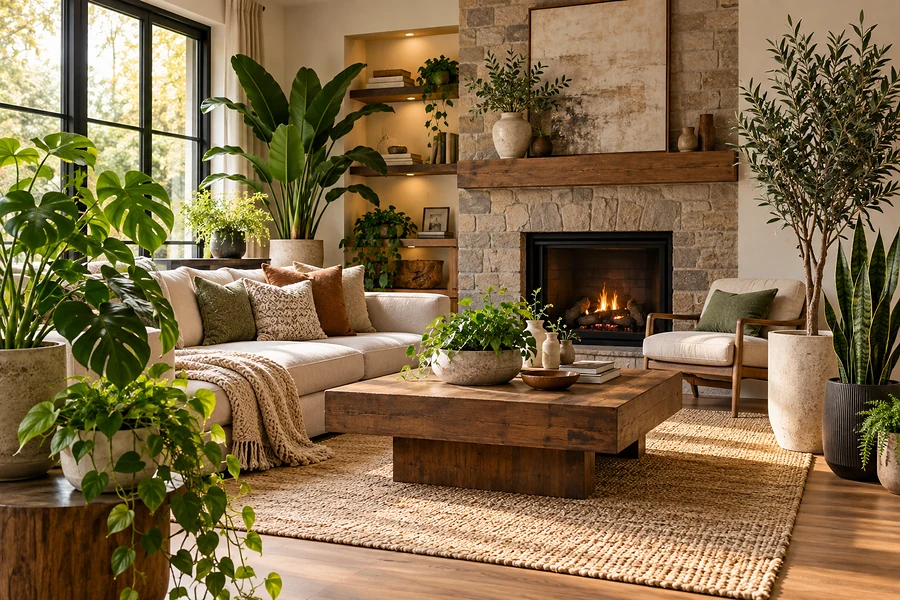
Natural plants bring growth and interaction, while artificial plants offer consistency and convenience. Choosing the wrong one can create unnecessary maintenance—or greenery that never quite suits the space.
Artificial plants are usually better for dark, difficult-to-maintain, or highly controlled spaces, while natural plants are better where suitable light, watering, and ongoing care are available. Real plants provide growth, change, and biological interaction; artificial plants provide predictable appearance, no watering, and greater placement freedom. For many homes and commercial interiors, a combination of both works best.
The decision becomes much easier when I stop asking which category is universally “better” and instead ask what the room actually needs. Light, maintenance, pets, access, design expectations, and how closely people interact with the greenery all change the answer.
What Are the Main Differences Between Artificial Plants and Natural Plants?
The most important distinction is that one is a decorative object and the other is a living organism.
Artificial plants are static décor designed to maintain a consistent shape and color, while natural plants grow, transpire, react to light, require water, and change over time. Artificial greenery offers lower routine care and more placement flexibility; natural greenery provides biological growth, sensory variation, and the experience of caring for something living.
Natural Plants Change With the Space
A living plant never remains completely finished.
It may:
- Produce new leaves
- Grow toward a window
- Become taller or wider
- Flower
- Lose older leaves
- Require pruning
- Need repotting
- Change seasonally
That movement through time is one of the qualities artificial plants cannot truly duplicate.
The Royal Horticultural Society emphasizes that houseplants are living organisms and should be positioned according to their needs rather than selected purely for decoration. Light, temperature, humidity, and water all influence whether a plant will thrive.
This means a real plant becomes part of the environment rather than simply occupying it.
Artificial Plants Stay Predictable
Artificial plants do the opposite.
A six-foot faux olive tree should remain approximately six feet tall.
Its branches do not grow toward the window.
It does not become root-bound.
It does not develop yellow leaves because the air-conditioning vent is too cold.
That predictability can be extremely valuable.
In 2026, commercial biophilic-design guidance is increasingly recommending a practical combination of live, preserved, and high-quality artificial botanical systems according to actual conditions. Planterra specifically notes that preserved and faux systems can be useful in low-light or difficult-to-service locations where living plants would struggle.
Artificial Does Not Automatically Mean Unconvincing
Modern artificial foliage has improved significantly.
House Beautiful’s 2026 coverage notes that faux greenery can now look highly convincing when properly selected and styled, while Architectural Digest continues to recommend lifelike artificial trees and plants for people who want greenery without irrigation or regular plant care.
The important phrase is high quality.
I look for:
- Matte leaves
- Natural color variation
- Irregular branching
- Realistic trunks
- Flexible stems
- Species-appropriate foliage density
- Hidden artificial bases
A cheap glossy fake plant and a premium molded faux tree should not be treated as the same product category.
Are Natural Plants Better for Health and Indoor Air Quality?
This is where the comparison needs more precision.
Natural plants carry out biological processes that artificial plants cannot, but ordinary houseplants should not be treated as meaningful substitutes for ventilation or air filtration. The U.S. EPA says there is no evidence that a reasonable number of houseplants remove significant amounts of pollutants in homes and offices, and peer-reviewed analysis reaches the same conclusion for passive VOC removal.
The Air-Purifying Claim Is Commonly Exaggerated
Real plants photosynthesize and exchange gases with their environment.
That is biologically real.
But the common claim that a few houseplants can significantly “clean” the air in a normal room is not supported by real-world evidence.
EPA guidance states that laboratory experiments have shown plants removing certain chemicals under controlled conditions, but there is no evidence that a reasonable number of houseplants removes significant quantities of pollutants in actual homes and offices.
A peer-reviewed review by researchers Bryan Cummings and Michael Waring examined 12 previous studies and 196 reported results. Their analysis estimated that approximately 10 to 1,000 plants per square meter of floor area could be needed for plant VOC removal to compete with ordinary building air exchange.
So I would not choose a real plant primarily because I expect it to replace:
- Ventilation
- Source control
- HVAC filtration
- A properly selected air cleaner
Those systems do much more for practical indoor-air management.
Real Plants Still Provide Biological Interaction
This does not make real and artificial plants equivalent.
Natural plants:
- Photosynthesize
- Transpire
- Grow
- Respond to environmental changes
- Produce new tissues
- Interact with soil microorganisms
The RHS explains that humidity affects plant transpiration, which in turn affects how quickly plants lose water and how much their roots need to absorb.
Artificial plants do none of this.
Their contribution is visual and spatial rather than biological.
Living Plants Can Also Create Moisture-Related Problems
Natural plants are not automatically beneficial under every condition.
EPA warns that overly damp houseplant soil may promote microorganisms that can affect people with allergies.
The CDC similarly notes that mold can grow where excessive moisture is present, including around plant pots, and that mold exposure can affect sensitive individuals.
That does not mean indoor plants are inherently unhealthy.
It means overwatering and poor moisture management can create problems.
I therefore avoid treating “natural” as automatically healthier in every possible situation.
Which Is Easier to Maintain: Artificial or Natural Plants?
Artificial plants clearly require less horticultural maintenance.
Artificial plants need cleaning, reshaping, and occasional inspection, but they do not require watering, feeding, pruning, repotting, pest treatment, or suitable growing light. Natural plants can be relatively easy to maintain when the correct species is matched to the environment, but they still depend on biological conditions that artificial greenery does not.
Natural Plant Maintenance Depends on Choosing Correctly
I do not think real plants have to be difficult.
The RHS notes that many houseplants are relatively easy to care for and that selecting a plant suited to the available conditions greatly improves success.
The main variables are:
- Light
- Water
- Temperature
- Humidity
- Drainage
- Plant species
The mistake is often choosing a plant for appearance first and environment second.
A fiddle leaf fig may look perfect beside a sofa in a design photo.
That does not mean it will thrive in a dark interior corner.
Light Is Usually the Deciding Factor
Every natural plant needs usable light.
The RHS specifically notes that many houseplants struggle when positioned far from windows and that ordinary domestic lighting generally does not provide enough light for healthy plant growth. Specialized grow lights may be needed where natural light is insufficient.
Artificial plants have a major advantage here.
I can place them in:
- Windowless hallways
- Interior bathrooms
- Deep office floorplates
- Conference rooms
- Dark retail corners
- Shelves far from windows
without worrying about photosynthesis.
For me, this is one of the strongest reasons to choose faux greenery.
Artificial Plants Still Need Maintenance
“Maintenance-free” is not completely accurate.
Artificial foliage collects:
- Dust
- Grease
- HVAC residue
- Pet hair
- General indoor debris
Large faux trees also need occasional reshaping.
If they are used commercially, they may need routine inspection to keep branches correctly positioned and finishes clean.
So I would describe them as low-maintenance, not no-maintenance.
Commercial Spaces Change the Equation
A few living plants in a home are manageable.
A plant program across multiple offices, restaurants, hotels, or retail locations is very different.
Planterra’s 2026 guidance describes large-scale living-plant programs as operational systems involving procurement, logistics, maintenance standards, and accountability rather than simple decorative purchases.
That is why commercial projects often use hybrid solutions.
Living plants go where conditions and maintenance support them.
Artificial or preserved greenery goes where access and light make living plants impractical.
Are Artificial or Natural Plants Better for Homes With Pets?
Neither category is automatically risk-free.
Natural plants require careful species selection because some common houseplants can be toxic to cats or dogs. Artificial plants avoid plant-specific botanical toxins, but pets may still chew or swallow plastic leaves, wire, foam, decorative stones, or other components. Pet households should therefore consider both toxicity and physical ingestion risk.
Some Natural Plants Are Toxic
The ASPCA maintains extensive lists of toxic and non-toxic plants for dogs and cats.
Its 2026 guidance specifically warns that pets may investigate plants by sniffing, licking, chewing, or eating them and recommends confirming that accessible plants are non-toxic.
Examples of plants that can present serious risks include:
- Sago palms
- Certain lilies for cats
- Some dracaenas
- Dieffenbachia
- Various other common ornamental plants
The ASPCA notes that true lilies in the Lilium and Hemerocallis groups can be particularly dangerous to cats.
If I have pets, I check the specific botanical name rather than relying on a vague common name.
Many Pet-Safe Natural Options Exist
Choosing natural plants does not mean accepting toxicity risk.
The ASPCA also lists numerous plants considered non-toxic to dogs and cats, including many commonly used ornamental species.
Pet-friendly plant planning is therefore possible.
It simply requires research.
Artificial Plants Remove One Risk but Introduce Another
A fake monstera does not contain the biological compounds found in a living monstera.
That is useful.
But if a dog chews a plastic leaf or a cat pulls out decorative stones, a different safety problem can appear.
I therefore avoid presenting artificial plants as automatically “pet safe.”
Instead, I ask:
- Does the pet chew objects?
- Is internal wire accessible?
- Can small decorative stones be swallowed?
- Is the planter stable?
- Can the plant be knocked over?
That is a more complete safety assessment.
Which Type of Plant Works Best in Different Spaces?
I choose according to the environmental conditions and how people use the room.
Natural plants work best where there is appropriate light, easy watering access, and someone willing to maintain them. Artificial plants work best in very dark, inaccessible, rarely occupied, or highly controlled spaces. In many homes and commercial interiors, the strongest solution is hybrid: living plants where they can thrive and premium faux greenery where conditions are unsuitable.
Living Room
I usually prefer real plants if the room has suitable windows.
Living rooms provide an opportunity to use:
- Ficus
- Palms
- Monstera
- Pothos
- Dracaena
- Large architectural foliage
depending on actual conditions.
However, if the intended corner receives almost no usable light, an artificial tree may look better than a permanently stressed real one.
Bedroom
Either can work.
A real plant can add changing greenery and a sense of interaction.
A faux plant can work better for people who travel frequently or do not want plant care in the bedroom.
I would not select a bedroom plant because of exaggerated claims that it will dramatically purify the air while someone sleeps. EPA’s guidance does not support that conclusion for ordinary numbers of houseplants.
Bathroom
Bathrooms can be excellent for real plants when they provide sufficient light.
The RHS notes that bathrooms often have higher humidity, which can suit many tropical houseplants.
But a windowless bathroom is different.
Humidity alone does not compensate for lack of light.
An artificial plant may be the more practical choice unless appropriate horticultural lighting is installed.
Office
Here I often use both.
Living plants can make desks, collaboration areas, reception zones, and lounge spaces feel more dynamic.
Artificial trees can solve:
- Dark corridors
- Meeting rooms
- Difficult corners
- Areas with inconsistent care
Planterra’s 2026 commercial guidance explicitly describes the growing practice of combining living, preserved, and faux elements according to maintenance and environmental conditions.
Restaurant or Hotel
Commercial hospitality spaces need another layer of analysis.
I consider:
- Lighting
- Cleaning
- Maintenance access
- Heat
- Air-conditioning
- Guest contact
- Longevity
- Replacement logistics
A beautiful living tree can become a signature element if it is professionally maintained.
A high-quality artificial tree may be preferable in a location where the plant could never remain healthy.
High Shelves and Hard-to-Reach Areas
Artificial almost always wins for me.
A real plant above a tall cabinet may be difficult to:
water,
inspect,
rotate,
or remove when pests appear.
A faux trailing plant or artificial branch arrangement is often more practical.
How Do Artificial and Natural Plants Compare Visually?
Natural plants have one advantage that artificial manufacturers constantly try to imitate: irregularity.
Real plants naturally create differences in leaf angle, color, age, shape, and growth direction. The most realistic artificial plants imitate those irregularities through varied foliage, asymmetrical branches, matte surfaces, and realistic trunks. A good faux plant can look extremely convincing, but poor styling—especially perfect symmetry and glossy leaves—quickly reveals artificial construction.
House Beautiful’s 2026 styling guidance emphasizes reshaping artificial foliage to introduce irregularity rather than leaving every stem upright and evenly distributed.
Architectural Digest also recommends upgrading faux plants with better planters and selecting foliage with realistic color variation and texture.
Real Plants Create Their Own Imperfection
Natural leaves:
- Face different directions
- Age differently
- Develop varying color
- Overlap irregularly
- Respond to light
That variation is difficult to reproduce perfectly.
It is one reason living greenery remains visually compelling.
Faux Plants Need Styling
I rarely use a fake tree straight from the box.
I:
- Separate the branches.
- Bend them in different directions.
- Create open spaces in the canopy.
- Rotate some leaves.
- Upgrade the planter.
- Hide the factory pot or foam.
- Dust the foliage.
Those small changes can significantly improve realism.
My insights: Artificial Plants vs Natural Plants-Which is Right for Your Space
After comparing horticultural guidance, indoor-air-quality evidence, current 2026 design recommendations, and commercial biophilic practices, I do not think the best answer is to choose one category for every room.
Artificial Plants vs Natural Plants: Which is Right for Your Space? The answer depends on whether the space can support living vegetation and whether you value growth or predictability more. Natural plants are strongest where light, care, and human interaction support healthy growth. Artificial plants are strongest where consistency, low maintenance, difficult access, or poor natural light make living plants impractical.
My First Insight: Start With the Environment, Not the Plant
This is my most important rule.
I do not begin with:
“I want a fiddle leaf fig here.”
I begin with:
“What can actually work here?”
I assess:
- Natural light
- Temperature
- Humidity
- Access
- Watering
- Maintenance
- Pets
The RHS repeatedly emphasizes matching plants to their actual growing conditions rather than choosing only for appearance.
If those conditions support living plants, real greenery becomes a strong choice.
If they do not, artificial foliage may be more honest and more visually successful.
My Second Insight: A Healthy Fake Plant Can Look Better Than an Unhealthy Real Plant
That sentence sounds contradictory, but it is practical.
A real plant with:
yellow leaves,
brown edges,
pests,
poor growth,
and bare stems
does not automatically improve an interior simply because it is alive.
If a location cannot support the plant, a high-quality faux tree may create a better visual result.
The goal is not to force living plants into every space.
The goal is to put living plants where they can remain healthy.
My Third Insight: Real Plants Offer Something Fake Plants Cannot—Change
This is the strongest case for natural plants.
Real plants introduce time into the interior.
A new leaf appears.
A vine becomes longer.
A branch turns toward light.
The plant may flower.
That process creates an ongoing experience.
Artificial plants imitate botanical appearance but preserve one visual moment.
So if I value interaction and growth, I choose real.
My Fourth Insight: Faux Plants Offer Something Real Plants Cannot—Control
Artificial plants give me reliable control over:
- Height
- Width
- Color
- Density
- Placement
- Appearance
That matters enormously in commercial environments.
A designer may need exactly the same tree form across twenty locations.
Natural plants cannot guarantee that level of consistency.
Artificial greenery can.
That is why I see faux plants less as replacements for living plants and more as a separate specification tool.
My Fifth Insight: Air Quality Should Not Decide the Question
I would not choose real plants solely because someone claims they will purify the room.
The EPA says a reasonable number of houseplants has not been shown to remove significant quantities of indoor pollutants, and the peer-reviewed analysis by Cummings and Waring found plant VOC-removal rates far below ordinary building ventilation.
The choice should instead focus on:
- Interaction
- Aesthetics
- Maintenance
- Environmental suitability
- Space planning
That creates a much stronger decision.
My Sixth Insight: Pet Homes Need a Different Checklist
With pets, I do not simply ask:
real or fake?
I ask:
what can my pet access?
A living plant may contain toxic compounds.
A fake plant may contain chewable plastic, wire, foam, or loose stones.
The ASPCA maintains current toxic and non-toxic plant references precisely because the botanical species matters.
So pet safety depends on both material and behavior.
My Seventh Insight: Hybrid Planting Is Often the Best Solution
This is increasingly the approach I prefer.
For example:
| Space | My likely choice |
|---|---|
| Sunny living-room corner | Real tree |
| Kitchen windowsill | Real herbs |
| Bathroom with natural light | Real tropical plant |
| Windowless hallway | Artificial |
| High bookshelf | Artificial |
| Office reception | Real if maintained |
| Dark meeting room | Artificial |
| Hotel atrium | Real or professionally maintained hybrid |
| Commercial low-light zone | Artificial or preserved |
| Desk | Real if convenient to care for |
Current 2026 workplace design guidance is moving in exactly this direction: greenery is being specified according to environmental and maintenance realities rather than applying one solution everywhere.
My Quick Decision Guide
I would choose natural plants when:
- There is adequate light.
- Someone enjoys caring for them.
- Watering access is easy.
- Growth and seasonal change are desirable.
- The species is appropriate for pets.
- The environment supports long-term health.
I would choose artificial plants when:
- The location is extremely dark.
- Watering access is difficult.
- The space is rarely occupied.
- Consistent appearance matters.
- Maintenance staff are unavailable.
- The greenery is high or inaccessible.
- A precise architectural form is required.
I would choose both when a project contains several different environmental conditions—which most homes, offices, hotels, and restaurants do.
My Final View
When someone asks me “Artificial Plants vs Natural Plants: Which is Right for Your Space?”, I do not think the answer should begin with ideology.
I begin with the room.
Can a living plant actually thrive there?
Is there enough light?
Who will water it?
Will pets interact with it?
Can it be reached easily?
Does the design need a predictable size?
Will the plant be viewed closely?
How long does the installation need to remain consistent?
If the environment supports life and someone is willing to maintain it, I generally prefer natural plants in places where people spend significant time.
Living greenery offers something unique:
growth, change, irregularity, and interaction.
If the environment cannot support a healthy plant—or if the design requires stable dimensions and minimal care—I choose a high-quality artificial plant without treating it as a compromise.
Modern faux greenery can be extremely effective when the foliage, trunk, scale, and planter are well chosen. Current 2026 design publications continue to feature realistic artificial plants precisely because they solve practical problems while still delivering visual greenery.
And in many projects, I would use both.
Put living plants near windows, seating areas, desks, and other places where their growth can be experienced.
Use artificial greenery in dark corridors, high shelves, difficult commercial locations, and spaces where predictable appearance is essential.
That is usually more successful than forcing one category to perform every job.
Conclusion
Choose natural plants where light, care, and growth can be supported. Choose artificial plants where consistency and low maintenance matter. For many spaces, combining both is the most practical solution.

