


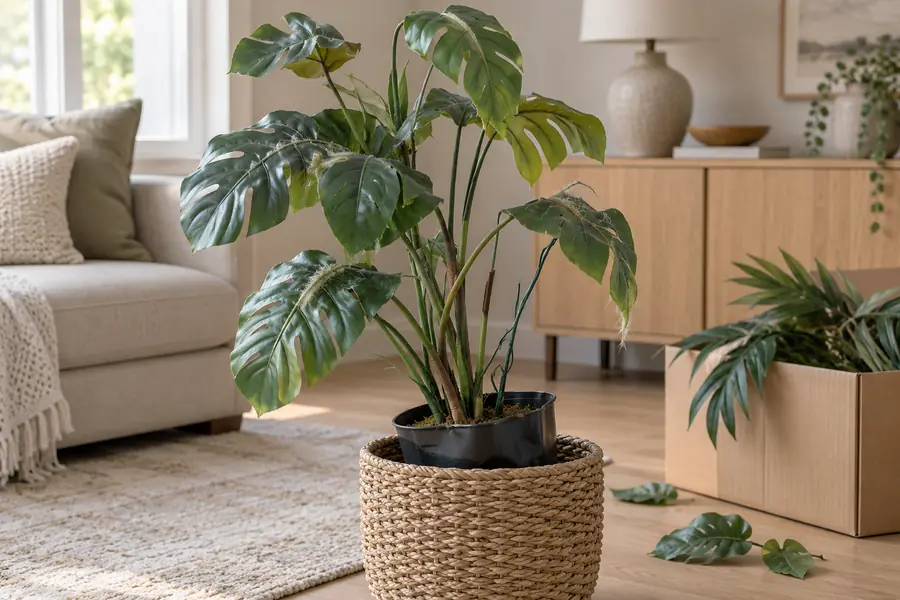
A bargain artificial plant can seem like an easy decorating win. Yet poor foliage, weak construction, fading, and constant replacement can quickly erase the original savings.
Cheap artificial plants often cost less because compromises are made in foliage materials, coloring, molds, trunks, stems, planters, finishing, or testing. The result may be an artificial plant that looks less realistic, deteriorates more quickly, needs more styling, and offers worse long-term value than a better-made faux plant purchased once and used for years.
Cheap faux plants can weaken a polished interior. Real value depends on realistic color, texture, scale, construction, placement, lifespan, and eventual replacement costs over time.
Why Do Cheap Artificial Plants Often Look Fake?
The difference usually becomes visible in the details.
Low-cost artificial plants frequently look less convincing because manufacturers simplify leaf molds, reduce color variation, use shinier materials, repeat identical foliage, minimize trunk detail, and supply undersized containers. Realistic faux plants rely on botanical irregularity, subtle coloring, natural proportions, and convincing surfaces rather than simply having more leaves.
House Beautiful’s current styling guidance recommends introducing asymmetry, varied stem lengths, gentle drooping, and concealed bases because perfectly uniform artificial greenery tends to reveal its manufactured origin.
Flat Color Can Make the Entire Plant Look Artificial
A living plant rarely has one identical green across every leaf.
Light changes the appearance of foliage.
New leaves can be lighter.
Older leaves can be darker.
Some leaves may have muted undertones or slight discoloration.
Cheap artificial plants often simplify that complexity into one saturated green.
From a distance, this can create a flat block of color instead of a botanical canopy.
This is particularly noticeable on species such as olive trees, ficus, palms, and fiddle leaf figs.
House Beautiful’s 2026 faux-olive-tree coverage specifically highlights more natural, intentionally sparse silhouettes as a strength because real olive trees are not uniformly dense.
Excessive Shine Is Another Warning Sign
Not every artificial leaf should be matte.
A rubber plant naturally has more sheen than an olive tree.
But inexpensive faux greenery often uses a similar glossy plastic surface across many unrelated plant species.
That creates a mismatch between the plant and the material.
Designer criticism collected by Homes & Gardens specifically points to unnatural coloring and inexpensive-looking plastic leaves as common reasons bargain faux plants disappoint in real interiors.
Repetition Reveals Manufacturing
Low-cost plants may reuse the same leaf mold repeatedly.
That can create:
identical leaf shapes,
identical vein patterns,
identical branch spacing,
and identical angles.
The human eye is surprisingly good at recognizing repetition.
Real plants contain structured irregularity.
Good artificial plants imitate that irregularity.
Cheap ones often imitate only the general outline.
Is Buying Cheap Artificial Plants Actually More Expensive Long Term?
Sometimes.
A low-priced faux plant is not automatically poor value, but repeated replacement can make inexpensive artificial greenery more costly over time. A higher-quality plant that remains attractive for many years may have a lower annualized cost than several cheap plants that fade, break, deform, or become visually dated.
I would compare artificial plants using cost per useful year, not purchase price alone.
Consider this simplified example:
| Option | Purchase cost | Useful attractive life | Approximate cost per year |
|---|---|---|---|
| Cheap faux tree | $45 | 2 years | $22.50 |
| Mid-range faux tree | $120 | 6 years | $20 |
| Better-made faux tree | $240 | 12 years | $20 |
These figures are illustrative, not market averages, but they demonstrate the purchasing principle.
The cheapest item can become the most expensive when it needs repeated replacement.
Visual Aging Matters as Much as Physical Failure
An artificial plant does not need to break completely before it loses value.
It may technically remain usable while developing:
faded leaves,
permanent bends,
obvious seams,
broken stems,
loose foliage,
or a dated appearance.
Once the plant no longer supports the intended design, it has effectively reached the end of its useful decorative life.
Commercial Projects Magnify Replacement Costs
For a homeowner, replacing one inexpensive faux tree may be inconvenient.
For a hotel, restaurant, office, retailer, or developer with 100 matching plants, replacement becomes an operational cost.
The real expense may include:
new plants,
shipping,
labor,
removal,
disposal,
and restyling.
That is why commercial buyers should evaluate consistency and longevity before approving large quantities.
Do Cheap Artificial Plants Create Styling Problems?
Very often.
Lower-cost artificial plants frequently require more reshaping, better planters, concealed bases, trimming, and careful placement before they look convincing. The initial product price may therefore exclude the additional materials and labor needed to make the plant suitable for a finished interior.
House Beautiful’s recent styling guide recommends bending stems, varying their height, introducing asymmetry, and hiding artificial bases with materials such as moss. Those techniques can dramatically improve faux greenery, but they also demonstrate that styling is part of the final product.
The Factory Pot Is Often Part of the Problem
Cheap artificial trees commonly arrive in a small black plastic or weighted nursery-style pot.
That container is useful for shipping.
It is rarely suitable for the finished room.
A convincing six-foot tree needs visual weight at the base.
Replacing the factory pot may require:
a larger decorative planter,
filler,
moss,
bark,
or another surface covering.
Once those extras are included, the original bargain becomes less dramatic.
Poor Branch Memory Can Limit Reshaping
Good wired branches can often be bent into a more natural silhouette.
Lower-quality stems may be:
too rigid,
too weak,
or unable to hold their adjusted position.
This matters because almost every shipped artificial tree needs reshaping after unpacking.
A product that cannot be reshaped well may always retain its boxed appearance.
Too Much Foliage Can Be a Problem
Consumers sometimes assume a fuller tree is automatically a better tree.
That is not always true.
Some real plant species naturally contain significant negative space.
House Beautiful’s faux-plant coverage notes that larger statement plants can look convincing when scaled and styled appropriately, while designers recommend using faux plants selectively rather than filling a room with them.
For realism, botanical structure matters more than maximum leaf count.
Can Cheap Faux Plants Fade or Break More Quickly Outdoors?
Yes, particularly when indoor products are used outside without verified UV or weather suitability.
Outdoor artificial plants need materials and pigments designed for sunlight, temperature change, moisture, and wind. An inexpensive indoor faux plant placed outdoors may fade, become brittle, loosen at connection points, or lose its original appearance much sooner than a product designed specifically for exterior exposure.
The key purchasing mistake is assuming:
plastic = weatherproof.
It does not.
An artificial plant may contain several materials, including polyethylene, PVC, polyester, coatings, adhesives, internal wire, and pigments.
Each component can respond differently to outdoor exposure.
UV Resistance Should Be a Separate Specification
I would not accept vague wording such as:
“great for indoors or outdoors”
without additional information for a long-term exterior project.
For professional use, I want to know whether the supplier identifies:
the product as outdoor-rated,
the type of UV stabilization,
the intended exposure,
and any warranty limitations.
Cheap products may provide little technical information beyond the marketing description.
Color Stability Can Be the First Failure
An artificial hedge or plant may remain physically intact while becoming visually unusable.
Dark green can shift.
Leaves can fade unevenly.
Different batches may age at different rates.
This matters enormously for commercial façades, rooftop installations, restaurant terraces, and artificial green walls where many modules need to remain visually consistent.
Are Cheap Artificial Plants Harder to Clean and Maintain?
They can be.
Artificial plants still collect dust and debris, and lower-quality foliage may be harder to clean without bending, detaching, or damaging leaves. Cheap plants can therefore require surprisingly frequent attention if glossy surfaces, dense foliage, weak attachments, or awkward construction make dust highly visible.
One designer quoted by House Beautiful summarized the practical issue clearly: faux plants still need dusting, and neglected examples can quickly become unattractive.
Dust Changes the Appearance
Dust affects:
color,
shine,
texture,
and contrast.
A dark artificial leaf may show dust very clearly.
Dense foliage also creates a large surface area that is slower to clean.
This becomes particularly relevant in:
hotels,
restaurants,
retail stores,
and offices
where maintenance labor has a real cost.
Cheap Attachments Can Make Cleaning Riskier
If leaves detach easily or stems cannot tolerate repeated handling, even basic cleaning becomes difficult.
This may shorten the plant’s useful life further.
A stronger product should tolerate normal:
dusting,
reshaping,
moving,
and cleaning
without gradually falling apart.
Do Cheap Artificial Plants Raise Material or Indoor-Air Questions?
The answer requires nuance.
Artificial plants should not automatically be described as harmful or toxic. However, synthetic furnishings may contain plastics, coatings, textiles, glues, or adhesives, and product-specific emissions depend on their actual materials and manufacturing. For large installations, buyers may reasonably ask for material and emissions documentation rather than relying only on a low price.
EPA identifies furnishings, building materials, glues, and adhesives among potential indoor sources of volatile organic compounds. It also emphasizes that the type and health significance of emissions vary widely by product and chemical.
That means I would avoid two extremes.
I would not say:
“Cheap artificial plants are toxic.”
There is not enough product-specific evidence to make that statement.
But I also would not assume that every unverified synthetic decorative product is identical.
Large Installations Deserve More Scrutiny
One small faux succulent on a shelf involves very little material.
A large artificial green wall may contain:
thousands of leaves,
plastic grids,
adhesives,
backings,
metal frames,
and possibly lighting.
EPA’s guidance for indoor material selection recommends considering emissions, adhesives, service-life performance, cleaning, and maintenance when choosing furnishings and interior products.
For a commercial green wall, that level of evaluation makes sense.
Can Cheap Artificial Plants Create Fire-Compliance Problems?
This is especially relevant in commercial interiors.
Artificial decorative vegetation may be regulated by applicable fire codes. A low-cost product without appropriate fire-performance documentation can therefore create a specification problem in hotels, restaurants, offices, public buildings, or large decorative installations even if it looks acceptable visually.
For example, the 2025 California Fire Code states that applicable artificial decorative vegetation must meet NFPA 701 flame-propagation performance criteria, subject to specific occupancy exceptions and conditions.
The International Fire Code also regulates artificial decorative vegetation and prohibits unlisted electrical wiring and lighting in applicable installations.
“Fire Retardant” Is Not Enough Information
For a professional project, I would want documentation that identifies:
the tested product,
the relevant test method,
the manufacturer,
and whether the supplied material matches the tested material.
A generic online statement reading:
fire resistant
is not the same thing as project-appropriate compliance documentation.
Price Savings Can Disappear Quickly
Imagine approving a cheap artificial wall covering for a restaurant.
The product arrives.
Then the fire consultant or authority having jurisdiction asks for documentation that the supplier cannot provide.
The project may then face:
replacement,
delays,
expedited shipping,
and new installation labor.
The cheapest original quotation becomes irrelevant.
Are Cheap Artificial Plants Worse for the Environment?
They can be when low durability encourages repeated replacement.
Artificial plants often contain mixed synthetic materials that can be difficult to separate at end of life. Their environmental case improves when they remain useful for many years. Cheap plants that fade, break, or are discarded quickly undermine one of the main potential advantages of artificial greenery: long-term reuse.
EPA explains that plastic products are produced in multiple polymer types and that recycling systems do not accept every type. Mixed and durable plastic products can be particularly challenging to recover economically.
This makes longevity especially important.
Durable Should Actually Mean Durable
If artificial greenery uses synthetic materials specifically because they are stable and long-lasting, then the product should ideally remain useful for a long time.
A fake plant discarded after one season creates a very different lifecycle than one used for a decade.
This is why I would rather purchase:
fewer,
better-made,
more timeless
artificial plants than constantly replace low-cost decorative greenery.
Cheap Trend Products Can Encourage Disposable Decorating
Artificial plants can become part of fast-decoration cycles.
One year:
fiddle leaf fig.
Next year:
olive tree.
Then:
eucalyptus.
Then another plant replaces it.
The material itself may still be functional.
It is discarded because the design trend changed.
That approach weakens the durability advantage of artificial greenery.
How Can You Tell if a Cheap Artificial Plant Is Worth Buying?
Cheap does not always mean bad.
A lower-priced artificial plant can still be good value if the foliage is botanically convincing, branches reshape well, construction is secure, the planter can be upgraded easily, and the plant suits the intended environment. The goal is not to avoid every inexpensive product; it is to avoid false economy.
I would evaluate it using the following comparison:
| Quality factor | Better sign | Warning sign |
|---|---|---|
| Leaf finish | Species-appropriate | Unnaturally glossy |
| Color | Multiple related tones | One flat bright green |
| Branching | Irregular and adjustable | Perfect repetition |
| Trunk | Textured and tapered | Smooth plastic pole |
| Attachments | Secure | Loose leaves |
| Stem | Flexible and stable | Brittle or floppy |
| Planter | Proportionate or easy to upgrade | Tiny unstable pot |
| Outdoor claim | Clear exposure guidance | Vague “all-weather” language |
| Commercial use | Relevant documentation available | No technical information |
| Packaging recovery | Reshapes well | Permanent crushing |
This allows inexpensive products to compete fairly.
Some may pass.
Others will clearly show why they cost less.
When Is It Worth Paying More for Artificial Plants?
I would spend more when failure is expensive or highly visible.
Better artificial plants make the most sense for statement trees, close-up residential décor, luxury hospitality, wedding focal pieces, permanent commercial installations, exterior applications, and projects requiring reliable fire or material documentation. Lower-cost products may still work for distant, temporary, or secondary decorative areas where fine realism matters less.
Viewing distance is a particularly useful rule.
A faux plant placed:
twenty feet away
does not need the same leaf detail as one sitting beside a sofa.
Similarly, a large overhead artificial installation is judged mostly by:
silhouette,
color,
and volume.
A tabletop succulent is judged from inches away.
I spend according to the level of scrutiny.
My insights: Beyond the Price Tag-Unraveling the Downsides of Cheap Artificial Plants
After comparing current 2026 designer opinions with material, maintenance, fire-code, and plastic-lifecycle information, I think the real disadvantage of cheap artificial plants is uncertainty.
Beyond the Price Tag: Unraveling the Downsides of Cheap Artificial Plants means looking beyond the initial purchase price. A bargain faux plant may compromise realism, structural quality, UV stability, maintenance, documentation, useful life, and recyclability. The better buying decision is the plant that meets its design and performance requirements for the longest reasonable period—not simply the one with the lowest price.
My First Insight: Cheap Is Not the Same as Good Value
Price is only one part of value.
If a $50 tree needs replacing three times while a $180 tree remains attractive, the expensive option may ultimately cost less.
This becomes even more important when replacement includes labor and shipping.
My Second Insight: Realism Depends on More Than Leaves
Many shoppers look first at foliage density.
I look at the entire plant.
The strongest realism comes from:
shape,
branch architecture,
color,
trunk,
surface finish,
negative space,
and planter scale.
House Beautiful’s 2026 styling coverage emphasizes precisely this role of asymmetry and natural irregularity.
A plant with fewer well-designed leaves can look more convincing than a cheap tree overloaded with repetitive foliage.
My Third Insight: The Cheapest Tree Often Needs the Most Work
A low-cost faux tree may require:
a new planter,
moss,
reshaping,
replacement stems,
or other styling improvements.
That does not automatically make it a poor purchase.
But those costs belong in the comparison.
I calculate:
plant + planter + styling + expected replacement
rather than evaluating the plant alone.
My Fourth Insight: Commercial Buyers Should Separate Decorative Quality From Technical Quality
A plant may look excellent and still be unsuitable for a particular commercial project.
I would separately evaluate:
visual quality
and
technical suitability.
For commercial artificial greenery, technical suitability may include:
fire-performance documentation,
installation method,
cleanability,
UV performance,
electrical integration,
and consistency across replacement batches.
Applicable fire codes can impose specific requirements on artificial decorative vegetation, which makes documentation more than a premium extra in some projects.
My Fifth Insight: Outdoor Artificial Plants Need a Different Buying Standard
For interiors, I focus heavily on realism.
For exterior use, I add:
UV performance,
weather exposure,
attachment strength,
and replacement planning.
A beautiful indoor faux tree is not automatically a good outdoor tree.
The lowest-cost artificial plant often becomes especially poor value outdoors if its color changes quickly.
My Sixth Insight: Sustainability Improves When Replacement Slows Down
Artificial plants are durable goods only if people keep using them.
EPA’s plastics guidance makes clear that polymer type and recycling infrastructure affect whether plastic products can actually be recovered at end of life.
For mixed artificial plants, reuse is often a more realistic first strategy than assuming easy recycling.
I therefore prefer artificial plants that can survive:
moving,
cleaning,
restyling,
and changes in interior design.
My Seventh Insight: The Best Budget Strategy Is Selective Spending
I do not think every faux plant needs to be premium.
Instead, I divide a project into visual zones.
| Application | My quality priority |
|---|---|
| Living-room statement tree | High |
| Hotel lobby focal plant | Very high |
| Tabletop plant at eye level | High |
| Distant shelf greenery | Medium |
| High overhead installation | Medium |
| Photography backdrop | Medium to high |
| Permanent exterior greenery | High technical performance |
| Short-term distant event filler | Budget can be more flexible |
This approach puts money where people can actually see—or where poor performance would become expensive.
My Eighth Insight: “No Plant” Can Be Better Than a Bad Fake Plant
This is an underrated option.
Designer opinions remain divided on faux greenery, but one repeated theme in 2026 coverage is that poorly made artificial plants can weaken an otherwise thoughtful room. House Beautiful quotes designers who would prefer no faux florals to obviously low-quality ones.
An empty corner does not always need to contain a plant.
It could use:
a floor lamp,
sculpture,
chair,
ceramic vessel,
natural branches,
or nothing.
Greenery should improve the space rather than fill space automatically.
My Final View
Cheap artificial plants are not inherently a mistake.
Some inexpensive products are surprisingly convincing.
Some expensive products are disappointing.
The problem is using price as the only quality test.
When I evaluate artificial greenery, I ask:
Does it look botanically believable?
Can I reshape it?
Is the trunk convincing?
Will the pot need replacing?
How easy is it to clean?
Will sunlight affect it?
How long should it remain useful?
If it is for a commercial project, is the necessary technical documentation available?
What happens when it eventually needs replacement?
Those questions expose the true cost.
A $40 faux tree that looks poor immediately is expensive at $40.
A $200 tree that looks convincing for a decade may be excellent value.
The goal is therefore not to buy the cheapest artificial plant—or automatically the most expensive.
It is to buy enough quality for the application, viewing distance, environment, and expected lifespan.
That is what lies beyond the price tag.
FAQ
Are cheap artificial plants always bad?
No. Some affordable artificial plants can look convincing when the foliage, proportions, and construction are good. The problem is that inexpensive products often have greater variability in realism and durability.
Why do cheap fake plants look so shiny?
Low-cost manufacturers may use simpler plastic materials or surface finishes. If the shine does not match the natural leaf surface of the species, the plant can look obviously artificial.
Are expensive artificial plants worth it?
They can be when better materials, molds, trunks, construction, UV protection, or testing documentation produce a longer useful life. Price alone, however, does not guarantee quality.
How can I make a cheap faux plant look more expensive?
Reshape the branches asymmetrically, replace the factory pot, conceal the base, clean the foliage, and position the plant at an appropriate scale. House Beautiful’s current styling advice particularly emphasizes natural irregularity and hidden artificial bases.
Can cheap artificial plants be used outdoors?
Only if the product is suitable for the intended outdoor conditions. Indoor artificial plants may fade or deteriorate more quickly under sunlight, moisture, wind, and temperature changes.
Do artificial plants need maintenance?
Yes. They do not need watering, but they still require dusting, cleaning, reshaping, and occasional repair or replacement.
Are cheap artificial plants safe for commercial interiors?
That depends on the project and product. Applicable fire codes may regulate artificial decorative vegetation, so commercial buyers should verify required test documentation and local code requirements rather than relying solely on marketing descriptions.
What should I prioritize when buying artificial plants?
Prioritize botanical accuracy, appropriate surface finish, realistic color variation, secure construction, flexible branches, planter scale, suitability for the environment, and expected service life.
Conclusion
Cheap artificial plants can save money upfront but create hidden costs through poor realism, fading, maintenance, and replacement. Buy for long-term performance—not simply the lowest price.

