


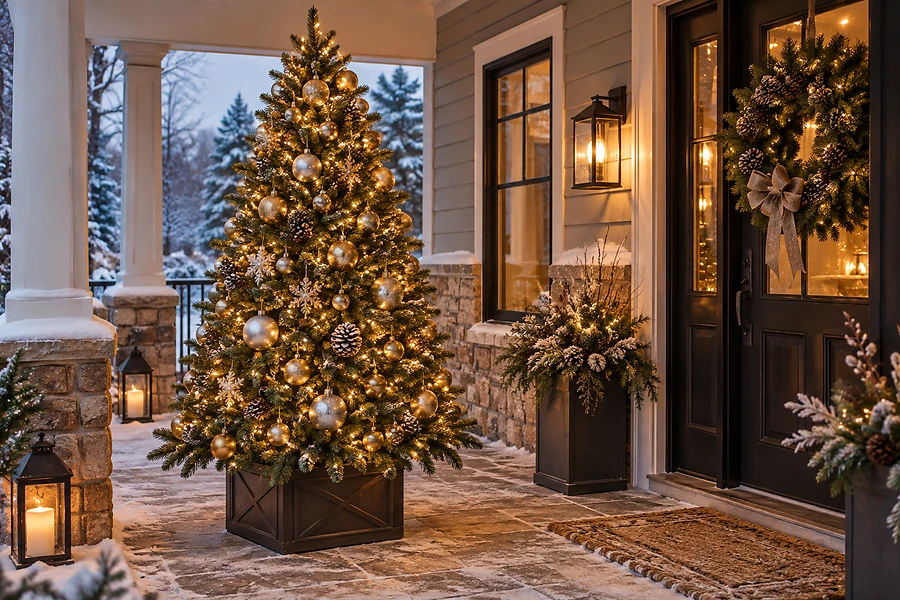
Putting an artificial Christmas tree outdoors can create an impressive holiday display, but rain, snow, sunlight, wind, and electrical exposure can quickly damage the wrong tree.
Yes, an artificial Christmas tree can be used outside—but only when the manufacturer rates it for outdoor or covered-outdoor use. Most standard artificial Christmas trees are designed for indoor use. For exposed yards, patios, or entrances, I choose a purpose-built outdoor tree with weather-resistant foliage, suitable lights, a stable base, and UV protection.
The important distinction is not whether the branches are artificial. It is whether the entire tree—foliage, frame, lights, wiring, connectors, stand, and finish—was designed for the environment where I plan to use it.
Can Every Artificial Christmas Tree Be Used Outside?
Artificial trees may look similar in photographs, but manufacturers generally divide them into indoor, covered-outdoor, and fully outdoor products.
No, I would not use every artificial Christmas tree outside. National Tree Company says most artificial Christmas trees are intended for indoor use unless they are specifically labeled for covered outdoor placement. Purpose-built outdoor trees use materials and construction designed to tolerate significantly more environmental exposure.
Indoor-Only Artificial Christmas Trees
The standard tree sold for a living room is usually designed around indoor conditions.
That means relatively stable temperatures, low wind, limited moisture, and no direct UV exposure.
An indoor artificial tree may contain PVC or PE foliage, painted metal branches, electrical connectors, pre-installed lights, transformers, and other components that have never been designed for repeated rain or snow.
A recent manufacturer response on Lowe’s makes the distinction especially clear. Polygroup explains that one of its indoor pre-lit trees should not be displayed outside because rain, snow, moisture, and large temperature swings can damage wiring and LED components designed for interior use. The manufacturer also warns that outdoor use may void the product warranty.
So I do not assume that plastic needles automatically mean waterproof.
They do not.
Covered-Outdoor Trees
Some artificial trees occupy a middle category.
National Tree Company, for example, says certain trees can be suitable for covered porches, patios, or sheltered entryways when the product description specifically permits that use.
Balsam Hill also currently sells artificial trees marked for indoor or covered outdoor use, including models in its potted and accent-tree ranges.
For me, “covered outdoor” means the location is substantially protected from direct precipitation.
A porch roof may block rain from above, but I still consider wind-driven rain, drifting snow, condensation, and temperature changes.
If the product says covered outdoor only, I do not treat that as permission to place it uncovered in the middle of a yard.
Fully Outdoor-Rated Artificial Trees
This is what I choose for an exposed display.
Outdoor Christmas trees are now available specifically for lawns, patios, gardens, hotel entrances, and other exterior areas.
Balsam Hill’s current Oakville Outdoor artificial Christmas tree, for example, is marketed specifically for exterior use and incorporates a UV coating, outdoor-oriented construction, a sturdy stand, and stakes for stability.
Home Depot also currently maintains a category of artificial Christmas trees filtered specifically for outdoor and waterproof use, showing that full outdoor-rated options are a distinct product category rather than simply ordinary indoor trees moved outside.
I therefore use the product label as my starting point.
| Tree rating | Where I would use it |
|---|---|
| Indoor only | Living room, office, interior lobby |
| Indoor/covered outdoor | Protected porch or sheltered entry |
| Outdoor rated | Yard, exposed patio, outdoor commercial display |
| Unclear rating | I keep it indoors until the manufacturer confirms suitability |
What Happens If You Put an Indoor Artificial Christmas Tree Outside?
The biggest risks are not limited to appearance. Outdoor conditions can affect both materials and electrical components.
Using an indoor artificial tree outside can cause fading, brittle foliage, corrosion, electrical damage, unstable footing, and premature lighting failure. Moisture is especially important with pre-lit trees, while sunlight can gradually affect untreated plastics and pigments. Even an unlit tree may deteriorate more quickly if its foliage, frame, or coatings were never designed for outdoor exposure.
Rain and Snow Can Affect Electrical Components
For a pre-lit indoor tree, moisture is my first concern.
Wiring connections that perform normally inside a living room may not be intended for rain, melting snow, or condensation.
Polygroup specifically cites moisture, snow, rain, and temperature swings as reasons its indoor Christmas tree should not be displayed outside.
This is why I do not try to make an indoor pre-lit tree “outdoor safe” merely by wrapping a connection in tape or putting a plastic bag around a transformer.
The complete electrical system needs to be appropriate for exterior conditions.
UV Exposure Can Affect Foliage
Sunlight creates a different problem.
Outdoor artificial foliage is often treated or formulated specifically to resist UV exposure.
Balsam Hill’s Oakville Outdoor tree, for example, uses a special UV coating intended to help its color withstand outdoor conditions.
Its outdoor potted Christmas-tree collections also specifically advertise UV protection and outdoor-safe materials.
Indoor trees may not have comparable protection.
Over time, untreated materials can fade, discolor, or become less attractive.
That matters even in winter because UV radiation does not disappear simply because the temperature is low.
Metal Components Can Corrode
Artificial trees often contain a surprising amount of metal.
The center pole, branch hinges, fasteners, stand, wiring, and reinforcement may all contain metal components.
Repeated moisture can promote corrosion if those parts were not designed or coated for outdoor conditions.
I pay particular attention to the lower trunk and stand because melted snow and rainwater may collect around them.
Wind Can Turn a Tree Into a Stability Problem
A seven- or nine-foot artificial Christmas tree has a large surface area.
Once wind pushes against hundreds or thousands of branch tips, the tree can behave almost like a sail.
That makes outdoor stability more important than it is in a living room.
Purpose-built exterior trees may include stakes or other stabilization features. Balsam Hill’s current Oakville Outdoor tree specifically includes a sturdy stand and stakes intended to help secure it outdoors.
For a large exposed tree, I consider wind before decorating it.
A heavy ornament collection does not necessarily improve stability. It can create additional falling objects if the tree tips over.
How Can I Use an Artificial Christmas Tree Safely Outside?
Outdoor placement requires more than choosing weather-resistant foliage. Electricity, anchoring, placement, and manufacturer instructions all matter.
To use an artificial Christmas tree outside safely, I choose a tree explicitly rated for the location, use only outdoor-approved lights and extension cords, connect outdoor lighting to GFCI protection, stabilize the tree against wind, inspect wiring for damage, and follow the manufacturer’s exposure limits. I never assume an indoor electrical product becomes outdoor-safe because it is under a tree canopy.
Check the Tree Rating Before Anything Else
This is my first step.
I look for language such as:
- Outdoor use
- Indoor/outdoor
- Covered outdoor
- Outdoor-safe
- Weather-resistant
- UV-protected
The exact wording matters.
“Covered outdoor” is not the same as “outdoor.”
“UV resistant” is not automatically the same as waterproof.
And an unlit outdoor-safe tree does not automatically mean every light string I add to it is suitable for outside.
Use Outdoor-Rated Lights
The U.S. Consumer Product Safety Commission recommends using only decorative lights that have been tested for safety and checking the labels to make sure lights used outdoors are certified for outdoor use.
The NFPA similarly advises consumers to use lights listed by a qualified testing laboratory and notes that some holiday lights are approved only for indoor or only for outdoor applications.
I check the lighting label rather than judging by appearance.
Two LED strings may look virtually identical while having different intended environments.
Use GFCI Protection
For outdoor lights, CPSC guidance says they should be connected to a ground-fault circuit interrupter (GFCI)-protected receptacle or portable GFCI.
This is particularly important outdoors because moisture increases electrical risk.
I also use extension cords specifically rated for outdoor use.
CPSC explains that indoor extension cords are not designed to withstand the same temperature, humidity, and mechanical stresses encountered outside.
Inspect Everything Before Setup
I examine pre-installed or added lighting for damaged sockets, loose connections, exposed wire, or frayed cords.
CPSC recommends discarding damaged holiday light sets rather than continuing to use them.
I also inspect:
the stand, hinges, power adapter, extension cord, branch connections, and anchoring system.
Outdoor use places more stress on all of them.
Stabilize the Base
For a small protected porch tree, a substantial planter may provide enough stability if the manufacturer permits the setup.
For exposed locations, I want an actual anchoring method.
Balsam Hill’s outdoor decorating guidance recommends placing outdoor trees in safer locations and checking whether the stand or planter is appropriately weighted and secure.
For a larger tree, I follow the manufacturer’s anchoring instructions rather than inventing a method that could damage the tree or create a trip hazard.
Be Careful With Metal Artificial Trees
CPSC advises against attaching electric lights to metallic artificial trees because faulty lights could energize the tree and create an electrical hazard.
That advice is easy to overlook because most modern Christmas trees use metal internally even though the visible branches appear green.
I distinguish between a conventional artificial evergreen with an internal metal structure and a deliberately metallic decorative tree intended to have exposed conductive branches. I follow the specific product instructions.
How Long Can an Artificial Christmas Tree Stay Outside?
Even an outdoor-rated artificial tree is not necessarily designed to remain outside permanently throughout the year.
I leave an artificial Christmas tree outside only for the seasonal period allowed by its manufacturer. Weather-resistant does not mean indestructible. UV exposure, wind, freeze-thaw cycles, dirt, and moisture accumulate over time, so removing, cleaning, drying, and storing the tree after the holiday season can significantly extend its useful life.
Outdoor-Safe Does Not Mean Permanent Outdoor Installation
This is an important distinction.
Balsam Hill currently recommends limiting some of its outdoor-safe Christmas greenery to a total of approximately three months of exterior display per year to help extend product life.
That three-month recommendation is specific to those products, not a universal rule for every artificial tree.
Still, it illustrates an important principle.
A manufacturer can describe something as outdoor-safe while still expecting seasonal rather than permanent exposure.
Covered Locations Usually Reduce Exposure
A tree on a deep covered porch experiences less direct rain, snow, and sunlight than the same tree standing in an open front yard.
That can reduce wear.
However, I still follow the tree’s official rating.
I do not use a covered porch as an excuse to ignore an indoor-only label.
Severe Weather Changes the Situation
Even a weather-resistant tree may not be intended for extreme winds, heavy ice, flooding, or major winter storms.
I consider temporary removal when severe conditions exceed what the product is designed to handle.
A tall artificial tree can be expensive.
Taking it down temporarily is often easier than repairing broken branches, damaged lights, or a bent stand afterward.
Store the Tree Dry
After the season, I clean the tree and make sure it is dry before packing it.
National Tree Company recommends storing artificial trees in the original box or a tree-storage bag in a cool, dry location.
Outdoor trees deserve particular attention because moisture can remain hidden around branch joints or the stand.
I would rather allow the tree to dry completely before storage than trap dampness inside a bag for eleven months.
My insights: Can an Artificial Christmas Tree Be Used Outside
After comparing current manufacturer guidance with holiday electrical-safety recommendations, I think the answer depends much more on product rating than on whether the tree simply appears durable.
Yes, an artificial Christmas tree can be used outside when it is specifically designed for outdoor or appropriate covered-outdoor use. I would not place a normal indoor pre-lit tree in an exposed yard. For exterior decorating, I choose purpose-built weather-resistant foliage, outdoor-approved electrical components, secure anchoring, and a product whose manufacturer clearly states where it can be displayed.
My First Insight: “Artificial” Does Not Mean “Weatherproof”
This is the most common misconception.
A plastic branch does not rot like a fresh branch.
But an artificial Christmas tree is much more than plastic needles.
It may contain:
painted metal, electrical wiring, LED controllers, connectors, adhesives, flocking, coatings, and mechanical hinges.
Every component has to tolerate the intended environment.
National Tree Company explicitly says most artificial Christmas trees are indoor products unless labeled otherwise.
That is the rule I follow.
My Second Insight: I Separate Three Different Use Categories
For me, the clearest purchasing framework is:
| Intended location | Tree specification I want |
|---|---|
| Living room | Indoor |
| Deep covered porch | Covered-outdoor or outdoor |
| Partially sheltered patio | Outdoor preferred |
| Open front yard | Outdoor |
| Commercial exterior entrance | Commercial outdoor-rated product |
| Unsure about exposure | Outdoor-rated |
This eliminates most ambiguity.
My Third Insight: Pre-Lit Trees Require More Caution
An unlit indoor artificial tree used briefly on a very protected porch may seem less risky than a pre-lit version, but I would still follow its labeling.
With pre-lit trees, the electrical distinction becomes particularly important.
CPSC guidance is clear that outdoor decorative lights need appropriate outdoor certification and GFCI protection.
So I never assume that lights permanently installed on an indoor tree are suitable outdoors.
If I want an illuminated exterior tree, I prefer one manufactured and sold for that use.
My Fourth Insight: UV Resistance Matters Even During Winter
People naturally think about rain and snow first.
I also think about sunlight.
Outdoor manufacturers specifically promote UV protection because exterior foliage needs to retain its color and material quality through repeated exposure. Balsam Hill’s Oakville Outdoor tree and several of its exterior greenery collections use UV-protected foliage for this reason.
A tree can remain electrically functional and still look poor if its foliage fades badly after repeated outdoor seasons.
My Fifth Insight: Stability Is Part of Outdoor Quality
I would not judge an exterior artificial tree only by foliage realism.
I also ask:
Does the stand feel substantial?
Are stakes included?
Can it be secured properly?
What wind exposure will it experience?
A realistic tree that repeatedly falls over is not a good outdoor tree.
Balsam Hill’s dedicated outdoor model includes stabilization features specifically because exterior installation creates different structural demands from indoor decorating.
My Sixth Insight: Outdoor-Rated Products Are the Simplest Solution
I do not see much reason to force an indoor tree into an exposed outdoor application now that purpose-built products are readily available.
Current outdoor Christmas-tree offerings include full-height trees, potted trees, topiaries, and other artificial evergreen decorations designed specifically for exterior use.
That gives me more design flexibility without improvising around product limitations.
My Final View
When someone asks me “Can an artificial Christmas tree be used outside?”, my answer is:
Yes—but the tree should be rated for the conditions where I intend to put it.
For a living room, an indoor tree is enough.
For a sheltered porch, I look for explicit covered-outdoor approval.
For an exposed patio, yard, entryway, or commercial display, I choose a genuine outdoor-rated artificial Christmas tree.
If it is pre-lit, I also verify the electrical system.
I use outdoor-approved lights and extension cords, GFCI protection, and undamaged wiring as recommended by CPSC.
Then I think about wind.
I stabilize the base.
I consider stakes where the manufacturer provides them.
I monitor severe weather.
And when the Christmas season ends, I clean, dry, and store the tree rather than assuming outdoor-safe means it should remain exposed all year.
The simplest rule is therefore:
Do not ask whether an artificial tree looks strong enough to go outside. Check whether the manufacturer actually designed and rated it to go outside.
That one distinction protects the tree, the lighting system, the warranty, and the quality of the display.
Conclusion
An artificial Christmas tree can be used outside when it is specifically outdoor-rated. Check weather resistance, lighting approval, GFCI protection, anchoring, and manufacturer instructions before installation.

